Hurricanes are multifaceted incidents that threaten life, property, and infrastructure with effects that range from inconvenience to extended disaster. Local emergency and health-care services may be significantly impacted, and changes in patient volume may necessitate staffing modifications.Reference McQuade, Merriman and Lyford1 The effect on individuals is also profound and may be greater for those with limited means or a reliance on daily medical support, especially in the event of an evacuation. In South Carolina, these individuals may seek shelter in general population shelters (GPS), while those requiring more comprehensive outpatient medical care may relocate to special medical needs shelters (SMNS).2,3 Generally, SMNSs are geographically distant from a disaster area to allow medically dependent people and caregivers to wait in safety, accessing electricity, other resources, and assistance from a SMNS nurse. Unfortunately, not everyone in shelters has an uneventful stay. If a medical emergency occurs, an emergency medical services (EMS) ambulance is dispatched, if local emergency crews are able to respond,3 to transport the patient to an emergency department (ED). However, these medical transports are expensive, difficult for patients, potentially risky, and may be preventable through telehealth.
The versatility of telehealth is increasingly recognized as a valuable tool in both routine prehospital use and disaster applications.Reference Doarn, Latifi and Poropatich4–Reference Amadi-Obi, Gilligan and Owens14 Previous EMS experience has successfully implemented this technology to reduce ED utilization for low acuity and psychiatric patients, as well as to improve access to provider education and specialty care for stroke, cardiac, and trauma patients.Reference Amadi-Obi, Gilligan and Owens14–Reference Winburn, Brixey and Lanagabeer19 Telehealth has been used for disaster planning and education.Reference Dorigatti, Pereira and Simoes20–Reference Doarn and Merrell23 There has also been some use during and after disasters, with models primarily focusing on triage and improving access to care.Reference Uscher-Pines, Fischer and Chari8,Reference Der-Martirosian, Griffin and Chu24–Reference Piza, Steinman and Baldisserotto31 This experience suggests that telehealth models could be used to address select medical issues encountered at shelters and in emergency responses during a disaster, which may enable patients to shelter in place.
In this study, we describe the use of telehealth technologies to assist shelters and prehospital providers near Charleston, South Carolina, during Hurricane Florence. We detail surrounding events to demonstrate telehealth potential, assess feasibility after a pilot study, describe steps for future disaster preparation, and explore the applicability of telehealth-support to shelters and emergency medical services.
NARRATIVE
Recent hurricanes have taxed EMS resources in the Charleston, South Carolina, region, even before making landfall. Facing large-scale evacuations, EMS has been tasked with the movement of nursing home and hospital patients and individuals with medical or mobility challenges. Some ambulances may be unavailable for hours while relocating patients inland, reducing emergency response resources, while also impacting receiving communities with the population increase. Changes in traffic flow related to evacuations and impassable roads also impact local EMS operations. Additional challenges result when medical providers, including staff from dialysis centers, clinics, and home health agencies, evacuate and leave patients with minimal support and little recourse other than accessing EMS to obtain critical services.
Shelters may impact EMS when individuals have medical needs not addressed by onsite services. GPS staff may have little to no medical training and may call EMS for assistance lifting patients or other minor medical emergencies. Further, occupants of shelters may not bring all needed medications and medical devices to shelters, resulting in requests for assistance. While the provision of medical support to community shelters is a critical responsibility of EMS, it can strain a system facing other operational challenges and decreased available personnel.
Once recent storms have made landfall, emergency operations have been further impacted. EMS stops responding when wind speeds are sustained above 39 miles per h and does not resume until winds subside. Any calls received in this period are held and triaged until EMS resources can safely respond. This backlog can initially tax responders, as can an increase in EMS volume after the storm. Extensive flooding and traffic impediments have presented additional response and transport challenges, often for extended periods. Simultaneously, local hospitals have looked to reduce patient volume in anticipation of a hurricane. These infrastructure challenges impact local shelters. For example, during Hurricane Florence, 13 SMNSs were activated with 1 shelter operating for 23 continuous days due to ongoing dislocation of residents.
With the myriad of challenges faced by emergency services, alternative approaches to care and operations are critical. Telehealth applications are increasing in use, especially in South Carolina.Reference Ford, Cristaldi and McElligott32 Local EMS has partnered with the academic medical center to use telehealth to link EMS with physicians and other health-care providers for various needs, including neurologic evaluations and psychiatric assessments.Reference McClain33
Before Hurricane Florence, agencies collaborated to create a telehealth model to support local shelters and EMS operations, including mental health emergencies. Vidyo, a Health Insurance Portability and Accountability Act (HIPAA) -compliant meeting room, creates a virtual space where patients can connect with providers for a video assessment. EMS providers at the bedside can facilitate assessment by an emergency physician (EP) and assist with vital signs, physical examination, limited point-of-care testing, and cardiac monitoring. The EP can then implement triage decisions, limited interventions, and electronic prescribing of medications, if needed. In addition to hosting secure meeting rooms, Vidyo was also selected to take advantage of the H.264 standard for video compression, Scalable Video Coding (SVC), which is effective in rural areas with limited bandwidth.34 The use of real-time video to assess patients is highly dependent on the quality of the cellular connection and bandwidth availability. During hurricanes and mass evacuations, cellular towers can become oversubscribed, which limits connectivity, although prioritized first-responder networks are available.Reference Hochgraf, Nygate and Bazdresch35
DISCUSSION
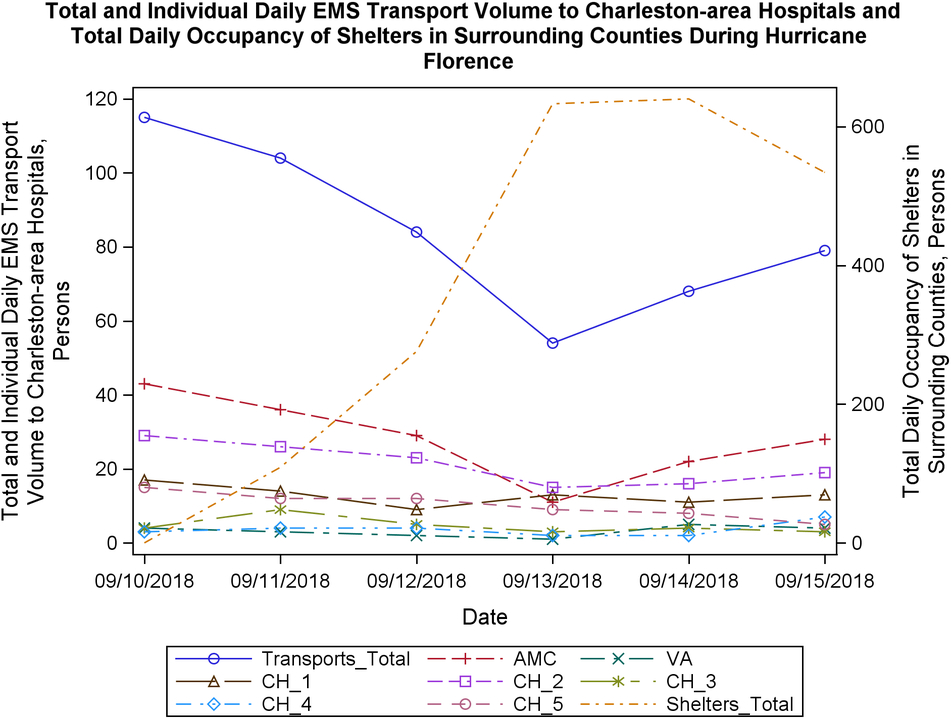
Even though Hurricane Florence passed north of the Charleston area, a mandatory evacuation of the coast and storm surge did create challenges in the region and impacted local emergency services. Charleston-area shelter occupancy increased in advance of the storm, while local EMS transports to EDs decreased then rebounded after the storm (Figure 1). This increased shelter population suggests that these sites may be areas to focus telehealth applications, while changes in workload for EMS and ED staff may allow for reallocation of resources to support such initiatives.
Total Daily EMS Transport Volume to Charleston-Area Hospitals and Total Daily Occupancy of Surrounding Area Shelters During Hurricane Florence. Legend indicating mileage from Academic Medical Center (AMC): Veterans Administration (VA) 1.0 miles; Community Hospital 1 (CH1) .5 miles; Community Hospital 2 (CH2) 7.2 miles; Community Hospital 3 (CH3) 8.1 miles; Community Hospital 4 (CH4) 13.9 miles; and Community Hospital 5 (CH5) 17.8 miles.

Although shelter populations during Florence did not impact EMS volume, previous hurricanes had a more profound effect on EMS operations. Overall, Florence did not impact the average call length for EMS, although staffing levels were reduced approximately 20% at the time of the storm. Impact to ED operations was more significant. During evacuations and continuing through the storm, EMS limited patient transports to the closest appropriate medical facility. As a result, many hospitals saw significant changes in ED patient volume, with hospitals further inland experiencing marked increases. Hospitals in flood zones saw large decreases in ED volume around the storm, with the academic medical center requiring 5 days to recover to prestorm volume.
Before the storm, EMS personnel were equipped with laptops configured with Vidyo software to connect EPs at the academic medical center to EMS personnel, allowing for real-time patient assessment and treatment with hopes of reducing unnecessary transports. Test calls were routed through the hospital Admit Transfer Center, which helped EPs connect with on-scene EMS personnel and access charting software to create a record of the encounter. EMS followed their routine care and documentation protocols. EMS units were able to use their usual cellular networks, but future use will likely access secure networks that prioritize first-responder network traffic. The feasibility of these telehealth interventions was successfully piloted during prestorm activations.
Due to the path Hurricane Florence took through South Carolina, there was a lack of significant usage data with this pilot. Shelters, both GPSs and SMNSs, were delayed in opening due to the uncertain path of the hurricane and the expected intensity of the storm. Only after the storm track shifted north did the less-severe forecast minimize the number of shelters operating in the Charleston coastal zone.
Still, the team conducted an after-action report, and feedback from EMS personnel centered on 2 areas. First, there were technical issues surrounding initial deployment of telehealth enabled laptops, requiring coordination among EMS, ED, and telehealth staff. Second, EMS leadership requested expanded deployment, but the shifting storm spared the region from worse impact. Additional EMS support was provided to affected counties to the north during the weeks following Hurricane Florence, and some units were equipped with telehealth services for mental health triage.
Strengths
This case demonstrates that implementation of telehealth applications to support medical needs at shelters is feasible. Furthermore, EMS can use the technology for medical and psychiatric emergencies during a disaster, and embedding telehealth with EMS allows for expanded community access and improved on-scene assessment and intervention when compared with other telehealth models. This implementation was accomplished with minimal changes to infrastructure and hardware for EMS and hospitals.
Limitations
The biggest limitation is that there were no actual uses to report. While feasible, demonstration of successful interventions is important. Further, there were no impacts to local infrastructure or cellular connectivity, which might limit telehealth use in a disaster.
Implications to Practice
After the pilot, discussions with local and state agencies have been ongoing to expand future use to support both GPSs and SMNSs with triage, assessment, and management of minor medical complaints, psychiatric evaluations, and access to specialty care. Evaluation of local connectivity for security and durability is also ongoing. Development of such infrastructure will allow telehealth applications to be applied to multiple situations in the prehospital environment to assist with weather-related and other events where the community is impacted for an extended period. In addition, this may allow for extension of community paramedicine models with routine home visits to patients. Regardless of use, ongoing conversations with federal, state, local, and nonprofit partners need to be prioritized to ensure that connectivity is addressed and that agencies can fully meet community needs.
CONCLUSIONS
Telehealth is increasingly recognized as an important asset in disaster management, but infrastructure to support these applications must be established in advance. Partnerships to support care and connectivity are critical components of these programs. Ultimately, growing trends toward frequent and severe weather events necessitate addressing these challenges and opportunities in a proactive and replicable manner, and telehealth should be deployed as an innovative tool to meet emergent community needs.
Conflicts of Interest
These authors have no conflicts of interest to disclose.
Acknowledgments
This project was supported in whole or in part by the South Carolina Telehealth Alliance (SCTA) and by the Health Resources and Services Administration (HRSA) of the U.S. Department of Health and Human Services (HHS) as part of the National Telehealth Center of Excellence Award (U66 RH31458-01-00). The contents are those of the author(s) and do not necessarily represent the official views of, nor an endorsement, by HRSA, HHS or the U.S. Government. Special thanks are due to the dedicated teams at the Berkeley and Charleston County EMS agencies as well as the Medical University of South Carolina Emergency Department, Center for Telehealth and Admit Transfer Center.