INTRODUCTION
Since Benson and William's (Reference Benson and Williams1982) path-breaking analysis, scholars have increasingly, albeit slowly, given attention to the role of religion in shaping legislative politics. After almost 25 years of scholarship in this area, we can feel confident in two propositions. First, legislator religion influences legislator policy preferences and decision-making. This is the case whether we define religion using categorical denominational measures (Chessanthis, Gilbert, and Grimes Reference Chressanthis, Gilbert and Grimes1991; Fastnow, Grant, and Rudolf Reference Fastow, Grant and Rudolph1999; Gohmann and Ohsfeldt Reference Gohmann and Ohsfeldt1994; Page et al. Reference Page, Shapiro, Gronke and Rosenberg1984; Richardson and Fox Reference Richardson and Fox1972, Reference Richardson and Fox1975; Schecter Reference Schecter2002; Tatalovich and Schier Reference Tatalovich and Schier1993), or more nuanced measures such as level of orthodoxy (Green and Guth Reference Green and Guth1991), or salience (Yamane and Oldmixon Reference Yamane and Oldmixon2006). Second, constituency religion also influences legislator decision-making (O'Connor and Berkman Reference O'Connor and Berkman1993, Reference O'Connor and Berkman1995; Meier and McFarlane Reference Meier and McFarlane1993; Oldmixon Reference Oldmixon2005). That is, legislators represent religious sub-constituencies in the same way they represent other socio-demographic sub-constituencies, such as those on the basis of race, partisanship, or class.
It is less clear, however, whether the effect of religion on legislation politics is operative across policy domains or in just a few select areas. One of the reasons scholars expect religion to shape political preferences and behaviors at the elite and mass levels, is that religious creeds provide individuals with a set of fundamental values that guide how they should live in the secular realm (Wald Reference Wald2003, 27). On issues that are relevant to creedal teachings, then, religion has the potential to influence political preferences and behaviors and animate political engagement. In investigating the religion and policy-making nexus, scholars have focused on hot button moral issues (for example, see Schecter Reference Schecter2002; Tatalovich and Schier 1993), general ideological orientations (e.g., Fastnow, Grant, and Rudolf Reference Fastow, Grant and Rudolph1999), and even foreign policy (Oldmixon, Rosenson, and Wald Reference Oldmixon, Rosenson and Wald2005; Trice Reference Trice1977). This makes sense, since for many religious adherents; creedal values are relevant in all these areas. Yet we have neglected to investigate the relationship between religion and domestic social policy, which includes issues such as the minimum wage, taxation, social insurance, and health care.
To the extent that social policy debates are informed by religious teachings, we should expect to find that religion influences legislative behavior in this area as well. This article investigates this possibility in the U.S. House of Representatives in the 109th Congress (2005–2006). The analysis focuses on Catholic legislators — Catholic Republicans, in particular. The analysis focuses on Catholics for two reasons. First, the Catholic Church offers explicit teachings on many domestic social policy issues. Second, Catholics are confronted with conflicting impulses on many of these issues. As the American bishops express it, Catholic Social Teaching (CST) encourages progressive policy-making in this domain, yet the upwardly mobile status of American Catholics encourages a more conservative approach. We analyze a series of roll call votes that are directly relevant to CST and on which the U.S. Conference of Catholic Bishops (USCCB) offered guidance. This is supplemented by a handful of elite interviews with legislators and Capitol Hill staff and staff at the USCCB. Ultimately, we find that Catholic legislators are strongly supportive of the domestic social policy aspects of CST. Among Catholic legislators, however, Republicans, younger legislators, and legislators for whom religion is highly salient, are less supportive of CST than their peers.
CONFLICTING IMPULSES
In addition to a common creed, “Religion also denotes a social group … a community of believers” who share “a common status” (Wald Reference Wald2003, 25, emphasis in the original). The status of a group may produce shared political preferences that are in the interest of the group, and that was certainly the case among Catholics for much of the twenty-century. As a largely ghettoized working class immigrant population, Catholics were Democratic loyalists and strong supporters of the New Deal. In the decades since the New Deal, however, the socio-economic status of American Catholics has improved and is virtually indistinguishable from that of Protestants. As Catholics joined the ranks of the middle-class and the salience of the New Deal faded, their rock-ribbed support for the Democratic Party slowly eroded. A plurality still identifies as Democrats, but a slight majority voted for the Republican candidate, George W. Bush, in the 2004 presidential election. In addition to their importance at the mass level, Catholics are also well represented at the highest levels of government. For example, they are the plurality religion in the U.S. House of Representatives, comprising about 30% of the membership. This puts Catholics in a position to influence policy-making across an array issues, foreign and especially domestic.
As policy-makers, Catholics often confront conflicting impulses. E.J. Dionne once noted, “Being a Catholic liberal or a Catholic conservative inevitably means having a bad conscience about something.”Footnote 1 This is because CST cross-cuts traditional partisan and ideological alignments and it makes Catholic elites a useful “case study of the manner in which the obligations of citizenship and discipleship may interact and conflict” (Jelen Reference Jelen, Manuel, Reardon and Wilcox2006, 70). To be sure, this is the case among many Democrats. On several issues, most importantly abortion, but also stem cell research and same-sex marital rights, many liberal Democratic politicians hold policy views at odds with Church teaching.Footnote 2 Because of Church teaching on abortion and other issues, Democratic Catholic politicians have had to face the dilemma of how to reconcile the teachings of their Church with their public policy commitments. To address the perception that they were unfaithful to their Church, fifty-five Democratic members of Congress recently issued a statement of their commitment “to making real the basic principles that are at the heart of Catholic social teaching.”Footnote 3 It is worth noting that on these very issues where Democratic policy commitments and CST apparently conflict, voluminous scholarship demonstrates that controlling for partisanship Catholic legislators tend to support the principles of Catholic doctrine (Chessanthis, Gilbert, and Grimes Reference Chressanthis, Gilbert and Grimes1991; Gohmann and Ohsfeldt Reference Gohmann and Ohsfeldt1994; Oldmixon Reference Oldmixon2005; Schecter Reference Schecter2002; Tatalovich and Schier Reference Tatalovich and Schier1993).
However, CST offers a fully elaborated set of teachings that go well beyond abortion and other questions of sexual and reproductive ethics. On policy issues such as taxes, immigration, health care, and economic inequality, Republican Catholic legislators often take public policy positions at odds with CST and have to grapple with how their public responsibilities conflict with their religious obligation to promote the Church's conception of the common good. It is important to note, however, that in contrast to the clear and unambiguous conflict that many liberal Democratic politicians face on life issues, the potential conflict between Republican legislators and CST is more opaque. This stems from the less definitive character of many of the moral principles of CST, especially in their application to specific economic or other domestic policies (Gaillardetz Reference Gaillardetz and Himes2005, 89–90). While the foundational moral teachings of CST, such as the dignity of the human person, have dogmatic character in Roman Catholic theology, the moral principles which derive from them, such as “a preferential option of the poor,” are authoritative yet historically contingent and potentially reversible in changing contexts.
While this differing status of Catholic Republican dissent makes their “bad conscience” potentially less troublesome for them, the Republican Party's embrace of conservative economic policy commitments in recent years does put them at odds with the more communitarian outlook of CST, as it expressed by the American episcopacy. With the assumption that prosperity across all sectors of society comes with less government regulation of the economy, the conservative vision embraced by many Republicans is characterized by an effort to limit taxation on wealth, limit the size of the welfare state and allow the free market to set wages. In the words of a more libertarian champion, many of these policies represent an effort to free individuals from “dependence on government and making them owners instead, in control of their own lives and destinies.”Footnote 4 Central to accomplishing this vision are fundamental reforms in policy areas such as privatizing Social Security, enhancing market competition in health care through “Health Savings Account,” and tax law changes to radically lower income tax rates, abolish the estate tax, and shield savings and investment from taxation. The thrust of these reforms aims to replace the New Deal legacy of social insurance and social welfare programs with individually owned and controlled assets (see Hudson Reference Hudson2005). The most fruitful efforts to advance laissez-faire social policies have thus far been in the area of tax policy. In the 109th Congress, where we focus, efforts to reform Social Security and expand Health Savings accounts have failed. However, the president and Republican majority did manage to extend prior cuts in capital gains and dividend rates.
THE SOURCE OF THE CONFLICT
With regard to domestic social policy, CST and many Republican policy commitments arguably conflict for two reasons. First, among more libertarian Republicans, their world view is inconsistent with that of Roman Catholicism, the former being individualistic and the latter being social. Libertarians regard human beings as “self-owned,” neither responsible to nor encumbered by anyone else in determining life's ends and goals.Footnote 5 Nothing could be further from the Catholic understanding of human beings as socially embedded creatures, made to live in community with one another. In characterizing the policy agenda of the USCCB, one of its staffers noted that people “are sacred beings, and we are radically social, like the Trinity is radically social. We are defined by our community and our family. Therefore, we are obligated to one another.”Footnote 6 Notes Catholic philosopher Henri Rommen, “Sociality is as essential to human nature as rationality” (quoted in Hines Reference Hines, Massaro and Shannon2002, 193). As socially embedded beings, individuals are “enmeshed in institutions that both constrain and empower them” (Coleman Reference Coleman and Lanham2004, 5).
The result of this incompatibility between libertarian and Catholic thought is that they imply incompatible conceptions of the common good. The social understanding of human nature links directly to the Catholic understanding of the common good, which the late Pope John XXIII defined as “the sum total of conditions of social living, whereby men are enabled more fully and readily to achieve their own perfection.”Footnote 7 Individual well being, in this conception, depends on the character of the society in which they live; it is not solely in their own individual hands. For libertarians, such talk of a “common good” makes no sense, since they believe that only individuals can have goals, purposes, interests, and values; all goods are individual. This is what former British Prime Minister Margaret Thatcher meant when she famously remarked that “there is no such thing as society.”
Closely related to the virtue of solidarity in Catholic social thought, in fact, following from it, is the notion of “the preferential option for the poor,” which refers to the responsibility of the powerful for the weak and the readiness to share with them as an attribute of solidarity (Dorr Reference Dorr1992, 327).Footnote 8 In their letter Economic Justice for All, the American Bishops emphasized the need for public policy to be evaluated in terms of its impact on the poor and its capacity to overcome sharp social inequalities (Land Reference Land1994, 81–83). From the perspective of CST, public policy attentive to the option for the poor needs to ameliorate structural injustices that produce inequality and prevent some from sharing in and contributing to the common good. To do so in market economies requires attention to how those economies in their normal operation, even as they generate overall prosperity, tend to distribute that prosperity unequally.Footnote 9 Yet the thrust of Republican domestic policy initiatives emphasizes market outcomes and potentially subjects the poor to greater risk. Republican tax policies have been heavily biased toward the wealthiest Americans while their support for the Earned Income Tax Credit, for example, has been lukewarm. Moreover, by reducing government revenues, tax cuts have increased deficits and created enormous pressure to cut government spending. This has meant, in practice, as it did in the 1980s — cutting discretionary domestic spending with the least powerful political support — programs for the poor.Footnote 10
Recently, the debate over immigration policy has placed many conservative Republican legislators at odds with Church teaching and the Church hierarchy. Los Angeles Archbishop Roger Cardinal Mahoney made headlines early this year denouncing the House version of an immigration reform bill that would make assisting illegal immigrants a felony. The bill had the strong support of the House Republican leadership, including Congressman Peter King (R-NY), then chair of the House Homeland Security Committee and a Catholic. Mahoney said he would order priests in his diocese not to obey the law if enacted. Other Church leaders have supported this position and the USCCB has lobbied against the House version.Footnote 11 Mahoney, and other Catholics, see the conservative Republican stance on immigration as contrary to respect for fundamental human dignity and the Gospel imperative to serve those in need. He explicitly linked the Church's stance to its pro-life agenda.Footnote 12 Immigration is not an economic issue in the way that taxation and health care are, but the Church's position is based in a concern for the poor and vulnerable.
Second, among more mainstream conservative Republicans, their dissent from Church teaching may be more about means than ends. These Republicans may embrace the concepts of the common good, solidarity, and the preferential option for the poor, but disagree with the Church about how these concepts should by applied to specific policies. Many argue that Church teachings on domestic social issues are less authoritative than teachings on other issues and involve prudential judgments from which even a faithful Catholic might dissent in the face of even the strongest exhortations of Church leaders. So, Catholic politicians who choose not to abide by the recommendations of the Bishop's pastoral letters on peace, capital punishment, or the poor might “legitimately differ with the bishops regarding these moral applications and prudential judgments” (Gaillardetz Reference Gaillardetz and Himes2005, 90). Conservative Catholics may embrace the Church's conception of the common good, but reject the idea that an expanded welfare state is the best way to achieve that goal, and they may exercise their prudential judgment as such. Also, legislators might point to the principle of subsidiary, which is a vital component of CST. It encourages the limited government and the dispersion — rather than the centralization — of the functions of government. Practically speaking, this means that if the Bishops Conference supports a piece of legislation because it advances economic social justice, a legislator might in good faith vote against that bill while (1) exercising his or her prudential judgment, and/or (2) advancing another principle of CST — subsidiary.
In sum, those Catholic legislators who have supported the Republican policy initiatives of the past few years have embraced policies that are arguably inconsistent with elements of CST and almost certainly contrary to the policy positions of the Bishops Conference. Thus, one can reasonably hypothesize that Catholic Republican legislators might suffer from Dionne's “bad conscience” when it comes to many of the domestic social policy positions of their party. In the rest of this paper, we will look to see whether Church positions affect the voting behavior of Catholic legislators and, to the extent that Catholic Republicans deviate from Church positions, explore how they understand these deviations.
INVESTIGATING SUPPORT FOR CATHOLIC SOCIAL TEACHING
In this section, we examine roll call data from the 109th Congress to see what influenced Catholic legislators on some key domestic issues. The dependent variable is an additive index that measures support for the domestic social policy dimension of CST. The Bishops Conference produces a regular report of the issues before for Congress on which they have taken a position.Footnote 13 Using this report, we identified six votes and one discharge petition in the 109th Congress that engage the principles of CST in this policy domain.Footnote 14 A review of the bills, which are listed in the Appendix, will reveal that the thrust of the index is left leaning — thus, the Republican dilemma. Again, these bills were hand picked by the Bishops Conference. Some legislators missed votes. To avoid losing observations, we generated the index by calculating the proportion of votes cast consistent with CST for each legislator that cast at least four votes. The proportions were divided into four ordinal categories (0–3), with high scores indicating high levels of support for CST.Footnote 15 The alpha is .9495, indicating a reliable index.
We ran two models: one that included all members of the Housess and another that only included Catholics. All of the models included the following independent variables: legislator partisanship (Republican = 1), district partisanship (percent of the district vote for the Democratic presidential nominee in the 2004 election), ideology (2005 American Conservative Union Scores, adjusted for missed votes), a generational dummy, and district median income. The model for all legislators also includes dummy variables for legislator religion (Catholic = 1, Jewish = 1, White Evangelical = 1, Black Protestant = 1).Footnote 16 The Catholics only model includes an additional variable for religious salience.Footnote 17
As we noted earlier, scholars have found that Catholic legislators are more likely to embrace moral traditionalism than their non-Catholic colleagues. This is consistent with CST. We expect to find, therefore, that this consistency carries over into the domestic social policy domain. This can be owed to the historical status of Catholics as an out-group, but also the clear and authoritative teachings of the Church in this area. Among Catholics, we expect to find that religious salience is also positively associated with support for CST. The inclusion of a salience measure allows us to move beyond discrete denominational classifications, and measure the extent to which religious commitment, in addition to identification, affects decision-making. Reliable measures of religious salience are difficult to attain. While some have attempted to measure salience using interviews (Benson and Williams Reference Benson and Williams1982; Yamane and Oldmixon Reference Yamane and Oldmixon2006), Guth and Kellstedt (Reference Guth, Kellstedt and Smidt2001) adopt a more “unobtrusive” approach, using internet sources to garner information about legislator religious involvement beyond affiliation. Taking our cue from them, we read the official biographies of each Catholic legislator that is linked to their House web page. Using a dichotomous measure, legislators who mention religious involvement or their religious identification in their biographies were coded 1, and the rest 0. That being said, this measure is a blunt instrument. It may be a measure of salience, but we concede that it may also capture the desire to project religious salience to constituents.
We also expect to find generational differences among Catholic legislators. More specifically, we expect that younger Catholics — those who came into the electorate after the Second Vatican Council — will be less likely to support CST on domestic social policy than older Catholics. This is coded as a dummy variable (born after 1947 = 1). Vatican II called on Catholics to apply their religious values to the secular problems. In short, it encouraged social transformation animated by Catholic values. In addition to issues of moral traditionalism, this included social transformation related to poverty, social justice, civil rights, nuclear proliferation, war, etc. The Church retained its moral traditionalism with regard to sexual ethics and traditional families, but it also took a leftward turn in other areas (Wald Reference Wald2003, 252–257). However, the ability of the Church to educate Catholics about the new priorities that emerged from Vatican II was undermined by contemporaneous institutional reforms in religious formation practices. “Influential Catholic educators questioned the compatibility of ‘education’ and ‘formation,’ two concepts that preconciliar Catholic educators understood to be intimately related” (Appleby Reference Appleby, Smidt and Penning1997, 100–101). The idea of “religious formation” was increasingly questioned, and a new emphasis was placed on “free thinking” and other secular pedagogical models. “Just when American Catholic educators were emphasizing process over content,” Appleby (Reference Appleby, Smidt and Penning1997, 101) notes that “the universal church was offering a great deal of ‘new’ content to master.” As a result of these institutional changes, post Vatican II Catholics may not have internalized Church teachings in these areas.
At the same time, these younger baby boomer Catholics came of age as Catholics were entering the middle-class and the New Deal was losing salience. In their generation, the political stigma associated with being a Catholic was diminished by the election of a Catholic president in 1960. At the same time, the structure of Catholic social life changed as ghettoized ethnic neighborhoods broke up and Catholics joined the ranks of the middle-class. They did not move en masse to the Republican Party, but they are far less Democratic than their parent's generation (Appleby Reference Appleby, Smidt and Penning1997, 98–99; Jelen Reference Jelen, Manuel, Reardon and Wilcox2006, 72). The status of these younger Catholics likely makes them more sympathetic to Republicans than their parents were.
Given the policy commitments of the Republican Party in Congress, we expect Republican partisanship will be negatively associated with support for CST. By the same token, we expect Democratic partisanship at the district level to be positively associated with support for CST. We include district median income in the analysis as a measure of aggregate socioeconomic status. Lower status districts are likely to benefit from and therefore be sympathetic to domestic social policies consistent with CST. We also expect that ideological conservatism will be associated with low levels of support for CST, since its policy implications on economic issues run contrary conservative principles. An initial plotting of the data suggested a non-linear relationship between ideology and the dependent variable. Therefore we included a quadratic term in the model.
THE ANALYSIS
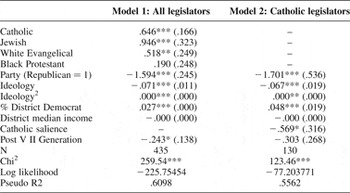
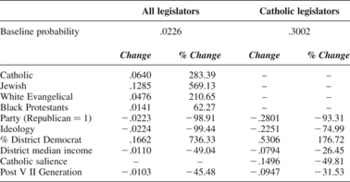
Ordered probit was used to derive estimates. Table 1 reports the results of the analyses. The statistically significant chi-square across both models indicates the model performs robustly and that the independent variables significantly increase our ability to explain legislator decision-making in this area. The coefficients indicate the direction of the relationship between each independent variable and the dependent variable. For ease of interpretation, in Table 2, we report changes in the predicted probability of supporting CST at the highest level.
Analysis of support for Catholic social teaching

Notes: *p < .10, **p < .05, ***p < .01, two-tailed. Entries are ordered probit coefficients, with robust standard errors in parentheses.
Analysis of support for Catholic social teaching at the highest level

Note: Figures where generated using Clarify for Stata 8. The baseline probability was calculated holding all the continuous variables at the mean and the categorical variables at zero. Percent change reflects the change in the predicted probability of supporting CST at the highest level when moving continuous variables from the mean to max values and categorical variables from zero to 1.
As expected, Catholic affiliation is positively associated with support for policies consistent with CST (although, see Fetzer Reference Fetzer2006 on the issue of immigration). Table 2 indicates that Catholic legislators are about 280% more likely to support CST at the highest level than their colleagues. Among Catholics, the relationship between the generation dummy variable and support for CST is negative, meaning that Catholics who came into electorate after Vatican II are less likely to support CST than their older Catholic peers. The relationship is insignificant using a two-tailed test, but it approaches significance using a one-tailed test. (Given the directional nature of our expectations, a one-tailed test is justifiable.) These Catholics probably retain the traditionalism of previous generations, but again, the importance of progressive domestic social policies diminished as the status of Catholics increased.
Interestingly, the relationship between religious salience and support for CST is significant and, contrary to our expectations, negative. High salience Catholics are less likely to support CST at the highest levels than their peers for whom religion is less salient. In other words, the most committed Catholics less likely to behave in ways consistent with CST as it is expressed in these votes. While it seems counter-intuitive, this finding is not altogether surprising given Layman's (Reference Layman1999) finding that among party activists, the traditionalist and regularly attending Catholics are more likely to be Republicans, while secular Catholics are more likely to be Democrats. If high salience Catholics are more likely to be Republican, then perhaps high salience Catholic legislators have internalized Republican economic policy commitments. Or, while voting against the USCCB's preferences, these Catholics may be voting for subsidiary in government, a principle that has strong grounding in Catholic intellectual life.
While Catholics are the focus of the analysis, we note that white evangelical and Jewish legislators are also more likely to support CST than their mainline colleagues. What makes Catholics unique among the religious families in the model is its centralized ecclesiastical teaching authority that can connect creedal values to secular policy-making. Yet even for these other denominations, we find that religious identification influences policy decision-making. The finding is not all that surprising for Jewish legislators, however, since American Jews tend to express high levels of economic liberalism and support for government services (see Wald and Calhoun-Brown Reference Wald and Calhoun-Brown2006, ch 7).
The finding for white evangelicals is more puzzling. White evangelicals in the aggregate are strongly Republican, strongly conservative, and strongly opposed to economic liberalism and government services (see Wald and Calhoun-Brown 2006, ch 2 and 7). While many think of cultural issues as the main animating force for these Christians, they were recruited into the Republican Party under a larger rubric of “‘big government’ as a threat to traditional religious and economic values” (Wald and Calhoun-Brown 2006, 214). Yet when we control for partisanship and ideology we find that white evangelicals are more than twice as likely as their mainline colleagues to support CST. This suggests that at least on these economic/immigration issues, the religious inclinations of these evangelical Protestants move them to adopt a more progressive stance.
In models 1 and 2, the coefficients for legislator partisanship are negative and strongly significant, demonstrating that Republicans are less likely to support CST than Democrats. As model 2 demonstrates this result holds when we consider among Catholics, where Republicans are about .2801 less likely to support CST than Democrats. District level partisanship also is strongly significant and has the predicted effect. District level Democratic partisanship is associated with support for CST. Overall, legislators coming from strong Democratic districts are more than seven times more likely to support CST at the highest levels than their colleagues from more moderate districts. Among Catholics, legislators from the strongest Democratic districts are about 176% more likely to support CST at the highest levels than Catholics from moderately Democratic districts.
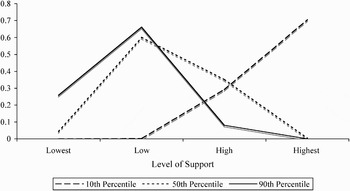
The main ideological coefficient is negative, while the quadratic is positive, and both coefficients are significant. Practically speaking this means that conservatism is associated with lower levels of support for CST — up to a point. Indeed Table 2 indicates that moving both ideological terms from their mean to maximum values decreases the probability of supporting CST at the highest levels by .0224. This is a decrease of almost 100%. To gain a better sense of the dynamic between ideology and support for CST, Figure 1 displays the relationship between level of ideological conservatism and the probability of supporting CST at various levels. As expected, liberals have a high probability of supporting CST at the highest levels, and moderates have a high probability of establishing a moderate voting record on these issues. The curvilinear relationship seems to be concentrated among the most conservative legislators. The probability that the most conservative legislators will support CST at the “Lowest” level is about .26, while the probability of being in the more liberal “Low” category increases to about .66. That is, highly conservative legislators are about 156% more likely to be moderately conservative than solidly conservative on these issues. While the theoretical explanation for this goes beyond the parameters of this paper, it warrants further study.
Predicted probability of supporting catholic social teaching by level of ideological conservatism.

RESPONSES OF CATHOLIC LEGISLATORS TO CONFLICTS WITH CHURCH TEACHING
While Catholic legislators overall are more likely than non-Catholics to establish voting records that are supportive of CST as it is articulated in the USCCB policy pronouncements, there are certainly many Catholics who adopt positions contrary to the Bishops Conference — particularly Republicans. When the policy positions of Republican Catholic legislators conflict with Episcopal teachings, we have identified three logical responses they might take to reconcile their policy position with the Church. We use interviews of a handful of House Republican Catholics and USCCB staffers to elucidate the relevance of these three approaches.
The first possibility is to distinguish their personal religious beliefs from their obligations as a public official and representatives of a pluralistic constituency. Many liberal Democrats adopt a similar stance on the abortion issue. Mario Cuomo first articulated this position in his 1984 speech at Notre Dame, although a similar position was implied much earlier in John F. Kennedy's speech to the Greater Houston Ministerial Association during the 1960 presidential campaign. Cuomo argued that although he regarded abortion as sinful he could not, as a public official; impose such a view on those who did not agree in a context in which a broad public consensus was not present.
Conservative politicians supporting Republican policy commitments in this domain might argue that constituency demands for such policies must take precedence over personal adherence to Church teachings if they are to fulfill their public obligation as elected representatives. On immigration, for example, one Catholic Republican made the point that while he understands the Church's position and “the good that Christ encourages, I have to look at this like a policy-maker. The people in my district are concerned that we are becoming a 2nd class nation.” As a result this legislator voted for the House immigration bill, which was contrary to the Church position. In doing so, he acknowledged that he acted contrary to CST and explained that: “I wake up every morning and know that God has given me this day to do for him. At the end of the day, I have to get down and my knees and say ‘I have failed’ and ask forgiveness.”Footnote 18
A second possibility is to argue that their policy stances on economic issues and other domestic issues are perfectly consistent with church teaching. A number of Catholic intellectuals, such as George Weigel, Michael Novak, and Richard John Neuhaus, have formulated an interpretation of CST that sees it as supportive of conservative and market-oriented approaches to economic policy.Footnote 19 They point out that throughout the corpus of CST private property and capitalist market relations are affirmed, with some qualification, as mainly positive values.
For these commentators, the strength of this affirmation increased substantially and with less qualification with the publication of John Paul II's encyclical Centesimus annus (Weigel Reference Weigel1992), in which John Paul connects ownership of private property to the “the autonomy and development of the person” and says it is “an extension of human freedom.”Footnote 20 The free market receives a strong endorsement as “the most efficient instrument for utilizing resources and effectively responding to needs.” In addition, Centesimus annus offers a serious critique of the welfare state as prone to “bureaucratic ways of thinking” and “an enormous increase in spending.” John Paul identifies “malfunctions and defects” that reflect a misunderstanding of the proper role of the state. In light of this interpretation of CST, Catholic legislators might argue that supporting conservative social policies simply corrects the defects of an overly centralized welfare state, regardless of what the USCCB advocates.
A corollary to this approach is to argue that their policy stances are perfectly consistent with Church teaching and that the Bishops are wrong on the issue. This theme recurred a number of times during interviews. When asked about the extent to which Church teaching influences his decision-making, one legislator responded that while he reveres the Church, “Sometimes you'll hear an 80 year old Cardinal say something that is just outrageous.” What is more, clerics “live a cloistered life and have no clue what's going on in the world.”Footnote 21 Another said that, “It depends on whether they are being consistent with their principles.”Footnote 22 What is more, “I would argue that supply side economics deals with the poor better” than welfare. In other words, while this legislator recognizes the priority of helping the poor, he views his policies as more effective than those advocated by the Church.
On immigration, he goes on to argue that growing up as a Catholic, “I was always taught you had to follow the rules,” and now the Church is supporting individuals who break the law and break the rules. Moreover, he charges the Church with hypocrisy on this issue: “What if 400,000 Turkish Muslims moved to Vatican City, and demanded accommodation? Demanded the right to determine the laws and vote in elections? What do you think the response of the Church leaders would be?” Ultimately, he views his support of the House immigration bill as consistent with Church teachings and tradition and the USCCB's position as incorrect. However, this legislator's approach suggests something deeper. It suggests that Catholic legislators who dissent from the USCCB may disagree over the means of achieving the common good, rather than the goal of the common good. In their view, free markets provide a more effective means increasing prosperity among the poor. Moreover their objections to growing the welfare state as a way to achieve the common good finds intellectual support in Church teachings on subsidiary.
A third and related possibility is to argue that church teachings on economic issues or other domestic issues, such as immigration, are not authoritative in the same way as a pronouncements on moral issues. On issues where the Church does not speak authoritatively, sometimes the bishops are prone to recommending mistaken courses of action that ought to be contradicted. Church leaders lack the capacity to understand thoroughly all the dimensions of many domestic policy issues and can be mistaken about what is the best policy approach. For example, while reducing government spending on programs for the poor may appear to ignore the preferential option for the poor, in reality these programs actually harm the poor by making them too dependent on government. Many conservatives made such an argument regarding the USCCB opposition to welfare reform in 1996. Therefore, Catholic legislators may feel freer to regard Church teachings on many policies that they favor as not making any authoritative demands on their policy choices.
One legislator explicitly referenced the distinction between issues of prudential judgment and moral absolutes. On moral absolutes, such as abortion, the teaching of the Church is authoritative. In matters of prudential judgment, Church teaching is not authoritative. Therefore, individuals and legislators are free to apply their own reasoned and morally informed judgment. To the extent that the Church adopts policy positions, they should do so in consultation with lay experts, especially Catholic lay experts. The death penalty, immigration, war, economic policy: these are all matters of prudential judgment in the view of this legislator, and he often finds himself adopting positions that are contrary to USCCB policy positions. On immigration he argued that “The Sensenbrenner immigration bill, for example, is not a moral absolute. And some bishops and cardinals in the Church mischaracterized it. It would not be illegal to give an illegal immigrant the Eucharist.”
What is more, he suggests that when the Church attempts to speak authoritatively on these issues, when the Bishops elevate their importance by adopting a seamless garment approach to politics, it weakens efforts to enact pro-life legislation. This is because pro-choice Catholics can defect from Church teaching on abortion votes, but still argue that they are observant Catholics because they oppose the death penalty, for example.Footnote 23 Still, he listens to the position of the Bishops on these issues and explains that “I take seriously Church Teaching, and I am happy to engage the Church on matters of prudential judgment, but only as a conversation.”Footnote 24
Without making the distinction between moral absolutes and prudential judgment, other legislators simply do not view Church teaching as determinative of their decision-making. One legislator explained that while he viewed the presence of the Church on Capitol Hill as positive, to be a representative is to use one's own judgment. To be sure, his judgment is informed by a “moral sense” that is influenced by religion. He incorporates Church teachings into his thoughts and sometimes uses USCCB staff as a “sounding board.” But he does not automatically apply Church doctrine. He has his own “thought process” and does not “automatically apply church dogma.” What is more, even tough this legislator sometimes votes contrary to Church teaching he still works closely with the Bishops Conference on other matters.Footnote 25
Still another legislator indicates that “I look at the Church's position and note it, but I decide on my own. My intellect and study of an issue tells me what to do.” On some issues, however, this legislator rejects Church efforts to lobby on Capitol Hill: “It is improper for the church or any clergy to lobby Congress on some issues. I will not take a meeting if they want to talk about an issue dealing with Church doctrine. I do not want direction on abortion or gay marriage. It's not appropriate. If it's an issue dealing with general secular welfare, then okay. World health, aid organizations, that's fine.”Footnote 26 It is interesting that this legislator rejects USCCB lobby on issues directly relevant to Church doctrine. But it is even more telling that he views abortion as relevant to Church teachings and does not view world health and social welfare as relevant to Church teachings.
These three approaches are not mutually exclusive, and they are probably not exhaustive. One can imagine, for example, that as a fourth approach, legislators might simply ignore the conflict. Unlike the issue of abortion, Church teachings relevant to economic, health, or immigration policy are not as well publicized, or normally as strongly advocated as the Church's moral stance on life issues. There may be less awareness among Conservative Catholic legislators of the conflict between their policy positions and Catholic teaching. Or, even if they themselves are aware, the political risk of taking such a conflicting stand is slight if they can assume that even their Catholic constituents are not likely to notice the conflict.
CONCLUSION
Domestic social policy decision-making is not a function of district need, as measured by district socioeconomic status. Our investigation suggests that in the 109th Congress, cleavages on these issues were largely a function of partisanship and ideology, but also religion. Our study confirms previous findings in the legislative behavior literature that religion influences legislator preferences. We have demonstrated that it does on domestic social issues, as it does on previously studied moral and foreign policy issues.
Our key finding is that on domestic social issues, Catholic legislators in the 109th Congress were more likely than their mainline colleagues to vote consistent with CST. At the same time, age and Republican partisanship diminish this relationship. While there has been a leftward drift in this particular dimension of CST since Vatican II, Catholic legislators who have come of age since then are less likely than their older peers to support CST in this area. This may be because a decline in the capacity of the Church to instill its teachings leaves younger Catholics less likely to accept Church teachings than older Catholics raised in a more traditional Church. Moreover, the social and economic mobility of Catholics since the 1960s places most in a more affluent social class than their parents. As a result, the commitments of CST to solidarity and concern for the poor are less consistent with their own self-interest. Also, Republican Catholics have found ways to take positions contrary to Church teaching without calling into question their religious loyalty.
In contrast to the dilemma liberal Democrats face on moral issues such as abortion or gay marriage, Republican legislators find it possible to claim more flexibility in interpreting CST. While they see Church teaching on moral issues as unambiguous and authoritative, the relevance of CST to their positions on domestic social issues is less obvious. Several of our respondents readily argue that Church leaders, even when they articulate specific positions on legislation, may be mistaken in their interpretation of how Church teaching applies. Therefore, Catholic Republicans may see CST as less authoritative, relevant, and subject to prudential judgments in relation to domestic social issues. In that sense, they may be dissenting from the bishops without dissenting from Church teachings. To the extent Catholic legislators can claim ambiguity in Church teachings, the religious influence on roll call voting will be diminished. This raises the interesting question of how Catholic legislators will position themselves in the long run on issues dealing with unambiguous conflicts between public policy and Church teaching.
APPENDIX: INDEX COMPONENTSFootnote 27
H.R. 4437, the Border Protection, Antiterrorism, and Illegal Immigration Control Act of 2005: The USCCB strong opposed this bill because, from their perspective, it “includes many harsh provisions which would bring undue harm to immigrants and their families.”Footnote 28 In particular, the Bishops objected to provisions that made illegal immigration a felony and subjected those who assisted illegal immigrants to criminal penalties. They go on to say that “The Scriptures as well as Catholic Social Teaching, form the basis of the Church position.” Legislators voting against this bill were credited with supporting CST.
H.Res. 653, the reconciliation bill for fiscal year 2006: In his January 24, 2006, letter to the members of Congress, the Most Reverend William S. Skylstad, president of the USCCB, expressed disappointment in the reconciliation bill and urged legislators to oppose it. In particular, Bishop Skylstad argued that the reconciliation bill would “prove harmful to many low-income children, families, elderly, and people with disabilities who are least able to provide for themselves.”Footnote 29 In a March 3, 2006, letter, Bishop Skylstad also expressed concern that the reconciliation bill did not provide sufficient resources to “promote the common good.”Footnote 30 Legislators voting against this reconciliation bill were credited with supporting CST.
H.R. 2429, the Fair Minimum Wage Act of 2005 (discharge petition): Over the course of two years, this bill would raise the minimum wage from $5.15 to $7.25. Noting that work “is a reflection of our human dignity, and a way to contribute to the common good,” the Bishops Conference argue that the “minimum wage needs to be raised to help restore its purchasing power, not just for the goods and services one can buy but for the self-esteem and self-worth it affords the worker.”26 To that end, the Bishops Conference strongly supported this bill and encouraged individuals to contact their Members of Congress and ask them to sign the discharge petition that would bring the bill to the floor. Legislators signing the discharge petition were credited with supporting CST.
H.Amdt. 8, H.R. 418, the REAL ID Act of 2005: This amendment sought to strike section 101 entitled “Preventing Terrorists from Obtaining Relief from Removal” from the bill. Section 101 “requires all applicants for asylum to prove that ‘at least one central reason’ behind their persecution is one of the following: the applicant's race, religion, political opinion, nationality, or membership in a particular social group. (Previously, the law required that persecution be based on one of the five grounds but did not have the “central reason” requirement).”Footnote 31 Legislators voting for this amendment were credited with supporting CST.
H.Amdt. 425, H.R. 3058, Transportation, Treasury, Housing and Urban Development, the Judiciary, the District of Columbia, and Independent Agencies Appropriations Act, 2006: This amendment would prohibit funds from being used to enforce section 703 of the District of Columbia Firearms Control Act which requires certain firearms to be unloaded and disassembled. Legislators voting against this amendment were credited with supporting CST.
H.Amdt. 596, H.R. 1461, Federal Housing Finance Reform Act of 2005: The USCCB opposed this manager's amendment and viewed as “restrictive.” This amendment limits the ability of groups that receive Federal funds to build affordable housing to participate in voter registration drives. Legislators voting against this amendment were credited with supporting CST.
H.Amdt. 648, H.R.4437, Border Protection, Antiterrorism, and Illegal Immigration Control Act of 2005: This amendment mandates the construction of specific security fencing along the Southwest border for the purposes of gaining operational control of the border. Legislators voting against this amendment were credited with supporting CST.