Introduction
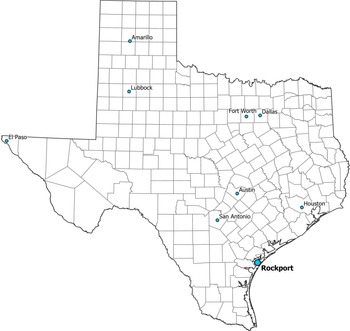
With 17 named storms, 10 hurricanes, and 6 major hurricanes (Category 3, 4, or 5), the 2017 hurricane season was extremely active. 1 After rapidly strengthening to a category 4 hurricane, Hurricane Harvey made landfall near Rockport, Aransas County Texas on August 25, 2017. Reference Blake and Zelinsky2 (See Figure 1)
Location of Rockport, Texas. Map courtesy of the Texas Department of State Health Services.

By March 3, 2019, data from the Texas General Land Office and the Federal Emergency Management Agency (FEMA) showed that for Aransas County, FEMA approved 7328 registrations for individual assistance and the National Flood Insurance Program received 5459 flood claims. 3 To better understand the Aransas County recovery process, the Texas Department of State Health Services (DSHS), Public Health Region 11, conducted a Community Assessment for Public Health Emergency Response (CASPER) following the Center for Disease Control (CDC) CASPER methods. A CASPER is a rapid-needs assessment to gather household-level information and is based on the World Health Organization’s technique for estimating vaccine coverage. Reference Lwanga, Sapirie, Steinglass, Stroh and Wylie4,5 CASPER teams take 2 - 3 days to collect surveys to capture the prevailing opinions and thoughts of the community for that same given timeframe and have been used in all phases of disaster from preparedness to recovery. The information gathered is then shared with community stakeholders to assist in future and ongoing responses, recovery, and preparedness efforts. 5 This hurricane recovery CASPER was conducted almost 2 years after Harvey made landfall in Aransas County to assess this community’s ongoing recovery, household preparedness, disaster communication, potential long-term effects on mental health status, and households’ greatest needs.
Methods
A 2- stage 30 x 7 cluster sampling design was used to conduct the Hurricane Harvey recovery CASPER on May 3 - 4 and May 18 - 19, 2019. 5 In the first stage of sampling, 30 clusters were selected with a probability proportional to the estimated number of household units within the cluster. In the second stage of sampling, interview teams used systematic random sampling to select 7 households from each of the selected clusters to complete the survey questionnaire. Teams made 3 attempts to contact each household before selecting a substitution with an overall target of 210 surveys.
The CASPER sampling frame consisted of census blocks within, or abutting the perimeter of Aransas County. Using data from the United States Census Bureau for 2010, the total number of households in this sampling frame, as cataloged by American FactFinder, was 15355 housing units in 2017. 6
For the Aransas County CASPER, 7 surveys were attempted in 27 clusters and 14 surveys attempted in 3 clusters. Survey teams were provided cluster maps with random starting points and instructed to begin at the random starting point, unless the point indicated was a business or a vacant dwelling. From the starting point, survey teams moved sequentially down the street attempting household interviews at every nth housing unit to complete the required surveys per cluster. The nth housing unit was calculated by dividing the number of housing units in each cluster by 7. Survey teams distributed hurricane preparedness and recovery, behavioral health, tuberculosis, and immunization information to adults consenting to an interview (> 18 years old) who provided household level data.
English and Spanish surveys were developed in coordination with Aransas County stakeholders and validated through a focus group. The survey included 20 questions on topics such as pre and post Hurricane Harvey preparedness, emergency communication, health and mental health, home damage and recovery. Some CASPER questions were previously validated from post-Hurricane Harvey CASPERs conducted in Harris County, Texas. Other questions were required for all Texas jurisdictions performing Hurricane Harvey recovery CASPERs to ensure consistent data were collected.
A Command Post was established at the Aransas County Sheriff’s Office where DSHS personnel conducted a Just-in-Time (JIT) training where 11 teams of 2 - 3 people composed of DSHS staff and Texas A&M School of Public Health EpiAssist student volunteers were assigned to 2 clusters. During the second weekend of surveying, 2 teams of 2 DSHS staff were deployed to housing clusters that no teams had attempted to visit in the previous sampling weekend. Interviews were attempted if the housing unit was accessible, if an adult was present, and agreed to participate.
Household tracking form data was entered into Microsoft Excel to calculate the contact, cooperation, and completion rates. 5 The contact rate indicates the percentage of surveys completed compared to the randomly selected housing unit approached. The cooperation rate is the willingness and eligibility of households to complete the CASPER interview. The completion rate indicates how close the CASPER field data collection was in reaching the intended goal of 210 completed interviews. A rate of 80% or greater was considered acceptable for generalizing findings to the entire sampling frame. Survey questionnaire data from completed household interviews were entered in Epi Info 7 (CDC, Atlanta, GA, USA). The weight assigned to each completed household interview is based on the household’s probability of selection and was calculated as indicated in CDC CASPER guidelines. 5 During field data collection, open ended questions, such as the household’s ‘greatest need’ resulted in a large number of different responses. Based on criterion developed using terminology with overlapping terms and concepts, 10 categories were created from 176 responses. If households did not meet any grouping criteria, then responses were placed in an ‘other’ category.
Results
Survey teams collected a total of 175 interviews during the CASPER in Aransas County for a completion rate of 83.3% (175/ 210). Out of the approximated 3674 housing units within the clusters, the survey teams approached 392 housing units for a contact rate of 44.6% (175/ 392) and identified 346 as accessible. Of these, the field teams made contact with 275 housing units for a cooperation rate of 63.6% (175/ 275).
As described in Table 1, Aransas County households undergoing recovery primarily resided in single-family homes (60%), followed by structures such as mobile homes, trailers, recreational vehicles, or prefabricated homes (35%). Almost 66% of households had 1 or more members aged 18 - 64 years old, and more than 50% had 1 or more members aged 65 years or older. While most households reported using public/ municipal (58%) or bottled (27%) drinking water, about 12% relied on well water as their primary drinking water source. Households were asked what type of communication resources they used during and after the hurricane to gather hurricane related information. The resources most used were television (51%), radio (22%), text messages (21%), and neighbors, family, and friends (17%). Households were also asked to identify any communication barriers present among household members. Few households had difficulty understanding English (4%) or understanding written material (3%), while 25% of households had a member with impaired hearing, 23% with impaired vision, and 8% with a developmental or cognitive disability.
Hurricane Harvey CASPER Results for Demographic and Communication Characteristics of Aransas County Households (HH), May 2019

*Weighted analysis are not applicable to responses with sample size less than 5, and these were omitted.
**Responses reported for anyone in the household.
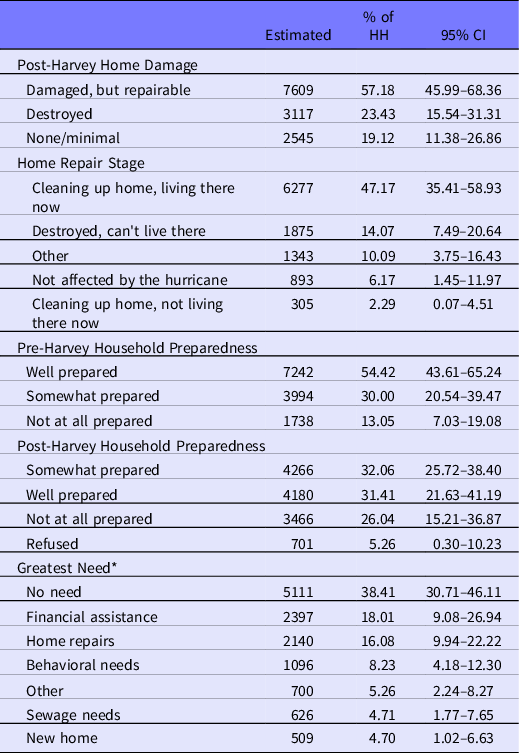
When asked about home damage and stages of repair, approximately 57% experienced repairable damage, 23% had destroyed homes, and 19% had minimal to no damage (Table 2). About 47% of households continued residing in homes during their repair process. When asked about the level of household preparedness prior to Hurricane Harvey, about 54% stated they thought that they were well prepared and 30% stated that they were somewhat prepared. However, since experiencing Hurricane Harvey, 32% thought they were somewhat prepared and 31% felt well prepared to handle another emergency disaster, similar to Hurricane Harvey. 38% of households stated that they had ‘no need,’ 18% stated that they had a need for financial assistance, 16% stated they had a need for household repairs, and more than 8% stated that they had a behavioral health need.
Hurricane Harvey CASPER Results for Preparedness and Home Recovery Characteristics of Aransas County Households (HH), May 2019

*Weighted analysis not applicable to responses with sample size less than 5, and these were omitted. Omitted responses include electrical/internet services and medical associated needs.
Of the households that experienced the behavioral health changes: trouble concentrating, changes in behavior, sleep habits, and appetite, as well as mood, anxiety/ stress, and social interactions, 17% were seeking services. Of the 35% of households who did not seek services, 14% felt there was no need and 4% were not aware of the resources available (Table 3). An estimated 63% of the Aransas County population did not require medical care when asked about their status at the time of the CASPER. Since Hurricane Harvey, 86% of the households have not had difficulty acquiring needed medical care, while 13% had experienced difficulty. Of those who experienced difficulty acquiring medical care, approximately 5% stated that the clinics were closed. Since Hurricane Harvey, 90% of households stated that they were not experiencing difficulty getting the prescription medication they needed.
Hurricane Harvey CASPER Results for Post-Hurricane Behavioral and Medical Care Characteristics of Aransas County Households (HH), May 2019

*Weighted analysis is not applicable to responses with sample size less than 5, and these responses were omitted.
**Responses reported for anyone in the household
If asked to evacuate, approximately 85% of the households in Aransas County said they would. The most agreeable response was to stay with family outside of the affected county (40%), and 88% had no need for external evacuation assistance. (Table 4). 66% of households would be evacuating with a pet, 4% of the households would decide whether to evacuate based on the situation, and 8% would not evacuate if asked. Most households were prepared with an evacuation plan, communication plan, important documentation, and medical care contact information, as well as emergency supply kit and knowledge of multiple evacuation routes. Approximately, 51% did not have a designated meeting place if households were separated during an emergency event. When households were asked what prevented them from going to a shelter before Hurricane Harvey hit, nearly 15% said they had ‘no need to go.’
Hurricane Harvey CASPER Results for Pre and Post-Harvey Planning Characteristics of Aransas County Households (HH), May 2019

*Weighted analysis is not applicable to responses with sample size less than 5, and these responses were omitted.
Limitations
This study has several important limitations. Since the Aransas community was still rebuilding, not all households had returned to their homes. This could have resulted in selection bias if those who did participate in the CASPER survey were different (e.g., less damage, and more resources for recovery) than those who had not yet returned. For example, those with vacation homes may not have been present to participate in the CASPER or may not have been able to respond to some of the CASPER questions. Similarly, in some clusters, groups of homes were inaccessible to survey teams due to no trespassing signs or other equivalent markings. Although data were collected over multiple weekends, there is no reason to assume that recall bias would be an issue since the CASPER was taking place 2 years after Hurricane Harvey, which was a major event. Additionally, the makeup of the CASPER teams changed on different survey days.
The survey assessed self-reported damage to someone’s home. To minimize bias and outside information influencing participant answers, protocol did not allow the survey teams to explain or expound on survey questions.
Discussion
At the completion of the CASPER, the results were descriptive and generalizable to the entire sampling frame of Aransas County, and depicted the sentiments of those households who provided survey responses, and not those vacant homes encountered by the field teams.
Since a majority of the county’s households had individuals greater than 65 years old, this highlights the need to consider preparedness planning and recovery response efforts in the elderly population. In May 2019, it seemed that not many families with school-aged children were living in the area. The low estimate of households with residents less than 18 years old could be because the county is largely a retirement community, or because families moved away from the county after Hurricane Harvey to put their children in schools in different counties that weren’t affected by the storm.
The top household emergency communication preferences rely on electricity and power (televisions, internet websites, radio, and text messages). Social media sites and word of mouth weren’t on the top of the communication list, but as social media sites continue to develop, the internet is a consideration for important community messaging. In an analysis of 12 CASPERs from 2014 - 2017, Wolkin et al. found that television was the primary source of information for emergency events, although some segments of the population relied on social media and word of mouth. Reference Wolkin, Schnall, Nakata and Ellis7 A number of reasons that may explain why television and radio were main sources of hurricane information in this CASPER are that most households had individuals over 65 years old, and television is an easily accessible, reliable source of coverage for this age group. Additionally, mainstream news and social media sites, like Facebook, as well as YouTube, Twitter, and Instagram, may be more widely accepted and user friendly now for information gathering than they were in 2017. None-the-less, there may be a need to combine media types to reach a broader audience.
When households were asked about their ‘greatest need,’ it’s plausible that households reported ‘no need’ because they were already done with their home repairs or home repairs were close to being completed. 16% needed repairs to the home and almost 5% had sewage needs, but less than 5 respondents had other needs consistent with short-term recovery, such as electrical/ internet service and medical needs. 18% stated that they needed financial assistance. A CASPER conducted within months or weeks of a hurricane would expect to find households’ greatest needs to be basic needs, such as electricity, running water, and sewage issues, as well as medication, trash removal, tarps, and mosquito repellent, etc. A majority of households in Aransas County used municipal water for drinking while 12% relied on a well for their drinking water, illustrating the diversity and need for public announcements if tidal surges or flooding compromised the safety of drinking water.
Since over 8% of the Aransas County households reported a behavioral health need since the hurricane, the timeframe of this CASPER plausibly allowed for the identification of long-term behavioral health needs, perhaps not otherwise noted in a response CASPER. Although most households noted no behavioral health changes, over 17% of households sought services and almost 4% of respondents who did not seek services for changes in behavioral health said that they were not aware of resources available. The end-of-survey packet given to households participating in the recovery CASPER included information created by the Substance Abuse and Mental Health Services Administration (SAMHSA), specific for Hurricane Harvey survivors.
In comparing household preparedness prior to and after Hurricane Harvey, more households stated that they were ‘well’ or ‘somewhat prepared’ prior to the hurricane, than those who were ‘prepared’ to handle another emergency disaster at the time of the survey (84% and 63%, respectively). Households may have responded differently depending on the status of their home repair. Those households still in the process of home repairs may not be prepared for another hurricane because of the state of their home and those who completed repairs (or those who did not sustain damage) may be prepared for a disaster in the future. Upon survey completion, participants were given preparedness information, a checklist of important documents, and a waterproof document bag.
Time constraints and possible survey fatigue from multiple questions potentially limited the amount of time that a team could spend with a household. Using open-ended questions allowed households to answer freely and openly, although if answers were not a pre-listed survey response, few responses were similar enough for aggregate analysis. An estimated 85% of households would evacuate if they were asked or told to do so, but there was little consensus on why a household would not evacuate. A similar lack of consensus occurred when households were asked what prevented them from going to a shelter before Hurricane Harvey hit. The most common open-ended response was ‘out of town,’ but unfortunately, analysis was limited because it was unclear whether households were out of town at the time of the hurricane or if they went out of town in response to the hurricane. Considering the amount of people who would evacuate and the number of people who would have pets with them, local officials may consider pet evacuation in future planning.
Ready.gov suggests that individuals speak to their doctor or pharmacist about building an emergency supply of medications, 8 because acquiring medications can pose an issue if pharmacies are closed due to a hurricane. 90% of households responded that they had not experienced difficulty in getting prescriptions medicine since Hurricane Harvey. A possible reason for this is that Texas state law and regulations indicate that during a disaster, a pharmacist may refill a prescription drug order without the authorization of the prescribing practitioner, 9 thus allowing pharmacist and mobile pharmacies to assist shelter residents and communities needing prescription refills.
The survey question, ‘Prior to the hurricane did your household have an emergency supply kit?’ was asked without providing households an explanation of what a kit includes or how long the contents should last. As defined by Ready.gov, emergency supply kits should have food, water, and basic emergency supplies to last for 72 hours. 8 Although 53% of households had an emergency supply kit and 47% did not have emergency kits prior to Hurricane Harvey, these findings do not assess whether households were using emergency kits as recommended.
Conclusions
The 2019 Aransas County CASPER helped characterize the needs of households 2 years after Hurricane Harvey made landfall. Results may be used to assist recovery partners and planners in strengthening disaster response and recovery, focusing on the long-term rebuilding of the community.
The information gathered from the CASPER methodology was generalizable to the entire county, providing county officials with quantifiable data on the community’s recovery from Hurricane Harvey and data that could be used in applying for recovery grants. These findings demonstrated a reliable tool for hurricane-related recovery and its equal potential in hurricane-related community preparedness and response.
Acknowledgements
DSHS would like to thank the Aransas County residents, Aransas County Sheriff’s Office, Judge Mills, and Emergency County Manager Rick McLester and Aransas County officials for their support and collaboration. We also thank our DSHS staff and volunteers who made this project possible and our DSHS ArcGIS team for their hard work and assistance.
Author contributions
Carla Gutiérrez Tyler: Aided in obtaining project funding. Integral part of the concept and format of the original CASPER report, providing interpretation of the analysis and the drafting and revision of the manuscript; Albesa Salinas: Integral part of the concept and format of the original CASPER report, including data entry, analysis and interpretation and the drafting and revision of the manuscript; Angel Guevara: Integral part of the concept and format of the original CASPER report, including data entry, analysis and interpretation and aided in the editing of the manuscript; Herminia Alva: Aided in the drafting and revision of the manuscript and provided technical consultations related to CASPERs; Mauro Ruiz: Aided in obtaining project funding and the editing of the manuscript and contributed to the approval of the document; Emilie Y Prot: Aided in the editing of the manuscript and led the approval process.