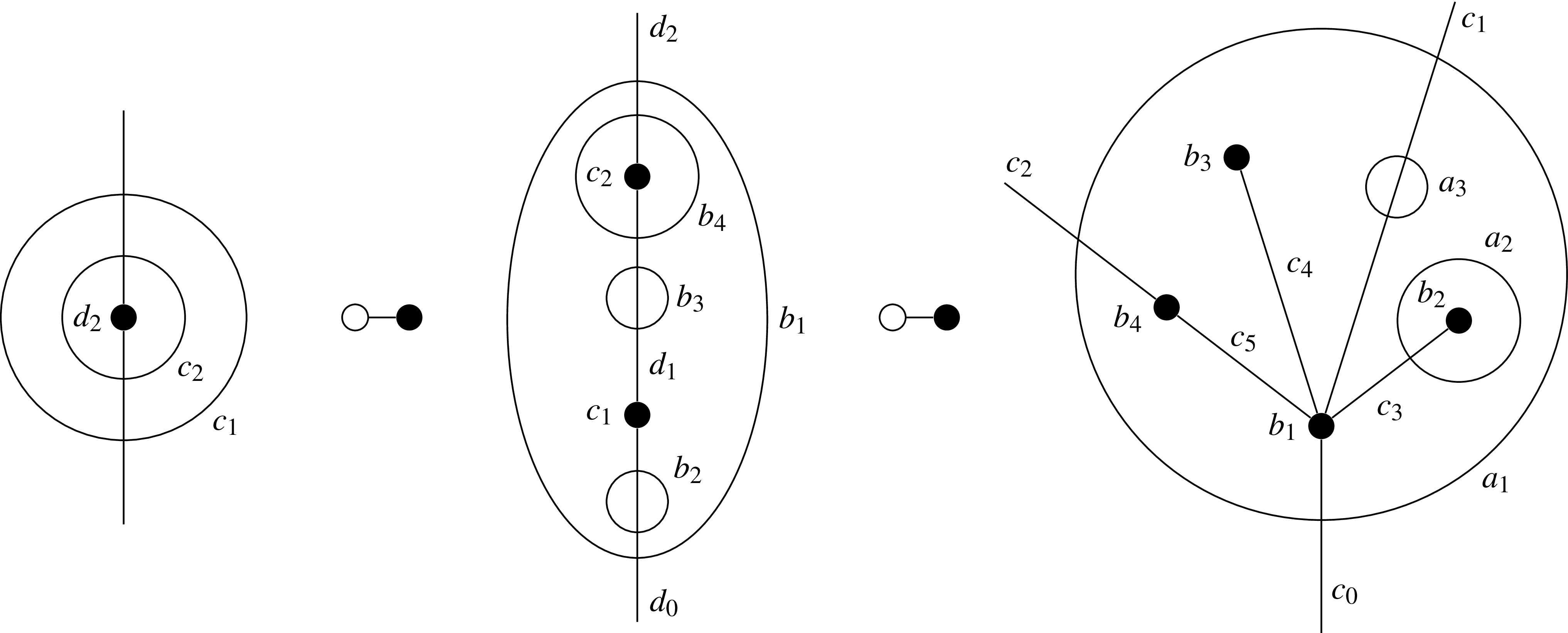
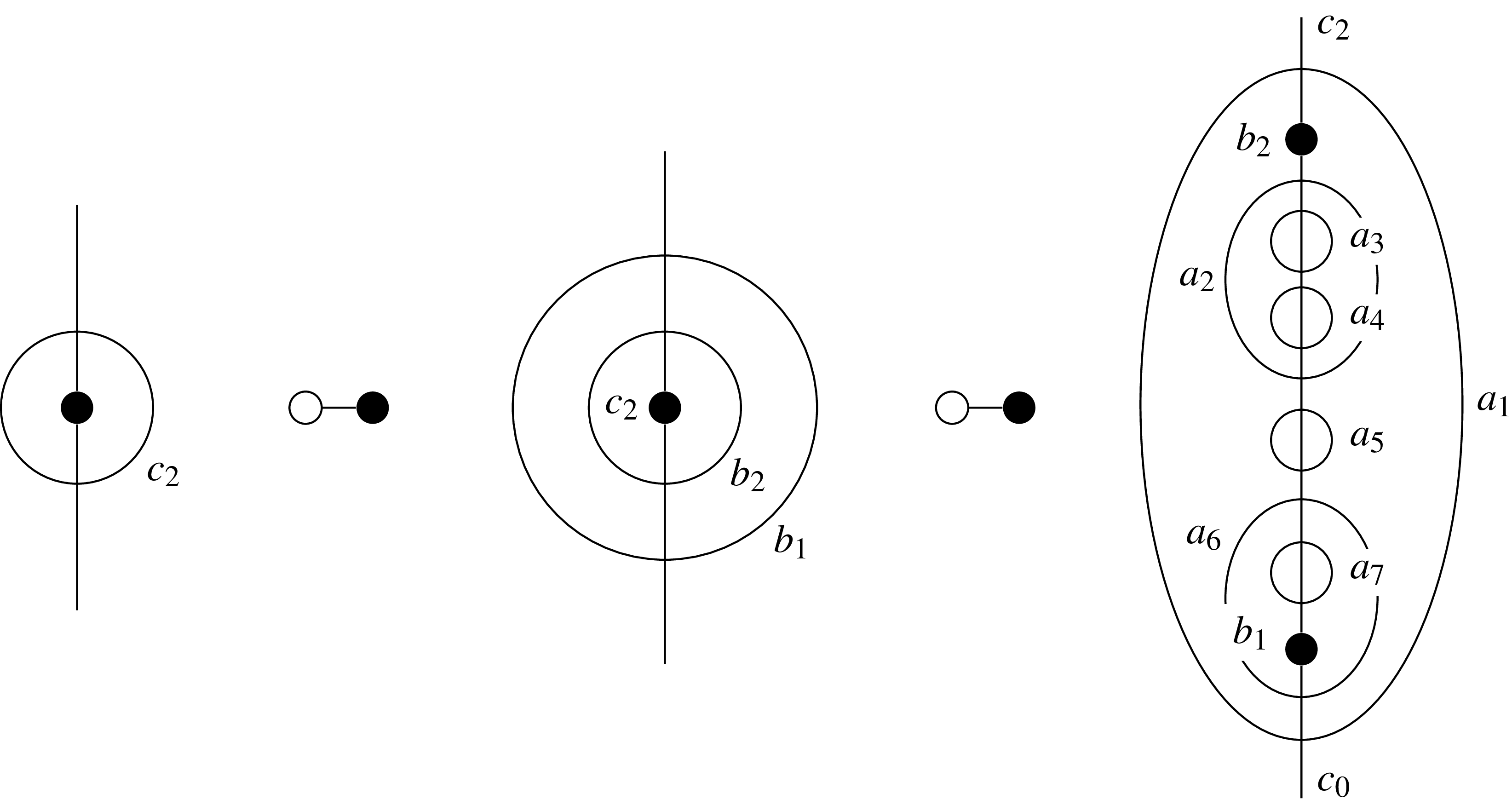
1. Introduction
Opetopes have been introduced first by Baez and Dolan (Reference Baez and Dolan1998) as a kind of pasting diagram for higher category theory. They consist of formal gluings of operations, which may have arbitrary arities. They enable an unbiased approach to higher algebra and may be combinatorially encoded in several ways.
A lengthier presentation of the concept may be found in Leinster (Reference Leinster2003) and Cheng and Lauda (Reference Cheng and Lauda2004) or (for the specific case of positive opetopes) in Leclerc (Reference Leclerc2023). We assume the reader to be already familiar with the underlying idea of opetopes and present now the subject of this article.
First of all, a new definition of (non-necessarily positive) opetopes will be introduced in Section 2, under the name dendritic face complexes (DFC). The idea is to store every cell of an opetope in a graded poset, and to characterise the posets which arise from opetopes. This approach is really akin to the one taken by Zawadowski (Reference Zawadowski2023a, Reference Zawadowski2023b) or Hadzihasanovic (Reference Hadzihasanovic2019). It is an extension of the formalism already presented in Leclerc (Reference Leclerc2023) to the broader context of non-positive opetopes. They form a category
 $\mathbf{DFC}$
, which restricts to a groupoid
 ${\mathbf{DFC}}^{\textsf{core}}$
when considering only the isomorphisms.
Then, we give, in Section 3, a brief description of zoom complexes and the definition of opetopes introduced by Kock et al. (Reference Kock, Joyal, Batanin and Mascari2010). We also denote their groupoid
 $\mathbf{KJBM}$
.
Finally, we introduce two functors between those two categories (Sections 4 and 5) and show that the two different points of view coincide modulo an equivalence of categories
 ${\mathbf{DFC}}^{\textsf{core}} \simeq {\mathbf{KJBM}}$
established in Section 6. This result is similar to the duality proven by Zawadowski in his work on positive opetopes (Reference Zawadowski2023a, Reference Zawadowski2023b).
2. Dendritic face complexes
We start by contributing a new definition of poset-type structure (many-to-one poset, Definition 2.1), which will carry the required data for encoding opetopes. Then, we introduce the definition of DFC (Definition 2.6) as a many-to-one poset satisfying some properties. This definition is intended to be yet another formalisation of opetopes, as it will be shown in Section 6.
Definition 2.1 (Many-to-one poset). A many-to-one poset (MOP) consists of:
-
• a finite set of elements
 $P$
(often called cells),
-
• a gradation
${\textsf{dim}} : P \to {\mathbb{N}} \cup \{-1\}$
. We let
$P_k := {\textsf{dim}}^{-1}(\{k\})$
for any
$k$
, -
• for each
$k\ge -1$
, two applications
$\delta _k,\,\gamma _k : P_{k+1} \to \mathcal{P}(P_k)$
(we will omit the index
$k$
for brievity),





such that the following properties hold:
-
•
$\forall x \in P,\quad {\textsf{dim}}(x)\ge 0 \rightarrow \gamma (x) \mbox{ is a singleton}$
. -
•
$\forall x \in P,\quad \delta (x) \cap \gamma (x) \neq \emptyset \rightarrow \delta (x) = \gamma (x)$
. -
•
$\exists !(x=:\ast ),\,{\textsf{dim}}(x)=-1$
, and
$\forall x,\, {\textsf{dim}}(x) = 0 \to \gamma (x)\setminus \delta (x) = \{\ast \}$
.


We write
 \begin{align*} \begin{array}{l}\qquad\quad \displaystyle y \prec ^{-} x \mbox{ iff } y \in \delta (x)\setminus \gamma (x) \qquad y \prec ^{+} x \mbox{ iff } y \in \gamma (x)\setminus \delta (x) \\\qquad\quad \displaystyle y \prec ^{{\circ }} x \mbox{ iff } y \in \delta (x)\cap \gamma (x) \qquad y \prec x \mbox{ iff } y \in \delta (x)\cup \gamma (x) \\ \displaystyle \partial (x) = \delta (x) \cup \gamma (x) \qquad \delta ^{-}(x) := \delta (x) \setminus \gamma (x) \qquad \gamma ^{+}(x) = \gamma (x) \setminus \delta (x) \qquad \Lambda = P \setminus \gamma ^{+}(P) \end{array} \end{align*}
In particular:
 $\prec ,\,\prec ^{-},\,\prec ^{+}$
and
 $\prec ^{{\circ }}$
are asymmetric, and the reflexive transitive closure of
 $\prec$
equips
 $P$
with a structure of partially ordered set, such that
 $\textsf{dim}$
is an increasing map.
For
 $x$
with
 ${\textsf{dim}}(x)\ge 1$
, we sometimes identify
 $\gamma (x)$
with its unique element, which we call the target of
 $x$
. The elements of
 $\delta (x)$
are called the sources of
 $x$
. If
 $y \prec ^{{\circ }} x$
,
 $x$
is said to be a loop on
 $y$
.
For
 $k\in {\mathbb{N}} \cup \{-1\}$
, we also denote
 \begin{equation*} P_{\ge k} := \bigcup _{i\ge k}P_i \qquad P_{\gt k} := \bigcup _{i\gt k}P_i \qquad {\textsf{dim}}(P) := \max \{{\textsf{dim}}(x)\}_{x\in P} \mbox{ the }\textit {dimension} \mbox{ of }P. \end{equation*}
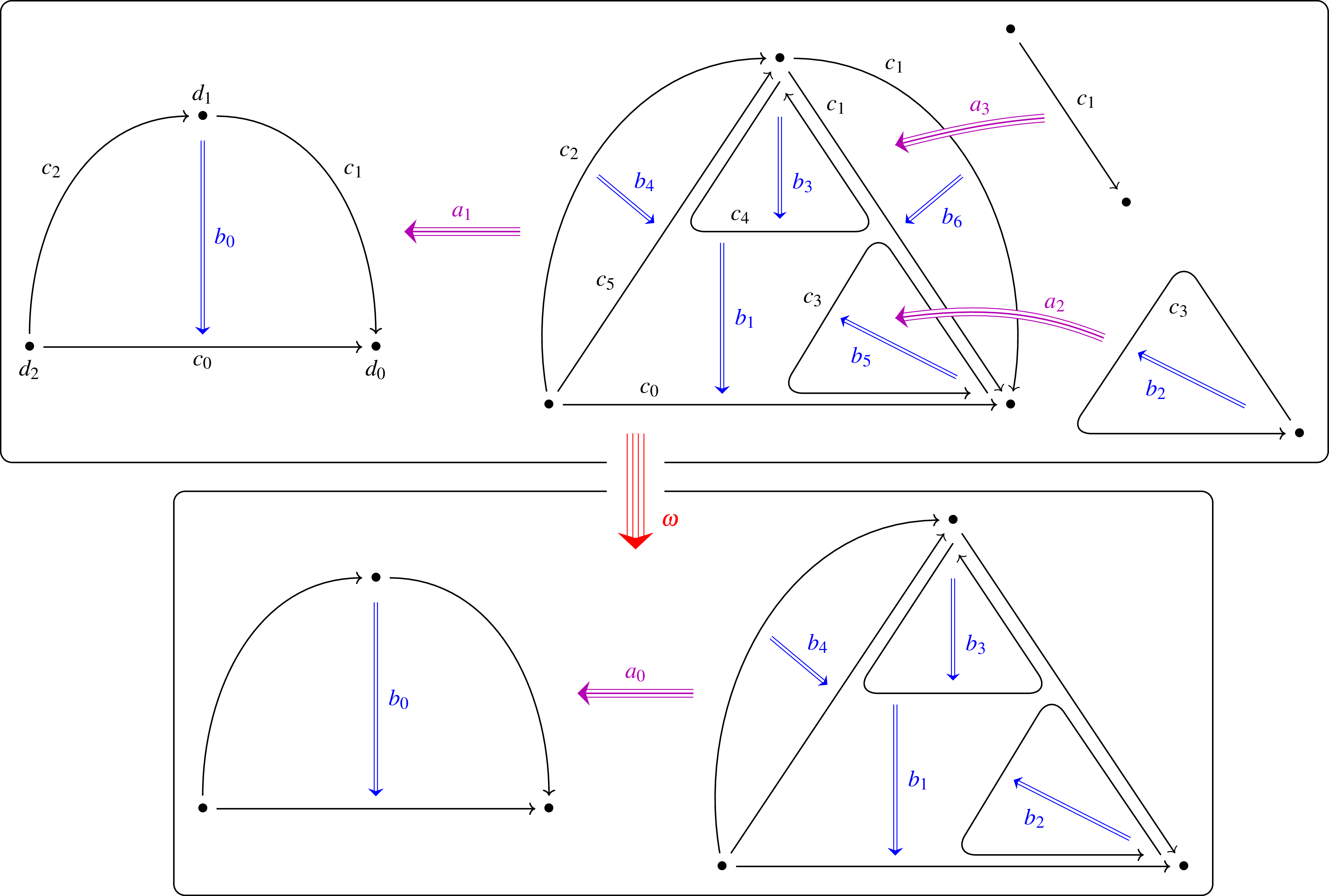
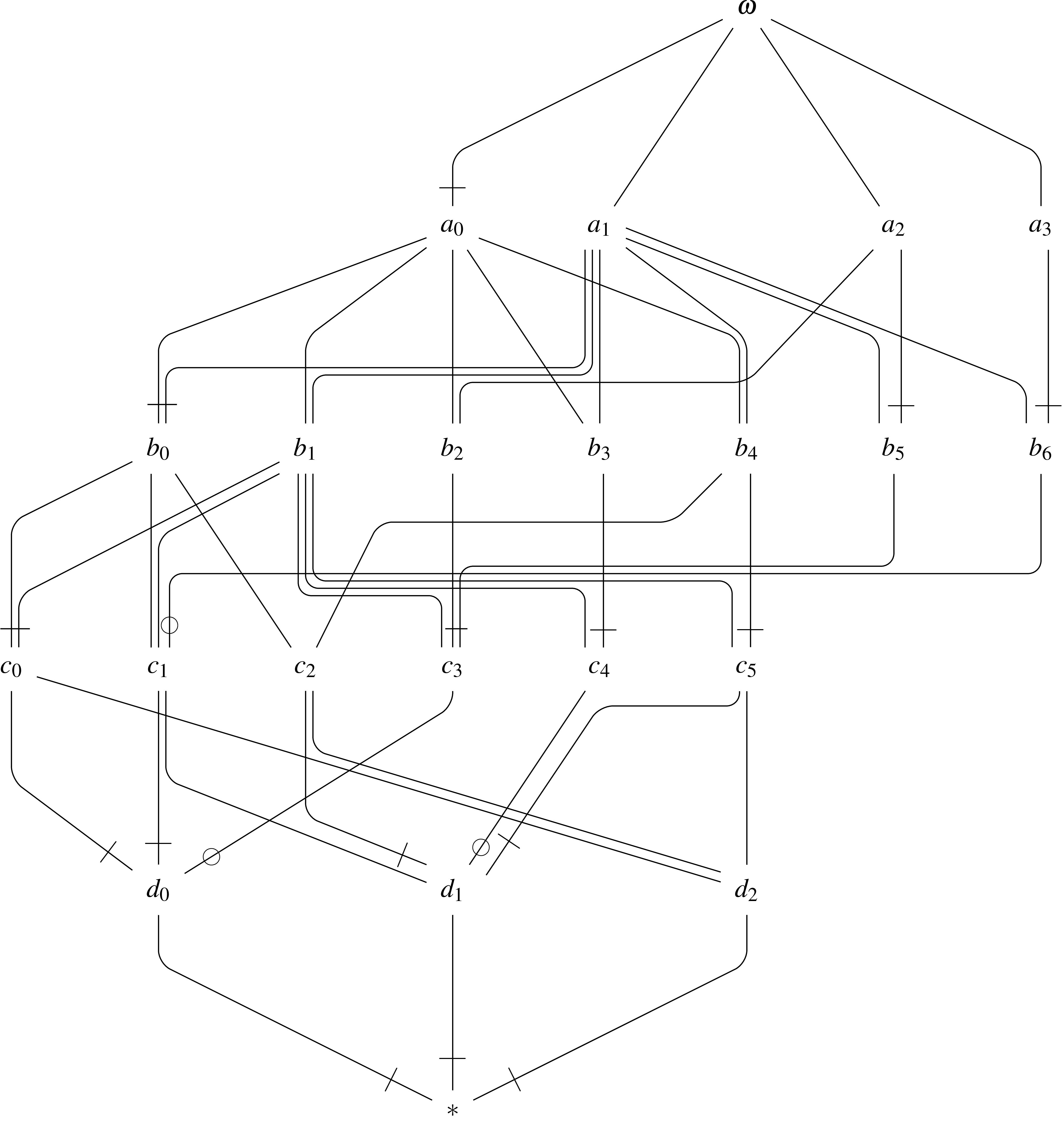
Illustration of a (non-positive)
 $4$
-opetope
 $\omega$
.

Finally, for each
 $x \in \Lambda$
and
 $z \in \partial ^2(x)$
, we ask for a total order
 $\triangleleft$
on the set
 $\{y \mid z \prec ^{{\circ }} y \prec ^{-} x\}$
, called the local order.
Remark 2.2. When
 $y \prec ^{{\circ }} x$
in a MOP, we have
 $\delta (x) = \gamma (x) = \{y\}$
. Especially, there is no
 $y' \prec ^{\alpha } x$
for some
 $\alpha \neq {\circ }$
. In the following, we make implicit use of the monoid structure on
 $\{+,\,-,\,{\circ }\}$
, seen as
 $\{+1,\,-1,\,0\} \subseteq (\mathbb{Z},\,\times )$
.
2.3. From now on, we will use a kind of Hasse diagram to represent MOP. The convention will be as follows:

The idea for encoding opetopes (such as depicted in Figure 1) as MOP is that they have cells, which will be the elements of the poset
 $P$
, and the gradation
 $\textsf{dim}$
really is the geometric dimension of those cells. Then, we will ask for a relation
 $y \prec x$
iff
 $y$
is a facet of
 $x$
. That is, a codimension one subface of
 $x$
. Since our opetopes have oriented faces (cells have sources and targets), we moreover label the relations
 $y \prec x$
as
-
•
$y \prec ^{+} x$
if
$y$
is the target of
$x$
, but not among its source. -
•
$y \prec ^{-} x$
if
$y$
is the source of
$x$
, but not its target. -
•
$y \prec ^{{\circ }} x$
if
$y$
is simultaneously the source and the target of
$x$
. That is, when
$y$
is a loop on
$x$
.


Of course, a MOP remember the data used to build an opetope, and how to reconstruct it, but fails to capture the properties of such objects. This is why the refined version of Definition 2.6 will be introduced later.
Example 2.4.
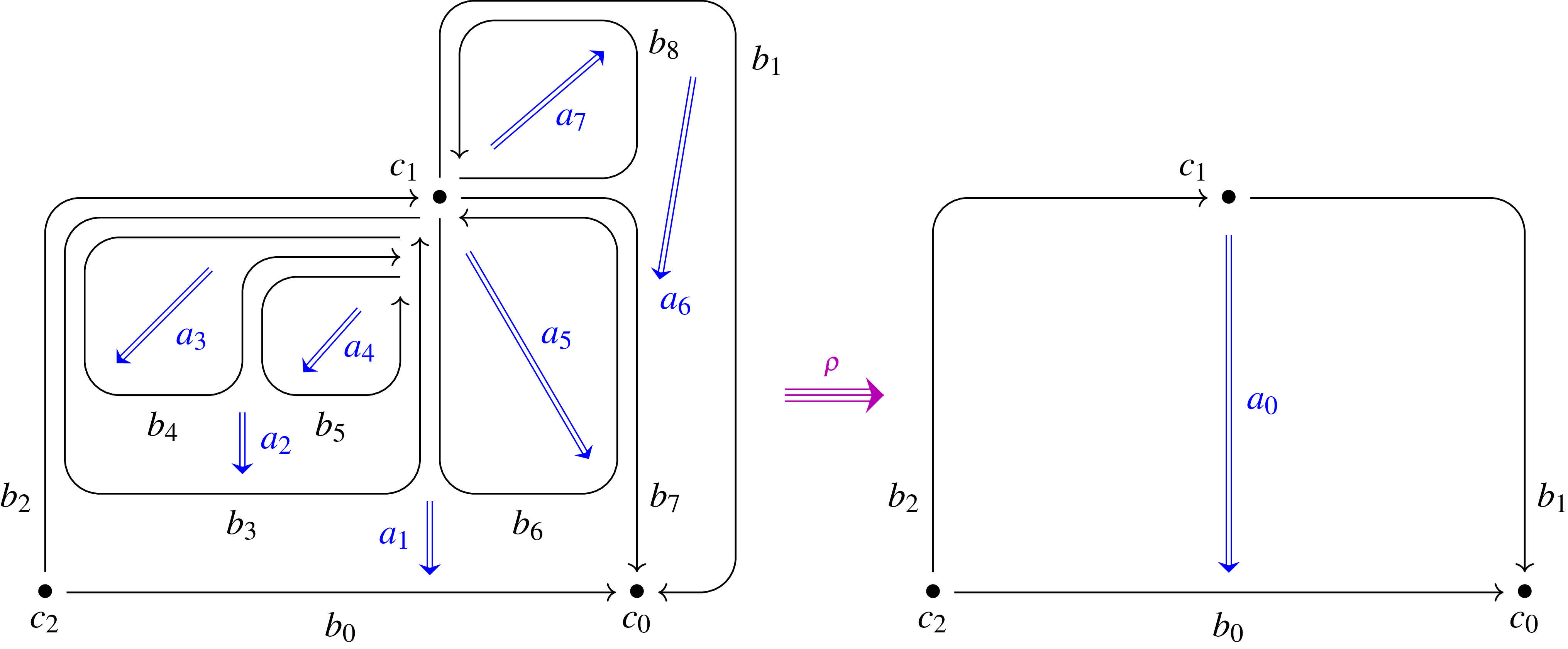
We depict in Figure
2
a
 $3$
-dimensional opetope
 $\varrho$
, which has five loops
 $b_3,\,b_4,\,b_5,\,b_6$
and
 $b_8$
on the same
 $0$
-cell
 $c_1$
.
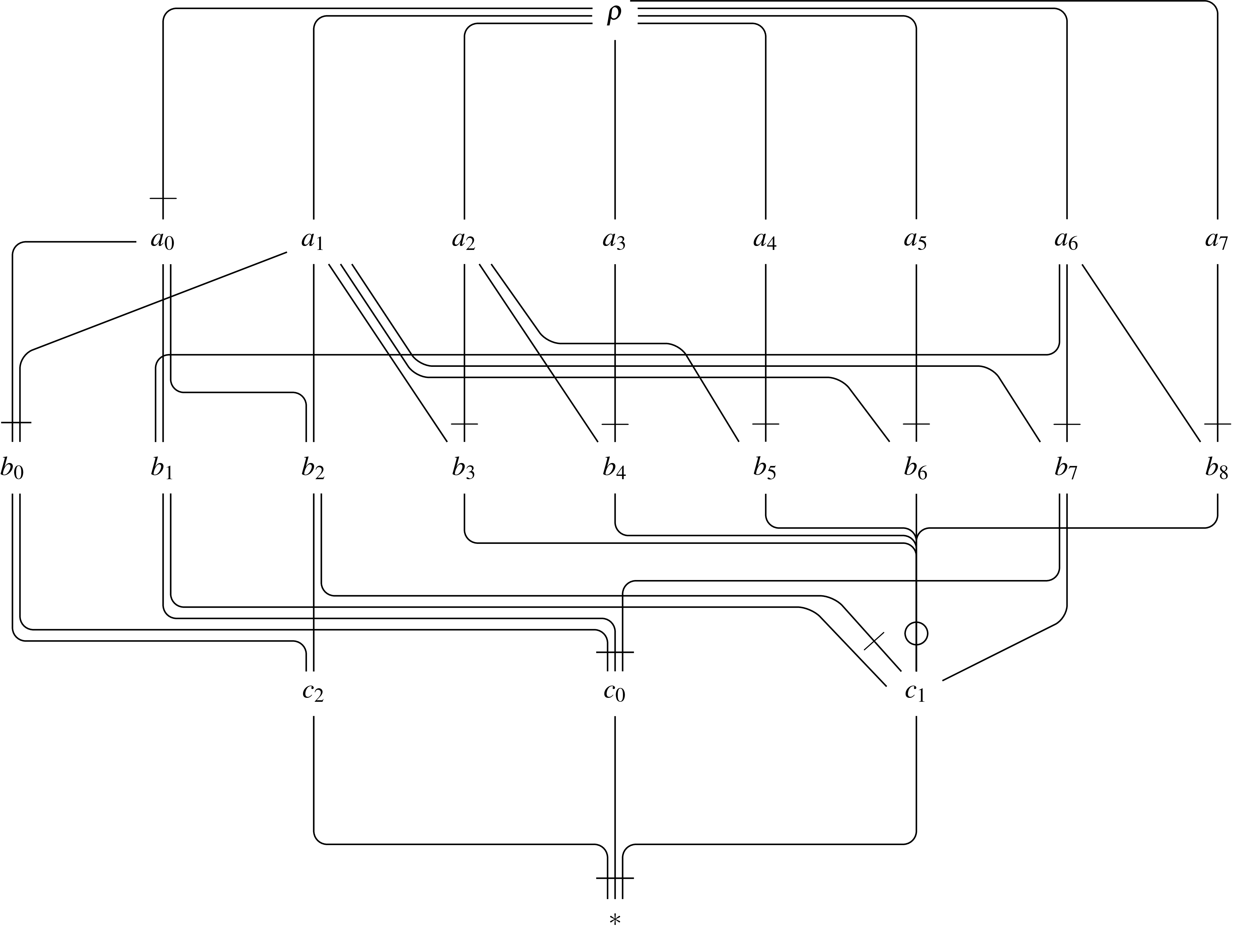
Which we may encode as the MOP of Figure 3 ,
where we have the local orders
 $b_5 \triangleleft b_4$
(as chains
 $c_1 \prec ^{{\circ }} \bullet \prec ^{-} a_2$
) and
 $b_6 \triangleleft b_3$
(as chains
 $c_1 \prec ^{{\circ }} \bullet \prec ^{-} a_1$
).
An illustration of a
 $3$
-dimensional opetope
 $\rho$
.

A
 $3$
-dimensional DFC.

2.5. Non-positive opetopes may have loops (cells whose only source is also their target), which make them behave more complicatedly than positive opetopes (i.e., opetopes where sources and target are always disjoint). When reduced to this simpler case, the formalism of MOP boils down to positive-to-one posets, their positive counterpart defined in Leclerc (Reference Leclerc2023). One of the complications of the non-positive case is the following: there is no canonical order for composing two loops
 $x,\,x' \succ ^{{\circ }} y$
on the same cell
 $y$
. For instance, one may consider Example 2.4 of the non-positive opetope
 $\varrho$
. There is no canonical order for comparing
 $b_4,\, b_5$
and
 $b_6$
. Hence, we need to add such a choice of order to the structure of many-to-one posets, so we know how we should compose the cells of the opetope. This is the order
 $\triangleleft$
of Definition 2.1.
Definition 2.6 (Dendritic face complex). A DFC is a many-to-one poset
 $C$
satisfying the following extra axioms:
-
• (greatest element) There is a greatest element of positive dimension in
$C$
, for the partial order induced by
$\prec$
. -
• (loops) When
$z\prec ^{{\circ }}y$
in
$C$
, there is some
$x \in C$
with
$y \prec ^{+} x$
. -
• (oriented thinness)
-
− For
$z \prec ^{\beta } y \prec ^{\alpha } x$
with
$\alpha ,\,\beta \neq {\circ }$
in
$P$
, there is a unique
$y'\neq y$
in
$P$
such that
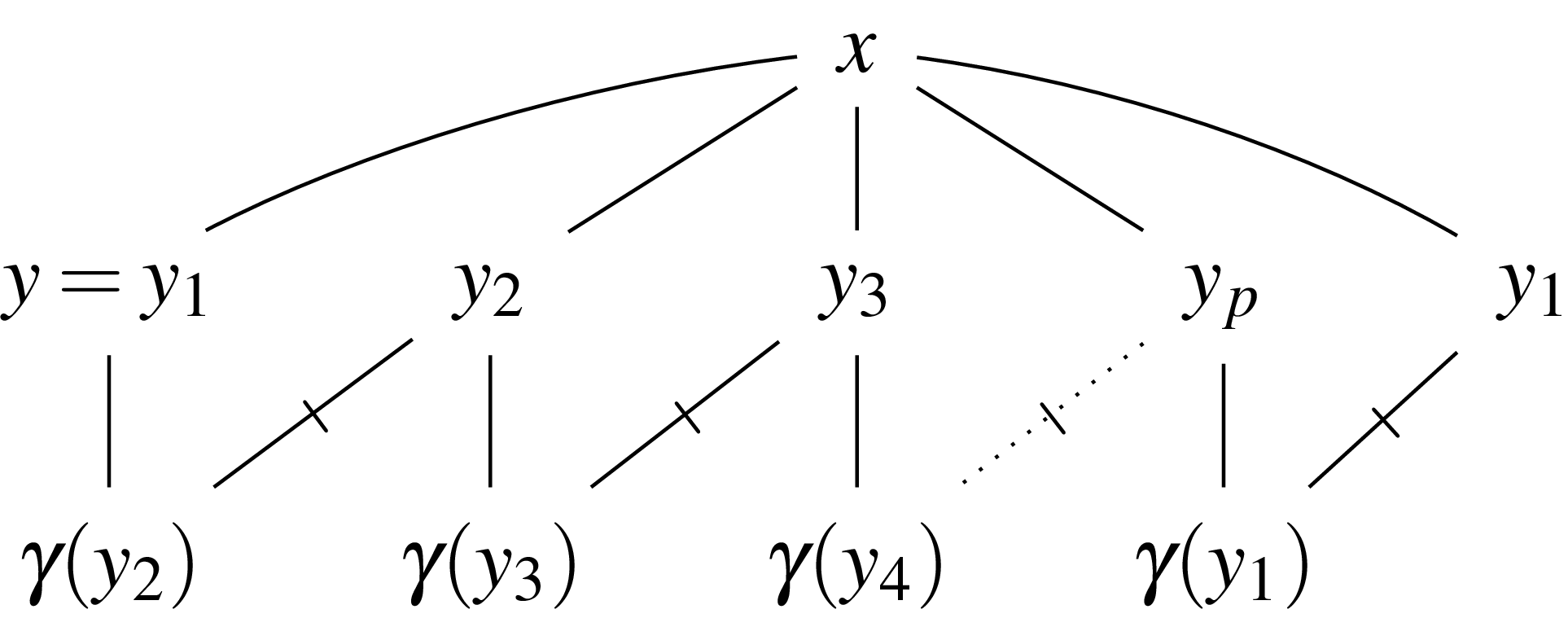
$z \prec y' \prec x$
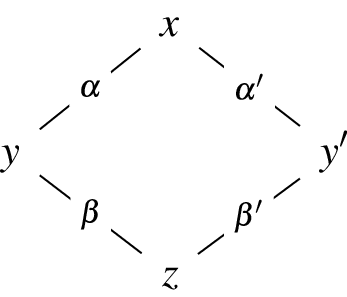
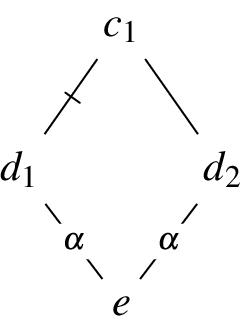
.Hence, there is a lozenge as in Figure 4 below. Moreover, we have the sign rule
$\alpha \beta = - \alpha ' \beta '$
. -
− For
$z \prec ^{{\circ }} y \prec ^{-} x$
, there is a
$y' (\neq y)$
such that
$z \prec ^{\beta } y' \prec ^{\alpha } x$
with
$(\alpha ,\,\beta ) \neq (-,\,{\circ })$
.
In both cases, when finding such a
$y'$
we say that we complete the half lozenge (or chain)
$z \prec y \prec x$
. -
-
• (acyclicity) For
$x\in P_{\ge 1}$
, there is no cycle as in Figure
5
below.





Lozenge.

Cycle.

Example 2.7. The MOP of Example 2.4 is a DFC.

A
 $4$
-dimensional DFC.

Definition 2.9 (Morphism of many-to-one posets). Let
 $C$
and
 $D$
be two many-to-one posets. A morphism
 $f : C \to D$
of MOP is a map
 $f$
between the underlying sets of
 $C$
and
 $D$
, such that:
-
•
$f$
preserves the dimension.
-
• For all
$x\in P_{\ge 0}$
,
$f_x := f\vert _{\delta (x)} : \delta (x) \to \delta (\,f(x))$
is a bijection and
$f(\gamma (x)) = \gamma (\,f(x))$
. -
•
$f$
preserves the local orders.


We let
 $\mathbf{MOP}$
be the category of many-to-one posets and their morphisms.
Definition 2.10 (
 $\mathbf{DFC}$
). The category
 $\mathbf{DFC}$
is the full subcategory of
 $\mathbf{MOP}$
whose objects are the DFC.
3. Zoom complexes and opetopes
In this section, we present the notion of opetopes as introduced by Kock et al. (Reference Kock, Joyal, Batanin and Mascari2010). We give a slightly different formalisation of their concept by using the notion of a rooted tree, which we first introduce.
Definition 3.1 (Rooted tree). A rooted tree
 $T$
consists of a finite set of nodes
 $T^\bullet$
, and a finite set of edges
 such that:
-
• each node
$a$
must be paired with exactly one target edge
$b$
, which we denote
. We also say that
$a$
is the source node of
$b$
. Sourceless edges are called leaves of
$T$
, and their set is written
$T^\vert$
. Formally, the relation
is functional and injective.
-
• each edge
$b$
may be paired with at most one target node
$a$
, we denote
such a relation. We also say that
$b$
is a source of
$a$
. Formally, the relation
is injective.


 . We also say that


 is functional and injective.


 such a relation. We also say that


 is injective.
We moreover ask for a distinguished targetless edge
 , called the root edge of
 $T$
, satisfying the following property: for each edge
 , there is descending path in
 $T$

from
 $b$
to the root of
 $T$
.
A rooted tree
 $T$
is called a unit tree iff it has no node and only one leaf: its root. It is called a corolla if it has exactly one node (and hence each edge is either a leaf or the root).
Definition 3.2 (Paths, zigzag, and subdivisions). More generally, in a rooted tree
 $T$
, an alternate sequence of nodes and edges
 $s = (x_1,\,x_2,\,\cdots ,\,x_p)$
will be called
-
• a descending path if
$\forall i\lt p$
,
$x_{i+1}$
is the target of
$x_i$
. -
• an increasing path if
$\forall i\lt p$
,
$x_i$
is the target of
$x_{i+1}$
. -
• a zig–zag if for any pair
$(x_i,\, x_{i+1})$
where
$x_i$
is an edge, we have
$x_{i+1}$
source of
$x_i$
and
$x_{i-1}$
target of
$x_i$
if
$i\gt 0$
, or
$x_{i+1}$
target of
$x_i$
and
$x_{i-1}$
source of
$x_i$
if
$i\gt 0$
. the zig–zag is said to be simple when
$\forall i\neq j,\, x_i \neq x_j$
. A simple zig–zag corresponds to a succession of a descending and an increasing path.


A subdivision for
 $T$
consists of a finite totally ordered set
 $W(b)$
for each edge
 . A subdivided tree may always be seen as a rooted tree, by replacing each edge
 $b$
by a linear tree

where
 $a_1,\,\ldots ,\,a_p$
are the elements of
 $W(b)$
following the increasing order.
Following Kock et al. (Reference Kock, Joyal, Batanin and Mascari2010), we let

Remark 3.3. Notice that the root is uniquely determined as the unique edge without a target node, and there is exactly one descending path from any node or edge down to the root edge
 $\rho (\omega )$
.
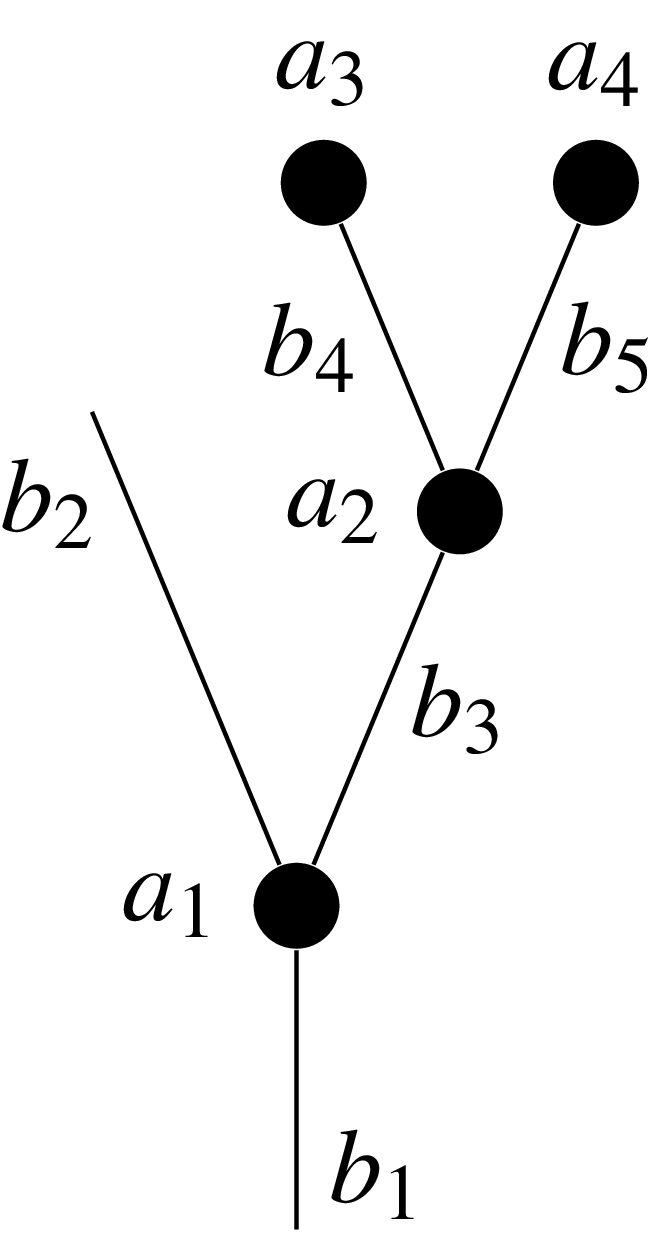
Example 3.4.
Figure
7
is a representation of the rooted tree
 $T$
having
-
• as nodes
$T^\bullet := \{a_1,\,a_2,\,a_3,\,a_4\}$
, as edges
and as root
$b_1$
. -
• as relations

 and as root


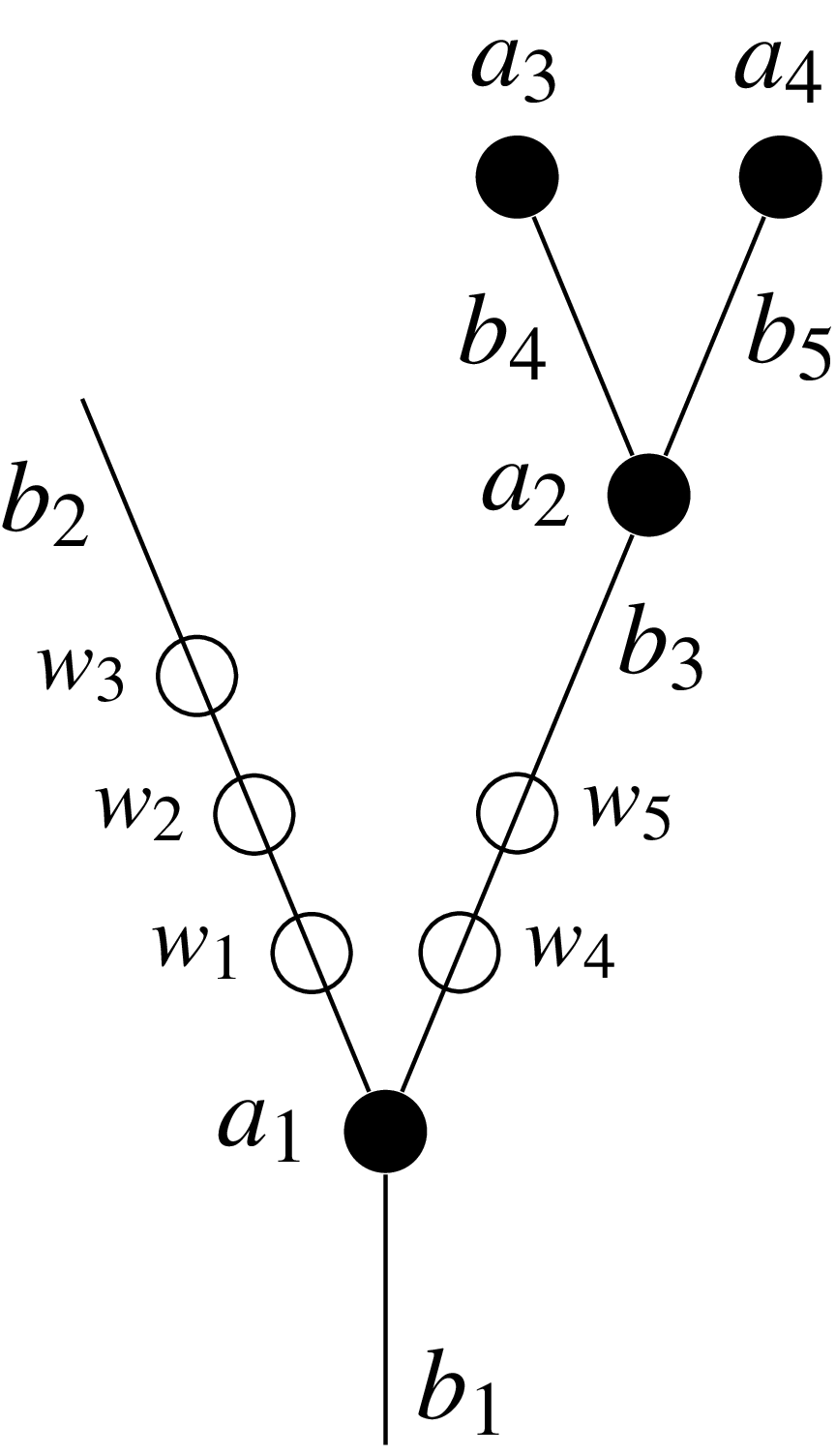
Figure
8
is a representation of the subdivided tree
 $T' = (T,\, W)$
, where
 \begin{equation*} W(b_2) = (w_1 \lt w_2 \lt w_3) \qquad W(b_3) = (w_4 \lt w_5) \qquad W(b_1) = W(b_4) = W(b_5) = \emptyset \end{equation*}
A rooted tree
 $T$
.

A subdivision
 $T'$
of
 $T$
.

Definition 3.5 (Constellation). A constellation
 $C : T \to U$
between two rooted trees
 $T$
and
 $U$
consists of:
-
• a subdivision
$T'$
of
$T$
, -
• a bijection
$\sigma _\bullet : \textsf{blackdots}(T') \to \textsf{leaves}(U)$
, -
• a bijection
$\sigma _\circ : \textsf{whitedots}(T') \to \textsf{nulldots}(U)$
,


such that the sum map
 $\sigma = \sigma _\bullet + \sigma _\circ$
satisfies the kernel rule:
-
• For each
$x \in \textsf{dots}(U), \mbox{the nodes } \{ t \in \textsf{dots}(T') \mid \sigma (t) \sqsubseteq x \}$
induces a connected full subgraph of
$T'$
.


where
 $x' \sqsubseteq x$
means that there is a descending path from
 $x'$
to
 $x$
in
 $U$
.
A constellation will be said to be exact when the maps
 $\sigma _\bullet$
and
 $\sigma _\circ$
are identities.
Remark 3.6. Following Kock et al. (Reference Kock, Joyal, Batanin and Mascari2010), a constellation
 $C : T \to U$
may be pictured as a nesting of the tree
 $T'$
, such as

where the
 $c_i$
’s are the edges of
 $T$
, the
 $b_i$
’s are the nodes of
 $T$
and the
 $a_i$
’s are the nodes of
 $U$
.
Definition 3.7 (Zoom complex). A zoom complex of degree (or dimension)
 $n$
is a sequence
 \begin{equation*} T_0 \overset {C_1}{\longrightarrow } T_1 \overset {C_2}{\longrightarrow } \cdots \overset {C_{n}}{\longrightarrow } T_n \end{equation*}
of rooted trees and constellations. It will be said to be exact when all the
 $C_i$
’s are.
Definition 3.8 (Opetope). For
 $n\in {\mathbb{N}}$
, a
 $n$
-opetope is an exact zoom complex
 $T_0 \to \cdots \to T_n$
of degree
 $n$
such that:
-
•
$T_0$
is a tree with one root, one leaf and one node.
-
• If
$n \ge 1$
,
$T_1$
has the same form as
$T_0$
. -
• If
$n \ge 2$
,
$T_2$
is a linear tree.


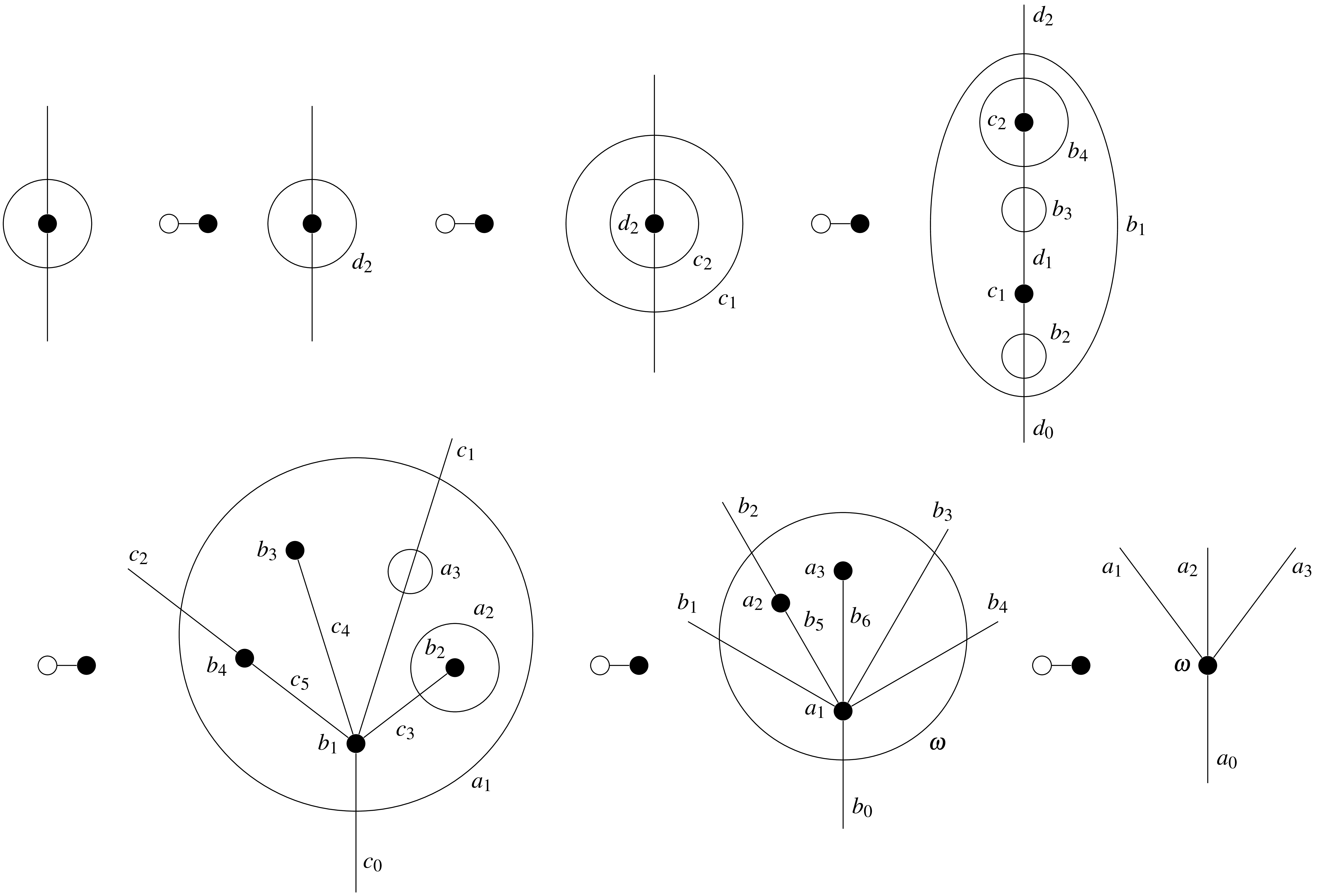
Example 3.9. The opetope associated to Figure 1 may be drawn as in Figure 9 (the first constellation is omitted).
A
 $4$
-opetope.

Example 3.10. The opetope associated to Figure 2 may be drawn as in Figure 10 . Notice that in the rightmost constellations, the smallest circles (the minimal ones for the inclusion) really are the white dots of Definition 3.1 .
A
 $3$
-opetope.

Definition 3.11 (Isomorphism of opetopes). An isomorphism between two opetopes
 $(T_i)$
and
 $(U_i)$
of the same dimension is a sequence of (subdivided) tree isomorphisms compatible with the structural maps of the constellations.
Definition 3.12 (
 $\mathbf{KJBM}$
). We let
 $\mathbf{KJBM}$
be the category of opetopes and their isomorphisms.
4. From dendritic face complexes to opetopes
From now on,
 $C$
is a fixed DFC. We let
 $\omega$
be its greatest element and
 $n$
its dimension. Our aim in this section is to build a functor
 $Z : {\mathbf{DFC}}^{\textsf{core}} \to {\mathbf{KJBM}}$
, where
 ${\mathbf{DFC}}^{\textsf{core}}$
denotes the core subcategory of
 $\mathbf{DFC}$
whose objects are the DFC and the morphisms are the isomorphisms of DFC.
4.1. The first part of the section is dedicated to prove some key properties of DFC, and to introduce some convenient notations. Then, the lengthy definition of the functor
 $Z$
will be shattered throughout the remainder of the section. Especially:
-
• the sequence of trees
$(T_k)$
underlying
$Z(C)$
is defined in Proposition 4.14. -
• the subdivisions of these trees will be introduced in Definition 4.26.
-
• the constellation axioms will be checked in Lemmas 4.15, 4.28, and 4.29.
-
• the linearity of the second tree
$T_2$
is proved in Lemma 4.30. -
• the action of
$Z$
on isomorphisms of
$\mathbf{DFC}$
is defined in Definition 4.33.


Proposition 4.2 (Confinement). Let
 $z \prec ^{{\circ }} y \prec ^{+} x$
in
 $C$
and
 $y' \in \delta (x)$
, then
 $z \prec ^{{\circ }} y'$
.

Proof.
In the configuration
 $z \prec ^{{\circ }} y \prec ^{+} x \succ ^{-} y'$
, let
 $z' = \gamma (y')$
.
We first show that
 $z' \prec ^{{\circ }} y'$
. Suppose the opposite, that is,
 $z' \prec ^{+} y'$
. Then by completing lozenges from left to right, we may find a pattern as below (the process ends by acyclicity).

Hence,
 $z = \gamma (y) \prec ^{+} y$
, but we assumed
 $z \prec ^{{\circ }} y$
. Whence
 $z' \prec ^{{\circ }} y'$
.
We then prove
 $z = z'$
. Using oriented thinness, we may complete
 $z' \prec ^{{\circ }} y' \prec ^{-} x$
as
 $z' \prec ^{\beta } y'' \prec ^{\alpha } x$
with
 $(\alpha ,\,\beta ) \neq (-,\,{\circ })$
.
-
• Suppose
$(\alpha ,\,\beta ) = (-,\,-)$
, then oriented thinness applied to the chain
$(z' \prec y'' \prec x)$
yields a lozenge completion
$(z' \prec ^{-} y''' \prec ^{+} x)$
or
$(z' \prec ^{+} y''' \prec ^{-} x)$
. In the first case, we have
$y''' = \gamma (x) = y$
, but
$y$
is a loop, hence
$\delta (y) = \emptyset$
and
$z' \prec ^{-} y$
is impossible. In the second case, we are reduced to the following case (replacing
$y''$
by
$y'''$
). -
• Suppose
$(\alpha ,\,\beta ) = (-,\,+)$
, then we have
$z \prec ^{{\circ }} y \prec ^{+} x \succ ^{-} y''$
, with
$z' = \gamma (y'')$
. Using the same reasoning as at the beginning of the proof, we see that
$z' \prec ^{{\circ }} y'''$
, which contradicts
$z' \prec ^{+} y'''$
. -
• Suppose
$\alpha = {\circ }$
, then
$y'' = y = \gamma (x)$
, but
$y \prec ^{+} x$
and
$y'' \prec ^{{\circ }} x$
. This is impossible.


Hence necessarily
 $\alpha = +$
and
 $y'' = y$
. Since
 $z' \in \partial (y'') = \partial (y) = \{z\}$
, we have
 $z' = z$
.
Proposition 4.3 (Lozenge completion for chains
 $z \prec ^{{\circ }} y \prec ^{-} x$
). For
 $z \prec ^{{\circ }} y \prec ^{-} x$
in
 $C$
, exactly one of the two properties below holds.
-
(i) There are two distinct completions
$z \prec ^{\beta } y' \prec ^{\alpha } x$
with
$\alpha \beta \in \{-,\,+\}$
. -
(ii) There is a completion
$z \prec ^{{\circ }} y' \prec ^{+} x$
.


Proof. That either (i) or (ii) holds is a consequence of oriented thinness.
Suppose (i) and (ii). Then choosing by (i) a completion
 $z \prec ^{\beta } y' \prec ^{\alpha } x$
with
 $\alpha = -,\, \beta \neq {\circ }$
and by (ii) a completion
 $z \prec ^{{\circ }} y'' \prec ^{-} x$
yields a lozenge

Contradicting Proposition 4.2.
Definition 4.4 (
 $\Gamma ,\,\Lambda ,\,\Omega ,\,N$
).
 \begin{align*} \mbox{We let} \qquad &\Gamma := \gamma ^{+}(C) \qquad \Omega := \{x \in C \mid x \mbox{ is a loop}\} \qquad N := \{x \in C \mid \delta (x) = \emptyset \}\\ & \Lambda _k := \Lambda \cap C_k,\,\Gamma _k := \Gamma \cap C_k,\, \Omega _k := \Omega \cap C_k,\, N_k := N \cap C_k \quad (k\in {\mathbb{N}}). \end{align*}
Definition 4.5 (
 $\triangleleft ^{C_k,\,+},\,\triangleleft ^{C_k,\,-},\,\lt ^{C_k,\,+},\,\lt ^{C_k,\,-}$
). We define the following relations:
-
•
$\lt ^{C_0,\,-}$
is the empty relation.
For
$k \gt 0$
,
$\lt ^{C_k,\,-}$
is the transitive closure of the relation
$\triangleleft ^{C_k,\,-}$
on
$C_k$
, such that
$x \triangleleft ^{C_k,-} x'$
iff
$x \succ ^{+} \gamma (x) \prec ^{-} x'$
. We write
$x \bot ^{-} x'$
iff either
$x \lt ^{-} x'$
or
$x' \lt ^{-} x$
, and we write
$x \le ^{-} x'$
iff either
$x = x'$
or
$x \lt ^{-} x'$
.A lower path is a sequence
$x_0 \succ ^{+} y_0 \prec ^{-} \cdots \prec ^{-} x_{p-1} \succ ^{+} y_{p} \prec ^{-} x_{p}$
. -
• For
$k\gt 0$
,
$\lt ^{C_k,\,+}$
is the transitive closure of the relation
$\triangleleft ^{C_k,+}$
on
$C_k$
, such that
$x \triangleleft ^{C_k,+} x'$
iff there is
$w \in C_{k+1}$
, such that
$x \prec ^{-} w \succ ^{+} x'$
. We write
$x \bot ^{+} x'$
iff either
$x \lt ^{+} x'$
or
$x' \lt ^{+} x$
, and we write
$x \le ^{+} x'$
iff either
$x = x'$
or
$x \lt ^{+} x'$
. An upper path is a sequence
$y_0 \prec ^{-} x_1 \succ ^{+} y_1 \prec ^{-} \cdots \prec ^{-} x_p \succ ^{+} y_p$
.


Proposition 4.6 (Strictness). The partial order
 $\lt ^{+}$
is strict.
Proof. We shall prove the following three properties:
 \begin{equation*} \begin{array}{ccl} \left (k\in { \left [\!\left [\, {{0}},\, {{n}} \,\right ]\!\right ] }\right ) & \mathcal{P}_k : & \lt ^{\scriptscriptstyle C_k,\,+} \mbox{ is a strict partial order}. \\ \left (k\in { \left [\!\left [\, {{0}},\, {{n-1}} \,\right ]\!\right ] }\right ) & \mathcal{Q}_k : & \delta ^{-}(C_{k+1}) = \delta ^{-}(\Lambda _{k+1}) \wedge \gamma ^{+}(C_{k+1}) = \gamma ^{+}(\Lambda _{k+1}). \\ \left (k\in { \left [\!\left [\, {{0}},\, {{n-1}} \,\right ]\!\right ] }\right ) & \mathcal{R}_k : & \Lambda _k \subseteq \delta (\gamma ^{(k+1)}\omega ). \end{array} \end{equation*}
by induction on the codimension
 $n-k$
.
-
•
$\boxed {k = n}$
Since
$\omega$
is a greatest element, we have
$C_n = \{\omega \}$
. Hence,
$\mathcal{P}_n$
is clear. -
•
$\boxed {k = n-1}$
Because
$\omega$
is a greatest element, when
$a{\triangleleft ^{\scriptscriptstyle \,C_{n-1},\,+}}a'$
, the only possible situation is:Hence, a cycle
$a_0{\triangleleft ^{\scriptscriptstyle \,C_{n},\,+}}a_1{\triangleleft ^{\scriptscriptstyle \,C_{n},\,+}}\cdots {\triangleleft ^{\scriptscriptstyle \,C_{n},\,+}}a_0$
must have the form
$a_0{\triangleleft ^{\scriptscriptstyle \,C_{n},\,+}}a_0$
with
$n=0$
and
$a_0 = \gamma (\omega )$
. But
$\gamma (\omega )\nprec ^{-}\omega$
. So there is no such cycle. Whence
$\mathcal{P}_{n-1}$
.Because
$\omega \in \Lambda _n$
is a greatest element,
$\mathcal{Q}_{n-1}$
and
$\mathcal{R}_{n-1}$
are clear. -
•
$\displaystyle \mbox{Induction}$
We suppose now
$\mathcal{P}_{k+1},\,\mathcal{Q}_{k+1},\,\mathcal{R}_{k+1}$
, and
$\mathcal{R}_{k+2}$
if
$k\lt n-2$
.First, we prove
$\mathcal{Q}_k$
. Let
$e \in C_k$
with
$e \prec ^{\alpha } d$
for some
$d =: d_1$
and
$\alpha \in \{-,\,+\}$
. If
$d_1$
is in
$\Lambda _{k+1}$
then we are done. Else, let
$c_1$
be such that
$d_1 \prec ^{+} c_1$
. Then, we may complete
$e\prec ^{\alpha }d_1\prec ^{+}c_1$
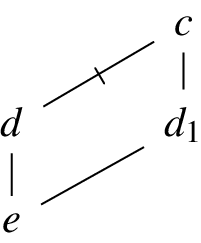
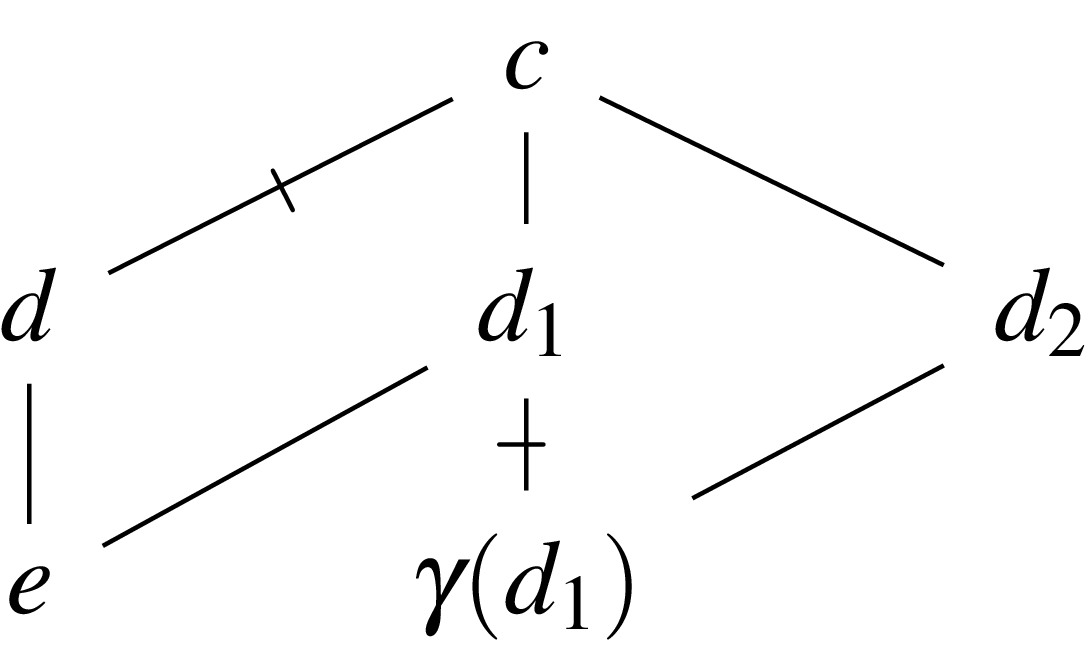
into a lozenge as in Figure 11 below. If
$d_2\in \Lambda _{k+1}$
, we have finished. Else, we continue with
$d_2$
, taking
$c_2$
such that
$d_2\prec ^{+}c_2$
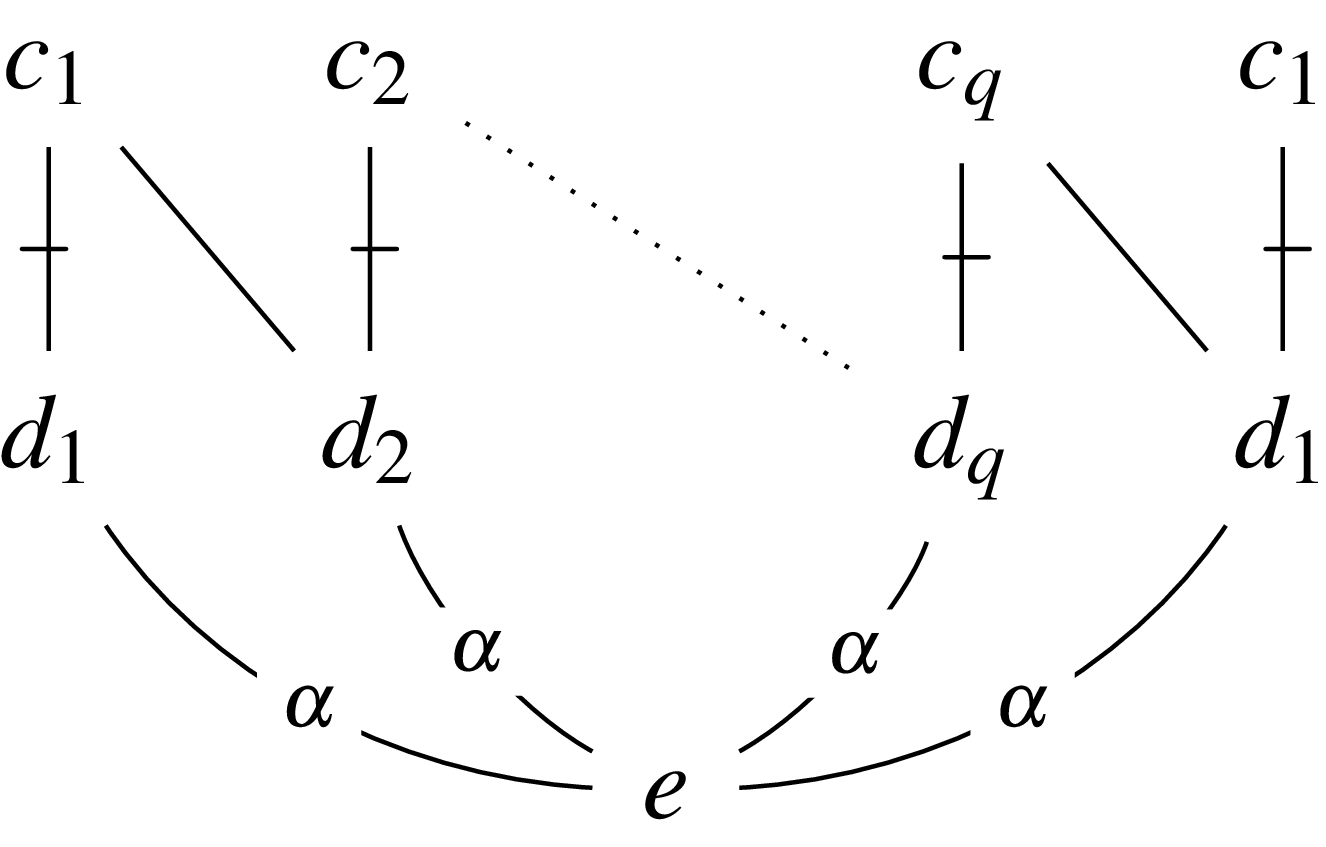
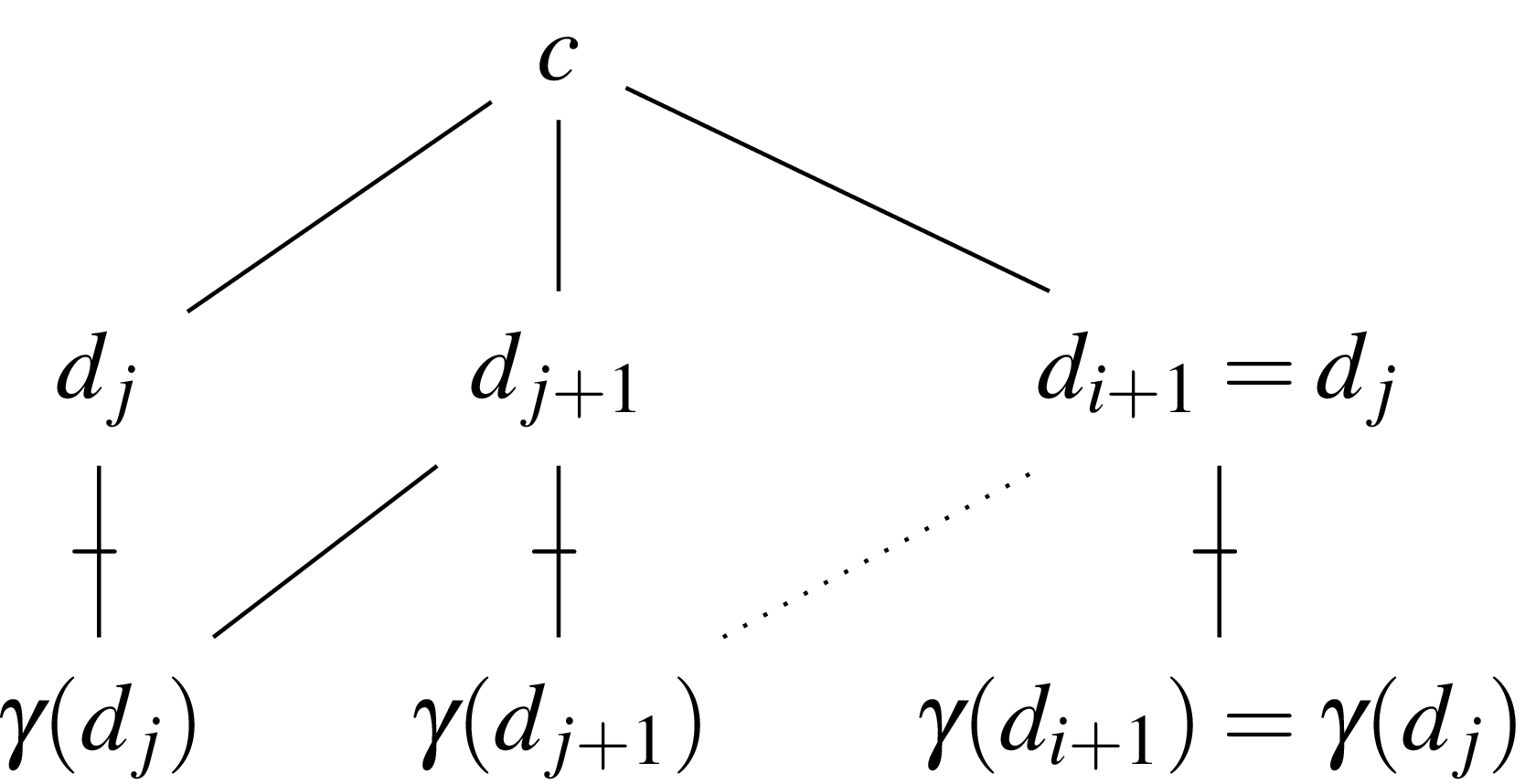
etc.. While iterating this construction, we cannot produce a loop as in Figure 12 below.Because it would contradict
$\mathcal{P}_{k+1}$
. Hence, each time
$d_i\notin \Lambda _{k+1}$
, the next element
$d_{i+1}$
is a new one, and this construction must finish because the poset is finite. So when the construction ends, it produces an element
$e\prec ^{\alpha }d_q\in \Lambda _{k+1}$
. Whence the existence.Figure 11.Lozenge.
Figure 12.Impossible loop.
We then prove
$\mathcal{R}_k$
. Let
$e\in \Lambda _{k}$
. Then,
$e \in \delta (d)$
for some
$d$
.Suppose first that
$e \in \delta ^{-}(d)$
. Then, using
$\mathcal{Q}_k$
we may assume
$d \in \Lambda _{k+1}$
, and by
$\mathcal{R}_{k+1}$
,
$d \in \delta (\gamma ^{(k+2)}\omega )$
.Either
$d \prec ^{{\circ }} \gamma ^{(k+2)}\omega$
, in which case
$d = \gamma ^{(k+1)}\omega \succ ^{-} e$
and we are done. Or
$d \prec ^{-} \gamma ^{(k+2)}\omega$
and, because
$e$
is not a source, the only possible lozenge completion for
$e \prec ^{-} d \prec ^{-} \gamma ^{(k+2)}\omega$
is
$e \prec ^{-} \gamma ^{(k+1)}\omega \prec ^{+} \gamma ^{(k+2)}\omega$
, and we are done.Suppose now that
$e \prec ^{{\circ }} d$
. Then there is some
$c$
with
$d \prec ^{+} c$
. Using
$\mathcal{Q}_{k+1}$
, we may assume
$c \in \Lambda _{k+2}$
.If
$k = n-2$
, then
$c = \omega$
,
$d = \gamma (\omega )$
and we are done. If
$k \lt n-2$
, then using
$\mathcal{R}_{k+2}$
we have
$c \in \delta (\gamma ^{(k+3)}\omega )$
. Now either
$c = \gamma ^{(k+2)}\omega \prec ^{{\circ }} \gamma ^{(k+3)}\omega$
, hence
$d = \gamma ^{(k+1)}\omega$
and we are done, or
$c \prec ^{-} \gamma ^{(k+3)}\omega$
and we are in the situation
$e \prec ^{{\circ }} d \prec ^{+} c \prec ^{-} \gamma ^{(k+3)}\omega$
. By successively completing lozenges from left to right, we may construct one of the two diagrams below.In the first case (left one), we are done, and in the second (right one), we are reduced to the case
$e \in \delta ^{-}(d')$
for some
$d'$
. This completes the proof of
$\mathcal{R}_k$
.Now we prove
$\mathcal{P}_k$
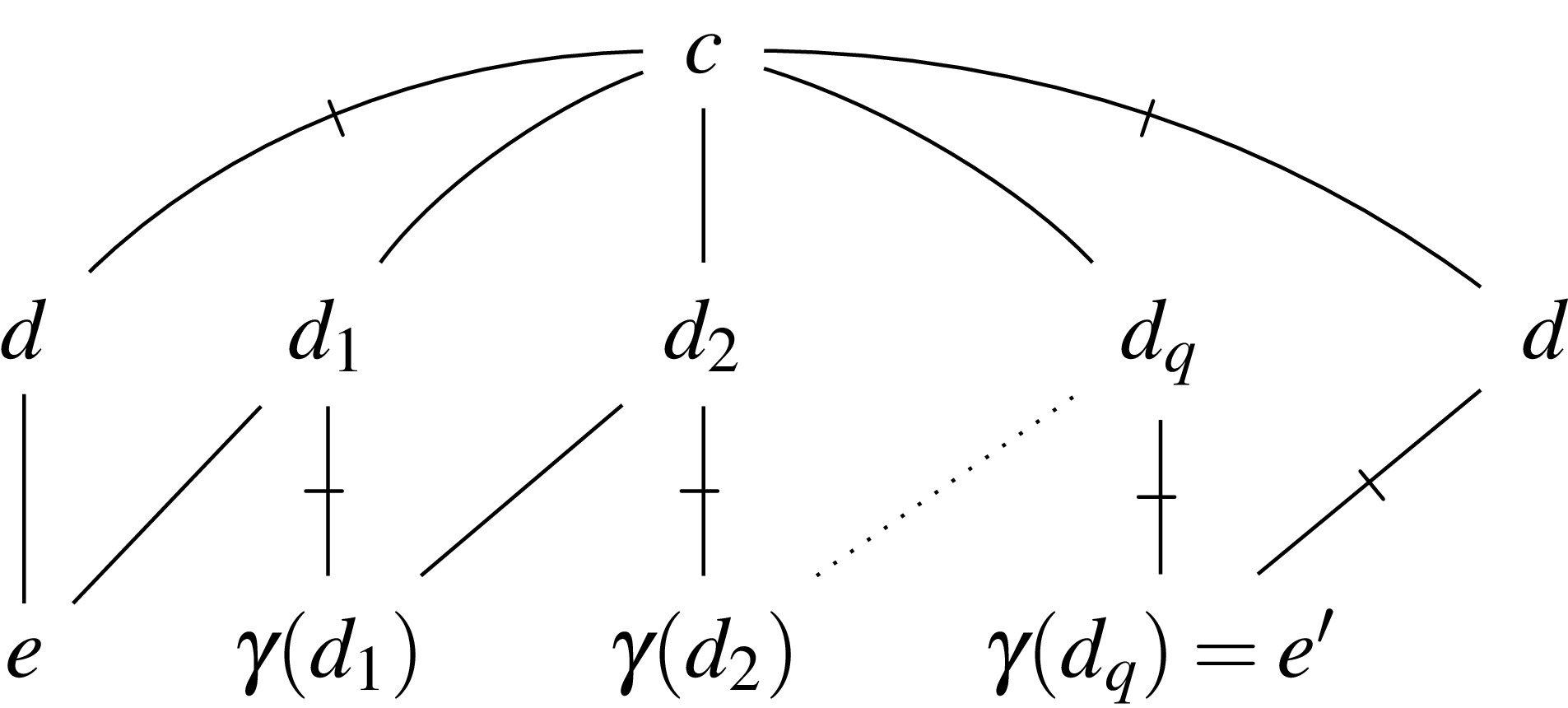
. The strategy is to replace a related pair
$e{\triangleleft ^{\scriptscriptstyle \,C_{k},\,+}}e'$
by a path
$e = e_0 {\triangleleft ^{\scriptscriptstyle \,C_{k},\,+}} e_1 {\triangleleft ^{\scriptscriptstyle \,C_{k},\,+}} \cdots {\triangleleft ^{\scriptscriptstyle \,C_{k},\,+}} e_q = e'$
as in Figure 13 above. Indeed, if we are able to do this, every cyclic path
$e_0{\triangleleft ^{\scriptscriptstyle \,C_{k},\,+}}e_1{\triangleleft ^{\scriptscriptstyle \,C_{k},\,+}}\cdots {\triangleleft ^{\scriptscriptstyle \,C_{k},\,+}}e_q = e_0$
will induce a longer path
$e_0 = e'_0{\triangleleft ^{\scriptscriptstyle \,C_{k},\,+}}e'_1{\triangleleft ^{\scriptscriptstyle \,C_{k},\,+}}\cdots {\triangleleft ^{\scriptscriptstyle \,C_{k},\,+}}e'_m = e_0$
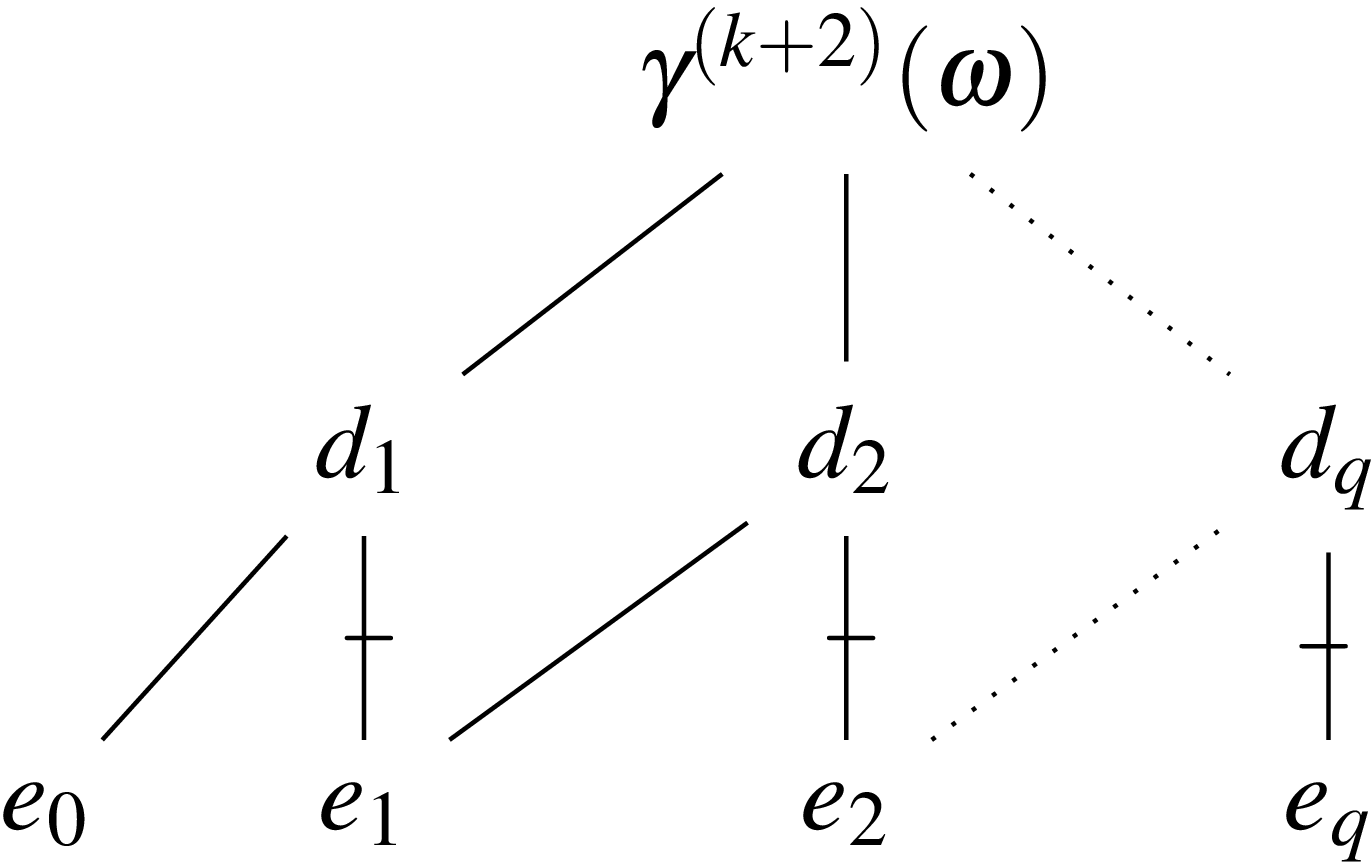
as above, which cannot exist because it would contradict the acyclicity axiom. Notice that either
$q=1$
and we are done, or if we know that each
$d_i$
is in
$\Lambda _{k+1}$
then we know that
$d_i \prec ^{-} \gamma ^{(k+2)}\omega$
(by
$\mathcal{R}_{k+1}$
, and because
$\gamma ^{(k+2)}$
has at least two sources, it cannot be a loop). So we will be able to conclude if we prove Lemma 4.7 below.





Path.

Figure 14.

Figure 15.

Type I.

Lemma 4.7.
if
 $e{\triangleleft ^{\scriptscriptstyle \,C_{k},\,+}}e'$
, then we have a sequence as follows, with
 $d_1,\,d_2,\,\cdots ,\,d_q\in \Lambda _{k+1}$
.

Proof.
If
 $e\prec ^{-}d\succ ^{+}e'$
with
 $d\in \Lambda _{k+1}$
, then the result is proven. So we may suppose that
 $d$
is the target of some element:
 $d = \gamma (c)$
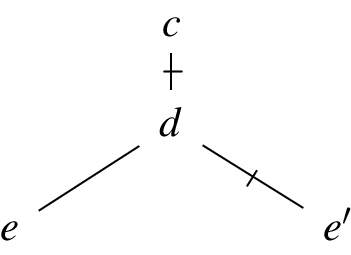
, as in Figure 14 below.
First, complete the left chain with some
 $d_1$
as in Figure 15 above.
Then, we consider its target
 $\gamma (d_1)$
, and complete
 $\gamma (d_1)\prec ^{+}d_1\prec ^{-}c$
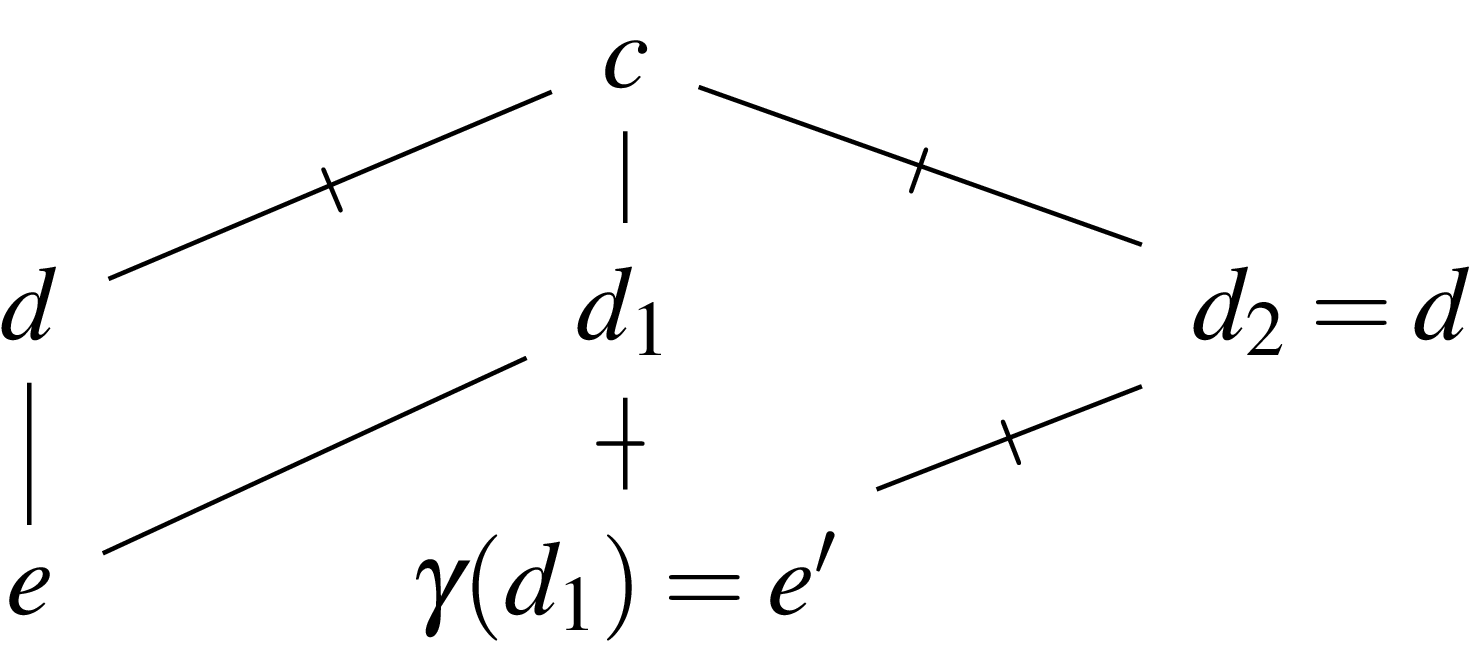
as a lozenge. We have two possibilities. Either the completion is of type I as in Figure 16 below, or it is of type II as in Figure 17 below:
In the second case, we keep completing lozenges on the right until ending with a diagram of the shape of Figure 18 below:
Type II.

Path.

Cycle.

First, we will never encounter a situation where
 $d_{i+1} = d_j$
for a
 $j\leq i$
as in Figure 19 above, by acyclicity. And this construction must finish as above by finiteness of the poset
 $C$
. Now, after renaming the elements, we end up with this situation:

If each
 $d[i]$
is in
 $\Lambda _{k+1}$
then we are done. In the other case, for example, if
 $d[2]\prec ^{+}c[2]$
, then we can once again unfold

Now, we may iterate this unfolding process. This will produce a tree-shaped collection of
 $d$
’s and
 $c$
’s, with relations
 \begin{equation*}d[a_1,\,\cdots ,\,a_p]\prec ^{+}c[a_1,\,\cdots ,\,a_p] \qquad \mbox{and} \qquad c[a_1,\,\cdots ,\,a_p]\succ ^{-}d[a_1,\,\cdots ,\,a_p,\,a]\end{equation*}
for each
 $a\in \left [\hspace {-3pt}\left [1,\,q_{[a_1,\,\cdots ,\,a_p]}\right ]\hspace {-3pt}\right ]$
. Each branch
 \begin{equation*}d[]\prec ^{+}c[]\succ ^{-}d[a_1]\prec ^{+}c[a_1]\succ ^{-}d[a_1,\,a_2]\prec ^{+}\cdots \succ ^{-}d[a_1,\,\cdots ,\,a_p]\prec ^{+}\cdots \end{equation*}
must be finite, otherwise it would contradict
 $\mathcal{P}_{k+1}$
. i.e., at some point, all
 $d[a_1,\,\cdots ,\,a_p]$
are in
 $\Lambda _{k+1}$
. We thus obtain a path of the desired form, which completes the proof of Lemma 4.7.
Notice that through the proof above, we have obtained the following result (c.f.
 $\mathcal{R}_k$
):
Lemma 4.8.
 $\forall k\in { \left [\!\left [\, {{0}},\, {{n-1}} \,\right ]\!\right ] },\quad \Lambda _k \subseteq \delta (\gamma ^{(k+1)}\omega )$
.
Lemma 4.9.
If
 $e \prec ^{\alpha } d$
for some
 $d \in C$
and
 $\alpha \in \{+,\,-\}$
, then
 $e \prec ^{\alpha } d'$
for a unique
 $d' \in \Lambda$
.
Moreover, for
 $k\lt n$
, we have
 $C_k \setminus \{\gamma ^{(k)}\omega \} \subseteq (\delta ^{-}\cup \gamma ^{+})(\Lambda _{k+1})$
.
Proof.
The existence part of the first statement has been seen in the proof of Proposition 4.6 above (c.f.
 $\mathcal{Q}_k$
).
We prove the uniqueness part. It is clear if
 $k=n-1$
, hence we assume
 $k\le n-2$
. Suppose
 $c\prec ^{\alpha }b$
and
 $c\prec ^{\alpha }b'$
, with
 $b,\,b'\in \Lambda _{k+1}$
. By using Lemma 4.8, either
 $\gamma ^{(k+2)}\omega$
is not a loop and we may construct a lozenge
 $(e,\,d,\,\gamma ^{(k+2)}\omega ,\,d')$
which, by the sign rule, implies
 $d = d'$
. Or
 $\gamma ^{(k+2)}\omega$
is a loop on
 $\gamma ^{(k+1)}\omega$
, hence
 $d = d' = \gamma ^{(k+1)}\omega$
.
We then prove the second point. Let
 $\gamma ^{(k)}\omega \neq e \prec ^{{\circ }} d$
for some
 $e,\,d \in C$
. By (loops), there is some
 $c$
with
 $d \prec ^{+} c$
. Using the first point, we may assume
 $c \in \Lambda _{k+2}$
.
Since
 $e \neq \gamma ^{(k)}\omega$
, we also have
 $c \neq \gamma ^{(k+2)}\omega$
. Hence
 $k \lt n-2$
, and Lemma 4.8 yields
 $c \in \delta (\gamma ^{(k+3)}\omega )$
. Necessarily
 $c \nprec ^{{\circ }} \gamma ^{(k+3)}\omega$
, otherwise we would have
 $d = \gamma ^{(k+1)}\omega$
which would contradict the hypothesis. Thus
 $c \prec ^{-} \gamma ^{(k+3)}\omega$
and we are in the situation
 $e \prec ^{{\circ }} d \prec ^{+} c \prec ^{-} \gamma ^{(k+3)}\omega$
. By successively completing lozenges from left to right, we may construct a diagram as below (
 $\alpha \beta \neq {\circ }$
):

Hence
 $e \prec ^{\beta } d_q$
and we are indeed reduced to the first statement.
Lemma 4.10.
For all
 $k\le n$
,
 $C_{k}\setminus \delta ^{-}(C_{k+1}) = \{\gamma ^{(k)}\omega \}$
.
Proof.
-
•
$\displaystyle \mbox{case }k=n$
. In this case,
$d = \omega$
is the only
$n$
-dimensional cell, and it is not in
$\delta ^{-}(C)$
. -
•
$\displaystyle \mbox{case }k\lt n$
. Suppose
$d\in C_k\setminus \delta ^{-}(C_{k+1})$
is not
$\gamma ^{(k)}\omega$
. Then there is some
$c\in C_{k+1}$
with
$d = \gamma (c)$
, and by Lemma 4.9, we may assume
$c\in \Lambda$
.Necessarily
$c \neq \gamma ^{(k+1)}\omega$
because we assumed
$d \neq \gamma ^{(k)}\omega$
. Hence
$k \le n-2$
and
$c \prec ^{-} \gamma ^{(k+2)}\omega$
by Lemma 4.8. By remembering that
$d \notin \delta ^{-}(C)$
, completing
$d = \gamma (c) \prec c \prec ^{-} \gamma ^{(k+2)}\omega$
yields
$d = \gamma ^{(k)}\omega$
.Conversely: if
$k = n-1$
, then
$\gamma (\omega ) \nprec ^{-} \omega$
, whence
$\gamma (\omega ) \notin \delta ^{-}(C_n)$
. If
$k \lt n-1$
, suppose
$\gamma ^{(k)}\omega \prec ^{-} c$
for some
$c$
. By Lemma 4.9, we may assume
$c \in \Lambda$
, hence
$c \in \delta (\gamma ^{k+2}\omega )$
by Lemma 4.8. We also have
$\gamma ^{(k)}\omega = \gamma ^2(\gamma ^{(k+2)}\omega )$
. If
$c \prec ^{{\circ }} \gamma ^{(k+2)}\omega$
, then
$\gamma ^{(k)}\omega \in \delta ^{-}(\gamma ^{(k+1)}\omega )$
which is impossible. If
$c \prec ^{-} \gamma ^{(k+2)}\omega$
, then we are in one of the two possible situations below.The left one violates the sign rule, and the right one contradicts Proposition 4.2.


Lemma 4.11.
For any
 $k\lt n$
,
 $\Lambda _k = \delta (\gamma ^{(k+1)}\omega )$
.
Proof.
One inclusion is by Lemma 4.8, so we show the other one. Let
 $d \in \delta (\gamma ^{(k+1)}\omega )$
, and suppose that
 $d \prec ^{+} c$
for some
 $c$
. By Lemma 4.9, we may assume
 $c \in \Lambda _{k+1}$
, hence
 $c \in \delta (\gamma ^{(k+2)}\omega )$
by Lemma 4.8.
-
• Suppose
$d \prec ^{-} \gamma ^{(k+1)}\omega$
. Either
$\gamma ^{(k+2)}\omega$
is a loop, hence
$c = \gamma ^{(k+1)}\omega$
, so
$d \prec ^{-} c$
and
$d \prec ^{+} c$
, which is impossible. Or
$c \prec ^{-} \gamma ^{(k+2)}\omega$
,
$\gamma ^{(k+1)}\omega \prec ^{+} \gamma ^{(k+2)}\omega$
, and there is a lozenge
$(d,\,c,\,\gamma ^{(k+2)}\omega ,\,\gamma ^{(k+1)}\omega )$
violating the sign rule. -
• Suppose
$d \prec ^{{\circ }} \gamma ^{(k+1)}\omega$
. Either
$\gamma ^{(k+2)}\omega$
is a loop, hence
$c = \gamma ^{(k+1)}\omega$
, so
$d \prec ^{-} c$
and
$d \prec ^{{\circ }} c$
, which is impossible. Or
$c \prec ^{-} \gamma ^{(k+2)}\omega$
,
$\gamma ^{(k+1)}\omega \prec ^{+} \gamma ^{(k+2)}\omega$
, and there is a lozenge
$(d,\,c,\,\gamma ^{(k+2)}\omega ,\,\gamma ^{(k+1)}\omega )$
contradicting Proposition 4.2.


4.12. Now that we have established some key lemmas about DFCs, we introduce a tree structure on the (non-loop) sources of any cell. When instantiated on the cells
 $\gamma ^k\omega$
, these tree structures will provide the underlying trees
 $T_k$
of the zoom complex
 $Z(C)$
.
Proposition 4.13 (Tree structure
 $\Delta _a$
). For all
 $a \in C$
, there is an associated tree structure
 $\Delta _a$
as follows.
-
• The nodes are
$\Delta _a^\bullet = \delta (a) \setminus \Omega$
, and the edges are
. -
• There is a relation
when
$b \prec ^{-} a$
and a relation
when
$b \prec ^{+} a$
. -
• The root edge is
$\gamma ^2(a)$
.

 .
 when

 when


Proof.
When
 $a \in \Omega$
,
 $\Delta _a$
is either reduced to its root if
 $\gamma (a)\in \Omega$
, or a corolla with
 $\delta ^{-}(\gamma (a))$
as leaves if
 $\gamma (a) \notin \Omega$
.
Suppose now
 $a \notin \Omega$
. Each node
 $b \in \Delta _a^\bullet$
is paired with exactly one target edge
 $\gamma (b) \prec ^{+} b$
. The sign rule shows the uniqueness of the target node, and also shows that
 $\gamma ^2(a)$
has no target node. Let
 $c \neq \gamma ^2(a)$
be an edge of
 $\Delta _a$
, there is some
 $b \in \Delta _a^\bullet$
and
 $c \prec ^{\alpha } b$
for some
 $\alpha \neq {\circ }$
. By oriented thinness, we may assume
 $c \prec ^{-} b$
. Now, completing lozenges from left to right as below yields the descending path from
 $c$
to the root
 $\gamma ^2(a)$
.

Proposition 4.14 (Tree structure
 $T_k$
). Let
 $C$
be a DFC and
 $2 \le k \le n+2$
. There is a rooted tree structure
 $T_k$
defined as follows.
-
• The set of nodes is
$\Lambda _{k-1}$
, and the set of edges is
$C_{k-2}$
. -
• There is a relation
iff
$y \prec ^{-} x$
, and a relation
iff
$y \prec ^{+} x$
. -
• The root edge is
$\gamma ^{(k-2)}(\omega )$
.


 iff

 iff


Proof.
Suppose
 $k \le n$
.
Because of Lemma 4.9,
 $C_{k-2} = \partial \Lambda _{k-1} \cup \{\gamma ^{(k-2)}\omega \}$
. Notice also that elements
 $y \in \Lambda _{k-1}$
are not loops, because there is no
 $x$
with
 $y \prec ^{+} x$
. Hence,
 $\Lambda _{k-1} = \delta (\gamma ^{(k)}\omega )\setminus \Omega$
according to Lemma 4.11. Hence,
 $T_k$
coincides with
 $\Delta _{\gamma ^{(k)}\omega }$
as defined in Proposition 4.13.
Consider now the case
 $k = n+1$
. There is a unique node
 $\omega$
with a set of leaves
 $T_{n+1}^\vert = \delta (\omega )$
and
 $\gamma (\omega )$
as root. It is a well-defined, rooted tree structure.
When
 $k = n+2$
, there is no node and a unique leaf
 $\omega$
:
 $T_{n+2}$
is a unit tree.
We then derive in Lemma 4.15 one of the required properties for
 $Z(C)$
to be a zoom complex.
Lemma 4.15.
Let
 $2 \le k \lt n+2$
. We have the equality
 $\textsf{blackdots}(T_k) = \textsf{leaves}(T_{k+1})$
.
Proof.
 $\textsf{blackdots}(T_k) = T_k^\bullet = \Lambda _{k-1} = C_{k-1} \setminus \gamma ^{+}(C_{k}) \overset {\mbox{{Lemma 4.9} {}}}{=} C_{k-1} \setminus \gamma ^{+}(\Lambda _{k}) = T_{k+1}^\vert = \textsf{leaves}(T_{k+1})$
.
4.16. Our next goal is to define the subdivisions associated to the trees
 $T_k$
. In particular, we need a linear order on the white dots lying on each edge, which we introduce in Definition 4.25. For this purpose, we will need some further properties, and the intermediate definitions of orders introduced in Definition 4.20 and 4.22.
Proposition 4.17 (Hexagon property). For every hexagon as follows, with
 $\alpha ,\,\alpha ',\,\beta ,\,\beta ' \neq {\circ }$
.

Either
 $c = c'$
, or (potentially by exchanging the role of
 $c$
and
 $c'$
) there is a simple zig–zag in
 $\Delta _b$
as below (with
 $p \ge 1$
):

Proof.
It is shown exactly as the Hexagon property (Proposition
 $3.19$
) in Leclerc (Reference Leclerc2023).
Proposition 4.18 (Pencil linearity).
 $C$
satisfies the axiom of pencil linearity introduced in Zawadowski (Reference Zawadowski2023). That is:
 $\forall k\gt 0,\,\forall e\in C_{k-1},\,\forall \beta \in \{+,\,-\},\quad \left \{d\in C_k \mid e\prec ^{\beta }d\right \}$
is linearly ordered by
 $\lt ^{+}$
.
Proof. By the same arguments as in Leclerc (Reference Leclerc2023), mutatis mutandis.
4.19. As DFC, zoom-complexes carry an order for loops. For instance, in Example 3.10, the subdivision of the edge
 $c_1$
:
 $(a_7 \lt a_5 \lt a_4 \lt a_3)$
tells us in which order the cells of
 $\varrho$
should be composed. Notice that this order is not immediately part of the DFC structure defined in Example 2.7, but it may be rebuilt out of the local orders
 $\triangleleft$
. To begin with, we will define in Definition 4.20 an order
 $\blacktriangleleft ^1$
, allowing us to compare
 $a_7$
to
 $a_3,\,a_4$
and
 $a_5$
. Then in Definition 4.22, we will introduce an order
 $\blacktriangleleft ^2$
, allowing us to compare
 $a_5$
to
 $a_3$
and
 $a_4$
. Finally, from
 $\blacktriangleleft ^1$
and
 $\blacktriangleleft ^2$
we will obtain a total order
 $\blacktriangleleft$
, allowing us to compare the loops on a given cell which are minimal for the inclusion.
Definition 4.20 (Loops order). For any chains
 $c \prec ^{{\circ }} b \prec ^{+} a$
and
 $c \prec ^{{\circ }} b' \prec ^{-} a$
with
 $a\in \Lambda$
, we say that the loop
 $b'$
is included in the loop
 $b$
, which we write
 $b' \subset b$
. We write
 $\subseteq$
for the reflexive transitive closure of this relation.
Notice that for any
 $0 \le k \le n-2$
and
 $c\in C_k$
, by Propositions
4.17
and
4.18
there is a zig–zag in
 $T_{k+2}$
as follows:

which lists every chain of the form
 $c \prec ^{\beta } b \prec ^{\alpha } a \in \Lambda$
for some
 $a,\,b$
and
 $\alpha ,\,\beta \in \{+,\,-\}$
. Note that the left or the right part of the diagram above may be empty, and even the zig–zag itself may be empty. For any two loops
 $c \prec ^{{\circ }} b \prec ^{-} a_i$
and
 $c \prec ^{{\circ }} b' \prec ^{-} a_j$
with
 $i \lt j$
and any two loops
 $b_1 \subseteq b$
,
 $b_1' \subseteq b'$
, we let
 $b_1 \blacktriangleleft ^1 b_1'$
.
Lemma 4.21.
Let
 $c \prec ^{{\circ }} b \prec ^{+} a \in \Lambda _k$
for some
 $k$
. Then we may find a (unique) path as follows in
 $T_{k+1}$
:

where
 $p \ge 0,\,\alpha \neq {\circ }$
and (
 $\beta \neq {\circ }$
or
 $b_p = \gamma ^{(k-1)}\omega$
).
Proof.
We proceed inductively as follows: First, if
 $b \notin \delta ^{-}(C)$
, then
 $b = b_0 = \gamma ^{(k-1)}\omega$
by Lemma 4.10 and we are done taking
 $p=0$
. If
 $b \in \delta ^{-}(C)$
, then
 $b \prec ^{-} a_1$
for some unique
 $a_1 \in \Lambda$
by Lemma 4.9. Then, according to Proposition 4.3,
-
• either
$c \prec ^{{\circ }} b_1 \prec ^{+} a_1$
, and we may continue the process, taking
$c \prec ^{{\circ }} b_1 \prec ^{+} a_1$
instead of
$c \prec ^{{\circ }} b \prec ^{-} a$
. -
• or there is a completion
$c \prec ^{\beta } b_1 \prec ^{\alpha } a_1$
for some
$\alpha ,\,\beta \neq {\circ }$
and we are done taking
$p=1$
.


The process ends with Proposition 4.6.
Definition 4.22 (Loops total order). Fix some
 $c \in C$
, we define an order
 $\blacktriangleleft ^2$
for loops of the form
 $c \prec ^{{\circ }} b \prec ^{+} a$
for some
 $a \in \Lambda \cap N$
.
Let
 $c \prec ^{{\circ }} b \prec ^{+} a$
and
 $c \prec ^{{\circ }} b' \prec ^{+} a'$
for some
 $b \neq b'$
and
 $a,\, a' \in \Lambda \cap N$
. Suppose they are not comparable by
 $\blacktriangleleft ^1$
. Then, by Lemma
4.21
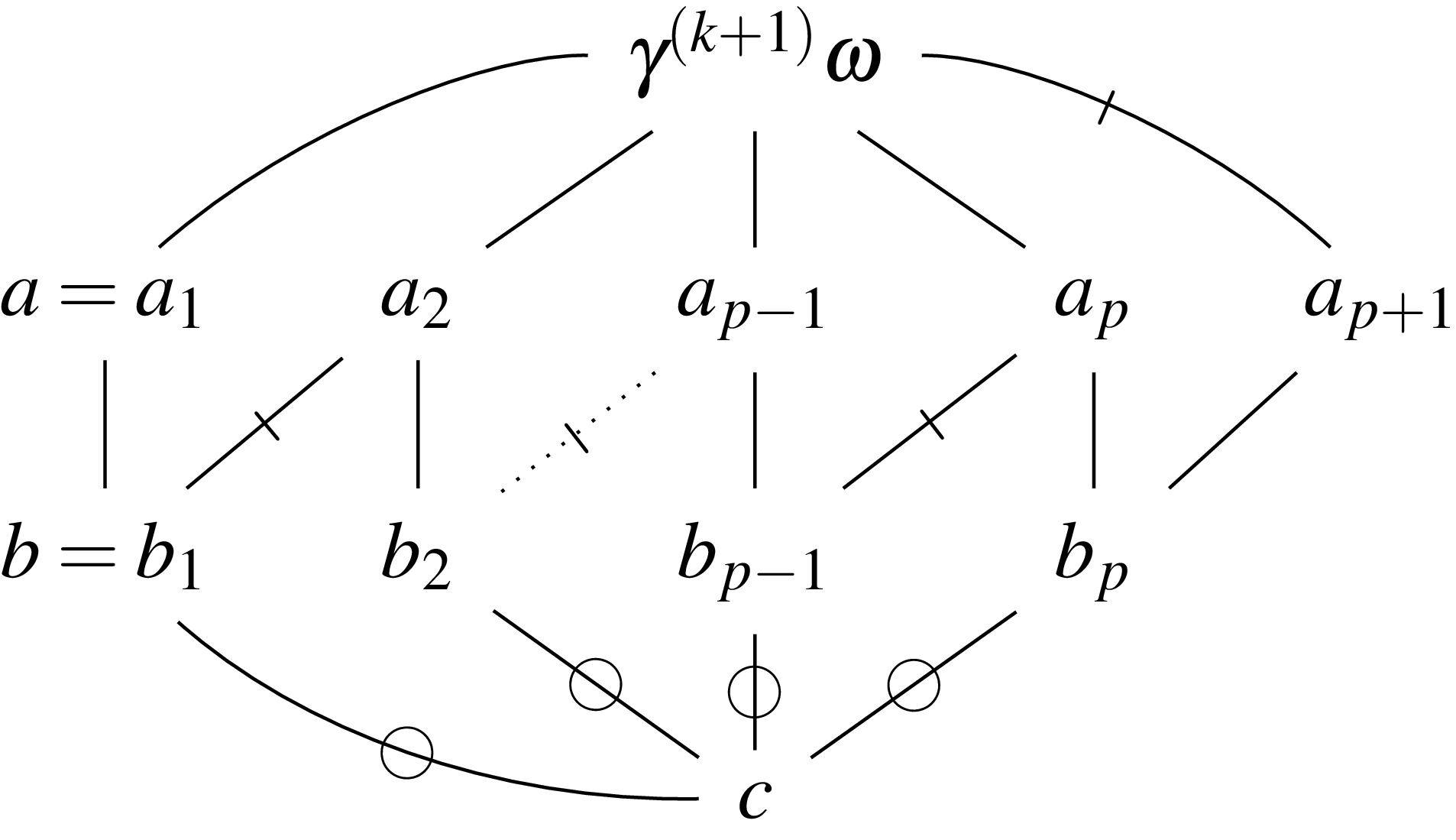
, we may find some
 $a'' = a_p = a_q' \in \Lambda$
with the following diagram in
 $C$
, with every
 $a_i$
and
 $a_i'$
in
 $\Lambda$
. Note that it is uniquely determined from
 $a,\,a' \in \Lambda \cap N$
.

Then, we set
 $b \blacktriangleleft ^2 b'$
if
 $b_{p-1} \triangleleft b_{q-1}'$
. In this sense,
 $\blacktriangleleft ^2$
is inherited from the already existing local order
 $\triangleleft$
(c.f. Definition
2.1
), and it is an extension of the latter.
Lemma 4.23.
Fix some
 $c \in C$
and let
 $V(c)$
denotes the set of loops
 $b$
of the form
 $c \prec ^{{\circ }} b \prec ^{+} a$
for some
 $a \in \Lambda \cap N$
. Then, the relation
 $\blacktriangleleft \,:=\, \left (\blacktriangleleft ^1 \cup \blacktriangleleft ^2\right )\vert _{V(c)}$
is a total order.
Proof.
 $\blacktriangleleft ^1$
and
 $\blacktriangleleft ^2$
are irreflexive by definition, hence so is
 $\blacktriangleleft$
.
By definition of
 $\blacktriangleleft ^2$
, having
 $b \blacktriangleleft ^1 b'$
and
 $b' \blacktriangleleft ^2 b$
at the same time is impossible, hence in order to show that
 $\blacktriangleleft$
is antisymmetric, it suffices to show that so are
 $\blacktriangleleft ^1$
and
 $\blacktriangleleft ^2$
. Since the diagram depicted in Definition 4.22 is uniquely determined by
 $a$
and
 $a'$
in
 $\Lambda \cap N$
, we have either
 $b \blacktriangleleft ^2 b'$
or
 $b' \blacktriangleleft ^2 b$
depending on whether
 $b_{p-1} \triangleleft b_{q-1}'$
or
 $b_{q-1}' \triangleleft b_{p-1}$
but nether both. Hence
 $\blacktriangleleft ^2$
is antisymmetric. By definition,
 $\blacktriangleleft ^1$
is also antisymmetric, hence so is
 $\blacktriangleleft$
.
We now check the transitivity. First, suppose
 $b \blacktriangleleft ^2 b' \blacktriangleleft ^1 b''$
. By definition,
 $b$
and
 $b'$
are incomparable by
 $\blacktriangleleft ^1$
. Hence
 $b \blacktriangleleft ^1 b''$
, whence
 $b \blacktriangleleft b''$
. The symmetric case is shown similarly.
Suppose now that
 $b \blacktriangleleft ^1 b'$
and
 $b' \blacktriangleleft ^1 b''$
. And suppose they are related by the following two diagrams (
 $a_p = \hat {a} = a_q'$
and
 $a_r' = \hat {\hat {a}} = a_s''$
):


Suppose that
 $r \ge q$
(the case
 $r \le q$
is symmetric). Then we have the following diagram, whence
 $b \blacktriangleleft b''$
:

Note that
 $\blacktriangleleft ^2$
allows us to compare precisely those elements which are not comparable using
 $\blacktriangleleft ^1$
, hence
 $\blacktriangleleft$
is a total order.
Lemma 4.24 (
 $\gamma (N_{\ge 2}) \subseteq \Omega$
). We have the inclusion
 $\gamma (N_{\ge 2}) \subseteq \Omega$
.
Proof.
let
 $y = \gamma (x)$
for some
 $x \in N_{\ge 2}$
. Then
 $y \prec ^{+} x$
because
 $\delta (x) = \emptyset$
. Suppose
 $\gamma (y) \prec ^{+} y$
, then completing the chain
 $\gamma (y) \prec ^{+} y \prec ^{+} x$
yields a chain
 $z \prec ^{+} y' \prec ^{-} x$
, which is impossible because
 $\delta (x) = \emptyset$
. Hence
 $\gamma (y) \prec ^{{\circ }} y$
, whence
 $y \in \Omega$
.
Definition 4.25 (Nulldot total order). According to Lemma
4.9
, each
 $y \in \Omega$
admits exactly one
 $x \in \Lambda$
with
 $y \prec ^{+} x$
. Hence, by Lemma
4.24
, the order
 $\blacktriangleleft$
introduced in Definition
4.22
induces a (strict) total order on
 $W(y) = \{w \in \Lambda \cap N,\, \gamma ^2(w) = y\}$
. We still denote it
 $\blacktriangleleft$
(there is no confusion because
 $N \cap \Omega = \emptyset$
).
When
 $b \blacktriangleleft b'$
we say that
 $b$
is below
 $b'$
or that
 $b'$
is above
 $b$
.
Definition 4.26 (
 $W_k,\,T_k'$
). For any
 $2 \le k \lt n+2$
, we define a subdivision
 $W_k$
of
 $T_k$
, by
 $W_k(y) = \{w \in \Lambda \cap N,\, \gamma ^2(w) = y\}$
. As order, we take
 $\blacktriangleleft$
as introduced in Definition
4.25
.
4.27. Finally, we will check the remaining axioms allowing the sequence of subdivided trees (
 $T_k'$
) to be a zoom-complex in Lemmas 4.28 and 4.29. Then, we show that
 $T_2$
is a linear tree in Lemma 4.30, thus proving that
 $Z(C)$
is an opetope.
Lemma 4.28 (
 $\textsf{whitedots}(T_k') = \textsf{nulldots}(T_{k+1})$
). For
 $2 \le k \lt n+2$
, we have
 $\textsf{whitedots}(T_k') = \textsf{nulldots}(T_{k+1})$
.
Proof.
We have
 $\textsf{whitedots}(T_k') = \bigcup _{z \in C_{k-2}}{W_k(z)} = N \cap \Lambda _k = \textsf{nulldots}(T_{k+1})$
.
A leaf over
 $a$
.

Lemma 4.29 (Kernel rule). Let
 $2 \le k \lt n+2$
and
 $\sqsubseteq$
the preorder on
 $T_{k+1}^\bullet \sqcup T_{k+1}^\vert$
given by
 $x \sqsubseteq y$
iff there is a descending path from
 $x$
to
 $y$
in
 $T_{k+1}$
. For any
 $x \in T_{k+1}^\bullet$
,
 $\mathcal{O}_x = \{y \in \textsf{dots}(T_k') \mid y \sqsubseteq x\}$
induces a connected full subgraph of
 $T_{k}'$
.
Proof.
Since
 $T_{n+2}^\bullet = \emptyset$
, we have the result for
 $k = n+1$
.
If
 $k = n$
or
 $k\lt n$
and
 $\gamma ^{(k+1)}\omega$
is a loop,
 $T_{k+1}$
is a corolla with
 $a = \gamma ^{(k)}\omega$
as only node, whence
 $\mathcal{O}_{a} = \textsf{dots}(T_k')$
inducing a connected full subgraph of
 $T_k'$
. We suppose now
 $k\lt n$
and
 $\gamma ^{(k+1)}\omega \notin \Omega$
.
Let
 $a \in \Lambda _{k} = T_{k+1}^\bullet$
, we prove that
 $\mathcal{O}_a$
induces a connected full subgraph in
 $T_k'$
by induction, assuming the result for all nodes
 $a'$
with a descending path from
 $a'$
to
 $a$
in
 $T_{k+1}$
.
To begin with, we handle the case where
 $\gamma (a) \in \Omega$
. In this case let
 $c = \gamma ^2(a)$
. First, we observe that there is no leaf
 $x \sqsubseteq a$
, indeed it would imply having a path
 in
 $T_{k+1}$
, hence, a diagram as below by successively applying Proposition 4.2:
But this implies
 $b_p \in \Lambda$
, contradicting the loops property. By a very similar argument, we see that each nulldot
 $a' \sqsubseteq a$
satisfies
 $\gamma ^2(a') = c$
, whence
 $a'$
lying on the edge
 $c$
of
 $T_k'$
. Moreover, they consist of all the white dots contained in
 $a$
, which must appear consecutively on the edge
 $c$
, whence the connectivity.
We suppose now that
 $\gamma (a) \notin \Omega$
. For any
 $b \prec ^{-} a$
, we let
 $\mathcal{O}_b := \{x \in \textsf{dots}(T_k) \mid x \sqsubseteq b\}$
. By induction hypothesis,
 $\mathcal{O}_b$
induces a connected full subgraph of
 $T_k'$
for any
 $b \prec ^{-} a$
, and we have
 $\mathcal{O}_a = \bigcup _{b\prec ^{-}a}\mathcal{O}_b$
. We prove the following properties.
-
(1) Let
in
$\Delta _a$
, then
$\mathcal{O}_b$
and
$\mathcal{O}_{b'}$
are linked by an edge. -
(2) Let
$b \in \delta (a) \cap \Omega$
, then
$\mathcal{O}_b \subseteq \textsf{whitedots}(T_k')$
. -
(3) Let
in
$T_k'$
. If
$b \in \mathcal{O}_a$
then
$\mathcal{O}_a \cap W_k(c)$
is a lower set of
$W_k(c)$
. -
(4) Let
in
$T_k'$
. If
$b \in \mathcal{O}_a$
then
$\mathcal{O}_a \cap W_k(c)$
is an upper set of
$W_k(c)$
.
 in


 in


 in


By using the tree structure of
 $\Delta _a$
, (1) and (2) imply that
 $\mathcal{O}_a \cap \textsf{blackdots}(T_k')$
induces a connected full subgraph of
 $T_k$
. Then (3) and (4) imply that
 $\mathcal{O}_a$
induces a connected full subgraph of
 $T_k'$
.
We are left to prove those few properties.
-
(1) Suppose
in
$\Delta _a$
. Then there is a lozenge
$(c \prec ^{-} b \prec ^{-} a,\, c \prec ^{+} b' \prec ^{-} a)$
in
$C$
. By successively completing lozenges, we may form a diagram as below in
$C$
:hence finding a relation
in
$T_k$
. Since
$b_0 \in \mathcal{O}_b$
and
$b_0' \in \mathcal{O}_{b'}$
, it yields the result. -
(2) Let
$b \in \delta (a) \cap \Omega$
. We may prove that there is no leaf
$x \sqsubseteq b$
by the same argument we used when dealing with the case
$\gamma (a) \in \Omega$
. -
(3) Let
in
$T_k'$
with
$b \in \mathcal{O}_a$
. Notice that
$\gamma ^{(k-1)}\omega \notin \Omega$
, because it would imply that
$b$
is a loop by Proposition 4.2, which is not the case since
$b \in \Lambda$
. Hence, for
$c \prec ^{{\circ }} b' \prec ^{+} a' \in \Lambda$
, using repeatedly oriented thinness and Proposition 4.3 yields the following diagram in
$C$
, where
$\alpha ,\,\beta \neq {\circ }$
.Then, for some
$a_1$
such that
$b \prec ^{-} a_1 \in \Lambda$
, applying Proposition 4.17 to the pairyields a diagram as follows in
\begin{equation*}(c \prec ^{-} b \prec ^{-} a_1 \prec ^{-} \gamma ^{(k+1)}\omega ,\,\,\, c \prec ^{\beta } b'' \prec ^{\alpha } a'' \prec ^{-} \gamma ^{(k+1)}\omega )\end{equation*}
$C$
, with
$p \lt q \le r$
.
Then
$a_{p+1} \sqsubseteq a$
. If
$c \prec ^{{\circ }} b'' \prec ^{+} a'' \in \Lambda$
for some
$b'' \blacktriangleleft b'$
in
$W_k(C)$
, then similarly we may find a zig–zag as appearing in the following diagramThen, by oriented thinness and the uniqueness of lozenge completions, both zig-zags must coincide up to
$a_{\textsf{min}(q,\,q')}$
, hence at least up to
$a_{\textsf{min}(p+1,\,p'+1)}$
. However, if
$p' \le p$
, then
$a'_{p'+1} = a_{p'+1} \sqsubseteq a_{p+1} \sqsubseteq a$
. Whence
$a'' \sqsubseteq a$
, that is
$a'' \in \mathcal{O}_a$
, which shows that
$\mathcal{O}_a \cap W_k(c)$
is a lower set in
$W_k(c)$
. -
(4) The case
is symmetric to the previous one.
 in


 in


 in





 is symmetric to the previous one.
Lemma 4.30 (
 $T_2$
is linear). The tree
 $T_2$
is linear.
Proof.
Let
 $x\in \Lambda _1 = T_2^\bullet$
. By Lemma 4.24,
 $x$
is not a nulldot because
 $\ast = \gamma ^2(x) \nprec ^{{\circ }} \gamma (x)$
. Hence
 $x$
admits at least one source. By oriented thinness, this source is unique, hence
 $T_2$
is linear.
Definition 4.31 (
 $K_0 : T_0 \to T_1,\, K_1 : T_1 \to T_2$
). Since
 $T_2$
is a linear tree (Lemma
4.30
), there is a unique exact zoom complex (up to renamings)
 \begin{equation*}T_0 \overset {K_0}{\to } T_1 \overset {K_1}{\to } T_2\end{equation*}
We define the constellations
 $K_0$
and
 $K_1$
as such.
Definition 4.32.
For
 $i\gt 0$
, Let
 $K_i$
denote the exact constellation
 $T_i \to T_{i+1}$
. It is well defined because of Lemmas
4.15
,
4.28
and
4.29
. Then
 \begin{equation*}T_0 \overset {K_0}{\longrightarrow } T_1 \overset {K_1}{\longrightarrow } \cdots \overset {K_{n-1}}{\longrightarrow } T_n\end{equation*}
is an opetope of dimension
 $n$
. It is denoted
 $Z(C)$
.
Definition 4.33.
Let
 $f : C \to D$
be an isomorphism of DFC. There is an isomorphism
 $Z(\,f) : Z(C) \to Z(D)$
of opetopes, as follows. Let
 $Z(D) = \left (U_0 \overset {L_0}{\longrightarrow } U_1 \overset {L_1}{\longrightarrow } \cdots \overset {L_{n-1}}{\longrightarrow } U_n\right )$
and
 $(U_k')_{0\le k \le n}$
the associated subdivided trees. Then
 $Z(\,f)_k : T_k' \to U_k'$
is defined as
 $f$
on blackdots, white dots and leaves.
Proof.
We check that
 $Z(\,f)$
defined as above is an isomorphism of opetopes.
Let
 $k \in { \left [\!\left [\, {{1}},\, {{n+2}} \,\right ]\!\right ] }$
. First,
 $f$
sends bijectively
 $\Lambda _{k-1} \subseteq C$
to
 $\Lambda _{k-1} \subseteq D$
, hence bijectively
 $T_k^\bullet$
to
 $S_k^\bullet$
. It also sends bijectively
 $C_{k-2}$
to
 $D_{k-2}$
, hence bijectively
 to
 .
Since
 $(y \prec ^{\alpha } x) \leftrightarrow (f(y) \prec ^{\alpha } f(x))$
for any
 $\alpha$
,
 $Z(\,f)_k$
preserves relations
 or
 from
 $T_k$
to
 $U_k$
. Hence
 $f$
induces an isomorphism of rooted trees
 $T_k \simeq U_k$
.
We then check that it extends as an isomorphism
 $T_k' \simeq U_k'$
. For
 ,
 \begin{equation*}\begin{array}{rcl} W_k(y) & = & \{w \in \Lambda _{k} \cap N \mid \gamma ^2(w) = y\} \\ \, & = & \{w \in C_k \mid (\delta (w) = \emptyset ) \wedge (\nexists v,\, w \prec ^{+} v) \wedge \gamma ^2(w) = y \} \\ \, & \overset {f}{\simeq } & \{w \in D_k \mid (\delta (w) = \emptyset ) \wedge (\nexists v,\, w \prec ^{+} v) \wedge \gamma ^2(w) = f(y)\} \\ \, & =: & X_k(f(y)) \end{array}\end{equation*}
is the set of white dots on
 $f(y)$
in
 $U_k'$
. Since
 $f$
is an isomorphism, it sends diagrams of the form given in Definition 4.22 to diagrams of the same form in
 $D$
. It also sends sourceless cells to sourceless cells, and by assumption, it preserves the order
 $\blacktriangleleft$
of Definition 2.1. Hence it preserves
 $\blacktriangleleft$
as given by Definitions 4.22 and 4.25. Hence,
 $Z(\,f)_k$
is a well-defined isomorphism of subdivided trees.
Since the structural maps in
 $K_i$
and
 $L_i \,(0\lt i\lt n+2)$
are identities,
 $Z(\,f)$
is compatible with them. Hence,
 $Z(\,f)$
is an isomorphism of opetopes.
Theorem 4.34 (
 $Z : {\mathbf{DFC}}^{\textsf{core}} \to {\mathbf{KJBM}}$
). There is a functor
 $Z : {\mathbf{DFC}}^{\textsf{core}} \to {\mathbf{KJBM}}$
given by Definition
4.32
on objects and by Definition
4.33
on isomorphisms.
Proof. The functoriality is clear from Definition 4.33.
5. From opetopes to dendritic face complexes
5.1. In this section, our aim is to define a functor
 $P : {\mathbf{KJBM}} \to {\mathbf{DFC}}$
.
In order to do so, it will be enlightening to extends canonically an opetope
 $Y = \left (S_0 \to S_1 \to \cdots \to S_n\right )$
of dimension
 $n$
to an opetope
 $\left (S_0 \to S_1 \to \cdots \to S_{n+2}\right )$
. Indeed, in Section 4, any
 $n$
-dimensional DFC
 $C$
gave rise to a sequence of trees
 $T_k$
for
 $0 \le k \le n+2$
, the last two of them being retrieved by this canonical extension. Formally, it goes as follows.
Definition 5.2.
Consider an opetope
 $Y = \left (S_0 \to S_1 \to \cdots \to S_n\right )$
of dimension
 $n$
. We let
-
•
$S_{n+1}$
be the corolla whose node is
$\{\top \}$
and set of leaves is
$S_n^\bullet$
, -
•
$S_{n+2}$
be a unit tree whose root edge is
$\top$
, -
•
$V_n$
(resp.
$V_{n+1}$
) be the empty subdivision on
$S_{n}$
(resp.
$S_{n+1}$
),
-
•
$S_k' = (S_k,\,V_k)$
the subdivided tree associated to
$S_k$
for any
$k\lt n+2$
.


Note that there are two exact constellations
 $S_n \to S_{n+1} \to S_{n+2}$
.
Example 5.3.
The
 $4$
-opetope introduced in Example
3.9
may be extended as the zoom-complex depicted in Figure
21
.
5.4. In the following, we fix such an
 $n$
-opetope
 $Y = \left (S_0 \to S_1 \to \cdots \to S_n\right )$
extended according to Definition 5.2. We also write
 $\rho (S_1)$
as
 $\bot$
.
Extended zoom complex.

Definition 5.5 (
 $S_x$
). Let
 $0 \le k \le n+1$
, for
 , we let
 $\mathcal{O}_{k,\,x} := \{y \in \textsf{dots}(S_k') \mid y \sqsubseteq x\}$
, where
 $y \sqsubseteq x$
means that there is a descending path from
 $y$
to
 $x$
in
 $S_{k+1}$
. By the kernel rule,
 $\mathcal{O}_{k,\,x}$
induces a connected full subgraph of
 $S_k'$
, that is a subdivided subtree of
 $S_k'$
. We then let
 $S_{k,\,x}$
denote the underlying tree structure, and
 $S_{k,\,x}' = (S_{k,\,x},\,V_{k,\,x})$
the associated subdivided tree.
Definition 5.6 (
 $P(Y)$
). We let
 $P(Y)$
be the following many-to-one poset.
-
•
$P(Y)_{-1} = \{\bot \}$
and when
$0 \le k \le n$
. -
• Let
$\delta$
and
$\gamma$
be defined by:

 when


-
(i)
$\forall k\ge 0,\, \forall x \in P(Y)_{k},\,\, \gamma (x) = \rho (S_{k+1,\,x})$
. -
(ii)
$\forall k\gt 0,\, \forall x \in P(Y)_{k},\,\, \delta (x) = S_{k+1,\,x}^\vert$
. -
(iii)
$\forall x \in P(Y)_0,\,\, \delta (x) = \emptyset$
.


-
• When
$z \prec ^{{\circ }} y \prec ^{-} x \in P(Y)_k$
and
$z \prec ^{{\circ }} y' \prec ^{-} x$
for
$y \neq y'$
, then both
$y,\,y'$
are distinct leaves of
$S_{k+1,\,x}$
, hence
$\mathcal{O}_{k,\,y}$
and
$\mathcal{O}_{k,\,y'}$
are disjoint sets of successive white dots on the same edge
$z$
of
$S_k$
. Hence, they may be compared by the order of the subdivision of
$z$
. If
$\mathcal{O}_{k,\,y} \lt \mathcal{O}_{k,\,y'}$
, we let
$y \triangleleft y'$
.


Remark 5.7. Notice that
 $\gamma (x) \prec ^{{\circ }} x \in P(Y)_k$
happens iff
 $k\gt 0$
and
 $S_{k+1,\,x}$
is a unit tree, that is iff
 $\mathcal{O}_{k+1,\,x} \subseteq \textsf{nulldots}(S_{k+2})$
. In particular, there is some
 $w \in S_{k+2}^\bullet$
with
 .
Remark 5.8. When
 $x\in S_{k+1}^\bullet$
for some
 $k \le (n-1)$
, then
 $x \in S_{k+2}^\vert$
, hence
 $S_{k+1,\,x}$
is the corolla whose only node is
 $x$
.
Hence for
 $k \gt 0$
,
 and for
 $k \ge 0$
,
 $\gamma (x)$
is the target edge of
 $x$
in
 $S_{k+1}$
.
In particular,
 $\delta (x) \cap \gamma (x) = \emptyset$
.
Lemma 5.9. Definition 5.6 indeed defines a many-to-one poset.
Proof.
First, we see that
 $\gamma ,\,\delta : P_{k+1} \to \mathcal{P}(P_k)$
. By definition, we always have
 $\delta (x) \cup \gamma (x) \subseteq P(Y)_{{\textsf{dim}}(x)-1}$
when
 ${\textsf{dim}}(x)\ge 1$
. When
 ${\textsf{dim}}(x) = 0$
,
 $\delta (x) = \emptyset \subseteq P(Y)_{-1}$
, and the only leaf of the linear tree
 $S_2$
must be in
 $\mathcal{O}_{1,\,x}$
, which is the unique node of
 $S_1$
. Hence
 $\gamma (x) = \rho (S_{1,\,x}) = \rho (S_1) = \bot$
.
We then check the properties of many-to-one posets.
-
• When
${\textsf{dim}}(x) \ge 0$
,
$\gamma (x)$
is given by (i). It consists of a unique element. -
• Suppose
$y \in \gamma (x) \cap \delta (x)$
for some
$x$
, then by Remark 5.7,
$S_{k+1,\,x}$
is a unit tree whose only edge is
$y$
. Hence
$\gamma (x) = \{\rho (S_{k+1,\,x})\} = \{y\} = S_{k+1,\,x}^\vert = \delta (x)$
. -
• By definition of
$P(Y)$
,
$P(Y)_{-1} = \{\bot \}$
. And by rule (iii), for all
$x \in P(Y)_0,\, \bot \prec ^{+} x$
.


Proposition 5.10 (Greatest element).
 $P(Y)$
admits
 $\top$
as a greatest element.
Proof.
 $\top$
is maximal since
 $P(Y)_{\ge n} = P(Y)_n = \{\top \}$
. Let
 $y \in P(Y)_{k}$
for some
 $k\lt n$
.
-
• If
, since
$S_{k+3}$
cannot be empty, it must admit at least one edge
$x$
. Then
$S_{k+2,\,x}$
is a subtree of
$S_{k+2}$
, that is, it is
$S_{k+2}$
, and
$y \prec ^{{\circ }} x$
. -
• If
for some
$x$
in
$S_{k+2}$
, then
$y = \gamma (x)$
by Remark 5.8. -
• If
for some
$x$
in
$S_{k+2}$
, then
$y \in \delta (x)$
by Remark 5.8.
 , since


 for some


 for some


Hence, for any
 $k\lt n$
and
 $y \in P(Y)_{k}$
, there is an element
 $x \in P(Y)_{k+1}$
with
 $y \prec x$
. It shows that
 $\top$
is the greatest element.
Proposition 5.11 (Loops). When
 $z \prec ^{{\circ }} y$
in
 $P(Y)$
, there is some
 $x \in P(Y)$
with
 $y \prec ^{+} x$
.
Proof.
Let
 $k\gt 0$
and
 $z \prec ^{{\circ }} y \in P(Y)_{k}$
. By Remark 5.7,
 for some
 $x$
in
 $S_{k+2}$
, hence
 $y = \gamma (x)$
. Since
 $x\in S_{k+2}^\bullet$
, we have
 $\delta (x) \cap \gamma (x) = \emptyset$
by Remark 5.8, thus we have
 $y \nprec ^{{\circ }} x$
.
Lemma 5.12 (Source trees). Let
 $x \in P(Y)_k$
for some
 $2 \le k \le n$
. There is a rooted tree
 $\Sigma _x$
as follows.
-
•
$\Sigma _x^\bullet = \{ y \in \delta (x) \mid S_{k,\,y} \mbox{ is not a unit tree} \}$
. And
. -
•
in
$\Sigma _x$
iff
$z \in S_{k,\,y}^\vert$
and
in
$\Sigma _x$
iff
$z = \rho (S_{k,\,y})$
. -
• The root edge is
$\rho (\Sigma _x) = \gamma ^2(x)$
.

 .
 in


 in


Proof. We check that it yields a well-defined rooted tree.
-
• Let
$y \in \delta (x)$
. Then its target edge is uniquely defined as
$\rho (S_{k,\,y})$
. -
• Let
. Since the
$S_{k,\,y}^\bullet$
(
$y\in \Sigma _x^\bullet$
) form a partition of
$S_{k,\,\gamma (x)}^\bullet$
and
$z \neq \gamma ^2(x) = \rho (S_{k,\,\gamma (x)})$
,
$z$
admits a target node
$y_0$
in
$S_{k,\,\gamma (x)}$
, and we have
$y_0 \in S_{k,\,y}^\bullet$
for a unique
$y \in \Sigma _x^\bullet$
. Hence
$z \in S_{k,\,y}^\vert$
and in
$\Sigma _x$
. -
• Since
$\gamma ^2(x)$
is the root edge of
$S_{k,\,\gamma (x)}$
, it may not be in
$S_{k,\,y}^\vert$
for some
$y \in \Sigma _x^\bullet$
, as it would imply
$\gamma ^2(x)$
having a target node inside
$S_{k,\,\gamma (x)}^\bullet$
. Hence,
$\gamma ^2(x)$
is targetless as an edge of
$\Sigma _x$
. -
• Since the
$S_{k,\,y}^\bullet$
$(y \in \Sigma _x^\bullet )$
are non-empty and disjoint, we have
$S_{k,\,y}^\vert \cap S_{k,\,y'}^\vert = \emptyset$
for
$y \neq y'$
in
$\Sigma _x^\bullet$
. Whence the uniqueness for the target node of an edge . -
• When there is a relation
in
$\Sigma _x$
, we have
$z' \in S_{k,\,y}^\vert$
and
$z' = \rho (S_{k,\,y})$
. Since
$S_{k,\,y}$
contains at least one node, we then find a path in
$S_k$
for some
$p \ge 1$
. Hence, the length of descending paths in
$\Sigma _x$
is bounded, which (using the second point) proves that there exists a descending path from every edge to
$\gamma ^2(x)$
. The uniqueness follows from the fourth point.


 . Since the





 in


 .
 in


 in


 to

Proposition 5.13 (Acyclicity).
 $P(Y)$
satisfies the property (acyclicity).
Proof.
It is a direct consequence of the tree structure
 $\Sigma _x$
as given by Lemma 5.12.
Lemma 5.14 (Leaf lozenge). Let
 $x \in P(Y)_{\ge 2}$
where
 $x$
is not a loop. There is a lozenge
 $(z \prec ^{-} y \prec ^{-} x,\, z \prec ^{-} \gamma (x) \prec ^{+} x)$
in
 $P(Y)$
iff
 is a leaf in
 $\Sigma _x$
.
Proof.
It follows from the observation
 $\Sigma _x^\vert = S_{k,\,\gamma (x)}^\vert$
, which follows from the fact that the
 $S_{k,\,y}^\bullet$
 $(y \in \Sigma _x^\bullet )$
form a partition of
 $S_{k,\,\gamma (x)}^\bullet$
.
Lemma 5.15 (Root lozenge). Let
 $x \in P(Y)_{\ge 2}$
where
 $x$
is not a loop. There is a lozenge
 $(\gamma (y) \prec ^{+} y \prec ^{-} x,\, \gamma ^2(x) \prec ^{+} \gamma (x) \prec ^{+} x)$
in
 $P(Y)$
iff
 in
 $\Sigma _x$
.
Proof.
It follows from the observation
 $\rho (\Sigma _x) = \rho (S_{k,\,y})$
for
 $y$
the root node of
 $\Sigma _x$
, that is, with
 in
 $\Sigma _x$
.
Lemma 5.16 (Sign rule). Let
 $x \in P(Y)_{\ge 2}$
where
 $x$
is not a loop. There is no lozenge of the form
 $(z \prec ^{\alpha } y \prec ^{-} x,\, z \prec ^{\alpha } y' \prec ^{-} x)$
in
 $P(Y)$
for
 $y \neq y'$
and
 $\alpha \in \{+,\,-\}$
.
Proof.
By observing that the sets
 $S_{k,\,y}^\bullet$
 $(y \in \Sigma _x^\bullet )$
are disjoint and non-empty.
Lemma 5.17 (loop lozenge). For
 $(z \prec ^{{\circ }} y \prec ^{-} x \in P(Y)_{\ge 2})$
, either there is some
 $y'$
and
 $\alpha \neq {\circ }$
such that
 $(z \prec ^{\alpha } y' \prec ^{-} x)$
, or there is a chain
 $(z \prec ^{{\circ }} \gamma (x) \prec ^{+} x)$
.
Proof.
Suppose that
 $\gamma (x)$
is a loop, then
 $S_{k,\,\gamma (x)}$
is an empty tree whose edge is
 $\gamma ^2(x)$
. Since
 $y \in S_{k+1,\,x}^\vert$
, we have
 $\mathcal{O}_{k,\,y} \subseteq \mathcal{O}_{k,\,\gamma (x)}$
, hence
 $S_{k,\,y}$
must also be a unit tree, with
 $z = \gamma ^2(x)$
as only edge. Whence the chain
 $z \prec ^{{\circ }} \gamma (x) \prec ^{+} x$
.
Suppose now that
 $\gamma (x)$
is not a loop. Then
 $S_{k,\,\gamma (x)}^\bullet \neq \emptyset$
.
-
• Either
$z$
admits a source node
$y'$
in
$\Sigma _x$
, whence
$z \prec ^{+} y' \prec ^{-} x$
by definition of
$\Sigma _x$
. -
• Or
$z$
admits a target node
$y'$
, whence
$z \prec ^{-} y' \prec ^{-} x$
by definition of
$\Sigma _x$
.


Proposition 5.18 (Oriented thinness).
 $P(Y)$
satisfies the property (oriented thinness).
Proof.
For chains of the form
 $(z \prec ^{\beta } y \prec ^{\alpha } x)$
with
 $x \in P(Y)_{\ge {2}}$
, this is shown by Lemmas 5.14–5.16 and Proposition 4.3 and using the tree structure of
 $\Sigma _x$
.
Consider  which is not a loop, then
 $S_{2,\,x}$
, as a (non-trivial) subtree of the linear tree
 $S_2$
, must contain exactly one leaf and one root (distinct from each other). Hence
 $x$
admits exactly one source
 $y \prec ^{-} x$
and one target
 $y' \prec ^{+} x$
, whence the lozenge completion for the chains of the form
 $\bot \prec y \prec x$
.
Theorem 5.19.
The many-to-one poset
 $P(Y)$
is a DFC.
Definition 5.20.
Let
 $f : Y \to Z$
be an isomorphism of opetopes. There is an isomorphism
 $P(f) : P(Y) \to P(Z)$
defined as
 $f$
on every element.
Proof.
First, denote
 $Y = (S_i)_{i\le n+2}$
and
 $Z = (T_i)_{i\le n+2}$
(by extending the respective opetopes according to Definition 5.2, and extending
 $f$
accordingly). Then for any
 $k \ge 0$
,
 $f$
sends
 to
 . Since
 $f$
is an isomorphism of trees, we have
 $\mathcal{O}_x \overset {f}\simeq \mathcal{O}_{f(x)}$
for any
 . Hence
 $\gamma (x) \overset {f}{\simeq } \gamma (f(x))$
and
 $\delta (x) \overset {f}{\simeq } \delta (f(x))$
. Hence,
 $P(f)$
preserves also
 $\prec ^{\alpha }$
for
 $\alpha \in \{+,\,-,\,{\circ }\}$
.
Theorem 5.21 (
 ${\mathbf{KJBM}} \to {\mathbf{DFC}}^{\textsf{core}}$
). There is a functor
 $P : {\mathbf{KJBM}} \to {\mathbf{DFC}}^{\textsf{core}}$
given by Definition
5.6
on objects and Definition
5.20
on isomorphisms.
Proof. The functoriality is clear from Definition 5.20
6. An equivalence of categories
6.1. In this section, we show that
 $Z$
and
 $P$
form an equivalence of categories.
Definition 6.2 (
 $\theta$
). Let
 $C$
be a DFC of dimension
 $n \ge 0$
, then by definition,
 $P(Z(C))$
has the same dimension as
 $C$
. We let
 $\theta _C : C \to (P \circ Z)(C)$
be the following natural isomorphism of DFC:
-
•
$\theta _C$
sends the bottom element to the bottom element.
-
• For
$x \in C_k \,(0 \le k \lt n)$
, .


 .
Proposition 6.3.
The natural isomorphism
 $\theta$
from Definition
6.2
is well defined.
Proof.
That
 $\theta _C$
is natural in
 ${\mathbf{DFC}}^{\textsf{core}}$
is clear. We check that it is a well-defined morphism of DFC.
-
• First, we see
$\forall x \in C,\, \delta (x) = \delta (\theta _C(x))$
. Let
$x \in C_k$
, we have
$\delta (\theta _C(x)) = S_{k+1,\,\theta _C(x)}^\vert$
.-
− When
$k = n$
, we have
$x = \omega$
and
$\theta _C(\omega ) = \top$
. Hence,
$\delta (x) = C_{n-1} \setminus \{\gamma (\omega )\}$
and
$\delta (\theta _C(x)) = S_{n+1,\,\top } = \Lambda _n = \delta (\omega ) \setminus \gamma (\top )$
. -
− When
$0 \lt k \lt n$
, we have
$x = \theta _C(x)$
, and using Lemma 4.9,
$S_{k+1,\,x}^\bullet = \{x' \sqsubseteq x \mid x' \in \Lambda _k\}$
, where
$x' \sqsubseteq x$
means that there is a descending path from
$x'$
to
$x$
in
$S_{k+2}$
.Let
$y \in \delta (x)$
. Then, repeatedly applying oriented thinness and Lemma 4.9 yields the following pattern in
$C$
, where
$w_1,\,\cdots ,\,w_p,\,x' \in \Lambda$
:Hence
in
$S_{k+1,\,x}$
. Suppose now that we have a relation in
$S_{k+1,\,x}$
, then there is a path
$x \prec ^{+} w_1' \succ ^{-} \cdots \succ ^{-} \bullet \prec ^{+} w_q' \succ ^{-} x'' \in \Lambda$
. Then using successively oriented thinness as above yields the relation
$y \prec ^{-} x''$
, which is absurd. Whence
$y \in S_{k+1,\,x}^\vert$
.Conversely, let
$y \in S_{k+1,\,x}^\vert$
. Then
$y \prec ^{-} x'$
for some
$x' \in \Lambda _k,\, x' \sqsubseteq x$
. Hence there is a path
$x = x_0 \prec ^{+} w_1 \succ ^{-} \cdots \succ ^{-} x_{p-1} \prec ^{+} w_p \succ ^{-} x' = x_p$
, and
$y \prec ^{-} x_i$
for all
$i$
’s. Indeed, suppose there is some
$i$
s.t.
$y \nprec ^{-} x_i$
and take a minimal such index
$i_0$
. Then the completion of the chain
$y \prec ^{-} x_{i_0+1} \prec ^{-} w_{i_0+1}$
must yields
$y \prec ^{+} x_1' \prec ^{-} w_{i_0+1}$
and by repeatedly applying oriented thinness and Lemma 4.9 as above we may find some
$x'' \sqsubseteq x,\, x'' \in \Lambda _{k}$
with
$y \prec ^{+} x''$
. Hence there is a configuration in
$S_{k+1,\,x}$
, which is absurd. Whence
$y \prec ^{-} x_0 = x$
, that is
$y \in \delta (x)$
.
-
-
• With a similar reasoning, we show that for
$x \in C$
,
$\gamma (\theta _C(x)) = \rho (S_{k+1,\,\theta _C(x)})$
, whence
$\gamma (x) = \gamma (\theta _C(x))$
.


 in

 in


 in


It proves that
 $\theta _C$
preserves
 $\delta$
and
 $\gamma$
, hence it preserves
 $\prec ^{+},\,\prec ^{-}$
and
 $\prec ^{{\circ }}$
.
We finally check that
 $\theta _C$
preserves the order
 $\blacktriangleleft$
. Let
 $z \prec ^{{\circ }} y \prec ^{-} x \in \Lambda _k$
and
 $z \prec ^{{\circ }} y' \prec ^{-} x$
with
 $y \blacktriangleleft y'$
in
 $C$
. Then for any loop
 $\bar {y}$
(resp.
 $\bar {y}'$
) included in or equal to
 $y$
(resp.
 $y'$
), we have
 $\bar {y} \blacktriangleleft \bar {y'}$
according to Definition 4.22. Hence
 $\mathcal{O}_{k,\,y} \blacktriangleleft \mathcal{O}_{k,\,y'}$
, whence
 $y \blacktriangleleft y'$
in
 $(P\circ Z)(C)$
. Hence,
 $\theta _C$
is an isomorphism of DFC.
Proposition 6.4 (
 $\tau$
). Let
 $Y = (S_i)_{0\le i\le n}$
be an
 $n$
-opetope for some
 $n\ge 0$
. Then by definition
 $(Z \circ P)(Y)$
is an
 $n$
-opetope, and there is an isomorphism
 $\tau _Y : Y \to (Z \circ P)(Y)$
, natural in
 $Y$
, as follows.
-
• Denote
$(Z \circ P)(Y)$
as
$(T_i)_{0 \le i \le n}$
(as given by Proposition
4.14
).
-
• Define
$S_{n+1},\, S_{n+2}$
according to Definition
5.2
. And consider
$T_{n+1},\, T_{n+2}$
as in Proposition
4.14
. -
• Define
$\tau _{Y,\,n+2} : S_{n+2} \to T_{n+2}$
in the only possible way (both are unit trees).
-
• For
$2 \le i \le n+1$
, let
$\tau _{Y,\,k} : S_k \to T_k$
be defined as the identity on all elements.
-
• Extend
$\tau _C$
in degree
$0$
and
$1$
in the only possible way.


Proof.
The naturality is clear from the definition. We check that
 $\tau _C$
is well defined.
-
• First, we need to show that
$S_i^\bullet = \Lambda _{i-1} = T_i^\bullet$
for
$2 \le i \le n$
.-
− Let
$y \in S_i^\bullet$
and suppose
$y \prec ^{+} x$
in
$P(Y)$
. Hence
$y = \rho (S_{i+1,\,x})$
. Since
$y \nprec ^{{\circ }} x$
,
$S_{i+1,\,x}$
contains at least one node, and where
$x'$
is the root node of
$S_{i+1,\,x}$
. Hence
$y$
is not a leaf in
$S_i$
. -
− Let
$y \in T_i^\bullet = \Lambda _i$
and suppose
$y$
is not a leaf in
$S_{i+2}$
. Then for some
$x \in S_{i+2}^\bullet$
and we have
$\{x\} = S_{i+1,\,x}^\bullet$
. Hence
$y = \rho (S_{i+1,\,x})$
, that is
$y \prec ^{+} x$
, which is absurd.
-
-
• We have
for
$2 \le i \le n$
. -
• Let
$1 \le i \le n$
, We now check that
$\tau _{C,\,i}$
preserves the relations and .-
− Suppose
in
$S_i$
, then
$y \prec ^{-} x$
because
$S_{i+1,\,x}^\bullet = \{x\}$
. Since
$x \in S_i^\bullet$
,
$x = \Lambda _i = T_i^\bullet$
by the first point, hence by definition of
$T_i$
, we have in
$T_i$
. -
− The case
is similar.
-


 where


 for some


 for


 and
 .
 in


 in

 is similar.
Theorem 6.5 (
 ${\mathbf{DFC}}^{\textsf{core}} \simeq {\mathbf{KJBM}}$
). There is an equivalence of categories

7. Conclusion and related works
In this article, we have presented a new way to encode opetopes, and shown our formalism to be equivalent to the one of zoom complexes presented in Kock et al. (Reference Kock, Joyal, Batanin and Mascari2010) through an equivalence of categories
 ${\mathbf{DFC}}^{\textsf{core}} \simeq {\mathbf{KJBM}}$
. As a consequence, and because of the other equivalence obtained in Leclerc (Reference Leclerc2023), it gives an embedding of positive opetopes as described by Zawadowski in the category
 $\mathbf{KJBM}$
defined in Definition 3.12.
Further work about DFC would be to figure out whether the whole formalism of DFC for non-necessarily positive opetopes is equivalent to the formalism of ordered face structures introduced in Zawadowski (Reference Zawadowski2008). The present paper has already done a step toward this goal, and it would not be surprising that those two formalisms are indeed equivalent.
Acknowledgements
I am grateful to Marek Zawadowski for our discussions about opetopes, and for offering me ideas for writing this article. I also express a special thank you to the supervisor of my master’s thesis, Pierre Louis Curien, who has accompanied me for an entire year of study of higher categories and opetopes.