Surgical site infections (SSIs) are common but potentially avoidable complications of adult and pediatric surgery; they contribute significantly to postoperative morbidity and mortality.Reference Anderson 1 The incidence of SSIs in pediatric populations ranges from 2.5% to 20%.Reference Shah, Christensen, Wagner, Pearce, Sweeney and Tait 2 Several measures have proven effective in preventing SSIs, including the use of aseptic conditions and techniques in the operating room, appropriate patient preparation, and the use of surgical antibiotic prophylaxis (SAP) before and during surgery.Reference Alexander, Solomkin and Edwards 3 Indeed, appropriate use of SAP reduces intraoperative wound contamination and minimizes the risk of SSIs of procedures for which it is indicated. Conversely, inappropriate use of SAP when it is indicated and administration of antibiotics when they are not indicated are potentially harmful practices; they expose patients to the risk of antibiotic side effects and complications, such as Clostridium difficile infection (a cause of antibiotic-associated colitis) and contribute to the emergence of antimicrobial resistance.Reference Goldmann, Weinstein and Wenzel 4 , Reference Khoshbin, So, Aleem, Stephens, Matlow and Wright 5
Guidelines for SAP in adult patients are well defined, even if numerous studies have shown that overall adherence to recommendations is hard to achieve.Reference Napolitano, Izzo, Di Giuseppe and Angelillo 6 – Reference Musmar, Ba’ba and Owais 12 Conversely, the use of SAP for pediatric patients is inadequately characterized, although SAP guidelines with recommendations are available regarding appropriate drug choice, timing, route, dose, and duration. 13 , 14 The few reports on SAP in pediatric patients have demonstrated that nonoptimal adherence is related to overuse in surgical interventions where there is no indication for prophylaxis or underuse of SAP when indicated, inappropriate use of third-generation cephalosporins, and administration of SAP for longer than 24 hours.Reference Rangel, Fung, Graham, Ma, Nelson and S Sandora 15 – Reference Ciofi Degli Atti, Raponi, Tozzi, Ciliento, Ceradini and Langiano 17
The aims of this study were to describe SAP administration and to analyze factors associated with nonadherence in pediatric patients.
METHODS
The study cohort included patients with the following characteristics: younger than 18, admitted between January 1 and December 31, 2015, to any of 4 randomly selected hospitals in Calabria (Italy), had undergone elective or urgent surgical procedures, were not on antibiotic therapy, and did not have any infection at the time of surgery.
Clinical records of these patients were retrospectively reviewed by trained medical residents in public health at the University “Magna Græcia” of Catanzaro, and data were retrieved on a standardized electronic report form. Demographic data included gender, nationality, and age. Clinical data included weight in kilograms, presence of risk factors and comorbidities, prior antibiotic allergies, ward of hospital stay, type of admission categorized as ordinary hospitalization or day surgery, admission and discharge dates, and diagnosis. Data related to surgical procedures included date, surgical procedure groups, type of surgery (elective or urgent), surgical wound classification,Reference Mangram, Horan, Pearson, Silver and Jarvis 18 American Society of Anesthesiologists physical status (ASA score), duration of surgical procedure in minutes, time of anesthesia induction and of surgical incision, length of hospital stay at time of surgery, and implantation of prosthesis. For patients receiving antibiotics, details of SAP, such as antibiotic agents and classes, place and route of administration, time of first dose, duration, dose, and number of postoperative doses were also recorded.
SAP indication was defined according to international guidelines. In particular, appropriateness of SAP, whenever it was indicated, was assessed based on the Scottish intercollegiate guidelines, 14 supplemented by the Italian national guidelines. 13 For each surgical procedure, the following items were evaluated: drug choice, route, timing, duration, and doses administered. SAP was deemed appropriate if all these parameters were in accordance with the guidelines.
Prophylactic drug choice was categorized as optimal if the antibiotic regimen was concordant with the guidelines. The term “adequate” referred to regimens that were effective for prophylaxis but were not appropriate according to guidelines, including agents with a spectrum of activity comparable to that recommended by the guidelines. Inadequate regimens included those deemed an unsuitable choice for SAP.
Route of administration was categorized as appropriate or not appropriate according to the guidelines. Timing of SAP was considered appropriate if the antibiotic was administered within 1 hour prior to surgical incision; in all other cases, it was considered inappropriate. SAP duration was considered appropriate if it was administered for <24 hours after surgery. SAP dose was considered appropriate if the antibiotic dose required for prophylaxis was the same as that for the therapy of infection, based on the body weight. 14 Otherwise, it was considered inappropriate, and the SAP dose was categorized as either excessive or inadequate.
Approval from the Institutional Ethics Committee of “Mater Domini” Hospital of Catanzaro, Italy, was obtained on February 2, 2016.
Statistical Analysis
Univariate analysis and multivariate stepwise logistic regression analysis were performed. Univariate analysis was performed using χ2 test for all categorical variables, and Student t test was used for independent samples to compare all continuous variables. Independent variables for which P was ≤0.25 in univariate analysis were included in the multivariate models. The significance level for variables entering the logistic regression models was set at 0.2 and for removal from the model at 0.4. A 2-sided P value ≤.05 was considered statistically significant.
In the multivariate logistic regression models, the outcomes of interest were the inappropriate SAP administration in procedures without SAP indication (Model 1) and the appropriate timing of SAP administration in procedures with SAP indication (Model 2). The following independent variables were included if they met the aforementioned criteria: gender (male=0; female=1), age (continuous, in years), weight (continuous, in kilograms), hospital with pediatric surgery ward (no=0; yes=1), ward of hospital stay (general surgery=0; surgical specialties=1), type of admission (ordinary=0; day surgery=1), surgical procedure group (urological, gynecologic/obstetric=0; head and neck=1; tegument=2; orthopedic=3; abdominal=4), type of surgery (elective=0; urgent=1), night-time procedures (no=0; yes=1), surgical wound classification (clean=0; clean contaminated, contaminated or dirty contaminated=1), ASA score (<3=0; ≥3=1), surgical procedure duration (continuous, in minutes), and implantation of prosthesis (no=0; yes=1). The results of the multivariate models, adjusted for hospitals, are expressed as odds ratio (OR) with 95% confidence interval (95% CI) and P values. Statistical analyses were performed using Stata Statistical software, version 14.0. 19
RESULTS
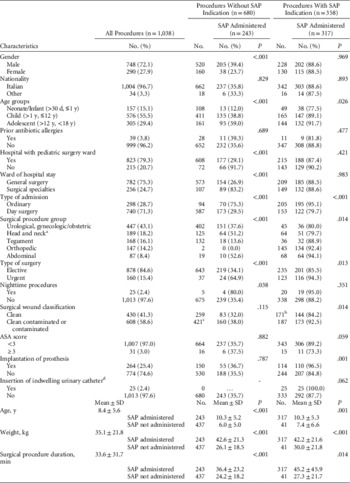
In this study, 955 pediatric patients who underwent surgery were eligible, and their charts were reviewed. These patients underwent a total of 1,038 surgical procedures: 876 underwent 1 procedure, 75 underwent 2 procedures, and 4 underwent 3 procedures. The main characteristics of included patients and related procedures are reported in Table 1. Among the most frequent procedures were excisions of skin lesions (11.8%), inguinal and crural hernia repairs (11.7%), circumcisions (11.4%), orchiopexies (9.9%), open reductions and internal fixations of bone fractures (5.6%), appendectomies (5.4%), and adenoidectomies and/or tonsillectomies (4.1%).
Distribution of All Procedures and of SAP Administration in Procedures Without and with SAP Indication According to Several Patients and Clinical Characteristics

NOTE. SAP, surgical antibiotic prophylaxis; SD, standard deviation; ASA, American Society of Anesthesiologists.
a Including ear, nose, and throat (ENT), ophthalmic, and maxillofacial surgery.
b Clean surgery with SAP indication is represented by orthopedic surgery with implantation of prosthesis, lacrimal surgery, and spinal surgery. 14 , Reference Mangram, Horan, Pearson, Silver and Jarvis 18
c Including only clean contaminated surgery without SAP indication, that is represented by urological surgery such as circumcision, orchiopexy, hydrocele, and varicocele repair. 14 , Reference Mangram, Horan, Pearson, Silver and Jarvis 18
d SAP is indicated for Hypospadias repair until indwelling urinary catheter removal.
Figure 1 shows the distribution of procedures according to SAP correct adherence. SAP was administered with 317 of the procedures for which it was indicated (88.5%) and with 243 of those in which it was not indicated (35.7%). Overall, correct SAP administration or nonadministration was identified for 754 (72.6%) procedures.
SAP administration approach.

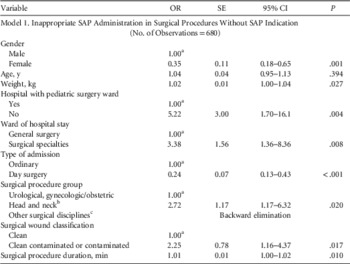
The inappropriate administration of SAP when it was not indicated significantly increased in relation to the following factors: with age; for surgical specialties; for hospitals without a pediatric surgery ward; for ordinary and urgent admissions; for nighttime procedures; in abdominal procedures, and in head and neck procedures. Also, this rate was significantly higher with increasing duration of the surgical procedure (Table 1). Results of the multivariate stepwise logistic regression analysis substantially confirmed those of the univariate analysis, except for age (which was no longer significantly associated with inappropriate SAP administration) and type of surgery and nighttime procedures (which were removed from the model). Moreover, inappropriate administration was less frequently observed in patients who underwent clean surgeries (Table 2).
Multiple Logistic Regression Analysis Results Examining Inappropriateness of SAP Administration in Procedures Without SAP Indication

NOTE. SAP, surgical antibiotic prophylaxis; OR, odds ratio; SE, standard error; CI, confidence interval.
a Reference category.
b Including ear, nose and throat (ENT), ophthalmic, and maxillofacial surgery.
c Including tegument, orthopedic, and abdominal surgery.
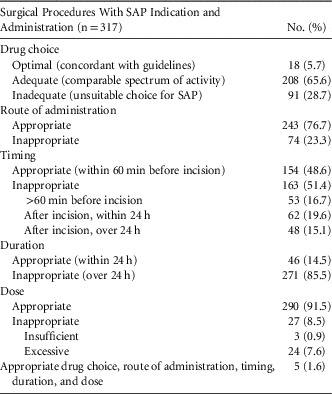
Surgical antibiotic prophylaxis data for procedures with an SAP indication are presented in Table 3. Adherence to all components of SAP (ie, drug choice, route of administration, timing, duration, and dose) occurred in only 5 cases (1.6%).
SAP Administration in Procedures With Indication According to Drug Choice, Route of Administration, Timing, Duration, and Dose

NOTE. SAP, surgical antibiotic prophylaxis.
Numerous combinations of antibiotics were used for SAP, and the guideline-recommended prophylactic drug was administered only in 18 cases (5.7%). In 208 procedures (65.6%), the chosen drug choice was considered only adequate. In most cases, an older-generation cephalosporin was inappropriately substituted with a newer one. In particular, ceftriaxone was used instead of cefazolin in 57% of cases and instead of cefoxitin in 76.8% of cases. Moreover, ampicillin-gentamicin combination was not used in hypospadias or epispadias repair, but it was replaced by ceftriaxone (44%). Broad-spectrum penicillins plus β-lactamase inhibitors (ampicillin plus sulbactam and amoxicillin plus clavulanic acid) were used instead of cefazolin or cefoxitin in 26.1% of cases.
Prophylactic administration was inappropriately prolonged in the great majority of cases, but the route of administration and dose of prophylactic antibiotics were appropriate in most circumstances.
Adherence to timing was respected in <50% of the procedures, and in >33% of cases, SAP was administered after incision, even as long as 24 hours after the start of the procedure.
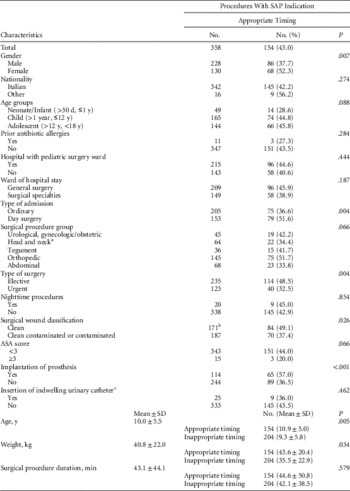
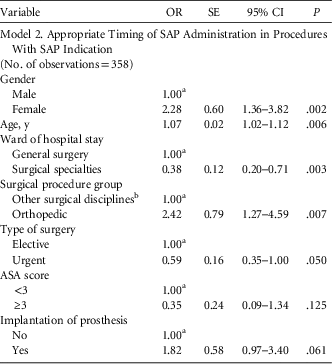
Appropriateness of SAP timing in surgical procedures with indication for prophylaxis according to the various characteristics of each procedure is presented in Table 4. At univariate analysis, appropriate timing of SAP administration was significantly more likely in procedures performed in females, in older children/adolescents, in day surgeries, in elective surgeries, in clean surgical wounds, and in those undergoing prosthesis implantation. Multivariate stepwise logistic regression analysis results underscore those of the univariate analysis, except for weight, type of admission and surgical wound classification, which were removed from the model. However, appropriate timing of prophylaxis was more likely in patients who were admitted in general surgery wards and in those who underwent orthopedic surgeries than in those who underwent all other surgical procedures (Table 5).
Distribution of SAP Appropriate Timing in Procedures With SAP Indication According to Several Patients and Clinical Characteristics

NOTE. SAP, surgical antibiotic prophylaxis. ASA, American Society of Anesthesiologists.
a Including ear, nose and throat (ENT), ophthalmic, and maxillofacial surgery.
b Clean surgery with SAP indication is represented by orthopedic surgery with implantation of prosthesis, lacrimal surgery, and spinal surgery. 14 , Reference Mangram, Horan, Pearson, Silver and Jarvis 18
c SAP is indicated for hypospadias repair until indwelling urinary catheter removal.
Multiple Logistic Regression Analysis Results Examining Appropriateness of Timing of SAP Administration in Procedures With SAP Indication According to Several Explanatory Variables

NOTE. SAP, surgical antibiotic prophylaxis; OR, odds ratio; SE, standard error; ASA, American Society of Anesthesiologists.
a Reference category.
b Including urological, gynecologic/obstetric, tegument, and abdominal surgery.
Although this was not a specific aim of our study, we reviewed the selected clinical records for development of an SSI, and none was detected.
DISCUSSION
Our study provides one of the few evaluations of the appropriateness of SAP administration in pediatric surgery. The results clearly indicate that the overall nonadherence to correct SAP administration or nonadministration (27%) is characterized by both SAP overuse and underuse, with physicians being more prone to overuse (ie, providing SAP when it is not indicated, 35%) than to underuse (ie, neglecting SAP when it is indicated, 11%). This attitude demonstrates that physicians are more concerned about the risk of SSIs than the risks related to an excess or inappropriate use of antibiotics, such as the emergence of resistant microorganisms or antibiotic side effects. Moreover, as reported in previous studies,Reference Rangel, Fung, Graham, Ma, Nelson and S Sandora 15 , Reference Sandora, Fung, Melvin, Graham and Rangel 20 , Reference Voit, Todd, Nelson and Nyquist 21 an extreme variation in SAP practice according to the different surgical interventions has also been revealed in our investigation.
We identified only 2 studies in which SAP administration in procedures without indication was taken into account. However, we only pursued this information as a marginal objective;Reference Khoshbin, So, Aleem, Stephens, Matlow and Wright 5 , Reference Ciofi degli Atti, Spila Alegiani and Raschetti 22 most studies have focused on procedures with an SAP indication. In our study, we chose to analyze the overall picture of SAP administration regardless of indication because the most frequent interventions in pediatric patients have no SAP indication; in our study population, almost two-thirds of procedures were in this group. Therefore, a substantial burden of inappropriate SAP administration pertains to these kinds of procedures that, in our study population, contributed to 243 of 560 total SAP administrations (43.4%) that were completely unnecessary. Multivariate analysis showed that SAP was more frequently inappropriately administered in surgical specialties wards, in ordinary admissions compared to day surgery, in clean contaminated procedures, and with increasing duration of surgical procedures. Taken together, these findings seem to indicate that SAP is cautiously overused whenever an intervention is perceived as complex, regardless of the associated SSI risk. Low adherence to SAP guidelines because of a cautious approach exposing pediatric patients to unnecessary antibiotics has already been reported in a previous study.Reference Klinger, Carmeli, Feigin, Freud, Steinberg and Levy 23 To improve the appropriate use of SAP, surgeons should be educated to distinguish overall complexity of interventions from the associated SSI risk. The benefits of educational intervention for SAP have been demonstrated in several previous studies. Hedef et alReference Hedef, Bulent, Aykut, Barcin and Mujgan 24 found that compliance to SAP guidelines improved with increased awareness among junior surgeons. Zvonar et alReference Zvonar, Bush and Roth 25 suggested that the administration of SAP by the anesthesiologist at the time of anesthesia resulted in a significant improvement in the timing of the preoperative dose of prophylactic antibiotic and decreased the median interval between antibiotic administration and skin incision. The finding that SAP administration when it is not indicated is more frequent in hospitals without a pediatric surgery ward is unacceptable, and we hypothesize that physicians do not take into consideration the unique characteristics of pediatric patients but rather extrapolate them from the adult population.
Although the overall proportion of children who did not receive SAP when it was indicated was not particularly high (11%), a more in-depth analysis of the ways SAP was administered overall and according to each of the single components reveals a very concerning situation. The overall rate of adherence to SAP guidelines is unacceptably low (1.6%). Previous studies on compliance with SAP guidelines in the pediatric population have similarly highlighted low rates of full adherence, ranging between 6.5%Reference Klinger, Carmeli, Feigin, Freud, Steinberg and Levy 23 and 25.3%,Reference Groselj Grenc, Derganc, Trsinar and Cizman 26 but never as low as our study. The main components that contributed to the low overall adherence rate were drug choice and duration.
Drug choice was not concordant with the guidelines in 94.3% of cases, with the highest discordance pertaining to hypospadias or epispadias repair; our data deviate significantly from results reported in previously published studies, in which the rate of adherence ranged between 16.7%Reference Groselj Grenc, Derganc, Trsinar and Cizman 26 and 42.7%.Reference Hing, Yeoh, Yeoh, Lin and Li 27 Even if in most cases the chosen drugs provided coverage against the expected microorganisms, they frequently had too broad a spectrum of activity, contributing to the risk of emerging antimicrobial resistance. This finding is extremely concerning because Italy is among the European countries with the highest consumption of antibiotics and the highest levels of antibiotic resistance. 28 Moreover, antimicrobial resistance in Italy has increased to as much as twice (cf, methicillin-resistant Staphylococcus aureus) to 4 times (cf, with carbapenem-resistant Klebsiella pneumoniae) higher than the European average. 29
Recommended duration was achieved only in 14.5% of surgical procedures. Unnecessarily prolonged SAP was observed for all types of interventions, with the highest frequency in abdominal and tegument procedures. Previous studies have likewise shown prolonged administration, with adherence ranging from 16% to 40.9%.Reference Ciofi degli Atti, Spila Alegiani and Raschetti 22 , Reference Klinger, Carmeli, Feigin, Freud, Steinberg and Levy 23 , Reference Groselj Grenc, Derganc, Trsinar and Cizman 26 , Reference Hing, Yeoh, Yeoh, Lin and Li 27 It is well known that prolonged postoperative antibiotics do not provide additional benefits and are useless for prophylaxis, and several studies confirm equal effectiveness of single compared to multiple doses.Reference Bucknell, Mohajeri, Low, McDonald and Hill 30 Conversely, prolonged SAP, probably related to a cautious attitude of surgeons, is associated with increased risk of emerging resistant bacteria strains and increased hospital costs associated with diagnosis and treatment of antibiotic-adverse events. Differently from other studies,Reference Groselj Grenc, Derganc, Trsinar and Cizman 26 , Reference Hing, Yeoh, Yeoh, Lin and Li 27 SAP duration was more appropriate in urological and gynecologic/obstetric procedures in our study.
Correct timing of SAP administration was achieved in <50% of surgical procedures, which is within the range reported elsewhere in the medical literature (31.9%–71.3%).Reference Ciofi degli Atti, Spila Alegiani and Raschetti 22 , Reference Klinger, Carmeli, Feigin, Freud, Steinberg and Levy 23 , Reference Groselj Grenc, Derganc, Trsinar and Cizman 26 , Reference Hing, Yeoh, Yeoh, Lin and Li 27 However, it is unacceptable that almost 35% of patients received antibiotics after surgical incision, when they are almost useless.
An appropriate drug dose was given to almost the entire cohort (91.5%); this component shows the highest adherence to guidelines. This figure is similar to the 92% reported by Groselj Grenc et alReference Groselj Grenc, Derganc, Trsinar and Cizman 26 and is higher than those reported in other studies.Reference Klinger, Carmeli, Feigin, Freud, Steinberg and Levy 23 , Reference Hing, Yeoh, Yeoh, Lin and Li 27
Overall, several main concerns have been highlighted by our results: (1) Some patients who do not need SAP are exposed to unnecessary antibiotics (23%). (2) Some patients who need SAP do not receive it (4%) or receive it when it is no longer effective (~11%) and are therefore exposed to SSI risk. (3) Some patients need SAP and do receive it, but in many cases it is ineffective or excessive (20%). The risk of overuse and inappropriate use is higher than with underuse, thus representing a problem for the emergence of resistance but not for the effectiveness of SAP. On the contrary, among patients who underwent procedures with an SAP indication, we analyzed in detail the timing of administration, the most crucial component responsible for ineffective SAP. SAP is fundamental in reducing the risk of SSIs,Reference Steinberg, Braun and Hellinger 31 – Reference Prospero, Barbadoro, Marigliano, Martini and D’Errico 35 and SAP was administered after incision in a substantial proportion of cases, thus undermining its effectiveness. Appropriate SAP timing was associated with certain patient characteristics (eg, being female and older) and with the type of ward of admission and type of procedure (general surgery wards and in orthopedic procedures), and, as expected, was less respected in urgent surgery. In none of the studies of SAP in pediatric patients have predictors of appropriate timing been investigated, and further research is needed in this area of study.
This study had several potential limitations. First, data were retrospectively assessed and relied on accuracy of the clinical records, which may not always be as complete as is desirable. Moreover, this data source did not allow any direct evaluation of reasons for nonadherence to guidelines. Second, patients were recruited from hospitals located in southern Italy and may not be representative of the entire country or generalizable to other populations. Finally, the lack of any SSI documented in the clinical records may represent an underestimation related to lack of postdischarge surveillance of SSI and/or very short hospital stay related to most evaluated procedures.
In conclusion, there are substantial discrepancies between SAP guidelines and practice behavior in pediatric surgery, more frequently oriented to excessive and inappropriate use of antibiotics than to underuse.
ACKNOWLEDGMENTS
We extend our sincere thanks to the Collaborative Working Group for allowing us to carry out the study and for their support in the retrieval of clinical records: Caterina De Filippo, MD; Ilario Lazzaro, MD; Francesco Fera, MD; Luisa Pavone, MD (Teaching Hospital of Catanzaro); Nicola MS Pelle, MD; Gianluca Raffaele, MD; Antonio Gallucci, MD (Regional Hospital of Catanzaro); Annalisa Spinelli, MD; Rita Marasco, MD (Local Hospital of Lamezia Terme, ASP of Catanzaro); Michelangelo Miceli, MD; Anna Maria Renda, MD (Local Hospital of Vibo Valentia, ASP of Vibo Valentia).
Financial support: No financial support was provided relevant to this article.
Potential conflicts of interest: All authors report no conflicts of interest relevant to this article.