Introduction
The Malay Archipelago, also known as Malesia (Van Steenis, Reference Van Steenis1950; Raes & Van Welzen, Reference Raes and Van Welzen2009), harbours c.1500 species of Euphorbiaceae sensu lato. As with most plant families, there are several large genera but also many with a single species. The latter are often rare in collections and relatively unknown. In this paper I briefly introduce five of them by extending the descriptions with recently collected material and by adding high quality drawings. Following APG III the family Euphorbiaceae is now split into several families. The uni-ovulate species constitute the Euphorbiaceae in the strict sense and four of the five genera (Alphandia, Borneodendron, Cladogynos and Tapoïdes) are part of this group. Ashtonia is a bi-ovulate genus, which is now part of the Phyllanthaceae. Unfortunately, none of the genera was sampled for the core phylogenies of the Phyllanthaceae (Wurdack et al., Reference Wurdack, Hoffmann, Samuel, De Bruin, Van der Bank and Chase2004; Kathriarachchi et al., Reference Kathriarachchi, Hoffmann, Samuel, Wurdack and Chase2005; Hoffmann et al., Reference Hoffmann, Kathriarachchi and Wurdack2006) and the Euphorbiaceae (Wurdack et al., Reference Wurdack, Hoffmann and Chase2005). Therefore, the old classifications of the Euphorbiaceae sensu lato (Webster, Reference Webster1994; Radcliffe-Smith, Reference Radcliffe-Smith2001) are presented and for Ashtonia also the one by Hoffmann et al. (Reference Hoffmann, Kathriarachchi and Wurdack2006).
Alphandia Baill. (Euphorbiaceae)
Alphandia is a small genus described by Baillon (Reference Baillon1873) based on New Caledonian species. Airy Shaw (Reference Airy Shaw1967a) recognised that two New Guinean specimens constituted a yet unknown species in this genus. Webster (Reference Webster1994) and Radcliffe-Smith (Reference Radcliffe-Smith2001) classified Alphandia in subfamily Crotonoideae, tribe Ricinocarpeae, subtribe Ricinocarpinae together with Beyeria and Ricinocarpos (according to Govaerts et al., Reference Govaerts, Frodin and Radcliffe-Smith2000, ‘a somewhat odd move and ultimately largely related to pollen form’). The exact relationships of the genus are still unknown as was also discussed by Airy Shaw (Reference Airy Shaw1967a). Typical for the genus are the stellate (to almost lepidote) hairs, absence of stipules, dense indument on the lower leaf surface, presence of staminate petals, and especially the partly united stamens with the thecae on one side of the broad connective.
Alphandia Baill., Adansonia 11: 85 (1873); Pax & K.Hoffm. in Engl., Pflanzenr. IV.147.iii: 22 (1911); Airy Shaw, Kew Bull. 20: 395 (1967); Airy Shaw, Kew Bull., Addit. Ser. 4: 8, 10, key (1975); Airy Shaw, Kew Bull., Addit. Ser. 8: 27 (1980); McPherson & Tirel, Fl. Nouvelle-Calédonie 14: 86 (1987); G.L.Webster, Ann. Missouri Bot. Gard. 81: 109 (1994); Govaerts, Frodin & Radcl.-Sm., World Checkl. Bibliogr. Euphorb. 1: 155 (2000); Radcl.-Sm., Gen. Euphorb. 311 (2001). – Type: Alphandia furfuracea Baill., designated by McPherson & Tirel (1987) [lectotypification probably unintentional, but valid and followed by Webster (Reference Webster1994) and Radcliffe-Smith (Reference Radcliffe-Smith2001)].
Shrubs to trees, monoecious; latex yellowish or red. Indumentum of stellate to somewhat lepidote hairs. Stipules absent. Leaves alternate (to subopposite at apex of twigs), simple, long petiolate, symmetric, coriaceous, base with two single or pairs of glands near the attachment, margin entire, apex rounded to acuminate, with one or two glands, both surfaces smooth, upper (sub)glabrous, lower densely hairy, no epidermis visible except above the venation, penninerved, raised on both surfaces, nerves ending in marginal vein (New Guinea) or looped and merging together near the margin (Vanuatu, New Caledonia), veins ± scalariform, veinlets densely reticulate. Inflorescences paniculate thyrses with basally short to long side branches with few-flowered cymes to apically single flowers per node, unisexual or bisexual, when latter then pistillate flowers basal to staminate flowers; flowers with two buds per petiole and an abscission zone above the buds, branches hairy; bracts triangular, minute. Flowers 5-merous, actinomorphic; pedicel round, hairy; calyx cupular, 5-lobed till halfway, valvate; disc annular, glabrous. Staminate flowers yellow; petals 5; stamens many, filaments of outer ones recurved, of inner ones united, anthers sub-basally dorsifixed, geniculate on abaxially thickened connective, thecae on front of connective, 2, pointing outwards, opening extrorse via lengthwise slits; pistillode absent. Pistillate flowers green; petals absent or 5 but caducous; ovary obovoid, densely hairy, later varnished (by nectar?), 3-locular, wall thick, a single ovule per locule; style short; stigmas 3, each completely divided into 2 triangular lobes, glabrous and smooth above. Fruits (Radcliffe-Smith, Reference Radcliffe-Smith2001) ellipsoid-globose, smooth, dehiscing into three 2-valved parts or 6 valves, wall woody; column long, apically with c.5 vein remnants per locule. Seeds (Radcliffe-Smith, Reference Radcliffe-Smith2001) ellipsoid-cylindric, apiculate, carunculate; testa marbled.
Distribution. A genus of three known species, one from New Caledonia, one from New Caledonia and Vanuatu and one from Indonesian New Guinea. The generic distribution may be explained by dispersal from the Inner Melanesian Arc, of which New Caledonia was part and which existed until the Pliocene (2–5 Ma), to the Outer Melanesian Arc of which Vanuatu and the northern coast of New Guinea were part.
Habitat and ecology. New Caledonia in maquis on serpentine soil; in New Guinea recorded from selectively logged primary forest on lateritic clay.
Note. Radcliffe-Smith (Reference Radcliffe-Smith2001) notes the presence of glands or minute scales exuding resinous or varnish-like sap. I could not find these scales or glands. As far as I can judge the basal and apical gland(s) of the leaves are the only exuding spots.
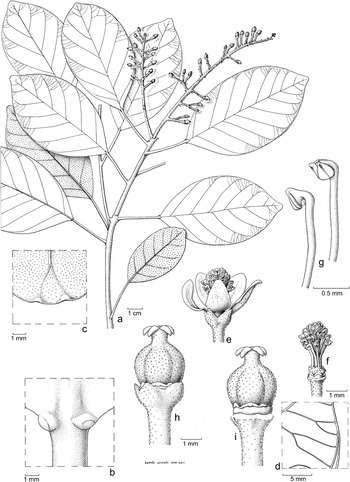
Alphandia verniciflua Airy Shaw, Kew Bull. 20: 395 (1967); Airy Shaw, Kew Bull., Addit. Ser. 8: 27 (1980). – Type: (Indonesia, Papua) Hollandia [Jayapura], Noordwijk, Versteegh BW 4815 (holo L; iso A).Fig. 1.
Fig. 1.Alphandia verniciflua Airy Shaw. a, habit; b, glands at the base of the leaf blade; c, glands at the apex of the leaf blade; d, detail of venation showing secondary veins connecting with marginal vein; e, staminate flower; f, idem with sepals and petals removed showing disc and stamens; g, stamens; h, pistillate flower; i, idem without sepals. a–c, h, i from Versteegh BW 4832; d–g from Versteegh BW 4815 (all L). Drawn by Esmée Winkel, 2011.


Trees, up to 18 m high; twigs c.4 mm in diameter, slightly angular, glabrescent. Indumentum of short stellate to somewhat lepidote hairs (partly fused radii). Leaves: petiole 2.5–7.2 cm long, hardly thickened basally and apically, basally round to adaxially flattened or grooved apically, (sub)glabrous, varnished; blade elliptic to slightly obovate, 5.7–18 × 3.1–11 cm, length/width ratio 1.6–1.8, base cuneate, with 2 obscure to distinct glands near the attachment, margin slightly recurved, apex acute to slightly acuminate, tip rounded to slightly emarginate, with two glands, each on a side of the midrib, sometimes seemingly one gland, upper surface glabrous, varnished, lower surface not hairy on venation (but young leaves probably are, stalk remnants of hairs present above veins), venation with distinct marginal nerve and 7–10 nerves ending in the marginal nerve. Inflorescences up to 18 cm long, with the longest side branch up to 9.5 cm long; bracts c.1 × 1 mm, outside hairy, inside glabrous; bracts 0.7–1 mm long, hairy outside, glabrous inside. Staminate flowers c.5.5 mm in diameter; pedicel c.5.4 mm long; calyx c.1.3 mm high, coriaceous, lobes triangular, c.0.7 × 0.6 mm; petals 5, obovate-oblong, c.3.2 × 1.7 mm, thin, margins inrolled, apex obtuse, glabrous; stamens c.30; filaments c.1 mm long; anthers c.0.3 × 0.3 mm. Pistillate flowers 2.8–3.5 mm in diameter; pedicel c.5.5 mm long; sepal lobes c.1.3 × 1.3–1.5 mm; petals absent; ovary obovoid, 1.5–2.3 × 1.5–2.3 mm; style c.0.8 mm long, stigma lobes c.0.7 mm long. Fruits and seeds unknown.
Distribution. Known from two specimens only, seemingly endemic to Indonesian New Guinea (Prov. Papua, formerly Irian Jaya), around Jayapura (formerly Hollandia).
Habitat and ecology. Recorded from selectively logged primary forest on lateritic soil; altitude: c.25 m. Flowering: September, October.
Note. Alphandia verniciflua can easily be distinguished vegetatively from the other two species from New Caledonia and Vanuatu; A. verniciflua is a tree (instead of shrubs), with a glabrous abaxial venation and the nerves ending in the marginal nerve (hairy veins in the other species with the nerves looped and connected near the margin, not ending in a marginal vein), and usually two apical leaf blade glands (instead of one). In flower Alphandia verniciflua has smaller calyx lobes and lacks petals in the pistillate flowers.
Ashtonia Airy Shaw (Phyllanthaceae)
Ashtonia was first described as a monotypic genus from Borneo by Airy Shaw (Reference Airy Shaw1968). Later he added a second species (Airy Shaw, Reference Airy Shaw1972), endemic to the Malay Peninsula. It is surprising that the two species were only recognised so recently as both are big trees. When still part of the Euphorbiaceae (sensu lato), it was classified by Webster (Reference Webster1994) and Radcliffe-Smith (Reference Radcliffe-Smith2001) in subfamily Phyllanthoideae, tribe Antidesmeae, subtribe Scepinae. Now this genus is in the Phyllanthaceae and Hoffmann et al. (Reference Hoffmann, Kathriarachchi and Wurdack2006) place it in subfamily Antidesmatoideae, tribe Scepeae. The latter is based on morphology, as the genus was not part of the sample that was used for a molecular phylogeny. Typical for the genus are the large size of the trees, dioecy, stipules very early caducous, disc absent, stamens 5 or 6, staminate pistillode relatively large, and locules 3 or 4. The way in which the fruit dehisces, often forming a star and leaving a basal ring-like scar at the base of the columella, is especially characteristic.
Ashtonia Airy Shaw, Kew Bull. 21: 357 (1968); Whitmore, Tree Fl. Malaya 2: 62 (1973); Airy Shaw, Hooker’s Icon. Pl. 38: t. 3702 (1974); Airy Shaw, Kew Bull., Addit. Ser. 4: 42 (1975); G.L.Webster, Ann. Missouri Bot. Gard. 81: 51 (1994); Govaerts, Frodin & Radcl.-Sm., World Checkl. Bibliogr. Euphorb. 1: 224 (2000); Radcl.-Sm., Gen. Euphorb. 64 (2001). – Type: Ashtonia excelsa Airy Shaw.
Trees, dioecious. Indumentum simple hairs, mainly absent, only some flower parts hairy. Stipules only present around terminal bud, nearly touching, early caducous, leaving almost ring-like, blackish scars. Leaves alternate, simple, mainly terminal on branches, glabrous; petiole round except for the adaxial groove, basally and apically pulvinate, sometimes indistinctly so; blade symmetric, thick coriaceous, margin entire, base and margin usually with glands adaxially, often also extrafloral nectaries abaxially near base and along the margin, apex with gland abaxially, venation slightly raised on both sides, nerves looped and connected near margin, veins and veinlets reticulate. Inflorescences axillary among and below leaves to ramiflorous, racemose thyrses, with either groups of 3 to many bracteate staminate flowers or single pistillate flowers with bract and two bracteoles; bracts and bracteoles broadly ovate, apex acute. Flowers actinomorphic; sepals 4, suborbicular to broadly ovate, imbricate, margin fimbriate, hairy or glabrous; petals and disc absent. Staminate flowers small, more or less sessile; stamens 5 or 6, filaments very short, free; anthers basifixed, 2-thecate, opening latrorse with lengthwise slits; pistillode larger than stamens, hairy, monopodial triangular to square table-like structure. Pistillate flowers: ovary 3- or 4-locular, ellipsoid, glabrous, 2 ovules per locule, style present or absent, stigmas apically slightly to deeply lobed with papillae adaxially. Fruits spade-like when young to suborbicular when mature, mesocarp thick and fleshy, drying corky, during dehiscence exo- and mesocarp shed in 3 or 6 pieces, woody endocarp dehiscing partly loculicidally and septicidally and remaining attached by connection above columella, becoming flat and star-like; columella persistent, with basal thickened ring where exo- and mesocarp were attached, apically tapering. Seeds obovoid, covered by thin sarcotesta.
Distribution. Two species, one endemic to the Malay Peninsula, the other to Borneo.
Habitat and ecology. In the Malay Peninsula at higher altitudes, in Borneo in primary and kerangas forest.
Key to the species
1a. Leaf blade 6–18.5 × 3–10.3 cm, usually with 2 or more large extrafloral nectaries basally on the abaxial surface, those along margin generally absent or present along lower half of blade. Staminate sepals hairy. Pistil with style of 0.8–1.1 mm long, stigmas split for 2/3. Fruits 1.8–3.6 cm in diameter; exo- and mesocarp 3–5 mm thick when dry1. A. excelsa
1b. Leaf blade 2.3–8.5 × 1.2–4.7 cm, with 2 distinct or several indistinct extrafloral nectaries basally on the abaxial surface, also present along margin to the apex. Staminate sepals glabrous. Pistil lacking distinct style, stigmas only apically split. Fruits 1.4–1.5 × c.1.4 cm when dry (immature); exo- and mesocarp up to 2.2 mm thick when dry2. A. praeterita
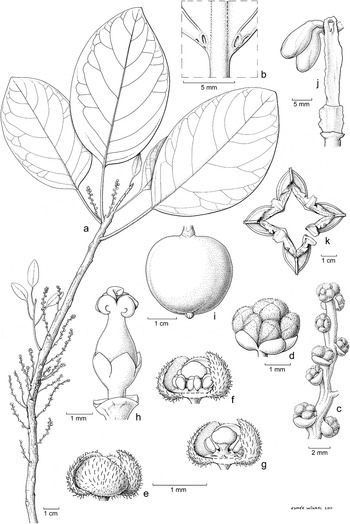
1. Ashtonia excelsa Airy Shaw, Kew Bull. 21: 357 (1968); W.Meijer, Bot. Bull. Herb. Forest Dep. Sabah 10: 230 (1968); Airy Shaw, Kew Bull., Addit. Ser. 4: 42 (1975). – Type: Malaysia, Sarawak, Sebuyau dist., Lankan Lori, Brunig S 4664 (holo K; iso A, L).Fig. 2.
Fig. 2.Ashtonia excelsa Airy Shaw. a, habit; b, base of abaxial surface showing extrafloral nectaries; c, part of staminate inflorescence; d, group of staminate buds with bracts; e, staminate bud; f, staminate bud with sepal removed; g, staminate bud with sepal and few stamens removed showing disc; h, pistillate flower; i, fruit; j, dehisced fruit showing columella with apical young seeds; k, remnants of dehisced carpel, often folding star-like due to partial septicidal (from apex) and loculicidal (from base, one complete) dehiscence. a, c–g from Nooteboom & Chai 2112; b from Van Balgooy & Van Setten 5595; h from Hallier 2274; i from Anderson S 12651; j, k from Sinclair10264 (all L). Drawn by Esmée Winkel, 2011.
Blumeodendron tokbrai auct. non (Blume) Kurz: W.Meijer, Bot. Bull. Herb. Forest Dep. Sabah 10: 229, tab. opp. 64 (1968).

Trees up to 40 m high, dbh up to 40 cm; buttresses sometimes present, low, rounded, spreading up to c.45 cm, 5–10 cm thick; flowering twigs 5–8 mm thick, often blackish. Outer bark smooth to cracked to minutely scaly, pale greyish buff to yellowish brown to reddish to light reddish-light brown, thin, soft; inner bark cream to white-pinkish to orange or white mottled to pale brown, granular to fibrous, 3–10 mm thick; sapwood pale yellow to khaki to yellow-orange to light brown with red rays, medium hard. Stipules broadly ovate, 3–9 × 2.2–5 mm, apex acute. Leaves: petiole 1.8–6.2 cm long, generally distinctly pulvinate; blade elliptic, 6–18.5 × 3–10.3 cm, length/width ratio 1.8–2, base broadly (to narrowly) cuneate usually with 2 or more large extrafloral nectaries on the abaxial surface, usually absent along the margin or only in the lower half of the blade, margin recurved, with no glands to a few in lower half, apex emarginate to broadly acute, usually damaged in specimens seen, upper surface medium green, glossy, usually drying dirty greenish yellow, lower surface pale green, drying brownish, nerves 8 or 9 per side. Inflorescences up to 8.5 cm long; bracts up to 2.4 × 2.5 mm. Flowers green. Staminate flowers seen in bud: sepals c.1.1 × 0.9 mm, hairy outside; stamens glabrous; pistillode hairy. Pistillate flowers: pedicel c.1 mm long, round; sepals c.1.3 × 1.3 mm, glabrous; ovary c.2 × 1.5 mm; style 0.8–1 mm, stigmas 1.3–2 mm long, split in upper 2/3. Fruits 1.8–3.6 cm in diameter when dry, up to 5.1 cm when fresh, yellowish to orange to reddish, acidic; pedicel up to 2 cm long; exo- and mesocarp 3–5 mm thick when dry; column 22–27 mm long. Seeds3–6, 9–10 × 5–5.3 mm; sarcotesta red.
Distribution. Endemic to Borneo.
Habitat and ecology. Primary lowland mixed dipterocarp forest, secondary forest, riparian forest, transition heath forest to mixed dipterocarp forest, kerangas/heath forest (Tristania–Dacryodes, very mossy), peat swamp forest (Shorea albida–Dryobalanops rappa association); soils: sand to white kerangas sand. On heath forest smaller than in primary forest. Altitude: 10–1250 m. Flowering: January, April, May; fruiting: March to December. The plant probably accumulates heavy metals and, therefore, colours dirty greenish yellow when dry.
Uses. Fruit edible (Kirkup768).
Vernacular names. Kalimantan Timur: Arang arang; Poeah koekang; Renseng renseng. Sarawak: Buah belabol (Kelabit); Senumpul; Tampoi.
Notes. 1. Chai S 35801 and Awa S 51080 have smaller fruits and a thinner exo- and mesocarp, but are otherwise not different.
2. Teijsmann HB 8712 and Teijsmann HB 8648, both sterile, from Kalimantan, have narrower leaves with a narrowly cuneate base that lacks the very obvious hollow glands. Instead they have smaller glands and the upper surface is more shiny when dry. However, stipules, colour of the dried leaves, etc. are the same. Endert 3694 and Hallier2274 (also from Kalimantan) form intermediates with the normal type of leaves.
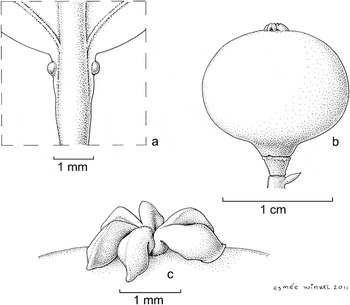
2. Ashtonia praeterita Airy Shaw, Kew Bull. 27: 4 (1972); Whitmore, Tree Fl. Malaya 2: 62, fig. 1 (1973); Airy Shaw, Hooker’s Icon. Pl. 38: t. 3702 (1974); Airy Shaw, Kew Bull., Addit. Ser. 4: 42 (1975); Govaerts, Frodin & Radcl.-Sm., World Checkl. Bibliogr. Euphorb. 1: 224, fig. p. 225 (2000). – Type: Malaysia, Pahang–Selangor border, Gunong Bunga Buah, Soepadmo783 (holo K).Fig. 3.
Fig. 3.Ashtonia praeterita Airy Shaw. a, base of leaf blade with extrafloral nectaries; b, fruit; c, persistent split stigma lobes. a–c from Whitmore FRI 12262 (L). Drawn by Esmée Winkel, 2011.

Emergent trees, up to 30 m high, up to 48 cm in diameter; bole fluted to 2 m; crown dense, rounded, domed with short massive branches; flowering twigs 4–5 mm in diameter. Outer bark grey to brown, narrowly closely fissured ridges, very rough with squarish chunky scales; inner bark cream to cream-fawn to flecked orange, firm, fibrous; sapwood cream with fawn flecks, hard. Stipules broadly ovate, 5–5.5 × 2–2.3 mm. Leaves: petiole 0.7–4.4 cm long, hardly to distinctly pulvinate; blade elliptic, 2.3–8.5 × 1.2–4.7 cm, length/width ratio 1.7–1.8, base broadly cuneate to cuneate, abaxial basal extrafloral nectaries usually not distinct, margin often recurved, with regular glands, sometimes with extrafloral nectaries in the basal half abaxially near the margin, less often also near apex, apex emarginate to rounded, drying brownish, wilting leaves yellow; venation c.6 nerves per side. Inflorescences up to 6 cm long; bracts up to 2.5 × 2.1 mm. Staminate flowers not seen, description after Airy Shaw (Reference Airy Shaw1974): staminate sepals c.1 mm long, glabrous, filaments c.1 mm long, pistillode c.1 × 0.5 mm. Pistillate flowers (partly after Airy Shaw, Reference Airy Shaw1974): pedicel c.2 mm from abscission zone; sepals 1.8–2 × c.1.5 mm, ovary c.2 × 1 mm, not persistent; style absent, stigmas c.1.2 mm long, slightly apically split. Fruits only seen unripe, 1.4–1.5 × c.1.4 cm when dry, shiny, deep red; exo- and mesocarp up to 2.2 mm thick when dry. Seeds not seen.
Distribution. Endemic to Peninsular Malaysia.
Habitat and ecology. Found at higher altitudes, c.1300 m. Flowering: March; fruiting: May, June.
Borneodendron Airy Shaw (Euphorbiaceae)
Borneodendron was described as a monotypic genus by Airy Shaw (Reference Airy Shaw1963). He compared it particularly to the genus Baloghia Endl. Later, Airy Shaw (Reference Airy Shaw1971) compared it to Cocconerion Baill. Likewise, Webster (Reference Webster1994) and Radcliffe-Smith (Reference Radcliffe-Smith2001) classified Borneodendron in subfamily Crotonoideae, tribe Ricinocarpeae, subtribe Bertyinae together with Cocconerion. Radcliffe-Smith (Reference Radcliffe-Smith2001) also discusses similarities with taxa in the subtribe Mischodontinae of the former subfamily Oldfieldioideae (now Picrodendraceae), taxa with 2 ovules per locule, to which Borneodendron, with 1 ovule per locule, does not belong. Typical is the verticillate leaf aestivation, branching pattern and inflorescence/flower arrangement (generally in threes), the stellate hairs, the united stipules covering the terminal bud, the early caducous male calyx, many stamens on a columnar receptacle, 2-locular ovaries and long-pedicelled fruits.
Borneodendron Airy Shaw, Kew Bull. 16: 358 (1963); Airy Shaw, Kew Bull. 25: 504, in obs. (1971); Airy Shaw, Kew Bull., Addit. Ser. 4: 60 (1975); G.L.Webster, Ann. Missouri Bot. Gard. 81: 110 (1994); Govaerts, Frodin & Radcl.-Sm., World Checkl. Bibliogr. Euphorb. 1: 274 (2000); Radcl.-Sm., Gen. Euphorb. 315 (2001). – Type: Borneodendron aenigmaticum Airy Shaw.
Trees, probably monoecious, branching verticillate in twos and threes. Indumentum dark ferruginous stellate and simple hairs. Stipules united, circumaxillary, covering terminal bud, shed when bud develops. Leaves verticillate in groups of three, alternate, at end of branchlets, simple, covered with stellate hairs when very young; petiole flattened and slightly grooved above, not pulvinate, often with two or more glands halfway to apically; blade thick coriaceous, symmetric, venation pinnate, very dense with the many nerves and intercalary nerves perpendicular to the midrib. Inflorescences terminal, staminate one racemose, short, with c.3 nodes, each with 3 flowers subtended by large bracts, peduncle nodding, dense stellate hairs; bracts outside with stellate hairs, inside mainly with simple hairs; pistillate flowers three together on the upper nodes, each flower single in axil of young leaf. Flowers yellow; pedicels flattened; calyx 3-lobed, splitting regularly, valvate, caducous, outside with mainly simple hairs, inside glabrous; petals and disc absent. Staminate flowers on short pedicels, stamens 25–30, inserted on columnar receptacle, filaments very short, strap-like, anthers basi-dorsifixed, 2-thecate, thecae above splitting apart, opening latro-extrorse via lengthwise slits, connective indistinct; pistillode absent. Pistillate flowers on short pedicels; ovary 2-locular, ovules 1 per locule, style absent, stigmas split, first split to c.4/5, each lobe split again for 1/3–2/3, above with a few, indistinct tubercles. Fruits capsules, splitting completely septicidally and partly (apically) loculicidally into two 2-valved cocci; pedicel elongated, long, thickened towards apex; calyx remnants recurved; wall thick, woody; columella very narrow, basally and apically somewhat thickened. Seeds often marbled, smooth, with very small caruncle.
Distribution. A single species endemic to N Borneo (Sabah).
Borneodendron aenigmaticum Airy Shaw, Kew Bull. 16: 359 (1963); Airy Shaw, Hooker’s Icon. Pl. 37: t. 3633 (1967); W.Meijer, Bot. News Bull. Forest Dep. Sabah 7: 24 (1967); W.Meijer, Bot. Bull. Herb. Forest Dep. Sabah 10: 10, 229 (1968); Airy Shaw, Kew Bull., Addit. Ser. 4: 60 (1975); Govaerts, Frodin & Radcl.-Sm., World Checkl. Bibliogr. Euphorb. 1: 275, fig. p. 276 (2000). – Type: Malaysia, Sabah, Pulau Sakar, M. Chai SAN 21695 (holo K; iso L).Fig. 4.
Fig. 4.Borneodendron aenigmaticum Airy Shaw. a, habit with staminate inflorescence; b, habit with pistillate inflorescence; c, occasional glands on top of petiole/base of leaf; d, staminate flower; e, pistillate flower; f, pistillate flower with part of calyx removed showing ovary and two branching stigmas; g, fruit; h, seed. a, b, d–f from Meijer SAN 44075; c, g from M. Chai SAN 21695; h from Madani et al. SAN 145393 (all L). Drawn by Anita Walsmit Sachs, 2011.

Trees, probably monoecious, to 40 m high, bole up to 25 m high, dbh 19 cm; buttressed (Radcliffe-Smith, Reference Radcliffe-Smith2001); flowering branches up to 5 mm thick, somewhat fleshy, slightly shrivelled when dry, with many leaf scars. Outer bark smooth to flaky, grey; inner bark pink to reddish brown to pale brown, exudate reddish, fast to appear; sapwood dark brown. Stipules united, up to 16 mm long, at least outside densely covered with stellate hairs. Leaves: petiole 1.8–3 cm long; blade elliptic to oblong to obovate, 4.2–22 × 1.7–7.9 cm, length/width ratio 1.9–2.8, base attenuate, margin entire, recurved, apex slightly emarginate to very shortly acuminate, upper and lower surface glabrous when mature, smooth, venation slightly raised on both sides, slightly less above, nerves 14–30 per side, looped and closed near margin, hardly distinguishable from the intercalary nerves, veins and veinlets reticulate. Staminate inflorescences: peduncle c.15 mm long, flattened, stellately hairy; bracts long ovate, c.11 × 2.8 mm, outside stellately hairy, inside mainly simple hairs. Staminate flowers c.6 mm in diameter (young); pedicel c.3 mm long, indumentum of mainly simple hairs; calyx lobes ovate, c.3.3 × 3.5 mm; stamens: filaments c.0.45 mm long, glabrous, anthers oblong, c.1.3 × 1 mm, with a few simple hairs. Pistillate flowers c.3 mm in diameter (excluding stigmas); pedicel c.4 mm long, elongating in fruit, indumentum of mainly simple hairs; calyx lobes (young) ovate, c.2.8 × 2 mm; ovary ovate, c.2 × 2 mm, covered with stellate hairs, stigmas 3.5–3.8 mm long. Fruits flattened ellipsoid, 2.3–2.9 cm high × c.2 cm broad, (sub)glabrous, greenish when immature; pedicel elongated up to 5.8 cm; wall 2–3 mm thick; columella 1.75–2 cm long. Seeds ellipsoid, flattened inside, 14–15 × 8.5–9.5 × 7.5–8 mm.
Distribution. Borneo: Sabah.
Habitat and ecology. Primary forest, on hills, along roadside; soil: ultrabasic rock. Altitude: 50–600 m. Flowering: April, May; fruiting: May, June, August.
Vernacular name. Bangkau bangkau.
Note. The specific epithet indicates that the genus/species is enigmatic with regards to its classification.
Cladogynos Zipp. ex Span. (Euphorbiaceae)
Several authors more or less simultaneously described this monotypic genus. Spanoghe (Reference Spanoghe1841), instigated by Zippelius, was the first to introduce the name Cladogynos. Later many other now-synonymous taxa were described (see below), either as monotypic genera, or in an infrageneric taxon of an existing genus, or just as a species in an existing genus. Webster (Reference Webster1994) and Radcliffe-Smith (Reference Radcliffe-Smith2001) classified Cladogynos in the subfamily Acalyphoideae, tribe Epiprineae, subtribe Epiprinae (stipules not glandular, inflorescences axillary, staminate flowers in heads). Other typical characters are the dense stellate indumentum, the coarsely serrate leaf margins, the staminate flowers with four stamens and a small pistillode, and the many times divided stigmas.
Cladogynos Zipp. ex Span., Linnaea 15: 349 (1841); Baill., Étude Euphorb. 468 (1858); Müll.Arg. in DC., Prodr. 15, 2: 895 (1866); Benth. in Benth. & Hook.f., Gen. Pl. 3: 323 (1885); Pax & K.Hoffm. in Engl., Pflanzenr. IV.147.vii: 264 (1914); Ridl., Fl. Malay Penin. 3: 276 (1924); Gagnep. in Lecomte, Fl. Indo-Chine 5: 478 (1926); Backer & Bakh.f., Fl. Java 1: 485 (1963); Airy Shaw, Kew Bull. 26: 232 (1972); Whitmore, Tree Fl. Malaya 2: 78 (1973); Airy Shaw, Kew Bull., Addit. Ser. 4: 9, in key (1975); G.L.Webster, Ann. Missouri Bot. Gard. 81: 79 (1994); Govaerts, Frodin & Radcl.-Sm., World Checkl. Bibliogr. Euphorb. 1: 341 (2000); Radcl.-Sm., Gen. Euphorb. 182 (2001); Chayam. & Welzen, Fl. Thailand 8, 1: 158 (2005). – Type: Cladogynos orientalis Zipp. ex Span.
Adenogynum Rchb.f. & Zoll., Acta Soc. Regiae Sci. Indo-Neêrl. 1: 23 (1856). – Chloradenia Baill., Étude Euphorb. 471 (1858). – Cephalocroton Hochst. sect. Chloradenia (Baill.) Müll.Arg., Linnaea 34: 155 (1865); Müll.Arg. in DC., Prodr. 15, 2: 760 (1866). – Conceveiba Aubl. sect. Adenogynum (Rchb.f. & Zoll.) Post & Kuntze, Lexicon 138 (1904). – Type: Adenogynum discolor Rchb.f. & Zoll. [= Cladogynos orientalis Zipp. ex Span.].
Shrubs (to treelets), monoecious. Indumentum densely tomentose (to sometimes somewhat floccose on stems), stellate (and simple hairs, latter longer than stellate hairs), present on most parts. Stipules late caducous. Leaves alternate, simple; petiole long, round to somewhat grooved above, slightly pulvinate at both ends, but less so basally; blade symmetric, papery, basally not to slightly peltate, margin (partly) coarsely dentate, teeth ending in small glands, lower surface usually whitish when dry, venation basally triplinerved, otherwise penninerved, nerves near margin connecting to veins ending in the glands in the teeth and connecting in the loops to veins interconnecting the nerves, third-order veins scalariform, veinlets reticulate. Inflorescences axillary, usually bisexual with a short joined peduncle, splitting into 1 or 2 single pedicelled pistillate flowers and a pedicelled dense head with staminate flowers; bracts at the top of the peduncle often leaf-like, basally with 2 very small bracteoles, the latter with a big round gland basally at one side; bracts within staminate head minute. Flowers actinomorphic; petals absent. Staminate flowers (sub)sessile; calyx 4-partite, lobes valvate; disc absent; stamens 4, filaments free, glabrous, anthers sub-basally dorsifixed, 2-thecate, opening latrorse with lengthwise slits, connective indistinct; pistillode slender, column short. Pistillate flowers pedicellate; sepals 5 or 6, usually foliaceous, glands alternating with sepals, perhaps disc-glands, round, similar to those next to bracteoles and stipules; ovary 3-locular, tomentose; ovules 1 per locule; style short, stigmas elongate, apically divided for c.2/3 of the length, each lobe further divided but less deeply so, with short stigmatic papillae. Fruits capsular, lobed, tomentose, dehiscing into 2-valved cocci or 6 parts, wall hairy outside, thin, woody when dry; columella persistent, with 4 vein remnants apically per locule. Seeds ellipsoid-globose, marbled or not; caruncle small.
Distribution. A monotypic genus of tropical SE Asia and Malesia.
Cladogynos orientalis Zipp. ex Span., Linnaea 15: 349 (1841); Müll.Arg. in DC., Prodr. 15, 2: 895 (1866); Pax & K.Hoffm. in Engl., Pflanzenr. IV.147.vii: 265 (1914); Merr., Enum. Philipp. Fl. Pl. 2: 444 (1923); Ridl., Fl. Malay Penin. 3: 276 (1924); Gagnep. in Lecomte, Fl. Indo-Chine 5: 478 (1926); M.R.Hend., J. Malayan Branch Roy. Asiat. Soc. 17: 69 (1939); Backer & Bakh.f., Fl. Java 1: 486 (1963); Airy Shaw, Kew Bull. 26: 232 (1972); Whitmore, Tree Fl. Malaya 2: 78 (1973); Chayam. & Welzen, Fl. Thailand 8, 1: 158, plate VIII: 3 (2005); Chayam. & Welzen in Welzen & Chayam., Fl. Thailand 8, 2: 615, fig. 6 (2007). – Cephalocroton orientalis (Zipp. ex Span.) Scheff., Ann. Mus. Bot. Lugduno-Batavi 4: 120 (1868–69). – Type: [Indonesia, Lesser Sunda Islands,] Timor, Zippelius s.n. (lecto L, designated here, barcode L 0164205).Fig. 5.
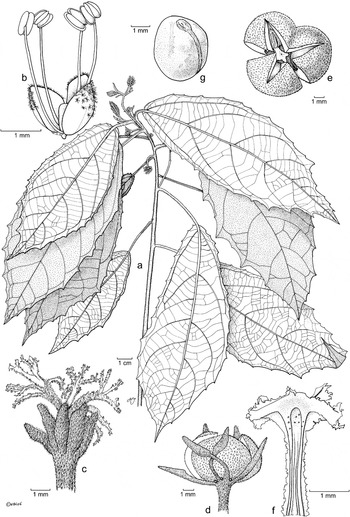
Fig. 5.Cladogynos orientalis Zipp. ex Span. a, habit; b, staminate flower; c, pistillate flower; d, fruit in lateral view; e, fruit in apical view; f, columella; g, seed. a, b from Bunchuai 1709; c, d, f, g from Van Balgooy 2991; e from Beumée1299 (all L). Drawn by Hanneke Jelles, 2006.
Rottlera ? albicans auct. non Hassk.: Hassk., Cat. Hort. Bogor Alt. 238, only text (1844). – Adenogynum discolor Rchb.f. & Zoll. in Zoll., Acta Soc. Regiae Sci. Indo-Neêrl. 1: 23 (1856); Rchb.f. & Zoll. in Zoll., Linnaea 28: 325 (1856), see note 1. – Chloradenia discolor (Rchb.f. & Zoll.) Baill., Étude Euphorb. 472 (1858); Craib, Aberdeen Univ. Stud. 57: 192 (1912). – Cephalocroton albicans (Hassk.) Müll.Arg., Linnaea 34: 155 (1865), nom. illeg. – Cephalocroton albicans (Hassk.) Müll.Arg. var. genuinus Müll.Arg., Linnaea 34: 155 (1865), nom. inval. – Cephalocroton discolor (Rchb.f. & Zoll.) Müll.Arg. in DC., Prodr. 15, 2: 761 (1866). – Cephalocroton discolor Müll.Arg. var. genuinus (Müll.Arg.) Müll.Arg. in DC., Prodr. 15, 2: 761 (1866), nom. inval. – Cladogynos orientalis Zipp. ex Span. var. genuina (Müll.Arg.) Pax & K.Hoffm. in Engl., Pflanzenr. IV.147.vii: 266 (1914), nom. inval. (see note 2). – Type: [Indonesia,] Java, Zollinger1550 (holo P, n.v.; iso HAL, L 2×).
Adenogynum odontophyllum Miq., Fl. Ned. Ind. 1, 2: 400 (1859). – Type: [Indonesia, Sulawesi,] Salajer, at the coast, Zollinger 1065 or Zollinger1165 (holo U, U 0001873).
Cephalocroton albicans Müll. var. virens Müll.Arg., Linnaea 34: 155 (1865). – Cephalocroton discolor Müll.Arg. var. virens (Müll.Arg.) Müll.Arg. in DC., Prodr. 15, 2: 761 (1866). – Cladogynos orientalis Zipp. ex Span. var. virens (Müll.Arg.) Pax & K.Hoffm. in Engl., Pflanzenr. IV.147.vii: 266 (1914). – Type: [Indonesia, Lesser Sunda Islands,] Timor, Guichenot s.n. (holo P).
Cladogynos orientalis Zipp. ex Span. var. grossedentata Pax & K.Hoffm. in Engl., Pflanzenr. IV.147.vii: 266, fig. 41 (1914). – [Baprea bicolor Pierre ex Pax & K.Hoffm. in Engl., Pflanzenr. IV.147.vii: 264 (1914), nom. nud., in synonymy]. – Type: Cochinchina, Mt. Pra, Pierre 6213 (iso L, P) (Baprea bicolor Pierre on label, name published in synonymy by Pax & Hoffmann, Reference Pax, Hoffmann and Engler1914).
Adenochlaena siamensis Ridl., J. Straits Branch Roy. Asiat. Soc. 59: 180 (1911). – Type: [Thailand,] Siam, Terutau, Curtis2112 (holo K).

Shrubs (to treelets), up to 5 m high, branches angled upwards, flowering branchlets 1.5–5 mm in diameter; with ferrugineous indumentum when young. Stipules triangular (to slightly falcate), 0.7–3.8 × 0.7–0.8 mm, basally usually with a round gland, hairy outside, glabrous inside. Leaves: petioles 0.8–9 cm long; blade (ovate to) elliptic (to obovate), 4.2–21 × 2–11 cm, length/width ratio 1.6–2.6, base subpeltate or not, when so then for up to 4 mm, emarginate to rounded, margin usually (double) dentate, sometimes only subdentate in the upper half (to almost subentire), flat, apex acute to cuspidate, upper surface mid green to dull dark green, hairy when young, soon glabrescent with a few hairs left at the base of the midrib, lower surface white to greyish white, usually epidermis not visible except with specimens in Sulawesi and the Lesser Sunda Islands (see note 2), venation slightly sunken to slightly raised above, raised below, nerves 8 or 9 per side. Inflorescences usually greyish white; peduncle 0.5–2 cm long; bracts often with a glandular margin, either elliptic, up to 5.5 mm long or leaf-like and up to 9.5 × 3.3 mm, basal c.3 mm petiole-like; bracteoles c.0.5 × 0.3 mm. Flowers yellow-green to white. Staminate flowers in heads of 5–6.5 mm in diameter; flowers 1.5–2 mm in diameter, calyx 1.2–1.7 mm high, yellow, lobed in upper half to almost completely, lobes triangular to ovate, 0.7–1.7 × 0.7–1 mm, hairy outside in upper half, glabrous inside; filaments 2.1–3.2 mm long, anthers elliptic, 0.6–0.7 × 0.5–0.6 mm, yellow; pistillode 0.8–1 mm high. Pistillate flowers 7–8 mm in diameter, pedicel up to 4 mm long in flower, up to 2.5 cm long in fruit; sepals recurved, greyish white, obovate (2.2–4.2 × 0.4–1.2 mm) to leaf-like (up to 9 × 2 mm), hairy outside, subglabrous inside, margin with glandular teeth, basal glands shortly stalked; ovary ovoid, c.2 × 1.5–1.8 mm, hairy, style 1.1–1.7 mm long, hairy; stigmas 2.2–3.8 mm long, bright clear yellow, hairy underneath. Fruits 10–11 × 6–6.5 mm, whitish or greyish green; column 4–4.5 mm long. Seeds ellipsoid-globose, slightly flattened inside, 4–4.5 × 3–4 × 3.5–3.8 mm, wall marbled or not, raphe well visible; caruncle small, grooved.
Distribution. South China, Thailand, Indo-China, Malay Peninsula, Java, Philippines, Sulawesi, the Lesser Sunda Islands and the Moluccas.
Habitat and ecology. Dry evergreen forest, secondary forest, gallery forest, Eucalyptus savannah, bamboo thickets, scrubby vegetation; common near streams and in open spots; soil often dry, half of specimens on limestone, other half on granite-derived soils; altitude: 0–800(–1100) m. Flowering and fruiting throughout the year.
Vernacular names. Lesser Sunda Islands, Flores: Mondjong keka. Komodo: Wajuh.
Notes. 1. Hasskarl (Reference Hasskarl1844) incorrectly identified a specimen (Zollinger 1550) in the Bogor Botanical Garden (Indonesia, Java) with Blume’s description of Adisca albicans (= now Sumbaviopsis albicans (Blume) J.J.Sm.). Later, Zollinger (Reference Zollinger1856a, Reference Zollinger1856b) realised the specimen was of an undescribed species once Blume’s species flowered in Bogor and was found not to be the same. This means that Hasskarl’s entry in the Bogor catalogue has a confusing double meaning. Nomenclaturally, his name, Rottlera ? albicans, is a later homotypic synonym of Blume’s Adisca albicans (= Sumbaviopsis albicans (Blume) J.J.Sm.). However, the specimen Zollinger 1550 is an altogether different species later described by Zollinger (Reference Zollinger1856a, Reference Zollinger1856b) who, afraid of causing confusion with Blume’s species if he used albicans, instead used the epithet discolor. Therefore, later synonyms using the epithet albicans are illegitimate. Zollinger published the name twice in 1856, once in Dutch/Latin (1856a) and once in German/Latin (1856b). It is not clear which publication appeared first.
2. The use of the epithet var. genuina/us is invalid as it generally means that the taxon comprises the type of the species and then the autonym rule applies. However, here the epithet genuinus was first used by Müller (Reference Müller1865) under Cephalocroton albicans and later used by himself (1866) and Pax & Hoffmann (Reference Pax, Hoffmann and Engler1914) for new combinations, all of which are also invalid. Pax & Hoffmann (Reference Pax, Hoffmann and Engler1914) placed Cephalocroton albicans var. genuinus in the synonymy of Cladogynos orientalis and used the epithet in its original meaning as an infraspecific entity of Cladogynos orientalis, which, unlike what one would expect based on the name, does not contain the type of the species.
3. There is some variation in the specimens. The dentation of the leaf blade margin is generally very obvious, but locally the leaves can be subentire, or only shortly dentate in the upper half. The leaves in specimens from the Philippines and on Sulawesi tend to be somewhat narrower and smaller than in W Malesia. In S Sulawesi and the Moluccas the leaf blades are broader than in W Malesia and the indument on the lower leaf surface can be far less dense with part of the lamina visible. Pax & Hoffmann (Reference Pax, Hoffmann and Engler1914) used the degree to which the leaf blade base is peltate for their infraspecific classification. However, even within a single region the degree to which the leaf blade base is peltate varies from absent to present. Therefore infraspecific taxa are not maintained.
Tapoïdes Airy Shaw (Euphorbiaceae)
Airy Shaw (Reference Airy Shaw1960) noted that the species newly described by Merrill (Reference Merrill1917) under Ostodes, O. villamilii, deviated in many aspects from other species in Ostodes. Airy Shaw created the monotypic genus Tapoïdes to accommodate it and he (Airy Shaw, Reference Airy Shaw1967b) classified Tapoïdes in tribe Jatropheae of the subfamily Crotonoideae. Webster (Reference Webster1994) and Radcliffe-Smith (Reference Radcliffe-Smith2001) placed the genus in subfamily Crotonoideae, tribe Aleuritideae, subtribe Grosserinae. Typical characters are the hairy staminate petals, lack of glands, axillary inflorescences, 6–8 stamens, annular staminate disc and ecarunculate seed. The epithet of the only species, Tapoïdes villamilii (Merr.) Airy Shaw, commemorates A. Villamil, a Filipino, who collected the plant and who worked for the Forestry Department of British North Borneo (= Sabah) from August 1915 till September 1917. Before this he probably worked for the Philippine Forestry Bureau (Van Steenis-Kruseman, Reference Van Steenis-Kruseman and Van Steenis1950; www.nationaalherbarium.nl/FMCollectors/V/VillamilA.htm).
Tapoïdes Airy Shaw, Kew Bull. 14: 473 (1960); Airy Shaw, Hooker’s Icon. Pl. 37: t. 3632 (1967); Airy Shaw, Kew Bull., Addit. Ser. 4: 200 (1975); G.L.Webster, Ann. Missouri Bot. Gard. 81: 115 (1994); Govaerts, Frodin & Radcl.-Sm., World Checkl. Bibliogr. Euphorb. 4: 1508 (2000); Radcl.-Sm., Gen. Euphorb. 337 (2001). – Type: Tapoïdes villamilii (Merr.) Airy Shaw.
Trees, dioecious; young parts hairy, soon glabrescent; latex present, colour not indicated. Indumentum of simple hairs, absent in most parts. Stipules only covering terminal bud, early caducous, scars triangular. Leaves alternate, simple, changing to smaller leaf-like bracts in the inflorescences; axillary buds apically forked; petiole long, pulvinate at both ends; blade entire, glabrous when mature, glandless, venation penninerved, raised on both sides when dry, nerves looped and closed near margin, veins and veinlets reticulate. Inflorescences difficult to distinguish but hairy axes considered as start of inflorescences, axillary to terminal, crowded near apex of twigs, a single branch to paniculate, thyrsoid, laxly many-flowered when staminate, (Radcliffe-Smith, Reference Radcliffe-Smith2001:) 1–3-flowered when pistillate; bracts in basal parts and at base of branches leaf-like, slightly hairy beneath, otherwise variable, with or without bracteoles. Staminate flowers actinomorphic; pedicel round, glabrous, apically widening into calyx; calyx splitting into 2 or 3 unequal parts, apically membranous and slightly bifid, venation distinct; petals 5, reflexing, white, with very distinct venation, inside lower third with multicellular simple, ferrugineous patent hairs; disc ring of tightly packed lobes, latter ± trapezoid, fleshy, with long ferrugineous hairs on the top; stamens 6, in 2 series, 4+2 (Radcliffe-Smith, Reference Radcliffe-Smith2001: up to 8 stamens, 5+1–3), filaments shortly connate at base, especially the inner ones, hirsute, anthers basifixed, 2-thecate, connective abaxially thickened and thus orienting thecae diagonally inward, dehiscence latero-introrse via lengthwise slits; pistillode absent. Pistillate flowers unknown. Fruits capsular, 3-lobed, 3-locular, dehiscing septicidally and loculicidally into 6 parts (Radcliffe-Smith, Reference Radcliffe-Smith2001 also found three 2-valved septicidal cocci), ridged along sutures, otherwise somewhat longitudinally wrinkled when dry; pedicel long, perhaps elongated; calyx persistent, recurved, 5-lobed; disc annular, velutinous; exocarp velutinous with many short hairs and a few long ones; endocarp woody, thick; columella short, with broad, wing-like remnants of septa. Seeds (Radcliffe-Smith, Reference Radcliffe-Smith2001) ovoid, ecarunculate; testa smooth, dull, dark brown.
Distribution. Monotypic genus endemic to Borneo.
Habitat and ecology. Primary dipterocarp forest.
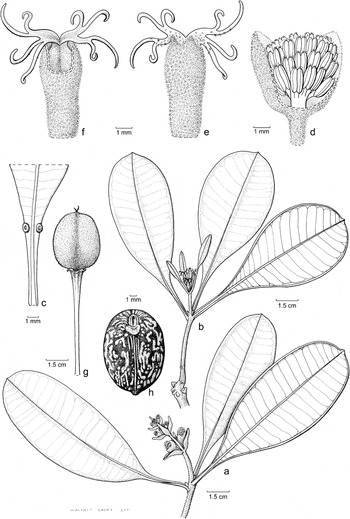
Tapoïdes villamilii (Merr.) Airy Shaw, Kew Bull. 14: 474 (1960); Airy Shaw, Kew Bull. 20: 412 (1967); Airy Shaw, Hooker’s Icon. Pl. 37: t. 3632 (1967); W.Meijer, Bot. News Bull. Forest Dept. Sabah 7: 30 (1967); Airy Shaw, Kew Bull., Addit. Ser. 4: 200 (1975); Govaerts, Frodin & Radcl.-Sm., World Checkl. Bibliogr. Euphorb. 1: 1510, fig. p. 1511 (2000). – Ostodes villamilii Merr., J. Straits Branch Roy. Asiat. Soc. 76: 92 (1917); Merr., J. Straits Branch Roy. Asiat. Soc., Special Number: 345 (1921). – Type: [Malaysia, Sabah,] British North Borneo, Sandakan, Villamil164 (holo PNH, destroyed; iso US?, n.v.).Fig. 6.
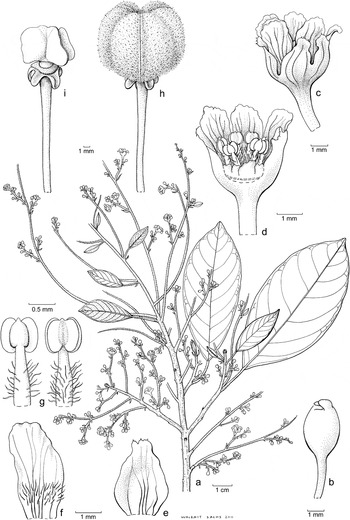
Fig. 6.Tapoïdes villamilii (Merr.) Airy Shaw. a, habit; b, staminate bud; c, staminate flower; d, staminate flower with a sepal and petal removed; e, sepal; f, petal from inside with hairs; g, stamens from both sides; h, fruit; i, dehisced fruit with only columella, disc and sepals left. a–g from Enggoh 10186; h, i from Wood SAN 16532 (all L). Drawn by Anita Walsmit Sachs, 2011.

Trees, up to 30 m high, bole up to 12 m, up to 20 cm dbh; flowering branches c.4 mm in diameter, grey when dry; latex pink. Indumentum sericeous except in flowers. Outer bark smooth, greyish to spotted white; inner bark yellowish to pinkish, brittle; sapwood pale yellowish to ochre. Stipules triangular, 3–4 × 0.7–1 mm, at least hairy outside. Leaves: petiole 1–7.8 cm long, round except apical pulvinus grooved adaxially, groove closed but open near attachment, soon glabrous; blades elliptic (to somewhat obovate), 7–23 × 2.2–10.2 cm, index 2.3–3.2, symmetric, coriaceous, base broadly cuneate, apex slightly emarginate to acuminate and then mucronulate, both surfaces smooth, soon glabrous, upper slightly hairy on midrib when young, lower slightly hairy all over when young, nerves 9–11 per side. Inflorescences sericeous, up to 15 cm long, some side branches up to 12.5 cm long; bracts when leaf-like up to 5.3 × 2.2 cm, otherwise mainly subulate, bracteoles triangular, 1.5–1.8 × c.0.8 mm, glabrous inside, slightly hairy outside. Staminate flowers c.8 mm in diameter; pedicel c.3.3 mm long; calyx lobes ovate, c.3 × 2.8 mm, rather stiff; petals obovate, c.5 × 2 mm; stamen: filaments c.1.8 mm long, round, rather thick; anthers elliptic, c.0.6 × 0.8 mm. Pistillate flowers unknown. Fruits c.1.6 × 2.1 cm; pedicel up to 2.8 cm long, with abscission zone; calyx lobes somewhat variable in size, elliptic, 3–3.5 × c.3 mm, few hairs outside, glabrous inside; style and stigma caducous; column c.7 mm long, septum wings c.5 mm broad; wall c.2.5 mm thick. Seeds not seen.
Distribution. Endemic to Borneo (Sabah and Sarawak).
Habitat and ecology. Primary lowland dipterocarp forest on brownish soil or near mangrove; altitude: 4–70 m. Flowering: March; fruiting: March, May.
Vernacular name. Sabah: Belit tangau (Dusun Kinabatangan).
Acknowledgements
The directors and curatorial staff of K, L and P are thanked for loans and use of their material. Hanneke Jelles, Anita Walsmit Sachs and Esmée Winkel are thanked for the beautiful drawings.
Identification List
The list contains all specimens from L with collector names and collector numbers. The number after the colon refers to the following species:
1 = Alphandia verniciflua Airy Shaw
2 = Ashtonia excelsa Airy Shaw
3 = Ashtonia praeterita Airy Shaw
4 = Borneodendron aenigmaticum Airy Shaw
5 = Cladogynos orientalis Zipp. ex Span.
6 = Tapoïdes villamilii (Merr.) Airy Shaw
Anderson S 12651: 2. – Arshid SAN 72898: 4; SAN 73477: 4. – Ashton BRUN 183: 2; S 21454: 2. – Awa S 51080: 2.
Backer 37050: 5. – bb series 14429: 2; 20622: 2. – Beumée 1299: 5. – Binideh SAN 58499: 2. – Bloembergen 3693: 5. – Brunig S 4664: 2. – Bunchuai 1709: 5. – Burgess SAN 27558: 4.
M. Chai SAN 21695: 4; SAN 26124: 4. – P. Chai S 35801: 2. – Chamchamroon et al. 2010: 5. – Charoenphol et al. 3658: 5. – Chin 907: 5; 1487: 5; 1561: 5. – Clason-Laarman F 53: 5. – Coert 462: 5. – Conklin PNH 11686: 5. – Coode5863: 5.
Dickason 8274: 5. – Dorgelo3059: 5.
Elbert 4658: 5. – Endert 3694: 2. – Enggoh 10186: 6. – Esser98-83: 5; 98-203: 5.
Gibot SAN 50744: 2; SAN 61836: 4; SAN 66603: 2.
Hallier 2274: 2; 2435: 2. – Hose42: 6.
Iboet76: 5.
Kaudern 490: 5. – Kiew & Anthonysamy 3086: 5. – Kirkup 768: 2. – Kjellberg 375: 5. – Koonthunthod et al. 335: 5. – Koorders 20612: 5; 29953: 5; 30194: 5. – Kostermans12741: 2; 13135: 2.
Larsen et al. 1129: 5; 1365: 5; 3254: 5; 45339: 5. – Lassan & Jahudin SAN 62527: 6. – Lee S 54195: 2. – Loh Hoy Shing FRI 17163: 5.
Madani SAN 133960: 4. – Madani et al. SAN 145393: 4. – Marcan 807: 5. – Martyn SAN 21601: 4; SAN 21605: 4. – Maxwell 92-779: 5; 94-1189: 5. – Meijer SAN 27676: 6; SAN 44075: 4; SAN 109845: 4. – Meijer & Gibot SAN 128772: 6. – Merrill 7208: 5. – Middleton et al. 1019: 5; 1233: 5. – Muas S 13394: 2. – Mujin SAN 37836: 4. – Murata et al. T-50023: 5; T-50048: 5.
Nooteboom & Chai2112: 2.
Paie S 16646: 2. – Paie & Azahari S 35624: 2. – Phengklai et al. 4288: 5. – Phusomsaeng 20 (1967): 5. – Pierre 6213: 5. – Plernchit 182: 5. – Promdej et al. 224: 5. – Put4153: 5; 4357: 5.
Ridsdale PBU 645: 2.
Samsudin A 183: 4. – Sangster A 3803: 4. – Schmutz 3175: 5; 5023: 5. – Shimizu et al. T-7733: 5; T-23405: 5. – Sidiyasa PBU 425: 2. – Sigon & Bakar SAN 86370: 2. – Sinclair 10264: 2. – Smitinand et al. 1163: 5. – Soejarto et al. 6018: 5. – Sørensen et al. 2175: 5. – Stone 8654: 3. – Sulit & Conklin PNH 16982: 5.
Teijsmann HB 8648: 2; HB 8712: 2; HB 10754: 5; HB 10755: 5.
Van Balgooy 2991: 5. – Van Balgooy & Van Setten 5595: 2. – Van Beusekom & Charoenphol 1876: 5. – Van Beusekom & Santisuk 2769: 5. – Van Beusekom et al. 3293: 5. – Van Borssum Waalkes 3130: 5. – Verheijen 4003: 5; 4965: 5. – Versteegh BW 4815: 1; 4832: 1.
Whitmore FRI 4236: 5; FRI 12240: 3; FRI 12262: 3; FRI 15100: 5; FRI 15973: 3. – Whitmore & Anderson S 8417: 2. – Williams & Pooma 1562: 5. – Wood A 288: 4; SAN 16532: 6. – Wyatt-Smith KEP 80510: 4.
Zainudin 5743: 5. – Zollinger 1165: 5; 1550: 5. – Zulkarnain & Giesen513: 2.