Introduction
Anxiety disorders are the most common class of psychological disorders (Kessler et al. Reference Kessler, Chiu, Demler and Walters2005), causing significant burden and suffering and highlighting the need for more effective prevention efforts (e.g. Donovan & Spence, Reference Donovan and Spence2000; Zvolensky et al. Reference Zvolensky, Schmidt, Bernstein and Keough2006). Identifying trait-like, predisposing factors, or vulnerabilities (Ingram & Luxton, Reference Ingram, Luxton, Hankin and Abela2005), for anxiety disorders may aid in elucidating mechanisms contributing to the development of these disorders and lead to more effective prevention efforts. Research examining youth at high risk for anxiety, such as children with parental histories of anxiety disorders, is a particularly useful approach for identifying potential vulnerability factors (Merikangas et al. Reference Merikangas, Dierker and Szatmari1998, Reference Merikangas, Avenevoli, Dierker and Grillon1999).
The startle response is a physiological measure of defensive responding that may be relevant for understanding the development of anxiety disorders. The startle response is a reflexive, cross-species fight-or-flight response to sudden, intense stimuli that is characterized by a cascade of behavioral responses, including rapid muscle contraction, and is most reliably assessed through eye blinks in humans (e.g. Lang et al. Reference Lang, Bradley and Cuthbert1990; Grillon, Reference Grillon2002; Grillon & Baas, Reference Grillon and Baas2003). As a measure of defensive responding, startle magnitude is potentiated in the context of a matching motivational or emotional state (e.g. fear) and inhibited in the context of an antithetical state (e.g. happiness); thus, startle is modulated by both pleasant and unpleasant affective states (Vrana et al. Reference Vrana, Spence and Lang1988; Bradley et al. Reference Bradley, Cuthbert and Lang1990; Lang et al. Reference Lang, Bradley and Cuthbert1990; Grillon & Baas, Reference Grillon and Baas2003). Two common paradigms for assessing modulation of the startle response include affective modulation paradigms in which startle probes are presented while participants view both pleasant and unpleasant stimuli, and fear learning paradigms in which startle probes are presented along with cues that predict threat (e.g. threat of shock) and safety (e.g. no threat of shock).
Many previous studies have found evidence of abnormal modulation of startle responses in adults with anxiety disorders, although results vary across disorders (Grillon & Baas, Reference Grillon and Baas2003; Vaidyanathan et al. Reference Vaidyanathan, Patrick and Cuthbert2009). In general, anxiety is associated with enhanced startle responses in threatening conditions, particularly when the threat is relevant to the disorder, with exaggerated startle responses most apparent in fear disorders (Lang & McTeague, Reference Lang and McTeague2009; McTeague & Lang, Reference McTeague and Lang2012). Individuals with specific phobias exhibit increased startle responses in the context of stimuli that are related to their fear (De Jong et al. Reference De Jong, Merckelbach and Arntz1991, Reference De Jong, Visser and Merckelbach1996; Vrana et al. Reference Vrana, Constantine and Westman1992), social anxiety has been linked to heightened startle responses in the context of a socially threatening situation (Cornwell et al. Reference Cornwell, Johnson, Berardi and Grillon2006; McTeague & Lang, Reference McTeague and Lang2012), and panic disorder has been associated with enhanced startle reactivity in threat conditions (Melzig et al. Reference Melzig, Weike, Zimmermann and Hamm2007; Shankman et al. Reference Shankman, Nelson, Sarapas, Robison-Andrew, Campbell, Altman, Mcgowan, Katz and Gorka2013). Anxiety may also be characterized by abnormal startle responses in pleasant conditions. For example, symptoms of anxious arousal have been linked to enhanced startle responses during viewing of both pleasant and unpleasant images (Larson et al. Reference Larson, Nitschke and Davidson2007).
On the other hand, anxiety characterized by more chronic and pervasive avoidance and distress has been linked to attenuated startle responses (Lang & McTeague, Reference Lang and McTeague2009; McTeague & Lang, Reference McTeague and Lang2012). In addition, despite high co-morbidity with anxiety (e.g. Fava et al. Reference Fava, Rankin, Wright, Alpert, Nierenberg, Pava and Rosenbaum2000), depression in adults has been associated with distinct abnormalities in modulation of startle, including reduced modulation of startle responses in both unpleasant and pleasant conditions (Allen et al. Reference Allen, Trinder and Brennan1999; Dichter et al. Reference Dichter, Tomarken, Shelton and Sutton2004; Kaviani et al. Reference Kaviani, Gray, Checkley, Raven, Wilson and Kumari2004; Forbes et al. Reference Forbes, Miller, Cohn, Fox and Kovacs2005; Dichter & Tomarken, Reference Dichter and Tomarken2008). There is also evidence that co-morbid depression may blunt affect-modulated startle effects among adults with anxiety disorders (Melzig et al. Reference Melzig, Weike, Zimmermann and Hamm2007; Vaidyanathan et al. Reference Vaidyanathan, Patrick and Cuthbert2009; Taylor-Clift et al. Reference Taylor-Clift, Morris, Rottenberg and Kovacs2011).
Relatively few studies have evaluated startle in youth with anxiety disorders, although there is evidence of increased whole-body startle responses overall among anxious youth (Bakker et al. Reference Bakker, Tijssen, Van Der Meer, Koelman and Boer2009). In addition, in two studies with small samples of anxious children, anxiety was related to increased startle responses overall at early stages of processing and after switching from the habituation to affective modulation phase of the startle task (Waters et al. Reference Waters, Lipp and Spence2005, Reference Waters, Neumann, Henry, Craske and Ornitz2008). More recently, in a fear-potentiated startle paradigm, adolescents with fear disorders (i.e. social or specific phobia) exhibited enhanced startle responses during safety cues and early phases of threat cues (Waters et al. Reference Waters, Nazarian, Mineka, Zinbarg, Griffith, Naliboff, Ornitz and Craske2014). However, another recent study failed to find differences in fear-potentiated startle in children and adolescents with generalized anxiety disorder (GAD) or social phobia compared to controls (Britton et al. Reference Britton, Grillon, Lissek, Norcross, Szuhany, Chen, Ernst, Nelson, Leibenluft, Schechner and Pine2013).
Importantly, there is some evidence suggesting that distinct patterns of modulation of the startle reflex may reflect a vulnerability to anxiety. Offspring of parents with anxiety disorders have been shown to exhibit heightened startle responses (Grillon et al. Reference Grillon, Dierker and Merikangas1997, Reference Grillon, Dierker and Merikangas1998; Merikangas et al. Reference Merikangas, Avenevoli, Dierker and Grillon1999), with high-risk males exhibiting greater fear-potentiated startle (i.e. larger startle responses during fearful than neutral stimuli) and high-risk females exhibiting larger startle responses overall compared to low-risk youth (Grillon et al. Reference Grillon, Dierker and Merikangas1998). Relatedly, exaggerated startle responses to unpredictable threat have been observed in individuals with a family history of panic disorder (Nelson et al. Reference Nelson, Mcgowan, Sarapas, Robison-Andrew, Altman, Campbell, Gorka, Katz and Shankman2013). In addition to heightened startle responses to threat conditions, larger startle responses in safe conditions have been observed among children higher in trait anxiety (Jovanovic et al. Reference Jovanovic, Nylocks, Gamwell, Smith, Davis, Norrholm and Bradley2014) and in children high in behavioral inhibition–a risk factor for anxiety (Barker et al. Reference Barker, Reeb-Sutherland and Fox2014). Moreover, enhanced startle responses in safe conditions have been found to prospectively predict first onset of anxiety disorders from adolescence into young adulthood (Craske et al. Reference Craske, Wolitzky-Taylor, Mineka, Zinbarg, Waters, Vrshek-Schallhorn, Epstein, Naliboff and Ornitz2012). These findings raise the possibility that failure to inhibit startle responses in safe, or pleasant emotional, contexts may play a role in the development of clinical anxiety.
Although there is growing evidence that abnormal startle responses may reflect a vulnerability for anxiety, a number of gaps in knowledge remain. First, previous studies have indicated that generalized defensive responses to safety cues may contribute to the development of anxiety (Reeb-Sutherland et al. Reference Reeb-Sutherland, Helfinstein, Degnan, Pérez-Edgar, Henderson, Lissek, Chronis-Tuscano, Grillon, Pine and Fox2009; Craske et al. Reference Craske, Wolitzky-Taylor, Mineka, Zinbarg, Waters, Vrshek-Schallhorn, Epstein, Naliboff and Ornitz2012), which raises the question of how those at risk for anxiety may respond during pleasant emotional contexts. Second, previous research has focused on older children or adolescents and/or included youth with lifetime histories of anxiety or depressive disorders. In order to evaluate startle responses as a vulnerability for anxiety, it is necessary to examine these patterns earlier in childhood and prior to the onset of symptoms (e.g. Kraemer et al. Reference Kraemer, Kazdin, Offord, Kessler, Jensen and Kupfer1997). Last, it is unclear whether abnormal affective modulation of startle may indicate risk for the broad class of anxiety disorders or a relatively specific vulnerability for certain disorders (e.g. fear disorders), as well as the extent to which startle modulation relates to risk for depression.
The current study evaluated associations between affective modulation of the startle response and anxiety risk in middle childhood. Eye-blink startle responses during pleasant, neutral, and unpleasant images were measured in 144 9-year-old children with no histories of mood or anxiety disorders. The primary goal was to evaluate startle responses as a vulnerability for anxiety, hypothesizing that children at high risk for anxiety (i.e. offspring of mothers or fathers with histories of anxiety disorder) would exhibit greater potentiation of the startle response in the context of unpleasant emotional images, as well as less attenuation of startle responses in the context of pleasant images compared to children at low risk (i.e. no parental history of anxiety). Additional exploratory aims were to evaluate main and interactive effects of maternal and paternal history of depression on startle responses in offspring and whether specific anxiety disorders in parents had stronger effects than others on the startle response in offspring.
Method
Participants
Participants were part of a larger longitudinal sample recruited through a commercial mailing list (Olino et al. Reference Olino, Klein, Dyson, Rose and Durbin2010). At the initial assessment, children were eligible if they were 3 years old, had no significant medical conditions or developmental disabilities, and were living with at least one English-speaking biological parent (some participants were recruited at a follow-up assessment in order to increase the racial/ethnic diversity of the sample). Participants were invited back to the laboratory as close as possible to their 9th birthdays, at which time a subset of the sample completed the startle paradigm. A total of 274 children completed the startle task. Of these children, 10 ended the task early due to technical difficulties or refusal to continue participation (resulting in too few trials for analysis), 67 were excluded due to excessive artifacts in the baseline period (50 ms before the startle probe) resulting in less than 50% artifact-free trials in one or more picture conditions, and 27 were excluded for failing to exhibit a measurable startle response on 50% or more trials per condition (non-responses). Acceptable startle data were available for 170 children (62.0%), which is comparable to exclusion rates in previous startle studies with children (e.g. Glenn et al. Reference Glenn, Klein, Lissek, Britton, Pine and Hajcak2012). Children included in analyses had 3–6 useable trials with observable startle responses in each picture condition. Children with acceptable startle data did not significantly differ from excluded participants with regard to depression or anxiety symptoms or frequency of parental depression or anxiety (ps > 0.11).
In order to evaluate risk for future anxiety, children who had already experienced a lifetime anxiety disorder (n = 23) or lifetime mood disorder (n = 3) were excluded from analysesFootnote 1 Footnote †. The final sample consisted of 144 children (56.9% male). Mean age at the startle assessment was 9.17 (s.d. = 0.43) years. With regard to ethnicity, 13.2% of the final sample was Hispanic, and with regard to race, 92.4% was Caucasian, 4.9% African American, 2.1% Asian, and 0.7% Native American.
Parental psychopathology
Detailed methods for assessing parental psychopathology are described in Kujawa et al. (Reference Kujawa, Proudfit and Klein2014). Both biological mothers and fathers were interviewed using the Structured Clinical Interview for DSM-IV non-patient version (SCID; First et al. Reference First, Spitzer, Gibbon and Williams1996) when families initially entered the study and again when children returned to the laboratory at age 9 to complete the startle task. Interviews were conducted by advanced doctoral students and masters-level clinicians in person or by telephone, which generally yields comparable results to face-to-face interviews (Sobin et al. Reference Sobin, Weissman, Goldstein and Adams1993; Rohde et al. Reference Rohde, Lewinsohn, Klein and Seeley2005). Inter-rater reliability was acceptable at both the initial (κ = 0.91 for lifetime anxiety disorder and 0.93 for lifetime depressive disorder, n = 30) and follow-up assessments (κ = 0.73 for anxiety disorders and 0.91 for depressive disorders, n = 45). Diagnoses from both assessments were combined to yield lifetime diagnoses. In cases where completion of the SCID with one parent was not possible, family history information was obtained from the other parent using a semi-structured interview (Andreasen et al. Reference Andreasen, Endicott, Spitzer and Winokur1977). Diagnoses for eight fathers were derived using the family history method.
Child psychopathology
At the age-9 assessment, one parent and the child were interviewed by advanced doctoral students or a masters-level clinician using the DSM-IV version of the Schedule of Affective Disorders and Schizophrenia for School-Age Children (K-SADS; Axelson et al. Reference Axelson, Birmaher, Zelazny, Kaufman and Gill2009). To assess inter-rater reliability, a second rater independently derived ratings from videotapes for 74 participants. Kappas for anxiety and depressive disorders were 0.68 and 0.79, respectively (see Kujawa et al. Reference Kujawa, Proudfit and Klein2014 for details). Parents also completed the Screen for Child Anxiety Related Emotional Disorders (SCARED; Birmaher et al. Reference Birmaher, Khetarpal, Brent, Cully, Balach, Kaufman and Neer1997) to assess current child symptoms of anxiety, as well as the Children's Depression Inventory (CDI; Kovacs, Reference Kovacs1992) to assess current child symptoms of depression. Child symptoms of anxiety and depression were included as covariates in main analyses.
Affect-modulated startle paradigm
Stimuli and presentation
Participants passively viewed 36 developmentally appropriate images (12 pleasant, 12 neutral, 12 unpleasant) from the International Affective Picture System (IAPS; Lang et al. Reference Lang, Bradley and Cuthbert2008)Footnote 2 divided into two blocks of 18 images. Neutral images included pictures of objects and scenes (e.g. lamp, desert), unpleasant images consisted of threatening stimuli (e.g. vicious animals, people with weapons) and pleasant images included a range of child-friendly scenes (e.g. cute animals, children having fun). IAPS images were presented randomly for 5 s each, with no more than two images of the same category presented consecutively. Inter-trial intervals (ITI) ranged from 6 to 8 s for trials in which no startle probe was presented during ITI, and 11–15 s on trials in which startle probes were presented during the ITI.
Auditory startle probes, consisting of 50 ms approximately 95 dB bursts of white noise with near instantaneous rise time, were presented binaurally through headphones. Startle probes were produced with a noise/tone generator (Contact Precision Instruments; USA) and were presented randomly at 3, 4, or 5 s after picture or ITI onset in order to increase unpredictability of the startle probes and produce maximal affective modulation of the startle reflex (Bradley et al. Reference Bradley, Cuthbert and Lang1993). During the experiment, startle probes were randomly presented during six neutral, six pleasant, six unpleasant, and six ITI periods.
Startle procedure
All participants were tested in a dimly lit, sound-attenuated enclosure, with the door propped slightly in order to make the children more comfortable. An initial four-trial habituation phase was used to reduce extreme startle responses from the first few trials. During the task, children were instructed to sit still and passively view the images presented on the screen. Participants were monitored by a video camera in order to ensure compliance with instructions.
Startle reflex data collection and processing
Startle-elicited EMG activity was collected in accordance with current guidelines (Blumenthal et al. Reference Blumenthal, Cuthbert, Filion, Hackley, Lipp and Van Boxtel2005). Two electrodes, 4 mm diameter Ag-AgCl filled with electrode gel (TD-40; Mansfield R and D), were positioned beneath the left eye with the first electrode placed in line with the pupil and the second electrode placed lateral to the first over the orbicularis oculi muscle with distance between electrodes adjusted as needed for each child's facial anatomy, and a third electrode was placed on the forehead to serve as an isolated ground. EMG activity was recorded using a PSYLAB Stand Alone Monitor (SAM) unit and an attached BioAmplifier system (Contact Precision Instruments, USA), and was sampled at 1000 Hz and filtered between 30 and 500 Hz. EMG responses were rectified in a window 200 ms long, beginning 50 ms before the onset of the startle probe. A 6-point running average was applied to the rectified data to smooth out sharp peaks. Raw startle magnitude was expressed as the difference between the average of the EMG in the 50 ms window prior to the startle probe and the maximum in the 150 ms post-probe window. Each participant's data were examined on a trial-by-trial basis. Trials with no perceptible eye-blink response were scored as zero and included in the overall averages; trials with excessive baseline artifacts or magnitudes that were outliers for each subject were excluded from analysis.
Data analysis
In order to control for inter-individual variability in startle magnitudes, analyses focused on ITI-corrected (i.e. average of startle magnitudes during an emotion condition minus startle magnitude during ITI) startle magnitudes. A mixed-design ANCOVA was used to statistically evaluate startle responding during the three affective conditions with maternal and paternal history of anxiety and depressive disorders as between-subjects variables. Child sex, symptoms of depression and symptoms of anxiety were included as covariates to evaluate risk for psychopathology controlling for child symptoms. Significant results were followed by paired-samples t tests; the Benjamini–Hochberg procedure was used to control the false discovery rate for multiple comparisons (Benjamini & Hochberg, Reference Benjamini and Hochberg1995).
Results
Participant characteristics
With regard to parental psychopathology, 34.0% (n = 49) of mothers and 20.8% (n = 30) of fathers had histories of anxiety disorders [9.0% (n = 13) of children had two parents with histories of anxiety disorders]. The most common anxiety disorders were specific phobias [16.7% (n = 24) of mothers, 6.3% (n = 9) of fathers] and social phobia [12.5% (n = 18) of mothers, 7.6% (n = 11) of fathers]. Rates of panic disorder [6.3% (n = 9) of mothers, 4.2% (n = 6) of fathers], GAD [4.9% (n = 7) of mothers, 4.2% (n = 6) of fathers], obsessive-compulsive disorder [OCD; 4.2% (n = 6) of mothers, 2.8% (n = 4) of fathers], and post-traumatic stress disorder [PTSD; 2.1% (n = 3) of mothers, 0.0% of fathers] were relatively low. In addition, 9.7% of mothers (n = 14) and 3.5% of fathers (n = 5) were diagnosed with two or three lifetime anxiety disorders.
With regard to depression, 32.6% (n = 46) of mothers and 12.5% (n = 18) of fathers met criteria for a lifetime depressive disorder (MDD or dysthymia), and 13.8% of mothers (n = 20) and 4.2% of fathers (n = 6) had co-morbid depression and anxiety.
Child SCARED (mean = 5.76, s.d. = 4.91) and CDI (mean = 5.79, s.d. = 4.07) scores were relatively low. Higher CDI scores were observed among children with maternal histories of anxiety (t 142 = −2.18, p = 0.03, d = 0.38), and maternal histories of depression (t 142 = −2.70, p = 0.01, d = 0.45), but associations between SCARED scores and maternal psychopathology did not reach significance (ps > 0.08). None of the associations between child symptoms and paternal depression or anxiety were significant (ps > 0.14).
Effect of parental anxiety and depression on affect-modulated startle
A 3 (condition: pleasant, neutral, unpleasant) × 2 (maternal anxiety) × 2 (maternal depression) × 2 (paternal anxiety) × 2 (paternal depression) mixed-design ANCOVA was computed to evaluate effects of parental psychopathology on affective modulation of startle, with child sex and symptoms of depression and anxiety included as covariatesFootnote 3 .
The interaction between foreground picture type and maternal history of anxiety was significant (F 2,272 = 4.20, p = 0.02, η p 2 = 0.03), but all other interactions between emotion condition and between-subjects variables were not significant (ps > 0.47). In addition, the main effect of emotion condition did not reach significance when accounting for the interaction (F 2,272 = 0.40, p = 0.67, η p 2 = 0.00)Footnote 4 . With regard to between-subjects effects, none of the main effects of parental psychopathology or child variables reached significance (ps > 0.29)Footnote 5 .
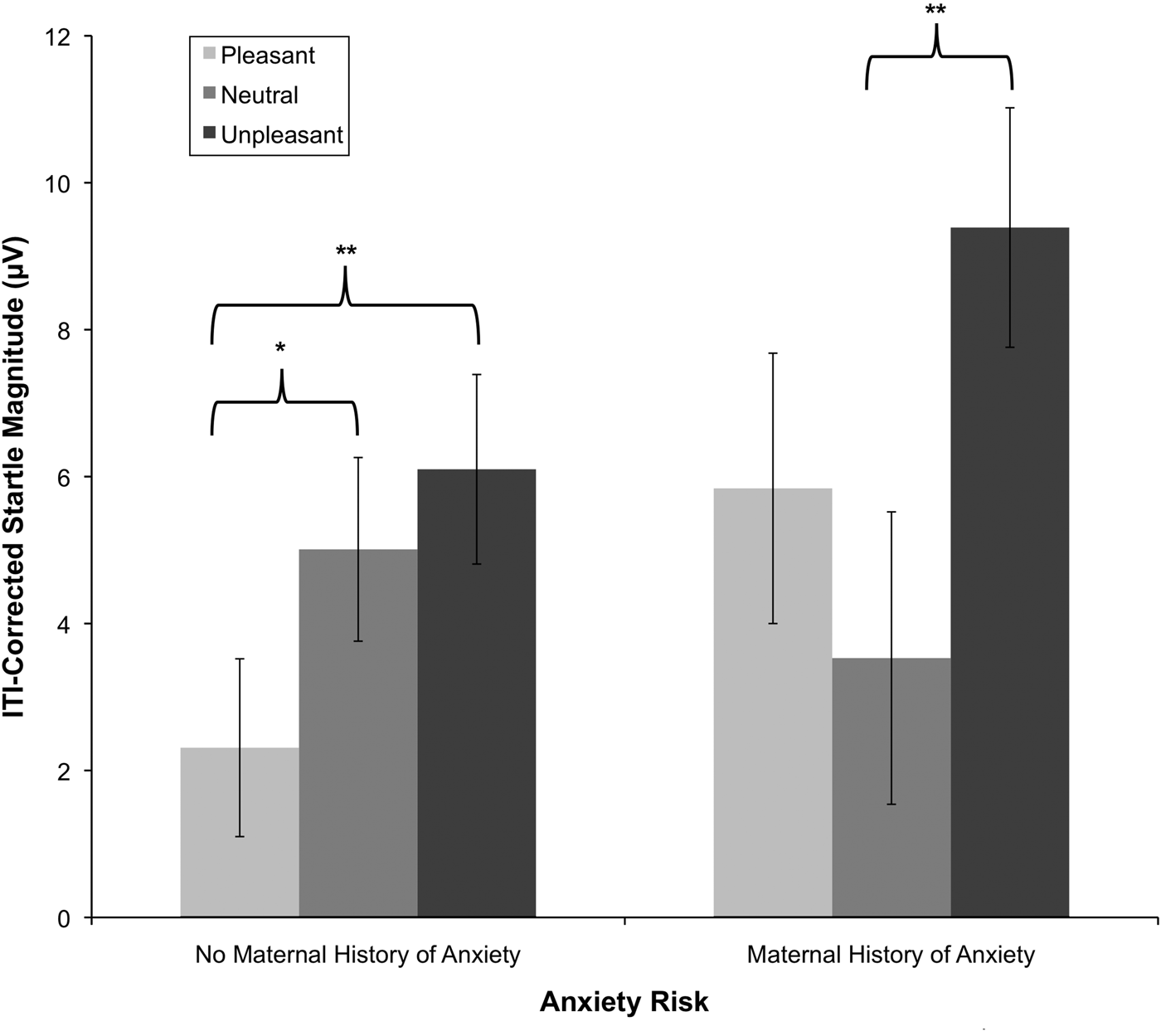
In order to evaluate the interaction between affective modulation of startle and maternal history of anxiety, data were split by maternal anxiety, and a within-subjects ANOVA was computed to evaluate the effects of emotion condition for children with (i.e. high risk) and without (i.e. low risk) maternal histories of anxiety disorders (Fig. 1). Because effects of paternal psychopathology, maternal depression, sex, and child symptoms of depression and anxiety were not significant in the overall model, these variables were not included in follow-up analyses. Affective modulation of the startle response was apparent for both low-risk (F 2,188 = 5.36, p = 0.01, η p 2 = 0.05), and high-risk (F 2,96 = 4.20, p = 0.01, η p 2 = 0.10) children. However, the direction of the affective modulation differed between the two groups: low-risk children exhibited significant attenuation of the startle response during pleasant compared to both neutral (t 94 = 2.16, p = 0.03, d = 0.30), and unpleasant (t 94 = 3.45, p = 0.001, d = 0.48) picture conditions, but the startle response during unpleasant images was not significantly potentiated relative to neutral (t 94 = −0.89, p = 0.38, d = 0.12). On the other hand, high-risk children exhibited significant potentiation of the startle response during unpleasant compared to neutral images (t 48 = −3.20, p = 0.002, d = 0.63), with a trend for potentiated startle response during unpleasant relative to pleasant pictures (t 48 = 2.01, p = 0.05, d = 0.40) (corrected p value = 0.076, Benjamini & Hochberg, Reference Benjamini and Hochberg1995). Among high-risk children, attenuation of the startle response was not apparent for pleasant relative to neutral pictures (t 48 = −1.19, p = 0.24, d = 0.23)Footnote 6 . In order to directly compare low-risk and high-risk children, we evaluated group effects based on two difference scores: (1) unpleasant potentiation: unpleasant startle magnitude minus neutral startle magnitude (greater unpleasant potentiation scores indicate larger startle responses during unpleasant stimuli), and (2) pleasant attenuation: neutral startle magnitude minus pleasant startle magnitude (greater pleasant attenuation scores indicate larger attenuation of the startle response during pleasant stimuli). Compared to children at relatively low risk, children at high risk for anxiety exhibited greater unpleasant potentiation (t 142 = 2.22, p = 0.03, d = 0.39), and less pleasant attenuation (t 142 = −2.25, p = 0.03, d = 0.39), of the startle response.
Affective modulation of the startle response in offspring as a function of maternal history of anxiety disorders (bars represent standard error). * p < 0.05, ** p < 0.01.

Exploratory analyses were computed to evaluate whether specific maternal anxiety disorders uniquely predicted greater unpleasant potentiation and/or reduced pleasant attenuation of the startle response. Two ANOVAs were examined with the unpleasant potentiation and pleasant attenuation difference scores as the criterion variables. Maternal history of panic disorder, specific phobia, and social phobia were included as between-subjects factors in each model. Variables indicating GAD, PTSD, and OCD were not included because fewer than 5% of mothers met criteria for these disorders (ns = 7, 3, and 6, respectively)Footnote 7 . Both panic disorder (F 1,140 = 4.90, p = 0.03, η p 2 = 0.03), and social phobia (F 1,140 = 4.34, p = 0.04, η p 2 = 0.03), were uniquely associated with greater unpleasant potentiation, but the effect of specific phobia on unpleasant potentiation was not significant (F 1,140 = 0.002, p = 0.96, η p 2 = 0.00). In addition, panic disorder (F 1,140 = 8.41, p = 0.004, η p 2 = 0.06), and social phobia (F 1,140 = 4.15, p = 0.04, η p 2 = 0.03), were associated with less pleasant attenuation, but the effect of specific phobia on pleasant attenuation was not significant (F 1,140 = 0.03, p = 0.87, η p 2 = 0.00).
Discussion
We evaluated affective modulation of the eye-blink startle response among children at high and low risk for anxiety disorders based on parental history of anxiety. Compared to children with no maternal history of anxiety, offspring of mothers with anxiety disorders exhibited greater potentiation of the startle response while viewing unpleasant pictures, as well as less attenuation of startle during pleasant pictures. That is, children at high risk for anxiety may be characterized both by heightened defensive reactivity in unpleasant or threatening contexts and a failure to inhibit defensive mobilizations in pleasant contexts. To our knowledge, the current study is the first to evaluate affective modulation of startle responses by both pleasant and unpleasant stimuli in risk for anxiety; thus, our findings extend Craske et al.'s (Reference Craske, Wolitzky-Taylor, Mineka, Zinbarg, Waters, Vrshek-Schallhorn, Epstein, Naliboff and Ornitz2012) study by suggesting that in addition to heightened responses to safety cues, failure to inhibit defensive responding in pleasant conditions may contribute to vulnerability for anxiety.
Importantly, based on the design of the current study, we can conclude that the affect-modulated startle effects were not driven by children's psychopathology, as no children met lifetime criteria for internalizing disorders, levels of current dimensional symptoms of internalizing disorders in the children were low, and we controlled for child symptoms of depression and anxiety in our analysis. Thus, abnormal affective modulation of startle does not appear to reflect a state marker or a consequence of a disorder, but instead may be a vulnerability that precedes the onset of anxiety and may play a causal role in the development of symptoms of anxiety (Kraemer et al. Reference Kraemer, Kazdin, Offord, Kessler, Jensen and Kupfer1997; Ingram & Luxton, Reference Ingram, Luxton, Hankin and Abela2005).
Effects of parental anxiety on startle responses in offspring were specific to maternal history of anxiety, with no effects observed for paternal anxiety. To our knowledge, this study is the first to evaluate the unique effects of maternal and paternal anxiety on startle in offspring. The lack of effects for paternal anxiety disorders is surprising given previous evidence of abnormal startle responses in a combined group of youth with maternal and/or paternal anxiety disorders (Grillon et al. Reference Grillon, Dierker and Merikangas1997, Reference Grillon, Dierker and Merikangas1998). However, very little previous research has examined effects of maternal and paternal anxiety separately on outcomes in offspring, and it has been suggested that fathers may play different roles in the development of anxiety in offspring than mothers (Bögels & Phares, Reference Bögels and Phares2008). In addition, the current results are consistent with previous evidence of stronger effects of maternal compared to paternal anxiety on anxiety disorders in offspring (McClure et al. Reference McClure, Brennan, Hammen and Le Brocque2001). That is, maternal anxiety may be associated with greater risk to offspring, possibly due to greater involvement by mothers in early parenting and more opportunities for mothers to model defensive reactions. It is important to also note that rates of anxiety disorders were lower among fathers than mothers, and diagnoses for a small proportion of fathers (5.5%) were obtained using family history interview methods; therefore, we cannot rule out the possibility that there was lower power to detect effects of paternal anxiety.
Although anxiety disorders characterized by focal fears have been linked to exaggerated startle responses in fearful or threatening conditions (Grillon & Baas, Reference Grillon and Baas2003; Lang & McTeague, Reference Lang and McTeague2009; Vaidyanathan et al. Reference Vaidyanathan, Patrick and Cuthbert2009; McTeague & Lang, Reference McTeague and Lang2012), there is also evidence of attenuated modulation of startle responses to threat in more chronic anxiety and co-morbid depression (Melzig et al. Reference Melzig, Weike, Zimmermann and Hamm2007; Vaidyanathan et al. Reference Vaidyanathan, Patrick and Cuthbert2009; Taylor-Clift et al. Reference Taylor-Clift, Morris, Rottenberg and Kovacs2011; McTeague & Lang, Reference McTeague and Lang2012). We did not find evidence of attenuated startle responses in unpleasant conditions among children at high risk for anxiety and failed to find effects of parental depression on startle responses. Instead, our findings indicate that risk for anxiety is characterized by exaggerated startle responses to threat. This finding raises the possibility that, for some individuals, enhanced defensive responding early in life may develop into reduced defensive reactivity in adulthood, with the onset of depressive symptoms and more pervasive and chronic distress (McTeague & Lang, Reference McTeague and Lang2012). In addition, our results suggest that abnormalities in affect-modulated startle responses may be relatively specific to risk for anxiety rather than depression, which is consistent with previous evidence that startle responses during safety cues prospectively predict the development of anxiety but not depression (Craske et al. Reference Craske, Wolitzky-Taylor, Mineka, Zinbarg, Waters, Vrshek-Schallhorn, Epstein, Naliboff and Ornitz2012).
Last, our results were relatively specific to parental history of social phobia and panic disorder, as opposed to specific phobia. Although modestly heritable, specific phobias have been shown to be less influenced by genes than other anxiety disorders and to often arise in response to specific traumatic events (Öst & Hugdahl, Reference Öst and Hugdahl1981; Kendler et al. Reference Kendler, Neale, Kessler, Heath and Eaves1992), which may account for the lack of effects of maternal specific phobias on startle responses in offspring.
A few limitations of the current study should be noted. First, given low rates of parental GAD, PTSD, and OCD in the sample, we were unable to adequately evaluate specific effects of these disorders on offspring startle responses, which may be an important area to consider in future work. In addition, we focused on children within a narrow range of development in middle childhood, which limits ability to generalize effects into adolescence or across development. It should also be noted that we did not ask participants to rate valence or arousal of the stimuli; thus, we are unable to evaluate group differences in subjective experience of the images. Last, data from a significant proportion (38.0%) of children were excluded due to children refusing to complete the task or inability to obtain enough artifact-free trials with visible startle responses, which raises the importance of developmental considerations and future work on optimal methods for obtaining startle data in childhood. Nonetheless, the current results suggest that distinct patterns of affect-modulated startle responses may be an early emerging vulnerability for anxiety, which may be particularly useful for identifying children at greatest risk for anxiety and developing more targeted prevention efforts.
Acknowledgements
This work was supported by National Institute of Mental Health Grant RO1 MH069942 to Daniel N. Klein.
Declaration of Interest
None.