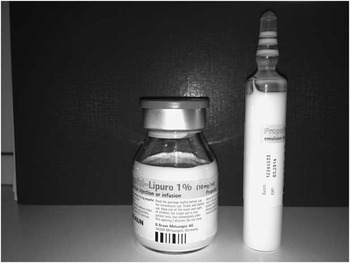


Propofol (marketed as Diprivan).
Where is the drug kept?
Propofol can be stored in a locked drug cupboard and is distributed in glass ampoules varying in size and strength.
What kind of drug is it?
Propofol is a short-acting, intravenously administered hypnotic agent with rapid onset. It is also a drug that reduces anxiety and tension. It can promote relaxation, sleep and loss of consciousness. It is not considered analgesia; hence, opioids such as ‘fentanyl’ may be combined with it to alleviate pain. It has been referred to as ‘milk of amnesia’ (a play on words of milk of magnesia), because of the milk like appearance of its preparation [Euliano, Reference Euliano and Gravenstein2004].
When is it used?
Propofol, the most widely used intravenous anaesthetic agent, can be used for induction or maintenance of anaesthesia in adults and children; however, it is not commonly used in neonates. It has also been found useful in respect to sedating patients who are mechanically ventilated. Propofol is also used in endoscopic procedures as its use in these settings results in a faster recovery compared with ‘midazolam’. Administration of Propofol is not associated with nausea and vomiting as is often seen with opioid medications (www.anaesthesiauk.com). In essence, Propofol is a very versatile drug; it can be given for short or prolonged sedation as well as for general anaesthesia [Topol, Reference Topol2004].
How is it used?
Propofol should be administered by a trained anaesthetist in a controlled environment. It is injected into a vein. Facilities for monitoring must be available alongside personnel who are appropriately trained and skilled in airway management, artificial ventilation and cardiovascular resuscitation (www.anaestheticuk.com). A supply of oxygen must also be available.
Pharmacokinetics
Propofol is highly protein bound and is metabolised by conjugation in the liver. Its half-life has been estimated to be within 2 to 24 hours [Favetta and Degoute, Reference Favetta and Degoute2002].
What are the side effects?
The most common side effects of Propofol are:
• Hypotension
• Tachycardia
• Flushing
• Transient apnoea
• Hyperventilation, coughing and hiccups during induction [British National Formulary (BNF), 2012].
What is new?
In June 2010, Teva Pharmaceutical Industries Ltd, the major supplier of the drug, announced they would no longer manufacture it. This aggravated an already existing shortage. A Teva spokesperson attributed the halt to the on-going process difficulties and to a number of pending lawsuits related to the drug (www.guardian.co.uk). Presently, the drug is supplied by Fresenius Kabi, a Swiss/German Company.