To act […] according to the rules of […] political wisdom […] is inevitably evil, and to act nevertheless, is moral courage. To choose among several expedient actions the least evil one is moral judgement. In the combination of political wisdom, moral courage, and moral judgement, man reconciles his political nature with his moral destiny [which] is nothing more than a modus vivendi, uneasy, precarious, and even paradoxical.
—Hans J. MorgenthauFootnote 1
This study aims to explore the foreign policy dilemmas faced by Turkish government officials and opinion makers who were publicly deliberating over how to address the lingering Syria crisis in early 2012. For the purposes of the study, the authors will first locate the key historical juncture at which Ankara constructed a deliberate policy choice between insisting on a norm-based humanitarian intervention and launching a utility-based political/military interference into Syria.Footnote 2
By looking at how Turkey’s Syria policy is represented in two prominent pro-government newspapers, Star and Yeni Şafak, we will argue that Turkey’s agenda building became increasingly paradoxical as the Syrian crisis entered a critical stage following the second double veto, by Russia and China, of the United Nations Security Council (UNSC) on February 4, 2012, which prevented it from making the decision to endorse a military intervention into Syria. Only then did Turkey begin to officially engage with the Syrian opposition, helping it to function as a political alternative to the regime of Bashar al-Assad. This became more visible particularly after the first meeting of the Friends of Syria Group (henceforth FSG) in Tunis on February 24, 2012.
This episode deepened the acute dilemma faced by Turkish foreign policy makers between interest-driven and value-based foreign policy agendas—that is, between preserving material interests and defending ideational values—particularly after riots broke out in the southern Syrian city of Deraa in mid-March 2011.Footnote 3 Turkey then began to oscillate between utilitarian/realpolitik (reel/çıkarcı politik) and humanitarian/normative (insani/normcu politik) modes of operation.Footnote 4 Initially, Turkey was primarily concerned with protecting its economic interests, and hence tried to preserve the dyadic status quo: the Turkish foreign policy elite could not abandon the Assad regime too early or too easily. The idea of abruptly cutting off political-economic ties with Syria was seen as potentially costly ahead of the parliamentary elections of June 12, 2011, in particular risking the alienation of voters from southeastern Turkey, who were dependent on cross-border trade and economic relations. Turkey’s government was thus inclined to balance political pressure from within and without.
To this end, Turkish officials have made several diplomatic attempts to convince Assad to put an end to the violence, trying to capitalize on the legacy of the governments’ years-long cooperation. On the other hand, they also realized the limits of their influence on the inner structure of Ba’ath leadership.Footnote 5
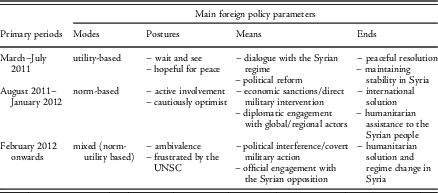
Still, Ankara initially held out hope for a peaceful solution and maintained dialogue with the Assad regime. However, after the critical Damascus meeting between Assad and Turkey’s Minister of Foreign Affairs, Ahmet Davutoğlu, in early August 2011, Ankara began to lose hope and gradually distanced itself from Damascus.Footnote 6 In this period, the government of the Justice and Development Party (Adalet ve Kalkınma Partisi, AKP) enhanced its unofficial engagement with the Syrian opposition, thereby demonstrating its political desire for a solution without Assad. Table 1 summarizes the chronology of Turkey’s foreign policy transformation over the course of the Syrian crisis.
Temporal transformation of Turkey’s Syria policy

Until the end of January 2012, Turkey attempted to generate support for an international/regional intervention into Syria. When these efforts proved futile—particularly after the UNSC veto on February 4, 2012—Turkey’s government became deeply frustrated. Following the Tunis meeting on February 24, 2012, Turkey officially engaged with the Syrian National Council (SNC) and provided assistance that would allow it to function as a political alternative to the Assad regime. In the subsequent period, Ankara redoubled its efforts toward regime change in Damascus.
Working within this periodization, this article will focus on the contextual and discursive evidence that emerged from this critical episode in February 2012. It will look at practices of agenda building in order to understand the political paradoxes encountered by Turkey’s government while deliberating over two foreign policy options. Due primarily to contextual constraints, Turkey was unable to persistently pursue a norm-based military intervention against the Assad regime. Despite the pervasive use of the rhetoric of “massacre” in an attempt to corner Damascus, Ankara’s foreign policy was risk averse and cost sensitive: its emphasis on potential losses spoke to its lack of desire to enter into a deadly humanitarian intervention into Syria. Turkey was neither ready to make “the ultimate sacrifice” of a loss of lives, nor willing to bear the inevitable humanitarian consequences that would be engendered by deadly warfare. For these reasons, Turkey’s foreign policy makers opted instead for a policy of covert military interference against the Syrian regime. Their support of and/or assistance to armed opposition groups—primarily the Free Syrian Army (FSA)—could only exacerbate the civil war conditions in Syria. Paradoxically, however, Turkey’s government put enormous effort into alleviating the suffering of the Syrian people. Since then, this policy paradox has not been resolved. To the contrary, it has only been deepened by puzzling developments in Syria as well as in the region at large.Footnote 7 It is thus necessary to revisit the February 2012 episode in order to critically analyze the contextual and discursive factors that, whether directly or indirectly, resulted in Turkey’s deep Syrian dilemma.
In analyzing the critical episode that unfolded in February 2012, the authors particularly inquired into the contextual-discursive paradoxes encountered by Turkey’s foreign policy decision and opinion makers. This analysis aims to explore why Turkey adopted an ambivalent agenda in Syria. Since Turkey built the backbone of its agenda in February 2012, we are particularly interested in understanding the reasons behind the discursive dilemmas as they emerged in the newspapers Star and Yeni Şafak. By looking at these two leading pro-government dailies, we have found that, in February 2012, the diplomatic engagement with the Syrian opposition became part of the official-public discourse. In line with some analysts,Footnote 8 we also believed that the posture of interference was a quite unprecedented phenomenon in the foreign policy making of Turkey. Analyzing how the AKP government managed to transform Turkey’s Syria agenda from intervention towards interference in the face of strong domestic public-political oppositionFootnote 9 is, therefore, significant.
Analytical framework
The authors approach foreign policy discourse from a pragmatic (i.e., contextually and discursively co-constituted) perspective.Footnote 10 From this standpoint, discourse and context are mutually constitutive, with each being influenced by and creating consequences for the other. This naturally implies a mutually constitutive and transformative relationship between the contextual and discursive aspects of foreign policy. Similarly, we take Turkey’s Syria policy discourse as a contextually constitutive and consequential transformation. The pragmatic perspective helps us to grasp the implications of the constitutive linkages between the text and contextFootnote 11 of foreign policy making. For this reason, it is necessary for scholars to trace the “dialectic interplay” between actors’ discourses and their making of international—i.e., global, regional, dyadic, or local—context.Footnote 12
This article focuses on frame and agenda building as interrelated processes of political communication and policy making.Footnote 13 These practices involve choosing broad thematic categories that constitute acts of framing. In the highly uncertain circumstances of crisis, foreign policy makers use what are called “core themes” for these purposes. Core thematic frames are discursive responses that address contextual questions such as “What is the major issue?”, “How should the crisis be perceived?”, “How can the crisis be dealt with?”, “Which means are deemed to be legitimate and/or effective?”, “How are other relevant themes related?”, and “How should intervening factors, such as important third parties, be interpreted?”Footnote 14 In other words, such core thematic frames establish attributes that, in turn, help to determine a so-called “central theme,” and hence a “dominant perspective,” in political communication.Footnote 15 Policy makers often resort to thematic framing in order to bring “the importance of an issue or event to the forefront,” or to raise “its visibility and relevance” in the public sphere:Footnote 16
[T]he way an object on the agenda is framed can have measurable behavioral consequences. […] How a communicator frames an issue sets an agenda of attributes and can influence how we think about it. Agenda setting is a process that can affect both what to think about and how to think about it.Footnote 17
Therefore, the thematic analysis of frame and agenda building is quite important for an understanding of the implications of foreign policy change. In order to analyze critical changes in Turkey’s foreign policy discourse between March 2011 and March 2015, we traced coverage of the Syrian crisis in the pro-government daily newspapers Star (print edition) and Yeni Şafak (online edition). In terms of government-media relations, a certain degree of government control over particular media outlets was taken for granted. Our analysis subscribed to the assumptions of government-centric/elitist (hegemony, indexing and cascade) modelsFootnote 18 of government-media communications, and so assumed that the Turkish government created political consent through its control of certain media outlets. By and large, pro-government newspapers provide a discursive service for the political purposes of legitimation and persuasion. Mutual interdependence has defined the ideological and political parameters of this relationship,Footnote 19 in that sense making pro-government newspapers a rich resource for understanding the government’s discursive strategies.Footnote 20
In line with this proposition, we have examined all the news and opinion columns from Star and Yeni Şafak that addressed Turkey’s foreign policy on the Syrian crisis.Footnote 21 Our particular focus was on the frame- and agenda-building practices of Turkey’s official foreign policy makers during February 2012; namely, President Abdullah Gül, Prime Minister Recep Tayyip Erdoğan, and Minister of Foreign Affairs Ahmet Davutoğlu). We also looked at how prominent pro-government columnists such as İbrahim Karagül, Nasuhi Güngör, and Ardan Zentürk framed the issue for readers, as such frameworks facilitate the process of public deliberation.
The article will explore three core themes: (1) dyadic context (the Syrian regime, the opposition, and the people); (2) third-party roles (regional and global players); and (3) Turkey’s policy options (intervention and/or interference). By tracing changes in the framing of core themes, the article attempts to find answers to three main questions: (1) When did Turkey’s framing of the context of the Syrian crisis begin to change and its policy agenda to shift from intervention towards interference?; (2) How were this change of frame and agenda made possible through public discourse?; and (3) What were the political consequences brought about by this change?
In order to answer these questions, we have adopted the “deliberative (argumentative-dialectical)”Footnote 22 variant of Critical Discourse Analysis (CDA). Within this framework, political actors’ deliberation depends on the framing of premises in context and on the rationality of intervention. There are two types of contextual premises: (1) the circumstantial premise, which “represents the existing state of affairs and the problems it poses”; and (2) the value premise, which expresses concerns that affect agents’ representation of the context of action. In line with the framing of context, intervention is rationalized and justified according to two types of premises: (1) the goal (or agenda) premise imagines that “the future state of affairs agents want to bring about or think ought to be brought about”; and (2) the means-end (or options) premise determines the line of action that would “take agents from the current state of affairs to the future state of affairs,” thereby enabling them to achieve their goal.Footnote 23
The premise for practical reasoning, and hence for action, is provided by prudential concerns about interests and desires on the one hand, and, on the other hand, by moral values about duties and commitments. In order to legitimize the desired political outcome, political actors frame their reasons for action in utilitarian (instrumental, power-based) and moral (normative, value-oriented) terms. Thus, political discourse reflects practical and pragmatic, if not natural, paradoxes existing between utilitarian rationality and normative morality. A paradoxical framing of the reasons for action is deepened by a dual conceptualization of the current and future state of affairs. Political discourse represents both actors’ conceptions of the actual context and their visions of a future, possible, non-actual (or not yet actual), and hence imagined world. Current contextual conceptions are framed as circumstantial premises, whereas future imaginations are framed as goal premises.Footnote 24
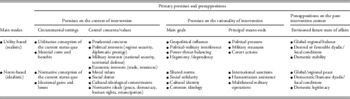
In line with these propositions, we have sketched two hypothetical typologies in an attempt to critically analyze the “contextualization models”Footnote 25 and “discursive modes”Footnote 26 of intervention and interference.Footnote 27 Put succinctly, these typologies were specifically developed for the analytical purposes of this study. They are not all-inclusive, and might be broadened or reformulated depending on specific research needs. These hypothetical typologies are reflected in Table 2.
Hypothetical typologies for tracing of intervention discourses

At the center of a utility-based discourse lies a conceptualization of the intervention context in terms of material costs/benefits and prudential concerns, such as political and/or military risks and economic gains and/or losses. Based on this conception, a utilitarian mode of discourse sets political/military interference and covert actions as a foreign policy option more viable for the achievement of such goals as geopolitical influence and a balancing of power and threat. On the other hand, the main goal (agenda) premise of a norm-based discourse emerges from a particular ideational contextualization of intervention that exalts such primary values as social solidarity and cultural identity. Hence, this type of discourse focuses more on the ethical/moral reasons that drive foreign policy toward humanitarian assistance and/or intervention. Based on these typologies of frame and agenda building, we have examined the reasons for Turkey’s foreign policy paradoxes being wedged between utilitarian and normative intervention discourses while addressing the Syrian crisis in February 2012 and beyond. In the following section, our research findings will be presented.
Research findings: revisiting the February 2012 episode
This section is divided into three subsections. Each section is organized thematically in such a way as to analyze the different important aspects of discursive ambivalence in Turkey’s Syria policy. The first and second sections inquire into the representation of uncertain presuppositions in the dyadic and the international context, while the third section investigates the deployment of ambiguous rationality premises for Turkey’s intervention-interference in Syria.
Constructing the uncertain dyadic context: the rhetoric of “massacre” and the shadow of civil war
Looking at how the crisis in Syria was portrayed by the newspapers Star and Yeni Şafak is important for an understanding of Turkish foreign policy and of how opinion makers reinterpreted changes in the dyadic context. A critical turning point in the confrontation between Assad’s forces and the opposition came on February 4, 2012, with the mass killings in Homs. On this day—which marked the Muslim observance (kandil) of Mawlid, the anniversary of the prophet Muhammad’s birth—Star was among the newspapers that were still able to report from Syria. As Star’s chief of editorial affairs, Doğan Ertuğrul wrote, Assad’s forces killed more than 300 civilians in Homs. Ertuğrul spoke to Syrian civilians in Damascus who perceived the violent acts as a “massacre.” Star also framed the Homs incident as “the kandil massacre” (kandil katliamı), notwithstanding official denials of the incident by the Syrian regime.Footnote 28 According to Yeni Şafak, the revolutionary activists in Homs were in desperate need of help, particularly from Ankara as opposed to Washington or Paris.Footnote 29
Turkey’s Ministry of Foreign Affairs (MFA, Dışişleri Bakanlığı) did not hesitate to condemn the “massacre,” which was taken as evidence of the Assad regime’s loss of legitimacy. The ministry released a public statement emphasizing the historical significance of the event: “On the thirtieth anniversary of the 1982 Hama-Homs incidents […] and on the day of decision for the United Nations Security Council regarding Syria,” the declaration called for the “international community” to take responsibility, “without losing one minute more,” for the prevention of any further such massacres.Footnote 30
In line with this normative/humanitarian framing, the bulk of Star’s front page was given over to a photograph of a young and conservative-looking (i.e., wearing a headscarf) female activist protesting the Assad regime while holding an English-language banner handwritten in capital letters and reading: “1982-Hama, 2012-Homs and the Massacres Continue.”Footnote 31 The banner reflected the main theme characterizing the crisis in Syria. In Star, the Homs “massacre” was placed into the historical context of the brutality leveled by the Ba’ath regime against Syria’s own citizens. For Ertuğrul, on the other hand, these latest developments went far beyond massacre, with actual “civil war” conditions intruding even on the streets of the Syrian capital.Footnote 32 However, the “civil war” frame did not resonate well with Turkey’s foreign policy rhetoric, which was urgently calling for humanitarian intervention.
Writing in their respective columns for Star, Nasuhi Güngör, Sedat Laçiner, and Ardan Zentürk, also framed the events from parallel perspectives. Güngör, concerned about Syria’s domestic dynamics, saw the main problem as lying in the political/military power of the “deep [intelligence] structure” of the Syrian state.Footnote 33 Laçiner similarly talked about the bloody history of military rule in Syria, also implying that the Ba’ath regime would not hesitate to shed more blood in order to remain in power.Footnote 34 Zentürk, who also termed the incidents in Homs a “massacre,” argued that “Assad has been acting not as a Syrian leader but as a colonial ruler appointed by Moscow and Beijing.”Footnote 35
Speaking at the AKP’s parliamentary group meeting, the then prime minister of Turkey, Recep Tayyip Erdoğan, also portrayed the killings as a “massacre”:
Bashar al-Assad says, “I will fight to the death.” If you’re a hero who will fight to the death, why didn’t you fight to the death for the Golan Heights? Is your heroism against your own oppressed, innocent people? Is that heroism? […] No oppression will go unreciprocated. The sigh of the oppressed will be heard, sooner or later.Footnote 36
Star also covered Erdoğan’s speech:
[T]hose who massacred hundreds of civilians in Homs will be held accountable [and judged] before divine justice [prevails]. Hama was not called to account, but rest assured that Homs will be called to account sooner or later […] I am warning Assad once again […] what goes around, comes around.Footnote 37
It was observed that Turkish foreign policy and opinion makers framed the events in Syria as a “massacre” and saw humanitarian intervention as a necessary response. At the time, American diplomats were more concerned with, and were discussing, potential security risks that might be posed by the transfer, if not necessarily the use, of chemical weapons in Syria.Footnote 38 Incidentally, it was also claimed unmanned American airplanes had made surveillance flights over Syria during this time.Footnote 39 Under these circumstances, Star openly predicted the likelihood of a Libya-style military intervention (with establishment of no-fly zones by Western air power and with Western logistical support for opposition forces)Footnote 40 and an opening up—and, by extension, a securing—of humanitarian assistance corridors inside Syria.Footnote 41
Even though this process of frame and agenda building entailed a thematization of the global/regional context along pro-interventionist lines, the analysis itself revealed that geopolitical frameworks were dominant in Turkey’s Syria policy discourse. This dominant interpretation of the global/regional context of the Syrian crisis along geopolitical lines made it more difficult for Turkish foreign policy makers to set, if not to sell, a norm-based intervention as against a utility-based interference agenda in the domestic public sphere.
The making of ambiguous third-party roles: geopolitical framing and the demise of diplomacy
In relation to the February 2012 episode, the UNSC’s Syria resolution vote stands out as a critical turning point, as do the immediate developments regarding Russia’s diplomatic moves with Assad. Observing how Star and Yeni Şafak portrayed the global/regional context of the Syrian crisis, what is striking is the criticism by and frustration of Turkey’s government with regard to the UNSC decisions. Star extensively covered the veto process, framing the UNSC’s diplomatic deadlock as a case of “giants dueling for Syria.” As Star saw it, the political rift between the United States and Russia was further deepened as the two sides continued to make seemingly unmeetable demands. While the White House consistently advocated for Assad to step down, the Kremlin’s position was marked by a “refusal of regime change and military intervention.” Although the then Secretary of State Hillary Clinton gave verbal assurances that the US had no intention of staging a “Libya-style intervention,” Russia firmly defended its position, portraying the draft resolution as providing the grounds for a military incursion into Syria.Footnote 42 Russia’s Minister of Foreign Affairs, Sergey Lavrov, argued that the draft resolution amounted to supporting “one side in a civil war.”Footnote 43
The UNSC’s veto process led to a diplomatic deadlock, and subsequent developments—particularly Lavrov’s visit to Damascus—were seen as legitimizing the Assad regime, which Turkey sought to have removed. Turkey’s foreign policy makers, seeing the difficulty of working through the UN, were thereby forced to reconsider their framing of the global/regional context. Lavrov’s Damascus visit was read as part of a larger geopolitical game.Footnote 44 Leaking the details of secret talks between Lavrov and Assad, Star portrayed Russia’s role as one of “massacre sponsor” and “massacre partner.”Footnote 45 Turkey’s Minister of Foreign Affairs, Ahmet Davutoğlu, expressed deep regret over the veto, as it prevented the UNSC from fulfilling its fundamental responsibility to preserve international peace and security. This underlined the political disappointment felt by Turkey’s foreign policy elite, who believed that “the international community should be on the right side of history and the Syrian people as a whole.”Footnote 46
In its news pieces, Star framed the UN veto as being Assad’s “license to kill.”Footnote 47 Addressing the political implications of the UNSC veto in the parliamentary group meeting, Erdoğan asserted, “Whatever their vested interests may be, it is not acceptable or excusable for any state to hand a tyrant a license to kill.”Footnote 48 Speaking at the 48th Munich Security Conference in February, Davutoğlu accused Russia and China of not behaving in an “ethical” manner. His comments were quite striking, as he stated that Turks and Arabs would pay the price of the veto, that Turkey desired “to put an end to the Cold War in the region,” and that one must not look at administrations as being supporters of either the West or the East when considering regional developments.Footnote 49
What has been especially interesting to observe is the growing frustration and declining trust among Turkey’s foreign policy elite regarding the workings of the UN, seeing it as incapable of meeting the demands of the post-Cold War international system. Davutoğlu described the Security Council as a relic of the Cold War and the purported misuse of veto power as an “inconceivable attitude.” In his view, the “international community” should not be considered to be composed of “the five permanent members” who would pay no price for their decisions. Therefore, he repeatedly advocated for a political query into the structure of the UNSC.Footnote 50 Similarly, Star columnist Ergun Babahan argued that “the United Nations system currently cannot provide decisions that would ease the conscience of the international community. Hence, it is not realistic to expect this structure to develop such a capability.”Footnote 51
Based on these circumstantial premises, the Syrian crisis was contextualized as part of a larger geopolitical “game” being played out by different international and regional actors. Nasuhi Güngör, for example, argued that the crisis in Syria was all about the battle over energy (oil and natural gas) resources and routes.Footnote 52 In Ardan Zentürk’s view, the tension stemmed from an Iranian financial “threat” relating to the global economy’s domination by the US dollar, the reason for which was simple: since August 2011, Iran had begun to de-dollarize its oil and natural gas trade, particularly with China, India, and Russia. This was an unexpected and disturbing move for the Anglo-American alliance that claimed control over the energy exchange, especially between China and Iran. Zentürk argued that the global power struggle was “the big game” behind the protection provided to Assad by the Chinese-Russian veto in the UNSC.Footnote 53
Mahir Kaynak viewed the Syrian crisis as a political-economic power struggle between global and local capital(ists).Footnote 54 Looking at the post-veto global rivalry between the dominant powers (the US and Russia) and aspiring actors (the European Union and China), he asserted that the geopolitical strategic environment was suitable for a joint Turkey-led and Arab League-supported peace building operation to control the crisis in Syria. As Kaynak saw it, “Turkey has been the sole country to fulfill this mission.” In his view, this type of friendly humanitarian assistance mission would not face serious dyadic opposition or regional reaction.Footnote 55 At this point in the Syrian crisis, İbrahim Karagül, one of the most outspoken Yeni Şafak columnists, smelled “the scent of an intervention”Footnote 56 by a coalition of Arab and Western countries, a coalition that included Turkey.Footnote 57 At the same time, the US and its partners were only working on methods and attempting to provide more conducive conditions for external intervention.Footnote 58 Karagül foresaw the strong possibility of an “immediate and indirect intervention” into Syria, which might set a somewhat “different example” for the years to come.Footnote 59 He also highlighted the risks of a civil war, and, by extension, the geopolitical costs of a direct military intervention into Syria.Footnote 60
In fact, the political signs coming from Damascus seemed to confirm Karagül’s propositions. For example, key Western countries (Spain, Belgium, the Netherlands, France, Italy), Gulf Cooperation Council (GCC) members (Bahrain, Kuwait, Oman, Qatar, Saudi Arabia, and the United Arab Emirates) called for their ambassadors’ return from Damascus.Footnote 61 Later, the US declared the closure of its embassy in the Syrian capital. Relying on American television news taken from CNN, Star reported information about Pentagon plans for a military operation in Syria.Footnote 62 However, US President Barack Obama acknowledged that conditions in Syria were not conducive to a Libya-style military intervention.Footnote 63 Instead, Washington proposed building an international coalition to support the Syrian opposition and implement sanctions against the Assad regime. At this point, France’s President Nicholas Sarkozy endorsed the establishment of a FSG among UN member states.Footnote 64 Also supported by the Arab League, this move implied a bypassing of the UNSC by means of diplomatic deliberations within the UN General Assembly.Footnote 65
Throughout this episode, the global/regional context of the Syrian crisis was depicted as part of an uncontrollable geopolitical struggle. Both Star and Yeni Şafak emphasized the weaknesses of the international community, the interests of the various actors, and the diplomatic battle over the Syrian crisis. This unfavorable depiction of the global/regional setting led to ambivalent agenda building in Turkey’s Syria policy. Since the UNSC had rejected international intervention, Turkey’s government began to reevaluate how it could control the crisis. Labeling the events in Syria as a “massacre” on the one hand while observing divergent policies in the international community on the other, the opinions of Turkey’s foreign policy makers oscillated between norm-based military intervention and utility-based political/military interference, in line with their portrayal of the international developments. In connection with this, Turkey’s search for other avenues was discussed in detail by Star and Yeni Şafak.
Building ambivalent agendas: rhetorical swings between intervention and interference
Looking at Turkey’s options as framed in Star and Yeni Şafak, the discussion revolves around why Turkey should not pursue direct/overt military intervention into Syria. Here, two primary concerns were widely discussed. The first of these related to US reluctance toward international military intervention. For example, İbrahim Kiras warned against the US’ Syria policy, writing that the Obama administration was acting according to a (Libya-type) policy of leading from behind and encouraging Turkey to carry out a military intervention in Syria.Footnote 66 Sedat Laçiner also argued that the US would not intervene militarily, but would instead shift its agenda toward interference; i.e., international intelligence operations and covert actions, arming local forces, and supporting regional partners.Footnote 67
Other columnists also issued warnings at this critical juncture. Nasuhi Güngör argued that “intervention is not the sole option for Ankara,” and called on Turkey “to avoid being at the center of bloody options.”Footnote 68 Ardan Zentürk emphasized how a direct/overt military intervention into Syria by Turkey would bring tragic consequences. Arab public opinion, for example, would turn against Turkey’s policy makers and Turkey would lose its “soft power” in the region. Even in the case of a multilateral (UN- or NATO-mandated) operation, Zentürk argued, Turkey’s contribution “ought to be kept at the level of logistical support. Turkish and Arab soldiers must never come face to face with each other on a front.” As Zentürk put it, “Ankara does not have the luxury of viewing the triad of Iran-Iraq-Syria through the lenses of Paris, London, Berlin, or Washington. In this region, Turkey has to act like itself […] Turkey’s recent attitude of balancing between ‘national interests’ and ‘normative diplomacy’ is important.”Footnote 69 In another piece, Zentürk called for Turkey to use diplomacy to minimize the risks of military conflict and work to stop “the fires of war” at Turkey’s border.Footnote 70
Looking into alternative diplomatic solutions, Nasuhi Güngör proposed that Turkey work jointly with Russia. According to him, Turkey’s geographical location presented remarkable advantages, like “power and depth,” for making unexpected moves.Footnote 71 He praised Turkey’s ability to talk with both the US and Russia, and therefore considered Ankara as “the address for less bloody options.”Footnote 72 Yet Güngör remained skeptical of ousting the Syrian regime either “today or tomorrow.” In his view, the main problem was Syria’s “deep” domestic political/military intelligence structure, something that Turkey’s decision makers should not neglect in their foreign policy reformulations.Footnote 73
The second major concern discussed by Star and Yeni Şafak columnists was related to Turkey’s domestic predicaments. In Güngör’s words, “the Syria problem” was “the password” of events unfolding inside and outside of Turkey.Footnote 74 He indicated that the domestic judicial operation launched on February 7 against the National Intelligence Organization (Millî İstihbarat Teşkilatı, MİT) could have significant implications for Turkey’s Syria policy.Footnote 75 Star and Yeni Şafak exposed the judicial process as an unprecedented challenge directed against not only MİT but also the AKP government. The Special Public Prosecutor’s Office of İstanbul (İstanbul Özel Yetkili Başsavcılığı) called to receive statements from top intelligence officials, including the current and former chiefs of MİT, Hakan Fidan and Emre Taner, as well as Afet Güneş, the then vice chief of MİT. The investigation was related to the Kurdistan Communities Union (Koma Civakên Kurdistan, KCK), known as the civilian wing of the Kurdistan Worker’s Party (Partiya Karkerên Kurdistan, PKK). Top MİT officials were alleged to have infiltrated the KCK/PKK, and more importantly to have held secret, and perhaps unlawful, meetings with PKK leaders in Oslo. In response to the allegations, various figures in the government, including Davutoğlu, defended Fidan and MİT.Footnote 76 President Abdullah Gül emphasized the need for “looking at the big picture” due to the unfortunate coincidence of the two crises from within and without.Footnote 77
In recent years, Fidan has been among the top bureaucrats involved in the implementation of Turkey’s Syria policy. According to Karagül, the timing of the MİT crisis might not have been merely a coincidence, since Turkey had been seeking “an alternative initiative for regime change in Syria.”Footnote 78 At this critical juncture, as contended by Kiras, the MİT crisis would not serve Turkey’s interests.Footnote 79 Similar views were shared by Beril Dedeoğlu, who saw the MİT crisis as the “worst-case scenario” for Turkey’s future policies.Footnote 80
In terms of Turkey’s primary concerns, the Kurdish issue and sectarian tension were persistently emphasized. Ergun Babahan’s comments on “Turkey’s really difficult situation” reflected the dire consequences of the Syrian crisis for Turkey:
[T]here is the reality of the Kurdish question that might spread into Syria […] the [probability of] Sunni-Shi’a conflict that might arise out of a [likely] military intervention into Syria […] This country, constituting the longest of our borders, would most likely be at the center of a long-lasting civil war in the near future […] In contrast to America and Russia, Syria is a matter of internal security for Turkey.Footnote 81
According to Babahan, Turkey’s concerns were mainly centered on the likelihood of Kurdish statehood in northern Iraq and the role of Syrian Kurds within the PKK and the region.Footnote 82 Ardan Zentürk also underlined the implications of collaboration between Syrian Kurds and the Kurdistan Regional Government (KRG) in Iraq with the aim of building an autonomous Kurdish region in Syria.Footnote 83
In relation to the growing relations between the PKK and the Assad regime, Star widely covered the two bodies’ political-military cooperation against the Syrian opposition. At Assad’s behest, Salih Muslim—one of the leading figures in the PKK’s camp in the Qandil Mountains on the Iran-Iraq border—returned to Syria. Both the PKK website and Syrian state television portrayed the events in Homs as fabrications of “the SNC supported by Turkey and the West.” This was read by Turkish policy makers as yet more evidence of the cooperation between Assad and the PKK, which would work against Turkey’s interests.Footnote 84 According to Star, Davutoğlu’s planned visit to the US on February 8–13, 2012, was designed to address such risks posed by the PKK, as well as to increase the possibility of enhancing Turkish-American security cooperation against the PKK.Footnote 85
Another development with direct implications for Turkish society was the growing Alawite/Shi’a-Sunni tension within Syria and the region. It must be noted that Star and Yeni Şafak did not generally cover the sectarian implications of the crisis as much as they did the Kurdish issue. Even so, it is possible to find a few pieces that portrayed this dimension of the conflict as posing risks to Turkey. For example, in his column, Sedat Laçiner called on Turkey to act cautiously because the conflict had strong sectarian implications.Footnote 86 For İbrahim Kiras, the sectarian dynamics were open to manipulation by regional and outside powers. He not only warned against Sunni-Shi’a divisions in the Syrian conflict, but also argued that the US might be working toward the creation of a regional cold war environment by facilitating such divisions for its own interests. This would cause Turkey to face external and internal pressures at the same time.Footnote 87 İbrahim Karagül also emphasized the divisive nature of the Syrian crisis with respect to Turkish-Iranian relations, which would create regional polarization along primarily sectarian axes.Footnote 88
Through the portrayal of Turkey’s options being limited by the US reluctance and the implications of the Syrian crisis on domestic stability, we can argue that Turkey’s Syria policy was rationalized from a liminal position between the discourses of intervention and interference. It seems, then, that what Yağmur Atsız advocated in his column in fact summarized Turkey’s ambivalent agenda in Syria: pursue neither a course of “tough” intervention nor one of “loose” interference.Footnote 89
Conclusion
This article has sought to explore the reasons behind the perennial paradoxes faced by Turkey’s foreign policy and opinion makers since the beginning of the Syrian crisis in March 2011. Critical deliberative (argumentative-dialectical) discourse analysis of media coverage in two prominent pro-government newspapers, Star and Yeni Şafak, has underlined the significance of the February 2012 episode in the formation of Turkey’s Syria policy. In this crucial episode of agenda building, discursive paradoxes began to paralyze Turkey’s Syria policy. Analysis of the core thematic frames in Star and Yeni Şafak delineated the primary discursive reasons behind Turkey’s deep dilemmas: ambiguous representation of the dyadic context (magnified in the Homs incidents so as to portray the situation in Syria as a “massacre” rather than a “civil war”), uncertain framing of third-party roles (emphasizing the impact of the UNSC veto and focusing on the impossibility of international military intervention for geopolitical reasons, as well as due to US reluctance), and ambivalent rhetorical reflection of Turkey’s policy options (overemphasizing the risks and negative consequences of intervention and framing interference as the more viable and less costly alternative). The article has also revealed that, in formulating Turkey’s foreign policy options, domestic risk framings weighed especially heavily.
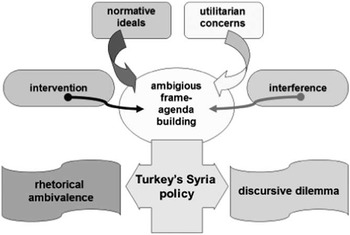
As articulated and substantiated in the previous sections, frame building and agenda setting co-constitute important facets of foreign policy discourses. By looking at how the crisis context and the agenda were mutually built by the discursive practices of Turkey’s foreign policy and opinion makers and reflected in Star and Yeni Şafak newspapers, this study has exposed the episodic evolution and thematic transformation of Turkey’s Syria policy. Critical deliberative (argumentative-dialectical) discourse analysis provided us with the evidence to witness, initially, the liminal logic wedged between the agendas of intervention and interference, and by extension to understand the subsequent shift from the former to the latter. Figure 1 provides a simple visual aid showing how the paradoxes were perpetuated in Turkey’s Syria policy.
Perpetuating paradoxes in Turkey’s Syria policy

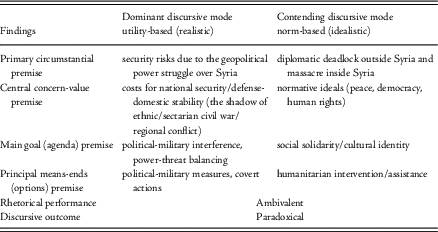
The study has rested on the assumption that the current and future state of affairs are and will be mutually constituted in critical episodes of frame and agenda building. By analyzing the critical episode of February 2012, this study has clarified how Ankara contextualized the Syrian crisis through ambivalent rhetorical frames, thereby pushing itself toward a liminal discursive position between intervention and interference. Due to the co-constitutive nature of frame and agenda building, Turkey’s discursive dilemmas contributed in different, and at times undesired, ways to what was going on in Syria. By way of conclusion, one can see the incoherent picture resulting from the incongruence between Turkey’s framings of contextual reasons (circumstantial premises) and its framing of rationality premises (prudential concerns vs. moral values) while deliberating over Syria policy. Table 3 presents the synopsis of the conclusions reached by this study.
Conclusions

To summarize, Turkey framed developments in Syria by using the label “massacre,” yet did not insist on a norm-based international military intervention, instead using moralistic rhetoric to justify its utilitarian strategy of regime change in Damascus. To that end, Ankara sought international and regional partners to mobilize the Syrian opposition so as to oust the Assad regime. To a certain extent, Turkey’s engagement with the Syrian opposition was justified by its casting doubt on and expressing frustration with the international framework. Turkey could not trust in the efficiency of the UN to resolve the Syrian crisis, nor could it directly control the emerging geopolitical battle over Syria. Warning against unilateral action by Turkey at a time of international (i.e., US) reluctance, emphasizing the spillover effects of the Syrian crisis, and citing its own domestic limitations were all rhetorical devices that helped shift Turkey’s Syria policy toward one of interference. In turn, this shift, rather than facilitating the declared end of regime change, only further exacerbated the crisis in Syria. The paradoxical choice of interference over intervention, independent of the conditions that had led to such a choice, began to reshape the dyadic context of the events in Syria. As the period of crisis became prolonged and interference became the dominant strategy, Turkey found itself in increasing difficulties—difficulties that it had itself helped to create during the critical February 2012 episode.