I. INTRODUCTION
In the past few decades, a large number of amorphous and nanocrystalline soft magnetic materials have been developed and studied extensively in both academia and industry. Reference McHenry, Willard and Laughlin1–Reference Leary, Ohodnicki and McHenry3 Applications such as motors, transformers, magnetic shields, sensors, and others are possible by utilizing these materials. Until now, most of the materials with the best soft magnetic properties contain boron (B). Reference McHenry, Willard and Laughlin1,Reference McHenry and Laughlin4 Boron (B) is often used as a glass former to improve the glass forming ability, thermal stability and prevent formation of undesirable large grains. Reference McHenry, Willard and Laughlin1,Reference McHenry and Laughlin4 It is also an important constituent in state of the art FeNdB permanent magnet systems. However, the high price of boron (B) results in expensive alloy production costs. This has led to some attempts to develop boron-reduced and boron-free alloys in the magnetics community.
Ramanan and Fish have investigated the effect of silicon (Si) substitution for boron (B) on the activation energy to crystallization in Fe-based amorphous alloys. Reference Ramanan and Fish5 This report builds on an earlier work of Donald and Davies who investigated activation energy barriers to primary crystallization with different metalloid glass formers. Reference Donald and Davies6 Chen et al. have studied the magnetic properties of Nd–Fe–B permanent magnets synthesized using boron carbide (B4C) as a precursor material Reference Chen, Liu, Geng, Zhao and Zhang7 following the reports by Sui et al. and Kou et al. who looked at the effects of carbon (C) substitution for boron (B) in this permanent magnet system. Reference Sui, Zhang, Xiao, Liu, Zhao, Zhao and Chuang8–Reference Kou, Sun, Chuang, Grossinger and Kirchmayr10 Other glass former substituents in the amorphous precursors to nanocomposite alloys have also been extensively studied and their role on crystallization kinetics and amorphous phase stability is of interest. Reference McHenry, Johnson, Okumura, Ohkubo, Hsiao, Ramanan and Laughlin11–Reference Butvinova, Butvin, Illekova, Svec, Vlasak, Janickovic and Kadlecikova14 The impact of boron-cost on nanocomposite alloys has driven efforts to find substituents for boron (B) in nanocomposite precursors. For example, silicon (Si) substitution for boron (B) also helps reducing the alloy production cost due to the significantly lower price of the former. 15,16 Okumura et al. and Zabransky et al. have explored this idea and looked at the structural, soft magnetic properties, and crystallization behavior of silicon-rich FINEMET. Reference Okumura, Laughlin and McHenry17,Reference Zabransky and Jiraskova18 More recently, Long et al. have reported a study on the structural and soft magnetic properties of a boron-free iron-rich alloy. Reference Long, Laughlin and McHenry19 In this system, zirconium (Zr) and silicon (Si) were used to prevent over-crystallization. After thermal annealing treatment, an optimum grain size and relatively low power loss of ∼10 nm and 19 W/kg, respectively, were observed.
Using silicon (Si), Reference Okumura, Laughlin and McHenry17,Reference Long, Laughlin and McHenry19 phosphorus (P), Reference Makino20 or mixture of glass formers Reference Makino, Kubota, Makabe, Chang and Inoue21 is common in bulk amorphous alloys to exploit the economic benefit of substitution for expensive boron (B). In iron-rich amorphous and nanocomposite materials, the economic benefit is not as large as in cobalt-rich materials. This is due to the readily available ferroboron (FeB) alloys, which reduce costs as compared with using elemental boron (B) as a raw material. 15,16 Nevertheless, boron (B) substitution can result in substantial alloy cost reduction. In cobalt-rich amorphous Reference Bordin, Buttino, Cecchetti and Poppi22–Reference Kurniawan, Roy, Panda, Greve, Ohodnicki and McHenry24 and nanocomposite alloys, Reference Ohodnicki, Park, McWilliams, Ramos, Laughlin and McHenry25–Reference Ohodnicki, Long, E Laughlin, McHenry, Keylin and Huth28 the cheaper ferroboron (FeB) additions cannot be made in alloys with insufficient iron (Fe) concentrations. Moreover, boron (B) content can vary significantly in ferrous alloys such as ferroboron (FeB). 29 This makes ferrous alloys unattractive for synthesis of cobalt-rich alloys with near-zero magnetostriction coefficient, which require precise control of the atomic ratio of the constituents. Reference McHenry, Willard and Laughlin1,Reference Makino, Bitoh, Kojima, Inoue and Masumoto30 Thus, it is important to identify other economical means to substitute elemental boron (B).
In this work, we investigated the effect of silicon (Si) substitution for boron (B) on the soft magnetic properties of cobalt-rich nanocomposite alloys. We also present here an alternative synthesis route to reduce the production cost significantly by boron carbide (B4C) substitution for elemental boron (B). Soft magnetic properties of the alloys (e.g., power loss, permeability, Curie temperature, etc.) with and without boron carbide (B4C) substitution are compared and discussed. A section discussing the effect of thermal annealing to improve the soft magnetic properties of these alloys is included. Finally, a cost analysis on alloy productions using various synthesis routes will be discussed as well.
II. EXPERIMENTAL DESIGN AND MEASUREMENT
Precursor ingots of 10 g were made using a MAM1 Edmund Buhler arc melter (Edmund Bühler GmbH, Hechingen, Germany). Soft magnetic ribbons were melt-spun in an argon atmosphere using an Edmund Buhler SC melt spinner. The synthesized ribbons were 20–40 μm thick and 1 mm wide. For core loss measurement, we used 0.5–1 g of produced ribbon placed in a homemade toroid of inner, outer diameter, and height of 2, 2.2, and 1 cm, respectively. High purity copper wire was used for primary and secondary winding with 20 turns for each. VITROVAC 6025 ribbons were thermal annealed in an argon atmosphere at 430 °C for 1 h using a Thermolyne 21100 tube furnace. Upon the completion of thermal annealing, the temperature was lowered down to 300 °C with a cooling rate of 4 °C/min before the ribbons were taken out of the tube furnace. A Walker LDJ Scientific Permeameter was used to measure the magnetic core loss while saturation magnetization and Curie temperature were measured in 300–900 °C temperature range with 398 kA/m applied magnetic field using Quantum Design Physical Property Measurement System (PPMS). Differential scanning calorimetry (DSC) measurement was carried out using a PerkinElmer DSC8500 at 20 °C/s heating rate to obtain the primary crystallization temperature from ∼10 mg of ribbon cut into small disks of diameter 5 mm. All the alloys with boron carbide (B4C) substitution exhibit slightly altered but nearly identical stoichiometry since boron (B) was replaced by boron (B4C) of an equal mass. For cost analysis, the prices of elements were gathered from the data available on www.metalprices.com 15 and www.metal-pages.com. 16 The purity and concentration of the constituents were taken into account in our calculation.
III. RESULTS AND DISCUSSION
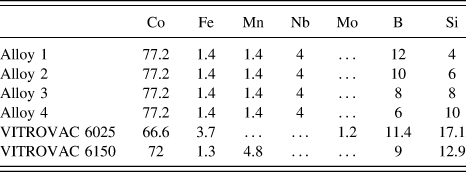
The chemical compositions of the four cobalt-rich alloys investigated in this work are summarized in Table I. The atomic concentration of cobalt (Co), iron (Fe), manganese (Mn), and niobium (Nb) is kept constant while boron (B) and silicon (Si) contents are varied from 12 to 6% and 4 to 10%, respectively. For boron carbide (B4C) substituted alloys, elemental boron (B) is replaced by boron carbide (B4C) of an equal mass, resulting in a nearly identical atomic stoichiometry due to the carbon (C) content. We used VITROVAC 6025 and 6150 as benchmark cobalt-rich alloys in this study due to their similar chemical compositions and the availability of their soft magnetic properties in the literature. 31–Reference Quintana, Amano and Valenzuela36 Neither silicon nor boron carbide (B4C) substitutions in Alloys 1–4, VITROVAC 6025 and 6150 has any effect on the castability and glass-forming ability of the ribbons. All the melt-spun ribbons were ductile, 20–40 μm thick, and 1 mm wide.
Chemical compositions of Alloys 1–4, VITROVAC 6025 and 6150. Alloys 1–4 have equal concentration of cobalt (Co), iron (Fe), manganese (Mn), niobium (Nb) while the boron (B) and silicon (Si) contents are varied. VITROVAC 6025 and 6150 are used as benchmark alloys in this work.

Soft magnetic properties of the as-cast Alloys 1–4 synthesized using both elemental boron (B) and boron carbide (B4C) are summarized in Table II. The table shows that boron carbide (B4C) substitution results in ribbons with comparable soft magnetic properties. However, it is interesting to note that the permeability (μ) of Alloys 1–4 decreases upon boron carbide (B4C) substitution while the saturation induction (B s) increases across the series. The effect of this substitution on the soft magnetic properties of VITROVAC 6025 and 6150 was observed to be less. For both of these cobalt-rich systems, we found that the soft magnetic properties had little variation with and without boron carbide (B4C) substitution. The parameters presented in Table II for VITROVAC 6025 and 6150 also agree with those published by Vacuumschmelze GmbH and Co. 31
Soft magnetic properties of the as-cast Alloys 1–4, VITROVAC 6025 and 6150. P loss, μ, H max, and H c were measured using a Walker LDJ Scientific Permeameter at f = 100 kHz and B max = 0.1 T. B s was measured using a Quantum Design PPMS.

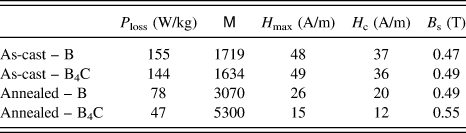
Thermal annealing near the crystallization temperature is necessary in some soft magnetic systems to improve their properties. Table III shows the improvement of VITROVAC 6025 ribbons upon thermal annealing at 430 °C for 1 h in an argon atmosphere. Also, it is interesting to note that VITROVAC 6025 with boron carbide (B4C) substitution exhibits a larger reduction in power loss (P loss) and an increase in permeability (μ) after thermal annealing compared to that without the substitution. Moreover, boron carbide (B4C) substitution also results in an increased saturation induction (B s) and significantly decreased coercivity (H c). These improved soft magnetic properties are particularly promising for applications with high frequency switching (transformers and high frequency motors) where lower power loss (P loss) and increased saturation induction (B s) will enable a reduction in size, weight, and cost of soft magnets. Future works will explore temperature treatments such as strain annealing (e.g., application of strain on magnetic ribbon while being annealed at elevated temperature) or field annealing (e.g., application of strong magnetic field on magnetic ribbon while being annealed at elevated temperature) to tailor and enhance these soft magnetic properties even further for specific applications. Reference Kernion, Leary, Shen, Luo, Grossman, Keylin, Huth, Lucas, Ohodnicki and McHenry37–Reference Ohodnicki, E Laughlin, McHenry, Keylin and Huth39
VITROVAC 6025 ribbons were annealed at 430 °C for 1 h in an Ar atmosphere using a Thermolyne 21100 tube furnace. Their soft magnetic properties are summarized below.

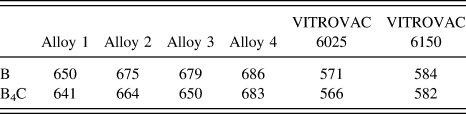
The primary crystallization temperatures (T x1) of Alloys 1–4, VITROVAC 6025 and 6150 are summarized in Table IV. With either elemental boron (B) or boron carbide (B4C), the primary crystallization temperatures (T x1) of Alloys 1–4 lie in 641–686 °C temperature range, while those of VITROVAC 6025 and 6150 are between 566 and 584 °C. The values obtained for VITROVAC 6025 and 6150 here show little difference with the data available in the literature. 31,Reference Quintana, Amano and Valenzuela36 For all the alloys investigated in this work, substitution of boron (B) by boron carbide (B4C) reduces the primary crystallization temperature (T x1) by 0.3–4%. The reduction in primary crystallization temperature (T x1) is small in Alloy 4 and VITROVAC 6150, while significant in Alloy 3.
Primary crystallization temperature (T x1) of the as-cast Alloys 1–4, VITROVAC 6025 and 6150. The numbers shown below are in centigrade (°C) and were obtained from DSC measurement with a heating rate of 20 °C/min.

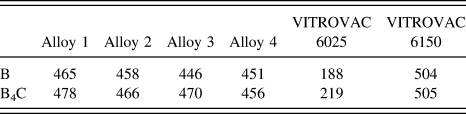
Another magnetic property that we investigated in this work was the Curie temperature (T C). Table V summarizes the Curie temperatures (T C) of Alloys 1–4, VITROVAC 6025 and 6150. Using elemental boron (B), Curie temperatures (T C) of Alloys 1–4 range between 446 and 465 °C. Opposite to the trend observed in the primary crystallization temperatures (T x1) data (Table IV), substituting boron carbide (B4C) for elemental boron (B) increases the Curie temperature (T C) for all the alloys investigated here. Similarly, Alloy 4 and VITROVAC 6150 exhibit the least change in Curie temperature (T C) upon boron carbide (B4C) substitution, while the increase was observed to be the largest in Alloy 3 and VITROVAC 6025. The variations in the Curie temperature (T C) of all the alloys are from 0.2 to 16%. Increase in Curie temperature (T C) approaching or exceeding 10% can positively benefit the high temperature performance of these soft magnetic materials in applications such as magnetic shields and sensing devices for harsh environments (e.g., deep drilling, oil and gas fracking). Reference Kurniawan, Roy, Panda, Greve, Ohodnicki and McHenry24
Curie temperature (T C) of the as-cast Alloys 1–4, VITROVAC 6025 and 6150. The numbers below are in centigrade (°C). Ribbons of 1 cm long and 20–40 μm thick were used for M(T) measurement with 398 kA/m applied field.

To the best of the authors' knowledge, there has been no published study on the boron carbide (B4C) substitution for elemental boron (B) in soft magnetic materials. However, Chen et al., Sui et al., and Kou et al. have studied the effect of boron carbide (B4C) and carbon (C) substitution for boron (B) in permanent Nd-magnet. Reference Chen, Liu, Geng, Zhao and Zhang7–Reference Kou, Sun, Chuang, Grossinger and Kirchmayr10 Similar to the results from our cobalt-rich soft magnetic alloys in this work, Nd2Fe14(B0.8C0.2) system exhibits magnetic properties comparable to those of Nd2Fe14B system. While the Curie temperature (T C) was found to slightly decrease from 320 to 300 °C, a coercivity (H c) as high as 1456 kA/m was observed upon boron carbide (B4C) substitution in Nd2Fe14B. Reference Chen, Liu, Geng, Zhao and Zhang7 Curie temperature (T C) is, however, a large concern in high temperature applications of Nd–Fe–B permanent magnets. Reference Yan, Chen, Ding, Guo, Lee and Yan40 In such alloys, ternary substitutions for boron (B), such as nitrogen (N) or phosphorus (P), may be warranted to both reduce the alloy cost and maintain or increase the Curie temperature (T C) through promoting distributed exchange interactions Reference Gallagher, Willard, Zabenkin, Laughlin and McHenry41 and enhanced localized iron (Fe) moments. Reference Turgut, Ferguson, Huang, Wallace and McHenry42 In nanocomposite magnets, the properties of the magnetic materials are intimately related to the chemical portioning of various species between phases, e.g., amorphous and nanocrystalline phases. Reference Ping, Wu, Hono, Willard, McHenry and Laughlin43–Reference DeGeorge, Deveraj, Keylin, Cui and McHenry45 In future work, it will be useful to identify the relative portioning of boron (B) and carbon (C) and determine the optimum stoichiometry in the multiple phases in nanocomposite magnets. Reference Kernion, Miller, Shen, Keylin, Huth and McHenry46
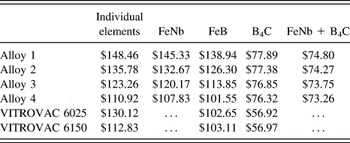
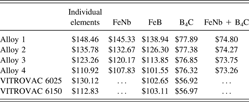
The production costs of Alloys 1–4, VITROVAC 6025 and 6150 using different raw materials are summarized in Table VI. The cost analysis here considers alternative synthesis routes using readily available boron carbide (B4C) and ferrous alloys such as ferroniobium (FeNb) and ferroboron (FeB). On the other hand, we found that the cobalt counterparts (e.g., cobalt niobium, cobalt boride, etc.) are relatively rare in the commodity market. Boron (B) is the most expensive component here at ∼$1323/kg while boron carbide (B4C) is significantly cheaper at only $10/kg. 15,16 Although boron (B) typically makes up for only 10 at.% in both amorphous and nanocrystalline soft magnets, it can account for up to 69% of the total alloy cost due to its much higher price relative to the other constituents. Boron carbide (B4C) is a commodity used for various engineering applications such as protective shields, armors, and bulletproof vests due to its excellent physical hardness. Reference Domnich, Reynaud, Haber and Chowalla47–Reference Niihara, Nakahira and Hirai50 Ferroniobium (FeNb) and ferroboron (FeB) substitutions also lower the alloy production cost due to their cheaper market price at $52.36/kg and $4.63/kg, respectively, compared to those of niobium (Nb) ($132.45/kg) and elemental boron (B). 15,16
Production costs of Alloys 1–4, VITROVAC 6025 and 6150 using pure elements and several available precursor alloys (e.g., ferroniobium, ferroboron, and boron carbide). The weight percentage of niobium (Nb) in ferroniobium (FeNb) and boron (B) in ferroboron (FeB) used in this analysis is 65 and 18.48%, respectively. 15 The numbers below are in US dollar per kilogram ($/kg).

Keeping the concentration of all constituents constant, by reducing boron (B) content from 12 to 6% and increasing the silicon (Si) content from 4 to 10%, Alloy 4 can be made 34% cheaper than Alloy 1. For Alloys 1–4, substituting ferroniobium (FeNb) for niobium (Nb) reduces the cost by 2–3%, while substituting ferroboron (FeB) for boron (B) results in 6–8% cheaper alloys. A significant cost reduction of 31–48% can be achieved by substituting boron carbide (B4C) for boron (B). However, by combining two substitutions, ferroniobium (FeNb) for niobium (Nb) and boron carbide (B4C) for boron (B), even further cost reduction of 34–50% can be realized. Ferroniobium (FeNb) substitution cannot be applied to VITROVAC 6025 and 6150 since these materials do not contain niobium (Nb). Our calculation shows that boron carbide (B4C) substitution in commercially available VITROVAC 6025 and 6150 results in a substantial 56 and 50% cost reduction, respectively. The processing route presented here will be beneficial when applied to other boron (B) containing amorphous and nanocrystalline soft magnetic systems, especially those with very high boron (B) content (>10%). Reference Lu, Huang, Chen, Ma and Laughlin51–Reference Lin, Tien and Chin55 The resulting cost reduction, as shown in our analysis here, will increase their market competitiveness.
IV. SUMMARY
We present here an attractive alternative alloy substituent route to produce soft magnets with comparable soft magnetic properties yet at a significantly cheaper production cost. Substituting boron carbide (B4C) for boron (B) reduces the production cost of the cobalt-rich alloys investigated in this work by almost 50%. We have applied the idea on the commercially available VITROVAC 6025 and 6150 alloys and found that the produced soft magnetic ribbons exhibit nearly identical soft magnetic properties to those produced without boron carbide (B4C) substitution. While the primary crystallization temperatures decreased with boron carbide (B4C) substitution, Curie temperatures were found to increase in all the alloys studied here, with the largest increase of 16% observed in VITROVAC 6025. The effect of thermal annealing was found to lower the power loss and increase the permeability of VITROVAC 6025 more significantly in boron carbide (B4C) substituted alloy, which is promising for high frequency switching applications such as transformers and high speed motors. Future works will explore other post synthesis treatments such as strain annealing or field annealing to improve the soft magnetic properties even further. It will also be interesting to investigate these boron carbide (B4C) substituted soft magnetic materials using advanced microstructural probes to evaluate the relative partitioning of boron (B) and carbon (C) in multiphase nanostructures. Similarly, our cost analysis calculation shows a significant cost reduction of 69 and 26% in iron-rich FINEMET and NANOPERM, respectively, with boron carbide (B4C) substitution. The idea explored in this work can be applied to a wide range of other magnetic materials to achieve significant alloy cost reduction while maintaining good magnetic properties.
ACKNOWLEDGMENTS
M.E.M. and M.K. acknowledge the support from the Army Research Laboratory (Contract No. W911NF-14-1-0184) and M.E.M. acknowledges the support from the Wright Patterson Air Force (Contract No. FA8650-12-D-2225). This report was prepared as an account of work sponsored by an agency of the United States Government. Neither the United States Government nor any agency thereof, nor any of their employees, makes any warranty, express or implied, or assumes any legal liability or responsibility for the accuracy, completeness, or usefulness of any information, apparatus, product, or process disclosed, or represents that its use would not infringe privately owned rights. Reference herein to any specific commercial product, process, or service by trade name, trademark, manufacturer, or otherwise does not necessarily constitute or imply its endorsement, recommendation, or favoring by the United States Government or any agency thereof. The views and opinions of the authors expressed herein do not necessarily state or reflect those of the United States Government or any agency thereof.