INTRODUCTION
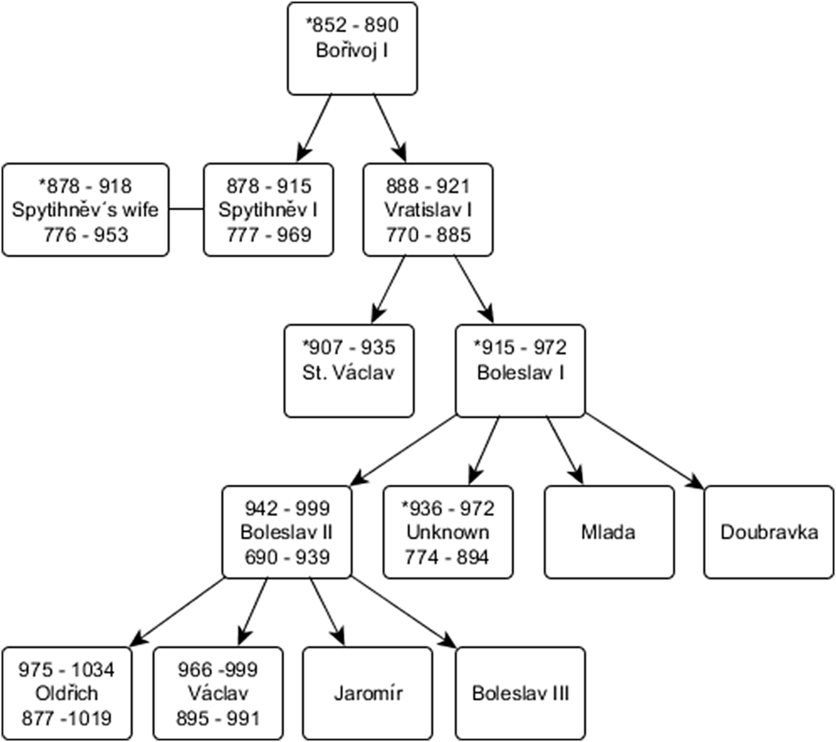
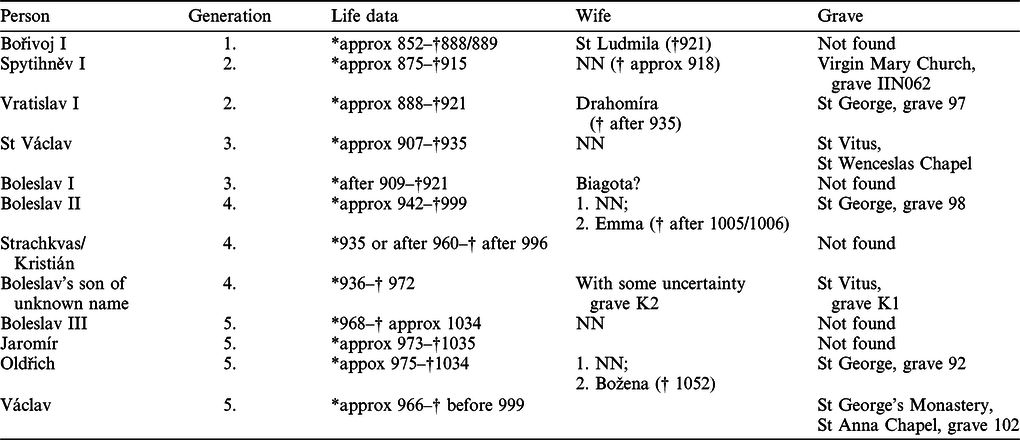
The oldest ruling dynasty in medieval Bohemia, later the Kingdom of Bohemia, was the Přemyslid (about 880–1306 AD). Historians have been acquainted with their personal fate and physical appearance since the 19th century (Bláhová et al. Reference Bláhová, Frolík and Profantová1999). The historical information was obtained by the work of archaeologists and anthropologists in the course of the 20th century. In the current project, attention was focused on the five oldest generations of the Přemyslids (Figure 1 and Table 1). In Figure 1, the years above the names have a historical origin while the years under the names originate from radiocarbon (14C) dating.
Genealogical tree of the Přemyslid family spanning the five oldest generations.

Male members of the first five generations of the Přemyslid family. Most life data are derived with varying degrees of probability, by Polanský (Reference Polanský2009).

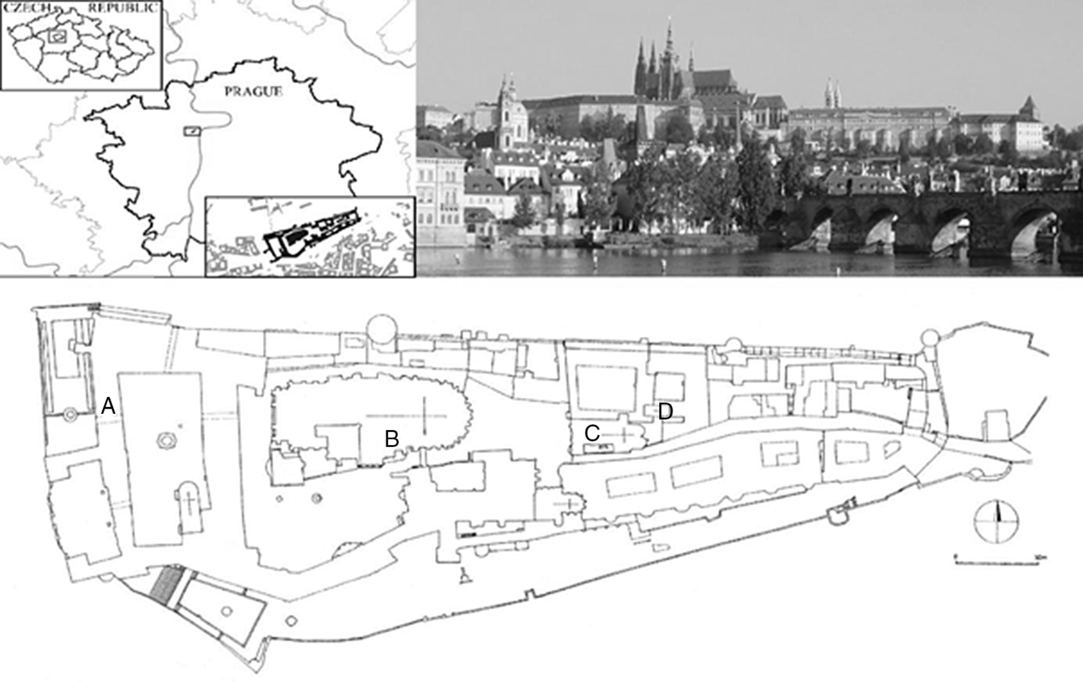
The burials revealed by an archaeological investigation in the center of the early Czech state, i.e., in the Prague Castle, starting in 1911, have become a center of the research. All Přemyslids of the studied period were buried in the church buildings of the Prague Castle. Archaeological research conducted in the Church of the Virgin Mary, St George’s Basilica and Cathedral of St Guy/Vitus, the three oldest churches within the Prague Castle complex, has discovered the skeletal remains of three members of the second generation (Spytihněv I/† 915/, his wife/† 918/ and brother Vratislav I/† 921/), two members of the fourth generation (Boleslav II/ † 999/ and his brother of unknown name/† before 972/) and two members of the fifth generation (Oldřich/† 1034/ and his non-ruling brother Václav/† before 999/) (Figure 2).
Location of the Prague Castle (in the upper-left corner); view of the castle from the south (in the upper-right corner) and the ground plan of the castle complex (below). A) Church of the Virgin Mary with grave IIN062; B) St Guys rotunda (today Cathedral) with grave K; C) St George’s Basilica with graves 97 and 98; D) Chapel of St Anne in St George’s Monastery, grave 102. Created by J. Frolík.

The main objective is to determine the correct identity of the buried individuals, given that none of the examined graves was marked. 14C dating has proven to be a useful tool in this regard, as the data thus obtained could be compared with historical records and anthropological estimates of lifespan of the studied individuals. Therefore, a comparative method is applied to analyze the following three variables: historical lifespan data of the oldest Přemyslids, anthropological lifespan estimations, and results of 14C dating of skeletal remains. Subsequently, based on these data, the skeletal remains are assigned to the historical figures to whom they most closely matched.
To verify if the studied human remains belong to the discussed members of the Přemyslid dynasty, it is necessary to get a more accurate idea of their age, and to investigate the levels of relatedness between the individuals. In this article, we present new 14C dates of the remains, assuming that the data with a wider dating interval would create a logical sequence that would at least support the identification of some graves. For the purpose of the most accurate dating results, we conducted analysis of carbon and nitrogen stable isotopes for diet reconstruction, and subsequently used this data for estimation of freshwater reservoir effect (FRE).
Historical and Archaeological Background
There are hardly any contemporary reports on the funerals of the Přemyslids, with the exception of the first Czech Saints (St Ludmila/† 921/, 1st generation and Duke St Václav/Wenceslas/† 935/, 3rd generation) (Třeštík Reference Třeštík1997) whose remains are not accessible for analyses. The events surrounding the death and funeral of Duke Oldřich († 1034, 5th generation) have been preserved only as a mention of the ducal funeral in the chronicle of Kosmas (Bretholz Reference Bretholz1923).
The place of burial of the other rulers (Spytihněv I, Vratislav I, Boleslav I, Boleslav II) has not been documented in any of the early medieval written sources, however, some mentions appeared later in high middle ages, as is the case of Duke Vratislav I († 921, 2nd generation), mentioned to be buried in the Basilica of St George in 15th century, as its founder (Borkovský Reference Borkovský1975). A similar tradition dated to the 14th century is associated with Boleslav II († 999, 4th generation), who was buried in the same basilica (Borkovský Reference Borkovský1975).
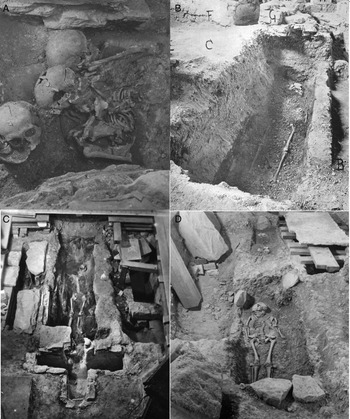
The burial sites in the Church of the Virgin Mary (grave IIN062, Duke Spytihněv I and his wife—Figure 3/A), in the interior of the rotunda of St Vitus (graves K1 and K2, the eldest son of the Duke Boleslav I and his wife—Figure 3/B) and in St George’s Basilica (grave 92—Oldřich; grave 97—Vratislav I, grave 98—Boleslav II—Figure 3/C) in Prague Castle were interpreted as royal. Grave 102 (Václav) from the interior of the Chapel of St Anne in the monastery of St George (Figure 3/D) was also included in the study group (Frolík Reference Frolík2005).
A) Church of the Virgin Mary, grave IIN062, ducal couple on the top and in the middle; younger secondarily removed skull on the left; B) Rotunda of St Vitus, grave K1; C) St George’s Basilica, grave 98; D) St George’s Monastery, Chapel of St Anne, grave 102. A, C and D—Institute of Archaeology of the CAS, archive of Prague Castle excavations. B—by Vlček Reference Vlček1997.

Archaeological findings have yielded little unambiguous knowledge for determining the identity of the deceased. The woman buried in tomb IIN062 was equipped with jewelry the usage of which should not be later than around 930 (Frolík Reference Frolík2015). Thus, the only possible interpretation regarding the Přemyslid family is that the remains belong to Duke Spytihněv I and his wife of unknown name (Smetánka et al. Reference Smetánka, Vlček and Eisler1983). Grave 98 contained a fragment of a silk string from around the year 1000. The grave is connected with Boleslav II (Bravermanová et al. Reference Bravermanová, Dobisíková, Frolík, Kaupová, Stránská, Svetlik, Vaněk and Velemínskýin press). Tomb 102 (Václav, 5th generation) in the Chapel of St Anne contained fragments of pottery from the 10th century. The chapel was built after the founding of the monastery in 976. Grave K1 in the interior of St Vitus was dug after the relocation of the remains of St Wenceslas in the year 938 and were covered by the floor laid during the reconstruction of the rotunda in the period between 1031 and 1039 (Bravermanová et al. Reference Bravermanová, Dobisíková, Frolík, Kaupová, Stránská, Svetlik, Vaněk, Velemínský and Votrubová2018). Guide for correct classification for the independent timing of grave 92 and 97 is missing.
The man in grave K1 died between the ages of 30 and 40 years, which proves that the remains could not belong to Duke Boleslav I (Bravermanová et al. Reference Bravermanová, Dobisíková, Frolík, Kaupová, Stránská, Svetlik, Vaněk, Velemínský and Votrubová2018). The discovery of low lifespan of the man in K1 and subsequently of the man in grave 102 in the Chapel of St Anne turned attention to the non-ruling Přemyslids. Based on these facts, grave K1 dated to 950 was attributed to the eldest son of unknown name (4th generation) of Duke Boleslav I (Bravermanová et al. Reference Bravermanová, Dobisíková, Frolík, Kaupová, Stránská, Svetlik, Vaněk, Velemínský and Votrubová2018). Grave 102 was attributed to the youngest (?) son of Duke Boleslav II, Václav/Wenceslas (5th generation).
MATERIAL AND METHODS
Sampling
For all destructive analyses performed in this study (stable isotopes and 14C dating), the samples were taken preferentially from ribs with the intent to use the same types of bone in each case for the analysis as well as to preserve anthropologically important bones. In grave K2, where the ribs were absent, a fragment of femur was sampled.
Bone Collagen Isolation for 14C and Stable Isotope Analyses
Bone samples were cleaned mechanically by a grinder, and then ultrasonically in demineralized water. Bone collagen for the isotopic analysis was extracted following the Longin (Reference Longin1971) method as modified by Bocherens (Reference Bocherens1992) in the laboratory CRL of the Nuclear Physics Institute (NPI) of the Czech Academy of Sciences (CAS) (14C analyses) and in the Department of Anthropology, National Museum, Prague (analyses of stable isotopes).
Radiocarbon Dating
The samples of dry collagen were placed into quartz tubes containing a prebaked oxidation agent (CuO) and torch-sealed under dynamic vacuum. The samples were combusted for a minimum of 6 hr in a muffle furnace heated to 900°C. The tubes were then cooled, cracked and CO2 was cryogenically transferred into an assembled Pyrex glass tube reactor with the appropriate reagents. A subsequent graphitization step was performed in the sealed Pyrex tubes using powdered Zn and Fe (Rinyu et al. Reference Rinyu, Molnár, Major, Nagy, Veres, Kimák, Wacker and Synal2013, Reference Rinyu, Orsovszki, Futó, Veres and Molnár2015; Orsovszki and Rinyu Reference Orsovszki and Rinyu2015). The resulting graphites were torch-sealed below the top of the inner reactor tube (through the wall of the outer tube, without opening it) to avoid contamination by the atmospheric 14CO2. The outer parts of the reactor were then removed and the sealed inner tube with graphite was packed for transport. Measurement of the graphites was performed in the MICADAS facility in the Hertelendi Laboratory of the Environmental Studies (DebA), Institute of Research Excellence in Debrecen, Hungary (Molnár et al. Reference Molnár, Janovics, Major, Orsovszki, Gönczi, Veres, Leonard, Castle, Lange, Wacker, Hajdas and Jull2013a, Reference Molnár, Rinyu, Veres, Seiler, Wacker and Synal2013b; Rinyu et al. Reference Rinyu, Molnár, Major, Nagy, Veres, Kimák, Wacker and Synal2013). The measured activities of 14C and the corresponding uncertainties were reported in years BP of convential radiocarbon age (CRA), following the Stuiver-Polach convention (Reference Stuiver and Polach1977). Actual typical uncertainties of 14C analysis of recent samples (one sigma, using AMS measurement, without additional corrections for freshwater reservoir effect or bone collagen remodeling) usually does not exceed 20 years BP of CRA. However, the samples of Oldřich and Boleslav I, dated several years ago, have greater uncertainties (34 yr BP) due to worse parameters of AMS measurement at this time.
The calibration software OxCal 4.2 was used to determine the sample age intervals. Considering the available data, the 14C calibration curve IntCal13 was chosen (Bronk Ramsey and Lee Reference Bronk Ramsey and Lee2013; Reimer et al. Reference Reimer, Bard, Bayliss, Beck, Blackwell, Ramsey, Buck, Cheng, Edwards, Friedrich, Grootes, Guilderson, Haflidason, Hajdas, Hatté, Heaton, Hoffmann, Hogg, Hughen, Kaiser, Kromer, Manning, Niu, Reimer, Richards, Scott, Southon, Staff, Turney and van der Plicht2013). After assigning uncertainties using the 14C calibration curve, the conventional 14C age and its combined uncertainty were converted to the interval (intervals) of calibrated age (Stuiver and Polach Reference Stuiver and Polach1977; Curie Reference Curie1995).
Analyses of Stable Isotopes
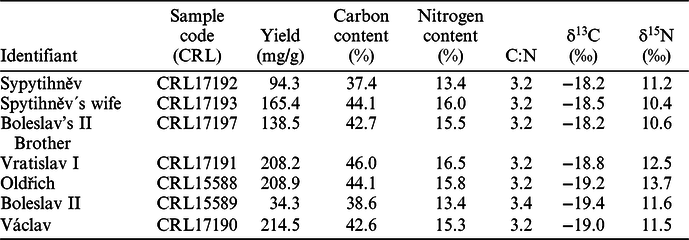
Elemental analyses were performed using a Europa Scientific EA elemental analyzer connected to a Europa Scientific 20-20 IRMS for carbon and nitrogen isotope analysis at Iso-Analytical Limited, Crewe (UK). The uncertainty of the stable isotope analyses, calculated on the different standard replicates, was less than 0.2‰ (1-σ uncertainty) for nitrogen and 0.1‰ for carbon. In the data presented in Table 2, the mean 1 σ for duplicates was even better than 0.1‰.
Results of stable isotopes analysis.

RESULTS AND DISCUSSION
The main objective of the stable isotope analysis was to track freshwater fish in the diet of the assessed individuals to analyze the extent of the freshwater reservoir effect (Philippsen Reference Philippsen2013). This effect can result in a seemingly higher 14C-dated age of samples usually due to fossil carbonates dissolved in water. These fossil carbonates are assimilated by water plants and then transferred by food chain to animals as well as to humans.
In present study, dietary analysis based on the stable isotopes revealed a notable portion of freshwater fish in the diet of Oldřich (ca. 14% of dietary input) and Vratislav I (ca. 7%). The remaining individuals consumed terrestrial diet without a substantial input of fish.
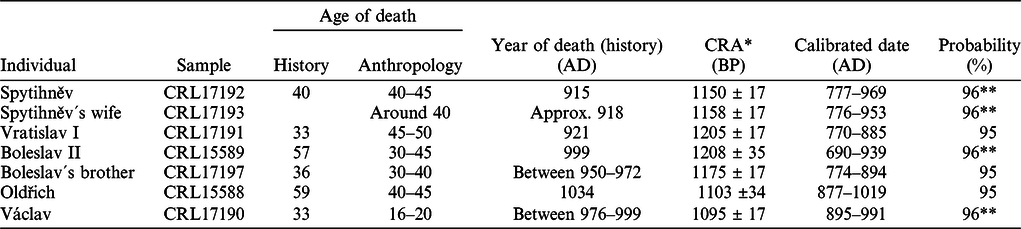
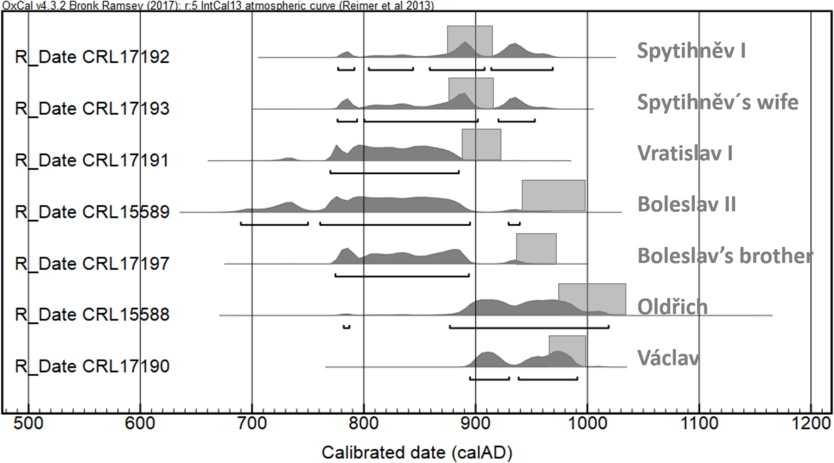
Table 3 summarizes the results of the 14C dating, historical dates and anthropological estimation of the age of death. How it is evident from resulting intervals of the calibrated age, results for Vratislav I, Boleslav II, Boleslav´s brother and Oldřich are outlying from intervals (2 σ) of 14C dating.
Results of 14C analysis and dating interpretation, historical dates and anthropological estimation.

* Uncertainties correspond to one sigma interval.
** Composed interval.
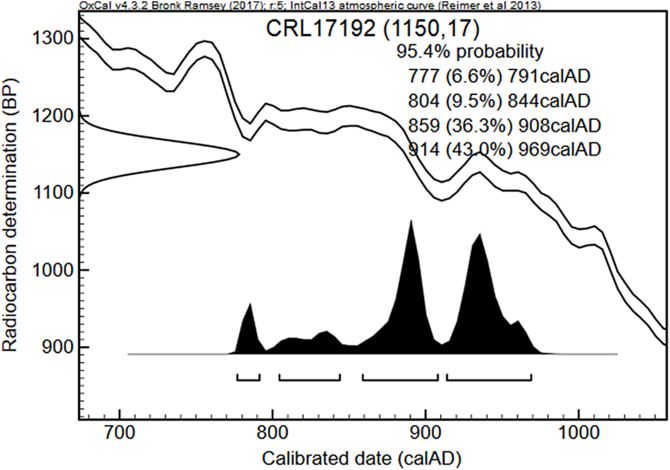
An example of the calibration, including relevant part of IntCal13 is included (Duke Spytihněv: Figure 4).
Calibration of Duke Spytihněv including relevant part of IntCal13 curve.

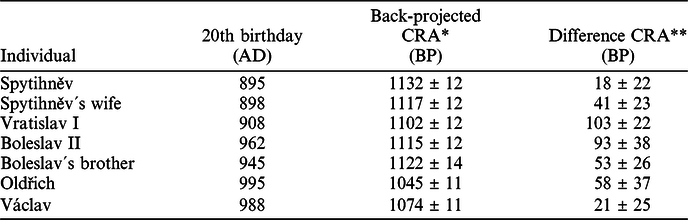
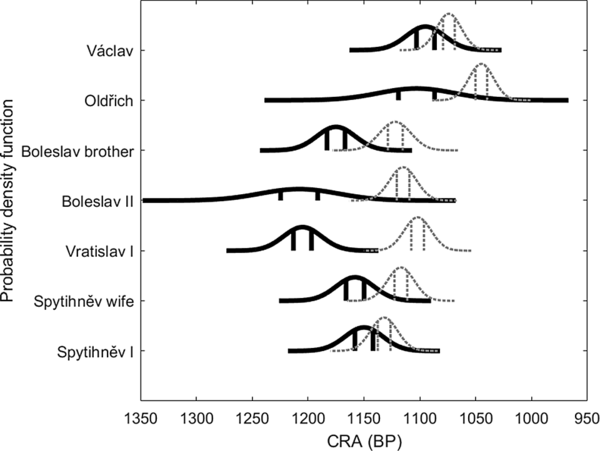
We can assume the time difference between the date of death (Table 3 and Figure 5) and the mean date of bone collagen origin (Table 4) is a result of collagen remodeling during life of a given human. Such differences can reach even several decades in the case of older individuals (Handlos et al. Reference Handlos, Svetlik, Horáčková, Fejgl, Kotik, Brychova, Megisova and Marecova2018). Human bone collagen representing the age of puberty (Geyh Reference Geyh2001; Bárta and Štolc Reference Bárta and Štolc2007). Let us consider bone collagen samples of twenty years old individuals (using historical year of dead and historical and anthropological age) and back-project them on the IntCal13 curve to obtain the corresponding 14C activities. The uncertainty (one sigma) of the back-projected CRA is, in such case, delivered from the uncertainty of the IntCal13 calibration curve. The back-projected 14C activities are systematically higher in comparison to the measured activities (Figure 6). Correction for bone collagen remodeling was not calculated in the case of Václav, due to his young age, about 20 years.
Reported intervals of calibrated age for 2-σ intervals of 14C analyses compared with lifetime of studied individuals (grey boxes).

Hypothetic dating of bone collagen on 20th birthday of the individuals.

* Back projection of the year of 20th birthday from IntCal13.
** Difference between the measured CRA (Table 3) and the back-projection of the year of 20th birthday. The uncertainty (1 sigma) includes the uncertainty of the measured CRA, the back-projected uncertainty, uncertainty equals to 8 years for collagen remodeling, and the uncertainty of the death eventually.
The comparison of probability density functions of the measured CRA (black) and the backprojected CRA of hypothetical bones of 20-year-old individuals (gray) using curves of normal distribution. Each line covers 4-σ intervals.

Subsequently, the differences of the conventional 14C age for the results of the analysis as well as for the values derived from the calibration curve for the year of death corresponding to the age of 20, were calculated. Moreover, the combined uncertainties of the differences (1 sigma) considering the partial uncertainties given by the measurement, the calibration curve, the estimation of correction for bone collagen remodeling (8 years each) and the uncertainty of the time of death in the case of intervals resulting from historical sources (half of the interval at this case).
All calculated differences have a positive value (i.e. observed 14C activities are lower than expected according the data derived from historical sources, even after considering the correction for bone collagen remodeling), as is indicated also by the comparison in Figures 5 and 6. We aimed for the most plausible interpretation of the observed difference, assuming the pretreatment part of the 14C analyses was sufficient for removal of contaminants and all individuals were correctly identified and connected with historically known age of death.
The largest difference was observed in the case of Vratislav I (103 ± 22 yr), which can be explained by the significant representation of fish in his diet (7%), as stated before. Therefore, a considerable part of the observed uncertainty can be attributed to the FRE and other possible systematic influence on the result is not quantifiable. The second largest difference observed concerns Boleslav II (93 ± 38 yr). However, an increased representation of fish in the duke’s diet has not been proven. For this reason, the difference cannot be justified by the FRE nor by our other initial assumptions.
The next three results concerning Spytihněv’s wife, the eldest son of Boleslav I and Oldřich have been calculated with an uncertainty close to the 2-σ margin. In the case of Oldřich it has been proven that fish accounted for 14% of his diet and thus could have contributed to the uncertainty. As for the last two results regarding Spytihněv and Václav, the differences were the smallest, around 1-σ uncertainty margin.
Systematic positive differences were observed in all cases, despite the corrections made, preceded by bone collagen remodeling and examination of fish intake. It is therefore appropriate to focus on the possible cause of these differences. It can be assumed that the diet of members of the noble family differed from the diet typical for the given historical period and could have included foodstuffs difficult to obtain or unavailable to the common people. Economic reasons, as well as ritual reasons resulting from the customs and rules of the ducal curia of those times, may have been the cause of the dietary differences. A nobleman’s diet might have, therefore, included, for example, archival wine and long-term stored foodstuffs such as dried meat, pulses and grain. To a lesser extent, fish affected by larger FRE might have also been present in the diet of the other studied individuals. A slightly reduced 14C content can be expected in long-term stored foodstuffs.
Excluding the most extreme values of differences (Boleslav II) and individuals with proven higher fish intake (Vratislav I, Oldřich), we get an average systematic difference for the remaining four individuals of 33 yr BP with an estimated uncertainty of approximately 17 yr BP.
Observed systematic differences offers an alternative explanation. A recently published study by McDonald et al. (Reference McDonald, Chivall, Miles and Bronk Ramsey2018) focused on the seasonal variations of 14C activity in pre-industrial tree rings and its impact on the calibration curve, describes that parts of tree rings formed during the spring (early wood) have rather lower 14C activities than the tree rings formed during the summer (late wood). This topic was covered even before by Kromer et al. (Reference Kromer, Manning, Kuniholm, Newton, Spurk and Levin2001). Despite this proved significant variation, the articles focused on 14C calibration curves worked simply with tree rings without distinguishing between early and late wood (Reimer et al. Reference Reimer, Baillie, Bard, Bayliss, Beck, Bertrand, Blackwell, Buck, Burr, Cutler, Damon, Edwards, Fairbanks, Friedrich, Guilderson, Hogg, Hughen, Kromer, McCormac, Manning, Ramsey, Reimer, Remmele, Southon, Stuiver, Talamo, Taylor, van der Plicht and Weyhenmeyer2004, Reference Reimer, Baillie, Bard, Bayliss, Beck, Blackwell, Ramsey, Buck, Burr, Edwards, Friedrich, Grootes, Guilderson, Hajdas, Heaton, Hogg, Hughen, Kaiser, Kromer, McCormac, Manning, Reimer, Richards, Southon, Talamo, Turney, van der Plicht and Weyhenmeyer2009, Reference Reimer, Bard, Bayliss, Beck, Blackwell, Ramsey, Buck, Cheng, Edwards, Friedrich, Grootes, Guilderson, Haflidason, Hajdas, Hatté, Heaton, Hoffmann, Hogg, Hughen, Kaiser, Kromer, Manning, Niu, Reimer, Richards, Scott, Southon, Staff, Turney and van der Plicht2013; Hogg et al. Reference Hogg, Hua, Blackwell, Niu, Buck, Guilderson, Heaton, Palmer, Reimer, Reimer, Turney and Zimmerman2013). This is the reason why it cannot be specified for which part of the period of growth the 14C calibration curve IntCal13 is more relevant. The spring season diet can be used as a possible explanation (at least partially) for observed small systematic differences, because of the lower 14C activities expected during this part of the year. Some types of food that correspond more to the spring than to the summer period (of the plant and also animal origin) should therefore be represented by a lower 14C activity than 14C activity in the three-rings used for the construction of the 14C calibration curve. The question of relationship between 14C content in tree rings and the atmospheric 14C has become a huge topic recently. Furthermore, for some time, an opinion prevailed that the atmospheric 14C is instantly used while the tree ring grows, but recently several studies showed that 14C could be stored and could remobilize later; this effect could be significant especially in the periods corresponding to slope parts of calibration curve. This is a problem that we know too little about concerning the “annual behavior” of this nonstructural carbon (Keel et al. Reference Keel, Siegwolf and Kötner2006; Dietze et al. Reference Dietze, Sala, Carbone, Czimczik, Mantooth, Richardson and Vargas2014; Gessler and Treydte Reference Gessler and Treydte2016).
Despite the observed differences, which did not exceed 100 years in these cases (excluding Boleslav II), 14C dating can provide only limited help as a tool for individual identification for the purpose of studying medieval Přemyslids dukes’ graves. For example, the grave of K1 (possibly of a son of unknown name of Duke Boleslav I) and grave 98 (possibly of Boleslav II) from 4th generation could be assigned to the 2nd generation. The grave 92 (possibly of Oldřich) and 102 (possibly of Václav) from 5th generation may belong to the 4th or 3rd generation based strictly on the 14C data. Further, from the anthropological studies, it is difficult to connect the skeletal or dental age with the calendar age. Archaeology is problematic too because there were hardly any artifacts in the graves for an accurate archaeological dating. The destructive analytical methods are unsuitable due to the poor state of preservation of the bones and at the same time because of an effort not to excessively damage the remains of the Přemyslids.
Several years ago, both 14C analysis using radiometric methods and the AMS methods had only provided uncertainties of above 30 yr BP of CRA for recent samples. Hence, the smaller differences of 14C dating with magnitude of several decades were almost hidden by relatively wider interval/intervals of dating results. Nowadays, AMS measurements approach uncertainties of 10 yr BP (using helium stripper gas) and so the differences become significant (Bronk Ramsey et al. Reference Bronk Ramsey, Higham and Leach2004; Synal et al. Reference Synal, Schulze-Konig, Seiler, Suter and Wacker2013).
CONCLUSION
The results of the 14C dating clearly point to several problems connected to the analysis of medieval anthropological and archaeological samples. First, it has interpretative potential for retrospective scientific branches. A wide dating range is sufficient for prehistory assemblages, however, relatively recent case study or effort to build a genealogical medieval tree is quite problematic or simply impossible. More accurate 14C dating results without significant discrepancies would be a benefit to such cases. Recent results of AMS-based analyses of 14C provide substantially smaller uncertainties than several years ago. However, some interfering effects arise from the reduction of the analysis uncertainties. Using historical and anthropological data, we have proposed an additional correction and estimated connected uncertainty, which is probably almost entirely caused by diet composition. Unfortunately, the correction proposed is connected only with the period studied and for food intake specific to Přemyslid dukes in the Bohemian region. It could be beneficial to compare this correction with similar results from abroad. It is important to quantify these effects properly or connect them with adequate uncertainties (e.g.: freshwater reservoir effect, age of bone collagen, other diet influences, fine possible discrepancies given by calibration curve). The specification of tree-ring data used for the construction of the 14C calibration curves and for the determination of early and late wood share in the given time intervals would be an advantage.
In this article, we discussed possible influences, which could have caused the observed differences between the 14C dating and the data from historical sources. 14C dating represents a useful tool for medieval archeologists with the potential to provide more accurate results, especially in combination with other dating/verification possibilities, using both archeological data and results of anthropology, history or genetics. This research on the medieval graves and the related genealogical trees of the Přemyslid dynasty is a fine example of when the 14C dating cannot stand alone but the results have to be corrected with the relevant corresponding uncertainties.
ACKNOWLEDGMENTS
This study was supported by the project of the Czech Science Foundation 14-36938G “Mediaeval Population in the Centre and Country: Archaeology, Bioarcheology and Genetics of Cemeteries of Prague Castle, Central and Eastern Bohemia”, and by OP RDE, MEYS, under the project “Ultra-trace isotope research in social and environmental studies using accelerator mass spectrometry”, Reg. No. CZ.02.1.01/0.0/0.0/16_019/0000728 and by the project of the Charles University Grant Agency No. 852119.