The probability of regime survival, especially in authoritarian regimes, is not only affected by the threat of a possible external opposition to a regime, but also, if not mainly, its internal enemies (Svolik Reference Svolik2012). However, some leaders, like Fidel Castro in Cuba, stay in office for decades without facing any domestic (successful) challenge to their rule; others, like Tito Okello in Uganda, on the other hand, are forced by an internal opposition to move out of office only after few months in power. Some state leaders thus seem to be able to deal with internal threats more effectively than others.
Usually, rulers can secure and prolong their survival by appeasing their supporters via the provision of a mix of private and public goods, depending on what portion of the society is essential for a regime’s survival (Bueno de Mesquita et al. Reference Bueno de Mesquita, Smith, Siverson and Morrow2004). Leaders might also pursue other strategies such as co-opting possible opponents (Wintrobe Reference Wintrobe1998), repressing internal threats (Davenport Reference Davenport2007), or—what we focus on in this article—strategies that directly seek to address the likelihood of a coup d’état, i.e., coup-proofing. Specifically, coup-proofing pertains to political leaders’ strategies that shall prevent groups inside or outside the state apparatus from seizing power via a coup d’état (Luttwak Reference Luttwak1969; Feaver Reference Feaver1992; Quinlivan Reference Quinlivan1999). In this research, we study one particular form of these strategies, counterbalancing, which divides a country’s military into rivaling organizations, thereby creating an artificial balance between and structural obstacles for the armed forces (Quinlivan Reference Quinlivan1999; Belkin and Schofer Reference Belkin and Schofer2003; Belkin and Schofer Reference Belkin and Schofer2005; Pilster and Böhmelt Reference Pilster and Böhmelt2011; Pilster and Böhmelt Reference Pilster and Böhmelt2012; Böhmelt and Pilster Reference Böhmelt and Pilster2015).Footnote 1
A general (implicit) assumption of the literature is that a ruler’s decision to adopt a certain level of coup-proofing is mostly led by a domestic process and influenced by domestic factors. Consequently, coup-proofing has been empirically evaluated as a policy output independent from the behavior of and events in other regimes (Quinlivan Reference Quinlivan1999; Belkin and Schofer Reference Belkin and Schofer2003; Belkin Reference Belkin2005; Belkin and Schofer Reference Belkin and Schofer2005; Pilster and Böhmelt Reference Pilster and Böhmelt2012). In light of this, while we argue that the level of coup-proofing implemented by a government is in fact influenced by events and factors at the domestic level, it is unlikely to be driven by domestic information alone. Given the uncertainty surrounding policies and their outcomes, regimes may want to avoid “trial-and-error” decision processes (Waltz Reference Waltz1979) and instead pursue policies based on their best information (see Sabatier Reference Sabatier1999).
The costs at stake for leaders are too high in the context of coup-proofing as wrong policy choices could lead to highly negative outcomes. For example, McGowan (Reference McGowan2006, 15) describes politics in West Africa between 1960 and 2004 as a zero-sum game “shown by what happened to many of these leaders when they lost power or thereafter: 14 (19.2 percent) were killed, 17 (23.3 percent) were exiled, and 21 (28.8 percent) were arrested.” It may thus seem plausible that rulers seek to exploit all possible sources of information for the implementation of coup-proofing policies, which makes it unlikely that this is based on domestic information only (Most and Starr Reference Most and Starr1990; Dolowitz and Marsh Reference Dolowitz and Marsh2000; Elkins and Simmons Reference Elkins and Simmons2005; Simmons, Dobbin and Garret 2006; Franzese and Hays Reference Franzese and Hays2008; Gilardi Reference Gilardi2010; Gilardi Reference Gilardi2012).
Policy diffusion, which Strang (Reference Stinnett, Tir, Schafer, Diehl and Gochman1991, 325) defines as the process by which “prior adoption of a trait or practice in a population alters the probability of adoption for remain non-adopters,” might affect states’ counterbalancing efforts. In this article, we shed light on this aspect both theoretically and empirically. Leaders can “take cues from what is happening to other leaders in neighboring countries” (Goldsmith Reference Goldsmith2001, 78), or as we extend and contend, a country’s level of counterbalancing is likely to be affected by other nations’ policies in this regard—if there are strong interlinkages between them (and not just mere geographical interdependence). We capture these linkages with the membership in “peer groups” (see also Neumayer, Plümper and Epifanio Reference Neumayer, Plümper and Epifanio2014), i.e., countries might compare their policy levels and adjust their counterbalancing policies according to those states that have similar circumstances, perceptions, and threat levels.
We argue that information about coup-proofing policies is more important for those regimes that could face a higher coup risk compared with those that have a rather low likelihood of government overthrow. In other words, states differ in the risk to see a coup and those states with a rather low coup propensity are unlikely to respond to the coup-proofing policies of countries with a high coup risk; only states facing high coup risk form a peer group, which then allows for the diffusion of counterbalancing policies. Ultimately, we suggest that rulers, when striving for information to learn about and emulate the proper level of counterbalancing, can opt for an “institutional peer group,” where countries share similar regime settings, or an “experiential peer group,” where rulers learn from countries with a similar coup-track record.
In the next section, we theoretically elaborate on how leaders might decide to implement coup-proofing for their own survival based on external events and other leaders’ strategic decisions. We then evaluate the implications of our theory as we empirically examine how peer group membership as captured with either non-democratic regime similarity (institutional peer group) or a comparable coup history (experiential peer group) influences the diffusion of a state’s counterbalancing level to another country. By combining time-series cross-section data on counterbalancing between 1976 and 2005 (Pilster and Böhmelt Reference Pilster and Böhmelt2011; Pilster and Böhmelt Reference Pilster and Böhmelt2012) with single spatial lag (Franzese and Hays Reference Franzese and Hays2007; Franzese and Hays Reference Franzese and Hays2008) and multiparametric spatiotemporal autoregressive (m-STAR) models (Hays, Kachi and Franzese Reference Hays, Kachi and Franzese2010), the findings suggest that a peer effect does indeed exist for the experiential peer group.
Coup-Proofing as a Policy Decision
Coup-proofing pertains to a set of different pre-emptive policies against coups d’état. While state leaders may substitute different techniques to a certain degree, coup-proofing of an institutional or structural form is the crucial element of any coup-proofing approach (Quinlivan Reference Quinlivan1999; Belkin Reference Belkin2005, 23; see also Pilster and Böhmelt Reference Pilster and Böhmelt2011; Pilster and Böhmelt Reference Pilster and Böhmelt2012, 359). As indicated above, this counterbalancing divides a country’s military manpower into competing organizations in order to limit power centralization in the hands of possible antagonists, thereby making co-ordination more difficult between the armed forces (Quinlivan Reference Quinlivan1999; Pilster and Böhmelt Reference Pilster and Böhmelt2012, 357; see also Belkin and Schofer Reference Belkin and Schofer2003; Belkin and Schofer Reference Belkin and Schofer2005; Pilster and Böhmelt Reference Pilster and Böhmelt2011).Footnote 2
Due to various other, non-coup-related negative consequences such as a higher risk of civil war (e.g., Roessler Reference Roessler2011) or lower military effectiveness for fighting external threats (e.g., Pilster and Böhmelt Reference Pilster and Böhmelt2011), coup-proofing is characterized by a trade-off—although it may eventually be effective in preventing coups. Put differently, a regime has the choice of either not investing in counterbalancing, which avoids suffering from the non-coup-related negative consequences, but this may increase the risk of a coup; or it chooses to implement a possibly effective tool for regime survival that nonetheless may induce several negative implications in other contexts. Hence, both costs and benefits are associated with coup-proofing, and the risk for a regime to implement the wrong policy, i.e., a wrong level of counterbalancing, is critical in this context, given the highly negative impact coups might have (e.g., imprisonment, exile, or death of the incumbent). When assuming that leaders primarily seek choosing the most effective polices to maximize their chances of political survival (Bueno de Mesquita et al. Reference Bueno de Mesquita, Smith, Siverson and Morrow2004), it is unlikely that leaders pursue a “trial-and-error strategy” as the error could be fatal (Waltz Reference Waltz1979). Hence, rulers may not exclusively base their decision on information from the domestic arena.
The conundrum for a leader and the survival of his political regime is thus about information: to what extent and from where can a regime get a sufficient amount of information on the best policy—in our case, the best level of counterbalancing—to increase the probability of survival and minimizing non-coup-related negative consequences? Factors at the domestic level, such as previous coups, the strength of the military, or economic conditions can provide information here (Belkin and Schofer Reference Belkin and Schofer2003; Belkin and Schofer Reference Belkin and Schofer2005; Pilster and Böhmelt Reference Pilster and Böhmelt2011; Pilster and Böhmelt Reference Pilster and Böhmelt2012). However, we argue that external information on counterbalancing stemming from other states may also be a major source of influence. Regimes are likely to compare their counterbalancing policy implementations with other, similar countries in order to decide how to minimize the built-in negative consequences of coup-proofing.
When subscribing to this claim, we should observe what has been defined as international policy diffusion, which “occurs when government policy decisions in a given country are systematically conditioned by prior policy choices made by other countries” (Simmons, Dobbin and Garret 2006, 787). Of course, few scholars have assumed that countries are independent units, and therefore may not be affected by the behavior of other states. It was only recently, however, that scholars began to theoretically elaborate on this assumption of interdependence (e.g., Elkins and Simmons Reference Elkins and Simmons2005) and the empirical implications thereof (e.g., Gleditsch and Ward Reference Gleditsch and Ward2006; Franzese and Hays Reference Franzese and Hays2007). In light of this, our main goal is to develop a theoretical framework for how a state’s level of coup-proofing could be influenced by other countries’ coup-proofing policies, conditional on the interdependence between them, and to empirically evaluate the associated mechanisms. Specifically, we argue that the diffusion of counterbalancing policies is likely to primarily work via learning and emulation in what we call “peer groups” (Neumayer, Plümper and Epifanio Reference Neumayer, Plümper and Epifanio2014), i.e., countries that are particularly coup-prone compare their counterbalancing level with those that have a similar risk of experiencing a coup d’état, and adjust their own counterbalancing policy based on this external peer group information.
Counterbalancing, State Interdependence, and Peer Group Effects
The policy diffusion literature highlights particularly two causal mechanisms for how diffusion might occur that are relevant to our study: learning and emulation (e.g., Most and Starr Reference Most and Starr1990; Dolowitz and Marsh Reference Dolowitz and Marsh2000; Elkins and Simmons Reference Elkins and Simmons2005; Simmons, Dobbin and Garret 2006; Gilardi Reference Gilardi2010; Gilardi Reference Gilardi2012). First, learning is a rational process in which actors “confronted with the uncertainty of difficult policy decisions […] gain information simply by observing the results of particular policies in other countries” (Meseguer Reference Meseguer2005, 72). Hence, due to a high amount of uncertainty associated with the optimal level of coup-proofing, states might rely on “the experience of others to estimate the likely consequences of policy change” (Gilardi Reference Gilardi2012, 463). Though, the crux is who are the “others” and “what to observe.” Second, according to emulation, states simply copy the majority behavior of others inferring from “the sheer number of followers […] that this might be the best thing to do” (Holzinger and Knill Reference Holzinger and Knill2005, 784; Gilardi Reference Gilardi2012, 466f).Footnote 3 For instance, a state converges to a specific level of coup-proofing, simply because a critical number of other states already have this position. Informational “herding” arises in situations where agents observe the actions of others and then, seemingly disregarding their own information, pursue the majority action (Gilardi Reference Gilardi2012, 467). A country may thus follow other states, because it is believed that these are better informed.
These two mechanisms suggest the diffusion of coup-proofing, i.e., a specific state in question also takes over other states’ counterbalancing policies—however, only if there are strong ties between these two. The crucial point is, therefore, that spatial dependence or links between states must exist so that coup-proofing policies can diffuse, because these links facilitate learning and emulation (see also Most and Starr Reference Most and Starr1990; Elkins and Simmons Reference Elkins and Simmons2005; Gilardi Reference Gilardi2010; Gilardi Reference Gilardi2012, 460f; Ward and Cao Reference Ward and Cao2012). In the following, we elaborate on the possible explanatory mechanisms of coup-proofing diffusion based on learning and emulation (see also Braun and Gilardi Reference Braun and Gilardi2006). Our core argument states that the counterbalancing policy of other countries can influence coup-proofing “at home” if interdependencies exist that induce learning and emulation. As we contend, these interdependencies or links either pertain to an “institutional peer group,” where countries share similar non-democratic regime settings, or an “experiential peer group,” where rulers learn from countries with a similar coup-track record.
Specifically, governments may make decisions based on a strategic interdependence with and information flows from their peers (see Neumayer, Plümper and Epifanio Reference Neumayer, Plümper and Epifanio2014), i.e., countries that are coup-prone compare their counterbalancing level with those with a similar risk of experiencing a coup d’état. For instance, regimes could implement counterbalancing policy decisions from abroad due to common events and shared characteristics they have with these other regimes, as Merton’s (Reference Merton1968) theory of social comparison stresses the role of a reference group. This mirrors our mechanisms of emulation and learning: learning from and emulating similar countries’ policies “is one of the simplest and most effective cognitive heuristics in the calculation of utilities” (Elkins and Simmons Reference Elkins and Simmons2005, 45). Leaders constantly face difficult decisions under uncertainty and they thus tend to use “cognitive shortcuts” by comparing their circumstances, preferences, and policies with peers (Kahneman, Slovic and Tversky Reference Kahneman and Tversky1982; see also Rosenau Reference Rosenau1990, 213). These shortcuts are essentially heuristics—shorthand guides to rational action that are prone to give reasonable results (Kahneman and Tversky Reference Kahneman, Slovic and Tversky1979; Gale and Kariv Reference Gale and Kariv2003, 22). We suggest that such a heuristic could be based on a “peer-decision rule,” which predicts that actors rely on similar states to help determine their policies (Neumayer, Plümper and Epifanio Reference Neumayer, Plümper and Epifanio2014). Therefore, we argue that interdependence is not a mere geographical aspect, but a “peer group” learning and emulation mechanism. Rulers focus on those countries that can be identified as similar in their coup d’état risk, they observe peers’ counterbalancing policies. On one hand, leaders can do this by selecting information from regimes with similar institutions, and hence those with a similar structural coup risk (institutional peer group), or, on the other hand, from countries that have a similar coup history (experiential peer group).
Against this background, the first peer group effect can be related to an institutional signaling device: regime type. State leaders may screen other countries with a similar institutional setting, which in turn carry a similar structural coup risk, in order to make educated decisions on the apt counterbalancing policy. Therefore, the first set of peers comprises states that share common institutional characteristics that make them particularly prone to coups, i.e., non-democratic regimes. For instance, Pilster and Böhmelt (Reference Pilster and Böhmelt2012) examine civil–military relations in the form of counterbalancing in both democracies and authoritarian states. Their core argument is based on a “principal-agent logic and claims that coup-proofing is both a relatively less attractive and necessary instrument for democratic principals” (Pilster and Böhmelt Reference Pilster and Böhmelt2012, 355). In line with this, it is found that authoritarian regimes are those that both face a higher coup risk and are more likely to implement coup-proofing strategies than their democratic counterparts (see also Böhmelt and Pilster Reference Böhmelt and Pilster2015). When subscribing to this result, non-democratic states form an institutional peer group among which learning and emulation in terms of counterbalancing might occur. As a result, we derive the hypothesis on an “institutional peer group” effect where coup-proofing efforts are more likely to diffuse among non-democratic states:
INSTITUTIONAL PEER GROUP HYPOTHESIS: A non-democracy’s coup-proofing level is positively influenced by other non-democracies’ coup-proofing polices.
The second network that facilitates learning and emulation pertains to an experiential peer group. Rulers not only have to decide whether and how to implement a policy, but, related to this, also when it is the right moment for such an implementation. Hence, the value of counterbalancing might be lower in certain times and higher in others—independent from the structural or institutional coup risk we described above, but dependent on others’ counterbalancing policies in light of one’s own coup history and the history of others. As Goldsmith (Reference Goldsmith2001, 78) states, “when an outcome is doubtful over time, it makes sense to mark down its present value.” In other words, rulers could discount the benefit of counterbalancing if they cannot individuate a “dynamic” peer group, which would allow learning from others’ coup-proofing policies in light of new events that can change the discount rate these leaders may employ. In these terms, a structural heuristic not based on actual and recent events is less useful than learning from networks based on real coup instances in one’s own country and others. The “institutional peer group” could thus be too static and non-democratic regimes may be a non-optimal signaling device for following the relevant “peer group” when seeking to determine the right, inter-temporal counterbalancing policy.
Hence, we extend the mechanism of learning and emulation to a more temporally dynamic “peer group” that is based on similar coup experience. Specifically, a peer group in this context, which we label “experiential peer group,” is formed when states have a similar coup history, i.e., have experienced coups in their past (Neumayer, Plümper and Epifanio Reference Neumayer, Plümper and Epifanio2014). The testable hypothesis follows that rulers learn from and emulate the counterbalancing policies of those states that have a similar coup experience as their own country:
EXPERIENTAL PEER GROUP HYPOTHESIS: A state’s coup-proofing level is positively influenced by countries’ coup-proofing polices if both have experienced coups in their past.
So far, we did not consider the outcomes or the success rate of coups as part of the learning and emulation process in the context of peer groups. The reason for this is that the previous literature has not (yet) reached consensus on whether actors are more likely to learn from success or failure, i.e., whether it is successful coups that overthrow a government or unsuccessful ones where a current leader is able to stay in power, which influence one’s own (counterbalancing) policies. On one hand, according to the diffusion literature, it is primarily success that matters for learning and emulation processes (e.g., Bennett Reference Bennett1991; Lee and Strang Reference Lee and Strang2006; Dobbin, Simmons and Garrett Reference Dobbin, Simmons and Garrett2007; Gilardi Reference Gilardi2012). That is, only if counterbalancing was effective at home and in other counties, a peer group is formed that facilitates learning and emulation. On the other hand, recent research from the literature on cognitive heuristics also considers how “positive or negative” experiences can influence people’s information selection and, thus, learning and emulation (e.g., McDermott, Fowler and Smirnov Reference McDermott, Fowler and Smirnov2008). In this literature, negative experiences, as in our context a successful coup d’état where the domestic opposition does indeed overthrow a current ruler, could have a stronger cognitive effect than a positive experience, i.e., a government survives and counters a coup attempt (see Baumeister et al. Reference Baumeister, Bratslavsky, Finkeuer and Vohs2001). For example, Khong (Reference Khong1992) focuses on leaders’ decision making and their heuristic shortcuts in light of a peer group reference. It is found that it is basically negative factors that tend to have a stronger impact on learning and emulation, and, in turn, decision making.
In light of these opposing arguments and findings, it follows that, in addition to the relevant informational challenge to process information of failed versus successful coups (Kebschull Reference Kebschull1994), rulers may not be able to neatly disentangle the experiential peer group on outcomes, but they elaborate their policy making in more general terms of coup experience in their own state and other countries, i.e., what we claim in our second hypothesis (see McDermott Reference McDermott1998). However, although we do not formulate an ex ante hypothesis on the possible direction of learning and emulation within the “experiential peer group” based on ties between countries stemming from negative or positive events, we take this into account in our empirical analysis.
Research Design
Data and Dependent Variable
We use Pilster and Böhmelt’s (Pilster and Böhmelt Reference Pilster and Böhmelt2011; Pilster and Böhmelt’s Reference Pilster and Böhmelt2012) time-series cross-section data that, in the latest version, comprise information on 198 states’ levels of counterbalancing between 1970 and 2014. As emphasized by Belkin (Reference Belkin2005, 29; see also Quinlivan Reference Quinlivan1999), the “counterbalancing of forces is likely to be the central element of any coup-proofing approach” (Pilster and Böhmelt Reference Pilster and Böhmelt2012, 359). Moreover, Pilster and Böhmelt (Reference Pilster and Böhmelt2012, 359) (see also Pilster and Böhmelt Reference Pilster and Böhmelt2011) highlight that, “compared with other strategies, institutional coup-proofing has the advantage that it does not only manipulate the military’s disposition to intervene, but that it also checks the ability of any other military organization to engage in a coup d’état.” The omnipresence of this counterbalancing is finally supported by several empirical studies (e.g., Goldsworthy Reference Goldsworthy1980, 73; Janowitz Reference Janowitz1977, 3f). After accounting for missing values on our explanatory variables that are explained below, our final data include 145 states while the country-year constitutes the unit of analysis.Footnote 4 The temporal domain covers the period from 1976 to 2005, but with varying years under study by country. Ultimately, the final data set consists of 3497 observations.
For the dependent variable in our analyses, we employ the counterbalancing variable by Pilster and Böhmelt (Reference Pilster and Böhmelt2012, 395f) (see also Pilster and Böhmelt Reference Pilster and Böhmelt2011) that measures the “effective number of ground-combat compatible organizations.” Specifically, this item incorporates “information on both the number of rivaling military organizations and their respective strengths to capture the degree to which a state divides its military manpower into rivaling organizations” (Pilster and Böhmelt Reference Pilster and Böhmelt2012, 360). For that purpose, Pilster and Böhmelt (Reference Pilster and Böhmelt2012, 359f; Pilster and Böhmelt Reference Pilster and Böhmelt2011), first, coded all ground-combat compatible military organizations of a country. Afterwards, information on the personnel in each of these organizations has been compiled, focusing on regulars and active reserves, but excluding standing reserve forces. Finally, the level of a state’s counterbalancing policy in the form of the effective number of military organizations is calculated via the measure proposed by Laakso and Taagepera (Reference Laakso and Taagepera1979):
 $$Effective\,Number\,of\,Military\,Organizations_{{it}} ={1 \over {\mathop{\sum}\limits_j {S_{{jit}}^{2} } }},$$
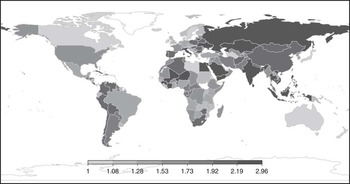
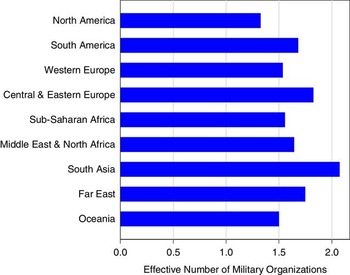
where s jit is the personnel share of the ground-combat compatible military or paramilitary organizations j in country i in year t (Pilster and Böhmelt Reference Pilster and Böhmelt2012, 361). A value of 1 of the variable consequently stands for “only one effective ground-combat military organization, while higher values signify that rivaling military organizations do exist. The higher the value of that measure, the higher the effective number of military organizations in a country. This in turn signifies higher institutional coup-proofing efforts in the form of creating an artificial balance between various rivaling military organizations” (Pilster and Böhmelt Reference Pilster and Böhmelt2012, 361). Figures 1 and 2 give an overview of the distribution of Effective Number of Military Organizations in our data set.
Average levels of Effective Number of Military Organizations worldwide, 1976–2014

Average level of Effective Number of Military Organizations by regions, 1976–2014 Note: coding of regions according to Correlates of War Project (Stinnett et al. Reference Strang2002).

Methodology: Spatial Maximum Likelihood (S-ML) Regression Models
Given our theoretical argument and the distribution of the dependent variable, spatial temporal autoregressive (“spatial lag”) models seem appropriate. When including a temporal next to the spatial lag, these models are defined as:
 $$y_{t} =\phi y_{{t{\minus}1}} {\plus}{\rm }X_{t} \beta {\plus}\rho Wy_{{t{\minus}1}} {\plus}{\varepsilon}, $$
where y t is the dependent variable, y t−1 signifies the temporally lagged dependent variable, X t pertains to the set of control variables and the constant, ε the error term, and Wy t−1 stands for the product of a row-standardized connectivity matrix (W) and the temporally lagged dependent variable (y t−1), i.e., Wy t−1 is a spatial lag. In terms of time-series cross-sectional data, the connectivity matrix W is given by a NT×NT matrix (with T N×N sub-matrices along the block diagonal) with an element w i,j capturing the relative connectivity of unit (country) j to unit (country) i. The spatial lag then represents a weighted average of all other observations (excluding a respective country under study), with each weight specified by w i,j , while the spatial coefficient ρ captures the strength of interdependence.
We row standardize each connectivity matrix so that the estimated values of ρ reflect the average influence of other states (excluding a respective country under study), i.e., “the spatial lag is a weighted average of the lagged dependent variable in other units” (Plümper and Neumayer Reference Plümper and Neumayer2010, 428f). Row standardization not only induces that a spatial lag has the same metric as the dependent variable, but also that the spatial lag’s coefficient is directly interpretable as the “approximate strength of interdependence” (Franzese and Hays Reference Franzese and Hays2008, 35; Plümper and Neumayer Reference Plümper and Neumayer2010, 429f). That said, row standardization is based on the theoretical assumption that states “exert an influence that becomes proportionally smaller the larger the number” of countries in the international system one is influenced by or connected with (Plümper and Neumayer Reference Plümper and Neumayer2010, 430), i.e., the actors involved divide their attention across other states in proportion to perceptions of their relevance, which is governed by the interlinkages (and their strength) between them.
Several estimators have been proposed for time-series cross-section spatial lag models (Elhorst Reference Elhorst2003; Beck, Gleditsch and Beardsley Reference Beck, Gleditsch and Beardsley2006; Franzese and Hays Reference Franzese and Hays2007; Franzese and Hays Reference Franzese and Hays2008). We employ S-ML regression models.Footnote 5 In order to rule out the possibility of common exposure, i.e., spatial clustering that is not driven by states’ interdependence, we control for a number of relevant alternative influences such as “exogenous-external conditions or common shocks and spatially correlated unit level factors” (Franzese and Hays Reference Franzese and Hays2007, 142). We thus follow Franzese and Hays (Reference Franzese and Hays2008) or Ward and Cao (Reference Ward and Cao2012) by including a temporally lagged dependent variable, country fixed effects, and year fixed effects. While the temporally lagged dependent variable captures any existent time dependencies more generally, year fixed effects control for temporal shocks that are common for all states in a given year. Finally, country fixed effects control for idiosyncratic path dependencies and other forms of cross-sectional heterogeneity. Note, however, that some of our control variables that we present below are almost time invariant; given the fixed effects in our models, this could induce an inefficient estimation of their coefficients (Plümper and Troeger Reference Plümper and Troeger2007). Ultimately, the temporally lagged dependent variable, country fixed effects, year fixed effects, and the full set of control variables (described below) make it more credible that contagion “cannot be dismissed as a mere product of a clustering in similar [state] characteristics” (Buhaug and Gleditsch Reference Buhaug and Gleditsch2008, 230; see also Plümper and Neumayer Reference Plümper and Neumayer2010, 427).
Core Explanatory Variables: Spatial Lags
For the operationalization of the key explanatory variables, i.e., spatial dependence via membership in institutional or experiential peer groups, we rely on three different spatial lags (e.g., Franzese and Hays Reference Franzese and Hays2007; Franzese and Hays Reference Franzese and Hays2008; see also Beck, Gleditsch and Beardsley Reference Beck, Gleditsch and Beardsley2006; Ward and Gleditsch Reference Ward and Gleditsch2008). The first one captures the possible linkage between states via institutional peer groups as we rely for its operationalization on the finding that democracies are likely so invest substantially less in coup-proofing, while non-democratic regimes (autocracies and anocracies) are characterized by higher counterbalancing efforts (Pilster and Böhmelt Reference Pilster and Böhmelt2012). Hence, a dyad of non-democracies should share common norms and preferences toward counterbalancing, which in turn leads to the “membership” in a common peer group and induces spatial dependence. Hence, we assign each element w i,j of the non-democracy connectivity matrix the value of 1 if both states in a dyad are non-democratic in a given year (0 otherwise). Non-democratic states are defined according to the combined polity scale of the Polity IV Project (Marshall and Jaggers Reference Marshall and Jaggers2013): both states in a dyad must score the value of +6 or lower on this scale that originally ranges in (−10 (fully autocratic); +10 (fully democratic)); otherwise, a dyad is treated as jointly democratic or mixed and receives the value of 0 for each element w i,j .Footnote 6 This spatial lag ranges in (0; 2.0359) with a mean value of 1.0496, while 2103 observations in our sample are connected to each other.
Second, in terms of experiential peer group effects, we define states’ peer groups and, hence, their ties via a common history of coups d’état. According to our theory, states are less affected by countries outside their experiential peer group, i.e., those that do not have a similar and joint history of coups; but dependence should be more strongly given for states within this group (Neumayer, Plümper and Epifanio Reference Neumayer, Plümper and Epifanio2014). We use two spatial lags to this end that capture coup onsets and coup outcomes, respectively, while the data for this are taken from Powell and Thyne (Reference Powell and Thyne2011). On one hand, we assign the absolute difference in years since the last coup attempt (if any) to the elements w i,j of the connectivity matrix for the coup-onset experiential peer group (WyCoups All). That is, it seems plausible that dependence decays with time. Moreover, we only assign this absolute difference to the elements w i,j as soon as soon as both states in a dyad have jointly experienced at least one coup onset in their past; before that, either none of the two states in a dyad has seen a coup attempt or only one of them and we assign the value of 0, indicating that these states are not experiential peers. For instance, Suriname has seen its first coup attempt in 1980 according to Powell and Thyne (Reference Powell and Thyne2011) data; Argentina, on the other hand, has experienced coups d’état in 1975 and 1976 (and several ones before that). Hence, while the value of w i,j =0 is assigned for the period before 1980 to this dyad, we assign the absolute difference in years since the last coup attempt to the elements w i,j as of 1980 (e.g., 3 for 1980 in this case due to an absence of a coup in 1977, 1978, and 1979). In order to facilitate the interpretation of this spatial lag, we re-scaled positive values of it so that higher values pertain to a shorter absolute difference in years since the last coup. Put differently, we ultimately use the inverse of the absolute difference in the years-since-coup for pairs of states that have both experienced a coup. The value of 0 is unaffected by this recoding, though, i.e., it still signifies no connection between two states as they do not belong to the experiential coup peer group. The final variable ranges in (0; 1.9469) with a mean value of 0.5148, while 1052 observations in our sample have “neighbors,” i.e., are connected.
On the other hand, we take the same operationalization as in the case of WyCoups All, but only take into account failed coup attempts, i.e., cases in which the government was successful in defeating the opposition and the ruler remained in power. Specifically, we assign the absolute difference in years since the last failed coup attempt (if any) to the elements w i,j of the connectivity matrix for the coup-outcome experiential peer group (WyCoups Outcome). Again, we only assign this absolute difference to the elements w i,j as soon as both states in a dyad have jointly experienced at least one failed coup onset in their past; before that, we assign the value of 0 as either none of two states in a dyad has seen a failed coup attempt or only one of them, or there were successful coups, i.e., the opposition was able to overthrow the government. Similar to WyCoups All, we also re-scaled the values of this spatial lag’s connectivity matrix so that higher values signify a shorter absolute distance in years since the last failed attempt (except 0). The final variable of this spatial lag ranges in (0; 2.0235) with a mean value of 0.5249, while 1052 observations in our sample are connected to each other.
We introduce the spatial lags separately into our models as including more than one might lead to “biased estimates of spatial effects as the single lag included partly acts as a proxy for others” (Ward and Cao Reference Ward and Cao2012, 1091). But we also present results for m-STAR models (Hays, Kachi and Franzese Reference Hays, Kachi and Franzese2010). These m-STAR models allow for a simultaneous inclusion of spatial lags, while controlling for the case where connectivity, i.e., the selection into a network, is endogenous to our dependent variable. While we expect a positive spatial coefficient ρ for WyNon-Democracy and WyCoups All, the impact of WyCoups Outcome depends on whether the diffusion literature or the literature on cognitive heuristics is more valid in our context (see discussion above).
Control Variables: Alternative Determinants of Counterbalancing
We also include a number of control variables, which may affect our dependent variable, in order to avoid omitted variable bias. Moreover, when examining a spatial diffusion effect, one has to account for other factors that may be “both spatially clustered and potentially related” to unit characteristics (Buhaug and Gleditsch Reference Buhaug and Gleditsch2008, 216; see also Plümper and Neumayer Reference Plümper and Neumayer2010, 427). Put differently, the spatial effects we argue for could simply be driven by a corresponding distribution of relevant domestic characteristics associated with counterbalancing and there is a “reverse Galton’s problem” (Buhaug and Gleditsch Reference Buhaug and Gleditsch2008) that we must address by considering relevant unit attributes that may be both spatially clustered and potentially related to our dependent variable. Following Pilster and Böhmelt (Pilster and Böhmelt Reference Pilster and Böhmelt2011; Pilster and Böhmelt Reference Pilster and Böhmelt2012), we focus on variables capturing a state’s domestic and international “threat configurations” that are other major determinants of coup-proofing.
First, Pilster and Böhmelt (Reference Pilster and Böhmelt2011) show that states’ attention is likely to shift to external threats in the presence of a challenging international security environment, which induces smaller investments in coup-proofing. In order to control for this, we include the variable Total Wars, which counts the numbers of wars a state has been involved in until the year under study. The data for this variable are taken from the Correlates of War Project (Sarkees and Wayman Reference Sarkees and Wayman2010).
Second, internal threats such as insurgencies frequently lead to a stronger involvement of the military in domestic affairs (Pilster and Böhmelt Reference Pilster and Böhmelt2012, 363): “[i]nward-oriented military organizations, in turn, are significantly more likely to attempt to overthrow political principals, which increases the benefits of coup-proofing for the latter” (Staniland Reference Staniland2008; see also Welch Reference Welch1976, 24f; Finer Reference Finer1988, 64f; Desch Reference Desch1999). Consequently, internal threats are captured by items, which supposedly affect the risk of an uprising of domestic insurgents. For that purpose, we rely on Fearon and Laitin (Reference Fearon and Laitin2003) who examined several time-variant variables that are related to the onset of civil war and insurgency: GDP per capita, a country’s total population, the share of export revenues derived from fuel exports, regime type, and political instability (Pilster and Böhmelt Reference Pilster and Böhmelt2012, 363).Footnote 7 The data for GDP per capita, population, and fuel exports as a percentage of merchandise exports stem from the World Bank Development Indicators. We calculated the natural log for GDP per capita and population to account for their skewed distributions. Finally, the variables capturing regime type and (in-) stability are taken from Polity IV Project (Marshall and Jaggers Reference Marshall and Jaggers2013): regime type is comprised of the combined polity scale (polity2) of the Polity IV Project (Marshall and Jaggers Reference Marshall and Jaggers2013), while regime (in-) stability is measured by an indicator that counts the number of years since a country entered the Polity IV data set in 1800 or had a three-point change (“most recent regime change”) in the polity2 score in either direction of the scale over a period of three years or less (Marshall and Jaggers Reference Marshall and Jaggers2013, 17). This coding rule also applies to the end of a transition period, i.e., “the lack of stable political institutions” (Marshall and Jaggers Reference Marshall and Jaggers2013, 17). As soon as such a change occurs, this count item is reset to 0 and the count starts again.
Third, we include the variable Military Centrality measuring the size of the land forces in relation to the population. In the words of Pilster and Böhmelt (Reference Pilster and Böhmelt2012, 363), “[r]elatively large armies are politically more central, which deters internal threats in the form of insurgencies or leaders’ implementation of institutional coup-proofing strategies” (see also Jenkins and Kposowa Reference Jenkins and Kposowa1992, 273f; Wang Reference Wang1998).
Empirical Findings
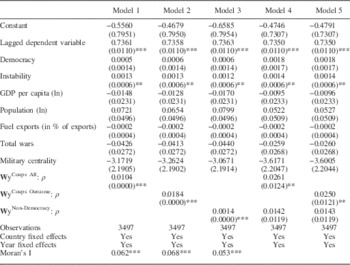
We provide estimates for five models, which are summarized in Table 1. Models 1–3 are fully specified models with one spatial lag introduced separately in each model and country and year fixed effects; we omit fixed effects from the presentation, however. Models 4–5 pertain to the estimations based on the m-STAR regression model where spatial lags are simultaneously included.Footnote 8 The spatial lag coefficients in Table 1 can be interpreted directly, although some caveats exist. First, because of the temporally lagged dependent variable in the models, the coefficient estimates in these models only reflect the short-term effects, i.e., the effect of a control variable or a spatial lag in a current year. In order to estimate the long-term impact of a spatial lag based on a row-standardized connectivity matrix, we incorporate the coefficient of the temporally lagged dependent variable by Plümper, Troeger and Manow (Reference Plümper, Troeger and Manow2005, 336):
 $$\mathop{\sum}\limits_{t=1}^T {\left( {\rho \mathop{\sum}\limits_j {w_{{ijt}} y_{{jt{\minus}1}} } } \right)} \beta _{0}^{{T{\minus}t}} ,$$
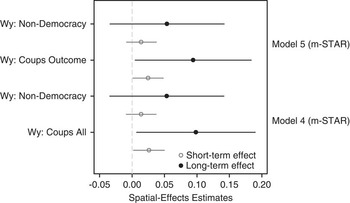
“where β 0 is the coefficient of the lagged dependent variable, T is the number of periods with t denoting a single period” (Plümper and Neumayer Reference Plümper and Neumayer2010, 425), and i and j pertain to units (states in a dyad). Accordingly, we estimate asymptotic long-term effects (in addition to short-term effects) for the spatial lag variables of Table 1 and summarize them in Table 2 (Models 1–3) and Figure 3 (Models 4–5).
Short-term and long-term spatial effects of spatial lag variables multiparametric spatiotemporal autoregressive (m-STAR) Note: horizontal bars pertain to 95 percent confidence intervals; dashed gray vertical line marks spatial effect of 0.

The Impact of and Spatial Dependence on Effective Number of Military Organizations

Note: table entries are coefficients; standard errors in parentheses; country and year fixed effects included, but omitted from presentation.
*p<0.10, **p<0.05, ***p<0.01 (two-tailed).
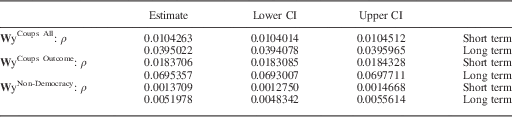
Short-Term and Long-Term Effects of Spatial Lag Variables (Models 1–3)
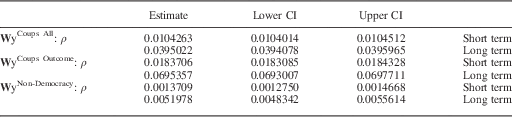
Note: confidence interval (CI) pertains to upper or lower bound of 95 percent confidence interval.
Second, when including a spatial lag into a model, coefficients provide information about the pre-dynamic impulses from the explanatory variables (excluding the spatial coefficient ρ, though), i.e., “the pre- [spatial] interdependence feedback impetus to outcomes from other regressors” (Hays, Kachi and Franzese Reference Hays, Kachi and Franzese2010, 409). In order to fully understand the effect of the explanatory variables (but not the spatial coefficient as this can be interpreted directly) when considering a spatial lag, one has to estimate spatiotemporal multipliers, which allow the “expression of estimated responses of the dependent variable across all units” (Hays, Kachi and Franzese Reference Hays, Kachi and Franzese2010, 409). Given our focus on the impact of the spatial lags, however, we do not estimate these “equilibrium effects” of the controls.
When briefly discussing the control items, first, only Instability has robust and consistently significant effects across the models, which are in line with the theoretical expectations. The higher the level of domestic instability, the more likely it is that state leaders want to invest in coup-proofing. None of the remaining control covariates has a significant impact on the level of counterbalancing, however. While this may come across surprising at first sight, recall that all our models include fixed effects. Fixed-effects models lack the ability to make inferences about time-invariant or slow-moving variables, because their coefficients are either not identified or difficult to estimate with precision (Plümper and Troeger Reference Plümper and Troeger2007).
Coming to our core variables of interest, i.e., the spatial lag variables, we start with Moran’s I that we report for each spatial lag in the last row of Models 1–3. A positive and significant value for this statistic suggests clustering of the dependent variable on the spatial lag concerned, while negative and significant values pertain to dispersion, e.g., a higher number of military organizations in other states actually leads to a lower number of ground-compatible military organizations in the state in question. In line with our expectations on positive spatial coefficients, we obtain positive and significant Moran’s Is. In addition, we find some initial support for the claims in the diffusion literature that it is primarily success that matters for actors to learn and emulate (e.g., Bennett Reference Bennett1991; Lee and Strang Reference Lee and Strang2006; Dobbin, Simmons and Garrett Reference Dobbin, Simmons and Garrett2007; Gilardi Reference Gilardi2012): the strongest clustering of counterbalancing in the form of the number of military organizations seems to be given for WyCoups Outcome as the estimate of 0.068 is higher than any other Moran’s I.
However, Moran’s I can only provide an initial assessment as covariates other than the lagged dependent variable and the connectivity between units are not taken into account here. Hence, a more systematic analysis is necessary, which we provide with Models 1–5. In terms of the actual coefficient estimates for the spatial lags, Models 1–3 demonstrate that the spatial lags for WyCoups All, WyCoups Outcome, and WyNon-Democracy are significant at the 1 percent level and positively signed. Hence, states actually do implement counterbalancing in response to their peers’ policies in this regard: the number of military organizations in other states influences the number of military organizations in the state in question. When comparing the actual size of these coefficients (i.e., their short-term effect), though, it seems that there is more evidence for an experiential peer group effect, and only little support for the institutional peer group influence.
In more detail, WyCoups Outcome has the largest coefficient estimate (0.0184) as compared with the other spatial lags in Models 1–3; the impact of WyCoups All (estimate of 0.0104) and WyNon-Democracy (estimate of 0.0014) is also positive and significant, but (much) lower. Against this background, Models 1–3 provide evidence for the claim that a higher number of military organizations in other non-democracies and experiential peers leads to a higher number of military organizations in the state in question. This seems to support our hypotheses, if only weakly in terms of the first one, as the absolute size of the coefficient (0.0014) is rather small.
Table 2 reveals more substantive effects for the spatial lags in Models 1–3. As demonstrated there, WyNon-Democracy also has a long-term effect that is rather close to 0. In terms of WyCoups All and WyCoups Outcome, when using Ward and Gleditsch (Reference Ward and Gleditsch2008, 38) to calculate substantive effects, the short-term spatial effect of WyCoups All is 0.0104 (i.e., the coefficient estimate), whereas the asymptotic long-term spatial effect is about 0.0395.Footnote 9 This implies, for instance, that a state’s level of Effective Number of Military Organizations would be 0.01 (0.04) points higher in the short (long) run, if its peers in the coup-attempt experiential peer group had an average coup-proofing score of 3.10 (which equals, e.g., the Philippines in 2004) compared with a neighbor average of 2.10 (which equals, for instance, Spain in 1986). With regard to WyCoups Outcome, the short-term spatial effect is 0.0184, while the asymptotic long-term spatial effect is substantially higher (0.0695). Hence, also coup-outcome-based peers as captured via WyCoups Outcome exert a positive impact on a country’s coup-proofing in the form of the effective number of military organizations that is significantly different from 0.
Interestingly, though, when examining the m-STAR models (Models 4–5; Figure 3) that simultaneously include the spatial lag for the institutional peer group and one of the experiential peer group lags, WyNon-Democracy does no longer exert a statistically significant effect both in the short and the long run. However, the effect of WyCoups All and WyCoups Outcome, respectively, mirrors the estimated influence for these variables in Models 1–2. Given the more conservative estimation strategy in Models 4–5, it thus seems that there is actually very little support for the institutional peer group mechanism; moreover, rulers that experienced at least one coup are more likely to respond stronger to counterbalancing of other states with any coup attempt, and less stronger to those where the government was able to stay in power and defeated the domestic opposition. This interpretation is supported by the fact that the impact of WyCoups All is consistently larger than the effect of WyCoups Outcome across Models 4–5 in Table 1.
In sum, the coefficient estimates for the spatial lags either in the single lag models (Models 1–3) or the m-STAR models (Models 4–5), and their long- and short-term effects (Table 2; Figure 3), support the following statement: the counterbalancing of countries that are linked via past coup experiences, i.e., those forming an experiential peer group, influences each others’ levels of counterbalancing positively.
Conclusion
Processes of diffusion are empirical puzzles that scholars must address systematically (Siverson and Starr Reference Siverson and Starr1990). In this article, we developed a theoretical framework on why and how regimes implement certain levels of counterbalancing based on external influences and how policy diffusion is an outcome of peer group learning and emulation.
Political survival and strategies to prolong it are almost always understood as a domestic phenomenon. Leaders decide what the best strategy is for this, mostly based on rational expectations of domestic actors’ interests and strategies (Bueno de Mesquita et al. Reference Bueno de Mesquita, Smith, Siverson and Morrow2004; Svolik Reference Svolik2012). We argued that leaders do and cannot only rely on domestic information for determining the optimal level of coup-proofing, because this may eventually be too risky. Consequently, political leaders may seek to obtain information from abroad as well. However, where to look at and what to learn? We claimed that learning and emulation should primarily occur through peer groups (Neumayer, Plümper and Epifanio Reference Neumayer, Plümper and Epifanio2014) defined by those regimes that have common institutional structures that may be more coup-prone ex ante (i.e., institutional peer group) or similar coup experiences, i.e., have experienced coup attempts (either successful or unsuccessful) in their past (i.e., experiential peer group). We empirically tested these arguments using time-series cross-section data on coup-proofing and a variety of spatial lag regression models.
Our results suggest that a peer group effect does indeed exist. However, while the evidence is strong for the experiential peers, there is only little—if any—support for the institutional peer group impact. In fact, the corresponding spatial lag for the latter is consistently insignificant in the m-STAR models. Still, learning and emulation seem to be given for experiential peers, while the outcome of their coup experience may not really matter. We thus contribute to the existing literature by empirically demonstrating that coup-proofing is not just a domestic business. Counterbalancing policies in countries with a similar coup history are very similar and may eventually converge. From a policy perspective, this should make it easier to assess and predict country’s level of coup-proofing more accurately as we did not treat spatial dependency as “statistical anomalies that require remedial attention” (Braithwaite Reference Braithwaite2005, 256).
Moreover, leaders’ domestic survival strategies are thus influenced by choices and experiences of other countries as the former indeed use the information from their peers. We found evidence for coup-proofing diffusion among experiential peers. In this context, consider the Organization of African Unity that was frequently referred to as “the dictators’ club.” Hence, this was not only a descriptive term used as a humorous name, but did indeed point to the high importance of this information network as an experiential peer group for African leaders’ survival (Souaré Reference Souaré2014).
Our work on the international diffusion of counterbalancing can provide a stepping stone for future and more general research on peer groups and the effect of heuristic bias in the context of learning and emulation. We found that unpacking the possible effects on learning and emulation between positive and negative outcomes of coup-proofing does not seem to matter. Rulers learn from peers, but not only form the counterbalancing of states with similar “positive” experiences. Our work, hence, also supports the theoretical literature and empirical research on how negative bias in cognitive heuristics can be important.
We believe that several important avenues for further research might emerge from this study. To outline one of them, while we know that counterbalancing policies diffuse between peers, we do not know whether their (in-) effectiveness also does. Is a counterbalancing policy, which is effective in one country, also an effective instrument for a leader in another state? If so, why? Clearly, our article shed light only on one particular aspect of coup-proofing diffusion, but there is much more to discover.
Supplementary Material
To view supplementary material for this article, please visit http://dx.doi.org/10.1017/psrm.2015.55