1 Introduction
The rising number of people with chronic conditions presents challenges for all health systems. In the European Union, in 2006, between 20% to over 40% of the population aged 15 years and over reported a long-standing health problem and one-fourth currently receives medical long-term treatment (TNS Opinion and Social, 2007). The complex nature of many chronic health problems requires a delivery system that involves coordinated inputs from a wide range of health professionals over an extended period of time and that places patients at the centre as co-producers of care to optimise health outcomes (Nolte and McKee, Reference Nolte and McKee2008a, Reference Nolte and McKee2008b). Yet, service delivery has developed in ways that have tended to fragment care, both within and between sectors, through, for example, structural and financial barriers dividing providers at the primary/secondary care and at the healthcare and social care interface (Glasby et al., Reference Glasby, Dickinson and Peck2006).
The growing recognition of this fragmentation is causing many countries to explore new approaches to healthcare delivery that can bridge the boundaries between professions, providers and institutions and so provide appropriate support to patients with long-standing health problems. Key elements suggested to address fragmentation include improved collection and sharing of information, moving care into the community and aligning payment schemes to incentivise care coordination and enhance integration of provision of services (Hofmarcher et al., Reference Hofmarcher, Oxley and Rusticelli2007). However, countries vary in their attempts to do so and approaches that are being implemented reflect the characteristics of individual health systems as they relate to the relationships between, and responsibilities of, different stakeholders in the regulation, funding and delivery of health care (Nolte et al., Reference Nolte, Knai and McKee2008).
This paper discusses some of the key approaches to overcoming fragmentation in health care, with a particular focus on the role of the regulatory, funding and organisational context for the development and implementation of approaches to chronic care. We illustrate these approaches with examples from Austria, Germany and the Netherlands.
Our analysis is based on a review of the published and grey literature, complemented by data collected within the DISMEVAL project (Developing and validating DISease Management EVALuation methods for European healthcare systems), using a common data collection template which is described in detail elsewhere (RAND Europe and London School of Hygiene and Tropical Medicine, 2011).
In order to contextualise chronic care development in each country, we provide a concise overview of selected features of the country's health systems. We describe the key regulatory and policy measures making possible current chronic care strategies, highlighting some of the main approaches to overcoming fragmentation in chronic care and reviewing the documented evidence of their impact.
2 Background on chronic care in Austria, Germany and the Netherlands
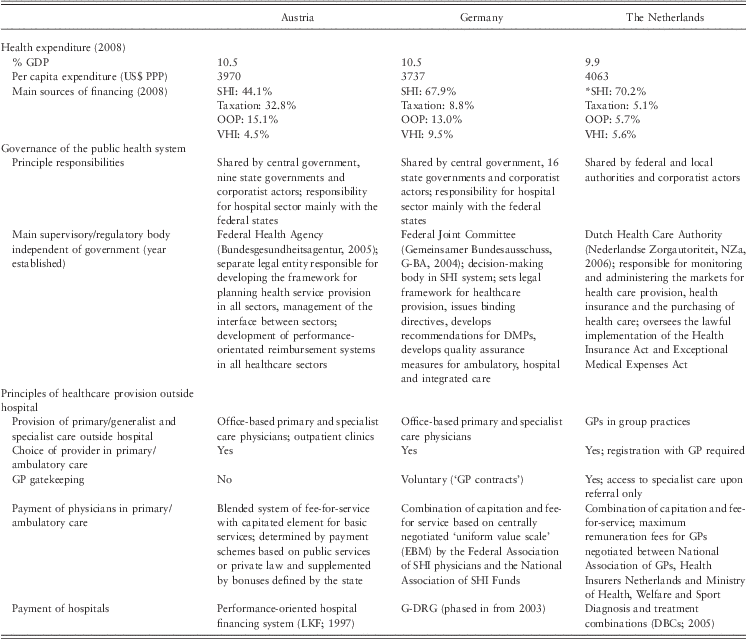
The implementation of chronic care policies in Austria, Germany and the Netherlands has to be understood in the overall context of healthcare governance and organisation. The three healthcare systems are principally based on the Bismarckian model of statutory health insurance (SHI), characterised by a universal, mandatory insurance scheme with responsibility for the healthcare system shared by government (central and state governments in Austria and Germany) and corporatist actors. More recently, the three systems have followed different paths, in particular with regard to the introduction of market elements into the system. In brief, in 1993, Germany introduced free choice of SHI (Busse and Riesberg, Reference Busse and Riesberg2004), whereas the Netherlands moved to a mandatory, regulated private insurance system with competing private insurance funds in 2006 (Schäfer et al., Reference Schäfer, Kroneman, Boerma, van den Berg, Westert, Deville and van Ginneken2010). In Austria, competition among health insurers, although discussed, has so far not been pursued (Hofmarcher and Rack, Reference Hofmarcher and Rack2006). In terms of the provision of health care, the Netherlands is unique among SHI systems in western Europe in that general practitioners (GPs) act as gatekeepers to specialist care, a characteristic feature maintained after the 2006 reform (Schäfer et al., Reference Schäfer, Kroneman, Boerma, van den Berg, Westert, Deville and van Ginneken2010). In contrast, Austria and Germany principally allow for free choice of office-based generalist and specialist care providers outside hospital (Busse and Riesberg, Reference Busse and Riesberg2004; Hofmarcher and Rack, Reference Hofmarcher and Rack2006). Table 1 provides an overview of selected characteristics of healthcare governance and provision in each country.
Selected features of healthcare systems in Austria, Germany and the Netherlands
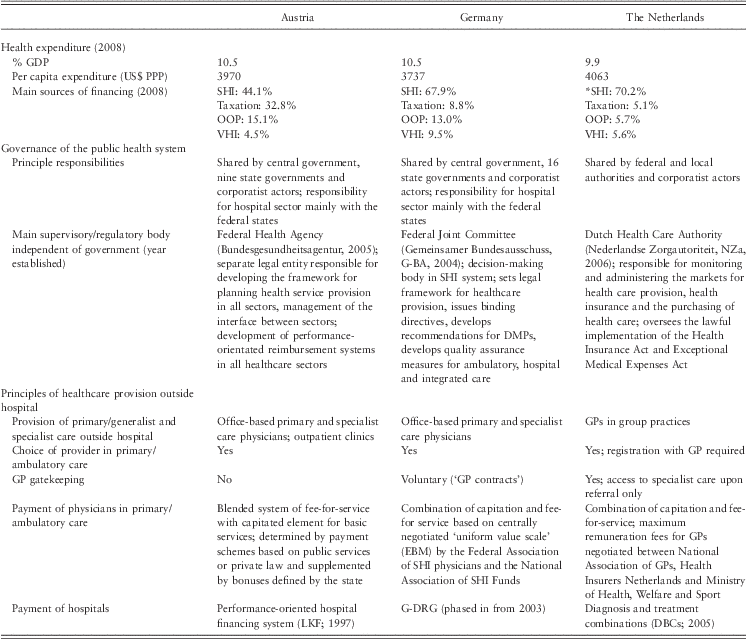
PPP, purchasing power parity; SHI, statutory health insurance; OOP, out-of-pocket payment; VHI, voluntary health insurance; DBCs, Diagnosis and treatment combinations; DMPs, disease management programmes; EBM, Einheitlicher Bewertungsmassstab; GPs, general practitioners; LKF, Leistungsorientierte Krankenanstaltenfinanzierung; G-DRG, German diagnosis-related groups.
Sources: Busse and Riesberg (Reference Busse and Riesberg2004); Ettelt et al. (Reference Ettelt, Nolte, Mays, Thomson and McKee2006); Hofmarcher and Rack (Reference Hofmarcher and Rack2006); OECD (2010); Schäfer et al. (Reference Schäfer, Kroneman, Boerma, van den Berg, Westert, Deville and van Ginneken2010)
Notes:*According to figures from the Dutch statistical office, in 2009, SHI accounted for 68% of GDP and taxation for 13%, with the remainder including OOP (∼9%) and VHI (4%) (Centraal Bureau voor de Statistiek, 2009).
3 The evolution of chronic care policies
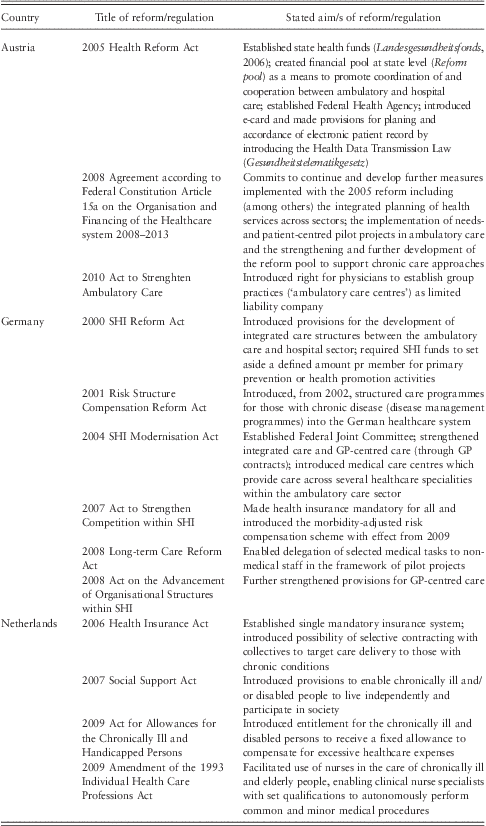
Care fragmentation, particularly at the boundary between primary and secondary care, has been a main concern in all three countries, and it has prompted a series of various regulatory measures and activities (Table 2). However, the pace, breadth and depth with which relevant initiatives and policies have been implemented have varied.
Overview of the regulatory framework for chronic care policies and approaches implemented during the 2000s in Austria, Germany and the Netherlands
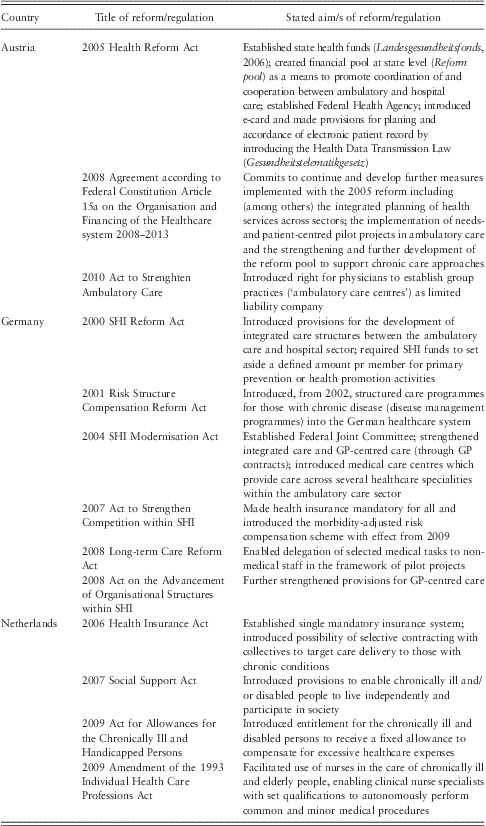
SHI: statutory health insurance; GP, general practitioner.
Thus, in Germany, provisions to support more integrated models of care were introduced as early as 1993, subsequently strengthened by the 2000 SHI Reform Act and the 2004 SHI Modernisation Act, which removed certain legal and financial obstacles towards better integration (Busse and Riesberg, Reference Busse and Riesberg2004). In parallel, in 2002, the government introduced structured care programmes for those with chronic disease, frequently referred to as ‘disease management programmes’ (DMPs), in an explicit effort to provide insurers and providers with incentives to encourage evidence-based chronic care (Siering, Reference Siering2008). Defined as ‘the coordinated treatment and care of patients during the entire duration of a (chronic) disease across boundaries between providers and on the basis of scientific and up-to-date evidence’ (Bundesversicherungsamt, 2011), DMPs became the predominant approach to chronic illness care in Germany. Subsequent reforms introduced additional measures to strengthen coordination within the ambulatory care sector, most notably the 2004 introduction of GP-centred care and of medical care centres or policlinics (Ettelt et al., Reference Ettelt, Nolte, Mays, Thomson and McKee2006), and provisions to enable the use of non-medical staff in chronic illness care from 2008 (Fullerton et al., Reference Fullerton, Nolte and Erler2011).
The Netherlands, in the 1990s, saw the introduction of the concept of shared care, based on the principle of cooperation and coordination between generalist and specialist caregivers with shared overall responsibility (Linden, Reference Linden2000). Although spreading rapidly throughout the 1990s, lack of sufficient funding challenged their viability and sustainability. From the 2000s, disease management approaches received growing interest (Vrijhoef et al., Reference Vrijhoef, Spreeuwenberg, Eijkelberg, Wolffenbuttel and van Merode2001), but uptake remained limited (Steuten et al., Reference Steuten, Vrijhoef, Spreeuwenberg and Van Merode2002), mainly because of a lack of a structured framework (Klein-Lankhorst and Spreeuwenberg, Reference Klein-Lankhorst and Spreeuwenberg2008). More recently, the 2006 health insurance reform, which granted insurers extended powers to negotiate with provider organisations, facilitated the development of new forms of service delivery and payment for more integrated care. This involved the initially diabetes-focused establishment of GP-formed ‘care groups’ who contract with health insurers on the basis of a ‘bundled payment’ for a defined package of diabetes care (Struijs et al., Reference Struijs, van Til and Baan2010). This was strengthened by the 2008 ‘Programmatic approach to chronic illness care’ and proposals to generally fund chronic care through bundled payment schemes, accompanied by regulatory measures to strengthen the role of nurses in the care of the chronically ill (Table 2; Schäfer et al., Reference Schäfer, Kroneman, Boerma, van den Berg, Westert, Deville and van Ginneken2010).
In Austria, activities to strengthen more integrated provision of care have been a more recent phenomenon, with the 2005 health reform contributing to the development of related approaches (Hofmarcher and Rack, Reference Hofmarcher and Rack2006). It established, in 2006, the State Health Funds in each of Austria's nine federal states and created a financial pool at state level (Reform pool), which combines funds from SHI and regional governments to finance projects that coordinate healthcare delivery across sectors, in particular between ambulatory and hospital care. These ‘reform pool projects’ have formed the basis for the majority of current approaches to chronic care in Austria, most frequently disease management programmes. Other efforts have aimed, since 2007, to establish ambulatory care centres to enhance integration of service delivery, particularly for those with chronic illness (Eichwalder and Hofmarcher, Reference Eichwalder and Hofmarcher2008). This was part of a wider policy development including the conclusion of agreements between the medical profession and health insurance funds to establish group practices, and the 2008–2013 government programme that made improving patient access to ambulatory care services a priority as part of an overall move to increase the effectiveness and efficiency of integrated healthcare services in the Austrian healthcare system (Hofmarcher and Hawel, Reference Hofmarcher and Hawel2010).
4 Approaches to chronic care
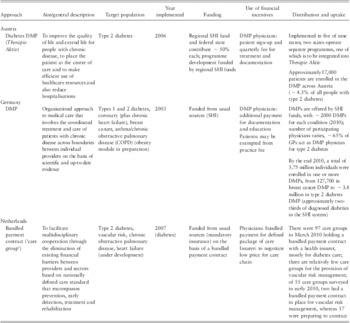
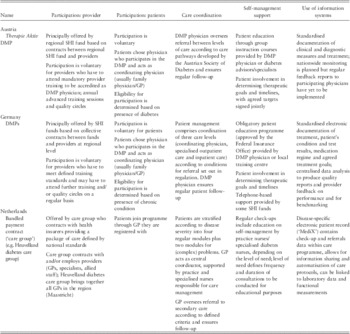
The regulatory and policy measures facilitated the implementation of chronic care approaches. This section describes in more detail the key features of approaches pursued in each of the countries, focusing on commonalities and differences between countries. As indicated above, the overarching care model tends to be a form of disease management, whose main characteristics as they relate to funding mechanisms, distribution and uptake, alongside principles of provider and patient participation and the coordination process are summarised in Tables 3 and 4.
Features of the principal approach to chronic care in Austria, Germany and the Netherlands: target population, funding, distribution and uptake

DMP, disease management programme; SHI, statutory health insurance.
Features of the principal approach to chronic care in Austria, Germany and the Netherlands: participation, principles of care coordination and patient self-management support, use of information systems

DMP, disease management programme; SHI, statutory health insurance; GP, general practitioner.
4.1 A focus on single chronic conditions
Most approaches pursued in all three countries tend to be disease-specific, with type 2 diabetes most typically targeted. The focus on diabetes is perhaps not surprising, given the disease and cost burden associated with this condition worldwide (Pomerleau et al., Reference Pomerleau, Knai and Nolte2008). However, a focus on diabetes was also prompted by existing examples of care models that could be drawn upon. For example, in the Netherlands, the development of diabetes care groups was greatly informed by a care model developed in Maastricht, the Maastricht Transmural Diabetes Organisation, which originates from the 1990s (Klein-Lankhorst and Spreeuwenberg, Reference Klein-Lankhorst and Spreeuwenberg2008). In Austria, the diabetes DMP was modelled, in part, on the disease management programme for type 2 diabetes developed in Germany. Other diseases targeted include cardiovascular disease, chronic respiratory disease and breast cancer (Germany).
However, the focus on single diseases has been identified as a concern, given the often multiple health problems among people with chronic conditions. In an attempt to address this, regulation in Germany has mandated the development of additional disease management modules for obesity and chronic heart failure to supplement existing DMPs (Siering, Reference Siering2008). In the Netherlands, a framework to address overweight and obesity within the care group approach is being developed (Partnership Overweight Netherlands, 2009).
Approaches addressing a wider spectrum of needs, including those arising from multiple conditions, frequently centring on populations aged 65 years and above (here referred to as ‘generalist’ approaches) have also been introduced but have as yet remained geographically localised and/or restricted to pilot programmes.
4.2 Conceptualisation of ‘disease management’ as a means to strengthen care coordination
The overarching approach to strengthen care coordination is through some form of disease management although the content and scope of related approaches differs considerably between the three countries. Thus, the care groups in the Netherlands have been conceived as a multidisciplinary team approach with a physician (‘director’) overseeing the overall coordination between the various participating care providers, whereas patient management is, to great extent, delegated to nurses (Table 4). In contrast, in Germany and Austria, disease management has remained very much within the traditional structure of care provided by doctors within the ambulatory care sector, although following a strict protocol overseeing the patient management between levels of care, and in which non-medical staff (typically confined to practice assistants) play, if anything, a small role. Indeed, the use of non-medical staff such as specialised nurses or practice assistants Austria and Germany is a fairly recent phenomenon. Examples include GP contracts in Germany (Fullerton et al., Reference Fullerton, Nolte and Erler2011) or home care for patients with chronic heart failure in Salzburg, Austria (Arbeitskreis Vorsorgemedizin Salzburg, 2010). In Germany, services provided by non-medical staff may include monitoring; the assessment of mental, physical or psychological problems; and coordination with other service providers. However, by law, all services must be assigned and performed under the supervision of the GP (Bewertungsausschuss nach § 87 Abs. 1 Satz 1 SGB V, 2009).
4.3 Incentivising the implementation of care coordination
Several approaches use financial incentives, usually targeted at physicians although funders have also benefitted from additional (time limited) resources earmarked for care coordination and integration initiatives. For example, in Germany, to make disease management programmes an attractive option for the SHI funds, their introduction was linked to the risk structure compensation scheme (RSA). This provided SHI funds with a substantial financial incentive to offer DMPs as part of their portfolio of services and to motivate their members to take part in these programmes. This strategy had considerable success: by October 2009 SHI funds offered over 13,300 DMPs and a total of 5.5 million patients had signed up to at least one DMP (Bundesversicherungsamt, 2007). However, since 2009, following a reform of the RSA scheme with the introduction of a morbidity-adjusted RSA, the financial incentive for SHI funds has been reduced markedly, and numbers of patients signing up for DMPs have been stagnating since (Fullerton et al., Reference Fullerton, Nolte and Erler2011). Whether this stagnation reflects a saturation effect or is a consequence of the reduced financial incentive is as yet unclear.
At the same time, SHI funds were also given the possibility to designate financial resources, of a total of 1% of their income, for selective contracting with single providers or network of providers (Busse and Riesberg, Reference Busse and Riesberg2004). The nature and scope of integrated care contracts has varied, with many focusing on the interface between acute hospital and rehabilitative care. By the end of 2008, approximately 6400 integrated care contracts had been concluded, covering ∼6% of all SHI insured. However, by the end of 2008, when the financial incentive was concluded, less than half of these contracts had incorporated elements of intersectoral care (Sachverständigenrat zur Begutachtung der Entwicklung im Gesundheitswesen, 2009).
In the Netherlands, the bundled payment scheme is based on the principle of a care group (zorggroep), a legal entity that brings together providers (mostly GPs) in primary care. As the principal contractor, the care group enters into a contract with a health insurer to provide a package of care for a given condition according to a nationally developed care standard (‘bundled payment contract’). The price for the package of care is negotiated between the provider care group and the insurance fund on the basis of the performance of the care group. Conceived as an ‘experiment’ in 2006, with 10 diabetes care groups receiving start-up funding for a period of 16 months and accompanying evaluation (Struijs et al., Reference Struijs, van Til and Baan2010), the government subsequently decided to roll-out this strategy nationally for the delivery of care for patients with diabetes, chronic obstructive pulmonary disease (COPD) or vascular risk (Vrijhoef, Reference Vrijhoef2010). However, although diabetes contracts have achieved national coverage, the negotiation of a bundled payment for COPD and vascular risk management has remained a challenge (Van Til et al., Reference Van Til, De Wildt and Struijs2010).
In Austria, as noted earlier, the reform pool made it possible to explicitly fund projects in integrated care, including disease management programmes described above, as well as a wide range of other approaches such as various forms of case management including managed discharge (Czypionka et al., Reference Czypionka, Kraus, Röhrling and Straka2008) or integrated care for stroke patients (Hofmarcher et al., Reference Hofmarcher, Röhrling and Walch2007). However, implementation of reform pool activities has been uneven across states and related projects have been slow to take off partly because of a lack of financial incentives for physicians to participate in such projects. There has been limited federal oversight of the reform pool funds and projects, leading to duplication of efforts and a lack of scale-efficiency in some regions. The highest number of projects was funded in 2007 (23), at a cost of €11 million, but project activity fell subsequently. Of all funds available, only 16% had been put to use, but this varied greatly by region with over 30% used in Styria and only 1.5% in Tyrol (Czypionka and Röhrling, Reference Czypionka and Röhrling2009).
4.4 Encouraging uptake of programmes by patients and providers
In all three countries, participation in the coordinated care approaches is voluntary for physicians and patients, and they are funded within the statutory system, thus making them principally available to all eligible patients. However, coverage is varied, in the case of diabetes care programmes ranging from some 4.3% of the population with type 2 diabetes in Austria (Österreichische Diabetes Gesellschaft, 2010) up to ∼60% in Germany (Schäfer et al., Reference Schäfer, Küver, Gedrose, Hoffmann, Russ-Thiel, Brose, van den Bussche and Kaduszkiewicz2010a, Reference Schäfer, Küver, Gedrose, von Leitner, Treszl, Wegscheider, van den Bussche and Kaduszkiewicz2010b). In the Netherlands, approximately two-thirds of an estimated 750,000 people with diabetes are covered by a bundled payment contract (Van Til et al., Reference Van Til, De Wildt and Struijs2010).
The comparatively low uptake in Austria partly reflects variation in availability of relevant programmes across the different states, which, in turn, reflects variation in the participation rates of primary care physicians in such programmes (Therapie Aktiv Diabetes im Griff, 2011), ranging from an estimated 16% in Lower Austria and Vienna to 36% in Salzburg (authors’ estimates based on Habl and Bachner (Reference Habl and Bachner2010)). Low participation may reflect physicians’ resistance to the (perceived or real) additional administrative burden imposed by DMPs.
The administrative burden caused by documentation requirements was initially also a concern for physicians in Germany, following the introduction of DMPs (Siering, Reference Siering2008); processes have since been simplified. In Germany, ∼65% of GPs participate in the diabetes DMP, which may be explained by financial incentives offered to participating physicians. In the Netherlands, participation rates of GPs in structured care programmes are likely to be higher, with relevant incentives inherent in the structure of the bundled payment contract, offering considerable means to negotiate prices. Participation is estimated at 77% of all GPs (Van Til et al., Reference Van Til, De Wildt and Struijs2010) and is likely to increase further with government plans to move all care for diabetes (and other chronic conditions) to bundled payment contracts.
5 What has the impact been?
The preceding sections have demonstrated how all three countries reviewed here have implemented a range of policies and approaches to achieve better coordination within and across the primary and secondary care interface and so better meet the needs of patients with chronic conditions. This has involved changes to the regulatory framework to support more coordinated approaches to care (Austria, Germany), coupled with financial incentives (Austria, Germany) or changes in payment systems (the Netherlands). What is common to the three countries, as indeed in most other OECD countries (Hofmarcher et al., Reference Hofmarcher, Röhrling and Walch2007), is the comparative ‘novelty’ of policies and approaches aimed at fostering coordinated care, and the evidence of their impact remains unclear.
In Germany, evidence from the statutory evaluation of diabetes DMPs points to improved quality of care for participating patients (Schäfer et al., Reference Schäfer, Küver, Gedrose, Hoffmann, Russ-Thiel, Brose, van den Bussche and Kaduszkiewicz2010a, Reference Schäfer, Küver, Gedrose, von Leitner, Treszl, Wegscheider, van den Bussche and Kaduszkiewicz2010b). The few existing controlled studies provide limited evidence of improved outcomes, such as quality of life (Ose et al., Reference Ose, Wensing, Szecsenyi, Joos, Hermann and Miksch2009) and mortality (Miksch et al., Reference Miksch, Laux, ose, Joos, Campbell, Riens and Szecsenyi2010; Stock et al., Reference Stock, Drabik, Büscher, Graf, Ullrich, Gerber, Lauterbach and Lüngen2010) as well as reduced costs (Stock et al., Reference Stock, Drabik, Büscher, Graf, Ullrich, Gerber, Lauterbach and Lüngen2010). However, the extent to which improved survival can indeed be attributed to the diabetes DMP remains uncertain (Miksch et al., Reference Miksch, Laux, ose, Joos, Campbell, Riens and Szecsenyi2010; Schäfer et al., Reference Schäfer, Küver, Gedrose, Hoffmann, Russ-Thiel, Brose, van den Bussche and Kaduszkiewicz2010a, Reference Schäfer, Küver, Gedrose, von Leitner, Treszl, Wegscheider, van den Bussche and Kaduszkiewicz2010b), with other studies failing to provide evidence of improved medical outcomes (Linder et al., Reference Linder, Ahrens, Köppel, Heilmann and Verheyen2011). In addition to methodological challenges, a major question remains as to whether disease-specific approaches such as the German DMPs are suited to meet the needs of the typical patient in primary care who frequently has multiple health problems with complex needs (Fullerton et al., Reference Fullerton, Nolte and Erler2011). More general approaches such as integrated care contracts or policlinics might potentially be better equipped to respond to more complex patient needs, yet evidence of their effect within the German healthcare system remains poorly understood because of lack of systematic evaluation.
In Austria, the phasing-in of DMPs was accompanied by evaluation in almost all federal states. For example, the diabetes DMP Therapie Aktiv, implemented in Salzburg, was evaluated using a cluster-randomised controlled trial. The evidence was mixed, however, with non-significant improvements in metabolic control, the main clinical outcome, although other measures (weight and cholesterol) improved significantly (Sönnichsen et al., Reference Sönnichsen, Winkler, Flamm, Panisch, Kowatsch, Klima, Fürthauer and Weitgasser2010). Improved process measures were also observed for the diabetes DMPs implemented in Lower Austria, for example, demonstrating a reduction in hospital utilisation among those enrolled in a DMP pointing to the potential for cost savings although the overall evidence for DMPs to actually do so has remained inconclusive (Ruh et al., Reference Ruh, Winter, Zeiler and Robausch2009).
In the Netherlands, findings from the evaluation of the first year of the 10 ‘experimental’ diabetes care groups found wide variation in number and type of participants, the content of the packages of care covered, and price (between €258 and €474 per patient per year) (Struijs et al., Reference Struijs, van Til and Baan2010). Thus, contracts differed in the extent to which they offer additional services beyond the core package of care, such as smoking cessation guidance and/or foot care. Importantly, as the precise content of care is not clearly defined, there is a risk of ‘double-billing’ of selected care components, although the extent to which this is happening in practice is unknown. Evidence of impact on outcomes has remained inconclusive thus far. An expectation that diabetes care groups will, through improving the quality of (diabetes) care, lead to cost reductions could not be verified at 12-month follow-up; indeed, although costs might be saved due to reduced hospitalisations, they may at the same time increase because of ‘intensification’ of care for diabetic patients (Struijs et al., Reference Struijs, van Til and Baan2010), an observation that was also made for selected DMPs in Austria (Ruh et al., Reference Ruh, Winter, Zeiler and Robausch2009).
6 Discussion
In this paper, we have traced the evolution of chronic care in Austria, Germany and the Netherlands, all of which are principally financed from SHI. We find that countries have implemented a range of policies and approaches to overcome fragmentation in the healthcare system to achieve better coordination within and across the primary and secondary care interface and so better meet the needs of those with chronic conditions. A predominant model of care in the form of structured disease management has emerged in all three countries, although the evolution of these models has differed. Thus, in Germany, disease management was introduced in a top-down process, using a regulatory framework to ensure nationwide implementation (Siering, Reference Siering2008). The Dutch model, although implemented nationwide upon government initiative, evolved from an experiment with a limited set of providers and informed by earlier experience of a delivery model developed in the 1990s (Klein-Lankhorst and Spreeuwenberg, Reference Klein-Lankhorst and Spreeuwenberg2008). In Austria, disease management programmes were made possible within the framework of a new financial instrument at the level of federal states, with states introducing such approaches broadly modelled on German DMPs. However, programmes have been slow to take off because projects require additional funds, and therefore disincentivising project approval (Hofmarcher et al., Reference Hofmarcher, Röhrling and Walch2007).
Recent reforms in Austria have attempted to shift supply from inpatient to outpatient settings and improve patient access to ambulatory care services. However, these reforms have been restricted to physicians and are yet to take off in practice. Overall, this highlights the challenges experienced in Austria to arriving at an overarching strategic approach in a system that involves multiple actors in the negotiation of ambulatory care, including 21 SHI funds, the Federation of Austrian Social Security Institutions, the Austrian Medical Association and associations of other health professions (Hofmarcher and Rack, Reference Hofmarcher and Rack2006). One area where the central government has taken a clear position is in efforts to promote a more integrated approach to planning, which is now being pursued towards coordinated supply across healthcare sectors.
In Germany, in contrast, while also involving multiple actors, negotiations relating to the ambulatory care sector are centralised at the national level (Busse and Riesberg, Reference Busse and Riesberg2004), which may have facilitated the development of a national framework. However, it should be noted that the introduction of DMPs was strongly supported by SHI funds such as the general regional funds, which, because of their member profile, were disadvantaged by the RSA and their national association took a leading role in the promotion of the programmes. The government was also very supportive of swift implementation of DMPs and it took provisions to do so despite resistance from many stakeholders.
At the same time, although the creation of a strict national regulatory framework has been viewed as beneficial in ensuring that programmes meet appropriate standards, there have been concerns that this may limit the way in which this approach is able to address local need (Siering, Reference Siering2008). The Dutch approach of ‘incremental’ implementation (Helderman et al., Reference Helderman, Schut, Van der Grinten and Van de Ven2005), starting out with a select set of pilots experimenting with bundled payment and that are being evaluated for subsequent roll-out may be regarded as an approach that combines centrally defined requirements and local autonomy, although it should be noted that national roll-out was advocated by the government before evaluation findings were available.
Ham (Reference Ham2003) has highlighted how competing pressures on organisations that arise from policies initiated by healthcare reformers on one hand and established ways of delivery, on the other, are likely to result in a gap between policy intent and actual implementation (Ham, Reference Ham2003). A critical role has to be played by professionals, who exert a large degree of control in healthcare organisations such as primary care practices and hospitals. Failure to engage them in the reform process is likely to hamper sustainable change. Indeed, as work on ‘chains of care’ in Sweden has demonstrated, approaches that engaged professionals, or were indeed initiated by professionals themselves, succeeded in developing improved interorganisational and interprofessional coordinated structures, whereas those initiated top-down by councils did not (Ahgren and Axelsson, Reference Ahgren and Axelsson2007). However, a supportive policy environment was also found to be critical for success.
Fundamentally, it is, however, important to highlight that DMPs in Germany and Austria did not fundamentally alter (or indeed challenge) existing structures in the healthcare system. Services continue to be provided within the existing delivery structure, comprising family physicians, specialists in private practice and hospitals. The integration of non-medical health professionals into the care system, which has led to considerable improvements in chronic care elsewhere, has only recently been pursued, although remaining limited to certain settings. In Germany, although wider use of nurses was considered and supported by the German nurses association as a means to strengthen the role of nurse practitioners, other stakeholders, in particular family physicians and their associations, were concerned about introducing another layer of care as well as losing control over the provision of medical care. It is interesting to note, in this context, that the role of nurses in the Dutch care groups, although prominent, has been reduced somewhat compared to the model that informed their development (Klein-Lankhorst and Spreeuwenberg, Reference Klein-Lankhorst and Spreeuwenberg2008). Here, the specialist diabetes nurse acted as liaison between the hospital and primary care for all patients and indeed acted as consultant to the GP who was responsible for the management of diabetes patients with low intensity needs. In 2007, the model was transformed into the diabetes care group by the Regional General Practitioners Organization in Maastricht/Heuvelland region. Thus, professional resistance to change remains in a challenge in all systems.
Finally, one of the greatest challenges for the systems reviewed here remains the development of a system-wide model of care for patients with chronic disease. As noted earlier, disease-specific approaches such as disease management programmes are ill-suited to meet the needs of the typical patient in primary care who frequently has multiple health problems with complex needs (Nolte and McKee, Reference Nolte and McKee2008a, Reference Nolte and McKee2008b). The Dutch care groups, although disease-focused, are envisaged as multidisciplinary care teams and, through stratification of patients according to severity and required care intensity, may go some way to meeting the requirements of those with multiple health problems. However, more generalist approaches such as the integrated care contracts implemented in Germany are potentially better equipped to respond more complex patient needs, yet the evidence as to their effect within the German healthcare system remains poorly understood. There is a need for more systematic evaluation of new models of care as a means to inform the development of efficient and effective interventions to address the growing burden of chronic conditions in Europe and elsewhere.
Acknowledgements
This work was supported, in part, by the DISMEVAL project funded under the European Commission FP7 programme (Grant no. 223277). The authors further gratefully acknowledge the research assistance provided by Leslie Tarver.