Introduction
Waste management is an increasingly pressing environmental issue in a world with a rapidly growing population (Gu & Ozbakkaloglu, Reference Gu and Ozbakkaloglu2016). A hierarchical framework favouring the 3Rs (reduce, reuse and recycle) is advocated to deal with the issue worldwide. The 3Rs, as upstream solutions, minimise the quantity of waste that needs to be treated or disposed of, therefore mitigating the negative effects of waste on the environment and improving the efficiency of recyclable resource use. Benton (Reference Benton2015) argued that if we would like to have a sustainable future, the only real solution is to begin looking into how the reduction of consumption and the reuse of the products we buy can be promoted, because the vast majority of our purchases still goes into the trash, even if some of them can be recycled. However, relatively little attention has been paid to the other two personal waste management habits – reduce and reuse – which are of equal importance in terms of waste management (Gu & Ozbakkaloglu, Reference Gu and Ozbakkaloglu2016; Zorpas et al., Reference Zorpas, Voukkali and Loizia2017).
The theory of planned behaviour (TPB) is one of the most commonly applied models to predict individuals’ waste management behaviours and allows for extra predictors as long as they account for a significant fraction of the variance in intention or behaviour after the three original constructs (attitudes, perceived behavioural control (PBC) and subjective norms (SN)) have been entered. This increases its flexibility when applied to a variety of target behaviours (Ajzen, Reference Ajzen, Kuhi and Beckmann1985). Steg and Viek (Reference Steg and Vlek2009) argued that not only intra-personal factors such as attitudes but also situational factors such as the availability of recycling facilities or the quality of public transport should be systematically examined to identify the predictors of people’s engagement in pro-environmental behaviour.
In light of this, the purpose of this study was to understand Hong Kong individuals’ plastic waste minimisation (PWM) intention, which extends the target behaviours to cover all 3Rs – reduce, reuse and recycle. Given the value of the TPB model and the potential role of situational factors in explaining the mechanism of individuals’ waste management behaviours, this study also aimed at exploring how PWM intentions would be influenced by situational factors, attitudes, PBC and SN based on an extended TPB model (Figure 1). The term ‘waste minimisation’ is used interchangeably with the ‘3Rs’ to include all waste prevention and recycling behaviours. Plastic waste minimisation intention was conceptualised as individuals’ intention to engage in the reduction, reuse and recycling of plastic waste. Two major research questions guided the study:
-
(1) Do Hong Kong citizens’ gender, age and education affect their attitudes, SN, PBC, situational factors and plastic waste minimisation intentions?
-
(2) Do Hong Kong citizens’ attitudes, SN, PBC and situational factors affect their plastic waste minimisation intentions?
Proposed model of PWM intention.

The PWM situation in Hong Kong
Hong Kong has seen its waste loads increase as its economy has grown. Among the different types of solid waste, plastic waste makes up the third-largest portion of municipal solid waste (MSW) after putrescible and paper waste (Environmental Protection Department, 2016). To effectively minimise plastic waste, the government has launched many campaigns regarding the 3Rs of plastic waste, including a levy on plastic shopping bags which took effect on 1 April 2015 and included all retail stores. However, plastic bags only constitute one-third of plastic waste (Environmental Protection Department, 2016) and reduction in their use does not solve the problem of the high percentage of plastic waste among the MSW in Hong Kong. The landfills could be full in several years if nothing is done to reduce MSW.
To reduce the amount of waste plastic ending up in landfills, Hong Kong has to collect more locally generated waste plastic from households, commercial and industrial sources. However, the lack of land availability, the high cost of labour and transportation and the relatively low commercial value of mixed plastic waste make plastic recycling quite difficult in Hong Kong. In this regard, the government has made efforts to raise public awareness of the need to minimise plastic use or increase recycling to prevent contamination (Environmental Management Division Hong Kong Productivity Council, 2014).
In addition, waste reduction or reuse is often associated with recycling, and the 3Rs have been promoted as a whole in Hong Kong (Environmental Protection Department, 2016). For instance, individuals are encouraged to reduce their waste using reusable bags and separating different types of waste (e.g. paper, metals and plastics) from their daily waste for recycling. According to the Hong Kong Blueprint for Sustainable Use of Resources 2013–2022 (Environmental Protection Department, 2013), one area of policy and action that the government proposes to undertake is to drive citizens’ behavioural change to reduce waste at the source through policies and legislation. The target is to achieve the goal of reducing the per capita disposal rate of MSW by 40% by 2022. Therefore, it is reasonable to combine the 3Rs in the context of Hong Kong, and it is also worth exploring whether a group of similar and related behaviours could be predicted collectively with sequential models in a psychosocial study. This led this study to extend the target behaviour to cover the other two Rs – reduce and reuse.
Environmental education in Hong Kong
Environmental education aims at cultivating environmentally responsible citizens, that is, people who are sensitive to the total environment and related problems, and who have a basic understanding of the environment and its issues, can identify environmental problems and show motivation to become actively involved in environmental protection and resolution of environmental problems (Hungerford &Volk, Reference Hungerford and Volk1990). However, it is not easy to cultivate individuals to behave in an environmentally friendly way, because environmental knowledge does not always lead to changes in attitudes or behaviours (Hungerford &Volk, Reference Hungerford and Volk1990; Lee, Reference Lee2000). Even after taking environmental courses, if students are exposed to environments where environmentally responsible behaviours are not encouraged, it would not be surprising that they do not sacrifice their personal interests for the environment (Li, Lee, Chan, &Tan, Reference Li, Lee, Chan and Tan2019).
To effectively influence individuals’ environmental knowledge, attitudes and behaviours, research (Hines, Hungerford, & Tomera, Reference Hines, Hungerford and Tomera1987; Hungerford & Volk, Reference Hungerford and Volk1990) has identified several factors that contribute to the outcomes of environmental education. Hungerford and Volk (Reference Hungerford and Volk1990) suggested that environmental education must provide opportunities for students to develop ownership (view environmental issues as very personal) and empowerment (a sense of being able to make changes) beyond sensitivity or knowledge. Additionally, individual and institutional factors (e.g. learning strategies, socioeconomic status) also play an important role in affecting the outcomes of environmental education courses (Li et al., Reference Li, Lee, Chan and Tan2019). Educators should consider background information such as age and gender to ensure appropriate designs (Liefländer & Bogner, Reference Liefländer and Bogner2014).
Environmental education is important for Hong Kong. The curriculum change in 2009 promoted integrating environmental education as one important part of a compulsory subject (Liberal Studies) in secondary schools, leading to the shift of environmental education from the margins to the core curriculum for teachers and secondary schools in Hong Kong (Tsang & Lee, Reference Tsang, Lee, Lee and Efird2014). At the higher education level, many tertiary institutes are involved in promoting environmental education (Palmer, Reference Palmer2002). For instance, Li et al. (Reference Li, Lee, Chan and Tan2019) introduced an environmental course, namely ‘Energy: Today and Tomorrow’ which aimed to provide undergraduate students with a broad perspective and knowledge of current energy issues.
The TPB
The TPB models the psychological process of how an intention leads to a certain behaviour (Ajzen, Reference Ajzen1991). The theory argues that attitudes are personal in nature and capture the individuals’ cognitive evaluation of the behaviour, whereas SN reflects the social influence or the perceived social pressure resulting from others’ expectations. PBC additionally takes account of the incomplete volitional control, focusing on the individuals’ perception of personal ability to perform the action and the extent to which the behaviour is up to the individual instead of general external factors. Intention plays an important role in affecting behaviour and mediating the effect of other factors on behaviour (Armitage & Conner, Reference Armitage and Conner2001; Latif, Omar, Bidin, & Awang, Reference Latif, Omar, Bidin and Awang2013).
Despite criticism of the limited predictive validity and utility of the TPB (Bamberg & Möser, Reference Bamberg and Möser2007; Sniehotta, Presseau, & Araújo-Soares, Reference Sniehotta, Presseau and Araújo-Soares2014), the TPB has been widely adopted to analysing intentions in health behaviour (e.g. Conner & Sparks, Reference Conner and Sparks2005; McEachan, Conner, Taylor, & Lawton, Reference McEachan, Conner, Taylor and Lawton2011) and pro-environmental behaviour (e.g. De Leeuw, Valois, Ajzen, & Schmidt, Reference De Leeuw, Valois, Ajzen and Schmidt2015; Xiao, Zhang, Zhu, & Lin, Reference Xiao, Zhang, Zhu and Lin2017), including waste management behaviours. A better understanding of different processes of forming intention to act using alternative explanatory approaches such as sequential models is still needed to better help people translate their intentions into action (Sniehotta et al., Reference Sniehotta, Presseau and Araújo-Soares2014).
TPB studies of waste minimisation
To the best of our knowledge, research on using TPB models to predict waste reduction and reuse behaviours is limited. One study in Malaysia examined food waste separation behaviour within the TPB framework and found a small to medium correlation between behavioural intention and attitude, SN and PBC (Ghani, Rusli, Biak, & Idris, Reference Ghani, Rusli, Biak and Idris2013). Like waste reduction and reuse, waste separation is often associated with recycling, but it is more complex than that. As such, the psychosocial factors forming the intention to separate waste and to reduce and reuse may be more similar.
Ari and Yılmaz (Reference Arı and Yılmaz2017) examined consumers’ attitudes and behaviour regarding the use of plastic and cloth bags with the help of the TPB. Their study showed that social norms have a significant effect on intention to reduce the use of plastic bags. Ertz, Huang, Jo, Karakas and Sarigöllü. (Reference Ertz, Huang, Jo, Karakas and Sarigöllü2017) advanced the TPB model to identify the mechanism underlying the use of reusable containers by Westerners and Asians and found that attitude is a significantly stronger predictor of intentions in the western context. The successful application of the TPB model in the above studies suggests that it is possible and potentially valuable to apply the TPB model to predict waste reduction and reuse. Based on the discussions above, the following hypotheses are proposed:
Hypothesis 1 (H1): Attitudes towards PWM will have a positive influence on PWM intention.
Hypothesis 2 (H2): SN regarding PWM will have a positive influence on PWM intention.
Hypothesis 3 (H3): PBC in PWM will have a positive influence on PWM intention.
Situational factors as an additional predictor
The factors in the TPB alone may be unable to fully explain intention, because situational conditions may also make a significant contribution. In fact, it is understandable that situational conditions may notably directly or indirectly affect the intention to minimise waste (e.g. Barr, Gilg, & Ford, Reference Barr, Gilg and Ford2001; Steg & Vlek, Reference Steg and Vlek2009; Kollmuss & Agyeman, Reference Kollmuss and Agyeman2002). The availability of space, time and facilities may greatly influence return/recycling intention (Oom Do Valle, Rebelo, Reis, & Menezes, Reference OoM Do Valle, Rebelo, Reis and Menezes2005; Khan, Ahmed, & Najmi, Reference Khan, Ahmed and Najmi2019). Other studies (e.g. Zorpas et al. Reference Zorpas, Voukkali and Loizia2017; Kianpour et al., Reference Kianpour, Jusoh, Mardani, Streimikiene, Cavallaro, Nor and Zavadskas2017) have found that a lack of information (e.g. campaigns, eco-labelling) may reduce one’s intention to minimise waste.
Several studies have examined the direct effects of situational factors on intentions. However, it seems that no consensus has been reached. While studies (Ghani et al., Reference Ghani, Rusli, Biak and Idris2013; Tonglet, Phillips, & Read, Reference Tonglet, Phillips and Read2004) did not identify any significant links between situational factors and waste recycling intentions, Xu, Ling, Lu and Shen (Reference Xu, Ling, Lu and Shen2017) revealed a significant and positive correlation between external influence of market facilitators, government incentive and government facilitators to waste separation intention.
Several studies have reported significantly positive effects of situational factors on attitudes (e.g. Arcury, Reference Arcury1990; Guagnano, Stern, & Dietz, Reference Guagnano, Stern and Dietz1995), SN (e.g. Guagnano et al., Reference Guagnano, Stern and Dietz1995) or PBC (OoM Do Valle et al., Reference OoM Do Valle, Rebelo, Reis and Menezes2005; Kianpour et al., Reference Kianpour, Jusoh, Mardani, Streimikiene, Cavallaro, Nor and Zavadskas2017). For instance, Kianpour et al. (Reference Kianpour, Jusoh, Mardani, Streimikiene, Cavallaro, Nor and Zavadskas2017) found that information positively influences perseverance in behavioural control to return electronic products for reuse and to recycle and repair through reverse supply chain management. Therefore, research about the indirect impacts of situational factors on PWM intention through attitudes, SN and PBC is warranted.
To increase the public’s education and awareness of plastic waste minimisation, the Hong Kong government offers information on waste reduction and outlets for recyclable materials and manages facilities for the collection and disposal of a variety of waste types. Meanwhile, the government is progressively developing a Community Green Station to enhance education and facilities in the management of various recyclables at the community level (Environmental Protection Department, 2016). However, the extent to which Hong Kong citizens are satisfied with the efforts by the government or relevant organisations and whether these efforts would contribute to their waste minimisation intention is unknown. By considering the Hong Kong context, this study included situational factors in terms of storage room, facilities and information delivery as an additional predictor to explain intention.
The following hypotheses are offered:
Hypothesis 4 (H4): Situational factors will have a positive influence on PWM intention.
Hypothesis 5 (H5): Situational factors will have a positive influence on attitude towards PWM and subsequently on PWM intervention.
Hypothesis 6 (H6): Situational factors will have a positive influence on SN regarding PWM behaviour and subsequently on PWM intervention.
Hypothesis 7 (H7): Situational factors will have a positive influence on the PBC regarding PWM behaviour and subsequently on PWM intervention.
Materials and Methods
Participants and data collection
A total of 996 Hong Kong permanent residents voluntarily participated in this study. They were among those who were in the streets at the time of the survey and were approached at random by our trained research assistants. This enabled the researchers to reach those people who are seldom online, such as elderly people.
The survey was administered and responses were collected in the public areas of 20 different residential estates across five geographical constituencies of Hong Kong, namely Hong Kong Island, Kowloon West, Kowloon East, New Territories West and New Territories East, in the form of a face-to-face questionnaire-based survey administered over a period of roughly 3 months. The number of samples at each site is proportional to the target population in the corresponding constituency. Respondents filled out the survey within approximately 20 minutes, but were not interviewed. The research assistants assisted the respondents in completing the survey by reading aloud or clarifying items when necessary. Approval was received from the university’s Human Research Ethics Committee before data collection.
Of the 996 participants (Table 1), 53.1% are females and 46.3% are males. 30.0% are aged 18–29, 29.2% are aged 30–44, 32.1% are aged 45–64 and 7.9% are aged 65 and above. Approximately 75% of the participants had received a secondary education or above. The sample profile in this study is generally similar to the 2011 Hong Kong population profile in terms of gender, age and education level (Census and Statistics Department, 2011).
Distribution of 996 samples by gender, age and education

Instrument
A questionnaire was designed to measure the proposed model (Figure 1) based on the TPB theory (Ajzen, Reference Ajzen2011). According to the proposed model, five constructs were devised, namely: (1) attitude towards PWM behaviour, (2) SN regarding PWM, (3) p PBC in PWM, (4) situational factors related to PWM and (5) PWM intention. A total of 25 7-point Likert scale items were modified with reference to the questionnaires used in several previous studies (e.g. Barr et al., Reference Barr, Gilg and Ford2001; Bortoleto, Kurisu, & Hanaki, Reference Bortoleto, Kurisu and Hanaki2012; Cheung, Chan, & Wong, Reference Cheung, Chan and Wong1999; Conner, Godin, Sheeran, & Germain, Reference Conner, Godin, Sheeran and Germain2013; Oom Do Valle et al., Reference OoM Do Valle, Rebelo, Reis and Menezes2005; Taylor & Todd, Reference Taylor and Todd1995; Tonglet et al., Reference Tonglet, Phillips and Read2004; Wan, Shen, & Yu, Reference Wan, Shen and Yu2014b).
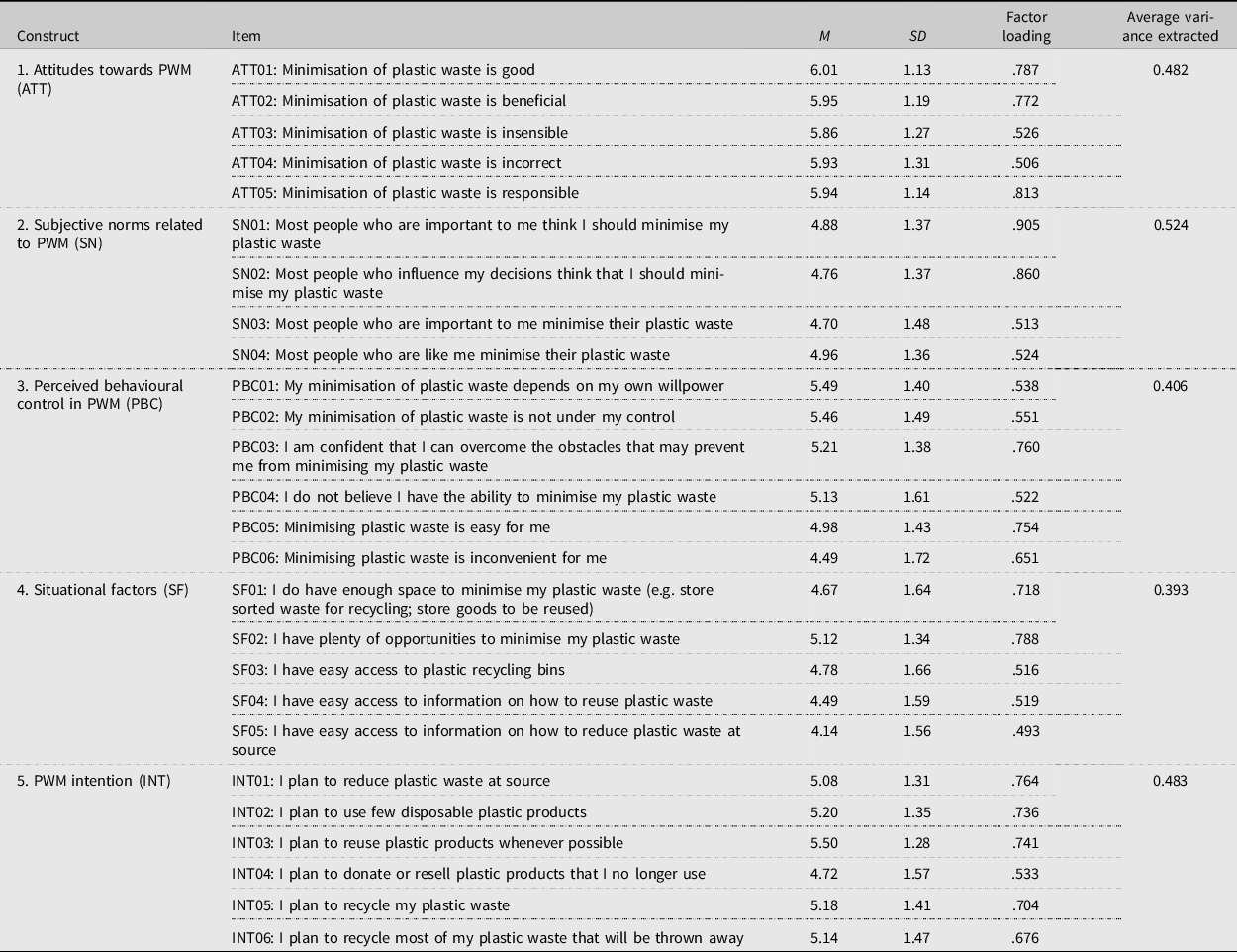
The results of the confirmatory factor analysis revealed that the overall fit of the revised measurement model is adequate (the root mean square error of approximation (RMSEA) = 0.06, the goodness of fit index = 0.907, the incremental fit index (IFI) = 0.915 and the comparative fit index (CFI) = 0.914). The scales have Cronbach’s alpha ranging from .795 to .905 and composite reliability ranging from 0.56 to 0.73 (Kline, Reference Kline2010). Other details, such as factor loading, average variance extracted, mean and standard deviation of the five constructs of the questionnaire for PWM intention, are presented in Table 2. These results indicated acceptable validity and reliability of this questionnaire.
Factor loadings, average variance extracted, means and standard deviations of the five constructs of the questionnaire for PWM intention

Statistical analysis
The analysis of data was performed in two major steps. Firstly, independent sample t tests and one-way ANOVA were used to determine whether gender, age and education had significant effects on PWM intention. Secondly, the original TPB model and the extended TPB model of PWM intention were tested with structural equation modelling in AMOS (Blunch, Reference Blunch2013). The aim was to assess the relations between situational factors, attitudes, PBC, SN and PWM intention, to identify significant predictors of PWM intention and to examine whether the inclusion of situational factors helped to improve the TPB model for better explaining the mechanism of individuals’ PWM intention.
Results
Gender, age and education differences in PWM intention
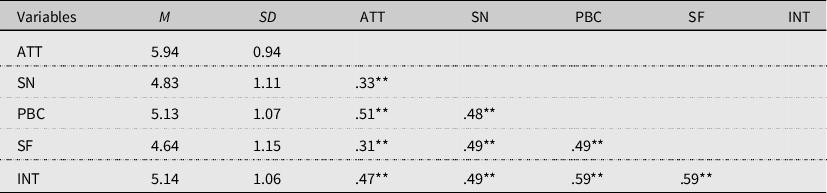
The participants (Table 3) reported relatively strong PWM intention (M = 5.14; SD = 1.06), positive attitudes (M = 5.94; SD = 0.94) and high PBC in PWM (M = 5.13; SD = 1.07). In contrast, their perceptions of SN regarding PWM and situational factors influencing PWM were relatively less positive, with mean scores of 4.83 (1.11) and 4.64 (1.15), respectively. Specifically, the participants reported with the lowest mean scores in the two items of situational factors (SN4: M = 4.49, SD = 1.59; SN5: M = 4.14, SD = 1.56), indicating the inadequate access to information related to reduction and reuse.
Means, standard deviations and correlations between all variables

ATT = attitudes towards PWM; SN = subjective norms related to PWM; PBC = perceived behavioral control in PWM; SF = situational factors; INT = PWM intention.
Questionnaire design used a 7-point scale.
**p < .01.
Looking at the effect of gender, t tests indicated that males and females differed significantly in their PWM intentions, attitudes and PBC (see Table 4). On average, females performed significantly better than males in the three constructs. The mean scores for females on PWM intentions, attitudes and PBC were 5.25 (0.98), 6.00 (0.91) and 5.24 (1.02), while those for males were 5.01 (1.13), 5.87 (0.94) and 4.99 (1.12).
Results of t tests on gender difference

ATT = attitudes towards PWM; SN = subjective norms related to PWM; PBC = perceived behavioral control in PWM; SF = situational factors; INT = PWM intention.
The questionnaire design used a 7-point scale.
*p < .05; **p < .01.
Regarding the effect of age, one-way ANOVA indicated that participants in groups of different ages differed significantly on all TPB constructs and on situational factors (see Table 5). Using post hoc comparisons, the Tukey honestly significant difference (HSD) results indicated that group 3 (aged 45–64) and group 4 (aged 65 and above) had significantly higher scores for PWM intention, PBC and SN than group 1 (aged 18–29) or group 2 (aged 30–44). For attitudes and situational factors, specifically, significant differences between group 3 and group 1 were found. Group 3 scored 6.09 (0.86) and 4.77 (1.19), which were significantly higher than group 1’s scores of 5.78 (0.89) and 4.53 (1.06).
Results of one-way ANOVA across different age groups

1 = 18–29; 2 = 30–44; 3 = 45–64; 4 = 65 above.
ATT = attitudes towards PWM; SN = subjective norms related to PWM; PBC = perceived behavioral control in PWM; SF = situational factors; INT = PWM intention.
The questionnaire design used a 7-point scale.
*p < .05.
For the effect of education, one-way ANOVA revealed significant effects of education on SN (F = 29.06, p < .05) and PBC (F = 10.72, p < .05) (see Table 6). Using post hoc comparisons, the Tukey HSD results indicated that participants without a higher education scored significantly higher than those with a higher education on SN. The mean scores for individuals with education level of primary (group 1) or secondary school (group 2) were 5.39 (1.07) and 4.96 (1.07), while the mean scores for those with higher educational levels (group 3, group 4 and group 5) were 4.72 (1.09), 4.55 (1.06) and 4.85 (1.24). Similar results were also found for PBC control. Significantly higher scores were reported by participants who had not received a secondary or higher education (M = 5.48, SD = 1.12) than by those who had. The mean scores of participants with a secondary education or bachelor degree were 5.08 (1.13) and 5.04 (0.97). Regarding the other constructs, there was no significant difference due to education level.
Results of one-way ANOVA across different education levels

1 = primary school; 2 = secondary school; 3 = Non-degree post-secondary; 4 = Bachelor degree; 5 = Master’s degree and above; ATT = attitudes towards PWM; SN = subjective norms related to PWM; PBC = perceived behavioral control in PWM; SF = situational factors; INT = PWM intention.
Questionnaire design used a 7-point scale.
*p < .05.
The model of PWM intention
Correlations between variables were tested (Table 3). The results indicate that the attitudes, SN, PBC and situational factors refer to different constructs, with their intercorrelations varying from only .31 to .51.
Model A (Figure 2) depicts the original TPB model and explains 61.0% of the PWM intention’s variance (R 2 = 61.0%). The model fit indices are within the accepted boundaries for a good fit (RMSEA = 0.059, ITF > 0.9, TLI > 0.9, CFI > 0.9). Nevertheless, SN related to PWM was found to be a statistically non-significant predictor of PWM intention.
Model A (TPB model) path analysis’ results (***P < .001).

In the extended TPB model of PWM intention (Model B), the situational factors predictor was added (see Figure 3). The model fit indices are within the accepted boundaries for good fit (RMSEA = 0.060, ITF > 0.9, TLI > 0.9, CFI > 0 .9), indicating that Model B, including a link between situational factors and SN, has a reasonable to good fit to the collected data as well as to the original TPB model (Model A). Plus, the amount of variance of PWM intention explained by Model B is slightly more than that explained by Model A. In Model B, the PWM intention has a squared multiple correlation of 0.688, which means that 68.9% of the variance in behavioural intention can be explained by attitude, SN, PBC and situational factors combined. Therefore, Model B has to be accepted and adequately predicts PWM behavioural intention.
PWM intention: Model B path analysis’ results (***P < .001).

As shown in Model B, the findings support Hypotheses 1 and 3 that attitudes and PBC are positively linked to PWM intention. Hypothesis 2 is rejected as SN is evident to show a non-significant impact. Regarding the direct effects of situational factors, Model B shows that situational factors also have a statistically significant direct effect on PWM intention (γSF→ INT = 0.43, p < .001). It has the highest standardised regression weight at 0.43 among the four variables affecting PWM intention. The findings supported Hypothesis 4.
For indirect impacts, situational factors are found to contribute substantially to attitude and PBC, and subsequently PWM intention. It also indicates that the inclusion of situational factors substantially reduces the effect of attitudes and PBC, particularly that of PBC. The findings supported Hypotheses 5 and 6. However, situational factors do not influence PWM intention through SN, leading to rejection of Hypothesis 7.
Furthermore, based on the results of the direct and indirect impacts reported in Table 7, roughly 57% of the effect of situational factors on PWM intention is direct, suggesting that the situational factors’ effect on PWM intention is not necessarily likely to be mediated through the attitudes and the PBC predictor.
Effects analysis of an individual’s PWM intention for Models A and B (based on the standardised path coefficients)

***p < .0001.
Discussion
Intervention efforts in higher education and community levels for promoting PWM intention
Compared to males, the results of this study reveal that females had significantly more favourable attitudes, PBC and intentions with respect to adopting PWM behaviours. It is likely that females express more environmental concerns than males (Hunter et al., Reference Hunter, Hatch and Johnson2004).
Regarding the effect of age, significant differences were found for all TPB measures as well as situational factors. Compared to younger participants, older participants (aged 45 and above) tended to view PWM as more needed. They perceived themselves as being more capable of performing PWM and reported higher PWM intention. These results corroborate previous findings (e.g. Al-Khatib, Arafat, Daoud, & Shwahneh, Reference Al-Khatib, Arafat, Daoud and Shwahneh2009; Fiorillo, Reference Fiorillo2013). An increase in the amount of storage space and time available for older persons to minimise plastic waste, and additionally, an increase in the desire to conserve resources for future generations may contribute to this (Martin, Williams, & Clark, Reference Martin, Williams and Clark2006; Pakpour et al. Reference Pakpour, Zeidi, Emamjomeh, Asefzadeh and Pearson2014). It is also possible that older people scored higher on these constructs due to social desirability. Studies that use a self-reported survey also need to consider social desirability when interpreting findings, as older people are likely to show higher social desirability than younger people (Dijkstra, Smit, &Comijs, Reference Dijkstra, Smit and Comijs2001).
Another demographic factor, education level, was found to have negative impacts on SN and PBC, that is, participants with higher educational levels, inversely, had less confidence or faced less social pressure for their plastic waste minimisation behaviours than those with lower educational levels. This observation contradicts prior studies (e.g. Barr, Reference Barr2007, Hines, Hungerford, & Tomera, Reference Hines, Hungerford and Tomera1987; Meen-Chee & Narayanan, Reference Meen-Chee and Narayanan2006; Tekkaya, Kiliç, & Sahin, Reference Tekkaya, Kiliç and Sahin2011). However, similar results were observed by Ma, Hipel, Hanson, Cai, and Liu (Reference Ma, Hipel, Hanson, Cai and Liu2018) who found that there were negative correlations between participants’ education levels with PBC and SN. One reason would be that highly educated participants made decisions more independently and were more aware of potential barriers to effective plastic waste management (PWM) (Ma et al., Reference Ma, Hipel, Hanson, Cai and Liu2018). Another reason would be that the percentage of older people who valued PWM as more needed was larger in the less educated groups (50%) compared to the more educated groups (20%). It is therefore understandable that less educated groups conversely scored higher in PBC and SN, as there were more elderly people in these groups.
Moreover, it was found that participants with higher education levels did not show more positive attitudes or intention to minimise plastic waste than those with lower education levels. This might be the result of a lack of effective environmental education in tertiary institutions. Universities in Hong Kong were left alone to conduct environmental education (Li et al., Reference Li, Lee, Chan and Tan2019). Problems such as a lack of assessment, failure to develop students’ skills and use of flawed instructional strategies by teachers (e.g. instruction is issue-specific and focuses only on the awareness level) to some extent limit the effectiveness of environmental education (Hungerford &Volk, Reference Hungerford and Volk1990; Li et al., Reference Li, Lee, Chan and Tan2019). As for the case of PWM, it is possible that the cultivation of the necessary and relevant knowledge, skills and values is not adequately emphasised in environmental education, particularly in higher education in Hong Kong.
Overall, these results suggest that educational intervention efforts might be more effective if directed at males or young adults. Additionally, it might show more effectiveness if there is more emphasis on PWM promotion in higher education. Recycling behaviour is more likely to increase among individuals who recognise its benefits (Meen-Chee & Narayanan, Reference Meen-Chee and Narayanan2006). Hence, relevant undergraduate courses can explicitly address the importance of PWM for human sustainability in the long run. Targeted educational materials can also be developed to help individuals, particularly males or younger people, to internalise the importance of PWM and encourage them to participate in plastic waste minimisation behaviours. Moreover, it is important to increase their personal PWM abilities. For instance, opportunities can be provided for them to discuss or exercise the ways of reducing plastic waste at the source or reusing plastic waste according to type during these courses.
At the community level, this study supports the Environmental Management Division Hong Kong Productivity Council’s (2014) recommendation that the government should increase and sustain public education on how to do source separation of plastic waste so as to improve Hong Kong citizens’ knowledge, skills as well as confidence in minimising plastic waste. Given the important role of digital media in information dissemination, particularly for younger people, it is also suggested that the government may consider designing and providing more digital resources that are free of charge and making digital media an effective platform for disseminating information of PWM to the younger generation and for promoting their favourable environmental behaviours (Cheung, Fok, Tsang, Fang, & Tsang, Reference Cheung, Fok, Tsang, Fang and Tsang2015).
Government efforts for investment in facilities and support of PWM
While structural equation analysis revealed excellent fits for both the original TPB model (Model A) and the extended TPB model of PWM intention (Model B), our proposed model including situational factors remarkably increased the proportion of explained variance (from 61.0% to 68.8%) in PWM intentions, suggesting that the introduction of situational factors helped enhance the original TPB model in terms of understanding individuals’ PWM intention. Overall, our model of PWM intention more reasonably predicts the behavioural intention to minimise plastic waste, which is defined as the aggregate of reducing, reusing and recycling behaviours.
Situational factors were found to have the largest contribution to PWM intention. It had a direct and positive effect on PWM intention, but also affected PWM intention indirectly via its significant effects on attitude and PBC. These results suggest that external factors, such as recycling facilities, storage space or information related to 3Rs, are significant in forming behavioural intention in waste management and moreover can affect psychological factors that influence the formation of intention. Chen and Tung (Reference Chen and Tung2010) also indicated that individuals’ perceived lack of facilities or support decreases their PWM intentions. Zhang, Zhang, Yu and Ren (Reference Zhang, Zhang, Yu and Ren2016) also confirmed that a lack of effective recycling facilities constitutes one of the obstacles that keep Chinese people from sorting and reusing most recyclable wastes. Storage convenience encourages the public’s involvement (Ghani et al., Reference Ghani, Rusli, Biak and Idris2013). This highlights the importance of including situational conditions in the analysis and modelling of waste management as well as other pro-environmental behaviours.
Another valuable indication is that by improving facilities and support related to PWM, governments can build a favourable image and cultivate positive attitudes towards and confidence in waste management behaviours in addition to encouraging behavioural intention directly. When facilities and supports are improved, individuals would be likely to show intention, regardless of their personal abilities of managing waste. As evident in this study, the addition of situational factors greatly decreases the effect of PBC on intention. Enhanced accessibility of facilities for waste management would lower behavioural costs and subsequently motivate people to take action (Grazhdani, Reference Grazhdani2016; Zhang et al., Reference Zhang, Zhang, Yu and Ren2016). The provision of valuable information related to reducing and reusing would further improve PWM intention. This study found that a certain proportion of the participants considered that they did not have easy access to information related to reuse and reduction, reflecting the insufficiency of information delivery, which may decrease their intentions. Hence, our findings support Wan et al.’s (Reference Wan, Shen and Yu2014a, Reference Wan, Shen and Yu2014b) study which suggested making government’s actions and the results they get through these actions transparent to the public to improve waste minimisation behaviour.
Scholars have detected a ‘spill-over’ effect (Berger, Reference Berger1997; Truelove, Carrico, Weber, Raimi, & Vandenbergh, Reference Truelove, Carrico, Weber, Raimi and Vandenbergh2014) and clusters of behaviours (Barr et al.,Reference Barr, Gilg and Ford2005; Thøgersen & Olander, Reference Thøgersen and Olander2006) where people are more likely to take up another pro-environmental behaviour if they are already practicing one. Positive spill-over is more likely to occur between two similar behaviours (Truelove et al., Reference Truelove, Carrico, Weber, Raimi and Vandenbergh2014). Whitmarsh and O’Neill (Reference Whitmarsh and O'Neill2010) observed positive spill-over effects between similar behaviours. Tobler, Visschers and Siegrist (Reference Tobler, Visschers and Siegrist2012) also found positive correlations between clusters of behaviours. In Hong Kong, reducing and reusing are similar to recycling in that they all aim to achieve the goal of landfill reduction by way of plastic waste minimisation. Thus, investment in facilities and support to improve waste minimisation may also be a cost-effective way of promoting general environmental responsibility in society.
Limitations and future research
There are some limitations of the present study. Firstly, the intention–behaviour gap has been reported in many previous studies (Chen, Li & Ma, Reference Chen, Li and Ma2015; Zhang et al., Reference Zhang, Zhang, Yu and Ren2016). Hence, further studies can be extended to explore whether and how situational factors or socio-demographic factors (e.g. income) would moderate the intention–behaviour relationship by including behaviour and/or socio-demographic factors in the extended TPM model to help quantify and bridge the intention–behaviour gap (Botetzagias, Dima, & Malesios. Reference Botetzagias, Dima and Malesios2015). Secondly, there is concern about the issue of social desirability that respondents might have over-estimated their waste minimisation intentions. Further studies can consider including a social desirability scale to correct for erroneous relationships (Dijkstra et al., Reference Dijkstra, Smit and Comijs2001). Thirdly, this study focused more on exploring the situational factors in terms of facilities provision or voluntary programmes by the government (e.g. facilities, opportunities or information related to the 3Rs). Further research is needed to explore the effects of cultural, economic or legal aspects of situational factors (e.g. socio-demographics, legislation) on intention or behaviour. Finally, whether the model of PWM intention fits the data from other regions needs to be further tested so as to generalise the model for application to a wider range of waste minimisation practices both in Asia and beyond.
Conclusion
The main finding of this study is that situational factors greatly contributed to intention to minimise plastic waste. The effect of situational factors is both direct and indirect. Situational factors positively influenced attitudes and PBC, which subsequently contributed to intention to minimise plastic waste. These findings support our hypothesis, expect for the direct and mediating effect of SN on PWM intention. Moreover, situational factors were found to weaken the relationship between PBC and intention. Regarding socio-demographic difference, there are significant differences in intention, PBC and SN due to gender and educational level. Overall, this study highlights the necessity of the implementation of environmental education programmes targeting plastic waste minimisation in higher education and suggests efforts by governments to improve facilities and support to transform waste minimisation behaviours into a more normalised activity.
Acknowledgement
None.
Financial Support
The work described in this paper was fully supported by the Dean’s Research Fund of the Faculty of Liberal Arts and Social Sciences, The Education University of Hong Kong, Hong Kong Special Administrative Region, China (FLASS/DRF 04118).
Conflicts of Interest
None.
Winnie Wing Mui So is a professor in the Department of Science and Environmental Studies, the director of the Centre for Education in Environmental Sustainability in the Education University of Hong Kong. Her research focuses on inquiry learning in science and environmental education, and STEM education.
Irene Nga Yee Cheng is an assistant professor in the Department of Science and Environmental Studies in the Education University of Hong Kong. She has a research interest in geographical education, interdisciplinary curriculum and teacher knowledge and development.
Lewis Ting On Cheung is an associate professor in the Department of Social Sciences in the Education University of Hong Kong. He has research interests related to protected areas management; environmental attitude and behaviour; environmental education and training.
Yu Chen, EdD is a senior research assistant in the Department of Science and Environmental Studies in the Education University of Hong Kong. Her research focuses on socio-scientific issues-based instruction in science education.
Stephen Cheuk Fai Chow is a professor in the Department of Science and Environmental Studies in the Education University of Hong Kong. He has research interests in environmental science and education.
Lincoln Fok is an associate professor of the Department of Science and Environmental Studies in the Education University of Hong Kong. His research focuses on hydrology/geomorphology with a particular concern on the impacts of water and sediment quantity and quality along with their implications on the environment.
Sing Kai Lo is a chair professor of the Faculty of Liberal Arts and Social Sciences, the Education University of Hong Kong. His research interests focus on evidence-based education, social and personal well-being, research methods and traditional Chinese medicine.