Whether to allow a young person who has received an implantable cardioverter-defibrillator to return to sports has been a controversial question for many years.Reference Lampert and Cannom 1 , Reference Maron and Zipes 2 The number of young people with implantable cardioverter-defibrillators will likely continue to grow. The increasing recognition of the importance of cascade genetic testing in families with a diagnosed family member, or following molecular autopsy, may identify asymptomatic family members also at high risk.Reference Priori, Wilde and Horie 3 , Reference Ackerman, Priori and Willems 4 The increasing popularity of pre-participation electrocardiogram screening in athletesReference Coris, Sahebzamani and Curtis 5 may also identify individuals at high-enough risk to warrant an implantable cardioverter-defibrillator. Until recently, consensus statements restricted patients with implantable cardioverter-defibrillators from engaging in sports more vigorous than golf or bowling.Reference Maron and Zipes 6 These restrictions were based on postulated risks of sports, including increased frequency of ventricular arrhythmias, potential failure of a shock to convert a life-threatening arrhythmia, damage to the device or lead system, or risk of harm due to momentary loss of physical or mental control from an arrhythmia or from the implantable cardioverter-defibrillator shock itself.Reference Maron and Zipes 6
On the other hand, the negative impact of restriction from sports on quality of life is also well-recognised. In a study comparing quality of life between athletes sidelined with an injury, actively competing athletes, and non-athlete college students, quality of life was highest among the athletes; however, the sidelined athletes had the lowest quality of life, both physical and emotional, even when compared with sedentary peers.Reference McAllister, Motamedi, Hame, Shapiro and Dorey 7 In general, for children, implantation of an implantable cardioverter-defibrillator significantly impacts quality of life, to a degree similar to severe CHD.Reference Czosek, Bonney and Cassedy 8 In a qualitative study of adolescents with implantable cardioverter-defibrillators, patients and children reported restriction from sports and the resultant feeling of not being normal as one of the worst aspects of having the device.Reference Rahman, Macciocca, Sahhar, Kamberi, Connell and Duncan 9
Data from the Implantable Cardioverter-Defibrillator Sports Registry
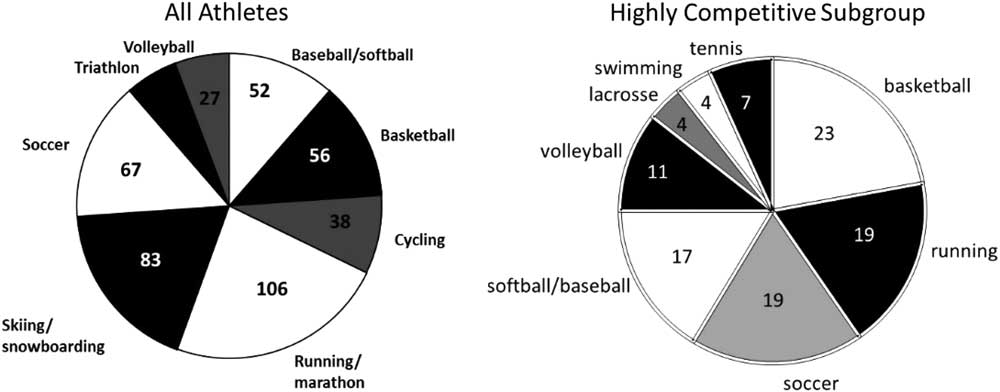
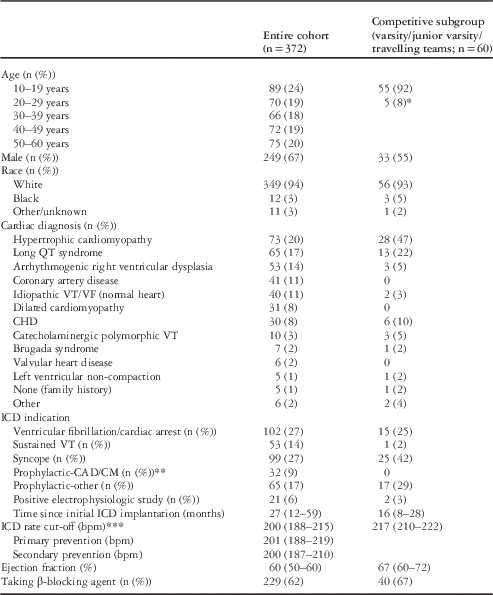
Recent data from the Implantable Cardioverter-Defibrillator Sports Registry have demonstrated that sports participation for patients with implantable cardioverter-defibrillators carries less risk than had been hypothesised.Reference Lampert, Olshansky and Heidbuchel 10 The initial report described 372 patients, of whom 89 (24%) were under 20 years of age and another 70 (19%) under 30, who were engaged in competitive sports more vigorous than “IA” or sports that might be considered dangerous, such as rock climbing. In all, 60 of the patients were highly competitive, engaging in interscholastic sports at the varsity, junior varsity, or, for younger patients, travelling team level. Participants underwent a baseline interview detailing their sports participation, and then were followed-up every 6 months to determine the occurrence of the primary end points: failure of the implantable cardioverter-defibrillator to convert a ventricular arrhythmia or injury due to shock, both during sports competition or practice. Clinical characteristics of the patients are shown in Table 1. The most common diagnoses were hypertrophic cardiomyopathy, long QT syndrome, and arrhythmogenic right ventricular cardiomyopathy. In all, 41% had received the implantable cardioverter-defibrillator following a ventricular fibrillation arrest or episode of sustained ventricular tachycardia. Sports represented are shown in Figure 1, with the most common being running, soccer, and basketball.
Sports represented in the Implantable Cardioverter-Defibrillator Sports Registry with permission from Lampert et al.Reference Lampert, Olshansky and Heidbuchel 10

Characteristics of patients enrolled in the Implantable Cardioverter-Defibrillator (ICD) Sports Registry, with permission from Lampert, et al.Reference Lampert, Olshansky and Heidbuchel 10

CAD=coronary artery disease; CM=cardiomopathy; VF=ventricular fibrillation; VT=ventricular tachycardia
Values are either numbers (percent) or medians (interquartile range) as appropriate
* All <21 years
** As defined by the Sudden Cardiac Death in Heart Failure Trial, Multi-center Unsustained Tachycardia Trial, or Multi-center Automatic Defibrillator Implantation Trial II
*** Lowest zone with treatment programmed, secondary prevention, VT or VF, primary prevention, other diagnoses
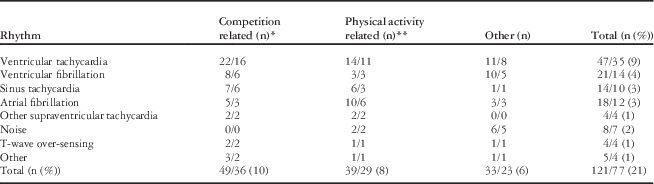
Over a median follow-up of 31 months, 37 individuals experienced shocks during competition or practice; however, there were no occurrences of either primary end point: no episodes in which the implantable cardioverter-defibrillator did not convert a ventricular arrhythmia and no arrhythmia- or shock-related injuries. Details of the shocks received are shown in Table 2. Younger patients were less likely to receive an appropriate shock during competition or practice compared with adults, with just one athlete treated for ventricular tachycardia/ventricular fibrillation during sports. There were seven participants who experienced ventricular arrhythmias requiring multiple shocks for termination, and only two were in the paediatric age group. A 16-year-old girl with catecholaminergic polymorphic ventricular tachycardia, who played field hockey and lacrosse, had two episodes of ventricular tachycardia requiring multiple shocks, both while running. A 15-year-old boy with hypertrophic cardiomyopathy received multiple shocks at rest, possibly related to substance ingestion.
Shock events in the Implantable Cardioverter-Defibrillator Sports Registry, with permission from Lampert et al.Reference Lampert, Olshansky and Heidbuchel 10

Values refer to number of events/number of unique individuals. Percentages refer to percentage of the study population; eighteen shocks did not have available implantable cardioverter-defibrillator-stored data, and therefore the diagnosis is based on that of the treating physician. Of these, four were ventricular arrhythmias, two were supraventricular, seven were noise, and five were others
* Includes competition, post-competition, or practice for competition
** Includes physical activity and after physical activity
Arrhythmia risks are not equal
These data suggest that many athletes with implantable cardioverter-defibrillators can return to sports participation safely; however, they do not suggest that every patient can participate in every sport. Not all disease substrates have the same arrhythmia risk. Channelopathies such as long QT syndrome type 3 and Brugada syndrome have an increased risk of arrhythmias at rest,Reference Antzelevitch, Brugada and Brugada 11 , Reference van den Berg, Wilde and Viersma 12 theoretically reducing the risk during exertion. Other channelopathies, however, such as long QT syndrome type 1 and catecholaminergic polymorphic ventricular tachycardia, and cardiomyopathies including hypertrophic cardiomyopathy and arrhythmogenic right ventricular cardiomyopathy are associated with life-threatening arrhythmias during high adrenergic states; furthermore, patients with long QT syndrome type 1 also have a higher risk of ventricular arrhythmias while swimming,Reference Ackerman, Tester and Porter 13 especially in cold water, suggesting that regardless of the presence of an implantable cardioverter-defibrillator, these patients should be counselled about the potential risk of an arrhythmia and/or a disabling shock while swimming.
The increased risk of arrhythmias during athletic endeavours is multi-factorial and is likely secondary to high adrenaline levels, electrolyte imbalances, acidosis, dehydration, and hyperthermia. This point is underscored in a retrospective study spanning 20 years of 12–25-year-olds in which the relative risk of sudden death was nearly 2.5 times greater in athletes versus non-athletes (2.5 versus 0.9 per 100,000) across all diseases, particularly in arrhythmogenic right ventricular cardiomyopathy in which the relative risk was 4.5.Reference Corrado, Basso, Rizzoli, Schiavon and Thiene 14 Certain disease substrates such as arrhythmogenic right ventricular cardiomyopathy are also progressive in nature, and high-intensity activity may accelerate the disease progression. There is growing evidence that the volume load associated with dynamic exertion has a detrimental effect on the right ventricle in patients with arrhythmogenic right ventricular cardiomyopathy,Reference Kirchhof, Fabritz and Zwiener 15 and intense endurance exercise is associated with earlier presentation of heart failure and arrhythmias,Reference James, Bhonsale and Tichnell 16 strongly suggesting that intense athletics be discouraged or limited to 1A sports. Recreational sports have not been shown to be detrimental.Reference Rojas and Calkins 17 The impact of intense activity on disease progression in hypertrophic cardiomyopathy has not been described.
Theoretical risks
Advances in implantable cardioverter-defibrillator technology have made implantation in younger and smaller patients more feasible. This has resulted in increased implantable cardioverter-defibrillator placement for primary prevention in children and adolescents. Device therapy is effective in children and adolescents with appropriate therapy being delivered in 26–28% of young implantable cardioverter-defibrillator recipients,Reference Berul, Van Hare and Kertesz 18 , Reference Von Bergen, Atkins and Dick 19 of which over half were felt to be life-saving.Reference Von Bergen, Atkins and Dick 19 A surprisingly high number (19–21%) of young implantable cardioverter-defibrillator recipients, however, receive inappropriate shocks.Reference Berul, Van Hare and Kertesz 18 , Reference Von Bergen, Atkins and Dick 19 Regardless of whether the implantable cardioverter-defibrillator shock is appropriate or not, there are deleterious effects that may be disabling. In a survey of physicians who care for implantable cardioverter-defibrillator recipients who participate in athletics, shocks were reported to have occurred during skiing (7%); bicycling or swimming (6%); and hunting, rock climbing, surfing, or rodeo (1%), all of which could have a life-threatening outcome during an incapacitated state.Reference Lampert, Cannom and Olshansky 20 In the prospective Implantable Cardioverter-Defibrillator Sports Registry, participants also took part in sports considered dangerous because of risk of injury, but this was not observed, suggesting that the risk of injury due to arrhythmic syncope and/or shock with loss of control is not high, but is probably not zero.Reference Lampert, Olshansky and Heidbuchel 10
Implantable cardioverter-defibrillator system failure due to lead or generator damage is also of concern. Regular strenuous and repetitive upper extremity activity may result in conductor fracture or loss of insulation integrity of the defibrillation lead, and traumatic blows to the chest may damage the implantable cardioverter-defibrillator generator, all of which could result in an inappropriate shock or the failure of the device to deliver life-saving therapy. Although to date there have been no studies that have shown an accelerated risk of lead failure in athletes, the follow-up period in the Implantable Cardioverter-Defibrillator Sports Registry is relatively short – 31 months (interquartile range, 21–46 months).Reference Lampert, Olshansky and Heidbuchel 10 In a multi-institutional study of implantable cardioverter-defibrillator lead performance in children and young adults (PLEASE study), which included 878 implantable cardioverter-defibrillator patients, with a median age at implant of 18.6 years, and 965 leads, the median time to lead failure was 2 years. The majority of leads that failed were Medtronic Fidelis leads, which was recalled in 2009; however, even when the Fidelis lead was excluded from analysis, the lead failure rate was still significantly higher (89% lead viability at 5 years) than that reported in adult studies (95–97% lead viability at 10 years).Reference Providência, Kramer and Pimenta 21 Actuarial analysis revealed an incremental risk of lead failure with younger age at the time of implantable cardioverter-defibrillator implantation (<8 years compared with <18 years, p=0.015).Reference Atallah, Erickson and Cecchin 22 Further analysis of longer-term follow-up in the Implantable Cardioverter-Defibrillator Sports Registry may be able to provide some data regarding the impact of arm-intensive activities and weight lifting on lead longevity. Given the higher frequency of competitive sports participation in the young, the increased lifelong risk of implantable cardioverter-defibrillator system failure in younger implantable cardioverter-defibrillator patients should not be overlooked.
Psychological complications
In addition to the risk of physical injury from shocks, it is also important to consider the profound psychological effects that implantable cardioverter-defibrillator shocks can have on this population. In a study of adult implantable cardioverter-defibrillator recipients, the experience of at least one implantable cardioverter-defibrillator shock was associated with reduced mental well-being and physical functioning.Reference Schron, Exner and Yao 23 It is not surprising that of the 37 participants in the Implantable Cardioverter-Defibrillator Sports Registry who reported receiving a shock during any sport, four discontinued participation from all sports, and seven discontinued participation in one or more sports.Reference Lampert, Olshansky and Heidbuchel 10 As noted previously, athletes who are “sidelined” from competition report having a lower quality of life than those competing or those who are sedentary. Voluntary discontinuation from some or all athletics may have a similarly significant psychosocial impact. There are also strong data to support the notion that participation in any extracurricular activity – athletic and non-athletic – can improve scholastic achievement and promote well-being, healthy choices, and pro-social behaviourReference Eccles, Barber, Stone and Hunt 24 , Reference Marsh and Kleitman 25 Shocks impact different individuals to varying degrees. As seen in the Implantable Cardioverter-Defibrillator Sports Registry, some went back to sports after a shock, and others did not. It is important to discuss with children and families the possibility of shocks during sports. For some children and families, directing implantable cardioverter-defibrillator recipients towards class 1A sports or other extracurricular activities such as music, theatre, the arts, or scouting activities may be prudent.
Conclusions
The decision of whether to allow a young patient with an implantable cardioverter-defibrillator to continue to participate in sports is complex and multi-factorial. The positive physical and psychosocial impact of sports participation must be weighed against the potential adverse events associated with implantable cardioverter-defibrillators. Arrhythmias appear to be more prevalent in athletes and occur more frequently during physical activity or competition/practice, but there is growing evidence that implantable cardioverter-defibrillator therapy is effective in athletes across a wide range of competitive sports. Failure of an implantable cardioverter-defibrillator to convert a life-threatening arrhythmia, major injury from an implantable cardioverter-defibrillator shock, and increased lead failure have thus far not been reported in the prospective Implantable Cardioverter-Defibrillator Sports Registry, but follow-up remains relatively short. Thoughtful consideration of disease state, arrhythmia risk, and the potential dangers of implantable cardioverter-defibrillator therapy during the desired sports is imperative before allowing participation. Frank discussion with children and families regarding the possibility of shocks during sports, as well as at other times, is imperative. Ongoing and future studies will help guide these decisions.
Acknowledgements
None.
Financial Support
Research described in this review was supported by Boston Scientific, Medtronic Inc, and St Jude Medical.
Conflicts of Interest
Dr Lampert has received honoraria and consulting fees (modest) from Medtronic Inc.
Ethical Standards
The authors assert that all referenced work contributing to this review complies with the ethical standards of biomedical or medicolegal investigation.