Introduction
Psychosocial impairment – along with marked distress – is a defining criterion in the diagnosis of most psychopathology (APA, 2000). Impairment can occur across one or more life domains, including occupational, social, leisure and household functioning. Although research primarily has focused on impairment in depression, the anxiety disorders are the most prevalent psychological disorders in the USA (Kessler et al. Reference Kessler, Chiu, Demler and Walter2005) and have similarly elevated levels of psychosocial impairment as depression (Kessler et al. Reference Kessler, DuPont, Berglund and Wittchen1999). There is not a consensus regarding the definition of psychosocial impairment, or how it is connected to associated constructs like functioning, disability and quality of life. Broadly, functioning may be divided into two (related) levels: (1) functioning within the context of daily living and tasks, and (2) functioning within the larger context of one's values and perceptions of a meaningful life (Ro & Clark, Reference Ro and Clark2009). Psychosocial impairment is more aligned with the former, whereas quality of life is more closely associated with the latter. Most research has emphasized reports of quality of life in the anxiety disorders, rather than descriptions of daily impairment that probably make an impact on perceived quality of life. By clarifying the nature of the association between impairment and the anxiety disorders, we may be better able to improve daily functioning of those suffering from anxiety.
Among individuals receiving care for common medical conditions and/or depression, those with co-morbid anxiety disorders had greater levels of impairment in multiple domains, including social and physical functioning (Sherbourne et al. Reference Sherbourne, Wells, Merideth, Jackson and Camp1996). Similarly, primary care samples that included individuals with post-traumatic stress disorder (PTSD), generalized anxiety disorder (GAD), panic disorder and social anxiety disorder (SAD) had elevated levels of impairment (Stein et al. Reference Stein, Roy-Byrne, Craske, Bystritsky, Sullivan, Pyne, Katon and Sherbourne2005; Sherbourne et al. Reference Sherbourne, Sullivan, Craske, Roy-Byrne, Golinelli, Rose, Chavira, Bystritsky and Stein2010). Overall, levels of impairment were similar across disorders, although there was some evidence that those with SAD were most impaired in terms of work, social and home functioning (Sherbourne et al. Reference Sherbourne, Sullivan, Craske, Roy-Byrne, Golinelli, Rose, Chavira, Bystritsky and Stein2010), whereas those with GAD were less impaired (Stein et al. Reference Stein, Roy-Byrne, Craske, Bystritsky, Sullivan, Pyne, Katon and Sherbourne2005; Sherbourne et al. Reference Sherbourne, Sullivan, Craske, Roy-Byrne, Golinelli, Rose, Chavira, Bystritsky and Stein2010). There are complementary findings within the quality-of-life literature: in a meta-analysis of quality of life among those with anxiety disorders versus non-disordered controls, those with SAD, GAD, panic disorder and PTSD all reported markedly lower levels of quality of life (Cohen's d's = 1.28–1.60; Olatunji et al. Reference Olatunji, Cisler and Tolin2007).
Psychosocial impairment is particularly relevant to psychological treatment, as problems with daily functioning are frequently the impetus for seeking treatment, and reducing impairment is often a primary goal of treatment (e.g. Zimmerman et al. Reference Zimmerman, McGlinchey, Posternak, Friedman, Attiullah and Boerescu2006; Lam et al. Reference Lam, Filteau and Milev2011). As such, understanding the dynamic relationship between impairment and symptoms over time is important in assessing and improving the efficacy of treatment, as well as preventing the development of a new disorder or a recurrence. Both pharmacological treatment and cognitive-behavioral therapy (CBT) typically result in higher quality of life among those with anxiety disorders (e.g. Safren et al. Reference Safren, Heimberg, Brown and Holle1997; Pollack et al. Reference Pollack, Otto, Worthington, Manfro and Wolkow1998; Moritz et al. Reference Moritz, Rufer, Fricke, Karow, Morfeld, Jelinek and Jacobsen2005), but there is evidence that even those who have recovered following treatment may continue to experience lower quality of life and greater impairment as compared with the general population (Safren et al. Reference Safren, Heimberg, Brown and Holle1997; Stout et al. Reference Stout, Dolan, Dyck, Eisen and Keller2001). Among individuals who recovered from a past anxiety or mood disorder, worsening impairment over time substantially increased the odds of a recurrence of GAD and panic disorder, after accounting for co-morbid disorders (Rodriguez et al. Reference Rodriguez, Bruce, Pagano and Keller2005). Overall, changes in impairment appear to be closely tied to changes in symptoms of anxiety over time.
Understanding the temporal associations between impairment and individual anxiety disorders is complicated by the high rates of co-morbidity both within the anxiety disorders and with other disorders (particularly depression) (e.g. Kessler et al. Reference Kessler, Chiu, Demler and Walter2005). Among those with at least one anxiety disorder, there is evidence that co-morbid depression and multiple anxiety disorders are associated with lower levels of quality of life and impairment (Stein & Kean, Reference Stein and Kean2000; Lochner et al. Reference Lochner, Mogotsi, du Toit, Kaminer, Niehaus and Stein2003; Sherbourne et al. Reference Sherbourne, Sullivan, Craske, Roy-Byrne, Golinelli, Rose, Chavira, Bystritsky and Stein2010). The anxiety disorders generally remain associated with impairment after accounting for co-morbid depression and anxiety disorders (Stein et al. Reference Stein, Roy-Byrne, Craske, Bystritsky, Sullivan, Pyne, Katon and Sherbourne2005; Sherbourne et al. Reference Sherbourne, Sullivan, Craske, Roy-Byrne, Golinelli, Rose, Chavira, Bystritsky and Stein2010), but it is important to consider the role of co-morbidity when examining impairment in individual anxiety disorders to draw more precise conclusions.
The current study aims to assess the temporal associations of psychosocial impairment and symptoms of three common anxiety disorders [i.e. panic disorder with or without agoraphobia (PDA), SAD and GAD] over 2 years in a large, diagnostically heterogeneous clinical sample. We focus on the above disorders because they are among the most prevalent of the primary anxiety disorders as defined by the Diagnostic and Statistical Manual of Mental Disorders, 5th edition (DSM-5); specific phobia was excluded due to its relatively low levels of impairment (e.g. Hussain et al. Reference Hussain, Weisaeth and Heir2011) and because it has heterogeneous subtypes that complicate latent variable modeling (see below for our approach). For descriptive purposes, we quantify mean impairment for individuals with a principal diagnosis of one of these three disorders, assessing overall impairment as well as impairment across five life domains (i.e. private leisure, work, household tasks, social leisure, family). A second aim is to examine the relationship between change in impairment and change in the above anxiety disorder symptoms. For these analyses, we utilize a latent variable modeling approach (latent growth modeling; LGM) that incorporates both self-report and interview measures for each anxiety symptom to provide a comprehensive assessment that is not overly influenced by measure-specific error. Each anxiety disorder symptom was assessed dimensionally (rather than as the presence or absence of a disorder) because of evidence that the relationship between anxiety disorders and impairment is gradual and continuous, wherein subthreshold symptoms are also associated with elevated impairment (e.g. Olfson et al. Reference Olfson, Broadhead, Weissman, Leon, Farber, Hoven and Kathol1996; Spitzer et al. Reference Spitzer, Kroenke, Williams and Lowe2006; Ruscio et al. Reference Ruscio, Brown, Chiu, Sareen, Stein and Kessler2007; Markon, Reference Markon2010). Third, we evaluate the association of each anxiety symptom and impairment after accounting for co-morbidity among symptoms to examine whether changes in certain anxiety symptoms ‘drive’ or are most specifically associated with changes in impairment.
Method
Participants and procedure
The sample consisted of 606 out-patients who presented for assessment or treatment at the Center for Anxiety and Related Disorders (CARD) of Boston UniversityFootnote 1 Footnote †. Individuals who were acutely psychotic, manic or suicidal and therefore required more intensive treatment were referred elsewhere. The majority (62.9%) of the participants were female, and the average age at intake was 34.72 years (s.d. = 11.89 years, range 18–74 years). Most participants identified themselves as Caucasian (89%), with the remaining identifying as African-American (4%), Asian (3%) or Latino/Hispanic (3%).
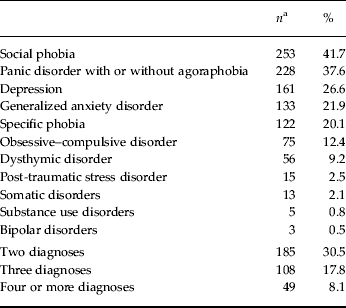
Participants completed self-report questionnaires and a structured clinical interview at three time points: intake, 12-month follow-up, and 24-month follow-up. Diagnoses at intake were established using the Anxiety Disorders Interview Schedule for DSM-IV: Lifetime Version (ADIS-IV-L; Di Nardo et al. Reference Di Nardo, Brown and Barlow1994), a semi-structured interview designed to ascertain reliable diagnosis of the DSM-IV anxiety, mood, somatoform and substance use disorders and to screen for the presence of other conditions (e.g. psychotic disorders). Note that the DSM-IV hierarchical rule for GAD was followed, such that GAD was not assigned if the disorder occurred solely during the course of a mood disorder (APA, 2000). All patients in the sample were assigned a principal diagnosis that was the primary focus of distress/impairment, and additional diagnoses were assigned if diagnostic criteria were met. Table 1 shows the prevalence of diagnoses (including principal and additional diagnoses) at intake, with the most frequent diagnoses being SAD (41.7%), PDA (37.6%), unipolar depression (26.6%), GAD (21.9%) and specific phobia (20.1%). Of the sample, 57% was assigned more than one diagnosis at intake, and most participants (76.2%) elected to receive CBT at CARD shortly after intake.
Baseline diagnoses and co-morbidity rates

a Total n = 606.
Patients were re-evaluated at the two follow-up assessments using the follow-up version of the ADIS-IV (ADIS-IV-FU), which is identical to the ADIS-IV-L except that the sections assessing past diagnoses are omitted. Both versions of the ADIS-IV provide dimensional ratings of the key and associated features of disorders (0–8 ratings); such features are dimensionally rated regardless of whether a formal DSM-IV diagnosis is under consideration. A reliability study of a subset of the current sample (n = 362), which had two independent administrations of the ADIS-IV-L, indicated good to excellent inter-rater agreement for current disorders (range of κ's = 0.67 to 0.86) except dysthymia (κ = 0.31; Brown et al. Reference Brown, Di Nardo, Lehman and Campbell2001).
Measures
GAD
One self-report questionnaire and three ADIS-IV dimensional rating measures (0–8 scales) were used as indicators for the GAD latent variable. The self-report questionnaire was the Penn State Worry Questionnaire (Meyer et al. Reference Meyer, Miller, Metzger and Borkovec1990). The ADIS-IV dimensional ratings were: (a) the mean of excessiveness of worry in eight areas (e.g. work/school, physical health), (b) a single rating of difficulty controlling worry, and (c) the mean of frequency and severity ratings of the six symptoms comprising the DSM-IV associated symptom criterion of GAD.
PDA
The latent variable of PDA was formed using two self-report questionnaires and one clinical rating measure. The self-report questionnaires were the Agoraphobia and Interoceptive subscales of the Albany Panic and Phobia Questionnaire (Rapee et al. Reference Rapee, Craske and Barlow1994/1995; Brown et al. Reference Brown, White and Barlow2005). The clinician-rated measure of PDA was the sum of ADIS-IV dimensional ratings of agoraphobic avoidance of 23 situations that individuals with panic disorder commonly fear entering (e.g. public transportation, elevators).
SAD
Two self-report questionnaires and one clinical rating measure were used as indicators for SAD. The self-report questionnaires were: (a) the Social Interaction Anxiety Scale (SIAS; Mattick & Clarke, Reference Mattick and Clarke1998; cf. Brown et al. Reference Brown, Turovsky, Heimberg, Juster, Brown and Barlow1997), and (b) the Social Phobia Scale of the Albany Panic and Phobia Questionnaire (Rapee et al. Reference Rapee, Craske and Barlow1994/1995; cf. Brown et al. Reference Brown, White and Barlow2005). In addition, patients' fear of 13 social situations (e.g. speaking with unfamiliar people, initiating a conversation) was rated by the clinician during administration of the ADIS-IV-L and ADIS-IV-FU.
Psychosocial impairment
The five items from the Subjective Symptoms Scale (SSS) were used as indicators for the impairment latent variable. The SSS is a modification of a scale introduced by Hafner & Marks (Reference Hafner and Marks1976) [Work and Social Adjustment Scale (WSAS); see also Mundt et al. Reference Mundt, Marks, Shear and Greist2002; Mataix-Cols et al. Reference Mataix-Cols, Cowley, Hankinsa, Schneider, Bachofen, Kenwright, Gega, Cameron and Marks2005), and respondents rate the extent (ranging from 0 = not at all to 8 = severe) that symptoms have interfered with five different areas of daily functioning (private leisure, work, household tasks, social leisure, family relationships) over the past week. In the current study, responses to the items were averaged to index overall impairment across domains, in addition to examining each individual item. The SSS was found to have good internal consistency in a psychiatric out-patient sample (Cronbach's α = 0.83; Brown et al. Reference Brown, Antony and Barlow1995), and the original WSAS has also demonstrated strong psychometric properties (Mundt et al. Reference Mundt, Marks, Shear and Greist2002; Mataix-Cols et al. Reference Mataix-Cols, Cowley, Hankinsa, Schneider, Bachofen, Kenwright, Gega, Cameron and Marks2005). In the current sample, coefficients α ranged from 0.84 to 0.90 across the assessment points.
Statistical analyses
All analyses were conducted using a latent variable software program and maximum-likelihood minimization functions (Mplus 6.0; Muthén & Muthén, Reference Muthén and Muthén1998–2010). Attrition was negligible at time 2 (7%), but increased to 50% at time 3. Thus, missing data were accommodated in all models using direct maximum likelihood (Allison, Reference Allison2003; Raykov, Reference Raykov2005). Goodness of fit of the models was evaluated using the root mean square error of approximation (RMSEA; Steiger, Reference Steiger1990), the Tucker–Lewis index (TLI; Tucker & Lewis, Reference Tucker and Lewis1973), the comparative fit index (CFI; Bentler, Reference Bentler1990) and the standardized root-mean-square residual (SRMR; Jöreskog & Sörbom, Reference Jöreskog and Sörbom1996). Acceptable model fit was defined in part by the criteria forwarded by Hu & Bentler (1999): RMSEA values close to 0.06 or below, CFI and TLI values close to 0.95 or above, and SRMR values close to 0.08 or below. The marker variable method was used to define the metric of latent variables in all models, with the first indicator listed for each latent variable in the ‘Measures’ section serving as the marker variable. A self-report indicator was selected as the marker variable for each of the three disorders in order to enhance comparability with self-reported impairment.
Results
Mean impairment by principal diagnosis
We first examined mean impairment levels across the subset of the sample with the three principal diagnoses of interest (GAD, SAD, PDA; n = 397), analysing overall mean scores on the SSS as well as individual items that assess different domains. Groups did not differ in race, age or treatment status, but those with SAD were more likely to be male (F 2,394 = 14.83, p < 0.001) and those with GAD had more co-morbid diagnoses (F 2,394 = 9.51, p < 0.001). To determine whether the three groups differed significantly in overall or domain-specific impairment, we conducted multiple regression analyses in which each impairment score was regressed onto three dummy codes that represent the presence/absence (1/0) of GAD, SAD and PDA (note that because principal diagnoses were analysed, diagnostic groups were mutually exclusive). These analyses are equivalent to analysis of variance, but the multiple regression framework was used instead so that the analyses could be conducted within Mplus using maximum likelihood estimation to accommodate missing data.
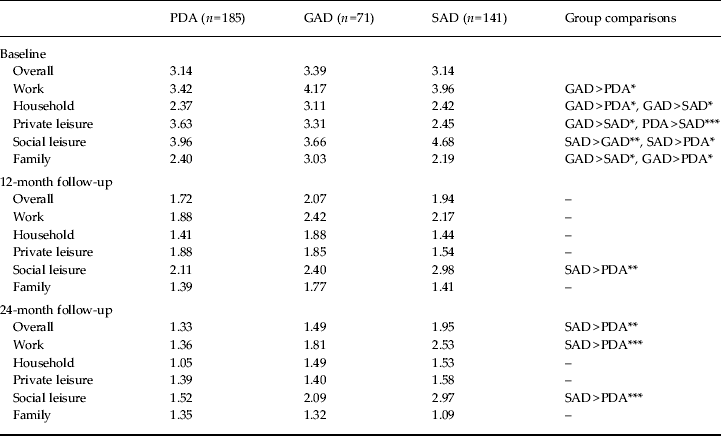
Table 2 shows the results of these analyses at each of the three assessment points (using groups as determined by principal diagnosis at intake), with impairment levels generally declining over time across groups and domains. At baseline, each of the three groups reported overall levels of impairment falling between the ‘mild’ and ‘moderate’ ratings (3.14 to 3.39 out of 8.00); groups did not significantly differ in overall impairment. There was evidence of differences in severity for numerous impairment domains (p's < 0.05), although all effect sizes were small in magnitude based on Cohen's (Reference Cohen1988) interpretive guidelines. Individuals with a principal diagnosis of GAD generally reported greatest impairment across a number of domains at baseline: the GAD group had greater impairment in work, household tasks and family relationships than the PDA group, and greater impairment in household tasks, private leisure and family relationships than the SAD group (Cohen's d's = 0.14 to 0.18). As might be expected, those with a principal diagnosis of SAD reported greater impairment in social functioning than did the other two groups (d's = 0.13 for PDA and 0.18 for GAD). Last, individuals with PDA endorsed greater levels of impairment in private leisure than did individuals with SAD (d = 0.23). There were few significant differences in impairment across diagnostic groups at 12- and 24-month follow-up, but all differences involved greater impairment among those with SAD as compared with those with PDA. Specifically, the SAD group had greater impairment than PDA in social leisure at 12-month follow-up (d = 0.17), and greater overall, work and social impairment than PDA at 24-month follow-up (d's = 0.18, 0.26 and 0.31, respectively).
Comparison of mean levels of impairment across principal diagnoses a

PDA, Panic disorder with or without agoraphobia; GAD, generalized anxiety disorder; SAD, social anxiety disorder.
a Principal diagnoses were established at baseline.
* p < 0.05, ** p < 0.01, *** p < 0.001.
LGM
We next conducted LGM analyses of each of the three disorder latent variables and the impairment latent variable (using the five items from the SSS as indicators) in the full sample. LGM provides estimates of initial levels (intercepts) and change over time (slopes) for each construct, allowing us to examine the temporal associations between the disorder constructs and impairment. Because the majority of change in impairment and each disorder construct occurred between the first two assessments, a non-linear growth model was specified: the slope factor loadings of the baseline, 12-month and 24-month assessments were set at 0, *, and 1, respectively (where * = freely estimated). The intercepts of the latent variables for each time point were fixed to zero and the residual variances at each time point were constrained to equality to improve identification and parsimony. Correlations were allowed for each indicator across the three assessment points (e.g. the residual variances of SIAS at each assessment were correlated with one another). Univariate LGMs for GAD, SAD and PDA were previously reported in this dataset and all models had excellent fit; see Gallagher et al. for further details regarding temporal measurement invariance and the results of the LGM analyses (M. W. Gallagher et al. unpublished observations; contact the first author K.N.-G.).
A longitudinal measurement model of impairment revealed partial measurement invariance, and all factor loadings were strong and significant (standardized estimates = 0.65 to 0.86; p's < 0.001), indicating that it was acceptable to proceed with LGM. The LGM provided an excellent fit to the data (χ 2 88 = 187.49, p < 0.001; CFI = 0.98; TLI = 0.97; RMSEA = 0.04; SRMR = 0.05). Levels of impairment declined significantly over the 2-year period (unstandardized estimate = −1.40, p < 0.001), and there was significant interindividual variability in initial levels of impairment and change in impairment over time (p < 0.001). Full results from the impairment LGM are available from the first author (K.N.-G.) upon request. Effect sizes that index total change over the 2-year assessment period were calculated using the parameter estimates from the longitudinal measurement models. The three disorder constructs had small to medium effect sizes (d's = 0.47 for PDA, 0.42 for GAD, 0.39 for SAD; change was in the direction of fewer symptoms) and impairment had a medium to large effect size (d = 0.73).
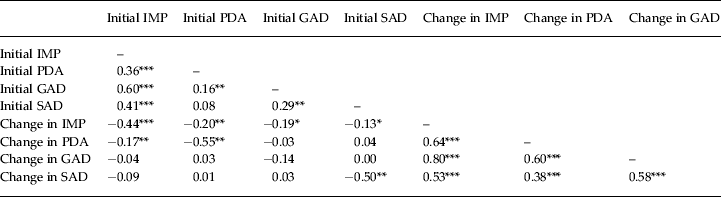
Table 3 shows the correlations among the LGM parameter estimates (i.e. initial levels and change over time) for each disorder construct and impairment. Initial levels of impairment were moderately to strongly correlated with initial levels of each disorder construct (r's = 0.36 to 0.60), and GAD was more strongly correlated with impairment than were the other two disorders (p < 0.001). In addition, initial levels of GAD were significantly associated with the other two disorders (r's = 0.16 and 0.29), whereas SAD and PDA were not associated at baseline. Finally, initial levels of PDA, SAD and impairment were negatively correlated with change in the corresponding construct over time. For example, individuals with a higher initial level of impairment demonstrated more reduction in impairment over the 2-year study period (r = −0.44). In contrast, initial levels of GAD were not significantly associated with change in GAD. Correlations among the slopes were also assessed to determine the magnitude and nature of simultaneous change among the constructs. Change in impairment was closely associated with change in GAD (r = 0.80), whereas change in impairment was less strongly associated (p < 0.001) with PDA and SAD (r's = 0.64 and 0.53, respectively). Symptom change across disorder constructs was also moderately to strongly correlated (r's = 0.38 to 0.60).
Correlations among initial values of and change in IMP and disorder constructs a

IMP, Impairment; PDA, panic with or without agoraphobia; GAD, generalized anxiety disorder; SAD, social anxiety disorder.
a n = 606. Model fit: χ 2 890 = 2034.89 (p < 0.001), comparative fit index = 0.94, Tucker–Lewis index = 0.93, root mean square error of approximation = 0.05, standardized root-mean-square residual = 0.06. Initial values are intercepts from the latent growth models, and change values are slopes.
* p < 0.05, ** p < 0.01, *** p < 0.001.
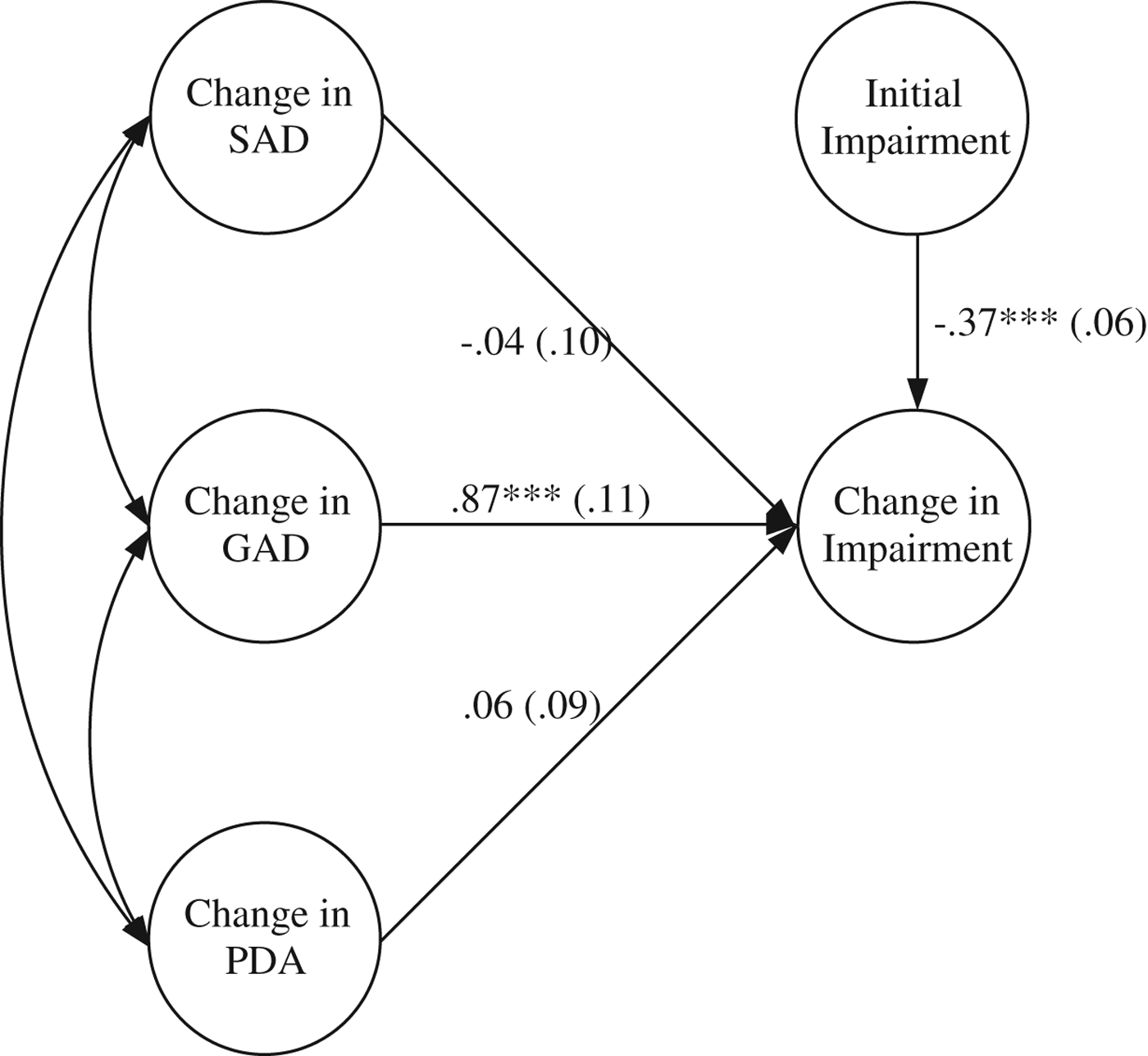
Last, we evaluated a structural model in which change in impairment was regressed onto change in each of the three disorder constructs, holding constant initial levels of impairment, to account for co-morbidity and determine which disorder(s) uniquely predicted change in impairment (see Fig. 1). Correlations were allowed among the intercepts of all constructs, and between the slope and intercept of each disorder construct. This model had good fit, and initial impairment and change in the three disorder constructs accounted for 92% of the change in impairment over time. Only change in GAD was uniquely and significantly predictive of change in impairment (standardized estimate = 0.87, p < 0.001), whereas change in SAD and PDA did not contribute unique variance to change in impairment. Because depression and CBT both have strong associations with impairment (e.g. Dunn et al. Reference Dunn, Vittengl, Clark, Carmody, Thase and Jarrett2012), we also ran the above model with (1) baseline depression diagnosis as a covariate, and (2) presence versus absence of CBT as a covariate. The above results were unchanged after accounting for baseline depression or for CBT.
Change in disorder constructs as unique predictors of change in impairment, controlling for initial levels of impairment. Parameters estimates are standardized, and standard errors are shown in parentheses. n = 606. Model fit: χ 2 902 = 2054.75 (p < 0.001), comparative fit index = 0.94, Tucker–Lewis index = 0.93, root mean square error of approximation = 0.05, standardized root-mean-square residual = 0.06. Model R 2 = 0.92. Initial level of impairment is the impairment intercept from the latent growth model, whereas change values are slopes from the latent growth models. SAD, Social anxiety disorder; GAD, generalized anxiety disorder; PDA, panic with or without agoraphobia. * p < 0.05, ** p < 0.01, *** p < 0.001.

Discussion
In a large, heterogeneous treatment-seeking sample, those with principal diagnoses of GAD, SAD and PDA generally had similar levels of impairment across various domains over the course of 2 years. However, GAD was associated with more severe impairment in certain areas (i.e. work, household, family, private leisure). This finding stands in contrast to other cross-sectional research, in that two prior studies found that GAD was most weakly associated with impairment among several anxiety disorders (although impairment was still elevated relative to controls) (Stein et al. Reference Stein, Roy-Byrne, Craske, Bystritsky, Sullivan, Pyne, Katon and Sherbourne2005; Sherbourne et al. Reference Sherbourne, Sullivan, Craske, Roy-Byrne, Golinelli, Rose, Chavira, Bystritsky and Stein2010). This discrepancy may be due to the fact that those with a principal diagnosis of GAD had more co-morbid diagnoses than the SAD and PDA group in the current study. In addition, participants in this sample were all seeking specialty psychological treatments, whereas participants in prior studies were patients recruited from a primary care setting who were not necessarily seeking psychological treatment.
The current study extends the literature on impairment in the anxiety disorders by also examining associations between impairment and specific anxiety disorders over the course of 2 years. Comparisons across principal diagnostic groups at 12-month and 24-month follow-ups indicated that individuals diagnosed with GAD at baseline no longer had greater impairment than the other two groups. Rather, those with SAD had more severe impairment than those with PDA, particularly at 24-month follow-up. Although dimensional symptoms of SAD declined similarly to symptoms of GAD and panic across the entire sample (d's = 0.39 to 0.47), this finding across diagnostic groups is consistent with naturalistic studies that indicate that individuals with PDA tend to have higher recovery rates and lower recurrence rates than those with SAD (e.g. Keller, Reference Keller2003; Ramsawh et al. Reference Ramsawh, Raffa, Orlando Edelen, Rende and Keller2009).
In addition to examining impairment levels across principal diagnostic groups over time, we also used LGM to evaluate dimensional symptoms of panic, SAD and GAD over the course of 2 years. It is noteworthy that the effect size for change in impairment (d = 0.73) was larger than the effect sizes for any of the three anxiety symptoms (d's = 0.39 to 0.47). This is aligned with transdiagnostic models of psychotherapy (e.g. Barlow et al. Reference Barlow, Ellard, Fairholme, Farchione, Boisseau, Allen and Ehrenreich-May2011) and with the strong association between general internalizing symptoms and impairment (e.g. Markon, Reference Markon2010; Seeley et al. Reference Seeley, Kosty, Farmer and Lewinsohn2011), in that change in impairment may be more closely linked to change in common processes across numerous disorders (e.g. reduction in emotional avoidance, situational avoidance, or maladaptive cognitions) than to specific disorders or symptoms.
We also found that change in symptoms covaried with change in impairment over time. In particular, change in GAD symptoms was very closely related to change in impairment (r = 0.80). The design and number of assessments of the current study precluded a thorough examination of the directionality of the association. However, a few studies have examined the direction of the temporal associations between change in impairment and change in depression, particularly within the context of treatment. Most evidence suggests that changes in impairment lag behind changes in depression, although there is also evidence for bidirectional associations (for a review, see McKnight & Kashdan, Reference McKnight and Kashdan2009). In a sample of patients with recurrent depression who received CBT, improved psychosocial functioning predicted later symptom reduction during the course of therapy, after accounting for levels of functioning and symptoms at the previous assessment point. However, prior to therapy, impairment and symptoms had reciprocal effects on one another (Dunn et al. Reference Dunn, Vittengl, Clark, Carmody, Thase and Jarrett2012). To the extent that such findings may also apply to the association between anxiety and impairment, these results suggest a complex association that changes over time. Future studies should examine the nature of the associations between impairment and anxiety symptoms in a naturalistic context, as well as during treatment.
Finally, given high rates of co-morbidity among the anxiety disorders and that symptom change across the three disorders were all substantially associated with one another (r's = 0.38 and 0.60), we also evaluated which symptoms may be uniquely associated with change in impairment, after accounting for co-morbidity and initial impairment levels. We found that only change in GAD was uniquely and significantly predictive of change in impairment. Based on phenotypic and behavior genetic research, some have hypothesized that GAD may be the ‘basic emotional disorder’ (e.g. Brown et al. Reference Brown, Chorpita and Barlow1998) because it is largely isomorphic with neuroticism, a trait that is closely associated with co-morbidity among the mood and anxiety disorders (e.g. Hettema et al. Reference Hettema, Prescott and Kendler2004; Watson et al. Reference Watson, Gamez and Simms2005; Weinstock & Whisman, Reference Weinstock and Whisman2006). Thus, much of the unique variance of GAD may tap into sources of co-morbidity across various disorders that are most closely associated with impairment. Similarly, the association between GAD and impairment may be particularly strong because worry is pervasive and can be focused on any area of life (including social situations and physical concerns), whereas the focus of distress for PDA and SAD is typically more narrow. Although we cannot conclude that changes in GAD symptoms lead to changes in impairment, these results suggest that if a patient is struggling with numerous anxiety symptoms, it may be helpful to prioritize GAD in treatment due to its close and specific association with impairment.
The current study has numerous strengths, including a large, clinical, diagnostically diverse sample, longitudinal assessment, and latent variable analyses that account for measure-specific sources of error. However, the study has several limitations that should be considered when interpreting the results. First, we assessed impairment with a single self-report measure and each impairment domain was assessed with a single item; as such, domain-level analyses should be considered preliminary and primarily descriptive. Relatedly, the analyses examining diagnostic group differences in impairment domains involved a substantial number of comparisons that increase the chance of a type I error. Therefore, emphasis should be placed on patterns of findings and magnitude of effect sizes, rather than individual significant differences. Our study design did not allow for an analysis of the direction of the temporal association between impairment and symptoms, so the results cannot provide information regarding causality. In addition, because the period between assessments was fairly long (i.e. 1 year), there may have been other variables or intervening processes that affected impairment levels. Last, the sample was heterogeneous with respect to treatment, as most but not all initiated CBT after intake. While the results may be more generalizable to real-life clinical settings in which treatment engagement varies following intake, we did not have sufficient information to examine whether particular elements of treatment may have affected impairment levels (although including treatment as a covariate did not affect results).
We found evidence of elevated levels of impairment across three of the most common anxiety disorders in a large, treatment-seeking sample, although rates declined substantially over the course of 2 years. Temporal change in symptoms was closely associated with change in impairment, with GAD symptoms uniquely predicting change in impairment. Future studies should examine the directionality of these associations by conducting more frequent assessments, as well as examining which factors (particularly related to treatment) might moderate the association between anxiety symptoms and impairment. Such studies could reveal common processes across the mood and anxiety disorders that are most closely linked to impairment and that may be amenable to modification via treatment.
Acknowledgements
This research was supported by a grant from the National Institute of Mental Health (no. R01 MH039096; principal investigator: T.A.B.). We thank Stephan Siwiec for his assistance in preparing this paper.
Declaration of Interest
None.