Introduction
Epistaxis is one of the most common otorhinolaryngological emergencies. Although most such cases can be managed conservatively, some are complicated, and persistent bleeding necessitates surgical intervention.Reference Moñux, Tomás, Kaiser and Gavilán1 Surgical procedures include ligation of the external carotid artery, the maxillary artery or the ethmoidal artery, or angiographic embolisation of the main arterial feeding vessels of the nasal mucosa. With the development of endoscopic technology, endoscopic electrocautery and sphenopalatine artery ligation have become popular treatment methods.Reference Sengupta, Maity, Ghosh, Basak, Das and Basu2 Nasal endoscopy has also made identification and direct cauterisation of posterior nasal cavity bleeding sources simpler and more accurate.Reference McGarry3, Reference Thornton, Mahesh and Lang4
Epistaxis is clinically divided into posterior and anterior types. Posterior epistaxis is also termed intractable epistaxis, because the bleeding originates from the posterior aspect of the nasal cavity where it is concealed and frequently recurrent.Reference Chiu and Shaw Dunn5 In the current study, the term intractable epistaxis was strictly defined as an unidentifiable bleeding origin, diagnosed as such by anterior rhinoscopy, which could not be controlled with at least one trial of standard anterior and posterior nasal packing.
The purpose of this study was to identify (1) common bleeding sources of intractable epistaxis and (2) the efficacy of subsequent endoscopic management.
Materials and methods
Patients
The study reviewed 265 cases of idiopathic epistaxis admitted to the otorhinolaryngology department of the Eye Ear Nose and Throat Hospital, Fudan University, Shanghai, between July 2008 and July 2009. In all patients, there was no identifiable bleeding source on anterior rhinoscopy, and bleeding could not be successfully controlled by at least one attempt at standard anterior and posterior nasal packing.
The study was limited to idiopathic epistaxis. We excluded cases of post-traumatic epistaxis and of secondary haemorrhage due to nasal neoplasm, haematological disease or hereditary haemorrhagic telangiectasia.
Antihypertensive, haemostatic, antimicrobial and supportive therapies were used during treatment.
Demographic data pertaining to patient age, gender, bleeding duration, past history of hypertension and blood profile result were recorded.
Informed consent was obtained in advance from all patients.
Endoscopic management
All patients were positioned supine. After slow, gentle removal of all packing materials, cotton wool pledgets soaked in 1 per cent lidocaine and 0.1 per cent adrenaline were placed in the olfactory cleft, in the inferior and middle meatuses, and on the nasal floor, for 15 minutes.
When topical anaesthesia was achieved, the nasal cavity was examined comprehensively using an endoscope with 0°, 30° and 45° lenses. A displacement fracture of the middle or inferior turbinate was created when necessary to enhance visualisation. If the bleeding origin was clearly identified, radiofrequency electrocautery was the treatment of choice. If the bleeding was copious, or if an approximate bleeding site was located rather than a definitive bleeding source, we used selective packing with absorbable surgical oxidised cellulose (Johnson & Johnson Wound Management, Somerville, New Jersey, USA). If no suspicious bleeding origin was identified, observation alone was preferred.
After 72 hours of observation on the ward, discharge was permitted. Patients were followed up at three months, with special attention given to any history of recurrent bleeding or complications.
Statistical analysis
Statistical analysis was performed using the Statistical Package for the Social Sciences software program (version 16.0; SPSS Inc, Chicago, Illinois, USA). Data are presented either as means ± standard deviation or as percentages, as appropriate. The relationship between age and bleeding origin was analysed using cross-tabulation with chi-square testing. A p value of less than 0.05 was considered statistically significant.
Results and analysis
Patient demographics
The mean patient age was 51.52 ± 14.20 years (range, 16–82 years). There were 224 males and 41 females.
All patients were treated with at least one trial of standard anterior and posterior nasal packing, prior to hospitalisation. Twenty-one (7.9 per cent) patients were treated with more than two applications of posterior nasal packing. Two patients underwent arterial ligation and one patient underwent arterial angiographic embolisation.
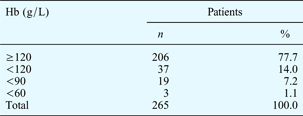
On admission, 78 (29.4 per cent) patients had a history of hypertension and 105 (39.6 per cent) had an elevated white blood cell count. Table I shows the lowest haemoglobin concentration recorded in patients during bleeding.
Patients' lowest recorded HB level
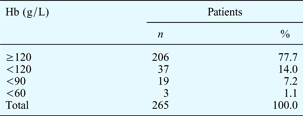
Hb = haemoglobin
Bleeding origin
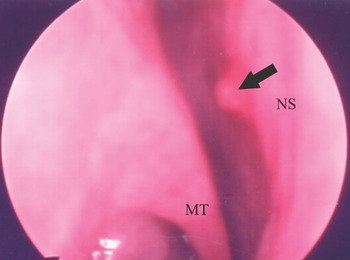
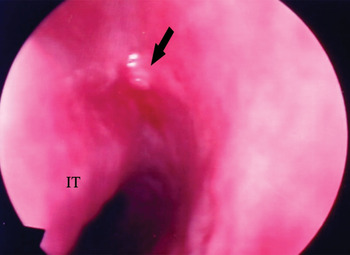
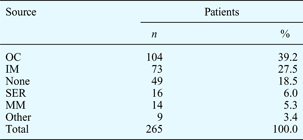
All patients had unilateral bleeding. After pack removal, no bleeding source could be identified in 49 patients. The remaining 216 (81.5 per cent) patients had only one identified bleeding source each (Table II). The commonest bleeding sources were the superior nasal septum at the olfactory cleft (Figure 1) and the inferior meatus (Figure 2). Most bleeding appeared as a pulsatile, spurting haemorrhage; during active bleeding, the bleeding source appeared as a red, arteriola-like bulge.
Nasal endoscopic view showing bleeding source (arrow) on the superior nasal septum (NS) at the olfactory cleft. MT = middle turbinate

Nasal endoscopic view showing bleeding origin (arrow) on the lateral wall of the inferior meatus. IT = inferior turbinate

Patients' bleeding source
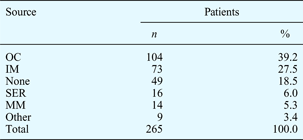
OC = superior nasal septum at olfactory cleft; IM = posterior lateral wall of inferior meatus or end of lateral aspect of inferior turbinate; None = no abnormality found; SER = sphenoethmoid recess; MM = posterior lateral wall of middle meatus or end of lateral aspect of middle turbinate; Other = other origin (e.g. inferior midseptum)
Age and bleeding source
The location of the bleeding source varied among different patient age groups, and a correlation was observed. Specifically, the most common bleeding source was the olfactory cleft in patients aged 50 years or older, and the inferior meatus in those less than 50 years (Table III).
Bleeding source by age group

The difference in bleeding source between the two age groups was statistically significant (p < 0.01). Y = years; IM = posterior lateral wall of inferior meatus or end of lateral aspect of inferior turbinate; MM = posterior lateral wall of middle meatus or end of lateral aspect of middle turbinate; None = no abnormality found; OC = superior nasal septum at the olfactory cleft; SER = sphenoethmoid recess; Other = other origin (e.g. inferior midseptum)
Choice of therapy
In all 191 patients with a bleeding source in the inferior meatus, middle meatus or olfactory cleft, the bleeding source was successfully treated with radiofrequency electrocautery.
Thirteen of the 16 patients with a bleeding source in the sphenoethmoid recess were treated with selective packing. The remaining three patients were treated with radiofrequency electrocautery.
Fifty-seven (21.5 per cent) patients were treated with observation alone. Of these, eight patients had a bleeding source identified while undergoing a second endoscopy undertaken due to re-bleeding. In the other 49 patients, no further bleeding was observed.
Outcomes
Control of bleeding was achieved in all cases, with no recurrence during the three-month follow-up period.
In the first month of post-discharge follow up, adhesions were identified in 28 cases: 19 (7.2 per cent) between the inferior turbinate and the septum, and nine (3.4 per cent) between the medial border of the middle turbinate and the septum. None of these patients complained of discomfort. Separation procedures were performed successfully.
No other severe complications were found.
Discussion
The key to epistaxis management is identification of the bleeding source. In such cases, endoscopic visualisation is greatly affected by factors such as concealed bleeding sources, rhinostenosis and active bleeding. Therefore, it is sometimes only possible to identify an approximate bleeding source.
In our patients, intractable epistaxis was usually due to a concealed bleeding source. These patients' bleeding sources, in descending order of frequency, were the olfactory cleft, inferior meatus, sphenoethmoid recess, middle meatus and other origins; however, no abnormality was found in 18.5 per cent of patients.
Our findings differ from those of Hara, in whose patient group most bleeding arose from an area near the sphenopalatine foramen, and also from the posterior part of the middle meatus, the inferior meatus, the nasal floor and Woodruff's nasopharyngeal venous plexus.Reference Hara6 Similar to the report of Yang et al., we found that bleeding seldom arose from the nasal floor or Woodruff's nasopharyngeal venous plexus.Reference Yang, Cheng, Han, Shu and Zhang7 Most of the bleeding encountered in our patients was of a pulsatile, arterial nature rather than a venous nature. This may have been due to high arterial blood pressure and arterial wall atherosclerosis, in contrast to the low intravenous blood pressure and good compliance of veins, although our statistics did not show a relationship between hypertension and intractable epistaxis.
Based on our patients' results, we suggest that, in cases of intractable epistaxis, the first site of endoscopic should be the inferior meatus in patients younger than 50 years, and the olfactory cleft in patients 50 years and older. Otolaryngologists should pay special attention to these regions, and should perform an orderly and thorough examination. In our patients, despite careful initial endoscopy there were eight false negative cases in which a bleeding source was identified upon repeated endoscopy.
Currently, epistaxis is usually classified into anterior and posterior types. However, based on our study findings we consider that classification into superior and inferior types may be more useful for diagnosis and management. We would define superior epistaxis as bleeding from a source above the inferior border of the middle meatus, and inferior epistaxis as bleeding from a source below that level. In our study, nearly half of our intractable bleeding cases (i.e. olfactory cleft cases plus sphenoethmoid recess cases, n = 120/265, 45.2 per cent) occurred in the superior part of the nasal cavity. This area is relatively concealed and difficult to access via nasal packing. Therefore, we would strongly recommend that, following diagnosis by anterior rhinoscopy, endoscopy and electrocautery should be undertaken rather than packing.
A classification of superior versus inferior epistaxis is consistent with an earlier, traditional classification of epistaxis based on anatomical blood supply. However, if embolisation or ligation is not considered, then epistaxis classification based on blood supply provides little useful information for further intervention.
The site of the individual bleeding source is another decisive factor dictating treatment. The use of a fine radiofrequency electrocautery probe has been reported to enable more effective tissue coagulation and more accurate cautery of bleeding vessels, even in deep, narrow clefts. Furthermore, radiofrequency electrocautery has a reported initial treatment success rate of 95.9 per cent. Therefore, in cases of epistaxis originating from the olfactory cleft, inferior meatus or middle meatus, endoscopy-guided radiofrequency electrocautery should be the first choice of treatment.
Bleeding involving the sphenoethmoid recess, which may come from the posterior nasal septal artery, is seldom reported. Our patient group contained three cases with specific bleeding sources below the sphenoid sinus ostium, along the course of the posterior nasal septal artery, which were successfully stanched by radiofrequency electrocautery. However, we cannot exclude the possibility that blood from nearby bleeding sources (e.g. the olfactory cleft) accumulated here because of the supine patient positioning, and that correct identification of the bleeding source was prevented by poor visualisation due to active bleeding and rhinostenosis. Bleeding sources within the sphenoethmoid recess are more concealed, compared with those at other sites (e.g. the olfactory cleft and inferior and middle meatuses). Therefore, distinct bleeding sources at this site were seldom found, and we were forced to use selective packing instead. Following such selective packing, bleeding did not recur in any of these cases. However, we were not able to show that selective packing was significantly more advantageous than radiofrequency electrocautery for the treatment of sphenoethmoid recess epistaxis, as our patient group contained insufficient numbers to enable such a comparison.
Nasal packing, introduced following anterior rhinoscopy, is often ineffective in resolving refractory epistaxis, and repeating packing has been shown to be useless and painful. It has been reported that 8.3 per cent of epistaxis patients have nasal packing performed more than twice. In our study, 18.5 per cent of epistaxis cases (n = 49) resolved with observation alone. Posterior nasal packing has been associated with adverse respiratory events (e.g. sleep apnoea).Reference Rotenberg and Tam8
In cases of epistaxis, we strongly recommend the performance of further, active endoscopy before nasal packing is repeated. Furthermore, we believe that it is preferable to perform endoscopy prior to the first attempt at posterior nasal packing, if possible. Thornton et al. studied posterior epistaxis cases and reported that, despite a failure to locate the bleeding source during examination, the combination of vasoconstriction due to topical adrenaline plus hypotension due to general anaesthesia facilitated the formation of a stable clot.Reference Thornton, Mahesh and Lang4 However, in our series the use of local anaesthesia was insufficient to resolve all patients' epistaxis; this may have been due to mucosal swelling after packing removal, or a reduction in patient anxiety.
Our results showed that in 39.5 per cent of cases epistaxis originated from the superior nasal septum at the olfactory cleft; this incidence is nearly twice the 20 per cent reported by Thornton et al. Reference Thornton, Mahesh and Lang4 The blood supply to this area is derived primarily from the anterior and posterior ethmoidal arteries. Therefore, we believe that patients with intractable epistaxis have a higher incidence of bleeding from the ethmoidal arteries, compared with patients with easily resolved epistaxis. This is contrary to the opinion of some scholars, who believe that epistaxis involving the ethmoidal arteries is relatively uncommon.Reference Floreani, Nair, Switajewski and Wormald9, Reference Douglas and Wormald10 Angiographic embolisation for posterior epistaxis generally embolises the maxillary artery, which is ineffective for treating epistaxis originating from the ethmoidal arteries (which are branches of the internal carotid artery). Angiographic embolisation also requires skilled interventional radiologists, and carries with it a risk of neurological sequelae.Reference Fukutsuji, Nishiike, Aihara, Uno, Harada and Gyoten11 Moreover, the incidence of recurrent bleeding in this scenario is high.Reference Christensen, Smith, Barnwell and Wax12 Recently, endonasal ligation or cautery of the sphenopalatine artery has been reported to achieve very good outcomes.Reference Nouraei, Maani, Hajioff, Saleh and Mackay13 Theoretically, the offending vessel should be ligated at as distal a location as possible, while still proximal to the bleeding source.
Our experience confirmed the advantages of endoscopy and minimally invasive management. In our group, one patient had undergone posterior nasal packing at another hospital on four occasions, and also maxillary artery ligation. Another patient had previously undergone facial and internal maxillary artery embolisation. On endoscopy, both patients had an arteriolar, pulsatile bleeding source on the nasal septum surface of the olfactory cleft. Another patient underwent ineffective external carotid artery ligation, only to be subsequently identified as having a bleeding source on the posterior lateral wall of the inferior nasal meatus. All the above patients achieved complete epistaxis resolution following endoscopic radiofrequency electrocautery.
Although intractable idiopathic epistaxis presents many difficulties, anaemia is relatively infrequent, and severe anaemia rare. Thus, clinicians can usually afford to examine and manage epistaxis cases in a careful, stepwise manner. Recognition of this fact is also useful when calming nervous patients who demand haemostasis, and may help to decrease the frequency of over-treatment, especially repeated packing. Because it is difficult to measure epistaxis bleeding frequency and quantity, our study used bleeding duration as a approximate surrogate marker; however, we failed to find a practical linear correlation between epistaxis duration and haemoglobin concentration.
• Epistaxis is one of the most common ENT emergencies
• Anterior and posterior nasal packing for intractable epistaxis leads to mucosal injury
• When endoscopy shows a distinct bleeding source, radiofrequency electrocautery can control intractable epistaxis, without repeated packing
Adhesions between the inferior turbinate and the nasal septum can be largely attributed to nasal mucosa damage caused by petroleum jelly impregnated gauze. Adhesions between the medial border of the middle turbinate and the olfactory cleft septum may be due to mucosal damage caused by endoscopic examination and electrocautery. As no severe complications were found in the reported patient group, the described endoscopic technique for intractable epistaxis is thought to be safe.
Last, but not least, all manipulations in our study were performed under topical anaesthesia. This is in contrast to the related literature. Because of the simple manipulation and short duration of the described procedure, topical anaesthesia was sufficient to achieve the desired effect, and was also calculated to be cost-effective. In addition, topical anaesthesia can be easily carried out in out-patient clinics, facilitating active endoscopy and helping reduce the incidence of painful and unnecessary nasal packing.
Conclusion
Severe anaemia is relatively infrequent among patients with intractable idiopathic epistaxis. Thus, clinicians can afford to conduct a careful, stepwise examination and management. Endoscopy enables better visualisation and more orderly examination, and facilitates the identification of concealed bleeding sources in the posterior superior nasal cavity and meatuses. The following treatment is effective for cases of intractable epistaxis: endoscopy-guided radiofrequency electrocautery in cases with a distinct bleeding source; selective nasal packing in cases with an indistinct bleeding source or poor visualisation; and observation in cases in which active bleeding cannot be detected. Endoscopic techniques are simple and safe, and should be attempted before alternative treatments such as repeated packing or interventional radiological procedures; they may even usefully precede the first attempt at posterior nasal packing.