Geographic variation in behaviour of individuals within a species is well known (Foster & Endler Reference FOSTER and ENDLER1999), both across ranges (Iriarte et al. Reference IRIARTE, FRANKLIN, JOHNSON and REDFORD1990) and locally (Hertz & Huey Reference HERTZ and HUEY1981). For predators, variation in prey use within a given site is often seasonal (Brillhart & Kaufman Reference BRILLHART and KAUFMAN1995), and related to changes in relative abundance and/or vulnerability of various prey (Kunkel et al. Reference KUNKEL, PLETSCHER, BOYD, REAM and FAIRCHILD2004). Behavioural diversity also occurs because prey behaviours vary and predators change foraging tactics, even on a daily basis (Ropert-Coudert et al. Reference ROPERT-COUDERT, KATO, BOST, RODARY, SATO, LE MAHO and NAITO2002).
The jaguar (Panthera onca Linnaeus) has a wide distribution and varying food habits; it is a somewhat opportunistic predator that has been reported to prey on more than 85 species across its geographic distribution (Weckel et al. Reference WECKEL, GIULIANO and SILVER2006). Its diet, especially in rain forests, apparently varies with ease of capture and density of prey (Rabinowitz & Nottingham Reference RABINOWITZ and NOTTINGHAM1986, Seymour Reference SEYMOUR1989), though medium- and large-sized prey consistently comprise a large portion of its diet (Gonzalez & Miller Reference GONZALEZ and MILLER2002). Competition with puma (Puma concolor Linnaeus) also may affect jaguar prey selection and foraging behaviour (Novack et al. Reference NOVACK, MAIN, SUNQUIST and LABISKY2005), and trophic diversity may vary with season (Chinchilla Reference CHINCHILLA1997). Jaguar movements (Pontes & Chivers Reference PONTES and CHIVERS2007) and activity patterns (Hoogesteijn & Mondolfi Reference HOOGESTEIJN and MONDOLFI1993) reflect prey species availability.
Corcovado National Park (CNP), Costa Rica, supports a relatively high-density jaguar population (~7 per 100 km2, Salom-Perez et al. Reference SALOM-PEREZ, CARRILLO, SAENZ and MORA2007). Previous studies there identified white-lipped peccary (Tayassu pecari Link) as a major prey species for jaguar; its remains occurred in 55% of 22 jaguar faeces examined (Chinchilla Reference CHINCHILLA1997). Jaguars, however, also prey on marine turtles in CNP (Carrillo et al. Reference CARRILLO, MORERA and WONG1994), though their remains are rarely detected in faeces (Chinchilla Reference CHINCHILLA1997). Marine turtles are probably easily caught by jaguars because they do not move quickly on land; they are, however, only available to jaguars while nesting on the beach which occurs year round and varies temporally with moon phase (Carrillo Reference CARRILLO2000).
In this study, we sought to identify the relative influences on jaguar behaviour in CNP by nesting marine turtles and an adjacent herd of white-lipped peccaries, especially since turtles vary in their availability. Fortuitously, an El Niño weather event that occurred during the study (Changnon Reference CHANGNON2000) and reduced turtle nesting frequency served as a natural experiment to help identify the role of prey availability on jaguar behaviour.
The 500-km2 CNP is located in the western half of the Osa Peninsula on the southern, Pacific Ocean side of Costa Rica. Areas near the beach were farms when the park was established in 1975 and are now a mosaic of second-growth habitats. Several small rivers flow through the area from higher elevations (50–700 m asl; Tosi Reference TOSI1969) down through the humid tropical forest (45% of the park is < 50 m asl). The climate is hot and humid, with an annual average temperature of 25 °C. Annual average precipitation is about 5000 mm, with pronounced dry (December–April) and wet periods (May–November). Sea surface temperature is a good indicator of El Nino events (Trenberth & Stepaniak Reference TRENBERTH and STEPANIAK2001), and within 50 km of our study site, the deviation above monthly temperature means was always > 0.6 °C during September 1997–April 1998; this is the period we designated in our analyses as the El Niño event.
Most Costa Rican mammals that occur in humid forests exist in CNP, as do a large proportion of bird and reptile species that occur in the country (Vaughan Reference VAUGHAN1981). During the 3 y of our study a herd of about 200 white-lipped peccaries ranged over 38 km2 adjacent to the beach (Carrillo et al. Reference CARRILLO, SAENZ and FULLER2002).
At the beach, >95% of nesting turtles are olive ridley (Lepidochelis olivacea Eschscholtz); Pacific green (Chelonia mydas Linnaeus), and leatherback (Dermochelys coriacea Vandelli) turtles also occur (E. Carrillo, unpubl. data). These turtles are solitary nesters that show no strong seasonality (Carrillo Reference CARRILLO2000). However, nesting is usually highly related to moon phase through the year (Carrillo Reference CARRILLO2000); from February 1996–December 1998, 10 times as many turtles nested during last quarter and new moon (LQNM) phases each month than during first quarter and full moon (FQFM) phases (χ2 = 63.0, df = 1, P < 0.0001), except during the El Niño when LQNM-phase turtle nesting was 90% lower (χ2 = 11.5, df = 1, P = 0.0007; Table 1).
Frequency of turtles nesting on a 5-km beach during different moon phases (LQNM = last quarter/new moon; FQFM = first quarter/full moon) in Corcovado National Park.

During February 1996–December 1998, we obtained information on jaguar food habits in three ways. First, we opportunistically collected jaguar faeces in the forest (none was ever found on the beach), and predator-killed carcasses. No scats found near kill sites were collected (to avoid bias), and carcasses and other scats we found were attributed to species (i.e. those of jaguars differentiated from those resulting from puma or carnivore predation) by means of associated signs (e.g. tracks) (Chinchilla Reference CHINCHILLA1997, Nunez et al. Reference NUNEZ, MILLER and LINDZEY2000); scats and carcasses that could not be definitively attributed were excluded from analyses. Second, we counted fresh (< 24 h old) jaguar-killed turtles during beach surveys. Both olive ridley and Pacific green turtles were killed, and unambiguous species identification was recorded whenever possible. We compared numbers of carcasses found between different moon phases (LQNM vs. FQFM), and weather (El Niño = October 1997–May 1998). Finally, we identified kills made by a radio-monitored jaguar. We searched for prey remains when sequential locations of the jaguar indicated it had not moved for 2 d and thus could have been at a kill site (Anderson & Lindzey Reference ANDERSON and LINDZEY2003). Although this technique probably biased the sample towards large prey, prey that took a long time to eat, or to more easily found prey remains (including turtles), it gave results independent of those obtained from scats and beach carcass counts.
After capturing one 60-kg adult female jaguar on 25 February 1996 in a box trap baited with shark meat, we immobilized, weighed, and fitted her with a 500-g radio-collar (Telonics Inc. Mesa, AZ, USA); capture and handling followed standard guidelines (Gannon et al. Reference GANNON and SIKES2007). We triangulated her location using two-element hand-held antennae (error = 150 ± 100 m at 0.5–0.8 km) or two permanent 10-m towers (each with a two-element antenna) located on the two highest hills in the study area (error = 75 ± 50 m at 0.5–0.8 km). At no time did it take us longer than 24 h to find the jaguar signal and obtain a location. On average, we located the jaguar once every 2 d, with 45% of locations occurring at night; in total, we located the jaguar 530 times in 3 y. To estimate general habitat use, we categorized each jaguar location as at the beach (< 75 m from the mean high tide) or in the forest, and compared totals by moon phase and weather (El Niño). We also estimated activity patterns by assessing the variation in signal strength when monitoring the jaguar for a 30-s interval, once per hour; we similarly monitored activity of radio-marked white-lipped peccaries (Carrillo et al. Reference CARRILLO, SAENZ and FULLER2002).
We collected 18 jaguar scats in the study area, and found remains of white-lipped peccaries in 16 of them. Other species remains included collared peccary (Pecari tajacu Linnaeus; n = 7), two-toed sloth (Choloepus hoffmanni Peters; 4), olive ridley turtle (2), three-toed sloth (Bradypus variegates Schinz; 2), white-faced monkey (Cebus capucinus Linnaeus; 1), a common agouti (Dasyprocta punctata Wagler; 1) and a chestnut-mandibled toucan (Ramphastos swainsonii Gould; 1). In contrast, 14 of 20 kills that we found opportunistically or in the course of radio-tracking the jaguar were of olive ridley turtle, two were of Pacific green turtle, and four were of white-lipped peccary. In addition, we identified carcasses of 72 turtles freshly killed by jaguars during beach surveys. Most were located during LQNM phases (0.91 per survey vs. 0.03 during FQFM; χ2 = 49.5, df = 1, P < 0.0001; Table 2), except during the El Niño (0.08; χ2 = 15.1, df = 1, P = 0.0001).
Frequency of jaguar-killed turtle carcasses occurring on a 5-km beach during different moon phases (LQNM = last quarter/new moon; FQFM = first quarter/full moon) in Corcovado National Park.

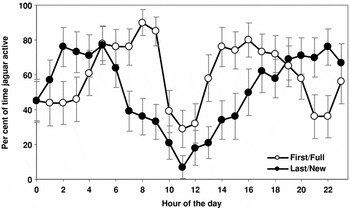
A higher proportion of radio-locations of the jaguar were at the beach (vs. in the forest; Table 3) during LQNM phases (40%) than during the FQFM phases (24%; χ2 = 13.3, df = 1, P = 0.0003), except during the El Niño event (8%; χ2 = 14.9, df = 1, P = 0.0001). In addition, the jaguar showed a strongly bimodal activity pattern, with peaks that varied by moon phase (Figure 1). She was more nocturnal during the LQNM phases (when turtles were more often on the beach at night) and more diurnal during the FQFM phases; peccary activity was mainly diurnal with a major decrease during the middle of the day (Carrillo et al. Reference CARRILLO, SAENZ and FULLER2002).
Frequency of locations of a radio-marked jaguar on or near the beach vs. in the during different moon phases (LQNM = last quarter/new moon; FQFM = first quarter/full moon) in Corcovado National Park.

Activity patterns of a radio-marked female jaguar monitored during first quarter/full and last quarter/new moon phases in Corcovado National Park, Costa Rica, during February 1996–December 1998. Mean number of activity checks h−1 was 73 (range = 58–92 h−1).

Although jaguars in CNP are opportunistic predators on red-brocket deer (Mazama americana Erxleben) and green iguanas (Iguana iguana Linnaeus, Chinchilla Reference CHINCHILLA1997), peccaries and marine turtles were major components of their diet in this study. Jaguars are major predators of peccaries throughout their range (Sowls Reference SOWLS1997, Valdez Reference VALDEZ, Demarais and Krausman2000) and in Corcovado, annual mortality of female adult white-lipped peccaries due to jaguar predation averages about 3% (Fuller et al. Reference FULLER, CARRILLO and SAENZ2002). Throughout the tropics jaguars prey on a wide variety of both marine and freshwater turtle species in both the rainy and dry seasons (Emmons Reference EMMONS1987, Garla et al. Reference GARLA, SETZ and GOBBI2001, Rabinowitz & Nottingham Reference RABINOWITZ and NOTTINGHAM1986, Troëng Reference TROËNG2000), but they are rarely described as a major prey species driving overall hunting behaviour.
The jaguar has been described as a species whose movements (Pontes & Chivers Reference PONTES and CHIVERS2007) and activity patterns (Rabinowitz & Nottingham Reference RABINOWITZ and NOTTINGHAM1986) depend on those of their major prey. Our marked jaguar changed activity and movement patterns about every 2 wk, depending on availability of marine turtles. An overall decrease in turtle nesting during the El Niño event that we observed confirmed the clear effects of turtle abundance on jaguar hunting behaviour. This finding concurs with Rabinowitz (Reference RABINOWITZ1986), who said that jaguars are opportunistic feeders and vary their diet and activity patterns based on prey availability, as well as with findings for other species (Whitaker et al. Reference WHITAKER, NEEFUS and KUNZ1996).
ACKNOWLEDGEMENTS
Field work was funded by the National Geographic Society, Wildlife Conservation Society, World Wildlife Fund (Central America office), the U.S. Fish and Wildlife Service, Universidad Nacional de Costa Rica, Ammonite Company, and Idea Wild. We are grateful for field assistance from A. Diaz, J. Meyer, F. Wolf, S. Durno, E. McCain, R. Perez, R. Arias and J. Villalobos, and especially M. Altrichter and H. Campero. We are also grateful for the help of L. Leon and the Corcovado National Park rangers, and P. Sievert for statistical advice.