Introduction
Bone-anchored hearing aids (BAHAs) provide a means of hearing for those patients who, for a variety of reasons, cannot wear a conventional hearing aid. Bone-anchored hearing aids were first used in 1977, and have since been implanted in tens of thousands of patients.Reference Tjellström, Håkansson and Granström1 They have been used in a variety of conditions, in patients with conductive, mixed or sensorineural hearing loss.Reference Snik, Mylanus, Proops, Wolfaardt, Hodgetts and Somers2
The BAHA is based on the principle of osseointegration; a process by which metal integrates with bone.Reference Tjellström, Lindström, Hallén, Albrektsson and Brånemark3 This allows a titanium fixture to be inserted into the mastoid bone, to which an abutment and aid can be fitted. The BAHA transmits sound, processed by the hearing aid, to the cochlea via the cranium, therefore bypassing the tympanic membrane and ossicular chain and, by definition, any middle-ear pathology.
Bone-anchored heading aids have been in use in the Greater Manchester region for over 20 years. The indications for BAHA implantation have changed since the procedure was first developed in the 1980s.Reference Snik, Mylanus, Proops, Wolfaardt, Hodgetts and Somers2 The devices were first used in patients with conductive or mixed hearing loss due to a variety of pathology, particularly conditions resulting in a chronically discharging ear.Reference Proops4 Another important indication is children and adults with congenital ear malformations.Reference Granström5 These patients are unable to wear a behind-the-ear hearing aid, as the mould will not fit effectively in the ear. Other suitable conditions include otosclerosis, tympanosclerosis and previous ear surgery rendering the patient unable to wear a conventional hearing aid.Reference Proops4
More recently, BAHAs have been used in patients with unilateral sensorineural hearing loss, frequently after excision of acoustic neuromas; however, some have queried the evidence base for this indication.Reference McLarnon, Davison and Johnson6–Reference Baguley, Bird, Humphriss and Prevost8 The BAHA is implanted on the ipsilateral side and sound is transmitted transcranially to the functioning contralateral ear to give improved directional hearing and sound recognition.Reference Wazen, Spitzer, Ghossaini, Fayad, Niparko and Cox9
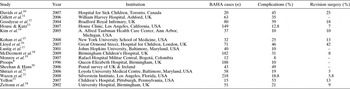
The aims of this study were to assess BAHA complication rates at the authors' institutions, and to compare these to nationally and internationally published data. There have been a number of studies reporting complications of BAHA implantation (see Table I), but none involving such a large number of patients as the present study.
Summary of published BAHA studies

BAHA = bone-anchored heading aid; – = data not provided by authors
We have developed a database of all patients who have undergone BAHA implantation since our programme started in 1984. This database contains details about the surgical procedure and the follow-up period, including complications and revision surgery. Not all records are complete, especially for earlier operations. Nevertheless, to our knowledge, this is currently the largest such database in the UK, and it has allowed us to examine our BAHA complication rates.
We assessed four different factors to investigate whether they influenced outcomes: grade of surgeon, local or general anaesthetic, one or two stage procedure, and operative technique. The operative technique has changed over the years. Initially, the procedure was performed using a scalpel to raise the flap, thin it down and remove hair, whereas now a dermatome is commonly used to raise the skin flap.Reference Woolford, Morris, Saeed and Rothera25, Reference Stalfors and Tjellström26 Initially, the procedure was performed in two stages under a general anaesthetic. Now, most procedures are single-stage, performed if possible under local anaesthetic.Reference Mylanus and Cremers27
Materials and methods
A list of all the patients who had undergone BAHA implantation in Central Manchester and Salford was compiled by the audit departments of the Manchester Royal Infirmary and Hope Hospital. This covered the period 1984–2008. Surgical indications, operative notes and follow-up details were then identified by examining the patients' medical records. We recorded the grade of the operating surgeon, whether the procedure had been performed under local or general anaesthetic, the operative technique, and whether the procedure had been performed in one or two stages. We compared published results to our own.
Additionally, a literature search was performed using the Medline, PubMed and Cochrane electronic databases, using the following medical subject headings: ‘adult’, ‘child’, ‘hearing aids’, ‘hearing loss’, ‘postoperative complications’, ‘prostheses and implants’, ‘retrospective studies’, ‘surgical wound infection’ and ‘treatment outcome’. The search included all articles published in English up to 31 January 2009. Relevant references were used to identify other studies.
Six hundred and two BAHAs were implanted in 499 patients. Patients' ages ranged from four to 87 years. The procedures were performed by 32 different surgeons, mainly registrars rotating through the north west deanery training scheme. A consultant surgeon performed the operation in 284 cases.
Results and analysis
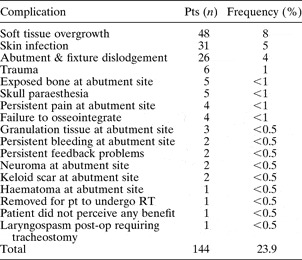
We found an overall complication rate of 23.9 per cent; this compares favourably with published rates of 8–59 per cent, as shown in Table I. The types of complications encountered are shown in Table II. The main complications were soft tissue overgrowth (48 patients), abutment site infection (31), abutment and fixture dislodgement (26) and trauma (six). Exposed bone (five patients), skull paraesthesia (five), persistent pain (four) and failure of osseointegration (four) were also encountered. Other rare complications included neuroma, and excess feedback due to weight gain. One patient had their BAHA removed in order to undergo radiotherapy, and one patient asked that the BAHA be removed as they did not perceive any benefit from the device (their hearing thresholds were at the minimum limit for a Compact BAHA, but they would not consider wearing a Cordelle device). All but one of the complications in our series was considered minor. One patient, a 45-year-old woman with Treacher Collins syndrome, developed laryngospasm which precipitated complete airway obstruction in the recovery room. Anatomical difficulties made reintubation difficult and so an emergency tracheostomy was performed, which was subsequently removed with no further sequelae.
Complications encountered

Pts = patients; RT = radiotherapy; post-op = post-operatively
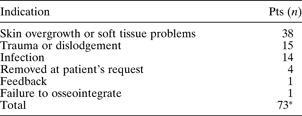
Of the patients with complications, 73 required revision surgery (12.1 per cent), 38 for skin and soft tissue problems, 15 due to trauma or dislodgement of the fixture and abutment, and 14 for infection. Revision was also required for excessive feedback and failure to osseointegrate. Four BAHAs were removed at the patient's request: for pain in two cases, for failure to provide benefit in one case, and to enable the patient to undergo radiotherapy in the other case. These results are shown in Table III.
Indications for revision surgery
*Total revision surgery rate = 12.1 per cent
In order to determine whether any risk factors existed that were more likely to produce complications, various aspects of the operation were assessed in more detail. Statistical analyses were performed using Fisher's exact test (GraphPad software; La Jolla, California, USA) to investigate the different factors which may have affected the complication rate.
Implantation procedures were performed by three consultants and 29 specialist registrars. This appears to be a reasonably large number of operators, but actually equates to 1.5 registrars per year attached to the consultants who performed BAHA insertion. This is not an uncommon number in the context of a rotational training programme. In cases in which a trainee performed the surgery, a consultant present in the operating theatre during the procedure almost invariably supervised it. Of the patients who experienced complications, 84 (58 per cent) were operated upon by a consultant; the difference between consultant and non-consultant complications rates was statistically insignificant.
Three hundred and sixty-six procedures were performed at Hope Hospital and 236 at the Manchester Royal Infirmary. There was no statistically significant difference between the complication rates for either site.
In this series, local anaesthesia was used in 332 cases. General anaesthesia was preferentially used in children, and occasionally in adults if requested due to nervousness or intolerance of local anaesthesia. The type of anaesthetic used did not contribute significantly to the complication rate.
Initially, the insertion had been performed as a two-stage procedure. The first stage had involved choosing the site and placing the titanium fixture to allow osseointegration. The second stage, performed three months later when the fixture was uncovered, had checked for osseointegration; if this was satisfactory, soft tissue reduction had been performed and placement of the abutment undertaken. More recently, this method was still employed for younger children and adults with poor cognition, in order to minimise the risk of trauma during osseointegration.Reference Proops4 However, the majority of our patients underwent a single-stage procedure. The complication rate was significantly greater in patients undergoing a two-stage procedure, compared with a single-stage procedure (p < 0.0001).
Prior to placement of the titanium fixture, a skin graft was taken to ensure a hairless area of skin around the fixture. Various grafting techniques have been described; in this series, a scalpel and a dermatome were the most commonly used instruments.Reference Proops4, Reference Woolford, Morris, Saeed and Rothera25–Reference Browning29 Grafts undertaken with a scalpel had a statistically significantly higher complication rate, compared with those undertaken with a dermatome (p < 0.0001). The senior author (MR) preferred to use a scalpel in order to retain the technique for use during insertion of bone-anchored auricular prostheses, but trainees mainly used a dermatome in order to minimise the complication rate and improve outcomes.
Discussion
The Manchester Bone Anchored Hearing Aid Programme has been implanting patients for over 20 years. A number of studies have reported the complications of BAHA implantation, but none have examined such a large number of patients as the present study.Reference Proops4, Reference Davids, Gordon, Clutton and Papsin10–Reference Zeitoun, De, Thompson and Proops24 Most studies have involved relatively small numbers of patients; previously published series have included between five and 188 subjects. Reported complication rates have ranged from 8 to 59 per cent, and reported revision rates from 5 to 42 per cent. Comparing such a heterogeneous group of data can be difficult; however, for interest, the weighted means of these studies were calculatedReference Proops4, Reference Davids, Gordon, Clutton and Papsin10–Reference Zeitoun, De, Thompson and Proops24, giving a combined complication rate of 24.90 per cent (±14.85 standard deviation) and a combined revision rate of 12.68 per cent (±10.5 standard deviation). The results are summarised in Table I.
Bone-anchored heading aid implantation is generally safe. Almost none of the published studies have reported any major complications or fatalities, although Scholz et al. have presented an interesting case report of a 42-year-old man who suffered a brain abscess after undergoing change to his bone-anchored implant.Reference Scholz, Eufinger, Anders, Illerhaus, König and Schmieder30 This is a very rare complication, but noteworthy for its gravity. The present study encountered a case of laryngospasm, which was related to the increased anaesthetic risk of patients with craniofacial abnormalities. Thankfully, the outcome in this case was satisfactory. Most of the adverse outcomes seen in this and other studies comprised local reactions or problems with the implant itself.
The most common complication reported in the literature is an adverse skin reaction around the implant (generally, skin overgrowth or localised infection). The incidence of this complication varies from 7.5 to 37 per cent in the single centre studies.Reference House and Kutz13, Reference Lloyd, Almeyda, Sirimanna, Albert and Bailey16 However, Sheehan and Hans's postal survey of BAHA implantation in Down syndrome patients identified soft tissue complications in 49 per cent.Reference Sheehan and Hans20 Most of these complications were successfully treated with antibiotics, although 1 to 2 per cent required surgical intervention, with some requiring removal of the BAHA fixture. More recently, steroid gel has been used to reduce skin overgrowth.Reference Falcone, Kaylie, Labadie and Haynes31
In our study, traumatic damage to the BAHA was seen in 1 per cent of patients; perhaps unsurprisingly, this complication was more prevalent in studies involving a predominantly paediatric population. Lloyd et al. found that 26 per cent of their patients had experienced fixture loss at some point.Reference Lloyd, Almeyda, Sirimanna, Albert and Bailey16 Davids et al. identified a greater incidence of traumatic fixture losses in children older than five years, compared with those under five.Reference Davids, Gordon, Clutton and Papsin10 Yellon made several recommendations in order to minimise the BAHA complication rate in the paediatric population: “(1) allow a six-month period between stages in children with thin skulls, (2) thin the flap with a scalpel when it is tented by healing fixture, or infiltrate the flap with local anaesthetic to balloon it, prior to using the dermatome for second stage cases, and (3) create an extremely thin flap to prevent cellulitis” and; the latter two recommendations could presumably be extrapolated to adult practice.Reference Yellon23
In our series of BAHA patients, we encountered two previously unreported complications. One patient gained weight after BAHA implantation, resulting in the hearing aid coming into contact with the patient's scalp, causing feedback. This was easily managed by changing to a longer abutment. The second patient had a very thick scalp and the healing cap cut into the soft tissue. This too was managed conservatively.
• Bone-anchored heading aids (BAHAs) provide a means of hearing for those patients who, for a variety of reasons, cannot wear a conventional hearing aid
• These devices have been in use for over 20 years
• Various institutions have published data regarding the safety of BAHA implantation
• In over 600 operations, we encountered only one serious complication: laryngospasm in a patient with craniofacial abnormality
• Minor complications were encountered in 23.9 per cent of patients, mostly soft tissue overgrowth and skin infections
• Revision surgery was required in 12.1 per cent of patients
• This study represents the largest published series to date; its complication and revision rates were similar to those of other identified series, which had combined, weighted means±standard deviation of 24.90±14.85 per cent and 12.68±10.5 per cent, respectively
We conclude that the BAHA is safe and effective in the rehabilitation of patients with conductive or mixed hearing loss, or with unilateral sensorineural hearing loss. Significant complications are uncommon after BAHA implantation; however, those that do occur may require local wound care, antibiotics or revision surgery.
Conclusion
This study involved a significantly larger number of patients than any other previously reported study. The overall complication rate in the current series was 23.9 per cent, and the revision rate was 12.1 per cent. These rates compare favourably with previously reported findings. The grade of surgeon, hospital site and anaesthesia type did not contribute significantly to the complication rate. However, performing the procedure in two stages rather than one, and using a scalpel rather than a dermatome for the skin graft, did appear to increase the complication rate significantly.