A lovely stream flows through the campus at UC Davis. While it is widely believed to be filled with dangerous agrochemical runoff, this stream offers an idyllic place for students, staff, and faculty to stroll or sunbathe. One day toward the end of the spring quarter of 2010, a young man stood in that beautiful but toxic water, protected by hip-high waders. He wore a cowboy hat and overalls and looked like a character from the 1849 Gold Rush. With a pan in his hands, he called out to passersby to watch as he demonstrated his solution to student financial problems. A sign planted in the ground near him said: gold: the tuition solution. He cried out to passersby, “It's an old California tradition, and it's the only way I can pay for school!” He had several gold-painted rocks to prove that one could still strike it rich, and he offered them to passersby. As a small crowd gathered around to observe this Swiftian “modest proposal,” he made his point about the desperate situation students have found themselves in at the University of California.Footnote 1
As with many American public universities during this economic crisis, the University of California finds itself in dire times. Confronted with a disastrous shortfall in income, President Yudof decided to raise student tuition by 32 percent in 2009–10 and by another 8 percent in 2010–11, lay off staff, reduce class offerings, and furlough staff and faculty. Critics complained that Yudof's decisions showed misguided priorities and that he was not doing enough to cut the bloated upper administrative sector of the university, which had increased greatly both in number of positions and in salaries since 2000. Some wondered why new billion-dollar construction projects were continuing as planned while the university was drastically cutting back on basic services and salaries.
This culminated in a swell of protest in 2009 and 2010 that involved staff, students, graduate students, and faculty. The administrative building of UC Davis was occupied, and campus police arrested fifty-three demonstrators.Footnote 2 Similar occupations occurred at UC Berkeley and on most of the other campuses. Protestors engaged in demonstrations, marches, street theatre, and walkouts. Many students have been arrested, beaten, and pepper-sprayed in confrontations with campus and municipal police on the various campuses of the UC system.
In referring to these tuition hikes and budget cuts, Yudof joked infamously in a 2009 New York Times article that being president of the UC system was “like being the manager of a cemetery: there are many people under you, but no one is listening.”Footnote 3 The interview was full of similar lighthearted quips.
Indeed, on 1 June 2010, Mark Yudof could be seen enjoying a luxurious picnic lunch on the grounds in front of the student union on the UC Davis campus. Sitting comfortably on a red tablecloth, he poured himself wine and noshed on what looked like caviar on crackers. A young reporter came up with a microphone and began to ask him questions. He answered with the same glib answers as he had in the New York Times interview.
As the “interview” continued, half a dozen students began slowly creeping up on him from behind. They wore white makeup and horror movie–style gore on their faces and hands. These undead students were just about to pounce on the president from behind when he repeated the infamous line about managing a cemetery. At that point, the noon bell tolled and “Yudof” threw on a red leather jacket like the one Michael Jackson wore in the music video for “Thriller.”
Before the gathering crowd knew what was happening, the Yudof look-alike was leading the zombie-students in a humorous formation dance that mixed familiar moves from the Michael Jackson video with mischievous new choreography that expressed a playful but harsh critique of Yudof's policies. A servile student shines Yudof's shoe; he kicks her away in perfect rhythm. The students form a human staircase and Yudof steps on them all the way to the top; once there, he rubs a wad of cash on his crotch and gyrates his hips happily. Then he jumps off and kicks them over; the students collapse like undead dominoes. Yudof laughs, then sits down and resumes his sumptuous meal.
The lyrics to “Mark Yudof's Thriller,” written and sung by UC Davis student Christina Noble, creator-choreographer of the project, are as follows:
What change will this kind of action bring? Noble reflected on this question later:
I am under no false pretenses—Mark Yudof's Thriller is not likely to change philosophies among the policymakers of the University of California, lower our tuition, or put professors back in the classroom full-time. Rather, through the performance, I hoped to create a fun, creative, and safe outlet for dissent, and I hoped to achieve elevated morale among a community in dire need of change. While we're all suffering the burdens of a University in crisis, we can still find satisfaction in challenging and criticizing power dynamics—at least, in the case of Mark Yudof's Thriller, for three and a half mischievous minutes.Footnote 5
The Gold Rush prospector and the “Thriller” writer-singer-choreographer were both my students, and these performances were their final projects for my Tactical Performance class.Footnote 6 Students that I know have been beaten and arrested, and I myself was on the streets in character as a writer-performer on the picket line. This encroachment of the budget crisis into my own pedagogy and street-performance work compels me to write this essay, in which I will analyze the challenges involved in performing with and for a diverse coalition around an issue as complex as the crisis in the UC system.
There are unique challenges to building an effective progressive movement within the UC system to contest the budget cuts and austerity measures. It is always difficult to create an effective movement with multiple constituencies. Faculty, staff, and students all have different interests and agendas and different relationships with the administration and the state government. However, during the recent and ongoing crisis, all three stakeholder groups were hurt by decisions the administration and the state made, and the activists among the faculty, staff, and students formed a tentative and partial coalition.
The additional challenge in this case is that the target is multiple, shifting, and slippery. Who is to blame for the crisis and the cuts? Who to put pressure on, embarrass, lobby, ally with? Is it the fault of the state legislature? The governor? The regents and the president of the University of California? One thing is for certain; all of these power centers have their own strengths and pressure points, and all are happy to pass the blame to others in a manner that can and has sent protesters spinning around fruitlessly. Saul Alinsky argued that because those in power constantly try to pass the buck in an never-ending cycle, social movements must choose a target, fix their efforts on that target, and begin to dramatize the situation in a compelling, urgent, and mobilizing radical narrative. This is what social movement theorists refer to as creating a “collective action frame.”Footnote 7
It is also difficult to convince the greater audience, the California taxpayers, of the importance of world-class public higher education in a time of crisis and neoliberal/neoconservative hegemonologue—by which I mean the relentless hegemonic monologue of the inevitability of crisis capitalism, in which there is no money for affordable higher education but endless funds for war, tax breaks for the rich, and bailouts for Wall Street and in which resistance is criminalized. The hegemonologue drones on and drowns out dissent. In hard times, it puts the necessity of investing in the future of our civil society and maintaining and improving public education, from kindergarten to doctoral programs, into wrongful competition with the immediate fiscal needs of low and middle-income taxpayers. To interrupt that hegemonologue requires a canny and consistently creative application of the principles of sociodrama and tactical performance to show taxpayers that public education must be preserved for their own long-term good and for that of their children.
The complex nature of the issues involved challenges this coalition's longevity and efficacy. What amount of tuition is fair for students? What amount of financial aid is fair? How many work–study opportunities are fair? What is fair treatment for staff and faculty regarding pensions, salaries, and job security? Who is to blame for the current crisis, and what is to be done to fix it? Finally, what are the role and the relative importance of public education in a functioning and democratic civil society? Should it be a priority, or should it be allowed to wither? Should public schools, community colleges, California State University, and the University of California be set in competition with each other for a shrinking education budget, or can they work together to pressure the government for more funding for all? If Proposition 13 were eliminated for corporate land holdings (as opposed to individual homes), would that be a just and fair way of balancing the budget and restoring excellence to California's public education system?Footnote 8
For the larger audience of the state's general taxpaying population, effective political performance is needed to express a convincing, compelling, progressive position for this difficult and intricate set of issues. This is what we as theatre and performance theorists and practitioners can offer to the movement—a sense of the dramatic and the ability to create what civil rights organizers called sociodramas and what Philippe Duhamel calls the “dilemma demonstration,” which uses creative nonviolence to put one's institutional opponents in a no-win situation even though they have the law, force, and legitimacy on their side.Footnote 9
In this conflict I propose that opening space is as important as occupying it. Several impressive occupations of administrative buildings have taken place.Footnote 10 However, the most inspiring actions involved opening up those public buildings, those public resources, for creative reuse, illustrating what a better, different world might look like. Combining the act of occupying a space with opening that space for a new use seems to be key; opening space within the imagination by reworking traditional forms of action—picket lines, rallies, and so forth—is necessary in these dark times when protest is all too easily marginalized, preempted, shouted down, or ignored.Footnote 11
Activists need to think dramaturgically (in terms of the chosen audience, timing, sight lines, tension/suspense, etc.), avoid cliché, create irresistible images, create surprise as opposed to shock, and anticipate and incorporate the opponent's reaction. We need to keep in mind the qualities of established symbolism and rituals and look for opportunities to co-opt or disrupt them with performance. For example, for a mass rally at the UC Berkeley campus, organizers were concerned with how to make the event more compelling. It is almost expected that any demonstration at UC Berkeley will take place on Sproul Plaza, the birthplace of the famous Free Speech Movement of the 1960s. Protests need to be more surprising and engaging to be effective; a rally with predictable signs and chants may be hobbled by its own cliché.Footnote 12
This was the advice I gave the organizers of the 24 September walkout demonstration of 2009:
Give special attention to the beginning of the demo. Many demonstrations seem to start without any dramatic intention or consideration. People mill around and gradually accumulate, and eventually someone gets up to the mike on the platform and starts speaking. This is a missed opportunity. With a little organizing, you can build up dramatic tension and make the beginning of the demo something exciting. Have one group arrive from the east, banging drums and cheering. Five minutes later, with cheers and banners flaring, another group arrives from the north! A few minutes after that, another group marches up from the south! This was fun, and before the speeches even began there was a sense of an event that is important, that has social magnitude and momentum, and that perhaps even has promise because it's well organized.
It's also important, from a sociodramaturgical perspective, to pay attention to the end of a demonstration. Rather than allowing the demo to just peter out as so often happens, perhaps one should try to end on a high, energetic note and when possible and appropriate, allow this massing of people to lead directly to a tangible action: an occupation, or a mass-participatory art creation (e.g., a mural, graffiti).
This is not to give short shrift to the speeches made or the music played during the actual rally itself; I'm just suggesting that we theatre practitioners may have something to contribute to the success of these events with our understanding of the importance of framing, timing, and dramatic tension.
At that rally was a group of besuited activists called the University of California Movement for Efficient Privatization, or UCMeP. This group, in the tradition of Billionaires for Bush and other ironic moguls and multimillionaires of radical performance, claimed that not only did they support the marketization and privatization of the UC system but they felt the university regents were not moving this process forward quickly or ruthlessly enough. UC Berkeley graduate student Shane Boyle stated that “the guiding logic behind these early actions and all of those that followed was to take the logic of the UC administration to its extremes in an effort to ridicule the authoritative discourse used by administrators to legitimate everything from furloughs to the criminalization of dissent.”Footnote 13
I suggested to the UCMeP innovators and organizers (Boyle and Brandon Woolf) that they “auction off” buildings on the Berkeley campus—after all, that's some great hillside real estate that would be better used in private hands. Boyle and Woolf radically improved on this idea during what they called the “buy-in” auction segment of the rally, when they auctioned off valuable commodities such as the rights to free assembly and free speech. UCMeP amused the crowds while making their critique. They went on to be a headline-grabbing magnet for media attention for the movement, creating many comedic, bitterly ironic events, manifestos/press releases, and YouTube videos to spread their message.Footnote 14
As Brandon Woolf put it:
The kinds of critiques we hoped to perform at/as each action aimed to use—as best we could—the specifics of the particular issue at hand as a kind of internal logic governing our own dramaturgy. The September 24th “buy in,” for example, was an outright and broad-based call-to-arms against the rhetoric of efficiency, operational excellence, privatization, and future-oriented profits. The auction was designed to be highly legible to a large group—nearly 5000—who had gathered for a rally in support of public education.Footnote 15
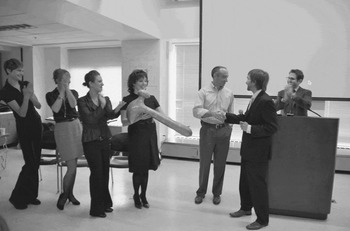
UCMeP went on to create satirical proposals such as “Help Mark Yudof Buy a Plane” and “Adopt-A-Regent.” They presented Dan Mogulof, the spokesperson for the Berkeley campus, the T.O.O.L. (Top Outstanding Oratorical Leader) Award, with an enormous golden hammer, for his excellence in making statements that criminalized student protesters (Fig. 1).Footnote 16 They even ran a satirical slate of candidates for student government in the tradition of electoral guerrilla theatreFootnote 17 and made a fake version of the Daily Cal Web site to promote their radical critique of the neoliberal hegemonologue dominant in UC discourse.
UCMeP members present the T.O.O.L. award to Dan Mogulof, executive director of the UC Office of Public Affairs. Photo by Benjamin Kiesewetter.

The protests and arrests continued throughout the spring term of 2010. A UC systemwide strike and walkout was planned for 4 March 2010. One of the problems that all strikes face is how to handle the picket line. What are the rules of engagement with “scabs,” or people who cross the picket line? Yelling and screaming? Chanting and sign waving? Silently glaring? Engaging in cheerful conversation?
UCMeP decided that, true to its ironic tone, it would applaud and encourage people who crossed the picket line, taking their pictures and giving them celebrity treatment. For this action, UCMeP would form an elite antiwalkout unit called SCAB, or the Strategic Counter-Activism Brigade.Footnote 18 As Woolf said,
The Student Counter-Activism Brigade (SCAB) educational videos were meant to circulate virally and to encourage those students who might be hesitant to participate in a March 4th day of action to come out for a different kind of event: one which asked them to think about the importance of picket lines and the gravity of a decision to cross one.Footnote 19
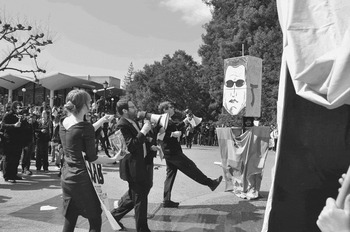
I brought a glitzy, sparkling vinyl red “carpet” to add to the spectacle. We offered people who were crossing the picket line the opportunity to walk down the red carpet as heroes of privatization and supporters of UCMeP's agenda to sell off the UC system to the highest bidders. In this way, the red carpet (actually, a long roll of sparkly red vinyl that read well on camera or from a distance) could serve as a playful shaming device (see Figs. 3–5).
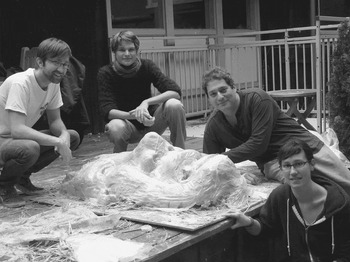
UCMeP agents, in plainclothes, work on the Governator face … which later melted in the rain just before the action. (Sigh.) Photo by Catherine Cole.

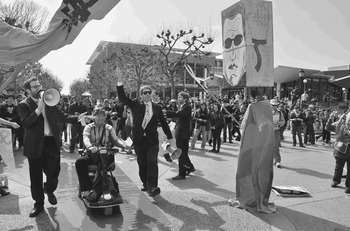
SCAB members beg people to cross the picket line and break the walkout/strike on the UC Berkeley Campus (Bogad with megaphone, Boyle with sign on right). Photo by Benjamin Kiesewetter.

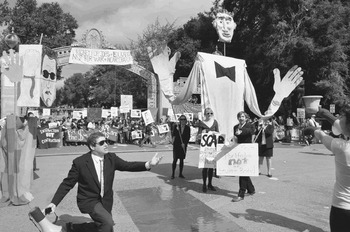
SCAB members find an ironically willing strikebreaker/collaborator in Professor and Theater Survey Editor Catherine Cole and escort her regally down the red carpet across the picket line while the Governator puppet watches approvingly. From left: Woolf, Cole, Bogad. Photo by Benjamin Kiesewetter.

Woolf and Bogad escort another ironic collaborator (hidden between them) down the red carpet, megaphones in hand. Photo by Benjamin Kiesewetter.

The UCMeP organizers had devised a SCAB “Hall Pass” for people who wanted to cross the picket line. With their patient indulgence, I made a few changes at the last minute to make the little slips of paper interactive: in order to receive the pass and walk on the red carpet, people would have to check a box and read what it said into our megaphone, either “YES! I am compliant! Please raise my tuition, cut my classes, staff and faculty, and privatize my university!” or “No. I'm joining the walkout and rally! Public Education must be saved!”
With the help of the great puppeteer-activist Amy Trompetter, we created a huge Arnold Schwarzenegger clay puppet head (Fig. 2). If people agreed to check YES! on the SCAB pass, they would be escorted down the sparkly red carpet, have rice flung at them, be cheered and photographed, and would even have the opportunity to kiss the Governator at the end of their stroll, in thanks for their complicity.
The result on the day of the protest: thanks to some unexpected rain, our Schwarzenegger was too damp, and we quickly substituted a cardboard version. As we came to set up, we first spoke to the “serious” picketers to make sure we weren't upstaging them; they thanked us and gave us a reasonable time limit for our absurd activities. (Such communication between ironic and earnest, absurd and solemn wings of the movement is crucial.) We introduced the idea in character with megaphones as we set up.
Unsurprisingly, nobody who really wanted to scab or break the strike took us up on our offer; the shaming device was clear enough that folks steered clear and found another way onto campus. However, the UCMeP installation became an ironic play space for the protestors; the mass of people got the joke, and some decided to play along (see Fig. 3).Footnote 20 Folks were given an opportunity to speak into the microphone to sarcastically declare why they were complying with the neoliberal agenda or selling out their socioeconomic class or whatever they wanted to say; they then goose-stepped or marched down the carpet, kowtowed to the Governator, and generally embodied their ideological opponents as creatively as they could (Figs. 4 and 5). One fellow even did an elaborate and painful-looking stage dive onto the red carpet. There was a spontaneous slow-motion race down the red carpet between Max Alper, a labor organizer for university staff, and Brandon Woolf, one of the UCMeP showmen. In perfect slow motion, Woolf tripped and fell while the organizer laughed and pumped his fist in the air victoriously.Footnote 21 We had created a moment where irony was more than a cool detached cultural mode; the admittedly heavy-handed “in joke” provided a creative outlet for participants and a spectacle for passersby that was more engaging and interesting than the usual chanting and circular marching.Footnote 22
The satirical struggle continues. The worst of the crisis may be over, but that is not certain. It is still difficult for activists to decide on which authority to apply the most pressure. Unlike other actions that may focus on one target, such as Chevron, BP, or a particular politician, in this case the opponent is diffuse. Should we focus on pressuring the regents, in the hope that they will more equitably divide the resources they have? The state legislature and governor, in the hope that their budget will restore the drastic cuts to education and make California's corporate tax structure fairer? Or both authorities at the same time? How do you get a put-upon, taxpaying public to appreciate the role of the public university in our social contract, in our society? Not just the economic payoffs, such as the development of the wine and high-tech industries, but the social necessity of a critically thinking and educated public in a republic? How can we express these values through tactical performance?
As an added challenge, the UC system now faces the chilling effect of the administration's threats to discipline and even detenure or fire lecturers and professors who take issue with the system in creative, disruptive ways. Ricardo Dominguez of UC Santa Cruz has faced the threat of detenuring as a result of his own electronic civil disobedience “sit-in” of the UCOP Web site on 4 March, apparently also motivated by the controversy surrounding his Transborder Immigrant Tool. Ken Ehrlich faced threats of investigation and discipline after he created a satirical Web site mocking that of President Yudof.Footnote 23 As our budgets get slashed we can either run for cover and hope we are spared or enter into complex and difficult, tensive and tenuous solidarity with others who are threatened by this neoliberal readjustment of the role of the public university. This means working with striking staff to make their picket lines more dynamic, more colorful, and more embarrassing to cross. It means working with students to develop disruptive performance that articulates our common critique of policy and increases the political costs of those policies for the policy makers. It means working with each other across disciplines, not just to write an article but to create hybrids of direct action and sociodramatic spectacles that expose and disrupt the processes of privatization and gentrification of the public university.
Professors are not above this fray; we are very much in the middle of it. We need to act that way. Professors of performance are uniquely positioned to contribute skills, aesthetics, and analysis to this movement to help make greater “ethical spectacles”Footnote 24 that can capture the imagination of voters and other publics, galvanize counterpublics, change the narrative, interrupt the hegemonologue. Freedom is a “use it or lose it” proposition.
In choosing an underpinning philosophy of engagement with the system we inhabit—a system that, in a complex antagonistic/agonistic interaction, we hope to radically improve but that we are also simply struggling to preserve from total corporatization—we are confronted by the difference in philosophy typified by the contrast between the contemporary Critical Art Ensemble and the Dutch Kabouters of the late 1960s. Critical Art Ensemble has put forward the compelling proposition that revolution is futile—that the capitalist system is here to stay and that the role of radical artists is inventively to monkey-wrench, resist, and sabotage it and “slow the velocity of capitalism.”Footnote 25 The Kabouters preferred what they called the “two-handed strategy”: with one hand they would tear down the old corrupt society; with the other they would build a new and better one, “[growing] like a toadstool on a rotting tree trunk.”Footnote 26 I propose that these two philosophies of action confront each other in the social movement to preserve public education.