Introduction
Strunzite was first described as a new mineral related to stewartite, laueite and pseudolaueite by Frondel (Reference Frondel1957, Reference Frondel1958). He noted that the latter three minerals are polymorphs that conform to the formula Mn2+ Fe23+ (PO4)2(OH)2·8H2O, whereas his analysis of strunzite from the Hagendorf Süd pegmatite, Bavaria, corresponded to a formula with ~6H2O. The lower water content was confirmed in a crystal-structure determination by Fanfani et al. (Reference Fanfani, Tomassini, Zanazzi and Zanzari1978). They found no zeolitic water, though it is present in the three other polymorphs, and gave the formula for strunzite as Mn Fe23+ (PO4)2(OH)2·6H2O. The structure comprises heteropolyhedral laueite-related sheets of composition [Fe2(OH)2(H2O)2(PO4)2]2– that are interconnected via corner-sharing of the PO4 tetrahedra with trans-MnOp2(H2O)4 octahedra (Op = oxygen coordinated to P). The interlayer separation in strunzite is much shorter (9.0 Å) than that for stewartite, laueite and pseudolaueite (9.9 to 10.0 Å). Fanfani et al. (Reference Fanfani, Tomassini, Zanazzi and Zanzari1978) suggested that this was due to the lack of zeolitic water in the interlayer region in strunzite. A recent structure refinement of Al-bearing strunzite from Hagendorf Süd also found no evidence for zeolitic water, despite having diffraction data of high-enough quality to locate all the H atoms (Grey et al., Reference Grey, MacRae, Keck and Birch2012).
The possibility of zeolitic water in strunzite is evident, however, from a number of early studies. A detailed characterization of strunzite from Seixeira, Portugal, published by Correia Neves (Reference Correia Neves1960), included a thermogravimetric analysis that gave a considerably higher water content, 27.1 wt.% than that obtained by Frondel, 22.5 wt.%. Van Tassel (Reference Van Tassel1966) analysed a Mn-free strunzite from Blaton, Belgium, with iron predominantly in the ferric state and obtained a similar water content of 26.3 wt.%, (averaged from two separate samples). Peacor et al. (Reference Peacor, Dunn, Simmons and Ramik1987) subsequently obtained approval of the International Mineralogical Association to name the Blaton mineral ferristrunzite. They obtained a thermogravimetric analysis for water of 26.0 wt.% in close agreement with the results of Van Tassel, and gave the empirical formula as Fe2.923+ (PO4)2(OH)2.76(H2O)5.89. Peacor et al. (Reference Peacor, Dunn and Simmons1983) described a third member of the strunzite group, ferrostrunzite, with Fe2+ replacing Mn2+. Using a water content of 27.1 wt.% determined by difference in their microprobe analyses, they reported an empirical formula with the sum of hydroxyl plus water of 8.52. This is similar to their value of 8.65 for ferristrunzite and to the value of 8.48 for strunzite from Seixeira (Correia Neves, Reference Correia Neves1960), and all three are greater than the value of 8 for the accepted formula. Peacor et al. (Reference Peacor, Dunn and Simmons1983) did not conduct single-crystal structure determinations for ferristrunzite or ferrostrunzite to check the origin of the greater water content.
We have recently reported the characterization of a fourth member of the strunzite group, zincostrunzite, with Zn replacing Mn2+, from co-type localities at the Sitio do Castelo tungsten mine, Portugal, and Hagendorf Süd, Bavaria (Kampf et al., Reference Kampf, Grey, Alves, Mills, Nash, MacRae and Keck2017; Grey et al., Reference Grey, Keck, MacRae, Glenn, Kampf, Nash and Mills2017). Single-crystal structure refinements for crystals from both localities showed that the structures contain zeolitic water in the interlayer region, displaced by ~0.4 Å from an inversion centre. The water content represents full occupancy of the special site in both refinements, corresponding to an additional H2O per unit cell or 0.5 H2O per formula unit. We were interested to know if the presence of water in the interlayer region extended to other members of the strunzite group. To this end, we collected and refined single-crystal diffraction data for samples of ferristrunzite and ferrostrunzite, as well as strunzite from three localities; the results of these studies are presented here.
Experimental
Samples
The strunzite-group samples were all selected from micromounts in the collection of the Natural History Museum of Los Angeles County. Efforts were made to locate specimens from or near to the type localities. Strunzite specimens were sourced from Hagendorf Süd (type locality), the Big Chief mine, Glendale, South Dakota and the Lord Hill quarry, Stoneham, Maine, both in the USA. The ferrostrunzite came from Burlington County, New Jersey, USA and the ferristrunzite from Belgium (most likely from Blaton, the type locality).
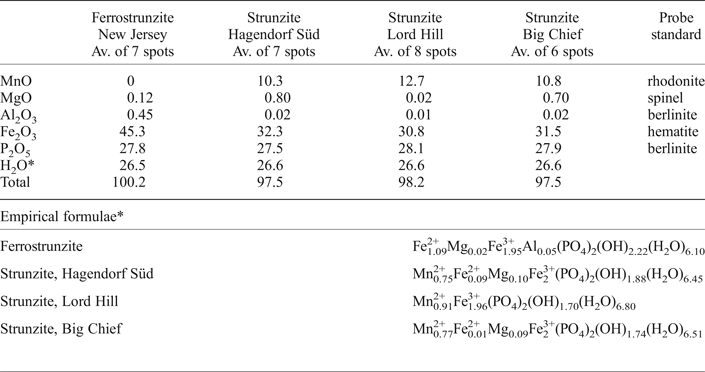
Crystals of the strunzite specimens were analysed using wavelength-dispersive spectrometry on a JEOL JXA 8500 F Hyperprobe operated at an accelerating voltage of 15 kV and a beam current of 4 nA. The beam was defocused to 2 µm. Analytical results are given in Table 1. The slightly low totals are due to extensive fine cracking of the crystals. The ferristrunzite was not analysed, but energy-dispersive spectrometry showed that it contained only Fe and P and the structure refinement confirmed that it contained only ferric iron. The results in Table 1 show that the strunzites from the Big Chief mine and Hagendorf Süd contain minor MgO, while the ferrostrunzite contains minor Al2O3, all < 1 wt.%. Empirical formulae, normalized to 3 P, are given in Table 1. The total number of OH + H2O are from the structure refinements, with OH adjusted for charge balance.
Analytical data (wt.%) for strunzite samples.

*Formula normalized to 3P; Σ(OH + H2O) from structure, OH adjusted for charge balance.
X-ray data collection and refinements
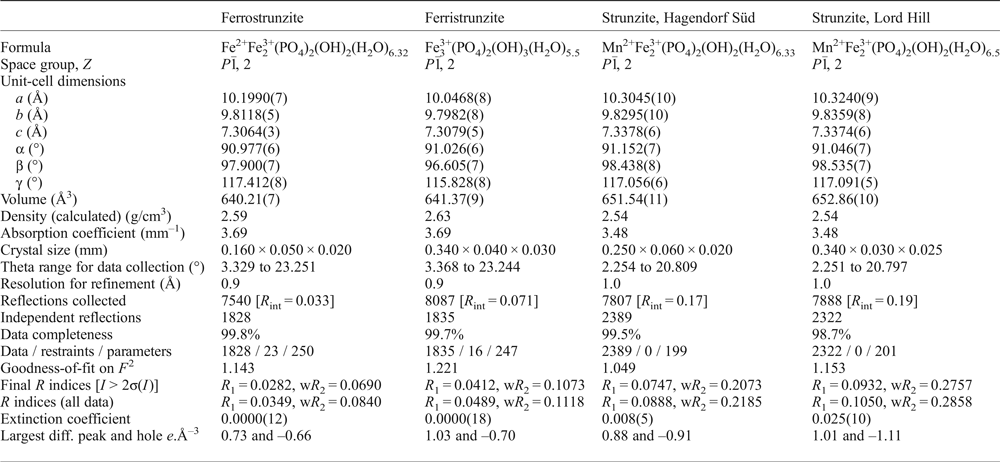
Single-crystal data collections were obtained at ambient temperature on a Rigaku R-Axis Rapid II curved-imaging-plate microdiffractometer utilizing monochromatized MoKα radiation. The diffracting quality of the strunzite crystals were affected adversely by the fibrous nature of the crystals and by twinning, as described for zincostrunzite (Kampf et al., Reference Kampf, Grey, Alves, Mills, Nash, MacRae and Keck2017). The TwinSolve program within the Rigaku CrystalClear software package was used for processing the structure data for the twinned strunzite crystals, including the application of an empirical multi-scan absorption correction using ABSCOR (Higashi, Reference Higashi2001). The atom positions for Al-bearing strunzite (Grey et al., Reference Grey, MacRae, Keck and Birch2012) in space group  $P \bar{1}$ were used as the starting point for the structure refinements, which employed SHELXL-2013 software (Sheldrick, Reference Sheldrick2015). For ferristrunzite and ferrostrunzite, scattering factors for Fe were used for the three independent metal atom sites. For the strunzites, the scattering curve for Mn was used for the divalent cation site.
At this stage, difference-Fourier maps revealed the presence of zeolitic water, Ow7, in the interlayer space, displaced by ~0.4 to 0.5 Å from the inversion centre at (½ 0 ½) in all five refinements. For the ferristrunzite and the Lord Hill strunzite, refinement of the site occupancy of Ow7 showed that the site was fully occupied (full occupation of the site at the inversion centre corresponds to 0.5 occupancy of the split general site). The other three samples showed partial occupancy of Ow7. An interesting observation was that one of the coordinated water molecules, Ow4, which is H-bonded to Ow7, was split between two positions for these three samples, with the amount of Ow4 in the major site matching the occupancy of Ow7. In the refinements, the occupancies of Ow7 and Ow4 were tied together.
The diffraction data sets for the ferrostrunzite and ferristrunzite were of higher quality than those for the strunzite samples, with little or no twinning contributions. In the case of ferrostrunzite, the positions of all H atoms were located in difference-Fourier maps. The H atoms were refined with soft restraints, O−H = 0.82(2) and H−H = 1.30(2) Å, and with a common U iso. For the refinement of ferristrunzite, H atoms associated with all water/hydroxyl were located, except for the split Ow7 site. Also, only one H atom could be located for two of the coordinated water molecules. The same soft restraints noted above were applied. For the three strunzite samples, the H atoms could not be located unambiguously from difference-Fourier maps. The final refinements involved anisotropic displacement parameters for all non-H atoms for the samples with full occupancy of the Ow7 site, and for all non-H atoms, except Ow7 and Ow4, for the samples with partially occupied sites.
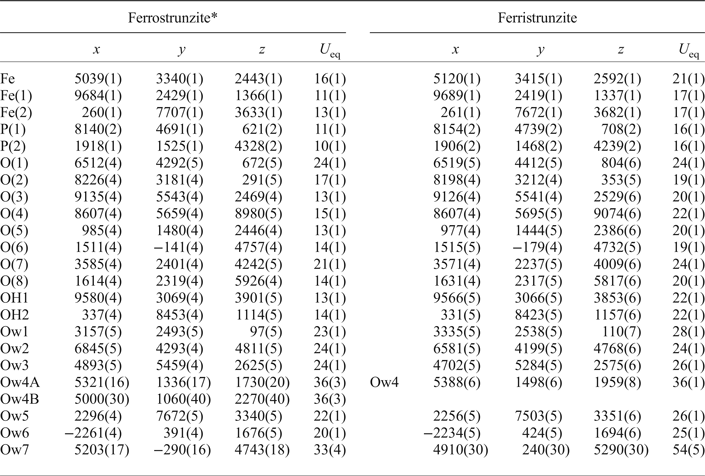
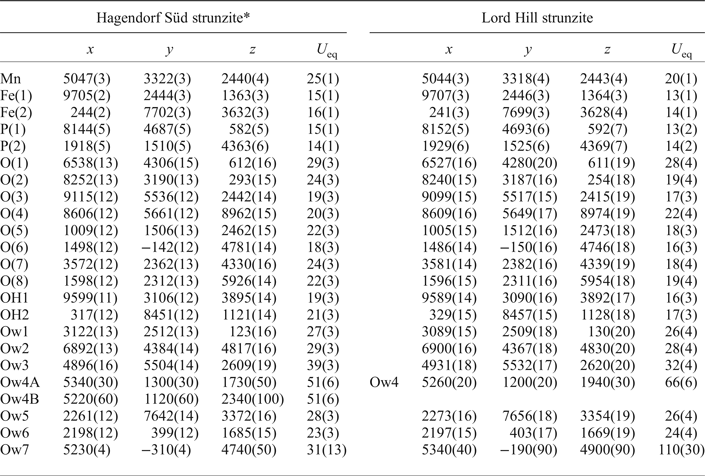
Further details of the data collections and refinements are given in Table 2. Refined fractional coordinates and equivalent isotropic displacement parameters for ferristrunzite and ferrostrunzite are reported in Table 3, and for Lord Hill and Hagendorf Süd strunzites in Table 4. Tables of H atom coordinates and isotropic displacement parameters for ferristrunzite and ferrostrunzite and anisotropic displacement parameters for all refinements have been submitted as crystallographic information files in Supplementary material. The data for Big Chief strunzite was not of high enough quality to report, other than to note that the zeolitic water, Ow7, was located in the refinement, but with <50% occupancy.
Data collection and refinement details.

Atom coordinates (×104) and equivalent isotropic displacement parameters (×103) for ferrostrunzite and ferristrunzite.

*Site occupations for ferrostrunzite: Ow7, Ow4A = 0.64(2), Ow4B = 0.36(2)
Atom coordinates (×104) and equivalent isotropic displacement parameters (×103) for strunzites from Hagendorf Süd and Lord Hill localities.

* Site occupations for Hagendorf Süd strunzite: Ow7, Ow4A = 0.66(7), Ow4B = 0.34(7)
Discussion
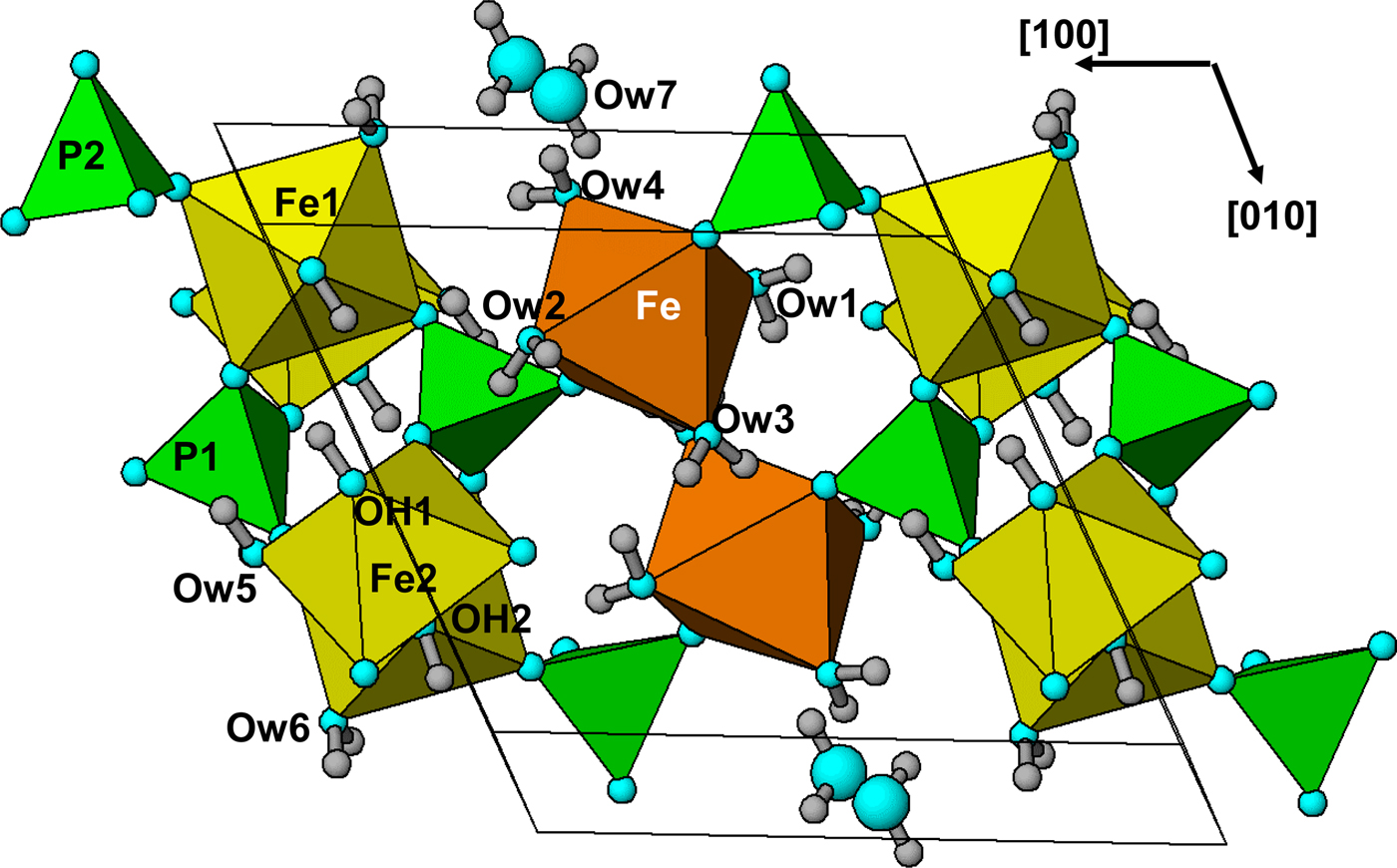
A polyhedral representation of the structure for ferrostrunzite, with all H atoms shown, is given in Fig. 1. Corner-connected Fe1- and Fe2-centred octahedra form 7.3 Å chains along [001], approximately normal to the diagram. The chains are interconnected via corner-sharing with P1O4 and P2O4 tetrahedra to form laueite-related layers parallel to {100}. Fe2+Op2(H2O)4 octahedra connect the layers into a 3D framework by trans-corner sharing with the PO4 tetrahedra. Zeolitic water, Ow7, is located near the inversion centre at (½ 0 ½) in the interlayer region. As shown in Fig. 1, it is disordered over two positions, displaced by 0.47 Å from the inversion centre.
Polyhedral representation of the structure of ferrostrunzite, viewed along approximately [001]. Atom labels and unit-cell axes are shown. Note that Ow7 is split with Ow7−Ow7 = 0.94(2) Å.

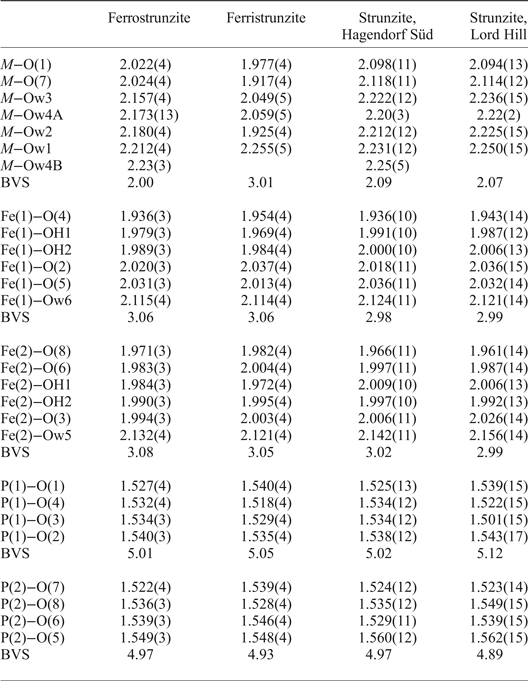
Polyhedral bond lengths in ferrostrunzite, ferristrunzite and the strunzites from Hagendorf Süd and Lord Hill are compared in Table 5. Also reported in Table 5 are bond-valence sums (BVS) calculated for the metal atom sites, using the bond-valence parameters of Brown and Altermatt (Reference Brown and Altermatt1985). The BVS values confirm that the interlayer iron site is occupied by Fe2+ in ferrostrunzite (BVS = 2.00) and by Fe3+ in ferristrunzite (BVS = 3.01), with no evidence for mixed valence at this site, as also reported for ferrostrunzite from Arnsberg, Germany, based on Mössbauer measurements (Van Tassel and de Grave, Reference Van Tassel and de Grave1992).
Polyhedral bond distances (Å) and metal atom bond-valence sums (BVS) in valence units.

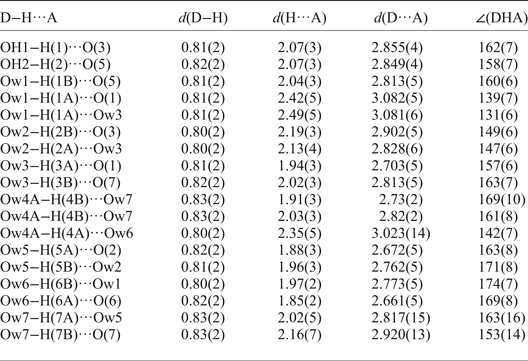
All H atoms were located in the refinement of ferrostrunzite, allowing the H-bonding to be determined unambiguously. The H-bonding scheme is given in Table 6. It is similar to that reported for Al-bearing strunzite (Grey et al., Reference Grey, MacRae, Keck and Birch2012) with the exception of bonds associated with Ow4. In Al-bearing strunzite, which has no zeolitic water, Ow4 does not participate in any H-bonding with bonds shorter than 3.0 Å, whereas in ferrostrunzite, Ow4 acts as a donor to Ow7 with a relatively short Ow4−Ow7 distance of 2.73 Å. The corresponding distances found in the refinements of ferristrunzite and strunzites from Lord Hill and Hagendorf Süd are 2.62, 2.60 and 2.73 Å, respectively. This H-bonding entails a twisting of the interlayer octahedron with a relatively large displacement of Ow4 (0.6–0.7 Å) relative to Al-bearing strunzite with no zeolitic water. In the latter mineral, Ow4 is at (0.503, 0.104, 0.250) and it shifts to (0.539, 0.150, 0.196) in ferristrunzite, a distance of 0.63 Å. It is interesting to note that in ferrostrunzite, in which the Ow4 site is split into Ow4A (with the same occupancy as Ow7) and Ow4B, the position of Ow4B, at (0.503, 0.106, 0.230) closely matches that for Ow4 in Al-bearing strunzite. The same applies to the Hagendorf Süd strunzite, with a partially occupied Ow7 site and Ow4B located at (0.522, 0.112, 0.234). The results suggest that minerals with partially occupied zeolitic water sites comprise domains with different positioning of the interlayer octahedron depending upon whether the zeolitic water site is occupied or empty. This is reflected in the high U eq values for Ow4A, Ow4B and Ow7 relative to values for the other atoms in Table 3.
Hydrogen bonds for ferrostrunzite.

The information obtained here on the location of Ow4 as a function of the presence or absence of zeolitic water suggests that the strunzite mineral studied by Fanfani et al. (Reference Fanfani, Tomassini, Zanazzi and Zanzari1978) did in fact contain zeolitic water, but perhaps the quality of their data was not adequate to locate it. Their published position for Ow4 is at (0.524, 0.123, 0.192), which agrees closely with that for Ow4 in ferristrunzite with a fully occupied zeolitic water site, whereas if zeolitic water was absent, it should be displaced by ~0.7 Å to a position near (0.50, 0.11, 0.25), as in Al-bearing strunzite. Also, the isotropic displacement parameter, B, reported by Fanfani et al. (Reference Fanfani, Tomassini, Zanazzi and Zanzari1978) for Ow4 of 5.3(4) is a factor of ~4 times higher than for the other water molecules, suggestive of partial occupancy of this site as we have found for the samples with incompletely occupied zeolitic water sites.
The structural results reported here, together with those reported for zincostrunzite from two localities, as well as for Zn-bearing ferristrunzite from Hagendorf Süd (Kampf et al., Reference Kampf, Grey, Alves, Mills, Nash, MacRae and Keck2017; Grey et al., Reference Grey, Keck, MacRae, Glenn, Kampf, Nash and Mills2017) are all consistent with zeolitic water being an integral component of strunzite-group minerals. The only exception, out of nine separate structure refinements, is the Al-bearing strunzite from Hagendorf Süd (Grey et al., Reference Grey, MacRae, Keck and Birch2012). This may be related to the formation of the Al-bearing strunzite as an alteration of jahnsite, involving selective leaching of large divalent cations from the jahnsite structure, which itself does not contain zeolitic water. The finding of incompletely occupied zeolitic water sites in some samples is not surprising in view of the thermogravimetric (TG) results reported by Correia Neves (Reference Correia Neves1960) for strunzite from Seixeira, Portugal. The TG curve shows a mass loss of 7.8 wt.% to 65°C, then a plateau to 75°C before a mass increase jump to 15.8 wt.% at 85°C. It is likely that the zeolitic water is lost below a temperature of 65°C, and variable dehydration in the field is expected. One unusual twist in the zeolitic water story is that zincostrunzite from the Sitio do Castelo mine, Portugal (Kampf et al., Reference Kampf, Grey, Alves, Mills, Nash, MacRae and Keck2017) has the zeolitic water located near (½ 0 0) rather than near (½ 0 ½), as found for all other samples. This is discussed by Grey et al. (Reference Grey, Keck, MacRae, Glenn, Kampf, Nash and Mills2017).
On the basis of the new crystallographic results, a new formula can be proposed for strunzite-group minerals with divalent interlayer cations: M 2+Fe3+2(PO4)2(OH)2·(6.5–x)H2O; where M = Mn, Fe or Zn and 0 < x < 0.5 accounts for varying degrees of dehydration. For ferristrunzite and other potential members with trivalent cations in the interlayer octahedron, the corresponding formula is M 3+Fe3+2(PO4)2(OH)3·(5.5–x)H2O. The refinement results for ferristrunzite indicate that charge balance is maintained by replacement of H2O by OH– at one or more of the water molecules coordinated to the interlayer cation.
Acknowledgements
The authors thank Aaron Torpy for help with the electron microprobe analyses. A portion of this study was funded by the John Jago Trelawney Endowment to the Mineral Sciences Department of the Natural History Museum of Los Angeles County.
Supplementary material
To view supplementary material for this article, please visit https://doi.org/10.1180/minmag.2017.081.042