The first reports of human morbidity caused by the type A subtype H1N1 (A/H1N1) influenza virus appeared in April 2009. Great efforts were made to prepare hospitals and primary care clinics for the anticipated flow of patients. One focus of these efforts was improving the preparedness of health care workers (HCWs) by providing them with knowledge regarding the disease and the measures required to prevent its spread, mainly through the use of personal protective equipment (PPE).Reference Hon, Gamage and Bryce 1 In spite of the grim predictions, actual morbidity was significantly lower than feared. Nevertheless, concerns regarding mutation of this or other viruses with pandemic potential have persisted among HCWs and the general public.Reference Patel, Dennis, Flutter and Khan 2
Past experience shows that HCWs are at increased risk of infection in influenza pandemics.Reference Buxton Bridges, Katz and Seto 3 A basic tool to reduce their infection rates, thus lessening the spread of pandemic, is the proper use of PPE, which includes gloves, dressing gowns, masks, and protective eyewear. Appropriate use of PPE by HCWs has been shown to reduce transmission of influenza in health care settings, resulting in decreased influenza-related patient morbidity and mortality, as well as reduced HCW illness and absenteeism.Reference Mitchell, Ogunremi and Astrakianakis 4 In spite of the PPE's proven efficacy, its misuse and low HCW compliance are frequently reported.Reference Mitchell, Ogunremi and Astrakianakis 4 - Reference McGovern, Vesley, Kochevar, Gershon, Rhame and Anderson 6
Mitchell etal reported, that HCWs who felt better protected by PPE exhibited higher PPE compliance.Reference Mitchell, Ogunremi and Astrakianakis 4 Confidence in PPE was, in turn, found to be related to HCWs’ training regarding PPE and its use. Conversely, one can assume that low levels of knowledge among HCWs about the diffusion mechanisms of infectious diseases and the protection offered by PPE will decrease confidence in these measures and increase fear and risk perception. In previous pandemics, such feelings were associated with decreased HCW willingness to treat patients and increased absenteeism.Reference Balicer, Omer, Barnett and Everly 7 The same studies also found that as many as 50% of HCWs surveyed stated that they would be unwilling to work in case of an influenza pandemic. A study that examined the impact of the H1N1 influenza pandemic on Canadian HCWs reported significant rates of influenza-like illness and absenteeism.Reference Mitchell, Ogunremi and Astrakianakis 4
We conducted a wide-ranging survey among HCWs in Israel at the peak of the A/H1N1 influenza outbreak. The study's aim was to assess the effect of HCWs’ knowledge (both tested and self-perceived) regarding personal infection control practices on the degree of confidence in PPE.
Methods
Instrument and Key Measures
The questionnaire was a modified and independently validated version of the one used in previous infectious outbreaks,Reference Peltz, Avisar, Ventura-Gabay and Bar-Dayan 8 , Reference Richman, Shohat, Soffer and Bar-Dayan 9 which consisted of 13 items grouped in 4 sections: demographics (gender, age, profession, work place, professional experience, marital status); knowledge regarding infectious disease spread and PPE indications and efficacy (3 questions); self-perceived knowledge (3 questions); and confidence in PPE (1 question).
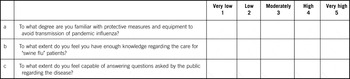
The inter- and intraobserver variability for each questionnaire item was very low, and the internal consistency coefficient was 0.826. The questionnaire included open-ended and multiple-choice questions, as well as questions on a 5-point Likert-type scale (5 = very high to 1 = very low). Confidence in PPE was assessed through the question, to what extent do you feel that the personal protective equipment can protect you from infection by the A/H1N1 virus? Tested knowledge was assessed through 3 multiple-choice questions regarding PPE effectiveness in preventing infection by direct contact, droplet mechanism, and regarding the first thing to be performed before treating a patient suspected of being infected by the A/H1N1 virus. Self-perceived knowledge was assessed through 3 questions regarding the sense of acquaintance with PPE, the sense of knowing how to treat A/H1N1 patients, and the sense of being able to answer the public's questions on this topic.
Population
The study was conducted between November 26, 2009, and December 10, 2009 (the peak of A/H1N1 pandemic in Israel according to Israel's Ministry of Health reports). The questionnaire was completed by a convenience sample of 617 clinical HCWs (nurses and physicians) from 40 primary care clinics and 21 of 24 hospitals in Israel that were sampled. Most primary care clinics were small, with 1 to 2 physicians and 2 to 3 nurses; therefore, the sample size in those clinics was relatively small. In the 21 hospitals, only the relevant departments were surveyed (eg, emergency department, internal medicine, intensive care unit), which also reduced the sample size.
The surveyors were sent at prespecified times to predefined hospital departments and community clinics. On arrival, they distributed questionnaires to all available personnel. The numbers and roles of the sampled health care professionals within the various hospital departments were preassigned to reflect hospital health staff composition according to Israel's Ministry of Health reports, which indicate a physician to nurse ratio of 1:2. The study was approved by the Bar-Ilan University ethics committee.
Data Collection
The questionnaires were completed at the workplace at that time and collected by the surveyors without subject identifiers. The surveyors reported very low refusal rates (∼10%).
Statistical Analysis
The relationships between HCWs tested and self-perceived knowledge and the confidence level in PPE at the peak of the A/H1N1 flu outbreak in Israel were analyzed. For some of the data analysis, where dichotomous categorization was needed, confidence in PPE (assessed by a 5-point Likert scale) was transformed to either very high/high (4-5) or moderate/low/very low (1-3). Differences were analyzed using the independent sample t test, 1-way ANOVA, and χ2.
A multivariate logistic regression analysis (method = ENTER) was conducted to predict high confidence in PPE. The predictors examined were collective tested and self-perceived knowledge score (number of tested knowledge questions answered correctly and average score of all 3 self-perceived knowledge questions), and personal experience with caring for H1N1 patients, adjusting for potentially confounding variables: gender, age, marital status, years of education, profession, work place, seniority. A P value of <.05 was considered significant. The reference group for the categorical variables (profession, work place, and gender) was physicians, hospital, and male, respectively. To avoid multicollinearity, the correlation between variables in the model were examined to be P < .7. Statistical analysis was performed using a statistical software package, version 17.0 (SPSS Inc).
Results
A total of 617 questionnaires were answered by health care personnel, 29% by physicians and 71% by nurses (physician to nurse ratio was 1:2.4). Hospital employees accounted for 89% of the sample group, and primary care clinic employees for 11%. Mean population age (±SD) was 41 ± 11 years, 65% of respondents were women, and 75% were married. Participants had an average of 18 ± 3 years of education and 15 ± 11 years of professional experience.
Regarding HCW distribution in hospitals, 41% worked in general hospital wards, 14% in ICUs, 13% in emergency departments, 13% in pediatrics wards, 9% in outpatient clinics, and the remaining 10% in imaging and pharmacies.
Confidence in PPE
The percentage of participants who stated they had either high or very high confidence in PPE was 58%versus 31% who stated they had moderate confidence in PPE, and 11% who had low or very low confidence in PPE.
Score on Knowledge Questions
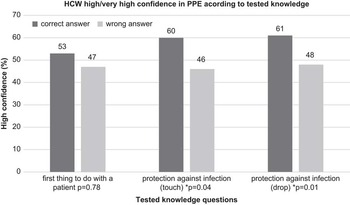
Of the 3 knowledge questions on the questionnaire, knowledge was positively related to confidence in PPE on 2 of them. High confidence was found in 61% of the subjects who correctly answered the question regarding the appropriate PPE to prevent contagion by droplet mechanism, as compared with 48% who answered incorrectly (P = .01). The results were similar for subjects who answered correctly the question regarding the appropriate PPE to prevent contagion by direct contact (touch) (P = .04) (Figure 1).
High and Very High Confidence by Health Care Workers in Personal Protective Equipment According to Tested Knowledge.

Correctly answering the third knowledge question, regarding the appropriate initial action when confronted with a patient with suspected H1N1 infection, did not significantly relate to confidence in PPE (P = .78). The average knowledge score on all 3 also was not significantly related to confidence in PPE (P = .28). Participant response rates to the tested knowledge questions were included in Table 1.
Response Rates to Tested and Self-Perceived Knowledge Questions

aNurses and physicians.
Self-Perceived Knowledge
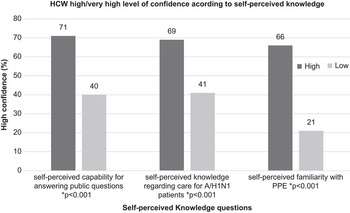
The questionnaire contained 3 Likert scale questions assessing self-perceived knowledge by HCWs regarding H1N1 infection, treatment modalities, and PPE effectiveness. The answers to each question were significantly associated with confidence in PPE. Also, 66% of HCWs reporting a high level of familiarity with PPE had high confidence in it, as compared with 21% of those reporting low familiarity (P < .001). The results were similar for HCWs reporting they knew how to treat A/H1N1 patients and for those reporting that they could adequately answer questions by the public regarding the disease (P < .001) (Figure 2).
High and Very High Confidence by Health Care Workers in Personal Protective Equipment According to Self-Perceived Knowledge.

Significant association was also found between the collated score on all self-perceived knowledge questions and the levels of confidence in PPE. HCWs who had high confidence in PPE also had a higher average score in all 3 questions than those who reported low confidence in PPE (M = 4.10, SD = 0.69 vs M = 3.47, SD = 0.78; t[602] = −10.15; P < .001). Participant rates of response to self-perceived knowledge questions were recorded in Table 1.
Correlation Between Tested and Self-Perceived Knowledge
Significant differences were found between the level of self-perceived knowledge and the collective tested knowledge score (F(3) = 4.67, P = .003). Post hoc analysis (Scheffe procedure) indicated that participants who did not answer a single question correctly also had the lowest level of self-perceived knowledge (M = 3.39) compared to participants who answered 2 or 3 questions correctly (M = 3.91, M = 3.84, respectively).
Differences Between Physicians and Nurses
Confidence in PPE was significantly higher among nurses than among physicians (P = .02). No significant differences were found between the tested knowledge of nurses and physicians (P = .68) or between their self-perceived knowledge (P = .50). Results were presented in Table 2.
Average Scores in Tested and Self-Perceived Questions and Confidence in Personal Protective Equipment (PPE) According to Demographic Groups (95% CI)

aSignificant at P < .05.
Differences Between HCWs in Hospitals and Primary Care Clinics
Hospital HCWs had higher confidence in PPE than those in primary care clinics (P = .03). No significant differences were found between the tested and self-perceived knowledge of hospital HCWs and primary care clinic HCWs (P = .93 and P = .45) (Table 2).
Of all the participants, 53% reported that they had treated a patient diagnosed with A/H1N1 influenza. The percentage among physicians was 60% and 50% among nurses. Only 5% of all participants self-reported that they were infected with A/H1N1 influenza. No significant association was found between HCWs who reported treating A/H1N1 patients and who reported self-morbidity (P = .25) (Table 2).
Confidence in PPE was significantly higher among participants who reported that they had treated A/H1N1 patients than among those who had not (P = .02) (Table 2). Self-perceived knowledge was also significantly higher among subjects who reported treating A/H1N1 patients than among those who had not (P = .03). No significant differences were found in the level of tested knowledge (P = .12) (Table 2).
Multivariate Logistic Regression Model
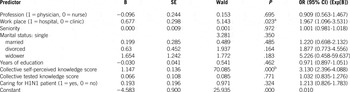
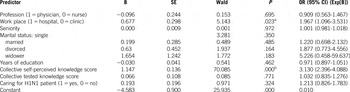
A logistic regression model was conducted to predict high confidence in PPE. The model included the following demographic variables: marital status, years of education, profession, work place, and seniority. The demographic variables gender and age were excluded from the final model as they were found to be highly correlated with other demographics (profession and seniority, respectively) and modified the model outcomes. Other predictors included in the model were collective score of tested and self-perceived knowledge and personal experience in caring for H1N1 patients. A test of the full model against a constant-only model was statistically significant (R2 = 0.22, χ2 = 101.148, P < .001 with df = 10). The results indicated that the strongest predictor of high PPE confidence was self-perceived knowledge (OR = 3.148[2.397-4.135], P < .001). Place of work (hospital vs primary care clinic) was also a significant predictor (OR = 1.967[01.096-3.531], P = .023). Other variables included in the model did not reach statistical significance. Results were presented in Table 3.
Logistic Regression Analysis Predicting High Confidence in Personal Protective Equipment During the Peak of A/H1N1 Pandemic in Israel
a Significant at P < .05.
b Significant at P < .001.
Discussion
The outbreak of the 2009 A/H1N1 pandemic highlighted the need for health systems worldwide to prepare for future occurrences. Because HCWs will be at the forefront in future incidents, optimizing PPE use is a crucial element of preparedness. Many reports have described low rates of compliance and high rates of misuse, even in high-risk settings.Reference Daugherty, Perl, Rubinson, Bilderback and Rand 10 Previous studies have shown a strong link between HCW confidence and PPE compliance. Qureshi etal reported that confidence in the effectiveness of the N95 respirator to protect against exposure was related to increased intentions to use it during an epidemic.Reference Qureshi, Gershon, Yamada and Li 11 A similar association also was observed in influenza vaccine uptake among HCWs during the H1N1 pandemic.Reference Seale, Kaur and Wang 12
In this study, a number of variables were found to be statistically significant. Nurses were found to have a higher level of confidence in PPE than physicians. In 2005, a study performed in Singapore similarly found that nurses had significantly higher confidence in the protective effect of facial surgical masks when compared with physicians.Reference Chia, Koh and Fones 13 Greater adherence to PPE use among nurses compared with other clinical HCWs was also reported in a US study published in 2009.Reference Daugherty, Perl, Needham, Rubinson, Bilderback and Rand 14
Furthermore, in our study, hospital HCWs (nurses and physicians) had a higher level of confidence in PPE than HCWs employed at primary care clinics; this finding was also a significant predictor of high confidence in PPE in the regression model. This finding was consistent with that of a study in Singapore, which reported that hospital HCWs thought that their workplace was better prepared than those in primary care clinics.Reference Wong, Koh and Cheong 15 The higher confidence levels of hospital HCWs versus community HCWs may have been related to greater every-day experience in using PPE when treating patients or to more intense PPE training. The value of increased training was supported by Qureshi etal, who reported that taking measures to increase knowledge such as N95 facemask training and fitting helped increase confidence in its effectiveness and also led to an increased likelihood of reporting to duty in a large-scale influenza pandemic.Reference Qureshi, Gershon, Yamada and Li 11
Another finding of our study showed that HCWs (nurses and physicians) who reported treating A/H1N1 influenza patients also reported higher levels of confidence in PPE and higher levels of perceived knowledge, as compared to HCWs who did not treat such patients. These findings corresponded with those of a Canadian study, which found that 60% of HCWs who were exposed to patients with severe acute respiratory syndrome (SARS) reported increased awareness of disease control measures. That is, the SARS outbreak provided a learning experience.Reference Nickell, Crighton and Tracy 16 In our opinion, the experience of caring for A/H1N1 patients may have increased self-perceived knowledge and sense of self-efficacy while increasing confidence in PPE. Demographic characteristics were not found to be significantly associated with confidence in PPE in our current study.
Tested and Self-Perceived Knowledge and Confidence in PPE
We found that high levels of tested PPE knowledge were significantly associated with PPE confidence. Similarly, higher self-perceived knowledge was significantly associated with PPE confidence level and was the strongest predictor of high confidence in PPE in the regression model.
A study conducted in Hong Kong suggested that lack of PPE knowledge contributed to the higher HCW infection rates observed at the early stages of the SARS outbreak.Reference Gomersall, Joynt and Ho 17 Our findings demonstrated that a high level of knowledge, both tested and self-perceived, regarding PPE use for A/H1N1 was associated with increased confidence in PPE among HCWs, potentially promoting a sense of efficacy in coping with the pandemic. Corroborating evidence of the importance of HCW confidence in PPE was also demonstrated in a Hong-Kong study, in which nurses who believed that the protection PPE provided them was inadequate reported low willingness to treat patients suffering from avian influenza.Reference Tzeng and Yin 18 Several other studies also indicated that providing HCWs with preferential access to PPE is an effective mitigation strategy to reduce absenteeism and may improve willingness to report to duty in a pandemic influenza event.Reference Garrett, Park and Redlener 19 - Reference Gershon, Magda and Qureshi 21 Our study showed that many HCWs have moderate or low confidence in PPE. The strong association between knowledge and confidence in PPE and its possible implications on preparedness and response to future events is promising, given that knowledge regarding the efficacy and appropriate use of PPE can easily be augmented.
Limitations
The main potential limitation of this study is it being somewhat subjective, in that it was based on the self-reporting of HCW confidence in PPE. Confidence in PPE however may be difficult to assess using observational methods. Another limitation is that although the facilities and wards were preassigned, the participants were not; rather, they were selected according to presence and availability. Therefore, selection bias may possibly have limited the generalizability of our findings. Although refusal rates were very low (∼10%), a large portion of the sampled clinics and hospital department health care staff was not present or available at the time of sampling and therefore was not included in the study. Cultural and organizational differences between countries may also have affected this study's generalizability.
Conclusions
This study, we believe, is unique in its assessment of the confidence in PPE by HCWs at the height of the only pandemic in recent years. Its strength is that it samples physicians and nurses from most general hospitals and from primary care clinics in Israel. Proper PPE use by HCWs is important in routine times, but crucial to health system preparedness for large-scale epidemics. According to the literature, HCW adherence and compliance with PPE guidelines are suboptimal, in part due to lack of knowledge and/or confidence in PPE. Such practices and attitudes by HCWs may prove detrimental in a large-scale epidemic, causing increased HCW infection rates, as well as further disease transmission by HCWs, increased absenteeism, and decreased willingness to treat infected patients.
That the findings of this study showed significant association between the tested and self-perceived knowledge of HCWs and their confidence in PPE is promising. One can infer that enhancing knowledge regarding PPE among HCWs may contribute to their confidence in it; boost PPE usage and adherence to guidelines, as well as positively affect their willingness to treat infected patients; reduce absenteeism; and decrease infection and transmission of the disease by HCWs. Further research is needed on which interventions may optimally increase knowledge about PPE and raise confidence of HCWs in it.
Acknowledgment
The first and second authors have contributed equally to this article.
Appendix
Assessing Medical staff attitudes towards pandemic influenza in hospitals and primary care clinics
-
1. Age:____
-
2. Gender: _____
-
3. Familial status: _____
-
4. Number of years in school and higher education:_____
-
5. Profession: Physician/Nurse.
-
6. Work-place:
-
a. Primary care clinic
-
b. Hospital ED
-
c. Hospital adult inpatient ward.
-
d. Hospital pediatric inpatient ward.
-
e. Hospital outpatient clinics.
-
-
7. Professional experience (years):_____
-
8. Do you personally know someone who has contracted pandemic influenza (more than one option can be marked)?
-
a. No.
-
b. Yes, I personally contracted the infection.
-
c. Yes, a relative of mine.
-
d. Yes, a friend or acquaintance.
-
e. Yes, a patient I cared for.
-
f. Yes, Other_____________
-
-
9. What are the most important protection infection control practices to avoid contracting an infection transmitted through "droplet" mechanism?
-
a. Isolating the patient in a negative pressure room.
-
b. Wearing a surgical mask.
-
c. Wearing an N-95 mask when performing invasive procedures.
-
d. Wearing gloves.
-
e. I don't know.
-
-
10. What are the most important protection infection control practices to avoid contracting an transmitted through "contact"?
-
a. Wearing gloves and a gown before any contact with the patient or his surroundings.
-
b. Isolating the patient in a negative pressure room.
-
c. Wearing gloves only during invasive procedures.
-
d. Wearing gloves only when in close proximity (less than 50cm) to the patient.
-
e. I don't know.
-
-
11. You are caring for a patient with unusual symptoms that could be the signs of swine influenza. Which of the following should be your first action?
-
a. Apply a surgical mask on myself.
-
b. Provide the patient with a surgical mask and instruct him to apply it.
-
c. Consult with the institution's infectious disease specialist.
-
d. Wear gloves and a gown and escort the patient to isolation room.
-
e. I don't know.
-
-
12. Please rank the following questions regarding "Swine influenza” pandemic:
13. Regarding personal protective equipment for use in a "swine" influenza pandemic