1. Introduction
The area of East Anglia in which its traditional dialects are spoken has shrunk significantly over the past few decades and seen a marked decline in the use of traditional features. These include lack of -s marking on third-person singular forms (Kingston, Reference Kingston2000; Potter, Reference Potter2018), as well as the long-standing distinction between those words descended from Middle English /ɔ:/ and /ɔu/, as in ‘moan’ vs ‘mown’, which failed to become homophonous as part of the Long Mid Mergers (Wells, Reference Wells1982a). Like other relics, this distinction now only remains in East Anglia's more northern locales (Trudgill & Foxcroft, Reference Trudgill, Foxcroft and Trudgill1978; Trudgill, Reference Trudgill, Schneider, Burridge, Kortmann, Mesthrie and Upton2004; Butcher, Reference Butcher2019). This apparent ‘dialect death’ situation (Trudgill, Reference Trudgill1986: 68) is the outcome of continued supralocalisation, a situation in which locally specific linguistic forms lose out to linguistic variants with greater socio-spatial currency, usually as a result of mobility and dialect contact (Britain, Reference Britain, Llamas and Watt2010). In East Anglia's case, Trudgill (Reference Trudgill, Fisiak and Trudgill2001) argues that dialect levelling has largely been driven by the impact of London and Home Counties varieties of English. This process is predicted to continue (Trudgill, Reference Trudgill1986; Kingston, Reference Kingston2000), though is unlikely to be straightforward. Britain (Reference Britain2011) reports that substantial intra-regional differences are found in relation to route and rate of sound change in East Anglia. This calls for more comprehensive analyses of East Anglian English to better understand the workings of this ‘heterogenous homogenisation’ (Britain, Reference Britain2011: 57), and how individual case studies relate to the overall shrinkage of the area in which traditional East Anglian dialects are spoken. This paper presents data in this vein from two studies undertaken in Suffolk, southern East Anglia. The first presents data on unstressed vowel tensing, which refers to the alternation between [ə] and [ɪ] in those unstressed syllables where /ɪ/ occurs in other varieties of Southern British English (SBE) e.g. ‘carpet’ [kɑ:pɪt] / [ka:pəʔ]. The second reports data on yod dropping, i.e. the absence of /j/ from sequences of C+/ju/ e.g. ‘huge’ [hju:dʒ] / [hu:dʒ]. Both variables are well known from descriptions of East Anglian dialects but, as we will see later, they appear to behave differently in this study of contemporary East Anglian English.
2. Background
2.1. Defining East Anglia
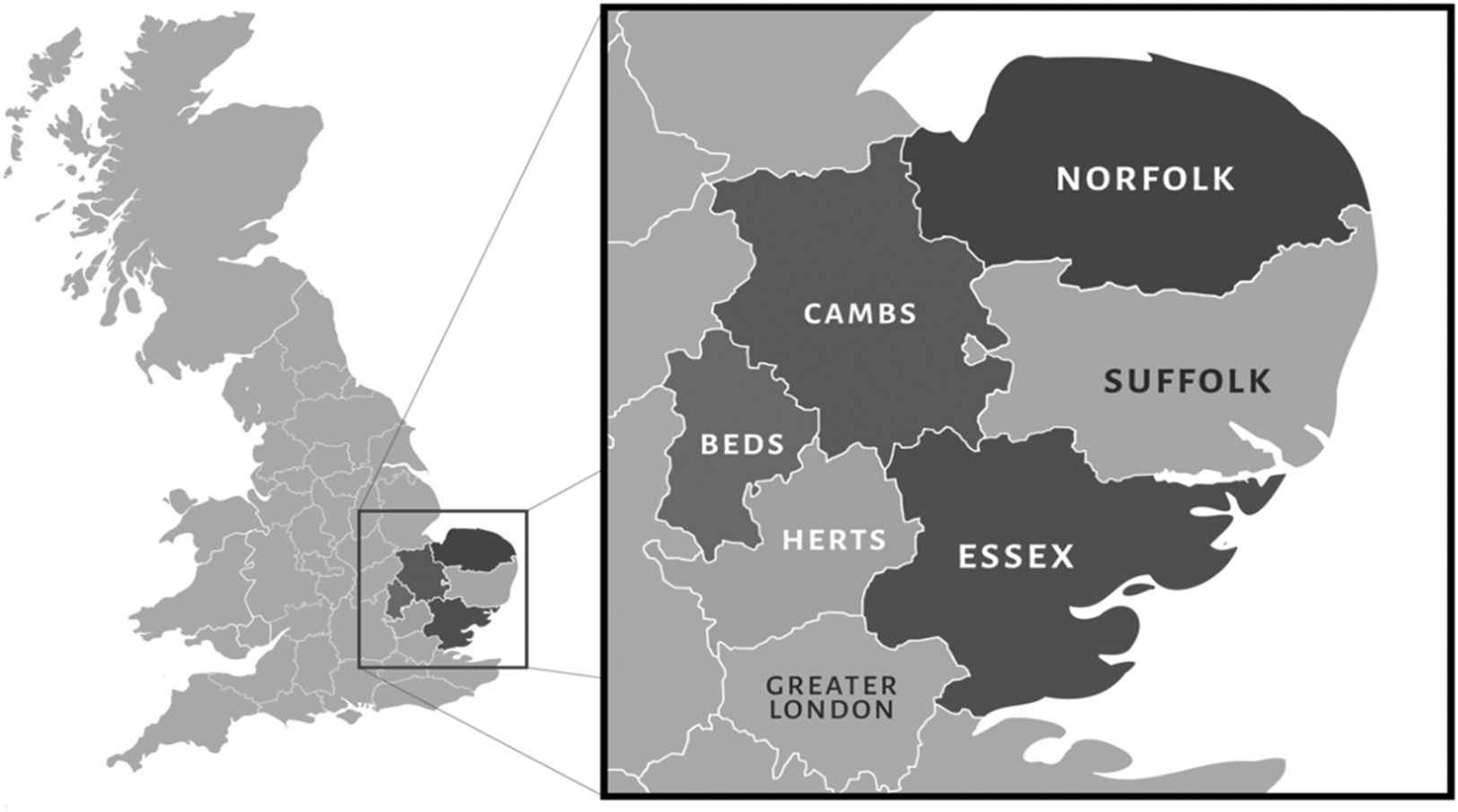
Featuring in the first major works on the dialects of England, including Ellis’ The Existing Phonology of English Dialects (Reference Ellis1889), Wright's English Dialect Grammar (Reference Wright1905) and the Survey of English Dialects (SED) (Orton et al., Reference Orton, Barry, Halliday, Tilling and Wakelin1962–71), East Anglian English is accepted as a distinct variety of English, though its linguistic boundaries are ambiguous. Attempts to define these are made more difficult by East Anglia's nebulous geographic boundaries and a lack of official administrative status; the notional label ‘East Anglia’ is culturally and politically derived (Fisiak & Trudgill, Reference Fisiak, Trudgill, Fisiak and Trudgill2001) (see Figure 1). For example, Britain (Reference Britain2002) notes a number of prototypically East Anglian linguistic features in the Fenlands (the North West of East Anglia), such as remnants of the Long Mid Mergers, as well as yod dropping (Amos, Britain & Spurling, Reference Amos, Britain and Spurling2008), but the Fenlands’ inclusion in East Anglia is a source of disagreement (Fisiak & Trudgill, Reference Fisiak, Trudgill, Fisiak and Trudgill2001). In the most recent attempt to define the linguistic boundaries, Trudgill (Reference Trudgill, Fisiak and Trudgill2001) argues that justifiably ‘East Anglian’ features will be geographically co-extant with conservative features, such as ‘zero marking’ (i.e. the lack of third-person-singular inflection, an established morphological East Anglianism). This leads to the exclusion of the Fenlands and the conclusion that, at the time of writing, only Suffolk, Norfolk and North East Essex constitute linguistic East Anglia. More recent work (Potter, Reference Potter2018) reports that zero marking is present amongst working class speakers in South Suffolk, although it is shown to be in rapid decline. So, while this description holds in principle as far as Suffolk is concerned, the status of North East Essex remains more uncertain.
Map of possible candidates for inclusion in ‘non-linguistic’ East Anglia (except Greater London)

2.2. Under the influence
London's historical connection with Suffolk English seems to be longstanding. Kökeritz (Reference Kökeritz1932: 65–67) addresses possible attrition stemming from contact across the southern borders of Suffolk at the beginning of the Early Modern English period, arguing that it is the vernacular pronunciations on the one hand and ‘Standard English’ or Cockney on the other that produces the intermediate sounds that characterise the modern Suffolk dialect. He specifies parallels between the two varieties, such as the alternations between [æ] – [ɛ] as in [hɛv] ‘have’ and [aʊ] – [ɛu] as in [hɛus] ‘house’. Trudgill (Reference Trudgill1974b) writes that a number of linguistic innovations that have appeared in East Anglia seem to have origins in London, such as ‘TH-Fronting’, and Spurling (Reference Spurling2004: 14) later describes this alleged ‘London influence’ as arguably ‘one of the more significant influences of dialectal variation in Suffolk’. However, Straw and Patrick's (Reference Straw and Patrick2007) work on the acquisition of East Anglian varieties by Barbadian immigrants suggests that both the influence of supra-regional sources and the expected patterns of South Eastern diffusion are not as expected. Note that London to East Anglia wasn't always the direction of influence; Kristensson (Reference Kristensson, Melchers and Johannesson1994) explains how the presence of East Anglians in 14th-century London gave rise to a prestigious sociolect spoken amongst the wealthy merchant class of the time. In more recent times, though, the reverse has occurred. Fielding (Reference Fielding1992) delineates the South East (London and surrounding areas) as an ‘escalator’ region from which middle-class individuals step off the (social) class escalator and into the urbanised countryside at the latter stage of their careers or at retirement age. He shows, through migration records, that in the years of 1985 and 1986, East Anglia was one of the most popular settlement destinations for these individuals. It is large-scale counter-urbanisation and migration patterns such as these that create unstable environments and lack the stable social networks needed to reinforce linguistic norms and impede language change (Williams & Kerswill, Reference Williams, Kerswill, Foulkes and Docherty1999).
3. Study one: schwa in unstressed syllables
3.1. Background
Trudgill (Reference Trudgill1986: 53) argues that East Anglian varieties of English possess a phonotactic constraint ‘which allows /ə/ as the only vowel which may occur pre-consonantally in unstressed syllables’. This is inferred to include both open and closed syllables, as Trudgill (Reference Trudgill, Schneider, Burridge, Kortmann, Mesthrie and Upton2004: 166) later writes that, in older forms of the dialect, ‘/ə/ was the only vowel which could occur in any unstressed syllable’, removing the following consonant from the original description e.g. ‘fellow’ [fɛlə], ‘city’ [sɪtə], ‘biscuit’ [bɪskəʔ] and ‘between’ [bətwi:n]. Although this feature has long been attested in the literature, and has served as the core focus for a number of variationist studies, its distribution is far more limited within the modern dialect (Trudgill, Reference Trudgill, Schneider, Burridge, Kortmann, Mesthrie and Upton2004). Nowadays, the alternation between [ə] and [ɪ] only occurs in unstressed syllables where [ɪ] might occur in other varieties of SBE e.g. ‘exit’, ‘getting’, ‘university’ or ‘David’. The process will herein be referred to as ‘unstressed vowel tensing’ to represent the change away from the traditional form /ə/.
3.2. Previous work on schwa in East Anglia
Both Ellis (Reference Ellis1889) and Kökeritz (Reference Kökeritz1932) report that schwa in unstressed syllables is well established across a number of Suffolk locations early on, which is later echoed by the SED (Orton et al., Reference Orton, Barry, Halliday, Tilling and Wakelin1962–71). Four decades later, Kingston's (Reference Kingston2000) results from Glemsford (West Suffolk) suggest a sharp change away from [ə], led by young females. Young speakers are shown to retain the traditional form across a third of tokens, in comparison to 82% for older speakers, though this rural village had been subject to a recent influx of Londoners. Subsequent work by Spurling (Reference Spurling2004) in Ipswich, the comparatively ‘urban’ county town, paints a starkly different picture: [ə] in unstressed syllables is conserved at levels of 90% and 80% for older and younger speakers respectively, and young females, again, are shown to favour the ‘innovative’ form. Potter (Reference Potter2018) later reports healthy use of [ə] at around 70% of all tokens for each of his three East Suffolk locations (including Ipswich), though neither age nor location emerged as significant in the statistical analysis. These findings have since been ratified by Britain et al.'s English Dialects App data (see this volume), demonstrating that the decline of [ə] in unstressed syllables is more evident in western than eastern Suffolk locales, and shows stability in the core areas. While the above studies provide some evidence for a female-led change, the overall rate at which use of the traditional form may be declining is likely quite gradual within those eastern locations that maintain it. Why this might be the case is discussed in Section 3.4.
3.3. Methods
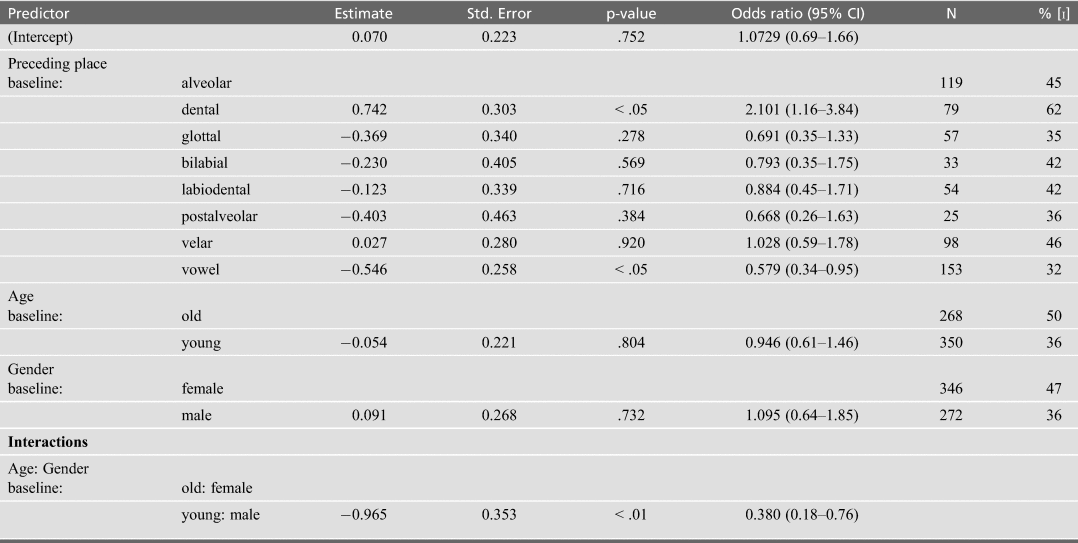
Data were collected from 12 working-class speakersFootnote 1, native to Ipswich (see Table 1). Tokens of (ɪ) in (bound) /ɪŋ/ morphemes were extracted for analysis from the conversational excerpt of sociolinguistic interviews (n=618).Footnote 2 This morpheme is selected for its status as one of the most common inflectional endings (cf. Kingston, Reference Kingston2000; Spurling, Reference Spurling2004). Tokens were then coded and analysed both auditorily and visually through inspection of spectrograms using Praat (Boersma & Weenink, Reference Boersma and Weenink2020). The data were analysed using logistic regression modellingFootnote 3 (RStudio Team, 2020). Pairwise comparisons were conducted using likelihood ratio tests to arrive at the best fit model (reported in Table 2), with ‘vowel realisation’ as the dependent variable. Preceding phonological environment, genderFootnote 4 and age were included as predictors. Age was separated into two groups, comprising speakers between the ages of 18–35 (young) and speakers aged 60+ (old).Footnote 5
Speaker sample

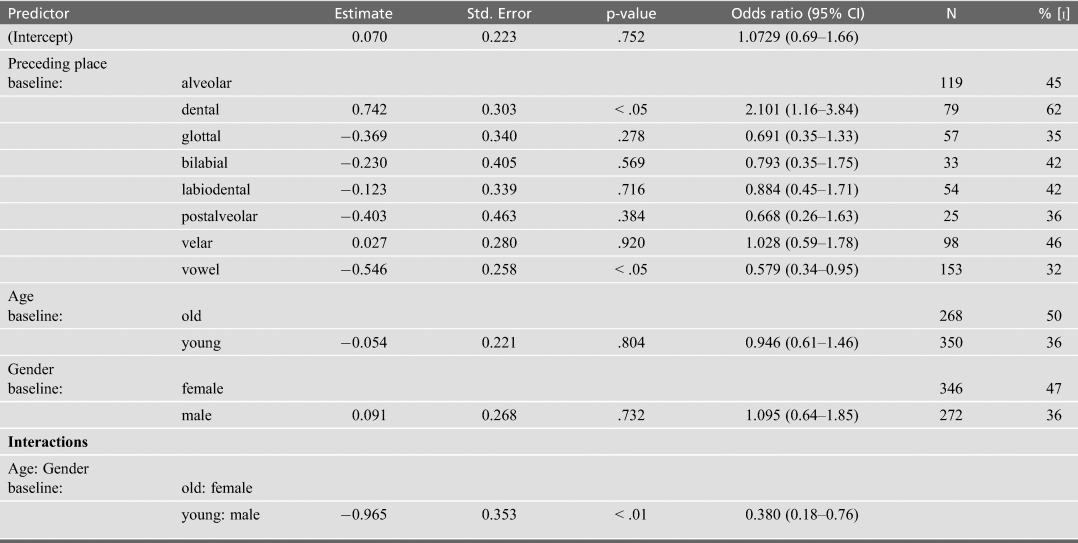
Results from a multiple logistic regression analysis of vowel realisation ([ɪ] and [ə]) with the overall % of [ɪ] tokens
3.4. Findings
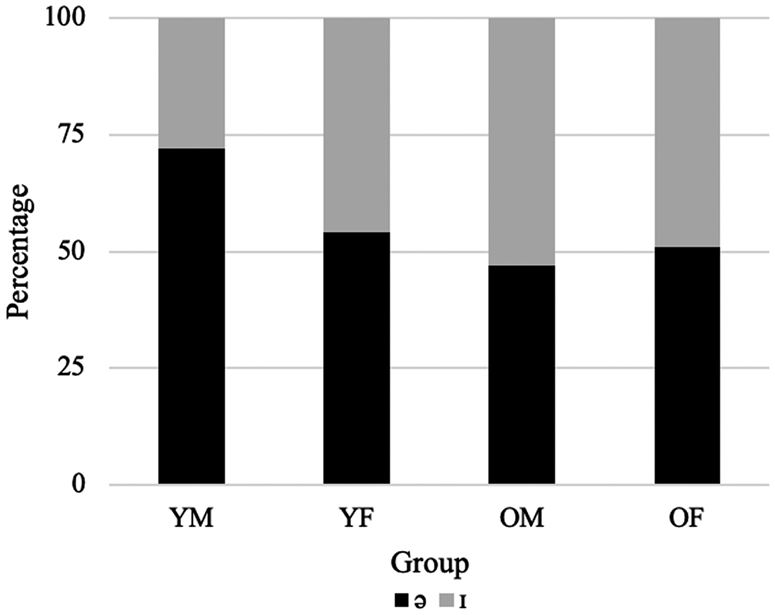
Overall, schwa was found to occur in 58% of all tokens. This aligns with results from previous studies undertaken in Ipswich, which report the traditional form as favoured, albeit at higher levels (Spurling, Reference Spurling2004; Potter, Reference Potter2018). The statistical analysis (Table 2) indicates that neither age nor gender is significant in isolation as a predictor of vowel realisation. This closely mirrors the findings of Potter (Reference Potter2018) who found no correlation between age and use of [ə], but conflicts with those studies that report young speakers to favour the innovative form [ɪ] more so than old speakers (Kingston, Reference Kingston2000; Spurling, Reference Spurling2004). The model does, however, highlight a significant interaction between age and gender. This interaction is consistent with the anomalous results for only one permutation of these two factors – young males – although comes short of an explanatory account of why this group preserves the traditional form more so than the young females, or any other group (see Figure 2). Sources of this group's conservatism (e.g. identity, social network density, traditionalness, etc.) may be of interest for future work. Those groups more disposed to adoption of the innovation pattern closely together (all show approximately a 50-50 split for [ə]/[ɪ]), and there is no clear evidence for any one group leading a change away from the traditional form in apparent time, but that is, of course, not to say that change is absent. Regarding preceding environment, the alveolar context, which has previously been shown to most strongly disfavour [ɪ] (Kingston, Reference Kingston2000), differs significantly from vowels and dentals. Vowels most often pattern with realisations of the traditional variant [ə], and dentals with [ɪ].
Percentage of [ə] and [ɪ] tokens by age and genderFootnote 6

This continued maintenance and favouring of [ə] is somewhat unique amongst East Anglia's traditional features, weathering the dialect-levelling storm with relative ease, in comparison to many of its counterparts. It is likely that Trudgill's (Reference Trudgill1986) phonotactic constraint on the variable, if present, may have had considerable restrictive effects, slowing any change away from the traditional East Anglian form. Further, he argues that speed of diffusion is directly related to speakers’ tendencies to accommodate to socially salient (or stigmatised) forms (cf. the rapid ascent of h-dropping into East Anglia), and whether a change carries any radical phonetic differences. However, it seems that unstressed vowel tensing may not meet these criteria. Firstly, the lack of evidence reported here for a change in progress led by a particular group could suggest that social meaning is less likely to be attached to the variable. Secondly, of all the lax vowels, kit's formant structure bears closest resemblances to that of [ə] (Watson, Maclagan, & Harrington, Reference Watson, Maclagan and Harrington2000), and is, therefore, not radically different. However, fine-grained acoustic analysis is necessary to assess the categorical or phonetically gradient nature of this change in East Anglia, because, as Straw and Patrick (Reference Straw and Patrick2007) point out, what appears to be homogeneity in diffusion can potentially result from undertaking purely auditory analysis. Lastly, Trudgill (Reference Trudgill1974a) points to schwa's special status in the dialect and its role in common processes such as smoothing, e.g. /faɪə/ → [fa:]. Smoothing is a relatively recent phenomenon in the dialects of East Anglia, which Trudgill (Reference Trudgill1986) noted to be spreading southwards in the late 1980s. East Anglian smoothing is distinct from similar processes found in London and other South East varieties, as it occurs beyond just triphthongs, and, instead, commonly occurs across both morpheme and word boundaries, as in ‘do it’, ‘saying’, ‘snowing’ and ‘going’ which surface as [dɜ:ʔ], [sae:n], [snɒ:n] and [gɔ:n], respectively. It is the presence of [ə] following a diphthong that acts as a trigger. Put simply: without [ə], smoothing cannot occur. In the dataset presented in this paper, a preceding vowel was shown to have a significant effect, with [ɪ] less likely to follow a vowel than [ə]. Whether the reported prevalence of [ə] in this particular environment ties into the smoothing story justifies further investigation into the extent of interaction between the two processes in East Anglia. Britain (Reference Britain2005) shows how sound change is eased by compatibility with an innovation from the outside, but incompatibility often leads to a rejection of change. If it is accepted, it is likely to progress slowly. Unstressed vowel tensing may well be a case of mismatch of compatibility between the donor dialect and the receiver, where [ə] is not so easily replaced by [ɪ]. The continued spread of smoothing could be stunted in the future by decay of the prerequisite [ə], yet, for now, it may play a role in why this traditional form is resisting change more so than the likes of zero -s marking, which fits more neatly into the salience criteria above.
Overall, maintenance of the traditional form [ə] for this community may relate to a combination of internal factors, such as Trudgill's (Reference Trudgill1986) phonotactic constraint, while change away from the traditional form may potentially be hindered by a lack of any clear social motivation. Studies of this variable reveal a landscape in which the degree to which unstressed vowel tensing is favoured fluctuates considerably between locations. This relates not only to patterns of diffusion, but potentially to the extent to which particular locales or sub-sets of communities maintain or reject certain interconnected features, such as smoothing. This study, therefore, exemplifies the importance of looking beyond the study of variables in isolation in order to consider the broader systematic picture.
4. Study two: yod dropping
4.1. Background
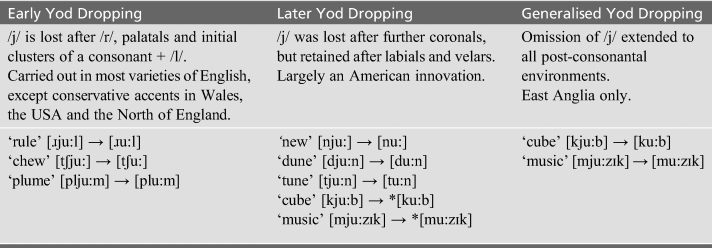
Historically, yod dropping has progressed through distinct stages, affecting multiple varieties of English to varying extents. These developments are presented in Table 3, as a summary of Wells (Reference Wells1982a: 206–208).
The three classes of yod dropping

4.2. Previous work
The extension of yod dropping to all post-consonantal environments is considered somewhat of an East Anglian shibboleth, often used in media representations of the region, and is a typical diagnostic feature (Trudgill, Reference Trudgill1990). Ellis (Reference Ellis1889) first records ‘generalised yod dropping’ for the working-class communities of Norfolk and Suffolk in the late 19th century, which is later mirrored by Kökeritz's assessment of the region (Reference Kökeritz1932). The SED (Orton et al., Reference Orton, Barry, Halliday, Tilling and Wakelin1962–71) shows that rural speakers consistently produce yod-less [u:] across C+/ju/ sequences in Suffolk some 30 years later, and, by Trudgill's original Norwich study (Reference Trudgill1974a), all classes are shown to exhibit ‘generalised yod dropping’. More recently, data from neighbouring North Essex (Amos, Reference Amos2007) show a marked decline, with the traditional realisation reportedly preserved by old speakers only half the time, while young females display near-categorical maintenance of yod retention. Data from the Fens and Ipswich (Amos et al., Reference Amos, Britain and Spurling2008) show the traditional form to be preserved at much higher levels; over 80% for old speakers and 70% for young speakers. Britain (Reference Britain2014) later confirms that location matters. Generalised yod dropping was most marked in rural East Anglia, while in towns and cities it was shown to be on the decline. Britain (Reference Britain2011) also points to a further possibility; in London and South East accents, elision of /j/ is typical after /t, d, n/, however, palatalisation of sequences such as /tj, dj/, whereby the approximant /j/ coalesces with the preceding alveolar stop to result in [tʃ, dʒ] now seems to be increasingly prevalent. This type of palatalisation is, of course, phonetically unsurprising, and occurs in a number of varieties of English, such as Australian (Kazemi, Reference Kazemi2015) and General American (Wells, Reference Wells1982a). Amos et al.'s (Reference Amos, Britain and Spurling2008) data show a sharp uptake in palatalisation by younger speakers in both Mersea and Ipswich, the two locales included in their study that are closest to London, but not the more geographically removed Fenlands. Superficially, this pattern could suggest a correlation between levels of coalescence and proximity to London. However, their data also reveal a similar pattern for yod retention, where young speakers in locales closer to London are more yod-ful. Given that the coalescence process requires /j/ by definition (Hannisdal, Reference Hannisdal2006), this is wholly unsurprising, and it could be that in the case of coalescence, geography might not be so important.
4.3. Methods
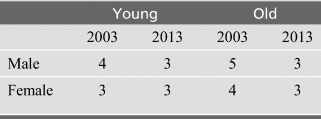
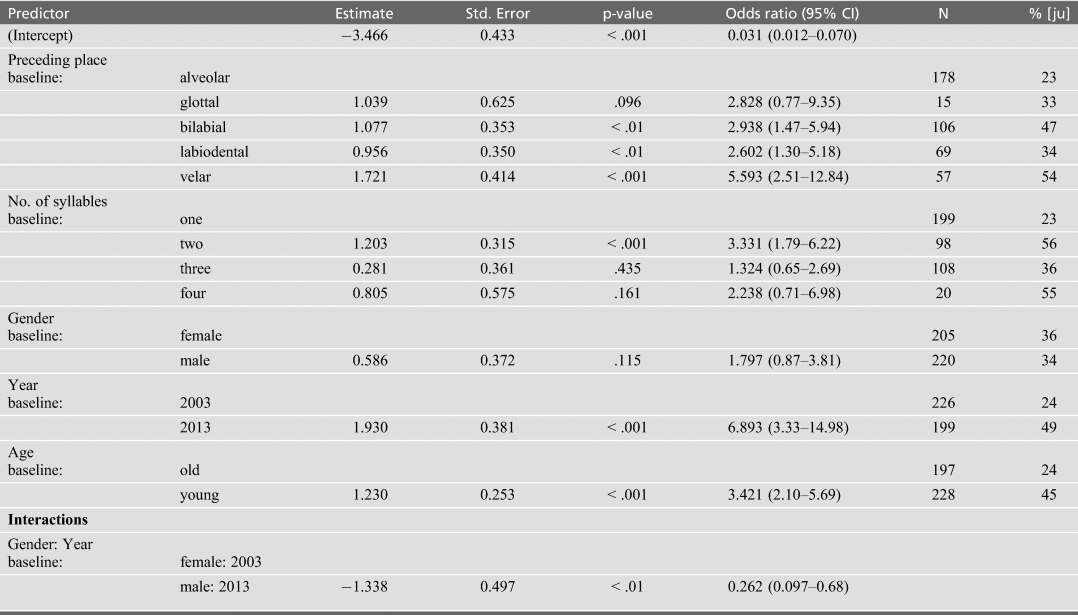
The data compared below are based on 28 speakers from Ipswich and are taken from the University of Essex East Anglian Corpus, 2003Footnote 7 (n = 256, including preceding /t, d/), and Butcher (Reference Butcher2013)Footnote 8 (n = 258, including preceding /t, d/). Table 4 shows the speaker sample, separated by age and gender. Age is categorised as ‘young’ and ‘old’, representing 18–35 and 60+ respectively. The data were extracted auditorily and analysed using logistic regression modellingFootnote 9 (RStudio Team, 2020). Pairwise comparisons were conducted using likelihood ratio tests to arrive at the best fit model (reported in Table 6), with ‘yod variant’ as the dependent variable. Preceding environment, number of syllables, year, age and gender were included as predictors. Note that preceding /t, d/ tokens were removed from the main model, due to the possibility of coalescence.
Speaker sample

Results from a multiple logistic regression analysis of yod variant ([ju] and [u]) with the overall % of [ju] tokens

4.4. Findings
The overall data highlight a sharp trajectory of traditional feature decline over time, as shown in Table 5, and year is reported as a significant predictor (Table 6).
Percentage of yod retention/deletion

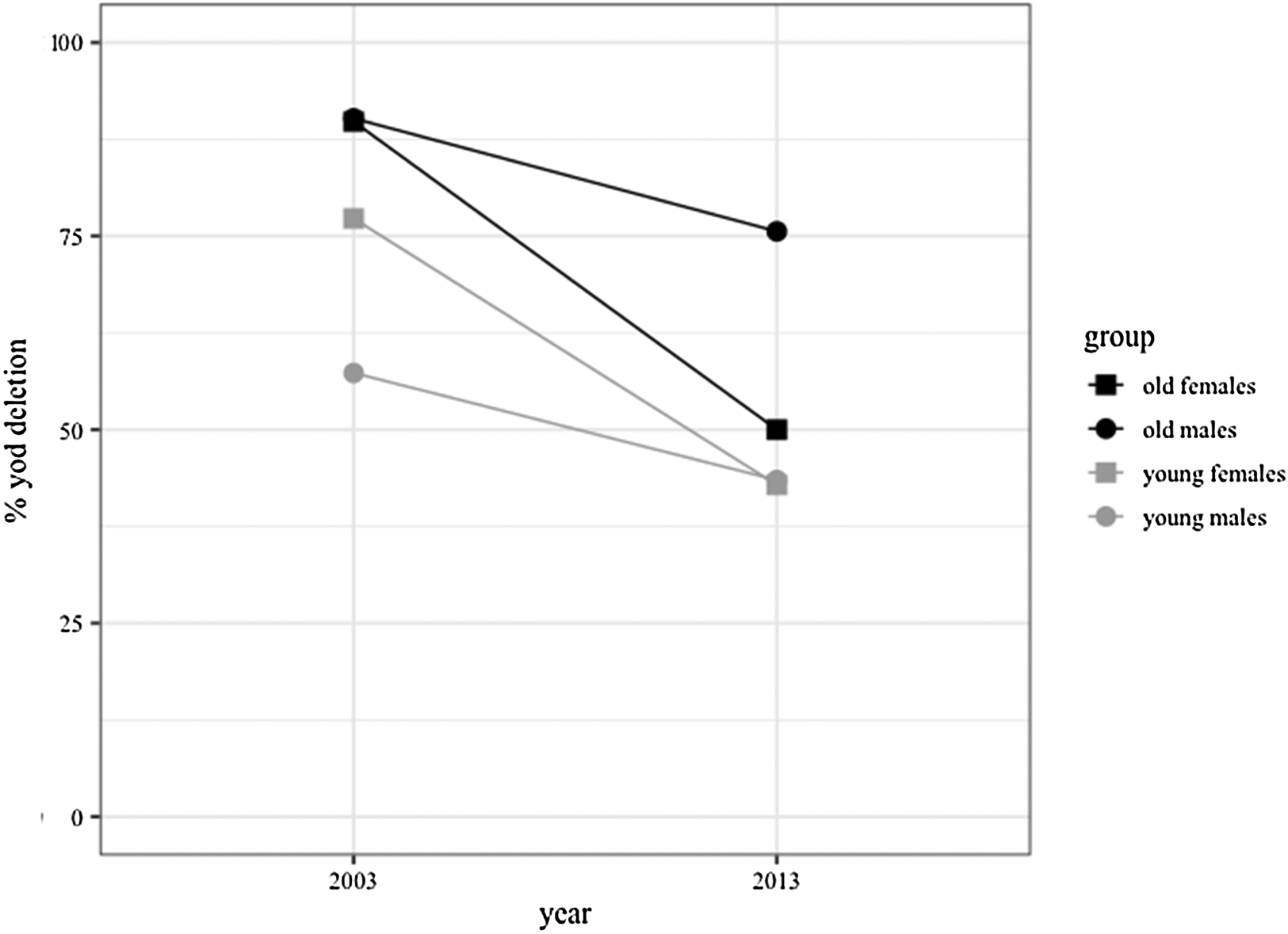
Age is also reported as a significant predictor in the model. As can be seen in Figure 3, old speakers exhibit higher yod deletion rates when compared to the young speakers. This is the case in both 2003 and 2013. Young males are shown to have the lowest rates of yod deletion in 2003, which conflicts greatly with their old male counterparts, who have the highest rates of deletion (cf. Amos et al., Reference Amos, Britain and Spurling2008). A similar pattern emerges in 2013, where the gap between the two male groups remains. Despite the fact gender is not reported as a significant main effect, the model highlights a significant interaction between gender and year, which suggests that females are more affected by year. This can be seen in Figure 3, where the difference between young males and females reduces between years, but increases for old males and females, as the old females begin to favour the innovative form. It is well established that female speakers often lead in linguistic change, as summarised by Labov (Reference Labov1990), and this clear upsurge in yod retention suggests they may have accelerated this one.
Percentage of yod deletion by age, gender and year

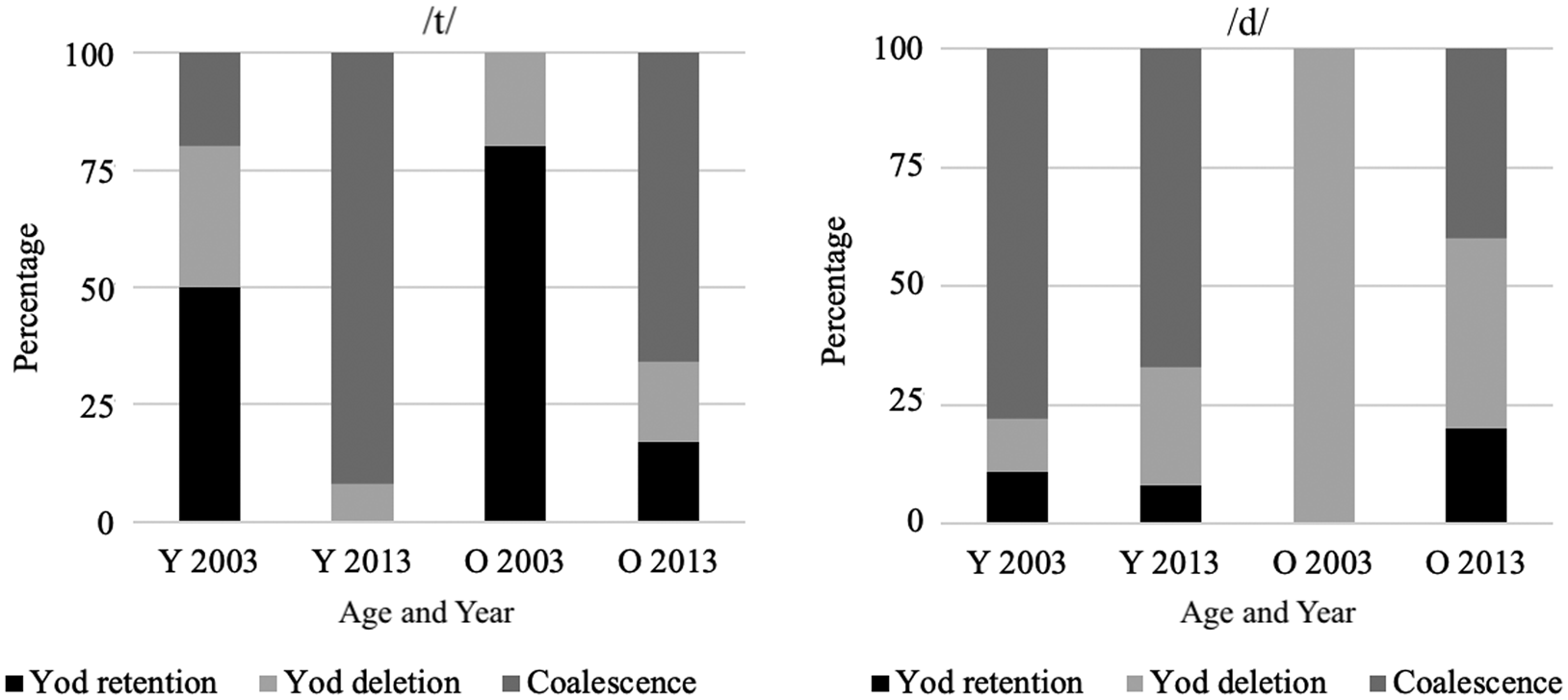
Looking to linguistic factors, monosyllables, which retain the yod least often, differ significantly from disyllables, which retain the yod most often. Labiodentals, bilabials and velars all differ significantly from alveolars, which show the least preference for a following yod, indicating more yod retention in these three environments. This finding largely aligns with Trudgill's (Reference Trudgill1974a: 102) predicted ranking, which ranges from least likely to most likely to retain /j/: s > n > d > t > v > f > m > b > p > k. The significant difference reported between velars (most likely to retain) and alveolars (least likely) provides important clues as to the effects of external influence on East Anglian English. Closer inspection of the data reveals that the alveolar nasal /n/ exhibits yod deletion rates of 83% (n=90) and 79% (n=61) in 2003 and 2013, respectively (cf. Amos, Britain & Spurling, Reference Amos, Britain and Spurling2008, who report a similar pattern for /n/). It is in urban areas of East Anglia less exposed to counter-urbanisation, such as this, that yod deletion after /n/ is suggested to be a crucial criterion in identifying a move towards a much more London-like pattern (Britain, Reference Britain2011). Post-coronal glide deletion after /n, d, t/ is a typical feature of Cockney English (Wells, Reference Wells1982b), and, thus, is a tempting candidate for an explanation couched in external motivation, given the historical links. Alternatively, this pattern may simply represent a natural development from the historical loss of /ju/ after coronals, such as /r/, whereby we begin to see synchronic manifestations of a historical change. Separation of /t, d/ to account for coalescence reveals a well-defined pattern (Figure 4, n = 89). In 2003, the old speakers categorically show no coalescence, while in 2013, they begin to show usage of the coalesced form. It is still, however, the younger speakers who show higher rates in the most recent data. Note that the younger group shows 0% and 8% yod retention for /tju/ and /dju/, respectively, in 2013. Rather than returning to the more widespread, yod-ful form seen in other varieties of English, this intermediate stage is bypassed, and there is a clear move towards a new possibility: coalescence.
Percentage of yod retention, deletion and coalescence for preceding /t, d/ by age and year

These findings over a mere ten-year period, coupled with similar trends found in comparable studies (Amos et al., Reference Amos, Britain and Spurling2008; Amos, Reference Amos2007), suggest that generalised yod dropping may well be on its way to becoming a relic feature, at least in South Suffolk, and coalescence may be on the rise. Although the decline of yod dropping has likely been led by female speakers, over time, all genders and age groups demonstrate a shift away from ‘generalised yod dropping’ – a once characteristic feature of the dialect – and towards a system more in line with varieties beyond East Anglia.
5. Conclusion
The data reported here reinforce Britain's (Reference Britain2011) observation that under the general umbrella of dialect attrition, microvariation and the complexities of supralocalisation between and within locales should not be overlooked, and indeed cannot be without sacrificing accuracy of analysis. The behaviour of these two variables is contrasting, differentiated by their respective degrees of maintenance and the extent to which this is driven more by internal or social factors. Yod dropping appears to show clearer social stratification, and its decline was shown to have progressed rapidly, while yod coalesence was shown to be on the increase. Additionally, uptake of post-/n/ yod deletion hints at the possibility of external influence bearing on the mechanisms of this sound change. On the other hand, realisation of schwa in unstressed syllables shows relative stability, as there is no consistent change in progress observable in apparent time. Its integral role in the facilitation of other common processes, such as smoothing, were suggested to potentially play a role in its maintenance, but requires more in-depth study. The traditional features that survive best in modern East Anglia today may then be those that are not considered social indicators (Labov, Reference Labov and Fishman1971) and/or have a more deeply embedded role in the phonological system. In order to better understand the apparent internal variation in East Anglia and what predicts which traditional features survive best, we must push beyond the geographic horizon inherited from previous studies by increasing our knowledge of the modern dialect beyond the South. Only then can we more accurately plot the degree of survival of traditional features and how these might correlate with known social factors, such as counter-urbanisation, and external influence from beyond the East Anglian borders.
 KERRI–ANN BUTCHER is a PhD student at the University of Cambridge. Her main research interests include the phonetics-phonology interface and sociolinguistics, but more specifically vowel mergers and instrumental/quantitative approaches to sound change. Her thesis looks at the perception and production of the many vocalic mergers that can be found in East Anglian English, and how any (a)symmetries might tie into social meaning. She received her BA and MRes from the University of Essex. Email: kab82@cam.ac.uk