


A widespread belief about politics in Africa is that people benefit from patronage when co-ethnics hold political power. Aspiring African politicians seem to confirm this intuition when they stress their credentials as a “native son” of a place. Voters confirm it because they often support a presidential candidate from their home area and because parties often receive a supermajority in some regions and almost no support from other regions. This assumption is central to many theories of why ethnic identities become political. Most political scientists take seriously a constructivist account of ethnicity, in which identities are mobilized in the pursuit of state resources. Scholars disagree on why ethnic identities, rather than any other social identity, should become the basis of competition for a piece of the national cake; however, on all these accounts individuals support co-ethnics because they gain from doing so.1
There are four explanations for why ethnic identities become the basis for competition over political goods instead of other identities: ethnic groups share common language or kinship ties; ethnic groups are geographically concentrated as are the goods that the state provides; ethnic identities are ascriptive and, therefore, naturally limit the size of coalitions formed to compete for resources; finally, ethnic identities provide clues to voters about a candidate's preferences where information is scarce (Bates 1983; Chandra 2004; Fearon 1999).
Case studies from a number of countries highlight instances in which African leaders have distributed goods to members of their own ethnic group or to their home area. For example, the Fifth Burundian Five Year Plan allocated 98% of gross fixed capital formation to the areas surrounding the capital and to Bururi, the home province of the southern Tutsi elite. This allocation left only 2% of capital investment for the country's other 14 provinces (Ngaruko and Nkurunziza 2000). Joseph Desire Mobutu of Zaire turned his home village, Gbadolite, into an opulent city, and the Ivorian president Felix Houphouët-Boigny even made his hometown the national capital.
Despite these dramatic examples of ethnic favoritism, it is worthwhile asking whether leaders reward co-ethnics with all kinds of patronage, which individuals are most likely to benefit, and how political institutions affect the propensity for politicians to reward their own. The answers to these questions are not obvious, in part, because it is surprisingly difficult to demonstrate that leaders always reward their ethnoregional base. Often all groups claim to receive less than their fair share of the national cake, and it is difficult to construct an empirical or normative benchmark of what an unbiased allocation of resources would be.
There are two streams of research that suggest that it cannot be taken for granted that people benefit when co-ethnics hold political power. First, both theoretical and empirical work on how incumbents allocate resources to ensure their political survival indicates that, in a range of settings, incumbents choose not to distribute resources to their core supporters. Work in this research area includes formal treatments of the problem (e.g., Cox and McCubbins 1986; Dixit and Londregan 1996; Lindbeck and Weibull 1995) and empirical tests in specific countries (e.g., Dahlberg and Johansson 2002; Diaz-Cayeros, Magaloni, and Estévez 2003; Khemani 2003; Miguel and Zaidi 2003). Second, research on the allocation of resources within communities suggests that local-level inequalities of wealth, education, and access to political power exert a powerful influence on who benefits from these resources (Bardhan and Mookherjee 2000; Platteau 2004). Although ethnic groups provide a useful shorthand for describing interest groups in many developing countries, viewing groups as corporate actors glosses over important internal divisions that may influence the allocation of resources across groups.
This paper examines how the ethnic identification of cash crop farmers affects how heavily governments tax them. Agricultural policy is extremely important because farmers form a majority in many sub-Saharan African countries, and high levels of agricultural taxation have contributed to large declines in a critical sector. Farmers in the government's home area are assumed to benefit from better prices for their crops. Bates (1989) argues that once Daniel arap Moi gained political power in Kenya he extracted revenue from coffee growers, who were largely affiliated with his predecessor and used these resources to benefit grain growers in the Rift Valley, his home region. Similar observations have been made concerning farmers in other countries including Cameroon and Benin (Decalo 1995; van de Walle 1989).
This paper takes advantage of the fact that both crop production and ethnic groups are geographically concentrated. By matching the location of crops to the government's ethnoregional base for 50 country-crop combinations (shown in Table 1), this paper investigates whether cash crop farmers benefit from having co-ethnics in power. In addition, this paper provides the first large-N test of whether regime type affects the degree to which farmers are taxed.

It establishes that farmers in the president's home area face higher tax rates than those outside of it. I argue that citizens who have fewer alternatives pay higher taxes. The dominant means by which rulers have secured support in the countryside has been by co-opting intermediaries. Rulers are better able to select and monitor influential local allies at home than they are abroad; therefore alternative candidates are less likely to emerge in a leader's home region. So rulers can avoid having to enact policies that benefit all the farmers in any given area, and it is easier for them to tax their own.
The claim that citizens with fewer alternatives pay more tax is also consistent with existing theories that maintain that policies in Africa tend to be biased against the rural majority because rural people are less likely to overthrow governments than are urban dwellers (e.g., Bates 1981). Other findings presented here confirm this intuition. Taxes are lower in democracies because farmers can threaten to remove leaders. Where there is more political competition at the local level, the tendency for leaders to tax their core more heavily is reduced because alternative candidates are more likely to emerge. Growers of perennials face higher tax rates because they are less likely to switch to other crops (McMillan 2001).
ETHNICITY AND PATRONAGE
Ethnicity and Formal Theories of Distributive Politics
The notion that politicians should reward co-ethnics is challenged by two simple insights that appear in the literature on distributive politics in democracies (Cox and McCubbins 1986; Dixit and Londregan 1996; Groseclose and Snyder 1996; Lindbeck and Weibull 1995). First, if voters receive what Chandra (2004) calls “psychic benefits” from seeing co-ethnics in office, politicians wishing to acquire power have to expend less money and effort in securing their support. This argument suggests that voters' affinity for candidates may mean that they receive fewer material benefits. Second, politicians have better information about and contacts in their home areas and can secure the same level of political support at home for less effort than they would in other regions of the country.
The central question of this literature has been whether it is more advantageous for a candidate seeking to retain power to redistribute goods toward core or swing voters. In these models, candidates allocate goods across groups through taxation and transfers. Individuals care about receiving transfers but also have nonmaterial preferences, which have been treated as analogous to ideology or partisanship, but can also be understood as a preference for co-ethnics.
Groups are distinguished from one an other by the degree to which they reward politicians' expenditure on them with votes. Politicians want to transfer resources to groups with high expected “rates of return.” These different rates of return arise because groups are assumed to differ in a number of ways, two of which are discussed here. First, groups differ from each other in the distribution of their preferences for the reallocative policies of candidates. Groups with greater numbers of moderates (or “swing voters”) receive more ceteris paribus (Dixit and Londregan 1996). Second, groups differ because candidates can target their resources more efficiently in some areas than others: transfers are more effectively targeted and taxes are easier to collect.
There are important limitations to application of the Dixit and Londregan (1996) model to the African context. For example, in this model, groups cannot engage in armed insurrection, candidates do not have the option of stealing money, and elections, where they occur, are fair. An alternative conceptualization of distributive politics in countries with weak institutions is provided by Padró i Miquel (2004), who argues that massive presidential corruption can be explained by fact that co-ethnic supporters are reluctant to oust rulers for fear that rival ethnic groups will take power and make them even worse off. The Padró i Miquel model predicts that when taxes can be levied on groups separately and leaders are more likely to be ousted by their own co-ethnics, taxes on co-ethnics will be lower.
Whether a president's co-ethnics benefit from his time in power depends on how likely they are to oust him when they disagree with his policies. Although it is possible that a president can be more easily sanctioned by his co-ethnics, it may also be the case that he has better tools for securing the support of some segment of the population. Further, it may be that co-ethnics are predisposed to support him. People do appear to have preferences for candidates of their own ethnicity that have little to do with anticipated patronage. Although much of the ordinary language of ethnicity in Africa concerns how it affects who acquires jobs and state benefits, people also discuss ethnicity in noninstrumental terms and appear to value the success of co-ethnics in realms that do not directly benefit themselves—football, for example. To argue that these intrinsic preferences exist is not to argue that people suffer from a sort of ethnic “false consciousness” or to argue that ethnic voting is a purely expressive act; rather, in deciding which candidates they support, people are willing to trade some other good in order to select a candidate who shares their ethnicity. In practice, however, it is difficult to assess how much these tradeoffs matter because they tend to coincide with instrumental motives for supporting co-ethnics.
Ethnicity and Patronage in Africa: Intermediaries and the Problem of Governing the Periphery
Governing peripheral areas has been a major challenge for rulers in Africa throughout its history. Leaders' capacity for generating political support, or even order, can vary greatly across regions. Poverty, low population densities, poor infrastructure, and ethnic diversity combine to create a situation in which controlling the rural majority is difficult (Herbst 2000). Colonial governments had to develop strategies for administering and extracting revenue from these areas with a relatively small number of European personnel. Postcolonial governments have attempted to integrate ethnically diverse populations in new states.
A common solution to the problem of governing the countryside has been the use of intermediaries through some variant of “indirect rule” (e.g., Boone 2003). The need for local allies exists even where rulers resort to rule by force because coercion is more effective if leaders can acquire better information about threats (Fearon and Laitin 2003). Where there are elections, case studies highlight the importance of local knowledge and contacts in ensuring support for a candidate and suggest that some individuals may be able to act as brokers, delivering the support of larger blocs (Lemarchand 1972). For example, Alila's (1986) study of local politics in Bondo, a constituency in Kenya, observes that candidates who tap into local networks do better than candidates who rely on indiscriminately distributing goods to the public as a whole. Further, in Nigeria, Ichino (2006) demonstrates that the dependence on party leaders on local politicians to mobilize support influences party organization, the distribution of patronage, and electoral violence.
It may be possible for governments to acquire clients with local knowledge and influence outside their home areas, but they cannot be sure that these individuals are not false brokers. For example, Azam (2001) argues that in Mali, General Moussa Traoré “purchased the quietness of the Tuaregs by distributing some advantages to the member of the traditional Tuareg chieftaincy, with very little fallout to the rest of the people.” He argues that as a result of this policy, the insurrection of the early 1990s was as much directed against these traditional rulers as it was against other ethnic groups in Mali.
The role of political intermediaries is worth examining because it is often difficult to know whether the benefits politicians suggest they have given co-ethnics spread beyond a small group of relatives and cronies. Politicians often find ingenious ways to expropriate resources from projects designed to benefit whole communities. Local authorities often have discretion over which citizens can gain access to scarce public services. A significant amount of the money spent on these goods pays the salaries of staff whose appointment may be politicized.
In addition, funds allocated by the central government for expenditure on local public goods may be captured by elites (Platteau 2004). In Uganda, Reinikka and Svensson (2001) find that primary schools received on average only 13% of central government spending for one education program and that most schools received nothing. Most of the money was “captured” by local politicians and influential individuals at the district level and divided among themselves.
The capacity of rulers to co-opt rural intermediaries is part of Bates' explanation of why governments are able to impose high taxes on all farmers. Governments have used their capacity to discriminate among farmers in delivering access to credit and other agricultural inputs to generate political support (Bates 1981). In the Senegalese groundnut basin, Leopold Senghor's government formed alliances with chiefs and marabouts—leaders of an Islamic sect. In exchange for securing the political support of their clients, these local notables were given access to credit and subsidized inputs. In particular, they were placed in charge of groundnut cooperatives which purchased all crops on behalf of the marketing board and which dispensed credit and subsidized inputs to farmers (Cruise O'Brien 1975). In Kenya, for example, Kanyinga (1994) argues that Gatundu, President Kenyatta's home area, was underdeveloped relative to the rest of Kiambu. He writes “Kenyatta's own personal dominance [in Gatundu] inhibited the rise of other patrons with an interest in attracting resources to the area, which was instead principally characterized by the appropriation of state resources for personal enrichment by his close relatives.”
Because African rulers have relied on intermediaries to secure support in regions, areas that dominate the governing coalition are more likely to be underserved in the local public goods communities desire, like schools, roads, and hospitals, if the benefits of these goods cannot be captured by politically connected individuals.
THE TAXATION OF AGRICULTURE IN AFRICA
African governments rely on the taxation of agricultural exports for two very practical reasons: cash crops are often their largest source of foreign exchange, and goods that leave the country by a port are relatively easy for the government to monitor. African governments have imposed taxes on agricultural exports in three ways. First, governments have levied direct taxes on exports. Second, overvalued exchange rates have acted as an indirect tax on exports of agricultural goods. Third, governments have set the prices paid to farmers. Farmers are effectively being taxed when farm gate prices are lower than the border price even after accounting for the costs of marketing (transportation, processing, distribution, etc.). This study explains variation in pricing policy and controls for exchange rate overvaluation.
In almost all African countries, governments have been heavily involved in the marketing of both food and cash crops. Governments have held a direct monopsony on the purchase of agricultural exports, issued trading licenses to intermediaries, or owned processing facilities. Marketing boards (or caisses de stabilisation) varied in their structure and remit, and most countries inherited their marketing institutions from former colonial powers. These marketing arrangements were instituted by colonists to extract revenue from farmers and secure monopolies for European-owned export firms (van der Laan 1987; Williams 1985). These systems were characterized by a lack of competition at the farm gate. Few marketing boards were physically involved in trade and most relied on intermediaries, either licensed buying agents (traitants) or cooperatives to which smallholders were required to belong. In these cases, the government set the prices that these intermediaries could offer farmers.
Throughout much of the postindependence period most economists and policymakers believed government intervention was warranted because agricultural markets were inefficient and dependence on agriculture was an impediment to development. In addition, it was accepted that farmers needed insurance against volatile prices, access to credit in order to purchase agricultural inputs, and protection from exploitative middlemen. Many marketing boards supplied agricultural inputs to farmers on credit, and most African governments intervened in markets for fertilizer. Although these marketing arrangements were designed to solve important problems, they often raised considerable revenue that was expropriated by governments and corrupt officials. The World Bank and IMF began making export crop liberalization a condition of loans in the early 1980s, but significant steps toward liberalization only occurred in the early 1990s (Shepherd and Farolfi 1999).
Because crop production is spatially concentrated, certain agricultural policies can be treated as local public goods, the benefits of which accrue primarily to one region of the country. This view of pricing policies is different from that of Widner (1994), who treats producer prices for coffee in Côte d'Ivoire and Kenya as national policies and contrasts them to local public goods such as schools.
Even if not all people residing in a region grow a crop, they benefit from the positive spillovers associated with growth in agriculture. For example, according to Azam and Djimtoingar (2002, 18–19), the cotton sector in southern Chad “provides incentives for the maintenance of the road network in the South, with positive spillover effects on the local economy. Earth roads are regularly maintained there, unlike the rest of the country.” Therefore, because both political affiliation and crop production are geographically concentrated in sub-Saharan Africa, ethnic geography should affect how much governments tax crops in different areas.
OTHER DETERMINANTS OF TAXES ON AGRICULTURE IN AFRICA
The most prevalent explanation for why governments extract revenue from agriculture is that taxes on exports in Africa are often part of a wider pattern of redistribution of resources from rural to urban areas (Bates 1981; Lipton 1977; Lofchie 1989). This urban bias persists because the costs of collective action are lower for urban dwellers and, although they may not contribute more votes, they can more easily bring down the government. By contrast, farmers cannot organize collectively because they are often uninformed, widely dispersed, or only able to engage in political action during slow seasons (Binswanger and Deininger 1997).2
Collective action should be particularly difficult for smallholders. I do not include a measure for the degree to which smallholders produce crops. These data are difficult to find for a cross-section of countries over time. However, the data set excludes crops such as sugar and tea, which are generally grown on estates
Democracy
In countries in which there are contested elections for national office and a rural majority, farmers can more easily punish governments for policies that harm agriculture. The prediction that taxes should be lower in democracies follows directly from existing theory about why farmers in Africa face such high taxes, but it is not uncontroversial, and the evidence from existing studies is contradictory. Varshney (1995) argues that as democracy in India increased, rural producers were able to demand higher prices for their crops. In contrast, Widner's (1994) comparison of Kenya and Côte d'Ivoire finds that elections matter less than whether political elites have themselves personally invested in agriculture. It may be that democracies are able to extract more revenue from farmers because they are more willing to comply (Levi 1988). Further, the impact of competitive elections may be contingent on other factors. Competitive elections may make affect the ability of rulers to discriminate among ethnic groups because group size and votes become more important.
Leaders' Tenure
The literature on the political economy of taxation suggests that leaders who expect to be in office for longer periods should tend to implement less extractive policies (Olson 1993). Leaders are aware that high taxes act as a disincentive to production and care about their future revenue stream. Leaders who are concerned about their immediate political survival may impose higher taxes on farmers. McMillan (2001) finds that leaders who do not expect to be in office long choose more extractive policies.
Crop-Specific Characteristics
The biological characteristics of crops affect how much farmers are taxed. Some crops, perennials in particular, require high initial fixed investments. Growers of perennials, such as coffee and cocoa, face higher taxes because once farmers have invested in these crops the government is able to exploit their investment by levying higher taxes (Besley 1997). McMillan (2001) finds that taxes are higher where crops have a high ratio of sunk costs to total costs.
Other characteristics of crops affect whether farmers can evade taxes. Farmers are more likely to smuggle some crops across borders than are others. It is more profitable to smuggle crops with a high value-to-weight ratio. For example, coffee's value-to-weight ratio ($2,008 per metric ton) is three times higher than that of groundnuts ($694 per metric ton; Food and Agriculture Organization [U.N.] 2001; International Monetary Fund 2003). Some crops, such as coffee, are more easily stored and transported than are others (Akiyama et al. 2003). Further, agroecologic conditions determine whether there are profitable alternative crops that farmers can switch to in order to avoid taxation.
The technology required to process a crop may also affect the bargaining power of farmers. For example, the cotton-ginning process requires high initial investments, making government intervention necessary at an earlier stage. This may create a natural monopsony, putting cotton farmers at a disadvantage relative to other cash crop farmers (Baffes 2001). On the other hand, Bingen (1998) suggests that cotton farmers may have more bargaining power because the “industrial-type discipline” required to grow high-quality cotton, like factory work, facilitates worker consciousness and the formation of cotton-growers unions. Further, international markets for each of the crops in this study differ; however, these differences have an unclear crop-specific impact on individual farmer's decisions to grow the crop.
An ideal measure would rank crops by the ease with which growers are able to evade taxes. It seems likely that the greatest differences on this dimension are between perennial and annual crops, but there is no good way of constructing such a ranking a priori. Therefore, the analysis below controls for crop-specific characteristics by using fixed effects, introducing dummies for each country-crop combination.
DATA AND MEASURES
Measuring Taxation
Farmers are effectively taxed when governments generate revenue by offering them low prices for their crops. Most commonly used measures of the effect of government policy on agricultural incentives compare the prices farmers would receive with and without government intervention.3
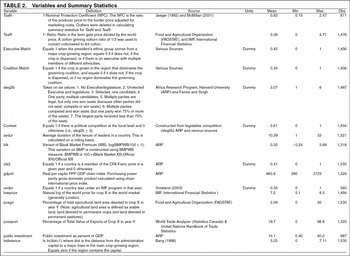
I thank Margaret McMillan for giving me the Jaeger (1992) estimates of the NPC. A full description of the variables used, sources, and summary statistics are found in Table 2.
Estimates of the border price are obtained by subtracting freight charges specific to each country and crop from the world price. These adjustments are common practice. See Jaeger 1992 and Krueger, Schiff, and Valdes 1991.
Other authors such as Krueger (1991), who are interested in how government policy distorts the agricultural sector in general, try to control for other aspects of policy including exchange rate overvalution, including distortions in the nonagricultural sector.

TaxN is the main dependent variable used in the analysis, but data are only available from 1970 to 1987. A cruder measure, TaxR, covers 1966 to 1995. This measure is 1 minus the producer price divided by the world price. This measure does not adjust for marketing and transportation costs that are specific to each case; therefore TaxR gives consistently higher estimates of the tax rate than TaxN.6
TaxR and TaxN have a correlation coefficient of 0.32.
Matching Ethnic Geography to Crop Areas
I capture the way in which ethnoregional politics may bias taxes on crops in two ways. Crops are coded as having an Executive Match when the president comes from a crop-growing region and as having a Coalition Match when the governing coalition is drawn from the crop-growing region. For example, Ghanaian cocoa is as not having a coalition match during the tenure of Jerry Rawlings, but it has an executive match because a small amount of cocoa is produced in the Volta Region. If ethnoregional politics affects taxes in the way suggested by conventional wisdom, we should expect a negative coefficient on both variables because an association with the governing elite should lower taxes imposed on farmers.
The Coalition Match variable more closely mirrors the reality of ethnoregional politics in Africa because presidents vary in the degree to which they accommodate the interests of other ethnic groups, and occasionally lead coalitions that are not composed of their co-ethnics. However, Executive Match has the advantage of simpler coding rules and reduces the need to make judgments about which ethnoregional group dominated the governing coalition. These alternative coding rules lead to different outcomes in a few cases, however, because Coalition Match and Executive Match are highly correlated.
The coding rules for Executive Match are as follows. Executive Match takes on a value of 1 when the president's ethnic group comes from a major crop-growing region and equals zero if it does not. Executive Match also equals zero when the crop is dispersed throughout the country, or if there is an executive with multiple members of different ethnicities.7
Crops are considered dispersed when they cross a major ethnoregional cleavage between the executive's ethnic group and other groups. In the way the variable is coded, crops without a match are treated as equivalent to dispersed crops.
To code these variables, I consulted a wide range of sources to determine the ethnicity of the head of state and what were the major ethnoregional cleavages in the country. In most cases the region and ethnic identity of inhabitants coincide for powerful historical reasons. In the past, ethnic groups were differentiated from each other by the practices they adopted to exploit their natural environment. Colonial rulers created internal administrative boundaries around “tribes” for administrative and ideological reasons, and these ethnic territorial units became the basis on which Africans competed for political power in the postindependence period. In almost all of the cases under consideration in this paper, crop farmers residing in an area are indigenous to that area.8
There are at least two exceptions. First, Ethiopia under Emperor Haile Selassie, Amhara and Tigre landlords (migrants from the north of the country) owned the land in the South on which their tenants (the Oromo) cultivated coffee (Keller 1981). In this case, I consider coffee as belonging in the Oromo region because good prices for crops benefit all people living in an area. Second, in Côte d'Ivoire governments actively encouraged internal migration. Data on internal migration are impossible to collect; however, in most cases the settlement of ethnic strangers is rare because it is extremely politically fraught. Further, in many cases migration is unlikely to greatly affect farm ownership because of the difficulties associated with purchasing land.
For Coalition Match I used the secondary sources to determine which groups were believed to be disproportionately represented in government. Although I do not have a quantitative measure of ethnic dominance, one consequence of the high salience of ethnicity in Africa is that, in most cases, sources made unambiguous statements about which groups dominated the governing coalition, and these statements were consistent across sources.
Where possible, I determined where crops were grown using data on crop production by region, obtained from agricultural censuses, reports issued by marketing boards, sector analyses by agricultural economists, and international commodities organizations. Data on production by region were not available in all instances. In those cases I relied on statements about the location of the major crop-growing region in the sources.9
A region counted as the main crop-growing region if over 60% of the crop produced in a country was grown in that area. Where a significant amount of production (20%) crossed a major ethnoregional cleavage the crop was coded as dispersed (e.g., Cotton and Tobacco in Zambia). In most cases crop production was more concentrated than this, and these thresholds were chosen to ensure that countries and crops for which there were production statistics were judged by the same standards as those for which there were none.
Measuring Democracy
As competitiveness enables voters to sanction their representatives by selecting alternative candidates, this study codes for whether or not there are competitive multicandidate elections for the legislature using a variable on legislative competition from Ferree and Singh (2002; see Table 2). The variable (Contest) indicates whether legislative elections are competitive, whether several parties can contest elections. It takes on a value of 1 if there are competitive elections for the legislature and zero if there are no elections. Other measures such as Polity scores, the democracy variable used by Przeworski et al. (2000), and the Ferree and Singh (2002) legislative competitiveness scale were also used.
The Contest variable excludes a number of attributes, such as civil liberties, that we generally associate with democracy. However, off-the-shelf assessments of the degree of democracy in a country are difficult to disaggregate into their component parts, not all of which are relevant to the theory of why political competitiveness should reduce taxes on farmers. In countries with competitive elections for the legislature, such as Zambia and Kenya, members of parliament were expected to bring development to their communities and could be removed for failing to do so (Barkan 1976). Agricultural pricing policy was an important local issue concerning farmers and their representatives. Lofchie (1994) argues that competitive elections for the legislature under a single party partly explain more farmer-friendly agricultural policies in Kenya than in Tanzania. Further, political competition at the local level has been shown to affect outcomes other than agricultural taxation. Bratton and van de Walle (1997) argue that plebiscitary democracies, which have elections for the legislature, are more likely to transition to multiparty politics in the future.
FINDINGS
To determine how the ethnic identification of farmers and political competition affect how much crops are taxed, I run a regression of Executive Match and various controls on TaxN using fixed effects for each country and crop combination and robust standard errors. This estimation technique presents a particularly hard test because it controls for time-invariant effects specific to each country and crop and relies on changes within each country and crop combination to estimate the effect of the explanatory variables on taxes. Because these country-crop-specific features are important determinants of taxes, my discussion of the findings primarily concerns the fixed-effects regressions. However, to illustrate other aspects of the data, I present results from two other estimation techniques. I present findings from a regression of changes in TaxN on the first differences of the main independent variables to demonstrate that changes in the regional base of the government correlate with changes in tax rates. I also use random effects to demonstrate some interesting time-invariant determinants of the taxation of these crops, such as the distance of the crop-growing region from the capital, the type of crop, and colonial legacy. Unless stated otherwise, the dependent variable is TaxN; the tax rate accounting for marketing and transportation costs.
Ethnic Geography and Taxation
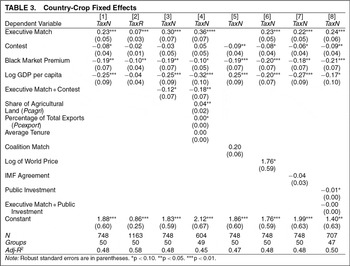
As Table 3, panel 1, reveals, when a president comes from a crop-growing region, farmers face taxes that are higher by 23 points. Substantively this means that regions with an executive match face taxes that are higher by 79% of the median tax rate and 55% of one standard deviation in the tax rate. This finding does not depend on the inclusion of a particular country-crop. Dropping each of the 50 country-crop combinations from Model 1 alters the size of the coefficient on Executive Match by at most 4 points either way, and it remains significant at the 1% level.10
These and other tables available on request.

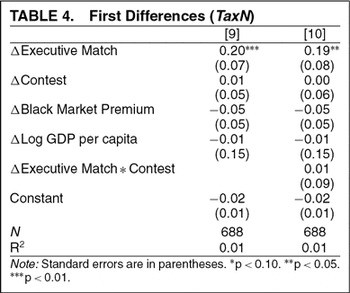
Crops grown in ethnically matched regions remain more heavily taxed when the estimation method is changed. Using first-differences, the coefficient on Executive Match remains positive and significant at conventional levels (Table 4). A change from a region with a match to one without reduces TaxN by 20 points. Very few variables can predict changes in the taxation, including changes in the world price of a crop.

Regime Type
Political competitiveness reduces taxes on farmers. In countries with competitive elections for the legislature, taxes are lower than in those without these elections (Table 3). However, changing the method of estimation to first-differences reduces both the magnitude and the significance of the coefficient on competitiveness (Table 4). Changing the measure of democracy to a Polity score or the measure used by Przeworski et al. (2000) does not reproduce this finding. This is probably due to the way in which these measures are distributed in this sample. Of the country-crop-years included in the analysis, 97% are coded as nondemocracies by Przeworski's measure, and 80% have a polity score of −5 or less (the polity score ranges from 10 to −10). However, when Ferree and Singh's measure of legislative competition is included instead of the Contest variable, the results show that increasing legislative competition reduces taxes.
One concern is that this relationship between competitiveness and tax rates exists only because the taxation of agriculture declined and the number of competitive regimes rose in Africa after the 1980s because of economic crises and political changes demanded by international donors. Including a variable that indicates whether a country is under an IMF agreement in a given year taken from Vreeland (2003) demonstrates that countries under IMF agreements do not impose lower taxes on cash crop farmers, and the coefficient on Contest remains negative and statistically significant at conventional levels (Panel 7, Table 3).
The data show that regime type affects how much leaders discriminate among farmers. The positive coefficient on the interaction term between the Executive Match and Contest suggests that leaders in competitive regimes bias taxation less against their home regions (Panel 3). The effect of moving from a region with an executive match to one without lowers the tax rate by 36 points if there are competitive elections and by 18 points if there are none. That is, competitive elections reduce a leader's bias against crops grown in his home area by about a half. The interaction between Executive Match and Contest remains positive when first differences are used, but it is not significantly different from zero.
Controls
These data provide an opportunity to analyze a number of other determinants of taxes on cash crops. This section examines the effect of GDP per capita, the black market premium on exchange rates, leaders' expectations about the length of their tenure, distance from the capital, type of crop, the importance of the crop to the economy as a whole, and colonial legacy (see Table 2 for descriptions). Many of these findings are consistent with the conventional wisdom on the taxation of agriculture in Africa.
GDP per capita is negatively correlated with taxes on agriculture. A 1% increase in GDP per capita reduces the tax rate between 20 and 30 points (Table 3). This is consistent with the view that more developed countries impose lower taxes on agriculture (Burgess and Stern 1993). However, I cannot rule out the possibility that low taxes on agriculture increase GDP because they increase agricultural production.
The coefficient on the black market premium on exchange rates is negative, suggesting that countries with overvalued exchange rates already extract revenue from farmers in this way rather than through pricing policy. Although all models control for the degree of overvaluation, it is worthwhile establishing that rulers do not tend to use exchange rate overvaluation when they come from a crop-growing region and taxation when they do not. If leaders behaved in this way we would observe low taxes and high official exchange rates where there is a match and high taxes and lower official exchange rates where there is no match.
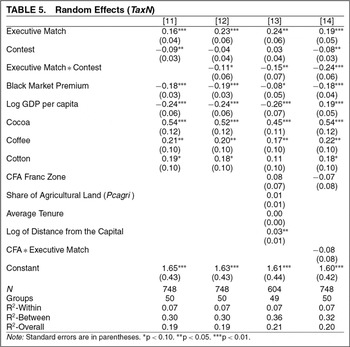
Two pieces of evidence suggest that this is not the case. First, the incidence of an Executive Match is not related to the degree of exchange rate overvaluation. Second, countries outside the CFA Franc Zone had discretion over their exchange rates, and those inside the Zone did not. If a government's choice of official exchange rates was dependent on the ethnic identification of farmers, we would expect to see that countries in the CFA Franc Zone discriminate between crops with and without an executive match to a greater extent. However, the interaction term between Executive Match and the CFA Franc Zone dummy is not significant at conventional levels (Panel 14, Table 5).

The evidence weakly supports the theory that leaders who expect to be in power longer implement less extractive policies (McMillan 2001; Olson 1993). Leaders' expectations about the length of their tenure are measured by the average duration of leaders in power, which is calculated on a rolling basis. Increasing the average tenure of leaders by 1 year reduces the tax rate by about 1 point. This effect is small and its statistical significance depends on the other variables included in the model (Panels 4 and 13, Table 5).
The distance of crop-growing regions from the capital may be a reason for higher taxes in regions associated the governing coalition. Proximity to the capital could make it easier for governments to extract resources from growers. Crops grown in regions associated with the governing coalition are closer to the capital than those that are not. The average distance from the capital for crops coded as having a coalition match is 132 km, and that for those without one is 219 km.11
This excludes crops that are dispersed throughout the country which are coded as being 0 km from the capital.
McMillan (2001) suggests that crops with a high ratio of sunk costs to total costs, specifically perennials, are taxed at higher rates. The analysis here also demonstrates that cocoa is taxed at higher rates than other crops, and coffee and cotton are taxed at higher rates than tobacco and groundnuts (Table 5).
If creating an infrastructure to intervene in the marketing of a crop is costly, the less important the crop is to a country's economy, the less likely it is that the government will intervene. Although governments care about the marginal benefits of taxing a crop, developing a marketing infrastructure for a crop that represents a tiny percentage of all agricultural production may not be worthwhile. The importance of the crop is measured using the percentage of total agricultural land in the country that is devoted to growing the crop (Pcagri) and the crop's the share of the value of total exports (Pcexport). The coefficients on both variables are positive, but only the coefficient on the percentage of total exports is statistically significant, and both their substantive effects are small (Panel 3, Table 3).
WHY ARE CO-ETHNIC FARMERS TAXED MORE HEAVILY?
Although there are good reasons why a leader might expend fewer resources to secure the support of co-ethnics, the evidence presented in this paper can confirm only that they are worse off on one indicator—their crops are taxed at higher rates. I have argued that taxes on farmers in a government's home area are higher because leaders are better at selecting and monitoring vital intermediaries in their home areas. Because of this, they can extract more from the majority at home than abroad using taxes on cash crops, which are regionally but not individually targetable. Below I demonstrate that four alternative explanations, which may appear to be consistent with this finding, cannot fully account for why leaders tax their home areas more heavily.
First, it may be the case that farmers in a leader's home region can be taxed more heavily because they are more likely to benefit from other transfers—such as jobs, contracts, and trading licenses—than are farmers elsewhere. Although it is unlikely that other transfers from the government fully compensate farmers for the revenue extracted from them by offering them low prices for their crops. If farmers in the government's home region are being reimbursed in the aggregate for these large financial burdens, then transfers to them must be even more biased than is generally supposed.
Missing transfers present a problem for all empirical studies of distributive politics that examine one policy instrument (Dahlberg and Johansson 2002; Diaz-Cayeros, Khemani 2003; Magaloni, and Estévez 2003). Authors of these studies generally argue that the particular transfer they have analyzed is uniquely discretionary or targetable and is, therefore, ideally suited to reveal the political motives behind distributive policies. However, each one of these transfers is part of a wider scheme of taxes on and transfers to localities. Unexamined transfers may compensate communities for discrimination in the transfer analyzed.
Unless we have much better data than are currently available, we cannot say very much about the full set of benefits given and costs imposed on localities by governments. One, albeit highly imperfect, test is to look at how public investment affects how much farmers are taxed. If we assume that the bulk of public investment goes to a ruler's home area, it ought to be the case that where public investment is higher there is greater discrimination against farmers in a government's home region. However, there is no empirical support for this claim and an interaction term between public investment as a percentage of GDP and Executive Match is not statistically significant at conventional levels (Panel 8).
Furthermore, even if we believe that a leader's co-ethnics are better off in the aggregate, we need to know why co-ethnic farmers do worse on this particular indicator. This question is an important one because these policies affect large numbers of farmers. I suggest that the answer lies in the fact that rulers can offer a few favored clients more narrowly targeted benefits. Because rulers are better at finding and managing these clients at home, they can afford to impose greater costs on the majority in their home areas by taxing their crops.
Second, it may be the case that co-ethnics can be taxed more heavily because they view the leadership as somehow more legitimate or because they view having co-ethnics in power as intrinsically valuable. As stated above, it is difficult to separate these “psychic benefits” from instrumental reasons for supporting co-ethnics. However, the fact that the degree of over-taxation against a leader's home region is lower in more democratic regimes, suggests that material concerns play an important role in explaining why governments can tax co-ethnic farmers more heavily (Panel 3, Table 3).
Third, this result may arise because taxes on crops are less observable than whether governments deliver schools or cabinet positions to co-ethnics. Although agricultural policy is central to the livelihoods of many African farmers and agricultural policy can be highly politically salient, farmers may not know exactly how much governments extract from them. However, this explanation is unsatisfactory because it relies on the assumption that farmers in a government's home are less likely to know how much they are being taxed than farmers in other areas. Further, it is not obvious that fairness in taxation is less observable than fairness in other policy areas, because individuals may not know if their leaders are exerting as much effort as they can to provide services. People who are likely to be uninformed about whether prices are fair are also likely to be uninformed about whether the government is doing the best it can to deliver public services.
Finally, it may be the case that, for historical reasons, most cash crop farmers are ethnically identified with the current regime and, as a result, form the core of the tax base. However, the data do not suggest that this is the case, as the sample contains similar numbers of crops with and without an executive match. These crops are not the only exports that could be taxed; the median percent of exports comprised by the 50 country-crop combinations in the sample is 20%. Further, changes in Executive Match and Coalition Match for each country-crop affect taxes (Table 4).
CONCLUSION
This paper documents what appears to be a remarkable anomaly patterns of patronage politics in Africa: those farmers with co-ethnics in power get taxed more. I have been able to document this anomaly because African governments have for the most part taxed cash crop farmers by controlling internal markets and offering them low prices for their crops. For agroecologic reasons crop-production in Africa tends to be spatially concentrated, complementing the geographic concentration of ethnic groups. Therefore, the main finding of this paper arises because I have been able to match groups to crops in order to analyze taxes on 50 country-crop combinations over a number of years.
Although the finding that farmers who are ethnically identified with the current regime are taxed more may appear counterintuitive, this finding supports the intuitive idea that rulers extract the most from those who cannot evade their grasp. Therefore, farmers in democracies face lower taxes and growers of perennials face higher taxes.
Does the finding that farmers that are ethnically identified with the current regime imply that people are always worse off when their co-ethnics hold political power? The evidence presented in this paper cannot settle to that question definitively; however, it can cast doubt on some common alternative explanations for this surprising finding. Co-ethnic farmers may be compensated by transfers that are unmeasured in this study, making them better off in the aggregate. However, given that these taxes often present large burdens on farmers, they are worth understanding in their own right. Further, if these missing transfers are designed to compensate farmers for taxes on their crops, they may be much larger than is commonly supposed, and it also would be worthwhile knowing whether they went to the same individuals who were taxed. Even if we assume that all public investment is biased to the president's region, the evidence shows that increasing levels of public investment do not decrease the degree to which co-ethnic farmers are taxed more. Competitive elections make leaders less likely to tax their own implying that it is not simply the case that people find rule by co-ethnics more legitimate. These findings are unlikely to arise because taxes are less observable than transfers, because it would require that farmers in the government's home area be more easily deceived than farmers elsewhere. Further, it is not the case for the set of countries examined here, that cash crop farmers are identified with the president's ethnic group for historical reasons.
The findings presented here have three important implications for the future study of ethnicity and distributive politics in Africa. First, where political institutions and infrastructure are weak, the study of patronage ought to consider the means by which rulers at the center secure support in localities. I have argued that the ability of rulers to control ethnic intermediaries and reduce alternatives can result in a situation where co-ethnics are taxed more because they can be.
Second, in studying the distribution of patronage in Africa and elsewhere, it may be important to distinguish among different types of government largess. This is particularly true in a context where political leaders are frequently able to divert resources intended for those they represent to their own purposes. I have suggested that state resources which the majority of people in an area cannot be excluded from ought to be treated differently from those that can be made to benefit individuals and that agricultural taxation, being regionally, but not individually targetable, falls in the former category.
Finally, distinguishing between forms of patronage that accrue to individuals and those that accrue to groups encourages us to rethink our treatment of ethnic identities. Although ethnic groups provide a useful shorthand for political interest groups, local political and economic inequalities within groups may have significant effects on the distribution of patronage amongst groups. These issues need to be explored if we are to have a better understanding of ethnic politics and political accountability in developing countries.
APPENDIX 1: CODING THE REGIONAL POLITICS VARIABLE—CONGOBRAZZAVILLE, 1966–1995
The two crops in this study from Congo-Brazzaville are cocoa and coffee. Most of cocoa is grown in the North. In 1989, the Sangha region, in the Northwest, produced 96% of Congolese cocoa. Coffee is grown in the South, and 68% of coffee is produced in three southern provinces; Kouliou, Niari, Lekoumou, and Bouenza (République Populaire du Congo. Direction de la Statistique Agricole 1990, 75 Table 2-08).
Congolese cocoa is coded as having an executive match for the whole period except from 1966 to 1968 and 1992 to 1995. Coffee has an executive match in 1966–1968 and 1992–1995. Coalition Match and Executive Match take on the same values for both crops.
In the late 1950s, while Congo was still a French colony, three main parties emerged which each represented an ethnoregional group. The three ethnoregional groups were the North and Center (the Mbochi-Kouyou and Bateke ethnic groups), the Southeast (the Lari a Bakongo sub-group based in Brazzaville), and the Southwest (the Villi a Bakongo sub-group). Fulbert Youlou, a Lari, united the Bakongo vote in the Union for the Defense of African Interests (UDDIA) was Congo's president upon independence in 1960. Youlou consistently favored the Lari in the allocation of posts and “showed his disdain for Northerners” (Decalo, Thompson, and Adloff 1996, 8). Youlou's government fell in a military coup in 1963 and Alphonse Massamba-Debat (a Bakongo) succeeded him.
In 1968, Marien Ngouabi, a Kouyou, came to power after armed conflict between the governing party's youth wing and the northern-dominated regular army. This coup marked a fundamental change in Congolese politics and was widely regarded as the assumption of power by the North (Amphas 2000; Clark 1994). General Joachim Yhomby Opango (a Kouyou) replaced Ngouabi after members of his own army assassinated him in 1977. During this period divisions emerged between the Mbochi and the Kouyou. In 1979 Denis Sassou Nguesso (an Mbochi) unseated Yhomby Opango in a bloodless coup.
After the transition to democracy three political parties, each with its own ethnoregional base and presidential candidate, contested the 1992 elections. The three main parties matched the cleavages of the late 1950s. Sassou's party represented the Mbochi, Pascal Lissouba's stronghold was in the non-Lari southwest (the Nibolek areas), and the Lari supported Bernard Kolelas.
Lissouba won the elections and formed a short-lived coalition government with Sassou's party. The coalition broke apart and new legislative elections were called in 1993. Conflict over these elections started a civil war among these three factions and their militias. Southern politicians brokered a ceasefire in 1994 and formed a government of national unity in 1995.
I am grateful to Sarah Anderson, Bob Bates, Alberto Diaz-Cayeros, Jim Fearon, Nahomi Ichino, Tonja Jacobi, Saumitra Jha, Eliana LaFerrara, David Laitin, Peter Lorentzen, Beatriz Magaloni, Nikolay Marinov, Gerard Padró i Miquel, Vidal Romero, Mike Tomz, Jeremy Wallace, and seminar participants at the March 2004 meeting of the Working Group on African Political Economy (WGAPE), the December 2005 Conference on Poverty, Democracy and Clientelism, the Comparative Politics Workshops at Stanford University and Duke University as well as three anonymous reviewers at the APSR for useful comments on earlier versions. Any mistakes are my own.



Comments
No Comments have been published for this article.