BACKGROUND
Early Language Exposure and the Critical Period
It has long been known that young infants are equipped with the ability to perceptually discriminate speech sounds, both those representing contrasts that are present in their native language and those not occurring in their immediate linguistic environment. In a pioneering study by Eimas, Siqueland, Jusczyk, and Vigorito (Reference Eimas, Siqueland, Jusczyk and Vigorito1971), it was shown that 1- to 4-month-old infants from English-speaking environments categorically perceived the phonemic contrast /p/-/b/ and that they were less capable of discriminating acoustic differences within these categories. These researchers concluded that “the means by which the categorical perception of speech . . . is accomplished may well be part of the biological makeup of the organism” (p. 306). Additionally, Werker, Gilbert, Humphrey, and Tees (1981) demonstrated that 6- to 8-month-old infants from English-speaking environments as well as infants and adults from Hindi-speaking environments discriminated a Hindi consonant contrast, whereas English-speaking adults did not. Subsequent research on infant perception (e.g., Best, Reference Best, de Boysson-Bardies, de Schonen, Jusczyk, McNeilage and Morton1993; Kuhl, Williams, Lacerda, Stevens, & Lindblom, Reference Kuhl, Williams, Lacerda, Stevens and Lindblom1992; Werker & Lalonde, Reference Werker and Lalonde1988; Werker & Tees, Reference Werker and Tees1984) suggests that, during their first year of life, infants become perceptually attuned to the phonemic contrasts found in their immediate linguistic environment, thereby experiencing a reorganization of perceptual abilities that makes them increasingly insensitive to nonnative contrasts.
Further evidence that very early linguistic exposure is crucial in first language (L1) development comes from children who were deprived of verbal input during infancy. Ruben (Reference Ruben1997) reports on studies of children who, during their first year of life, suffered from otitis media (i.e., inflammation of the middle ear) with fluctuant hearing losses as a result but who all regained normal hearing abilities after age 12 months. Examinations of these children at the age of 9 years revealed that they had significantly less capacity for both verbal memory and phonetic discrimination when compared to a control group of children with normal hearing during their first year. One of the conclusions offered by Ruben (Reference Ruben1997) is that a supposed critical period for phonetic and phonological acquisition may well come to an end at the age of 1 year, whereas any critical periods for morphosyntax and semantics may extend to much later ages.
One classical issue in research of age effects on language acquisition concerns whether theories of one or several critical periods also extend to second language (L2) acquisition. The fact that a foreign accent is not easily overcome by adult L2 learners is well established, as is the fact that those who begin their L2 acquisition early in life, in most cases, end up speaking the language as if it were their mother tongue. The question is, however, whether the capacity to acquire phonetic detail is lost, deficient, or weakened in any way in late language learning because of a lack of verbal L2 exposure during a limited, biological time frame for phonetic sensitivity, or whether a nativelike perception and an accent-free pronunciation is biologically possible for any adult L2 learner, given the right social, psychological, and educational circumstances.
Studies that have investigated the relation between L2 speakers’ age of onset (AO) of acquisition and any measure of their L2 ultimate attainment have consistently concluded that there is a negative correlation between the two, not least of all where pronunciation is concerned (see, e.g., Asher & García, Reference Asher and García1969; Munro & Mann, Reference Munro and Mann2005; Oyama, Reference Oyama1976; Patkowski, Reference Patkowski1990; Seliger, Krashen, & Ladefoged, Reference Seliger, Krashen and Ladefoged1975; see also DeKeyser & Larson-Hall, Reference DeKeyser, Larson-Hall, Kroll and de Groot2005, for an overview). Additionally, performance tends to be uniform among learners who began their L2 acquisition before a certain age and is, in most cases, comparable to that of native speakers, whereas ultimate outcomes resulting from later AOs are neither uniform nor nativelike. Listening experiments conducted by Flege (see, e.g., Flege, Reference Flege and Birdsong1999, for an overview) have shown that early learners with an AO of 1–8 years generally receive pronunciation scores within the range of native controls, whereas late (i.e., postpuberty) learners never do. Although not concerned with pronunciation, the most frequently cited study of this kind is that of J. S. Johnson and Newport (Reference Johnson and Newport1989). They found that L2 learners with an AO of 3–7 years uniformly performed like native speakers on a grammaticality judgment test, whereas learners with an AO of 8 years and above performed below native-speaker controls. Interpretations of results like these most often adhere to Lenneberg’s (Reference Lenneberg1967) critical period hypothesis (CPH) and the idea of a biologically defined critical period for language acquisition, some assuming that puberty constitutes the upper limit for such a period and others that 6–7 years is the critical age.
Researchers skeptical of biological explanations, however, point to the existence of learners who, despite a late start, reach nativelike command of their L2, and these researchers suggest that studies of randomly selected L2 speakers with different AOs (e.g., J. S. Johnson & Newport, Reference Johnson and Newport1989; Munro & Mann, Reference Munro and Mann2005) have typically failed in capturing these rare individuals. Data from such studies, the argument goes, indicate only that late learners generally end up with lower proficiency levels than early learners, but these studies necessarily remain neutral to the reasons for such differences in ultimate attainment. A better way of conducting research on maturational constraints and the critical period, therefore, is to attempt to identify late (i.e., adult or postpuberty) learners who give the appearance of having attained a nativelike use of their L2. If such candidates, after intensive and detailed linguistic investigation, are found to have, in fact, attained a proficiency level indistinguishable from that of native speakers, they would possibly constitute the exceptions that invalidate explanations based on maturational changes of the language faculty (Long, Reference Long1990, Reference Long, Hyltenstam and Viberg1993). One simply does not expect exceptions to a critical period (either for language or for any other kinds of development), and the claims of maturational constraints on L2 acquisition would therefore be refuted. According to this line of argument, the average late learner’s typical failure to attain nativelike levels of L2 proficiency should instead be explained by increasingly negative social, psychological, and educational circumstances associated with postpuberty or adult learning.
However, empirical results have been far from unanimous. Some researchers have indeed reported L2 performance within the range of native controls for one or a few such individuals and for one or a few linguistic phenomena (for pronunciation studies, see Birdsong, Reference Birdsong, Bohn and Munro2007; Bongaerts, Mennen, & van der Slik, Reference Bongaerts, Mennen and van der Slik2000; Bongaerts, Planken, & Schils, Reference Bongaerts, Planken, Schils, Singleton and Lengyel1995; Bongaerts, van Summeren, Planken, & Schils, Reference Bongaerts, van Summeren, Planken and Schils1997; Moyer, Reference Moyer1999; for morphosyntax, see Birdsong, Reference Birdsong1992; Birdsong & Molis, Reference Birdsong and Molis2001; White & Genesee, Reference White and Genesee1996). Others have reported slight deviations from native-speaker norms or less than native-speaker performance in very advanced late L2 learners, especially when a whole range of L2 proficiency has been investigated (e.g., Abrahamsson, Reference Abrahamsson2012; Hyltenstam & Abrahamsson, Reference Hyltenstam, Abrahamsson, Fraurud and Hyltenstam2003a; Ioup, Boustagui, El Tigi, & Moselle, Reference Ioup, Boustagui, El Tigi and Moselle1994).Footnote 1 Furthermore, comprehensive and detailed linguistic analyses of early learners have, in recent years, revealed that very low AOs do not automatically result in completely nativelike L2 proficiency (e.g., Abrahamsson, Reference Abrahamsson2012; Abrahamsson & Hyltenstam, Reference Abrahamsson and Hyltenstam2008, Reference Abrahamsson and Hyltenstam2009; Bylund, Abrahamsson, & Hyltenstam, Reference Bylund, Abrahamsson and Hyltenstam2012; Ekberg, Reference Ekberg, Møller, Quist, Holmen and Jørgensen1998; Flege et al., Reference Flege, Birdsong, Bialystok, Mack, Sung and Tsukada2006; Flege, Yeni-Komshian, & Liu, Reference Flege, Yeni-Komshian and Liu1999; Hyltenstam, Reference Hyltenstam and Harris1992; Hyltenstam & Abrahamsson, Reference Hyltenstam, Abrahamsson, Fraurud and Hyltenstam2003a; Mack, Bott, & Boronat, Reference Mack, Bott and Boronat1995; Stölten, Reference Stölten, Ambrazaitis and Schötz2006; Stölten, Abrahamsson, & Hyltenstam, Reference Stölten, Abrahamsson and Hyltenstam2013).
However, another complexifying factor is how different researchers measure nativelikeness. Whereas some researchers examine nativelikeness in terms of L2 speakers’ self-identifications (e.g., Piller, Reference Piller2002; Seliger, Reference Seliger and Ritchie1978; Seliger et al., Reference Seliger, Krashen and Ladefoged1975), others argue that nativelikeness should be examined by perceptual judgments made by native speakers of the target language (e.g., Bongaerts et al., Reference Bongaerts, Mennen and van der Slik2000; Moyer, Reference Moyer1999; Neufeld, Reference Neufeld2001). A third way of analyzing nativelikeness is by well-controlled investigations of the actual L2 linguistic proficiency of L2 speakers, which is the one we advocate (e.g., Abrahamsson & Hyltenstam, Reference Abrahamsson and Hyltenstam2008, Reference Abrahamsson and Hyltenstam2009; Birdsong, Reference Birdsong and Birdsong1999, Reference Birdsong, Bohn and Munro2007; Bley-Vroman, Reference Bley-Vroman, Gass and Schachter1989; Hyltenstam & Abrahamsson, Reference Hyltenstam, Abrahamsson, Fraurud and Hyltenstam2003a; Long, Reference Long1990). Because nativelike competence as measured by self-identifications does not provide a reliable indication of actual nativelike L2 competence, it is usually disregarded in cognitive approaches to language acquisition (Abrahamsson & Hyltenstam, Reference Abrahamsson and Hyltenstam2009). Similarly, although it gives a sociolinguistic dimension to the notion of nativelikeness, the second definition does not provide any additional information to the question of whether a L2 speaker is, in fact, linguistically indistinguishable from a native speaker.Footnote 2 Thus, perceptual judgments alone do not suffice to capture subtle interspeaker differences that would allow for a distinction between near-nativeness and actual nativelikeness. Therefore, the imperceptible nonnativeness of very advanced L2 learners should be investigated through perceptual judgments followed by detailed linguistic analysis of those who pass as native speakers in the perceptual judgment test. Furthermore, because the differences (if any) between these very advanced, apparently nativelike L2 speakers and native speakers are expected to be very small, it becomes extremely important that the tests and tasks used are discriminatory enough and that the analyses and instruments used are as sensitive and accurate as possible. If not, one runs the risk of making Type II errors—that is, claiming that there are no differences between advanced L2 learners and native speakers, or between early and late L2 learners, when there in fact are differences, although they are not are easily perceived in everyday conversation. Avoiding Type II errors is especially important in research on L2 ultimate attainment because it reduces the risk of overhasty claims for the existence of counterevidence to maturational constraints and critical periods.
Voice Onset Time as a Measure of Nativelikeness
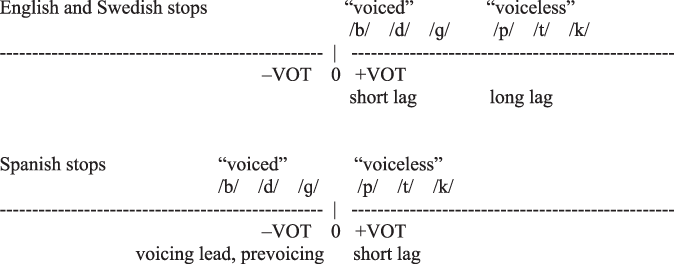
Voice onset time (VOT) is defined as the time interval between the onset of the release burst of a stop consonant and the onset of periodicity from vocal fold vibration. Traditionally, voiceless stops (e.g., /p t k/) are associated with longer VOT values, whereas voiced stops (e.g., /b d ɡ/) are associated with shorter VOT.Footnote 3 However, as established by Lisker and Abramson’s (Reference Lisker and Abramson1964) crosslinguistic study, languages that recognize a phonological distinction between voiced and voiceless stops may differ as to where on the VOT continuum the two categories separate. As shown in Figure 1, languages like English and Swedish are generally described as treating long-lag (i.e., when voicing onset lags considerably behind the release burst, resulting in relatively long, positive VOTs) stops as voiceless and short-lag (i.e., when voicing is initiated immediately after the release burst, resulting in relatively short, positive VOT values) stops as voicedFootnote 4 (for English stops, see, e.g., Caramazza, Yeni-Komshian, Zurif, & Carbone, Reference Caramazza, Yeni-Komshian, Zurif and Carbone1973; Deuchar & Clark, Reference Deuchar and Clark1996; Deuchar & Quay, Reference Deuchar and Quay2000; for Swedish stops, see, e.g., Löfqvist, Reference Löfqvist1976; Sundberg & Lacerda, Reference Sundberg and Lacerda1999). In contrast, Spanish short-lag stops are categorized as voiceless, whereas stops with voicing lead (i.e., prevoiced stops, in which voicing is initiated during stop occlusion, resulting in negative VOT values) are classified as voiced (see also Deuchar & Clark, Reference Deuchar and Clark1996; Deuchar & Quay, Reference Deuchar and Quay2000; Zampini & Green, Reference Zampini, Green and Nicol2001).
A schematic representation of the VOT continuum showing the relationship between the English/Swedish and Spanish “voiced” and “voiceless” stops. “0” corresponds to release of stop closure (based on Deuchar & Clark, Reference Deuchar and Clark1996).

As a consequence of this crosslinguistic variation, L2 learners, especially those with a later start of L2 acquisition, experience greater difficulties in correctly perceiving and producing L2 voicing contrasts.Footnote 5 The general result obtained in L2 research is that late or adult learners tend to use either their native language VOT values or, perhaps more often, compromise VOT values—that is, VOT values somewhere between those of the L1 and the L2—when speaking the L2, frequently resulting in less contrast between voicing categoriesFootnote 6 (see, e.g., Caramazza et al., Reference Caramazza, Yeni-Komshian, Zurif and Carbone1973; Flege, Reference Flege1987, Reference Flege1991; Flege & Hillenbrand, Reference Flege and Hillenbrand1984; Obler, Reference Obler, Obler and Menn1982; Wang & Behne, Reference Wang, Behne, Bohn and Munro2007). However, incidences of nativelike production among some late L2 learners have been found in research (e.g., Flege, Munro, & MacKay, Reference Flege, Munro, MacKay, Bayley and Preston1996; Major, Reference Major1987; Schmidt & Flege, Reference Schmidt and Flege1996). For example, Birdsong (Reference Birdsong, Bohn and Munro2007) reported on 22 English late learners of French (AO of 18–61 years) who were investigated with regard to their realization of timing patterns in French vowels and word-initial voiceless stops (/p t k/). Additionally, the L2 speakers’ global pronunciation was judged by a group of native speakers of French. It was found that two (i.e., almost 10%) of the late L2 learners performed within the range of 17 native-speaker controls on all three tasks. According to Birdsong (Reference Birdsong, Bohn and Munro2007), findings like these are placed among studies suggesting that “post-pubertal acquisition of a second language is not necessarily doomed to failure” (p. 114). Although not concerned with VOT, this assumption is frequently confirmed by researchers reporting on similar or even higher percentages (i.e., 15% or above) of nativelikeness in postpuberty learners (for a review of studies, see Birdsong, Reference Birdsong and Birdsong1999, Reference Birdsong2005; see also Abrahamsson & Hyltenstam, Reference Abrahamsson and Hyltenstam2009).
When it comes to early or child L2 learners, VOT values in stop production have been shown, in general, to differ only minimally or not at all from native speakers (e.g., Flege, Reference Flege1991; Flege et al., Reference Flege, Munro, MacKay, Bayley and Preston1996; Magloire & Green, Reference Magloire and Green1999; Thornburgh & Ryalls, Reference Thornburgh and Ryalls1998; Williams, Reference Williams, Yeni-Komshian, Kavanagh and Ferguson1980; Yavaş, Reference Yavaş, Roca and Jensen1996). Some studies, however, report on L2 learners who, despite having an early start to L2 acquisition, do not exhibit nativelike stop production in their L2. Mack et al. (Reference Mack, Bott and Boronat1995) examined VOT in the production of /p t k/ in seven French-English bilingual elementary school children who had grown up in France with English spoken at home and who all had been exposed to both languages from birth. More than half of the children were found to produce English stops with VOTs similar to those in French. Although the results may be explained by the fact that French was the dominant language, the findings still illustrate that an early onset of L2 learning does not automatically result in entirely nativelike L2 proficiency in terms of phonetic detail.
Research on stop production has repeatedly shown that VOT is affected by various factors: for example, place of articulation (e.g., Lisker & Abramson, Reference Lisker and Abramson1964; Volaitis & Miller, Reference Volaitis and Miller1992; Yavaş & Wildermuth, Reference Yavaş and Wildermuth2006), stress (e.g., Lisker & Abramson, Reference Lisker and Abramson1967; Sundberg & Lacerda, Reference Sundberg and Lacerda1999), or segmental context such as the height of the following vowel (e.g., Flege, Frieda, Walley, & Randazza, Reference Flege, Frieda, Walley and Randazza1998; Klatt, Reference Klatt1975). Additionally, one aspect that is often mentioned is the effect of speaking rate on VOT, to which we shall turn next.
Effects of Speaking Rate on VOT
As has been demonstrated in several studies (e.g., Magloire & Green, Reference Magloire and Green1999; Miller, Green, & Reeves, Reference Miller, Green and Reeves1986; Schmidt & Flege, Reference Schmidt and Flege1995, Reference Schmidt and Flege1996; Volaitis & Miller, Reference Volaitis and Miller1992), the duration of VOT varies as a function of speaking rate in a manner of “the faster the speech, the shorter the VOT” (C. E. Johnson & Wilson, Reference Johnson and Wilson2002, p. 278).Footnote 7 Beckman, Helgason, McMurray, and Ringen (Reference Beckman, Helgason, McMurray and Ringen2011) analyzed VOT in Central Standard Swedish word-initial voiced /b d g/ and voiceless /p t k/ produced at different speaking rates (slow and fast). The target words were embedded in a carrier phrase, and word duration was measured as a proxy for overall speaking rate. Results revealed a significant effect of speaking rate on both word duration and VOT. At a fast speaking rate, words were almost 100 ms shorter than in slow speech, and both the voiced and voiceless stops had significantly shorter VOTs in the fast than in the slow speaking rate condition. The data clearly showed that “the relationship between VOT and speaking rate is largely due to the word duration” (Beckman et al., Reference Beckman, Helgason, McMurray and Ringen2011, p. 44). Moreover, because both prevoicing and aspiration were affected, the phonetic contrastiveness between stop categories became even more distinctive. The fact that this was found even in a language like Swedish, in which the phonological contrast is already overspecified (i.e., by both [voice] and [spread glottis]) led the researchers to the conclusion that modifications of VOT ought to be explained by natural articulatory dynamics and not by the speaker’s adjustment to the needs of the listener.
Schmidt and Flege (Reference Schmidt and Flege1996) analyzed VOT in word-initial stops produced at three different speaking rates by early and late Spanish-English bilinguals as well as by Spanish and English monolinguals. Among other results, one important finding was that the effects of speaking rate on VOT in the early bilinguals were similar to those found in English monolinguals; that is, VOT increased significantly as speaking rate decreased. The late bilinguals, in contrast, showed less effect of speaking rate on VOT than did the English monolinguals. This means that not only do L2 speakers have to acquire the VOT patterns of the L2, but, as Zampini (Reference Zampini, Hansen Edwards and Zampini2008) points out, they must also learn how to make language-specific adjustments of VOT to speaking rate to achieve native-speaker characteristics in the target language. Moreover, as can be concluded from Schmidt and Flege (Reference Schmidt and Flege1996), this ability seems to be affected by the age of L2 learning.
Furthermore, the studies by Kessinger and Blumstein (Reference Kessinger and Blumstein1997, Reference Kessinger and Blumstein1998) on the production of stops revealed that speaking rate has an effect on both VOT and vowel duration and that the VOT-to-vowel ratio remains relatively constant across speaking rates. Findings such as these thus suggest that VOT should be treated not independently but rather in relation to syllable or word duration. For L2 acquisition, speaking rate effects on VOT have been addressed in some studies on bilingual speakers (e.g., Magloire & Green, Reference Magloire and Green1999; Schmidt & Flege, Reference Schmidt and Flege1995). There is a general tendency, however, for speaking rate to be neglected in research on L2 phonetic and phonological acquisition. In fact, rate effects on VOT measurements either have not been mentioned at all in studies (e.g., Birdsong, Reference Birdsong, Bohn and Munro2007; MacLeod & Stoel-Gammon, Reference MacLeod and Stoel-Gammon2010; Major, Reference Major1987) or have been discussed as a methodological issue but have not been satisfactorily dealt with by researchers. For example, in a study by C. E. Johnson and Wilson (Reference Johnson and Wilson2002), VOT production was examined in word-initial stops produced by two children (2 and 4 years of age) learning Japanese and English. Word production was elicited through an object-naming task in which the children responded to their parents’ questions with one-word repetitions. In their description of issues in collecting data, which included speaking rate effects on VOT, the researchers stated that “if the rate of speech is held fairly constant during data collection, then accurate comparisons between the VOT of two (or more) languages of a given bilingual subject can be made” (C. E. Johnson & Wilson, Reference Johnson and Wilson2002, p. 278). However, despite this claim, the researchers reported having to eliminate words spoken at abnormally fast or slow rates. This implies that speaking rate could not be held constant during data collection and that there was no real control of how the children actually produced each word. Most importantly, the only effort to reduce possible speaking rate effects on VOT was the elimination of deviating word productions based solely on subjective estimations, while ignoring any imperceptible variation in the data.
It remains unclear to what extent earlier findings of nativelike L2 stop production have been influenced by speaking rate, resulting in the identification of false positives—that is, L2 learners who are considered nativelike when they, in fact, are not. As stated earlier, Type II errors can be avoided by using instruments and analyses that are as sensitive and accurate as possible—in the case of VOT, an analysis that accounts for the possible effects of speaking rate.
The Present Study
The current study is part of an extensive project on early and late L2 learners of Swedish, all of whom had Spanish as their L1 and are very advanced in Swedish. The participants for the present study were selected primarily on the basis of the criterion that they were perceived by native listeners as mother-tongue speakers of Swedish in everyday oral communication (for more details, see the section on participant selection). Their L2 proficiency was thereafter tested and analyzed at various linguistic levels and on a variety of phenomena and skills, such as speech perception in noise (for details, see Abrahamsson & Hyltenstam, Reference Abrahamsson and Hyltenstam2009), grammatical intuition and performance, lexical or semantic knowledge (Abrahamsson & Hyltenstam, Reference Abrahamsson and Hyltenstam2008, Reference Abrahamsson and Hyltenstam2009), and categorical perception of word-initial stops (Stölten, Reference Stölten, Ambrazaitis and Schötz2006; Stölten et al., Reference Stölten, Abrahamsson and Hyltenstam2013). The present study reports on VOT in the production of Swedish word-initial voiceless stops.Footnote 8
Studies on L2 stop production vary in the number of stop articulations being examined. Whereas some studies have analyzed two (e.g., /p t/ in Schmidt & Flege, Reference Schmidt and Flege1996) or three (e.g., Birdsong, Reference Birdsong, Bohn and Munro2007; Flege & Eefting, Reference Flege and Eefting1987; Major, Reference Major1987; Thornburgh & Ryalls, Reference Thornburgh and Ryalls1998; Yavaş & Wildermuth, Reference Yavaş and Wildermuth2006) places of stop articulation, others have focused on one place of articulation only (for /p/, see, e.g., Flege, Reference Flege1991; Schmidt & Flege, Reference Schmidt and Flege1995; for /p b/, see, e.g., MacLeod & Stoel-Gammon, Reference MacLeod and Stoel-Gammon2010; Magloire & Green, Reference Magloire and Green1999; for /t d/, see, e.g., Flege & Eefting, Reference Flege and Eefting1986). Because the present study aims at investigating fine-grained differences between native speakers and highly advanced early and late L2 learners, detailed analysis of a wider range of stop production was preferred. Accordingly, all three places of articulation (i.e., /p t k/) were analyzed here. In doing so, the study is able to account for the possibility that bilabial, dental, and velar stop productions may vary in the degree of difficulty they present to even the advanced L2 speaker.
It is important to note that the present study departs from earlier studies in that VOT measurements are analyzed in relation to word duration, thereby neutralizing the impact of speaking rate on VOT. Only when speaking rate effects are controlled for can comparisons between apparently nativelike L2 speakers and native speakers be justified as valid data on age effects and actual nativelikeness in L2 acquisition—in this case, in the acquisition of phonetic detail.
Research Questions
Given our discussion on age, nativelikeness, and speaking rate effects on VOT, we formulated the following research questions:
1. Is there a general age effect on stop production (i.e., in terms of negative correlations between AO and VOT or differences in mean VOT between early and late learners) even among L2 learners perceived as native speakers by native listeners?
2. Are there late L2 learners who produce all three voiceless stops with an average VOT within the range of native-speaker VOT?
3. Do all (or most) early L2 learners produce all three voiceless stops with an average VOT within the range of native-speaker VOT?
Each research question is dealt with by making comparisons between outcomes based on absolute VOT (i.e., in milliseconds) and relative VOT (i.e., in percentages of word duration).
METHOD
Participants
The participants for the present study were selected in three stages. First, a total of 195 potential participants with AOsFootnote 9 of 1–20+ years were identified through three large advertisements in daily newspapersFootnote 10 and a poster campaign at nearly all universities and university colleges in the Stockholm area. The advertisements explicitly targeted only individuals who knew from personal experience that they usually pass for native speakers of Swedish in everyday oral conversation. Of these respondents, 107 had begun to learn Swedish between the age of 1 and 11 years, and the remaining 88 at or beyond the age of 12 years. To qualify as candidates for the study, respondents had to meet six criteria mentioned in the advertisements. Participants were required to (a) have Spanish as their L1; (b) identify themselves as speaking Swedish fluently—that is, without a foreign accent or any obvious grammatical deviations; (c) be 19 years of age or older; (d) have lived in Sweden for 10 years or more; (e) have an educational level of no less than senior high school; and (f) have learned the variety of Swedish spoken in the Stockholm area.
Respondents called a project assistant on the telephone and completed a 15 min interview during which they were asked about their age of arrival in Sweden, present age, usage of Spanish, residency outside of Sweden or the Stockholm area since the time of immigration, any known hearing impairment, and other similar questions. With the respondents’ consent, the interviews were recorded. At the end of each interview, a sample of free speech was elicited, in that the candidates were instructed to talk freely for 1 min on a subject deemed generally relatable to Swedish residents.Footnote 11 Speech samples from 20 native Swedish speakers were also recorded over the telephone.
In the second stage of the selection process, the first 20–30 s of these 1-min speech samples were used as stimuli in a screening session. Ten native speakers of Stockholm Swedish who were linguistically and phonetically naïve and had no knowledge of Spanish listened to the recordings and were instructed to decide for each sample whether the speaker’s mother tongue was Swedish. The experiments were designed and run in E-Prime (Version 1.0; Schneider, Eschman, & Zuccolotto, Reference Schneider, Eschman and Zuccolotto2002a, 2002b), and the speech samples were presented through KOSS KTX/PRO headphones, one at a time, in a random order that was different for each judge (for more details, see Abrahamsson & Hyltenstam, Reference Abrahamsson and Hyltenstam2009). Because it has been shown in a study by Flege (Reference Flege1984) that native speakers, both trained and unsophisticated listeners, are able to detect subphonemic divergences associated with a foreign accent when presented with even very small L2 speech samples (i.e., proportions as short as 30 ms), speech extracts of 20–30 s were considered to be sufficient for the native listeners to decide for each sample whether or not the person’s mother tongue was Swedish.
It was decided that our definition of nativelikeness would be when a speaker was assessed as a native speaker by a majority of (i.e., at least 6 out of the 10) native judges.Footnote 12 As can be seen in Table 1, this criterion resulted in no fewer than 104 out of 195 (53.3%) individuals who passed as native speakers of Swedish, although there was a strong bias toward low AOs. Out of the 88 candidates with an AO of 12–20+ years, only 17 (19.3%) individuals passed as native speakers, whereas 87 (81.3%) out of the 107 candidates with an AO of 1–11 years passed as native speakers. As expected, all 20 native controls passed as native speakers.Footnote 13
Screening results, number (and percentages) of the 195 candidates who passed as native speakers (NSs) of Swedish with at least 6 of the 10 native judges

Finally, from the 104 candidates, 41 individuals (32 females, 9 males) met all the background criteria and were selected as participants for the study. The original intention was to include 60 L2 learners, evenly distributed across an AO span between 1 and 20+ years (that is, with three individuals for each AO) and carefully matched against one another for a variety of background factors. However, such selection procedures were possible only among the 87 candidates with an AO of 1–11 years: Because nativelike command was clearly biased toward lower AOs, there were several gaps in the upper half of the AO continuum (12–20+ years), with no nativelike L2 speakers with an AO of 12, 18, or 20+ years. Of the 17 late learners who passed as native speakers in the screening experiments, only 10 individuals who met all the background criteria could be selected.Footnote 14
All participants were adults at the time of testing (M age = 32 years, range 20–50), and their mean length of residence (LOR) in Sweden was 25 years (range 12–42 years). They had acquired the variety of Swedish spoken in the Stockholm area and had never lived outside Sweden or the Stockholm area more than sporadically since their time of immigration.Footnote 15 Except for chronological age, none of the differences between the groups of the 31 early (i.e., AO = 1–11 years) and 10 late (AO = 13–19 years) L2 learners were statistically significant (for details, see Abrahamsson & Hyltenstam, Reference Abrahamsson and Hyltenstam2009).Footnote 16 A native-speaker control group was included, consisting of 15 monolingual, native speakers of Swedish.Footnote 17 This group was matched with the experimental group regarding sex (11 females, 4 males), educational level (senior high school diploma at a minimum), variety of Swedish (Stockholm), and age (M = 30 years, range 23–46). None of the native controls had any experience in phonetics or linguistics.
As the largest group of Spanish speakers in Sweden immigrated from Chile, there was a strong bias toward Chilean Spanish (n = 27 individuals) in participants of the study; the other countries of origin represented were Peru (n = 6), Colombia (n = 2), Argentina (n = 1), Bolivia (n = 1), Mexico (n = 1), Uruguay (n = 1), and Spain (n = 2). In a study by Williams (Reference Williams1977b) analyzing the production of word-initial stops among four Latin American dialects (Guatemalan, Venezuelan, Peruvian, and Puerto Rican Spanish), no significant crossdialectal variation was found with regard to the realization of VOT. However, from Rosner, López-Bascuas, García-Albea, and Fahey’s (Reference Rosner, López-Bascuas, García-Albea and Fahey2000) comparison of Castilian Spanish and three Latin American dialects (Guatemalan, Venezuelan, and Peruvian; data from Williams, Reference Williams1977a, Reference Williams1977b), it is clear that a certain variation in VOT exists among Spanish varieties. In short, Castilian VOT boundaries tend to be positive—that is, with voicing onset following the stop release—whereas Latin American VOT boundaries are negative, meaning that the voicing onset is initiated before the release of the stop closure. From these findings, Rosner et al. (Reference Rosner, López-Bascuas, García-Albea and Fahey2000) concluded that “statements about ‘Spanish voice-onset-time’ apparently should be qualified by dialect” (p. 223). Nevertheless, as relevant as this point may be, it was disregarded in the present study because the differences in VOT among varieties of Spanish are marginal when compared to the difference between Swedish and any variety of Spanish.
Materials, Procedure, and Measurements
As previously mentioned, the present study is part of a large-scale project on near-native L2 attainment in which the participants have been tested individually at many linguistic levels and for many phenomena and skills during one session. The entire testing procedure, containing a test battery of 20 different instruments for speech elicitation and language testing (for details, see Abrahamsson & Hyltenstam, Reference Abrahamsson and Hyltenstam2009), took place in a sound-treated room and lasted for approximately 4 hr per individual, including two 15–20 min breaks with refreshments. Prior to language testing, all L2 learners completed a hearing test with an OSCILLA SM910 screening audiometer. A decrease of no more than 10 dB for one frequency in one ear was considered acceptable. After the session, participants received financial compensation. The experimenter was a male native speaker of Stockholm Swedish.
The testing concerned with the production of stops proceeded as follows. The participant was asked to read aloud three isolated Swedish words: par /par/ “pair, couple,” tal /tal/ “number; speech,” and kal /kal/ “naked, bald.” The reason for not using nonsense syllables such as /pa/, /ta/, and /ka/ was to ensure that the speakers would pronounce the stop consonants in Swedish, not Spanish.Footnote 18 Each word was read 10 times, with 2 s pauses in between. The experimenter indicated the reading rate to the participant by visually keeping count with his fingers. The readings were digitally recorded through a KOSS R/50B headset microphone at 22.050 Hz with a 16-bit resolution.
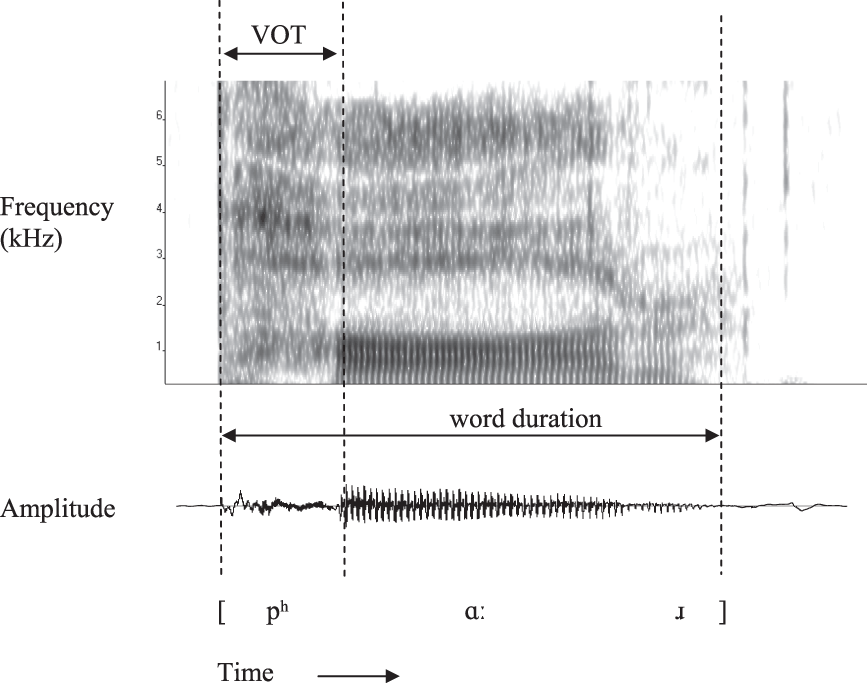
Voice onset time measurements were conducted by using the waveform display in combination with synchronized wideband spectrograms available in the Soundswell Core™ Editing and Analysis Tools package (Hitech Development). As shown in Figure 2, VOT was measured as the time interval between the onset of the stop consonant burst and the beginning of periodic pulsing corresponding to the onset of the following vowel.
A wideband spectrogram (upper display) and oscillogram (lower display) of the word par “pair, couple.” Cursor locations define the onset and endpoint of the VOT interval and word duration.
A total of 1,676 VOT measurements were made (41 L2 speakers + 15 native controls × 3 words × 10 readings − 4 unmeasurable tokens). Remeasurements of a randomly selected 10% portion of the tokens 4–6 months later yielded a virtually perfect correlation between the two sets of measurements, r = .99, df = 148, p = .001, indicating a high degree of intrarater reliability. The modal VOT difference between the two sets of measurements was 0 ms (122 out of the 150 tokens), the average difference was 0.6 ms, and the largest difference observed was 6 ms (one token, representing one periodic cycle).
Voice onset time analysis was followed by another 1,676 measurements, this time of word duration. As shown in Figure 2, word length was determined by measuring the time interval between the onset of the release burst and voicing offset in the word-final consonant (i.e., stop occlusion was not included in word duration measurements). Intrarater reliability was assessed through remeasurement of a randomly selected 10% portion of the tokens 4–6 months later. The correlation between the two sets of measurements was again perfect, r = .99, df = 148, p = .002; the modal difference was 1.0 ms (36 of the 150 tokens); the average difference was 4.9 ms; and the largest difference observed was 54.0 ms (one token).
RESULTS
It has been well documented that VOT varies with place of articulation: Bilabial stops have the shortest, dental/alveolar stops intermediate, and velar stops the longest VOT values (see, e.g., Lisker & Abramson, Reference Lisker and Abramson1964; Volaitis & Miller, Reference Volaitis and Miller1992). However, a certain amount of overlap between places of stop articulation, in terms of VOT, has been reported in the literature (see, e.g., Krull, Reference Krull1991; Sundberg & Lacerda, Reference Sundberg and Lacerda1999, for Swedish stops). Therefore, results for the three stops /p/, /t/, and /k/ are presented separately below.
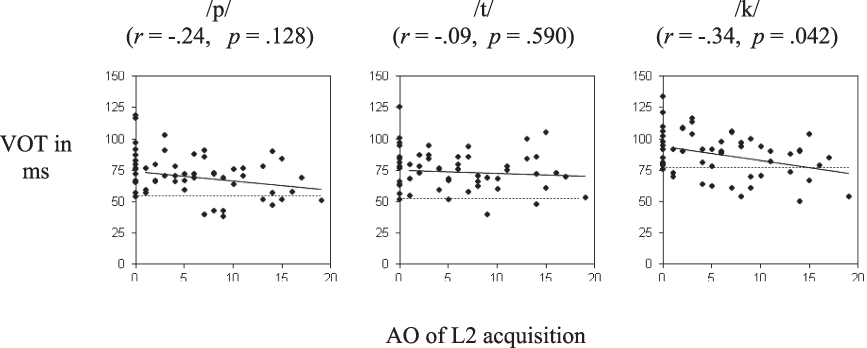
The scatter plots in Figure 3 show the relationship between the L2 learners’ AO and the average VOT (in milliseconds) in their stop production; the values at an AO of 0 represent the average VOT of the 15 native speakers of Swedish. Native-speaker VOT ranged between 54 and 199 ms for /p/, between 52 and 126 ms for /t/, and between 76 and 134 ms for /k/. For each place of articulation, the shortest native-speaker mean VOT was taken as a minimum criterion for nativelikeness (see the dashed lines in Figure 3). Correlations between AO and VOT were weak and nonsignificant, except for /k/: for /p/, r = −.24, df = 39, p = .128; for /t/, r = −.09, df = 39, p = .590; and for /k/, r = −.34, df = 38, p = .042. Furthermore, a majority of both early and late learners seemed to produce average VOT within the range of native-speaker production. In other words, no obvious age effects could be discerned in these figures. However, this analysis did not control for the effect of speaking rate.
The relationship between AO and average VOT in milliseconds; the values at AO = 0 represent the average VOTs of the 15 native speakers. The dashed lines represent the shortest native-speaker VOT.
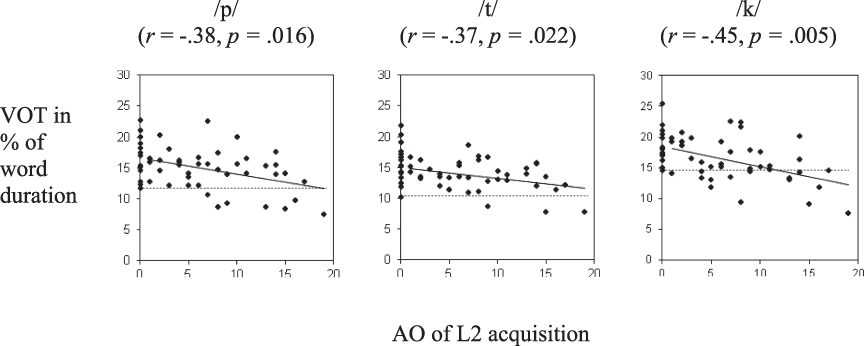
As shown in Figure 4, VOT was again plotted against AO, but, this time, VOT was expressed in terms of percentages of word duration, thereby neutralizing the effect of speaking rate.Footnote 19 The native-speaker VOT ranges were 11.7–22.7% for /p/, 10.3–21.8% for /t/, and 14.6–25.5% for /k/, and, again, the minimum criterion for nativelikeness was based on the shortest native-speaker mean value (see the dashed lines in Figure 4). The obvious change that occurred in the data was that correlations between VOT and AO became stronger and statistically significant: for /p/, r = −.38, df = 37, p = .016; for /t/, r = −.37, df = 37, p = .022; and for /k/, r = −.45, df = 37, p = .005.Footnote 20 Thus, there was an overall age effect for all three places of articulation, but it emerged only when speaking rate effects were accounted for (Research Question 1).
The relationship between AO and average VOT in percentages of word duration; the values at AO = 0 represent the average VOTs of the 15 native speakers. The dashed lines represent the shortest native-speaker VOT.
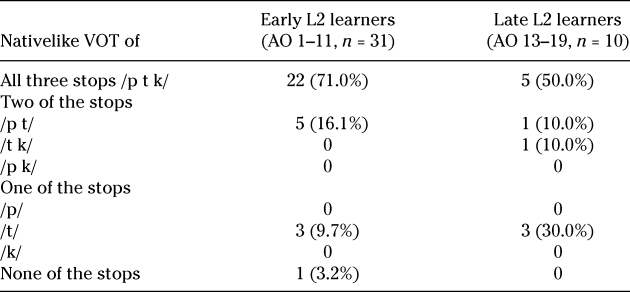
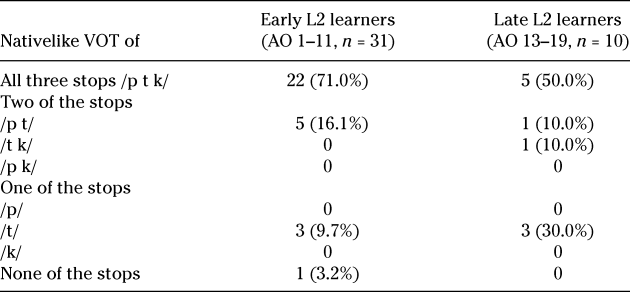
Next, comparisons were made between 31 early (AO = 1–11 years) and 10 late (AO = 13–19 years) L2 learners. Table 2 shows to what extent individuals in the two groups produce nativelike VOT (in milliseconds) for /p/, /t/, and /k/, respectively. As can be seen, 22 (71%) of the early and five (50%) of the late learners produced nativelike VOTs for all three stops. However, this group difference was not even close to the significance level, χ2(1) = 1.48, p = .22. In the early-learner group, five individuals produced nativelike VOT for two of the consonants (i.e., /p t/), and three participants did so for only one of the consonants (i.e., /t/). One of the early learners (with an AO of 9) exhibited nonnativelike VOTs for all three stops. In the group of late L2 learners, two individuals showed nativelike performance for either /p t/ or /t k/, and three learners did so for /t/ only. Note that no late L2 learner was identified with entirely nonnativelike VOTs (see Table 2). Taken together, these findings, when VOT was measured in milliseconds, show that no significant differences between learner groups could be detected.
Number (percentages) of learners with nativelike VOT (in milliseconds) according to place of articulation and early vs. late learning
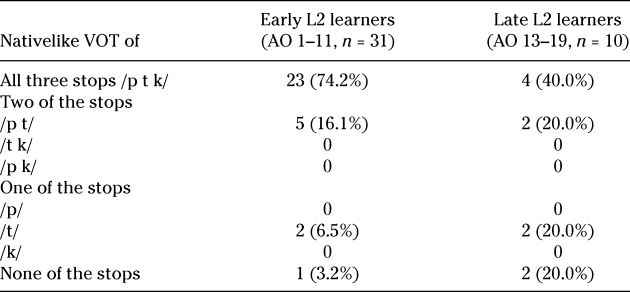
However, when VOT was transformed into percentages of word duration, interesting patterns appeared. When compared to Table 2, Table 3 shows that an obvious change occurred for the group of L2 learners exhibiting nativelike VOT for all three stops. Whereas the number of early learners with entirely nativelike VOT increased to 23 (74.2%), the number of late learners in this group decreased to 4 (40%) individuals (with AOs of 14, 14, 15, and 17). This time, the group difference did turn out to be statistically significant, χ2(1) = 3.93, p = .05. It is interesting to note that these two groups of early and late learners were not entirely consistent with the learners who performed within native-speaker range for all three stops when VOT was measured in milliseconds. To be more precise, two early learners (with AOs of 4 and 5) and one late learner (with an AO of 16) no longer showed entirely nativelike stop productions when speaking rate was taken into consideration (i.e., the early learners no longer demonstrated nativelike values for /k/, and for the late learner this was the case for both /p/ and /k/).
Number (percentages) of learners with nativelike VOT (in percentages of word duration) according to place of articulation and early vs. late learning
As displayed in Table 3, five early learners (16.1%) produced nativelike VOT for two of the consonants. However, these were not the same individuals as described in Table 2. Whereas two learners (AOs of 4 and 5, mentioned previously) moved from the group of entirely nativelike stop productions to this group, two other individuals (AOs of 1 and 10), who had initially been identified as having nativelike VOT (in milliseconds) for two stops (i.e., /p t/), performed within native-speaker range for all three stops when VOT was measured in percentages of word duration. Two early learners (AOs of 7 and 8) exhibited nativelike VOT for the dental stop only (see Table 3), and these were the same individuals shown in Table 2. However, one early learner (AO of 9) who had initially been found to have nativelike VOTs (in milliseconds) for one stop only now placed among those learners who performed within native-speaker range for all three stops. Finally, one early learner (AO of 9) who did not show nativelike performance for any of the stops in the previous VOT analysis (see Table 2) remained entirely nonnativelike when VOT was analyzed in relation to word length (see Table 3).
In the late-learner group, the most dramatic change took place in the classification of three learners. As mentioned previously, after the transformation of VOT into percentages of word duration, one learner (AO of 16) could no longer be identified as entirely nativelike. Instead, this individual was now placed among those learners who exhibited nativelike VOT for one stop only (i.e., /t/). Two late learners (AOs of 15 and 19) who both showed nativelike VOT (in milliseconds) for the dental stop turned out to be entirely nonnativelike when speaking rate effects were accounted for (see Table 3). Thus, whereas no late learner was initially identified as nonnativelike, there were two late learners (i.e., 20%) who no longer performed within the native-speaker range on all three stops after reclassification.
In sum, when VOT was transformed from milliseconds into percentages of word duration, reorganizations took place in the groups of the early and the late L2 learners regarding their nativelike performance of L2 stops. However, regarding the late L2 learners, there were still as many as four individuals who produced all of the stops with an average VOT within the range of native-speaker VOT (Research Question 2). Regarding the early-learner group, an even greater majority of early L2 learners showed nativelike VOT for all three stops when speaking rate was accounted for (Research Question 3). Moreover, after the transformation of absolute into relative VOT, the difference between the early and late L2 learners with entirely nativelike stop productions became statistically significant, thereby giving further support to the finding of a general age effect (Research Question 1). Thus, differences emerged with respect to the measures of absolute versus relative VOT that have important implications for the research on nativelike performance in SLA, as is discussed in the next section.
DISCUSSION
Nativelike L2 behavior in everyday communication is what we associate with those who began to acquire the L2 in childhood but not with those who learned it as adults. A negative correlation between AO and ultimate attainment is, therefore, what we expect from age studies of randomly selected L2 learners. However, the present study has revealed that even among L2 learners who have been strictly selected according to the criterion that native listeners perceive them as mother-tongue speakers of the L2, there is a weak but statistically significant correlation between AO and ultimate attainment—at least when the yardstick of L2 proficiency is defined in terms of VOT in voiceless stops and if this measure is used in relation to word duration. The finding of an overall age effect is in agreement with data obtained from other linguistic measurements performed on the same group of L2 speakers, such as the categorical perception of Swedish word-initial stops (Stölten, Reference Stölten, Ambrazaitis and Schötz2006; Stölten et al., Reference Stölten, Abrahamsson and Hyltenstam2013), speech perception in babble noise, grammaticality judgments, and formulaic language (Abrahamsson & Hyltenstam, Reference Abrahamsson and Hyltenstam2008, Reference Abrahamsson and Hyltenstam2009). Taken together, these results suggest that even if some L2 learners are sometimes perceived as native speakers, nonnativelike features can still be detected when the analysis goes beyond evaluations based on everyday oral communication. However, statistically significant age effects for all three places of stop articulation became apparent only when VOT was related to word duration, thereby neutralizing speaking rate effects on VOT that have been reported in the literature (e.g., Beckman et al., Reference Beckman, Helgason, McMurray and Ringen2011; Kessinger & Blumstein, Reference Kessinger and Blumstein1997, Reference Kessinger and Blumstein1998; Magloire & Green, Reference Magloire and Green1999).
Moreover, three early learners (with AOs of 1, 9, and 10), who initially performed within the native-speaker range on one or two stops, turned out to be entirely nativelike when speaking rate was taken into consideration. Thus, these individuals would not have been captured as nativelike L2 learners when their stop productions had been analyzed in terms of absolute rather than relative VOT. Even more important, two of the early (AOs of 4 and 5) and one of the late (AO of 16) learners who were initially identified as nativelike on all three places of articulation could no longer be classified as entirely nativelike when their productions were analyzed in relation to word length, rather than in absolute VOT values (i.e., in milliseconds). This means that, if investigations had been solely based on absolute VOTs, these three L2 speakers would have been identified as nativelike rather than as near-native (a Type II error). Furthermore, only one L2 speaker was identified as nonnativelike regarding all three stops when VOT was analyzed in milliseconds, but when VOT was analyzed in relation to word duration, three individuals, including the one just mentioned, did not exhibit VOT values within the native-speaker range for any of the stops. In fact, these detail adjustments had effects on the group level, in which significant differences between the early and late L2 learners emerged. Taken together, these findings clearly demonstrate that speaking rate had an impact on stop production. Given that all L2 speakers had passed for nativelike speakers of L2 Swedish in the screening experiment, the present study further suggests that actual nativelike command is, in fact, much more infrequent when investigated through the detailed analysis of VOT.Footnote 21 Moreover, our results indicate that a certain degree of adjustment would be necessary if speaking rate were to be brought into the picture, which automatically raises the question of whether the nativelike stop productions reported in previous studies as well as their interpretations can be considered entirely accurate.
After the transformation of absolute into relative VOT, the combined analysis of all three stop articulations revealed that a minority (i.e., 40.0%) of the 10 apparently nativelike late L2 learners exhibited nativelike VOT values, whereas this was the case for a majority of the early learners (i.e., 74.2%). Still, as many as eight (i.e., 25.8%) of the early learners did not produce nativelike VOT for all three stops; one of these individuals did not exhibit nativelike VOT for any of the stops. Similar results were obtained with other linguistic measurements on the same group of L2 speakers (see Abrahamsson & Hyltenstam, Reference Abrahamsson and Hyltenstam2009). In a recent study by Abrahamsson (Reference Abrahamsson2012), morphosyntactic and phonetic intuition were investigated in L1 Spanish early and late L2 learners of Swedish on the basis of a grammaticality judgment test and a test of categorical perception of VOT. When results from both measures were combined, a majority, or 55%, of early childhood learners (i.e., AOs of 1–6 years) and 28% of late childhood learners (AOs of 6–10) exhibited nativelike behavior. However, within both of these learner groups, 6% and 25%, respectively, were identified as nonnativelike on both tests. These findings, combined with the results from the present study, are not completely consistent with earlier findings suggesting that the ultimate attainment among child learners is mainly uniform and comparable to native-speaker ultimate attainment. Moreover, these results are not immediately predicted by the CPH, especially if puberty or, more precisely, the age of around 12 years, according to Lenneberg (Reference Lenneberg1967) and Scovel (Reference Scovel1969), is assumed to be the critical age.
To summarize, this study suggests (a) that there is an age effect among L2 learners with different AOs (i.e., in terms of negative correlations between AO and VOT and differences in VOT between the early and late learners), even if they are all perceived as mother-tongue speakers of the L2 in everyday communication (Research Question 1); (b) that only a minority of late, apparently nativelike L2 learners exhibit actual nativelike L2 behavior with regard to VOT production (Research Question 2); and (c) that many early learners do not perform at a level comparable to that of native speakers of the L2 when their language is analyzed in detail (Research Question 3). Most important, these conclusions are possible only when the analyses are adjusted to the effects of speaking rate.
We have suggested earlier that research on maturational constraints and the CPH in SLA should continue with the focus set on potential nativelike—late as well as early—L2 learners (see, e.g., Abrahamsson & Hyltenstam, Reference Abrahamsson and Hyltenstam2008, Reference Abrahamsson and Hyltenstam2009; Hyltenstam & Abrahamsson, Reference Hyltenstam, Abrahamsson, Doughty and Long2003b). This, however, calls for a methodology that is highly capable of distinguishing between different degrees of very advanced L2 proficiency, thereby eliminating the heightened risk of ceiling effects that naturally follows from this research program. In studies with no criterion of nativelikeness, the difference between early and late learners, or that between learners and native speakers, is generally so obvious that any rough measure of L2 proficiency will be able to discriminate between them. The difference in VOT, for example, between the average adult learner with a typical foreign accent and the child learner with no detectable accent is probably great enough for absolute VOT values (i.e., in terms of milliseconds) to suffice as a discriminating measure, without the researcher having to consider any possible effects of speaking rate. In contrast, when the intention is to distinguish between early and late learners, all of whom possess an apparently nativelike command and use of their L2, or between the nearly identical behaviors of native speakers and early L2 learners, small differences emerge, and Type II errors are avoided only when the researcher goes beyond crude measures and insufficient testing techniques. Note that all 41 L2 learners in the present study passed as native speakers of Swedish in the initial screening session but that only 27 of them (of which only four individuals began their L2 acquisition after the age of 12 years) turned out to be truly nativelike after careful time analyses of VOT that also controlled for the effect of speaking rate.
To claim, on the basis of the present study, that a nativelike command of phonetic detail is unattainable after the age of 12 years is, of course, to overstate the implications of the data. We have managed to identify four late L2 learners who indeed produced all three voiceless stops /p t k/ with VOTs within the range of native-speaker production. Seen from the opposite point of view, however, the study managed to identify only four nativelike learners among a total of 10 late nativelike L2 speakers, who, in turn, had been screened from a total of 88 advanced, late-learner respondents who identified themselves as potentially nativelike. Against this background, the present study has not been able to identify nativelike L2 command in more than only a few individuals (i.e., 4 out of 88, or 4.6%) who started their L2 learning in adolescence or early adulthood. To conclude that nativelike levels of L2 proficiency are, in principle, possible for any late or adult learner would therefore be to seriously understate the implications of the results.
The oft-mentioned estimate of 5% of absolutely successful adult L2 learners (suggested by Selinker, Reference Selinker1972, and perpetuated by numerous authors after him) can be evaluated in light of the present results. Given that the 10 late L2 learners in this study can be considered a representative sample of such an exceptional population, then the actual size of that population should be markedly smaller than has generally been suggested in the SLA literature, as only four of these 10 late learners produced nativelike VOT for all three stops. Additionally, the evaluation of our participants’ nativelike command was based solely on VOT production of voiceless stops. The extensive and detailed evaluation of these individuals’ phonetic proficiency (including categorical perception of word-initial stops and speech perception in noise) combined with that of L2 competencies and skills on other linguistic levels (such as grammatical intuition and performance, lexical or semantic knowledge, etc.; for details, see Abrahamsson & Hyltenstam, Reference Abrahamsson and Hyltenstam2008, Reference Abrahamsson and Hyltenstam2009) does, in fact, suggest a considerably more modest estimate—namely, that the rate of entirely nativelike performance in normal adult learners should, in principle, be close to nonexistent. In fact, when results from only stop production and perception were combined, the entire group of late L2 learners performed below native-speaker range, suggesting that phonetic/phonological components are especially vulnerable to AO effects (Stölten et al., Reference Stölten, Abrahamsson and Hyltenstam2013). Further evidence is presented in Abrahamsson’s (Reference Abrahamsson2012) study on grammaticality judgments and categorical perception of VOT by 200 Spanish-Swedish bilinguals with AOs between 1 and 30. Among other results, nativelike L2 performance on both measures could not be observed beyond an AO of 13. In other words, no entirely nativelike command was obtained for L2 learners who started their L2 acquisition after the age of 13, and it was concluded that “nativelikeness in both morphosyntactic and phonetic intuition is . . . highly unlikely (or even impossible) if first L2 exposure occurs after puberty (AO > 13)” (p. 209).
The general conclusion that can be drawn from this study is that we are still not at all able to reject the default hypothesis that L1 and L2 development are guided and constrained by maturational or biological factors. Even when searching among apparently nativelike late L2 learners, only a very few individuals turned out to be entirely comparable to native speakers when analyzed in detail. What therefore could (or should) be questioned, at this point, is perhaps, instead, the way in which biological explanations are sometimes dismissed with a more or less offhand reference to nativelike adult L2 learners—that is, in our view, learners whom empirical research has yet to identify.