INTRODUCTION
One of the most common foraging associations between reef fish is the nuclear–following behaviour. This association is characterized by an interaction between two species, one nuclear and the other known as a ‘follower’ (Strand, Reference Strand1988). The core of the association is formed by one or more individuals of the nuclear species and they are responsible for leading the foraging association, thus making possible the formation and maintenance of the interaction (Itzkowitz, Reference Itzkowitz1974; Strand, Reference Strand1988).
This association involves species that cause bottom disturbance when foraging and others that opportunistically feed on exposed prey (Fricke, Reference Fricke, Jennings and Lee1975; Sazima et al., Reference Sazima, Krajewski, Bonaldo and Sazima2007). It is a common interaction for carnivorous reef fish in which mullids, muraenids, and ophichthids usually act as nuclear species (Karplus, Reference Karplus1978; Dubin, Reference Dubin1982; Lukoschek & McCormick, Reference Lukoschek and McCormick2000; Sazima et al., Reference Sazima, Krajewski, Bonaldo and Sazima2007; Araújo et al., Reference Araújo, Pereira, Feitosa, Gondolo, Nottingham and Pimenta2009). However, this function can be assigned to other reef animals, such as turtles (Sazima et al., Reference Sazima, Grossman, Bellini and Sazima2004), octopuses (Strand, Reference Strand1988; Machado & Barreiros, Reference Machado and Barreiros2008), sea stars (Gibran, Reference Gibran2002), and hermit crabs (Sampaio et al., Reference Sampaio, Medeiros, Ilarri, Souza and Grempel2007). These interactions play a significant role on the reef trophodynamics, as they are a frequent and widespread means for the follower species to prey on items that would be otherwise unavailable (Lukoschek & McCormick, Reference Lukoschek and McCormick2000).
Octopuses are generalist predators with a broad diet (Leite et al., Reference Leite, Haimovici and Mather2009) mostly composed of small molluscs and crustaceans (Mather, Reference Mather1991; Hanlon & Messenger, Reference Hanlon and Messenger1996; Vincent et al., Reference Vincent, Scheel and Hough1998; Smith, Reference Smith2003). Juvenile snappers also feed mainly either on benthic or water column crustaceans, while adults inhabit deeper areas predating benthonic fish and invertebrates such as brachyuran crabs (Rooker, Reference Rooker1995; Rojas-Herrera et al., Reference Rojas-Herrera, Mascaró and Chiappa-Carrara2004; Claro & Lindeman, Reference Claro and Lindeman2004; Pimentel & Joyeux, Reference Pimentel and Joyeux2010).
This study aimed to describe the behavioural interactions between a species of octopus (Octopus insularis) and a juvenile Lutjanus at Fernando de Noronha Archipelago. Ecological, social outcomes and the motivation for the occurrence of this interaction have been assessed.
MATERIALS AND METHODS
The observation took place while snorkelling during October 2010 in Sueste Bay, at Fernando de Noronha Archipelago (03°50′09′′S–32°25′09′′W). Fernando de Noronha is an oceanic archipelago approximately 345 km off the north-eastern Brazilian coast, tropical West Atlantic, comprising a main island and 19 small islets totalling 26 km2 (Maida & Ferreira, Reference Maida and Ferreira1997). Most of the land and the shallow waters around the archipelago are part of a National Marine Park, a no-take area—where the study site is located, and the remainder is an Environmental Preservation Area where some fishing is allowed (Ferreira et al., Reference Ferreira, Jesus and Silva1990).
Sueste Bay, located on the windward side of the main island, is a shallow inlet with an inner protected reef flat and an outer reef slope leading to deeper waters. Depths in the area vary between 1 and 5 m, the flat and the slope are built by a sandy bottom and irregular rocky patches sparsely to thickly covered by brown foliose algae, red coralline algae, and stony corals (Maida & Ferreira, Reference Maida and Ferreira1997; Sazima et al., Reference Sazima, Grossman, Bellini and Sazima2004).
The behaviour was photographed and video-recorded between 10 00 and 13 00 hours. The focal animal methodology by Altmann (Reference Altmann1974) was used, and the total length (TL) of the fish recorded on the interaction was visually estimated and recorded on plastic sheets.
RESULTS AND DISCUSSION
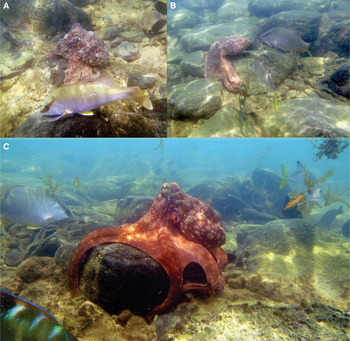
The present work represents the first record of a species from the genus Lutjanus following an octopus. During ~30 minutes, a 25 cm (TL) dog snapper (Lutjanus jocu) individual was sighted following an Octopus insularis specimen (Figure 1A). At the start of the interaction, the octopus was actively swimming being closely followed by the snapper, and after a few minutes moving about 40 m, the former stopped over a rock, and L. jocu stood nearby performing circular swimming movements around it. Several other reef fish species participated in these interactions, being attracted to the octopus hunting, including: Caranx latus, Cephalopholis fulva, Haemulon parra, Haemulon chrysargyreum, and Halichoeres radiatus (Figure 1B).
(A) ‘Following’ behaviour of a juvenile Lutjanus jocu with Octopus insularis; (B) other reef fish participating in the interaction; and (C) octopus foraging behaviour which attracts ‘follower’ fish.

Previous registered work on ‘following’ activities involving octopuses and other reef fish (e.g. Diamant & Shpigel, Reference Diamant and Shpigel1985; Strand, Reference Strand1988; Forsythe & Hanlon, Reference Forsythe and Hanlon1997; Sazima et al., Reference Sazima, Krajewski, Bonaldo and Sazima2007) are mainly of groupers from the genus Cephalopholis, Mycteroperca and Epinephelus. Despite all the records on this behaviour involving a Lutjanus species with sharks (Sazima et al., Reference Sazima, Krajewski, Bonaldo and Sazima2007), morays (Santos & Castro, Reference Santos and Castro2003) and snake eels (Araújo et al., Reference Araújo, Pereira, Feitosa, Gondolo, Nottingham and Pimenta2009), it has never been sighted following an octopus.
Furthermore, the dog snapper may also play a role as the nuclear species in the association. It was observed being followed by the jack Caranx crysos in Rio Formoso Estuary, north-eastern Brazil, in an interaction that lasted ~10 minutes (P.H.C. Pereira and R.L.G. Moraes, personal observations). Sazima et al. (Reference Sazima, Krajewski, Bonaldo and Sazima2007) registered that up to 20% of the fish species recorded joining nuclear–following associations acted both as nuclear and as attendants in the interaction.
An extensive description of the foraging behaviour of O. insularis was reported by Leite et al. (Reference Leite, Haimovici and Mather2009), also in the Fernando de Noronha Archipelago. When foraging, octopuses present several coloration patterns and behavioural tactics to ambush prey under rocks and inside reef crevices (Mather, Reference Mather1991). One of these is to insert its tentacles inside holes or to embrace rocks making prey flee into its mantle, avoiding them from escaping the attack (Forsythe & Hanlon, Reference Forsythe and Hanlon1997; Sazima et al., Reference Sazima, Krajewski, Bonaldo and Sazima2007; Leite et al., Reference Leite, Haimovici and Mather2009) (Figure 1C). This kind of behaviour also exposes hidden prey to their followers, which were otherwise unavailable for them.
Juvenile Lutjanus feed mainly on planktonic and benthic crustaceans while adults feed on fish and invertebrates (Rooker, Reference Rooker1995; Rojas-Herrera et al., Reference Rojas-Herrera, Mascaró and Chiappa-Carrara2004; Claro & Lindeman, Reference Claro and Lindeman2004; Pimentel & Joyeux, Reference Pimentel and Joyeux2010). The great presence of benthic invertebrates in stomach contents of juvenile snappers indicates a benthic foraging habit (Pimentel & Joyeux, Reference Pimentel and Joyeux2010). So, as the octopus efficiently feeds on hidden benthic prey, the chance to get an effortless meal missed by the predator is in fact worthwhile for the snapper, sparing the endeavour of searching and ambushing the prey.
It was also observed that the coloration exhibited by L. jocu during the interaction, with a distinct diagonal black stripe crossing the eye from the operculum to the snout, is similar to that seen on Lutjanus alexandrei on multi-specific foraging schools with grunts (Pereira et al., Reference Pereira, Feitosa and Ferreirain press) and on Epinephelus fasciatus when interacting with octopuses (Diamant & Shpigel, Reference Diamant and Shpigel1985). Not yet addressed herein, this pattern can be associated with social and feeding communication involving less energetic costs (Hurd, Reference Hurd1997).
Octopuses are of great importance as a fishing resource worldwide (Caddy & Rodhouse, Reference Caddy and Rodhouse1998), and are traditionally captured outside the no-take area on the Fernando de Noronha Archipelago (Leite et al., Reference Leite, Haimovici and Lins2008). It is known that areas with greater protection status marine protected areas (MPAs) achieve higher abundances of many different species—fish and invertebrates (Floeter et al., Reference Floeter, Halpern and Ferreira2006; Ferreira & Maida, Reference Ferreira, Maida, Prates and Blanc2007; Francini-Filho & Moura, Reference Francini-Filho and Moura2008). This great abundance of snappers and octopuses in Fernando de Noronha MPA promotes more encounters and interacting time between them, favouring the association to occur. Besides that, inside MPAs the reef fish behaviour is more spontaneous, reacting positively to the lack of fishing pressure and fewer divers, becoming less frightened (Kulbrick, Reference Kulbrick1998; Jouvenel & Pollard, Reference Jouvenel and Pollard2001), making the sighting of the interaction feasible.
The occurrence of the observed behaviour was motivated primarily by the overlap of food preferences between the involved species. Despite the snapper being capable of acquiring benthic prey unattended, the advanced foraging behaviour tactics exhibited by the octopus can provide an additional facilitated means of capturing its feed. In addition, species with a more inquisitive nature, like serranids and lutjanids (Diamant & Shpigel, Reference Diamant and Shpigel1985), are more prone to perform this kind of behaviour.
ACKNOWLEDGEMENTS
We would like to thank Laís Chaves, Peter Wirtz and Tatiana Leite for reviewing and improving the manuscript, and CNPq and CAPES for financial support.