Did voters in Durham, North Carolina divide along racial lines in the high-profile May 2, 2006, primary election for Durham district attorney? The results of an analysis of the primary vote by race suggest there were not major racial divisions: winner Mike Nifong received about the same percentage of support from African-American voters as from voters who are not African American. However, it seems likely, and I argue here, that Nifong used the high-profile prosecution of the Duke lacrosse rape case to win over some African-American and White voters in what otherwise might have been a low-key, low-information local election.1
Before proceeding, I want to make it clear that this article is not about the merits of the case, nor am I suggesting that Nifong is part of some sort of conspiracy related to the case. Nifong was simply district attorney when the charges in this explosive case were filed, and he strategically used the media to trumpet the case while running for reelection. I also make no claims in this manuscript regarding the arguments of the prosecution or defense, the guilt or innocence of the accused, etc. These are questions for legal analysts and juries, and I am simply interested in the effect of this high-profile legal case on racial politics in the city of Durham.
As the district attorney race was in the Democratic primary, it is likely Black voters made up a larger share of the electorate. Also, it is important to note that the district attorney election was held in Durham County. The city of Durham lies within the county (and takes up most of the population of the county), though the demographics are a bit different between city and county (the city of Durham has a Black population of 44% and a White population of 46%, based on the 2000 census).
The May 2 Durham primary election offers an empirical example of a set of local elections infrequently examined by scholars and it illuminates broader patterns of race in voting. The city of Durham and Durham County have a rich history of African-American political and electoral participation, though Durham has been rarely studied to examine racial and ethnic politics (but see McClain et al. 2006). Further, numerous scholars have used North Carolina as a case to examine racial and other politics (see, e.g., Arrington and Grofman 1999; Boatright 2004; Canon 1999; Eamon and Elliott 1994; Fleer 1994; Haynie 2002; Kazee 1998; Keech 1968; Knotts 2005; Kousser 1999; Prysby 2002; Scavo 1990; Sullivan 2000; Swain 1995; Thompson 1986; Yarbrough 2002), but the focus has seldom been on the political dynamics of Durham.
Scholars examining racial crossover voting in contexts involving Whites and African Americans have focused primarily on the extent that Whites are willing to cross over and vote for African-American candidates (Bullock and Dunn 1999; Davidson and Grofman 1994; Engstrom and Kirkland 1995; Highton 2004; Jeffries 1999; Kaufmann 2004; Liu 2006; Perry 2003; Reeves 1997; Swain 1995; Terkildsen 1993; Vanderleeuw, Liu, and Marsh 2004; Voss and Lublin 2001), and not on African-American voters' willingness to support White candidates when a Black candidate is also running (as occurred in the Durham D.A.'s race). Others studying African-American and other minority candidates in urban contexts have focused mostly on minority incorporation and the ability for minority candidates to achieve election through coalitions of minorities and Whites (Browning, Marshall, and Tabb 1984; Collet 2005; Sonenshein 1993; Sonenshein and Pinkus 2005; Wright and Middleton 2004). Further, most studies of local elections focus on mayoral races, though elections for lower offices are those where voters are most likely to use cues such as candidate race. This case study of the high-profile Durham D.A.'s primary and other concurrently held elections provides a window into an understudied aspect of race in elections. Scholars have infrequently examined Black voter support for successful White candidates when Black candidates were also running. More generally, beyond Durham, it suggests that White candidates, through the use of wedge issues or heresthetic maneuvers, can sometimes garner Black support even when more established racial cues would suggest otherwise.
The theoretical concept of heresthetics is useful for understanding the 2006 Durham primary for district attorney. Nifong used what Riker (1984) termed “heresthetic” by introducing a new issue dimension to persuade voters to ignore traditional cues used in making decisions in low-information local elections. A candidate successful at a heresthetic maneuver is able to disrupt the existing electoral equilibrium through rhetoric and persuasion with the introduction of an issue that creates a “new majority-minority division that is advantageous to him or her” (Riker 1990, 51).3
For other examples of heresthetical maneuvers in electoral and similar environments, see Baldwin (2005); Edwards (2004); Hixon and Marshall (forthcoming); McLean (2002); Riker (1986); Rose (2001); Schofield (2003); Shepsle (2003); Sides (2006); Stanley and Grose (2000); Taylor (2005).
It is important to note that this quote by Nifong was at a forum in April 2006, where he responded to accusations that the emergence of the lacrosse case itself was motivated by his political concerns. He clearly stated that the case itself was not something he chose to prosecute for political reasons. The record is clear that this case was brought to Nifong exogenously and the emergence of the case had nothing to do with his political goals. However, the case clearly played a role in his primary election bid to retain his position as district attorney.
Ironically, as I show below, Nifong's strategic public prosecution of this racially charged rape case caused African-American voters to disregard the more common racial cues underlying local elections in Durham. In fact, Nifong's high-profile defense of the alleged victim in the Duke lacrosse case resulted in one of the least racially polarized elections in Durham during the May Democratic primary.
A City and County Divided? Durham and the District Attorney's Race
What normally would have been a quickly forgotten district attorney's primary election became a national spectacle in the spring of 2006. Members of the Duke University lacrosse team were accused of raping an African-American woman on March 13, 2006, in a private home just off Duke's campus. Soon after, the Durham district attorney, Mike Nifong, announced he would investigate the accusations and prosecute the case. Within weeks, on April 18, two White lacrosse players were arrested on charges of rape and sexual assault by Nifong, and by this time the case had become a media circus. Soon after, a third White lacrosse player was charged. Reporting for Newsweek, Thomas and Meadows (2006) described the media coverage of the case as “a morality tale of pampered jocks gone wild.” The Raleigh News and Observer described the media horde in Durham (Chambers 2006): “Journalists … have descended on the town like locusts to cover the Duke lacrosse team story.” The horrific rape allegations and subsequent coverage focused particularly on possible racial divisions, but also on gender and class. Carroll Rogers (2006), writing in the Atlanta Journal-Constitution noted that “[t]he [dividing] lines being cut here cross between male and female, black and white, underprivileged and well-off.” David Brooks (2006), writing in a New York Times op-ed, stated: “In almost every article and piece of commentary, the event is portrayed not as a crime between individuals but as a clash between classes, races and sexes.”
The national media in particular seized on the assumed racial and economic divisions, often misrepresenting facts about Durham's population. Mary Ann Black of the Durham Chamber of Commerce pointed out that Durham was a “diverse community”: “To imply that almost all the people in Durham are black and poor is not the correct way to portray Durham” (Zimmer 2006). In fact, the median incomes of both Whites and African-Americans in Durham County, according to 2000 census data, are higher than the White and African-American median incomes, respectively, in both North Carolina and the United States as a whole, and Durham has a long history of African-American business and economic success (Weare 1993). Even though the national commentary sometimes bordered on stereotype, without question, this was a racially charged case being prosecuted by a White attorney in a city where the African-American and White populations are about equal in number.
As the case garnered national attention, Nifong faced increasing scrutiny as well. His high-profile public appearances about the case were both praised and criticized by observers: On April 10, 2006, John Fitzpatrick, a Durham lawyer, stated that Nifong was “showing he's not afraid to take on a challenge” (Niolet 2006a). Nicholas Kristof (2006), in an op-ed in the New York Times, argued that Nifong used stereotypes in publicly convicting the accused. Without question, his handling of the rape charges would be a key part of Nifong's primary bid for reelection as Durham district attorney.
Voter Cues, Race, and Low-information Elections
In local elections, Kaufmann (2004) has theorized that partisan cues are often not important; instead, group interest theory predicts that racial and ethnic cues may predominate. Durham is an excellent case to test some implications of this theory. The city and county votes overwhelmingly Democratic in local and state elections, and thus partisan cues are not particularly important. Further, the elections studied here were within the Democratic primary or were nonpartisan elections. Further, the city (and to a lesser extent, the county) has historically been divided almost 50-50 between African-American and White voters over the last few decades (though as McClain et al. 2006 points out, the city has recently become much more diverse with an influx of Latinos). A governing coalition of African Americans and White liberals, similar to those identified by Browning, Marshall and Tabb (1984), have typically worked together—though sometimes in opposition—in local elections in Durham.
Without this high-profile lacrosse case garnering substantial media attention, the Durham D.A.'s race would have likely been decided based on preexisting cues typically used in local elections. Though the incumbent, Nifong had been appointed to the D.A. position by North Carolina Governor Mike Easley following a vacancy. Nifong's challengers were Freda Black, who is White, and Keith Bishop, who is African American. However, Black and Bishop had advantages coming into the election that Nifong did not. Black had received extensive media attention for her prosecution of several high-profile cases in Durham. However, she also garnered some negative publicity for dating a criminal defendant that she was also prosecuting (Saunders 2006).
Bishop, before the Duke lacrosse case broke, likely had advantages based on racial cues voters frequently use.5
Bishop, a lawyer with experience only in private practice, did come to the contest with other negatives. In 2001, he was censured by the North Carolina Bar for “an improper delay in a civil case” (Niolet 2006b). While this censure and Bishop's lack of prosecutorial experience were noted during the course of the campaign, the effect of these were quite small as the media attention focused mostly on Nifong's handling of the Duke lacrosse case and Bishop's receipt of the Durham Committee endorsement (which I discuss below).
The first obvious racial cue used in elections is the racial backgrounds of candidates themselves. Scholars have shown repeatedly that voters are less likely to vote for candidates of different races when a viable candidate of their own race/ethnic background is running. Since Bishop was the only African American in a three-way election where the other candidates were White, a successful electoral strategy for him would be to maximize Black voter support. To win a primary in North Carolina, a candidate must win 40% of the vote to avoid a runoff. Bishop had considered running for an open judicial race, but instead, near the filing deadline, decided to run for district attorney. He announced he was running only after White candidates Nifong and Black announced their bids (Stevenson 2006b). Bishop, a Durham lawyer and first-time candidate for elected office, had strong connections to the Durham Committee. As the Durham Herald-Sun reported before the Duke lacrosse case broke (Stevenson 2006b): “Several court observers predicted … Bishop, who is black, might have a decent shot at becoming district attorney if the primary vote divided along racial lines—with Nifong and Black splitting the white electorate and Bishop raking in most of the community's black ballots.”
The second racial cue for African-American voters in Durham is the endorsement of a key political organization (see, e.g., Bullock 1984; Lieske 1989; and Liu 2003 for the importance of endorsements in local elections). The Durham Committee endorsed Bishop. Before running for district attorney, Bishop had played an active role in the Durham Committee as one of its officers (Gronberg 2006a). The Durham Committee has historically been a very important interest group in Durham's politics, and while not always able to swing election outcomes, it typically has provided a very important endorsement cue resulting in substantial African-American support (for scholarly discussions of the Durham Committee, see Swain 1995, 160; Keech 1968; and Kousser 1999, 257).6
Nifong garnered the endorsements of other groups in Durham, but these groups are generally viewed as less electorally powerful than the Durham Committee. Further, endorsements from other groups are not racial cues as membership is open regardless of race. The Durham Committee, in contrast, limits membership to African Americans.
Results: Little Evidence of Racial Polarization in the Primary Election for Durham D.A.
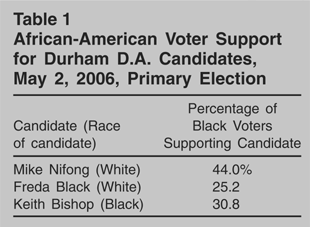
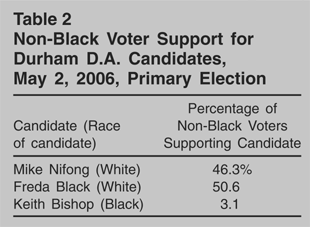
However, Nifong's public trumpeting of the Duke lacrosse case upset the existing, racial cue-based equilibrium. These racial cues—both the candidates' racial backgrounds and the Durham Committee endorsement—were not particularly important in the May 2 Durham D.A.'s Democratic primary. By overcoming these racial cues—and in contrast to media accounts portraying Durham as a racially divided city—Nifong was able to win with the support of both African-American and non-Black voters. Tables 1 and 2 display the primary results, broken down by race.
African-American Voter Support for Durham D.A. Candidates, May 2, 2006, Primary Election

Non-Black Voter Support for Durham D.A. Candidates, May 2, 2006, Primary Election

The analysis was conducted by examining the voting results from all Durham County precincts in the D.A.'s primary. These data were matched to demographic data about the race of registered voters in those precincts (the racial data were collected for the federal government to monitor compliance with the Voting Rights Act and were available on the Durham Board of Elections web site). Goodman's regression, one method of ecological inference, was used to estimate the extent of racially polarized voting (Goodman 1959; Achen and Shively 1995).7
Specifically, I estimate the percentage of support in Durham County in each local and state election held on May 2, 2006, and examine two groups: Black voters and non-Black voters. While Durham has become more racially and ethnically diverse recently, most of the non-Black voters are White (given that Durham County's population is 51% White and 40% Black). To arrive at the inferences, I used Goodman's regression based on the aggregate vote received for each candidate in each race in each precinct, the percentage of registered Black and non-Black voters per precinct, and the total turnout in a particular race in each precinct (e.g., I use the total number voting in the D.A.'s race in the D.A. analysis, the total number voting in the State Supreme Court election in Durham for the State Supreme Court analysis, etc.). The pitfalls of Goodman's method and ecological inference generally are well-known (Achen and Shively 1995; King 1997). I also estimated the election results using the King (1997) EI method and the results were very similar. Regardless of the method, we must remain cognizant of the drawbacks of making individual-level inferences from aggregate data.
The results displayed in Tables 1 and 2 are statistical estimates of the racial breakdown of the vote for D.A. in the Durham Democratic primary. Table 1 shows the breakdown in support for the three candidates among Black voters in Durham County, while Table 2 shows the breakdown in support among non-Black voters. Nifong received about the same percentage of support from Black and non-Black voters, 44.0%and 46.3%, respectively. Freda Black won a bare majority of non-Black support, 50.6%, while also receiving a quarter of the African-American vote. Keith Bishop drew support from 30.8% of African-American voters and 3.1% of non-Black voters. The Bishop vote results do indicate some racial polarization, though Nifong's support by race (and Black's to a lesser extent) does not indicate substantial racial polarization.
Mike Nifong won a close election, receiving about 45% of the overall vote, besting Freda Black by a few percentage points (she received 42% of the total vote). Keith Bishop trailed farther behind, receiving 13%, total. The extent of racial polarization in the vote is much lower than might be expected given the national coverage of Durham as a racially divided city and county. Given Nifong's victory over Black, we could imagine counterfactual scenarios without the Duke lacrosse case as an issue. In one counterfactual scenario, Bishop may have received a larger percentage of support from Black voters, which might have caused Nifong to place second or third overall. On the other hand, it is possible that Nifong would have won more non-Black voter support without trumpeting the lacrosse case (though many liberal non-Black voters also likely favored his trumpeting of the case).
In isolation, the results of voting by race in the Durham D.A.'s race are not sufficient to conclude that Nifong successfully used the Duke lacrosse case to upset the existing equilibrium of voting in Durham elections based on racial cues. To determine whether the Duke lacrosse case helped Nifong with African-American voters, we need to compare the voting patterns of African-American and non-Black voters in elections for other positions held concurrently with the Durham D.A.'s primary. If Nifong outperformed other White candidates and other candidates not endorsed by the Durham Committee among Black voters, then Nifong's heresthetic public prosecution of the lacrosse case clearly had an impact.
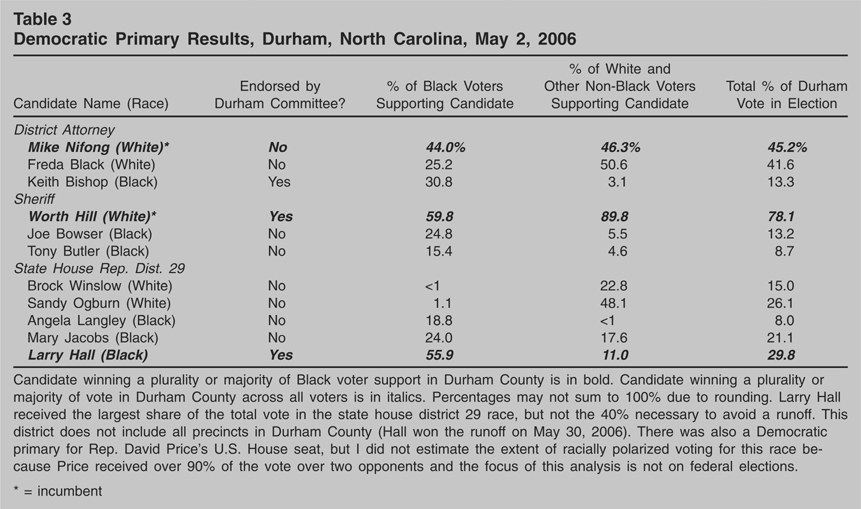
Table 3 lists all local or state elections held in the Democratic primary in Durham County on May 2, 2006.8
The Democratic primary for the 4th district U.S. congressional seat held by David Price (D-NC) was not analyzed as Price won a very lopsided victory in the primary and the same cue-taking expectations are less likely in federal elections (Kaufmann 2004). Price was endorsed by the Durham Committee and is White.
To identify the racial backgrounds of each candidate, I relied upon media accounts that mentioned candidates' racial backgrounds. For those candidates not identified by race in media reports, a Raleigh News and Observer reporter and a government official in North Carolina who lives in Durham identified the candidates' racial backgrounds. Hinchcliffe (2006) was the source for the Durham Committee endorsements.
Democratic Primary Results, Durham, North Carolina, May 2, 2006

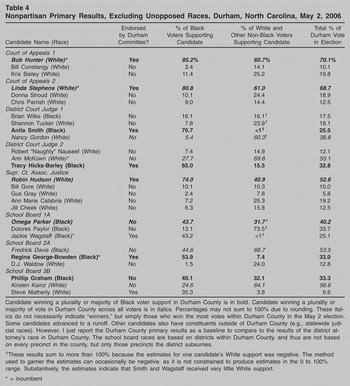
Nonpartisan Primary Results, Excluding Unopposed Races, Durham, North Carolina, May 2, 2006

A pattern emerges in Tables 3 and 4. Candidates who received a plurality or majority from African-American voters are listed in bold, and candidates who received the most votes from the entire electorate are italicized. In every election other than the D.A.'s race, either a Black candidate or a candidate endorsed by the Durham Committee won a plurality or majority of the African-American vote. The only White candidates—other than Nifong—who won a plurality or majority of the Black vote were endorsed by the Durham Committee. Further, the only candidates not endorsed by the Durham Committee—other than Nifong—who won a plurality or majority of the Black vote were African American. Incumbents also tended to do well among African-American voters, though a plurality of African-American voters went with a Black candidate over other incumbents in some races (e.g., Tracy Hicks-Barley in a district court race and Omega Parker in a school board election). Interestingly, the highly racialized campaign for district attorney did not lead to racially polarized voting in the D.A.'s race. However, in other races, racial patterns of voting were much more distinct, supporting Kaufmann's group interest theory (2004). Nifong's high-profile comments on his prosecution of a very volatile case helped him, ironically, overcome the preexisting disadvantages he had with African-American voters in Durham. Nifong was the only candidate running for office in Durham who received a plurality or majority of African-American voter support, but who was White and was also not endorsed by the Durham Committee in the primary.
In terms of non-Black support, Nifong secured a strong second place among non-Black voters in the primary. Freda Black received just over half of the non-Black vote, and Bishop received very little. Black may have benefited slightly from a White/non-Black backlash against Nifong, though this is speculative as non-Black voter support for other candidates in other races was not substantially different from Nifong's level of non-Black support. Among incumbents, though, Nifong did a little worse among non-Black voters when compared to other White candidates in other elections (e.g. Hill for sheriff and McKown for district court judge outperformed Nifong among non-Black voters).
Postscript: The November 7, 2006, General Election
As frequently happens in Durham County elections for local offices, there was initially no Republican opposition for D.A. in the November 7, 2006, general election. Going into the primary election on May 2, 2006, Nifong and the other two primary candidates assumed that the primary victor would be unopposed in the general election. However, following the results of the primary, two other candidates decided to launch campaigns in the general election. Lewis Cheek, a White county commissioner and Democrat, ran as an unaffiliated candidate in the general election. Cheek only declared his candidacy after Nifong won the primary. Cheek promised to resign the office if elected, which would have resulted in a replacement through gubernatorial appointment. A third candidate, Republican Steve Monks, also launched a write-in campaign against Nifong once the primary election results were known.
The general election campaigns of both Cheek and Monks were somewhat quixotic. Cheek did not aggressively campaign for the position of D.A., given that he promised to resign if elected (Niolet 2006c). After offering his name as an unaffiliated candidate and garnering enough signatures to be placed on the ballot, he pulled out of the race as a formal candidate (Phillips 2006). A group called “Recall Nifong/Vote Cheek” campaigned on Cheek's behalf, and argued that a vote for Cheek would essentially be the equivalent of a recall election against Nifong (Gronberg 2006b). Monks had support among some Republican voters according to published reports (Gronberg 2006b), though Durham County's heavily Democratic leanings and his write-in campaign made his candidacy quite an uphill battle.
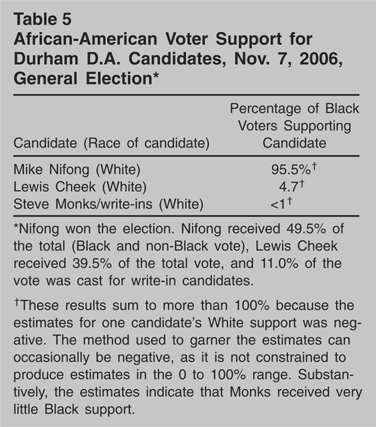
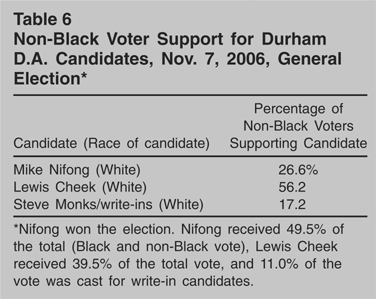
Unlike in the spirited primary election, Nifong garnered the endorsement of the Durham Committee (Dopart 2006). The final vote in the November general election was 49.5% for Mike Nifong, 39.5% for Lewis Cheek, and 11.0% for write-in candidates according to official tallies from the Durham Board of Elections. As with the above primary election analyses, I also analyzed the voting patterns by race among Black and non-Black voters for the D.A. general election. I estimated the extent of the vote for Nifong, Cheek, and Monks with precinct-level data using Goodman's regression. Results of these analyses are displayed in Tables 5 and 6 and reveal racial polarization in the general election. Unlike the primary election, Nifong received most of his support from African-American voters based on the results displayed in Table 5. Over 95% of Black voters supported Nifong in the general, while Cheek and Monks received very little Black voter support. In contrast, as shown in Table 6, 26.6% of non-Black/White voters supported Nifong, while Cheek received 56.2% of non-Black/White voter support. Write-in candidates (and most of these votes were for Steve Monks) received 17.2% of non-Black/White voter support.10
The estimates for Monks are based on estimates for all write-in votes. Most of these votes were presumably for Monks, but the precinct-level data available simply noted the number of write-in votes and not the number specifically for Monks.
African-American Voter Support for Durham D.A. Candidates, Nov. 7, 2006, General Election*

Non-Black Voter Support for Durham D.A. Candidates, Nov. 7, 2006, General Election*

Nifong's heresthetic trumpeting of the high-profile lacrosse case during the primary upset the existing equilibrium based on racial cues and may have had some lasting impact in the general, as Nifong received overwhelming support from African-American voters. However, the voting populace clearly reverted to those cues used in most local elections in Durham for the general election, which was more racially polarized. Thus, Nifong's heresthetic maneuver in the primary election may have only temporarily upset the electoral equilibrium based on racial cues. With the release of additional public information by defense lawyers on the lacrosse case following the primary, with rising criticism of Nifong among some voters, and with Cheek's promise not to serve as D.A., the general election became a referendum on Nifong himself. Nifong and observers had initially expected no opposition in the general election. However, even with these unusual, additional candidacies in the general, Nifong was still able to garner reelection, although the general was much more competitive than would have normally been expected. Given that all three candidates in the general were White, conclusions regarding racial cues based on candidate race are obviously not possible.
Conclusion
Was Durham, North Carolina a city divided by race in its May 2, 2006, primary elections? Media accounts have focused on the alleged divisions within Durham following the accusations in the Duke lacrosse case, and some have even claimed that a racial divide existed in the primary results of the district attorney's race (Dorell 2006). Without question, the Duke lacrosse case raised questions of race that likely would not have been as prominent in a typically low-profile district attorney's election. However, the empirical evidence, based on the voting results in the May 2, 2006, D.A. primary, does not substantiate the popular conception that Durham, North Carolina is a city and county divided along racial lines. In the district attorney's race in particular, voting was more similar between Black and non-Black voters than it was dissimilar. Ironically, in the other local and state elections held concurrently, where the Duke lacrosse case and its racial overtones were not relevant, African-American and non-Black voters were more likely to exhibit racially polarized voting. The power of racial cues, both the Durham Committee endorsement and candidates' racial backgrounds, was evident in elections other than the D.A.'s race held during the May 2 primary. However, Nifong was clearly able to cobble together a coalition of African Americans and Whites to achieve victory in the primary. Following the initial public outcry about the sickening sexual assault charges, his decision to aggressively prosecute the Duke lacrosse case in the court of public opinion helped him win the support of a plurality of Black voters and a strong second place with non-Black voters. His aggressive public positioning on the case is a classic example of a successful heresthetic maneuver, where he was able to upset the underlying equilibrium that typically predicts the outcome in local elections in Durham.
This study's intentions are neither to praise nor indict Nifong for his actions, but simply to analyze the electoral results. Supporters of Nifong and his handling of the case may conclude that his behavior was a positive and necessarily aggressive response to the needs of an alleged rape victim, and many have suggested that Nifong bravely took the side of the powerless in his public prosecution of the case. This study's results show he was rewarded by a coalition of Black and White voters on the primary Election Day. In contrast, Nifong's detractors may view this study's results and conclude that his actions were determined primarily by his Machiavellian concerns. While he won the primary and faced no general election opposition from Republicans, his trumpeting of the case drew opposition from an unaffiliated White candidate and a write-in campaign from another White candidate. Even with the tide of public opinion turning somewhat against Nifong between the primary election and the general election, Nifong won the general election with 49.5% of the vote. This study examined Nifong's use of heresthetics to upset the existing racial equilibrium in a primary election in a city and county where racial cues have typically trumped other voting cues. While not the focus of this study, Nifong's strong support among African-American voters, combined with some support among non-Black voters, clearly helped him secure the general election victory as well.
While a very interesting case study in its own right given the extensive media attention, this primary election answers and raises broader questions regarding the role of race and politics generally. Scholars should examine the lasting impact this case has on race relations in Durham and should also examine broader questions related to race, class, and gender. As Hancock (2006) has argued, “[t]he politics surrounding this case is not simply a matter of a primary election for district attorney.” These primary elections—and the exception of the D.A. primary election—demonstrate the continuing importance of racial voting cues in elections. More broadly, strategic politicians can use heresthetic maneuvers to garner electoral victories when the existing cues used by voters would not lead to a favored result. While infrequent, White candidates do win in majority-Black settings with the support of African Americans (e.g., Jerry Brown as mayor of Oakland, California; Scott King as mayor of Gary, Indiana), and Black candidates also occasionally win in majority-White settings with support from White voters (e.g., Sanford Bishop and David Scott in a majority-White congressional districts in Georgia; Ron Kirk as mayor of Dallas, Texas; Bill Johnson as mayor of Rochester, New York). It suggests that candidates who do not share the racial or ethnic backgrounds of voters can perhaps win support from these voters when they aggressively trumpet issues in a way that shake up the underlying equilibrium in the electorate, even when facing candidates of other racial backgrounds.
Author Bio
Christian R. Grose has been assistant professor of political science at Vanderbilt University since fall 2005. His research interests include representation and elections; Congress, the presidency, and the bureaucracy; and racial politics. He received his B.A. from Duke University and his Ph.D. from the University of Rochester.