Children with complex congenital cardiac disease sometimes have only one functioning ventricle. These children may require advanced cardiac surgery, nowadays usually performed to create a total cavopulmonary connection, and typically in two or three consecutive operations. This procedure, or its modifications, can conveniently be held to produce the Fontan circulation, remembering the surgeon who first performed such a procedure successfully, publishing the account in 1971.1 The functionally single ventricle supplies pulsatile blood flow to the systemic circulation and the venous return and the pulmonary arterial bed are coupled in series. This is achieved by attaching the caval veins to the pulmonary arteries. The lungs, therefore, are circulated with non-pulsatile flow. It is likely that this abnormal circulation through the lungs will influence their development and function. The patients, furthermore, undergo several sternotomies and thoracotomies, which may also adversely influence pulmonary function. Several studies2–6 have investigated the exercise capacity in patients with the Fontan circulation, but only a few6, 7 have included advanced testing of pulmonary function, with measurements of diffusing capacity or whole body plethysmography, and the numbers of children investigated are small. Little is known, therefore, about abnormalities of pulmonary function in children with the Fontan circulation. Impaired cardiac and pulmonary function both reduce exercise tolerance. These children, hence, may have a low exercise tolerance both because of their congenital cardiac malformation, and because of the impaired pulmonary function. In this study, we aimed to investigate the level of impairment of exercise and pulmonary function of such children, and to see if there was a correlation between them.
Materials and methods
Patients
All Norwegian children born between the first of January 1986 and the 31st of December 1995 who had undergone the Fontan procedure were identified from a medical and surgical register. There were 57 children who had been converted to the Fontan circulation and, at the time of the study, 43 (75 percent) of these children were alive. Of these, we excluded 4 children because of other illnesses, while 6 did not wish to participate. Participating parents, and the children themselves when above the age of 12, gave written informed consent. The final group, therefore, was made up of 33 (85 percent) of 39 who were eligible to take part. The local ethics committee approved the study.
Methods
On the day of the study, we measured the standing height, weight, and concentration of haemoglobin in all the children. Each subject performed lung function tests whilst sitting upright with a nose clip. At least three technically acceptable forced expiratory manoeuvres were done. We chose the highest value of forced vital capacity and forced expiratory volume in one second. The chosen value differed less than 5 percent from the next highest. We then selected the flow-volume loop with the highest sum of forced vital capacity and forced expiratory volume in one second for estimation of forced expiratory flow at 50 percent of forced vital capacity.8 Static lung volumes were measured by both whole-body plethysmography and the single-breath helium dilution test. Carbon monoxide diffusing capacity, also called the “transfer factor”, was measured by the single breath test. The diffusing capacity was corrected for concentrations of haemoglobin. Measurements of whole body plethysmography were performed at least three times, and the mean of values within 10 percent range were recorded. Diffusing capacity and volumes by the single breath test were measured at least twice and the mean value of two results within 10 percent of each other was used. All measurements of lung function were obtained with a Jaeger MasterScreen diffusion and MasterScreen Body version 4.3. (Viasys, Millenium III, 227 Washington Street, Suite 200, Conshohocken, PA 19428). The results of the tests were expressed as percent predicted for height and sex, and as a z score using the reference data of Zapletal et al.,9 except for haemoglobin corrected diffusing capacity for carbon monoxide divided by alveolar volume, where the reference equation of Stam et al.10 was used, which incorporates the measured alveolar volume. The z score is the difference between the observed and the predicted values for a given patient divided by the standard deviation.
After having completed their tests of lung function, the children rested before proceeding with an exercise test. The latter test was performed to fatigue on a treadmill, using the Oslo protocol for testing of children.11 Results for peak consumption of oxygen were given in percent predicted and z score of our Norwegian reference material, which is corrected for body weight in kilograms to the power of 0.67.12 The study was conducted from October, 2002, through June, 2004.
Statistics
Results are expressed both as mean and standard deviation of z scores, and mean and standard deviation of percent predicted. Statistical analyses were performed using the z scores. Comparisons of boys and girls were done with an independent samples t-test. Peak consumption of oxygen was analysed by Pearson linear correlation against the demographic characteristics of the patients, their parameters for lung function, and the numbers of thoracotomies and sternotomies. Parameters of pulmonary function were analysed by Pearson linear correlation against demographic characteristics, and numbers of thoracotomies and sternotomies. Independent samples t-test was used for analysing differences between patients with and without shunts, and with and without fenestrations. One way analysis of variance was used for analysing differences between the diagnostic groups. Univariate and multiple linear regression analyses were performed with peak consumption of oxygen as the dependent variable, and parameters of lung function, number of thoracotomies, age at operation, and age at test as the explanatory variables. To identify the best predictors for exercise capacity, we carried out several multiple regressions, testing several alternative models with 2 and 3 variables, as well as forward regression. Pairs of variables with a correlation higher than 0.7 were not included in the same analysis. A p value of less than 0.05 was considered statistically significant. We thoroughly checked for violations from model assumptions. The computer program SPSS 12.0 (Chicago, IL, USA) was used for all analysis.
Results
Population studied
As shown in Table 1, the mean body mass index expressed as the z score was minus 0.22, standard deviation being 1.10, with one child having a body mass index above a z score of plus 1.96, and two children having a body mass index below a score of minus 1.96, according to reference values.13 The mean height in z scores was minus 0.27, with standard deviation of 1.16, according to reference values14, 15 with four patients (12 percent) having a z score below minus 1.96, and one patient (3 percent) above 1.96. The average age at the last operation was 4.7 years. A shunt had been constructed in 9 prior to the Fontan procedure. The average number of sternotomies was 2.2, with standard deviation of 1.0. In 20 of the patients (60.6 percent), one thoracotomy had been performed, with no thoracotomy in 10 (30.3 percent), and two thoracotomies in two patients (6.1 percent). The other patient had undergone 4 thoracotomies. The Fontan circulation had been created in traditional fashion in 5 patients (15.3 percent), by an external tunnel in one (3 percent), and using a lateral tunnel in 27 (81.8 percent).
Table 1. Demographic characteristics showing mean values with standard deviation in parentheses, and numbers of patients in different diagnostic categories.

Pulmonary function
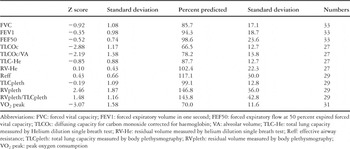
The results of the pulmonary function tests are given in Table 2 and Figures 1 and 2. The diffusing capacity corrected for concentrations of haemoglobin was low, with a mean z score of minus 2.88, this being the most marked and consistent finding, with 27 of 29 patients (93 percent) having values below a score of minus 1.96. When corrected for alveolar volume, 15 patients (58 percent) had a value below minus 1.96. The residual volume measured by plethysmography was increased, to a mean z score of 2.46, with 17 patients (59 percent) having a value above 1.96. The residual volume measured by the single breath helium dilution test was normal, at a mean z score of 0.10. On an individual basis the mean difference in litres between the residual volumes measured by plethysmography and by the single breath test was 0.47 litres, standard deviation being 0.25. This represents 11.7 percent, with standard deviation of 6.2, of the total lung capacity measured by plethysmography. The mean residual volume measured by plethysmography was 36.0 percent, with standard deviation of 9.7, of total lung capacity measured by plethysmography, which is a mean z score of 1.48, with a standard deviation of 1.16. The mean z score of the total lung capacity measured by helium dilution single breath test was minus 0.85, with standard deviation of 0.88, 2 patients having values below minus 1.96. The total lung capacity measured by plethysmography was normal, with a z score of minus 0.19, standard deviation of 1.09, and with 2 patients having values below minus 1.96. Mean forced vital capacity had a z score of minus 0.92, standard deviation of 1.08, with 4 patients (12 percent) having a z score less than minus 1.96. Mean forced expiratory volume in one second was virtually normal, as was forced expiratory flow at 50 percent of forced vital capacity.
Table 2. Measurements of pulmonary function with mean values and standard deviations.


Figure 1. Box plot showing the median, quartiles and extreme values in z scores of FVC (forced vital capacity), FEV1 (forced expiratory volume in 1 second) and FEF50 (flow forced expiratory at 50 percent of expired forced vital capacity).

Figure 2. Box plot showing the median, quartiles and extreme values in z scores of diffusing capacity for carbon monoxide corrected for hemoglobin (TLCOc). TLCpleth (total lung capacity) and RVpleth (residual volume) measured by body plethysmography (pleth) and helium dilution (TLC-He, RV-He) during a single breath hold.
There was no correlation between age at operation and the parameters of pulmonary function, nor was there any effect of having previous shunt or of fenestrations, although those with fenestrations had lower percutaneous saturations of oxygen, with a mean difference of 3.4, and confidence intervals from 0.8 to 5.9, the p value equalling 0.013. There was a negative correlation between the number of thoracotomies and forced vital capacity, the correlation coefficient being minus 0.38, equivalent to a p value of 0.03, forced expiratory volume in one second, the correlation coefficient being minus 0.38, with the p value equal to 0.03, residual volume measured by helium dilution single breath test, with a correlation coefficient of minus 0.45, and p value equal to 0.018 and total lung capacity measured by plethysmography, the correlation coefficient for this being minus 0.44, giving a p value of 0.016. The only correlation with age at examination was with the total lung capacity measured by helium dilution, the correlation coefficient being minus 0.442, with a p value of 0.021. There was no difference in lung function between the different diagnostic groups analyzed with one way analysis of variance test. Comparing boys and girls, boys had a lower forced vital capacity with a mean difference in z score of minus 0.83, confidence intervals varying from minus 1.57 to minus 0.10, and p value equal to 0.027.
Exercise testing
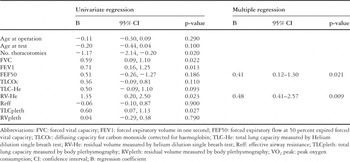
The mean z score of peak consumption of oxygen was minus 3.07, standard deviation being 1.58, with 22 patients (71 percent) having values below minus 1.96. The mean value corrected for body weight was 32 millilitres per kilogram per minute, with standard deviation of 8.1. The mean peak consumption of oxygen corrected for kilograms to the power of 0.67 was 130 millilitres per kilograms0.67 per minute, with a standard deviation of 26.82. The mean result for the girls was higher than for the boys when expressed as z score, but the difference was not significant. Peak consumption of oxygen correlated significantly with forced expiratory volume in one second, the correlation coefficient being 0.442, with a p value of 0.013, with forced vital capacity, where the correlation coefficient was 0.409, and the p value 0.022, total lung capacity measured by plethysmography, with a correlation coefficient of 0.410 and p value of 0.027, residual volume measured by helium dilution single breath test, with a correlation coefficient of 0.444, and p value of 0.023, and thoracotomies, this correlation coefficient being minus 0.415, with a p value of 0.020. There was no correlation between age at final operation and age at participation in the study and the percent predicted of peak consumption of oxygen. Neither was there any correlation with diagnostic group, presence of shunt, number of sternotomies, fenestrations, or percutaneous saturation of oxygen at rest. To assess the predictive value of the results of the lung function tests in relation to peak consumption of oxygen, we performed several multiple linear regression analysis. The model providing the best prediction included residual volume measured by helium dilution single breath test and forced expiratory flow at 50 percent remaining forced expiratory volume. These two variables explained 31 percent of the variation in peak consumption of oxygen (Table 3).
Table 3. Regression analysis with peak consumption of oxygen versus other parameters. The multiple regression analysis displays the best model with an adjusted R square of 0.31.

Discussion
Our study shows that children with the Fontan circulation have both a reduced exercise capacity and abnormal function of their lungs. The exercise capacity is below a z score of minus 1.96, or in other words, below the 2.5 centile, in seven-tenths of the children. The two most marked lung function abnormalities are the reduced diffusing capacity and the increased residual volume.
The diffusing capacity is below a score of minus 1.96 in over nine-tenths of the patients, although when correcting for reduced alveolar volume this is reduced to three-fifths. This low diffusing capacity in children has also been found by Ohuchi et al.16 and in adults and children by Larsson et al.6 In the latter study6, their average z score was minus 3.1, which is similar to our findings. The aetiology of the low diffusing capacity may be related to the abnormal circulation through the lungs. In the Fontan circulation, the pressure in the pulmonary vasculature is non-pulsatile, without the pressure drop during diastole.17 This may cause changes in the pulmonary vascular bed with thickening of the alveolar capillary membrane,18 giving rise to the decreased diffusing capacity. Another possible reason for the reduced diffusing capacity is recurrent microembolisation. Children with the Fontan circulation have an increased risk of formation of thrombus19 and microembolisation may occur within the lungs.
We also found that the patients have increased residual volume measured by plethysmography compared to residual volume measured by the helium dilution single breath test. We have not found this described in other studies since they have measured residual volume only by gas dilution, which only measures gas communicating easily with the large airways. Whole body plethysmography, in contrast, measures all gas within the thorax. The reduced total lung capacity measured by gas dilution and the reduced forced vital capacity in patients who have undergone the Fontan procedure may therefore both in part be explained by trapping of air, since the total lung capacity measured by body plethysmography is normal. Another measure of trapping of air is the increased proportion of residual volume in relation to total lung capacity, which we found in this study and which has also been described by Larsson et al.6 and Ohuchi et al.16
It is important to be aware of this reduced lung function so that measures to prevent further decline can be taken. One of the most important preventions is to protect the children from exposure to cigarette smoke, as both passive and active smoking lead to reduced lung function.20, 21 Education about this should be included in the general follow-up. In addition, prevention of respiratory infection by immunizations against influenza and pneumococcal infections should be considered, as well as use of early childhood immunoglobulin against respiratory syncytical virus. Concurrent respiratory illnesses, such as asthma or pneumonia, must also be appropriately treated.
Our children had a reduced exercise capacity. This is consistent with the findings in other studies. The degree of reduction found by us, however, was less than in other studies. The mean peak consumption of oxygen as determined in our study was 32 millilitres per kilogram per minute, whereas other studies have found from 14.1 to 28.3 millilitres per kilogram per minute.2, 3, 6, 7, 22–24 This may be due to the younger age of the patients participating in our study, other studies including both children and adults. Another possible reason may be a higher level of participation in physical activity due to local policies on exercise or cultural differences.25 Our unselected population with a high rate of participation may also explain the higher peak consumption of oxygen we have found.
Our study shows that exercise limitation is related to impaired lung function. A correlation between reduced lung function and exercise capacity in patients with the Fontan procedure has also been found in other studies.6, 7 The reduced forced vital capacity may be particularly important clinically, since it has been shown that the pulmonary circulation is dependent on respiratory motion in patients who have undergone total cavopulmonary connection.26 In our multiple linear regression analysis forced expiratory flow at 50 percent remaining forced expiratory volume, a measure of peripheral airway obstruction, and residual volume measured by helium dilution single breath test was found to be predictive of the low peak consumption of oxygen. In a study on adults with chronic heart failure, maximal mid-expiratory flow rate was found to relate to maximal consumption of oxygen.27 This finding supports the link between measures of peripheral airflow and exercise limitations in patients with cardiac disease. Ohuchi et al.16 found that a higher ratio of residual volume to total lung capacity was associated with a lower exercise capacity. The reduced exercise capacity, therefore, seems to be influenced both by lung volumes and peripheral airway flow in the children who have undergone a total cavopulmonary connection.
One of the limitations of the study is the small number in the study. The results, nonetheless, are fairly representative, since 85 percent of eligible children participated. Although we failed to find any differences between the four diagnostic categories, the numbers in each group are small, so a so-called “type II” error is possible.
In conclusion, we have found that children who have undergone construction of the Fontan circulation in the setting of a functionally univentricular heart lesion have reduced pulmonary function. Some of the variables for this impaired function correlate with their reduced exercise capacity. The reduced diffusing capacity was one of the most marked and consistent abnormalities, although it did not correlate with the reduced exercise capacity. An interesting finding was that the patients seem to have varying degrees of trapping of air, shown by the difference in residual volume between the helium dilution single breath test and plethysmography and the high residual volume to total lung capacity ratio. As expected, we have found that the children have a reduced exercise capacity, but less so when compared to other studies.
Acknowledgements
We thank the staff at the Paediatric Pulmonology and Allergology Department, in particular K. Gilhuus for help with the measurements of lung function, K. F. Froslie at the Section of Biostatistics, for help with the statistical analysis. Iren Lindbak Matthews receives a grant from the non-profit organization Health and Rehabilitation.