Clinical Implications
• Though common clinically, the concept of anxious depression is heterogeneously defined in the literature.
• Dimensionally defined anxious depression appears to be the most clinically relevant definition.
Introduction
The concept of anxious depression as a separate diagnostic entity or subtype is presently both unclear and controversial. Although depression and anxiety are traditionally conceptualized as two independent disorders, they are highly comorbid, with rates ranging from 40%–50%.Reference Fava, Rankin and Wright1–Reference Zimmerman, Chelminski and McDermut3 Despite this, no consistent criteria have been established to define anxious depression as a distinct disease state. In fact, clinicians and researchers conceptualize the idea of mixed anxiety and depressive states several different ways. Our lack of knowledge in this area underscores how important nosological exploration of this disease is, given that relevant treatment recommendations are often based on diagnostic criteria. In addition, the terms “anxious depression,” “mixed anxiety depressive disorder,” and “mixed anxiety depression” are often used interchangeably, further complicating this diagnosis from both clinical and research standpoints.
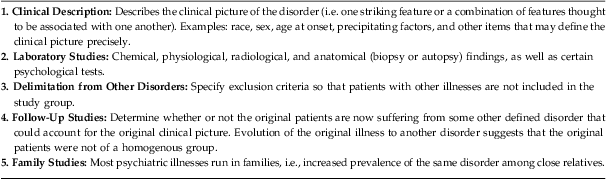
This review investigates the notion of anxious depression as a separate diagnostic entity, and the manner in which uncertainty surrounding its diagnosis has created clinical confusion. A review of the literature was conducted to explore the various ways that anxious depression is currently defined. Feighner's diagnostic criteriaReference Feighner, Robins and Guze4 (Table 1) have previously been set forth as a framework for establishing diagnostic validity in psychiatric disease, and are useful in comparing data between various research groups. In this review, Feighner's diagnostic criteria were used to organize the disparate findings, and to review and compare the extant evidence supporting the definition of anxious depression as an independent diagnosis.
Feighner and colleagues’ five diagnostic criteria for use in psychiatric research

Methods
A PubMed search was conducted for articles written in English, pertaining to adult human research, and published through October 2012 using the following search terms: “mixed anxiety depressive disorder,” “cothymia,” “anxious depression,” “agitated depression,” and “comorbid anxiety depression.” A total of 372 relevant articles were initially found. Further review narrowed the data to 32 studies related to anxious depression as a diagnostic entity. Because different terms and criteria are used to describe anxious depression, this article uses several different terms consistent with the respective sets of criteria that define them.
In a landmark 1972 article, Feighner and colleaguesReference Feighner, Robins and Guze4 proposed a set of standardized diagnostic criteria to define a variety of psychiatric diseases as a way to improve diagnostic consistency. These widely used and influential criteria emphasize several key points in psychiatric research: the systematic use of operationalized diagnostic criteria; an emphasis on illness course and outcome; and an emphasis on the need, whenever possible, to base diagnostic criteria on empirical evidence. Feighner's original criteria were broken down using the following headings: Clinical Description, Laboratory Studies, Delimitation from Other Disorders, Follow-Up Studies, and Family Studies (Table 1). Here, we used Feighner's framework to compare the different definitions of anxious depression, using the same subheadings.
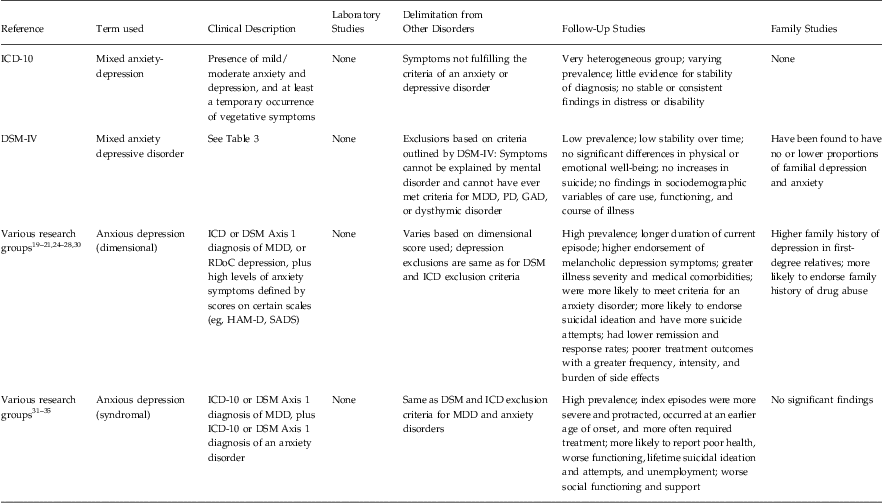
Culling the extant literature yielded four main ways of breaking down the data: International Classification of Diseases (ICD) criteria (10th revision), Diagnostic and Statistical Manual of Mental Disorders (DSM) criteria (both DSM-IV and DSM-5), Dimensional Criteria, and Syndromal Criteria. Table 2 gives a brief overview of these various diagnostic criteria, which are reviewed in greater detail below.
Diagnostic criteria for use in psychiatric research applied to anxious depression
Abbreviations: GAD, generalized anxiety disorder; HAM-D, Hamilton Depression Rating Scale; MDD, major depressive disorder; PD, panic disorder; RDoC, Research Domain Criteria; SADS, Schedule for Affective Disorders and Schizophrenia.
ICD Criteria
Clinical description
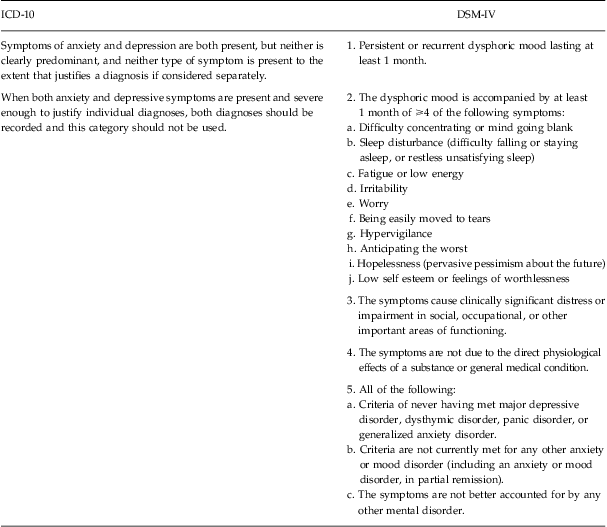
The ICD-10 was the first to introduce the diagnosis of “mixed anxiety-depression” in 1992 in response to mounting evidence that comorbid anxiety and depression were prevalent in patients who did not meet full criteria for either disorder.5 ICD-10 requires the presence of mild symptoms of both anxiety and depression that are not severe enough to qualify for either full diagnosis (Table 3). The ICD-10 further acknowledges the imprecision of the definition for research purposes.
Comparison of ICD-10 and DSM-IV criteria for anxious depression
*ICD-10 criteria based on 2010 version.
Laboratory studies
None.
Delimitation from other disorders
Symptoms for mixed anxiety depression could not meet criteria for another diagnosis.
Follow-up studies
One study found that primary care patients with ICD-10–diagnosed mixed anxiety depression were twice as likely to be psychologically distressed 3 months from baseline compared to those with no diagnosis, though this lessened to nonsignificant levels at 1 year; no predictors of persistent or recurrent distress were found.Reference Walters, Buszewicz, Weich and King6 These patients were more likely to be female, to endorse somatic symptoms, and to have a history of psychiatric difficulties. Subjects were no more likely to have a documented psychiatric problem by their general practitioner, and were no more likely to frequently attend a primary care clinic than subjects with other ICD-10 psychiatric diagnoses.Reference Walters, Buszewicz, Weich and King6
Data from the Munich Follow-Up Study found a rate of mixed anxiety depression of only 0.8% in the general adult population.Reference Wittchen and Essau7 Another primary care study showed a low rate of diagnostic stability.Reference Barkow, Heun and Wittchen8 In that study, only 1.2% of patients diagnosed with mixed anxiety depression at baseline had the disease 12 months later; patients had either remitted or progressed to other diagnoses. In contrast, of 78 patients with no psychiatric history interviewed in a primary care setting, 12.8% met ICD-10 criteria for mixed anxiety depression.Reference Stein, Kirk, Prabhu, Grott and Terepa9 Their level of disability was comparable to that of patients with full syndromal depression and anxiety. Notably, in addition to using ICD-10 criteria, the authors also used the following modified DSM criteria: (1) failure to meet any DSM-III-R diagnosis for a depressive or anxiety disorder; (2) at least 10 days of either (a) feeling depressed or down most days or (b) noticeable loss of interest in activities nearly every day; (3) consistent presence of at least two remaining DSM-III-R criteria for major depressive disorder (MDD); and (4) consistent presence of at least 3 of 18 DSM-III-R symptoms of generalized anxiety. This modification did not exclude patients with a history of anxiety or depressive disorders (unlike the DSM criteria).
As part of the National Psychiatric Morbidity survey that was conducted in Great Britain, the Clinical Interview Schedule—Revised (CIS-R) generated ICD-10 diagnoses for the general population.Reference Das-Munshi, Goldberg and Bebbington10 Those not meeting full criteria for anxiety or depression, but with scores ⩾12 on the CIS-R overall psychological morbidity scale, were given the diagnosis of mixed anxiety depression. This group comprised 8.8% of all participants, and was the most prevalent among mental health disorders.Reference Das-Munshi, Goldberg and Bebbington10
Family studies
None.
DSM-IV Criteria
Clinical description
Field trials provided insufficient evidence to include anxious depression as an official Axis I diagnosis in the DSM-IV. Instead, mixed anxiety depressive disorder was included as an area for further research in the DSM-IV's Appendix (see Table 3 for the full criteria).11, Reference Zinbarg, Barlow and Liebowitz12 Interestingly, the final criteria did not require the presence of both anxiety and depressive symptoms.
Laboratory studies
None.
Delimitation from other disorders
Symptoms could not be due to the direct physiological effects of a substance, general medical condition, or another anxiety or mood disorder, and could not be better accounted for by any other mental disorder. Past diagnoses of MDD, dysthymic disorder, panic disorder (PD), or generalized anxiety disorder (GAD) were not permitted.
Follow-up studies
Perhaps reflecting an increased need for diagnostic clarity, many studies used modified criteria instead of strictly using criteria proposed by DSM-IV. For instance, one group allowed for a history of MDD, dysthymic disorder, PD, or GAD in its primary care sample; 10 of the 539 participants (2%) had mixed anxiety depressive disorder at baseline.Reference Weisberg, Maki, Culpepper and Keller13 However, when strict DSM-IV criteria were applied, this dropped to 4 participants, or 0.2%. No significant differences in physical or emotional well-being were found between those with mixed anxiety depressive disorder and those with other anxiety disorders. None of the participants with mixed anxiety depressive disorder endorsed a history of suicide attempts, and they had higher global assessment of functioning (GAF) scores. In addition, mixed anxiety depressive disorder did not appear to be a stable diagnosis. The probability of remission at 6- and 12-month follow-up were 70% and 80%, respectively; these remission rates were significantly higher than those for GAD, MDD, and PD with agoraphobia for the same time frame. None of the patients who remitted were taking psychiatric medication, and only one was in psychotherapy. One of the remaining cases of mixed anxiety depressive disorder converted to MDD. As a result, the authors called into question the utility of mixed anxiety depressive disorder as a separate diagnostic category, as it appeared to often be transient and not require intervention.
Another group modified DSM-IV criteria by asking questions about generalized anxiety, depression, interference from symptoms, and recency of symptoms.Reference Means-Christensen, Sherbourne and Roy-Byrne14 The group found that of 37 patients eligible for a diagnosis of mixed anxiety depressive disorder, none actually met its modified DSM-IV criteria. Another study changed the DSM-IV criteria slightly by decreasing the length of criteria from 4 weeks to 2 weeks, and omitted Criteria 3 and 5c (see Table 3); they found no difference between those with mixed anxiety depressive disorder and those with subthreshold anxiety or subthreshold depression with regard to care utilization, functioning, and course of illness over two years.Reference Spijker, Batelaan, de Graaf and Cuijpers15 The authors concluded that mixed anxiety depressive disorder was not a relevant diagnosis in terms of consequence or prevalence.
Family studies
Patients with mixed anxiety depressive disorder did not differ with regard to familial depression or anxiety compared to those with no psychiatric diagnosis. When compared to either comorbid patients or to those with at least one depressive or anxiety disorder, mixed patients showed less familial depression and anxiety.Reference Balestrieri, Isola, Quartaroli, Roncolato and Bellantuono16
DSM-5 Criteria
The DSM-5 committee decided to omit the diagnosis of mixed anxiety depressive disorder for several reasons. Most notably, a recent estimate of test–retest reliability of mixed anxiety depressive disorder found that the diagnosis could not be reliably separated from MDD or GAD.Reference Regier, Narrow and Clarke17 In this field trial, MDD and GAD had low reliability, in part because of their high comorbidity with other disorders and their heterogeneous populations. To address this, the DSM-5 added an anxious distress specifier to MDD as a way to incorporate common anxious symptoms. Batelaan etal.Reference Batelaan, Spijker, de Graaf and Cuijpers18 had separately proposed several arguments against having mixed anxiety depressive disorder in the DSM-5, including (1) the new criteria might inflate prevalence rates compared to DSM-IV, as the duration of symptoms would be lowered to 2 weeks instead of 1 month; this loosening of the criteria might increase the false-positive rate, leading to unnecessary treatment; (2) few differences were found to exist between mixed anxiety depressive disorder and subthreshold anxiety or depression,Reference Spijker, Batelaan, de Graaf and Cuijpers15 thus the need for a separate category was questionableReference Batelaan, Spijker, de Graaf and Cuijpers18; and (3) concern had been expressed regarding the validity of the diagnosis, given that it has low diagnostic stability over time. Indeed, several studies have shown that most patients did not continue to meet criteria at follow up,Reference Spijker, Batelaan, de Graaf and Cuijpers15, Reference Batelaan, Spijker, de Graaf and Cuijpers18 either because of remittance or change in diagnosis.Reference Barkow, Heun and Wittchen8
Dimensional Criteria
Clinical description
When defined in a dimensional matter, anxious depression most often consists of MDD (based on DSM criteria) plus concurrent high levels of anxiety (defined as a baseline anxiety/somatization factor score of ⩾7 from the 17-item or 21-item Hamilton Depression Rating Scale; HAM-D).Reference Cleary and Guy23 This score encompasses hypochondriasis, insight, general and gastrointestinal somatic symptoms, and psychic and somatic anxiety.Reference Cleary and Guy23
Alternative dimensional criteria have also been proposed. Seo etal.Reference Seo, Jung and Kim24 defined anxious depression as a DSM-IV diagnosis of either MDD, dysthymic disorder, or depressive disorder not otherwise specified (NOS), plus a score on the Hamilton Anxiety Rating Scale (HAM-A) of ⩾ 20. Another group recommended a score of ⩾ 18 on the HAM-D and ⩾9 on the HAM-A,Reference Silverstone and von Studnitz25 regardless of DSM or ICD diagnoses. Similarly, Clayton etal.Reference Clayton, Grove and Coryell26 based their dimensional diagnosis of anxious depression on a score of ⩾16 on 6 items from the Schedule for Affective Disorders for Schizophrenia (SADS): (1) worry, brooding, painful pre-occupation, and inability to get rid of unpleasant thoughts; (2) panic attacks, (3) somatic anxiety; (4) psychic anxiety; (5) phobia; and (6) obsessions or compulsions plus Research Domain Criteria (RDoC) for depression. Similarly, several groups also used RDoC for depression combined with scores from various scales to define anxious depression.Reference Clayton, Grove and Coryell26–Reference Joffe, Bagby and Levitt28
Laboratory studies
None.
Delimitation from other disorders
Patients usually could not meet dimensional criteria for anxious depression if they met exclusion criteria from the DSM or ICD for MDD. Patients would also be excluded for not meeting anxiety cut-off scores, which varied based on the study.
Follow-up studies
Fava etal.Reference Fava, Alpert and Carmin19–Reference Fava, Rush and Alpert21 found that 44–53.2% of MDD participants in the Sequenced Treatment Alternatives to Relieve Depression (STAR*D) study had anxious depression, defined as having MDD plus a baseline HAM-D anxiety/somatization factor score of ⩾7. In this sample, anxious depression was more common among women, African Americans, and Hispanics, and those who were married, divorced, or widowed compared to those who never married. It had a higher prevalence in primary care settings than specialty psychiatric care settings. Subjects with anxious depression were also more likely to be unemployed, less educated, publically insured, older, and with lower income. No difference in age of onset or number of episodes was found.Reference Fava, Alpert and Carmin19–Reference Fava, Rush and Alpert21 Another study using the criteria found that inpatients with anxious depression were older, had less education, and were more often (prematurely) retired.Reference Wiethoff, Bauer and Baghai22
Interestingly, in the STAR*D study, subjects with anxious depression had a unique clinical profile that was independent of severity of depression, and included longer duration of current episode, higher endorsement of melancholic depression symptoms, and more medical comorbidities. They were also more likely to meet criteria for an anxiety disorder,Reference Fava, Rush and Alpert20, Reference Wiethoff, Bauer and Baghai22 to endorse suicidal ideation, to have attempted suicide, and to have lower remission and response rates.Reference Fava, Rush and Alpert20 In addition, subjects with anxious depression showed poorer treatment outcomes and reported a greater frequency, intensity, and burden of side effects.Reference Fava, Rush and Alpert20, Reference Wiethoff, Bauer and Baghai22 These subjects also had lower remission rates, kept fewer appointments, and spent less time in treatment.Reference Fava, Rush and Alpert20, Reference Farabaugh, Alpert and Wisniewski29 Furthermore, and using the same dimensional criteria as Fava etal., Papakostas etal.Reference Papakostas, Fan and Tedeschini30 found that anxious depression negatively influenced the relative degree of symptom reduction.
Using RDoC for depression as well as SADS scores, Clayton etal.Reference Clayton, Grove and Coryell26 observed that depressed subjects with high anxiety took twice as long to recover from index depressive episodes as depressed subjects with low anxiety. Using the RDoC, Joffe etal.Reference Joffe, Bagby and Levitt28 found that depressed patients with high anxiety had worse scores on both the Beck Depression Inventory (BDI) and the 17-item HAM-D, and more functional impairment. However, they were only slightly less likely to respond to antidepressants than depressed patients with low anxiety levels. Fawcett etal.Reference Fawcett, Scheftner and Fogg27 found that depression associated with severe psychic anxiety and panic attacks was associated with suicide within 1 year, further underscoring the links between anxiety, depression, and suicidal behavior.
Seo etal.Reference Seo, Jung and Kim24 used DSM-IV criteria for MDD and depression not otherwise specified plus a HAM-A score of ⩾20 to define anxious depression. They found that those with anxious depression had a longer duration of illness, endorsed more suicidal ideation, and had more past suicide attempts than those with non-anxious depression—findings that echoed the STAR*D data. They also found that subjects with anxious depression reported more depressive episodes and younger age of onset.
Family studies
Fava etal. found that anxious depression was associated with a greater likelihood of a family history of drug abuse,Reference Fava, Rush and Alpert20 but not depression or other mood disorders.Reference Fava, Rush and Alpert21 Similarly, Seo etal.Reference Seo, Jung and Kim24 found no significant family history of depression or other psychiatric disorders in subjects with anxious depression. However, another study found that individuals with anxious depression had more family history of depression—but not anxiety or alcoholism—in first-degree relatives.Reference Clayton, Grove and Coryell26
Syndromal Criteria
Clinical description
A syndromal approach has been proposed to include patients with comorbid anxiety and depressive disorders based on either ICD or DSM criteria. Similarly, the term “cothymia” has been proposed to describe those with dysthymic disorder and either PD, GAD, or all three disorders as defined by DSM criteria.Reference Tyrer, Seivewright, Simmonds and Johnson31
Laboratory studies
None.
Delimitation from other disorders
Subjects must have met criteria for at least one anxiety disorder and one depressive disorder; one disorder plus symptoms of the other would not be enough to qualify for the diagnosis.
Follow-up studies
Data from the Munich Follow-Up Study showed that comorbidity of anxiety and depressive disorders based on DSM-III criteria was 44.7% in an epidemiologic sample and 67.8% in a clinical setting.Reference Wittchen and Essau7 Another study of comorbid patients based on DSM-IV criteria showed that their index episodes were more severe and protracted, occurred at an earlier age, and more often required treatment than those with depression or anxiety disorders alone.Reference Penninx, Nolen and Lamers32 In that sample, 55.3% went on to develop a chronic course, and their median episode duration was over 24 months, which was worse than either diagnosis alone. Another study using ICD-10 criteria found that 26.1% of those with comorbid anxiety and depression continued to have both diagnoses at 1-year follow-up.Reference Barkow, Heun and Wittchen8 Comorbid subjects were more likely to report poor health, worse functioning, and unemployment than those with ICD-10–diagnosed mixed anxiety depression.Reference Das-Munshi, Goldberg and Bebbington10 Strikingly, several groups reported that anxiety comorbid with depression increases risk of suicide,Reference Nock, Hwang and Sampson33 including both lifetime suicide attemptsReference Das-Munshi, Goldberg and Bebbington10 and completed suicides.Reference Pfeiffer, Ganoczy, Ilgen, Zivin and Valenstein34
Another study found that cothymic patients had worse social functioning and worse scores on the Neurotic Disorder Outcome Scale at 12-year follow-up than patients with only one diagnosis.Reference Tyrer, Seivewright, Simmonds and Johnson31 Jeste etal.Reference Jeste, Hays and Steffens35 examined 352 depressed inpatients and outpatients aged 59 and older. They found that 42% had anxious depression, as determined by the Duke Depression Evaluation Schedule, which assessed DSM diagnoses of MDD and lifetime GAD symptoms using the National Institute of Mental Health (NIMH) Diagnostic Interview Schedule. In addition, comorbid subjects were younger, endorsed more suicidal ideation, and had worse subjective social support.
Interestingly, Diefenbach etal.Reference Diefenbach, Disch, Robison, Baez and Coman36 defined anxious depression as a combination of dimensional and syndromal criteria. In their urban sample of subjects aged 60 and older, anxious depression was defined as MDD plus symptoms of GAD or anxiety symptoms not otherwise meeting diagnostic criteria. In those with MDD, anxious symptoms were more common in Puerto Ricans (60.6%) than African Americans (48.4%), and those with anxious depression reported more depressive symptoms and suicidality.
Family studies
Jeste etal.Reference Jeste, Hays and Steffens35 found no significant family history in subjects with anxious depression. One twin study examined the association between life events and anxious depression, as measured by the Young Adult Self Report.Reference Middeldorp, Cath, Beem, Willemsen and Boomsma37 Although DSM criteria were not used, scores from this scale had previously been found to correlate with DSM-IV MDD and anxiety diagnoses by this research group. No gene–environment correlations were found for life events and the development of anxious depression.
Conclusions
Current definitions of anxious depression are inconsistent. As the evidence reviewed above has underscored, this diagnostic confusion has also led to considerable clinical confusion vis-à-vis the clinical profile of a patient with anxious depression. This is an issue of considerable nosological importance.
Using DSM and ICD-10 diagnostic criteria yields a clinical picture of a disorder that is often milder and more transient than a diagnosis of either depressive or anxiety disorders alone, bringing into question the usefulness of these diagnoses clinically and for research. Under those criteria, a diagnosis of anxious depression may represent transient variants of normal mood or prodromal states for anxiety and mood disorders. Indeed, the DSM-5 no longer includes mixed anxiety depressive disorder.
In contrast—and perhaps in response to the difficulty in capturing a “true” syndrome using ICD-10 or DSM criteria alone—defining anxious depression in a dimensional manner yields a considerably more serious clinical picture, and may be the most useful way of differentiating anxious depression from other types of mood and anxiety disorders. The evidence from dimensional studies suggests that anxiety accompanies depression at higher rates than expected, worsens depression outcome, and increases risk of suicide, all of which have important implications for clinical care. Notably, dimensional diagnoses of anxious depression—which typically combine DSM-diagnosed MDD with anxiety/somatization scores on the HAM-D—have, thus far, provided the most clinically relevant data on differences between subjects with anxious depression and their non-anxious counterparts. One key explanation for these differences in severity is that dimensional criteria, by definition, rely on more serious diagnoses. Because patients must meet full criteria for MDD in order to meet dimensional criteria for anxious depression, their illness will be more severe than those who only manifest subsyndromal symptoms in order to meet diagnostic criteria (eg, those with ICD-10 and DSM diagnoses).
This review has also highlighted the dearth of information regarding laboratory and family studies, and thus the need for future research projects in these areas. In addition, few studies have examined the stability of anxious depression over time, particularly using dimensional criteria. Over the last few decades, and despite significant research, no real reductions in prevalence, morbidity, or mortality have been seen for patients with depression.Reference Insel38 Diagnostic clarification may help, and thus future efforts should be aimed at projects that use consistent definitions of anxious depression. With the release of the DSM-5, the anxious distress specifier for MDD will allow for investigations into anxious depression using this new category. In addition, using dimensional criteria to conduct further research may elucidate the usefulness of this diagnosis for both clinicians and researchers alike, and determine whether a mixed anxious depression state warrants a separate diagnosis in future DSM and ICD editions.
Disclosures
Funding for this work was supported by the Intramural Research Program of the National Institute of Mental Health, National Institutes of Health (IRP-NIMH-NIH), by a NARSAD Independent Investigator to C.A.Z., and by the Brain & Behavior Mood Disorders Research Award to C.A.Z. Dr. Zarate is listed as a co-inventor on a patent application for the use of ketamine and its metabolites in major depression. Dr. Zarate has assigned his rights in the patent to the U.S. government but will share a percentage of any royalties that may be received by the government. The remaining authors have no conflicts of interest to disclose, financial or otherwise.