INTRODUCTION
Producers in agricultural communities, both men and women, are confronted by development challenges associated with new technologies, accelerated global economic integration, a degrading natural resource base and a changing population situation. In recent years, considerable interest has been raised among economists and sociologists alike in using a social lens in addressing these development issues. In particular, there has been growing interest in social capital as an additional factor with significant potential to foster sustainable development (Bourdieu, Reference Bourdieu and Richards1986; Coleman, Reference Coleman1988; Krishna and Uphoff, Reference Krishna and Uphoff1999; Portes Reference Portes1998; Putnam, Reference Putnam1993; Reid and Salmen, Reference Reid and Salmen2000). The attractiveness of the concept stems from its perceived positive consequences for development, its character of acting as a non-monetary source of power and influence, and as sources of information and opportunity for those who lack possession of and access to other forms of capital – financial, human or natural.
Likewise, studies on gender have highlighted entrenched inequalities in control over assets, gender discrimination in labour markets and lack of a voice in the power struggles controlling resource allocation as major reasons for women's poverty and vulnerability (Buvinić and Gupta, Reference Buvinić and Gupta1994; Jackson, Reference Jackson1995; Kabeer, Reference Kabeer1995; Lockwood, Reference Lockwood1995). One dimension of vulnerability, especially of the poor in marginal areas, is a lack of power, voice and social networks that limits their access to resources, institutions, technology and markets. This paper examines the gender dimensions of social capital and addresses an important gap in the literature regarding the significance of social capital and the gender dimensions in the technology uptake process. It also takes one step further to look at empowerment through social capital build-up as an outcome of the technology uptake process.
This paper is based on two arguments. First, social capital (looked at as social networks and associations) plays a crucial mediating role in the process of technology uptake. Second, recognition, inclusion, participation and empowerment of women in rural farm communities is an important dimension in stimulating gender-equitable impact.
This paper is structured as follows. The next section presents the conceptual and theoretical issues relating to social capital, gender, empowerment and technology uptake. The third section presents the methodology and approaches adopted in this study and the fourth section discusses the main findings. The final section presents lessons learned and conclusions, with implications for future work.
BACKGROUND
Poverty alleviation is a major criterion for agricultural research and technological innovation. While there is abundant literature focusing on the direct impacts from technology adoption (such as increase in yields and income, reducing unit costs of production, improving labour productivity and sustainability issues), there is an important dimension that is often almost ignored in conventional adoption studies – this relates to the qualitative dimensions of impact (such as human capital enhancement, empowerment, equity and other socio-cultural-institutional benefits). Even as Feder et al. (Reference Feder, Just and Zilberman1985) suggested early on that some adoption outcomes that cannot be explained with traditional models or by standard household data may be the result of differing social, cultural and institutional environments, over two decades later many questions and gaps relating to socio-cultural determinants of technology adoption remain unanswered. To start with, sociological perspectives contend that the technology diffusion process consists of interpersonal network exchanges, particularly between those individuals who have already adopted an innovation and those who are then influenced to do so. Various studies (Besley and Case, Reference Besley and Case1993; Feder and Slade, Reference Feder and Slade1984; Foster and Rosenzweig, Reference Foster and Rosenzweig1995) show how non-adopters learn from adopters, but analysis of the dynamic social dimensions explaining the process has been limited.
Among the social factors influencing technology uptake, this paper focuses on the role of social capital and the related gender dimensions involving relationships and collective action. Social capital is a concept with a variety of inter-related definitions (Bourdieu, Reference Bourdieu and Richards1986; Coleman, Reference Coleman1990; Lin, Reference Lin2001; Portes, Reference Portes1998; Putnam, Reference Putnam1993). The most appropriate definition of the concept in this context is based on the work of Pierre Bourdieu (Reference Bourdieu and Richards1986), who defines social capital as ‘the aggregate of the actual or potential resources which are linked to possession of a durable network of more or less institutionalised relationships of mutual acquaintance and recognition’. He breaks down his definition into two elements: first is the social relationship itself that allows individuals to claim access to resources possessed by their associates, and second, the amount and quality of those resources. For Bourdieu, social capital is a resource used by people to support their strategies for maintaining and changing their positions within hierarchical social structures. His ideas popularize the concept of social capital, especially as a facilitating agent or obstacle for development.
Social capital can be thought of as the framework that supports the process of learning through interaction, and requires the formation of networking paths that are both horizontal (across agencies and sectors) and vertical (agencies to communities to individuals). The quality of the social processes and relationships within which learning interactions take place is especially influential on the quality of the learning outcomes in collaborative approaches. Anchoring the concept of social capital in social networks and embedded resources, Granovetter (Reference Granovetter1973) stresses their importance in facilitating information and influence flows. Taken one step further, this suggests that social capital plays an important role in fostering the social networks and information exchange needed to achieve collective action and sustain a social and institutional environment that is ready to adapt and change.
Application of the concept in agriculture has shown that communities with higher levels of participation, social networks and local organizations are more efficient in information sharing and more receptive to extension projects, and therefore more likely to use modern agricultural inputs than those without. A positive correlation has been identified (Krishna and Uphoff, Reference Krishna and Uphoff1999; Reid and Salmen, Reference Reid and Salmen2000) between the level of association and social relationships with others and the use of modern agricultural inputs such as fertilizer, agrochemicals and improved seeds. Woolcock (Reference Woolcock2001) explored social capital as a factor distinguished from physical, financial and human capital. Social capital is the economic value obtained in institutional or individual networking, and its significant effects on development outcomes, both positive and negative.
This paper contributes to the ongoing discussion regarding the cyclical nature or two-way interaction between social capital and technology adoption. We use illustrative cases that show how social capital possibly mediates or may also inhibit technology uptake. This adds to the body of evidence on how collective action is a mechanism enabling adoption of innovation. The implications of social capital for facilitating access to information, credit, institutional support, common property resources, and community participation are elucidated.
A more significant contribution of this paper is that emphasis on social capital and gender addresses an important gap in the literature (Molyneux, Reference Molyneux and Morrow2001), i.e. how technological innovations are likely to affect the economic activities and social relationships among different groups of people in a community and provide equal opportunities for women and men to participate and benefit, ultimately leading to their empowerment. This essentially means that there is a cyclical building up of social capital that mediates technology adoption, i.e. social capital mediates technology adoption and in turn technology adoption stimulates further build-up of social capital. Ultimately, the changing dynamics of social capital in such situations may yield important insights for stimulating gender-equitable change processes.
METHODOLOGY
Social capital, as a concept, is rooted in interactions, social networks and social relations. Social relations are complex and cannot be quantified simply by using individual indicators. This section presents the approach used in this paper. First, the framework linking technology adoption–empowerment pathway is introduced. This is followed by a discussion of the studies used to examine the key linkages between social capital, gender dynamics, empowerment and technology uptake.
Learning in a technology adoption–empowerment pathway: A framework
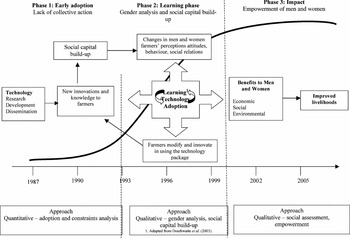
This study analyses the process of technology uptake by systematically probing through the various stages of the adoption–empowerment pathway using a social lens focusing on gender dimensions and social capital. Figure 1 depicts three phases:
Stages of adoption pathway leading to empowerment.

• Phase 1: in the early stage of technology adoption where lack of collective action is a constraining factor in technology uptake
• Phase 2: a subsequent stage, a learning phase looking at the gender dimensions of technology uptake when the constraint is lifted through social capital build-up and is seen as a mediating factor effectively facilitating technology adoption
• Phase 3: ultimate stage of individual and community empowerment achieved through social capital build-up as a result of technology innovation, whereby even marginalized groups (including women and tribals) gain better access to resources, information, knowledge and some opportunities for political participation.
Quantitative and qualitative studies
The analysis presented in this paper is based on data collected from three consecutive monitoring studies on genetic and natural resource management-based technology in the Indian semi-arid tropics, where quantitative as well as qualitative investigations were pursued to assess the impact of technological innovations. The studies were carried out in a phased manner from the early 1990s, initially determining the factors influencing adoption and the direct measurable economic benefits from adoption, and later the social dimensions of impact, particularly the gender dimensions and the role of social capital build-up. The qualitative analysis derived from focus group meetings, and participatory rural appraisals (PRAs) were carried out to understand the linkages between technology adoption and impacts, and the processes and intervening factors involved in these linkages. The technology assessed is specific to groundnut production for marginal environments in the semi-arid tropics (see Appendix 1).
The long-term observations on uptake and impacts involved the development of corresponding approaches for assessing various dimensions of impact. The three studies undertaken to examine the benefits accruing from the groundnut production technology (GPT) innovation provide data over an 11-year period from 1992 to 2003 are described below.
The first study, entitled ‘Impact assessment of crop and resource management technology – a case of groundnut production technology’, is an adoption assessment with a focus on factors facilitating and constraining adoption and the immediate economic benefits of early adoption. This study provides an objective tracking and assessment of the early adoption of GPT.
The second study is a complementary qualitative assessment using gender analysis for GPT, with a focus on the different perceptions of men and women; gender-related impact indicators; initial build-up of social capital and flow of benefits from GPT to diverse groups. The gender analysis identifies the relevant inter- and intra-farm household dynamics. It is noted that while the earlier study did not identify the role of social capital in its analytical discussion, its importance began to be recognized as soon as lack of collective action was identified as a major constraint limiting technology uptake (Parthasarathy and Chopde, Reference Parthasarathy and Chopde2000).
The third study is based on an ongoing monitoring and evaluation addressing gender-and social-capital-mediated technology uptake. This study provides a greater potential for more in-depth investigation of the qualitative aspects observed through monitoring and evaluation, highlighting the processes of collective action, participation and empowerment.
These three studies together provided the required long-term observations to analyse the GPT technology uptake process through the three stages from early adoption to learning and impacts.
Study areas
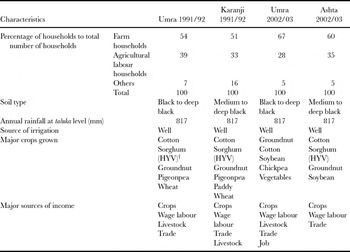
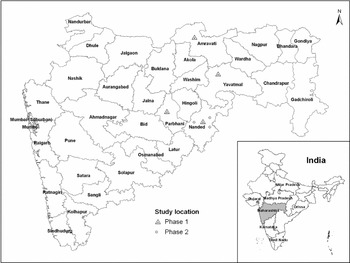
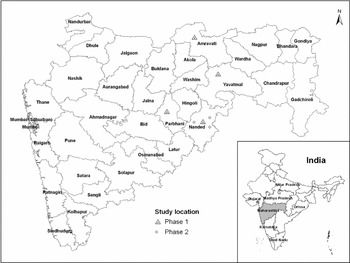
The first study, a quantitative assessment of early adoption, focused on a wide area of about 81 000 ha covering four major groundnut producing districts of Maharashtra, India – Amravati, Nanded, Parbhani and Yavatmal (Figure 2). Reconnaissance surveys in 1993 (Joshi and Bantilan, Reference Joshi and Bantilan1998) revealed that groundnut is cultivated in these districts as a major summer crop. For the two subsequent studies, three villages (Umra, Karanji and Ashta) were selected from one of the districts (Nanded) for the qualitative surveys targeted for gender analysis and social capital build-up during phases 2 and 3. In both studies, Umra served as the experimental village, while Karanji and Ashta served as the control villages in phases 2 and 3, respectively. The essential factors determining selection of these study villages were: their proximity to each other; their homogeneity in social structure; similarity of agro-climatic conditions; similarity in cropping patterns, and levels of adoption of improved agricultural technologies in the cultivation of groundnut crops. The specific factor that distinguishes them is the level of adoption of new packages of GPTs. Over the years, Umra has emerged as a major adopter of technologies and has grown to the stage of being a groundnut seed-supplying village, while Karanji and Ashta have lagged behind in the adoption process. This makes it especially convenient to study them as experimental and control villages (Table 1).
Village profiles, Maharashtra, India.

†High yielding variety
Source: Kolli and Bantilan (Reference Kolli and Bantilan1997), Padmaja et al. (Reference Padmaja, Bantilan, Parthasarathy and Gandhi2006).
Study areas, groundnut production technology assessment, Maharashtra, India. Source: GIS Unit, ICRISAT.
Methods used in phases 1–3
A combination of quantitative and qualitative methods were used in the three studies examining the three phases of the adoption–empowerment pathway.
Phase 1 – Early adoption assessment of GPT
The assessment of GPT in the early 1990s is a part of a series of case studies on adoption and impact carried out by ICRISAT in Asia and Africa. In these studies, the quantitative and tangible benefits from crop improvement and natural resource management research were identified, measuring returns to investment, and other indicators of economic and environmental impacts. For GPT, a sample of 355 farm households was randomly selected from 11 talukas in four groundnut growing districts of Maharashtra, India. Relevant information was collected from this representative sample of farmers using a structured questionnaire. The key variables included:
• Technology adoption – first year of adoption; extent of adoption of different components of GPT in the first year and the last three years ending 1994
• Modification of technology components, if any
• Cost of cultivation; yield and price of groundnut and its by-product
• Farmers' perceptions on sustainability issues
• Constraints to adoption of GPT.
The adoption pattern was established from the survey data by analysing farmers' responses when asked whether they practised different GPT components. If the answer was yes, the farmer was asked to recall the first year of adoption for different components. Two additional questions were useful: (a) the extent of adoption of different GPT components in the first year; and (b) the extent of adoption during the last three years ending in 1994. Several components of the technology package were already known and had been adopted even before the introduction of the package; farmers were free to choose and adopt any of its sub-sets. Hence, adoption sequences were evaluated by tracking discrete sub-sets of options available to the farmer. A systematic approach to tracking multiple technology adoption entailed measuring all sub-sets of technology components that included: (1) at least one option (say, land management); (2) two specific options (say, improved variety and land management); and (3) all options (full adoption). Farm survey data also served to estimate and project the adoption patterns of GPT components over time. By fitting a logistic function to data on the first year of adoption and data for the period 1989–1995, the proportion of farmers affected by GPT was estimated. The methodology provided the essential data for assessing the early adoption process and binding constraints.
Phase 2 – Learning phase: Gender analysis and social capital build-up
A complementary ex-post gender analysis of GPT was undertaken (almost simultaneously with the adoption study) to examine the differential effects of GPT on men and women farmers. This was undertaken using an in-depth case study which focused on labour and resource allocation, and the distribution of the benefits of this technology across farm and labour households, and among different men and women members. The study team was interdisciplinary in composition, and PRAs and rapid rural appraisals (RRAs) were adopted, along with individual interviews, to interact more closely with male and female farmers to assess their perceptions regarding the new technology and evaluate their needs in view of the changes resulting from technology introduction. The relevant enquiries, following Kolli and Padmaja (Reference Kolli and Padmaja1996) are:
• Technology uptake process
• Labour and time allocation: Who does what and how much time does it take?
• Who has access to and control of resources and benefits from GPT?
• User perspectives – perceptions of men and women farmers about GPT.
Follow-up focus group meetings probed in particular on the technology uptake process – reasons for limited adoption in the early phase, how they overcame the constraints, the benefits obtained and their planned actions to hasten the uptake process. This gender module enquired about considerations beyond gender roles to include the differential evaluation of men and women in attaching priorities to technology traits (e.g. alternative grain and plant traits).
Phase 3 – Social impact assessment: gender and social capital mediated technology uptake
In 2002–03, another round of focus group meetings and PRA techniques were utilized to gain insights on the key issues underlying the various dimensions in technology adoption and build-up of social capital leading to empowerment. The benchmark data derived from phase 2 were used to establish the basis for monitoring changes and impacts. The case study carried out in two villages (Umra and Ashta), focused on the actual process by which technology adoption mediated by gender and social capital build-up led to empowerment of the rural communities. Focus group meetings and key informant interviews were complemented by gender and social analysis tools adapted from the World Bank (2001). The key components of enquiry in this study were the social capital indicators, including:
• types of groups existing traditionally in the village
• new groups recently formed in the village
• membership of groups
• reasons for becoming members
• benefits from group membership
• links to other groups
• collective action and cooperation
• women's confidence and empowerment.
The evaluation of the empowerment process was later enhanced by using an analysis adapted from Bartlett (Reference Bartlett2005), which augments the conventional questions (what was planned? what was done? what was the outcome?) with questions relevant to:
• factors by which people gained access to available resources
• the process by which access and control were acquired
• the outcome of that control
• the process – what happened, how it happened, and, most importantly, who decided, who did what, how did they do it and who benefited?
RESULTS
The results from the three studies are systematically discussed by appealing to the iterative cycle of learning leading to successful adoption of an innovation. New innovations can change the perceptions of men and women farmers through social capital build-up (Figure 1). This learning can motivate adoption in stages, as well as necessary modifications/innovations to suit existing conditions or available resources. In other words, knowledge is transformed into action through a cycle of learning and innovations, including the build-up of social capital which empowers individuals (men and women) and ultimately improves livelihoods for the whole community.
The key results of the study relate to the important linkages among technology uptake, gender relations, collective action and social capital build-up: (a) technology uptake linkages in early adoption process; (b) differential roles and perceptions of men and women; (c) gender dimensions in build-up of social capital; (d) impacts of collective action on gender relations; and (e) role of networks in empowerment with a focus on women.
Technology uptake linkages: early adoption process
During the first phase (study 1), two aspects of GPT were examined: (a) adoption rates and spread of different components of GPT; and (b) tangible economic benefits accruing from it. While the study assessed that GPT gives 38 % higher yields, and reduces unit cost by 16 % (Joshi and Bantilan, Reference Joshi and Bantilan1998), the results from the survey data covering the period 1989–1994 used to track the adoption pathway for GPT confirm a situation of partial adoption and step-wise adoption. The data indicate that different components of technology are adopted in a step-wise process depending upon the (a) information about the technology, (b) availability of necessary resources and inputs (c) marginal returns to technology, (d) risk and (e) suitability of technology traits. The results clearly indicated that the components which experienced low and slow adoption were those that faced constraints with respect to lack of access, i.e. resources, information, necessary inputs and markets. In particular, the analysis of the responses specifically identified lack of collective action (which may facilitate access) as a binding constraint to the adoption of specific GPT components (including gypsum, other micronutrients and sprinkler irrigation).
Differential roles and perceptions of men and women
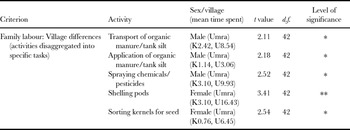
Having identified important binding constraints in phase 1, the analysis in the second study focused its attention on qualitative aspects analysing technology adoption, with focus on gender roles, access to and control over resources/information and benefits from technology uptake. The gender analysis (study 2) undertaken through an in-depth studies in two villages (Umra and Karanji) revealed that adoption of new technologies enhanced task specialization where activities were performed exclusively by a particular gender in order to optimize available household labour resources (Kolli and Bantilan, Reference Kolli and Bantilan1997). The findings revealed that gender roles were segregated into types of work (men do heavier jobs and women do lighter jobs) and into market and domestic activities, where men gain greater control over market-related activities and women over the domestic realm. Table 2 shows the significant differences in operation-wise use of labour time allocation.
Two-tailed t test on the mean time spent (h acre−1): summer groundnut crop activities, Umra, 1992–1993.

Note: Figures in brackets indicate the mean values for Karanji (K) and Umra (U).
* = significant at 5 % level; ** = significant at 1 % level.
Grouped activities were disaggregated into specific tasks for carrying out the tests (e.g. plant protection, including application of gypsum; application of micronutrients; spraying of pesticides/chemicals and crop watching).
Source: Kolli and Bantilan (Reference Kolli and Bantilan1997).
The analysis of the follow-up study on GPT confirms the increased time allocation of women – both family and hired – for the cultivation of groundnuts due to the enhanced task specialization and correspondingly increasing labour demand (sowing, weeding, harvesting and shelling of groundnut pods). There were some gender-specific social networks arising out of ‘bonding’ social capital – the ties that link women of the same social group (e.g. tribal women that provided the labour), as well as some ‘bridging’ social capital – the ties among women that cut across different social groups (land-owning as well as labour households). Another observation relates to the build up of social capital as a result of the increasing adoption of the GPT attributed to the strong cooperation that evolved among men and women belonging to the landholding class, the landless labourers and tribal groups.
The qualitative implications of higher yields were examined. Higher yields from GPT allowed households to diversify their use of the products of the groundnut crop. In this process, women gained control over the products retained for household use. Men were mostly concerned about financial viability of the technology, while women perceived the advantage of the new technology options in terms of workability and implications for drudgery and occupational hazards.
Follow-up reconnaissance in 1999 (Bantilan et al., Reference Bantilan, Parthasarathy, Padmaja, Mathur and Pachico2003) on the technology uptake process reiterated the importance of collective action and social capital build-up that continues to mediate the adoption of technologies. This reconnaissance result led to an in-depth probing of gender and social capital mediated technology uptake (study 3), which was carried out in the same experimental village of Umra. This gave additional insights on understanding the processes whereby collective action and social capital build-up facilitated higher technology adoption. Social analysis of the data derived from focus group meetings (involving homogenous groups of adopters, female-headed households, tribals; Appendix 2) revealed that the technology uptake process was hastened in Umra with the build up of social capital, whereby the men and women from all class and caste groups come together through the formation of kinship and formal networks, farmers groups and self-help groups (SHGs) among small- and medium-scale land-holding farmers, landless and tribal women. These helped to overcome the constraints to technology adoption, including access to information and credit, as well as to inputs like seed. In this case, social networks effectively facilitated large-scale adoption and resulted in positive impacts, not only in terms of higher yields and incomes for both farm and labour households, but also in terms of social and cultural dimensions.
Analysis confirmed that collective action was extensively used for (as Appendix 2 shows):
• procuring inputs for crop production (especially gypsum and culture for seed treatment)
• access to credit and other resources like seed
• access to tools and implements (broad bed and furrow, seed drill)
• knowledge sharing and dissemination.
The responses from the women-headed households group emphasized that social networks are central in the access of resources (tools, implements, sprinkler sets), especially among those who were earlier marginalized.
Multiplier effects were also noted over time, showing improvement in various dimensions: farm production, cropping pattern, consumption and ownership of assets, as well as other less tangible and indirect gains. In addition, sharp class and caste differences became less distinct. Ultimately, the social and cultural dimensions of impacts are observed: gender dimensions; network composition; gender and power relations and empowerment.
Gender dimensions in build-up of social capital
This section illustrates important dimensions of social capital build-up based on two situations: (a) the formation of new forms of social capital necessitated by critical conditions required for technology adoption (labour, input, marketing), and (b) the evolution and growth of relationships and associations among people in the community as part of improving individual and community welfare.
Some form of social capital existed even prior to the introduction of the technology. The evolution of men's and women's networks were documented in the study.
• Men's networks. The informal farmer associations traditionally dominated by men were concerned primarily with agricultural activities. New forms of social capital evolved as a result of technology adoption. The first formal association among these is the Krishi Vikas Mandal (KVM), a farmer's group, formed among members of the village to facilitate access to and purchase of inputs as a collective activity. In other words, the formation of social capital was instrumental in procuring inputs for crop production (credit, gypsum) and facilitating access to resources by sharing tools and implements required for sprinkler irrigation and broadbed and furrow cultivation. Farmers' realization of the need for group action led to the transformation of informal groups into a formal network, in this case, the KVM with an appointed leader and secretary and other officials.
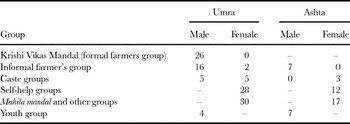
• Women's networks. For women, their participation in group action during the earlier years was minimal. Women members of the community were coming together as a group for other purposes like religious events and pooling of resources through chit funds (Table 3). These informal associations among women slowly evolved into a common source of saving for the female members in the community. These groups were later formalized into self-help groups (SHGs) with the assistance of the government through the Development of Women and Children in Rural Areas (DWCRA) programme.
• The exclusivity of membership by gender in each of these groups is noted (Table 3). The formal associations evolved to facilitate the adoption of technology which required collective action. The SHGs of women complemented this as a result of their role in the labour market. The participation of women from different social groups was enhanced, particularly among members of the Lambada tribal community.
Membership in different groups (%), 2002–2003.

Source: Gender and social capital mediated technology uptake surveys, 2002–03.
In summary, informal associations traditionally existed even before the introduction of the technology: one among men primarily concerned with agricultural activities and another among women primarily focused on cultural and religious activities. Gradually, social networks became inclusive of both men and women, particularly the KVM. It also became inclusive of caste and class, including the landless. As they evolved, the SHGs and kinship networks were strengthened as a source of social capital.
Composition of networks
The varying composition of men and women networks is clearly illustrated in the case study. On one hand, the traditional men's networks tended to be more formal, usually comprised of fellow workers. This feature was observed in Umra during the formation of the formal farmers' group (the KVM), which aimed to strengthen the existing weak social ties between the farmers and the labour class. On the other hand, women's networks tended to be informal and included more kin in contrast to male networks. For example, women's groups like pooja (prayer) groups, chit funds/mutual finance groups, mahila mandal groups, come together to discuss issues of common interest, including domestic problems. This confirms the earlier findings of Moore (Reference Moore1990). However, contrary to evidence in the literature, it was found that Umra women, particularly those who were working on the farm as family or paid labour, were more aggressive in coming together as a group and discussing their problems and trying to find some solutions. This social cohesion among them is seen as an important part in the build-up of social capital.
Power relations
Exploring the gendered power relations in the community, social networks were seen to benefit women and contribute to village collective action in different ways. Initially, women were excluded from male-dominated networks (e.g. the KVM, and the gram panchayat [village council] meetings) of the village. With the formation of their own SHGs and other informal groups, women's agenda and problems began to be considered as worthy of formal discussion and women were gradually invited to participate in the meetings of the formal groups. It was clear that the networks eventually crossed gender, caste and class lines (e.g. across gender in gram panchayat; across caste in labour sharing and across class in SHGs). In addition, as a result of enforcement of government reservation for women, they were also able to hold key positions in the gram panchayats. While the impact of this legislation is still marginal, the women who belong to the scheduled (lower) castes have gained self-confidence and acquired a number of skills, including community management, financial management and negotiating capabilities with local authorities.
Social networks were observed to operate along gender lines and they reflect the gendered nature of power relations between men and women. Women and men of Umra, traditionally separate, belong to different networks, and many programmes are set up or operate through ‘women-only’ or ‘men-only’ groups. While groups ensured participation and improved self-confidence, the ‘women-only’ networks often lacked the command and authority of men's networks. As a result, some women's groups have begun to invite participation and support of male members to strengthen their collective position.
Impacts of collective action on gender relations
Since the technology was fairly complex and needed initial investment, opening of credit lines was of importance despite the government subsidies for some of the capital investments. Community meetings, in this case organized through the Legumes On-farm Testing and Nursery Evaluation extension programme encouraged collective action and impressed upon the farming community the significance of mobilizing group action to enable them to benefit jointly from the technology.
Increased adoption of GPT required more supervision and labour. This stimulated better relationships among members of the community, especially among landowners and landless workers, including the adivasi (tribal) women who were the main source of labour in Umra. As commonly expressed during the PRAs, better social and political relations across the village evolved beyond the use of the technology. Men and women farmers in the village displayed rare willingness to join hands in repaying their long-term debts, and investing in production-enhancing assets to improve their creditworthiness. The stability of yields in the subsequent years due to GPT further improved the creditworthiness of the households. Formal institutions, such as banks, as well as retail suppliers of inputs such as seeds and fertilizers were more willing to give credit compared to earlier times before the use of GPT. This enhanced the multiplier effects of GPT impacts.
Role of social networks in empowering women
The documentation from the focus group meetings indicated that women's groups are an important source of social cohesion in Umra, which in turn is essential for community group action. Findings and discussions spanning different groups in the community – men and women, farmers and labourers, tribal and landless labourers – showed that women of Umra drew upon a range of social networks for personal and family livelihood. The important role of social networks in empowering women was analysed. Notable results from the focus group discussions are the following:
• Among income groups, it was observed that the women from the low-income category were the ones who had the strongest kin and community ties.
• Group formation in SHGs strengthened women's negotiating position and changed their role in household decision making.
• Diversification of skills evolved through development of horizontal networks (i.e. across income class and caste) in the community, e.g. groups formed for vocational training classes for women, especially in tailoring.
• Women, through their participation in various groups, also were involved in decisions on how the household spends the extra income gained – whether to invest in the farm, purchase consumption goods, or invest in health and education of children.
• Women participating in multiple networks (e.g. mutual finance, vocational training, religious groups) were the ones likely to be most empowered and were inclined to seek greater decision-making roles.
In addition, specific characteristics were seen to influence women's participation, i.e. marital status and family/kinship ties. The Umra study showed that married women are likely to be active in collective decision-making meetings because they are better trusted and respected. They are also able to influence higher-level decisions indirectly through their husbands and their own kinship networks. Their marital status allows them access to more networks and thus enables them to generate more social capital.
The Umra case study confirmed that social capital as a factor facilitating development can have significant positive outcomes, but this depended on the support of the other family members.
An important point worth noting from the focus group interactions is that social networks may also have some limitations in empowering women, i.e. they may operate in ways that exclude others. Two points noted in this study concerning this limitation are: (a) networking requires time, especially when formal group meetings are required – this presents a binding constraint especially for women from poor households because of their various livelihood activities and childcare responsibilities; (b) some marginalized women said that richer women were likely to form their own networks and they are at a disadvantage – this is in line with the same results obtained from Zimbabwe (Dikito-Wachtmeister, Reference Dikito-Wachtmeister2001) on how disadvantaged women, especially those who are poor and are not networked, are generally excluded from the decision-making processes. The evidence supports the arguments of Fine (Reference Fine2001) and Harriss (Reference Harriss2001) who believe that social capital can also lead to exclusion through the inequalities generated by traditional class distinctions.
LESSONS LEARNED AND CONCLUSIONS
The synthesis of lessons learned from the long-term observations sought to establish the relationship between social capital, gender and technology uptake. The results from the early adoption phase illustrated the critical importance of qualitative information complementing quantitative measures in achieving a more holistic understanding of the long-term effects and benefits from technology adoption.
Important lessons were learnt during the ex-post qualitative assessments focusing on gender and social capital. First, to ensure effective involvement of men and women in farm production, there is a need to incorporate views and perceptions from both genders during technology generation, development and uptake. Questions like ‘who does what?’ ‘who has access to resources?’ ‘who decides and who benefits?’ elicit qualitative data that provide useful indicators of gender-equitable change processes. Second, collective action brings about a transformation in gender relations leading to empowerment. As noted in Umra, people individually, and collectively as a group, acquired greater understanding of GPT and thereby were enabled to manage their economic, social and cultural environment with greater effectiveness to achieve a common goal. The transformation in the relations among Umra villagers across caste and class, including enhancement of the influence of women, distinguished them from other communities and villages.
The learning from the long-term observation of men and women farmers who used the integrated crop and natural resource management innovation illustrates that social capital is important for both adoption and impact to occur. Social capital is not merely an ‘input’ to development, it is also one of its most significant outputs. While social capital build-up plays a crucial role in bringing about positive economic changes, it also has a significant role in influencing impacts, especially empowering the men and women in agriculture.
The findings of this study confirmed that the build-up of social capital mediated the technology uptake process for GPT. It facilitated procuring inputs for crop production (especially gypsum and culture for seed treatment), access to resources (implements, broadbed and furrow, seed drill), diversification of farm activities, knowledge sharing and dissemination, learning, and empowerment of both men and women farmers.
Collective action was enhanced with the increased involvement and participation of women. Strong kinship ties were developed among diverse classes, including the landless tribal women, which formed the major labour force for this technology. Technology uptake improved as the farm households were empowered through building social capital, in this case social networks that crossed caste and class barriers. The build-up of social capital played an important role in influencing the distribution of benefits from the technology because of the ways in which social networks and social relationships facilitated technology dissemination.
The study observed that social networks, whether developed through formal organizations, kinship, neighbourhoods, work groups or informal interactions, are a critical component of social capital. Social resources embedded in networks may provide various benefits, such as information, influence and control. Social capital strengthens access to these resources. Women's networks facilitated communication, coordination, and the provision of information/knowledge regarding agricultural production, income generation, skill enhancement and family food security. They created obligations and expectations of reciprocity among their members. The trust, common understanding and knowledge generated multiplier effects in terms of evolving social networks, which stimulated new institutional arrangements.
The Umra case study illustrates that women's groups are vehicles for both individual and collective women's empowerment in decision making. This suggests that networks do generate social capital for individuals, leading to more participation and trust. Similar to the results shown in Bartlett (Reference Bartlett2005), increased participation brought about considerable benefits, and laid the foundations for self-determination, relationships among people began to change and the consequences of this change became positive in a way that was unpredictable.
New knowledge regarding farming practices expands choice. Mobilizing social capital through participation helps the successful adoption and diffusion of technologies. As reiterated in this paper, participation and collective action are more likely to result in an enhancement of some forms of human or cultural capital – those related to knowledge regarding innovations and the use of innovative techniques. Human capital enhancement, in the form of new knowledge regarding technological options, expands choices available to farm households and is a key feature of the empowerment process. These choices relate to cropping pattern, investment strategies, and choices to better manage risk and instability.
Finally, it is suggested that further insights into the role of social networks and power relations in the village may be examined in greater detail by establishing the village network architecture to include marginalized groups specifically. The importance of understanding formal and informal organizations and their contribution to the construction of social capital is necessary to perceive how people mobilize and acquire a wide range of assets and gain access to decision-making processes, technologies, resources and markets, and benefit from them.
Acknowledgements
This publication is a result of a collaborative research project, entitled ‘Gender dimensions in social capital build-up and technology adoption’, funded by FAO-RAP (Food and Agricultural Organization of the United Nations Regional Office for Asia and Pacific). The authors acknowledge the excellent contributions and consultations of D. Parthasarathy in planning and conceptualization of the study. The assistance of V. K. Chopde in conducting FGMs during fieldwork is greatly appreciated. Thanks are due to B. V. J. Gandhi and Neetu Choudhary for their work in the field. We also thank Revathi Balakrishnan of FAO-RAP for her advice and support to these diverse ideas.
Appendix 1. Groundnut Production Technology
Groundnut Production Technology (GPT) has been selected as the focus technology for the study. It is a package of practices for dryland cultivation of groundnuts, an innovation integrating crop improvement and natural resource management. The GPT was specifically developed for cultivation of groundnuts in dry areas, especially to promote cultivation in summer, using an improved package of practices, which included soil, nutrient, crop, water and pest management, along with improved cultivars. The components of the GPT can broadly be divided into:
• land management: preparation of broad- and raised-bed and furrows (BBF) using a marker for groundnut production;
• nutrient management: efficient application of macro- and micro-nutrients;
• improved varieties: high-yielding variety seeds, seed rate and seed dressing/treatment;
• insect and pest management: effective control of insects, diseases and weeds;
• water management: use of sprinkler sets to improve efficiency of irrigation.
The GPT was introduced in groundnut growing regions of seven states of India. This is a part of the Legumes On-farm Testing and Nursery Unit (LEGOFTEN), an initiative supported by the Government of India and ICRISAT in the late 1980s. The development of GPT in India was initially motivated by the need to enhance groundnut production and yield to meet the rising demand in the country during the 1980s and to reduce the import of edible oils.