Introduction
Annual bluegrass (Poa annua L.; also known as annual meadow grass or winter grass) has been documented on all continents including Antarctica, spanning environments where both warm- and cool-season turfgrasses are grown (Heide Reference Heide2001). It is a weed of field crops in many countries and is also found in lawns, urban parks, pastures, gardens, roadsides, and forests (Holm et al. Reference Holm, Holm, Holm, Pancho and Herberger1997; Wagner et al. Reference Wagner, Herbst and Sohmer1990). It is a serious weed in turf due to its unsightly appearance, competition with desirable species, and upright growth habit, which produces an uneven surface that affects ball roll in golf and other sports (Toler et al. Reference Toler, Willis, Estes and McCarty2007). Prolific seed production (Holm et al. Reference Holm, Holm, Holm, Pancho and Herberger1997) and ability to germinate under a wide range of environmental conditions (McElroy et al. Reference McElroy, Walker, Wehtje and Van Santen2004) make P. annua an exceptionally difficult weed to control. Although many herbicides are registered for P. annua control in turf, its high fecundity and high genetic diversity create strong selection pressure for herbicide resistance (Brosnan and Breeden Reference Brosnan and Breeden2013). To date, P. annua has evolved herbicide resistance more than any other turf weed species (Brosnan and Breeden Reference Brosnan and Breeden2013).
Worldwide, P. annua has evolved resistance to inhibitors of photosystem II (PSII; e.g., simazine), acetolactate synthase (ALS; e.g., trifloxysulfuron), enolpyruvylshikimate-3-phosphate synthase (e.g., glyphosate) and mitosis (e.g., dithiopyr) in managed turf systems (Binkholder et al. Reference Binkholder, Fresenburg, Teuton, Xiong and Smeda2011; McElroy et al. Reference McElroy, Flessner, Wang, Dane, Walker and Wehtje2013). The occurrence of glyphosate resistance in P. annua was first reported in the United States (Missouri, Tennessee) in 2010 (Heap Reference Heap, Pimentel and Peshin2014). Similarly, overuse of inhibitors of microtubule assembly (prodiamine) has resulted in the evolution of herbicide resistance in P. annua in North Carolina (Isgrigg et al. Reference Isgrigg, Yelverton, Brownie and Warren2002).
Herbicide resistance is caused by either target-site mutations or alterations in plant metabolism (Délye Reference Délye2013). So far, both target-site and non–target site based herbicide resistance (NTSR) to various herbicides has been confirmed in P. annua. Previous studies have documented that mutations Trp-574 and Ala-205 confer cross-resistance to many ALS inhibitors (Brosnan et al. Reference Brosnan, Vargas, Breeden, Grier, Aponte, Tresch and Laforest2016; McElroy et al. Reference McElroy, Flessner, Wang, Dane, Walker and Wehtje2013). Similarly, in P. annua, Ser-264 was confirmed to provide resistance to atrazine (Perry et al. Reference Perry, McElroy, Dane, Van Santen and Walker2012), Val-219 to metribuzin and diuron (Mengistu et al. Reference Mengistu, Mueller-Warrant, Liston and Barker2000), and Pro-106 to glyphosate (Cross et al. Reference Cross, McCarty, Tharayil, McElroy, Chen, McCullough, Powell and Bridges2015). On the other hand, an NTSR-based mechanism causing reduced absorption and translocation was reported as a mechanism of resistance to POST pronomide applications in P. annua (McCullough et al. Reference McCullough, Yu and Czarnota2017).
Greenskeepers in Australia have reported difficulty in controlling P. annua with herbicides. In response to their concerns, 31 purported resistant populations of P. annua were collected from golf courses across New South Wales (NSW), Victoria, and South Australia (SA) where herbicides had failed to provide weed control and were tested for resistance to several turf herbicides. Herbicide dose–response pot trials were conducted to investigate resistance to five herbicide mechanisms of action that are commonly used to control this weed on golf courses. The objective of this research was to determine the resistance status of P. annua collected from across southeastern Australia and to determine the mechanisms of resistance present.
Materials and Methods
Plant Materials
A total of 31 populations of P. annua (18 from Victoria, 6 from NSW, and 7 from SA) were collected by turf managers and sent as soil plugs to the Weed Science group of the University of Adelaide (34.9670°S, 138.6360°E). The samples were collected from greens and fairways where turf managers were having trouble controlling P. annua with herbicides. One susceptible (S) population collected from non–golf course areas was used as the susceptible control.
Preliminary Screening for Resistance in Sampled Populations
In December 2017, plants at the 2- to 3-tiller stage and of similar size from the cores were transplanted into 9.5 by 8.5 by 9.5 cm punnet pots (Masrac Plastics, Adelaide, SA) containing standard potting mix (produced by steaming 540 L cocoa peat, 220 L of water, and 60 L of sand for 1 h) (Boutsalis et al. Reference Boutsalis, Gill and Preston2012). Each pot had 4 plants of the same population and was replicated three times for each herbicide rate, arranged in a randomized complete block design. Plants were watered daily, and at 1 wk from transplanting, all 31 populations from golf courses and the control population were treated with the 1X rate (field rate of each herbicide) (Table 1) and 3X rate of the ALS inhibitors (WSSA Group 2 [WSSA 2020]) rimsulfuron, iodosulfuron, bispyribac, and foramsulfuron; the PSII inhibitor (WSSA Group 5) simazine; the inhibitor of microtubule assembly (WSSA Group 3) propyzamide, also known as pronamide; and endothall (WSSA Group 27) early POST. Herbicides were applied using a laboratory moving boom sprayer equipped with a twin nozzle (TeeJet® 110° flat fan, Spraying Systems, Wheaton, IL) delivering an output of 118 L ha−1 at a pressure of 250 kPa and speed of 1 m s−1. Plants exhibiting subsequent growth after 28 d, such as the initiation of new tillers, were classified as survivors, whereas plants with severe stunting or mortality were considered susceptible (Powles et al. Reference Powles, Lorraine-Colwill, Dellow and Preston1998). Seeds from nontreated control plants of all populations and from plants surviving the 3X rate of each of the herbicides were collected for further experiments.
Herbicide used, sources, recommended field rates in Australia, and rates used in the dose–response experiment.

a Product only used in preliminary screening experiments.
A separate screening trial was conducted in June 2018 with pinoxaden (acetyl-CoA carboxylase [ACCase] inhibitor, WSSA Group 1), a herbicide used to control some grass weeds in golf course roughs, applied POST to all 31 populations. Seeds of all populations, collected from nontreated control plants, were germinated in trays (330 by 200 by 50 mm) located outdoors, and 1- to 2-leaf seedlings were transplanted into punnet pots (95 by 85 by 95 mm) containing the previously described standard potting mix, with 4 plants per pot replicated three times. At the 2-leaf stage, plants were treated with herbicides at the 1X and 3X label field rates with three replications (4 plants per replication). The herbicide screening trial with all the herbicides was repeated in July 2018 using seed collected from nontreated plants. Seed were germinated and treated as described earlier, and survival was assessed after 28 d.
Following the initial detection of propyzamide resistance, further experiments were set up in July 2018 to check resistance to propyzamide when used as a PRE treatment. There are no previous reports of propyzamide (inhibitor of microtubule assembly) resistance in any weed species in Australia. Approximately 100 cleaned seeds were measured by volume (0.2 ml) and placed onto the standard potting mix surface, and herbicide was sprayed directly onto the seeds. Immediately after spraying, the seeds were covered with 5 mm of standard potting mix and watered daily as described earlier. Herbicides were applied with the same equipment as described earlier, and the experiment was assessed for seedling survival at 28 d after herbicide treatment. Plants that emerged and grew to the 2-leaf stage were considered survivors.
Confirming Resistance in Progeny with Dose–Response Experiments
Propyzamide-resistant populations were further investigated with dose−response pot trials to quantify the level of resistance to different herbicides with four replications (6 plants per replication). Seeds from survivors of propyzamide in the preliminary screening for the resistant populations were used. These were stored dry for at least 3 mo before use and tested for germination before use. The previously confirmed susceptible population was included as the control for this trial. Dose−response experiments were performed with the Group 2 herbicides rimsulfuron and foramsulfuron, the Group 5 herbicide simazine, the Group 3 herbicide propyzamide, the ACCase inhibitor pinoxaden (WSSA Group 1), and endothall (WSSA Group 27) in August 2018 and repeated in October 2018.
In golf courses, propyzamide is usually applied as both a PRE and early POST herbicide, whereas the other herbicides tested are used POST. Based on this, dose–response experiments with propyzamide were conducted with both PRE and POST treatments, whereas all other herbicides were only evaluated POST at a range of rates (Table 1). Herbicide applications were performed as described earlier. All the experiments were arranged in a completely randomized design with four replications and repeated.
Target-Site Mutation Identification
For resistant populations, tissues were sampled randomly from 5 individual plants of each population that survived the highest rate of herbicide treatment for a given site of action. Tissue samples for the susceptible population were taken from the nontreated controls. Fresh leaf material (0.1 g) was harvested from the youngest fully expanded leaf, snap frozen in liquid nitrogen, and then stored at −80 C until further use. DNA extraction was performed using the ISOLATION II plant DNA extraction kit (Bioline, Alexandrina, NSW, Australia) according to the manufacturer’s instructions. A polymerase chain reaction (PCR) was performed to amplify gene sequences that contain reported target-site mutations within each target site tested using ~200 ng of gDNA (genomic DNA) in a standard PCR reaction of 25 μl containing 2× MyFi Mix reaction buffer (containing 0.2 mM of dNTPs and 0.6 mM of MgCl2) and 0.4 µM of each gene-specific primer pair (Table 2). Thermocycling was performed in an automated DNA thermal cycler (Eppendorf Mastercycler Gradient, Eppendorf, Hamburg, Germany) with the following conditions: DNA initial denaturation at 95 C for 30 s followed by 37 cycles of 15 s at 95 C, 15 s at 58 C, and 15 s at 72 C. Samples were electrophoresed in 1× TAE buffer (40 mM Trizma base and 1 mM Na2EDTA, pH to 8 with glacial acetic acid) at 110 V. The amplified fragments were sequenced by the Australian Genome Research Facility, University of Adelaide, Australia, using the same primers used for amplification. Nucleotide sequences were assembled and analyzed using ContigExpress and AlignX programs from the VectorNTi v. 11.5 program suite (Invitrogen, Waverley, VIC, Australia).
Primer sequences with fragment size used for amplifying fragments of herbicide target-site genes covering known resistance sites in resistant and susceptible populations of P. annua.

Statistical Analysis
The screening trial was subjected to two-way ANOVA for each herbicide, with population and run as variables. There was no difference between runs (P > 0.05), so data were pooled. Populations were considered resistant to any herbicide if >50% of the individuals treated survived. Dose–response trials were set up as a completely randomized design and repeated. Data were subjected to three-way ANOVA for each herbicide, with population, rate, and run as variables. For every herbicide, there was a significant effect for rate (P < 0.0001) and population (P < 0.0001), but not for run, except for simazine (P < 0.001). For all herbicides except simazine, data were pooled across experiments. Survival at each rate was converted to mortality, and the data were analyzed using PriProbit v. 1.63 (Sakuma Reference Sakuma1998) with the LD50 (rate of herbicide that killed 50% of the population) with 95% confidence intervals (CI) determined and resistance ratios calculated as LD50 R/LD50 S. Population responses were considered different if confidence intervals at the LD50 did not overlap.
Results and Discussion
Preliminary Screening
Out of 31 populations from golf courses, all were resistant to three or more herbicides, with half being resistant to five mechanisms of action (Figure 1). Most populations were resistant to ALS inhibitors (97%), PSII inhibitors (94%), endothall (100%), ACCase inhibitors (94%), and inhibitors of microtubule assembly (81%) POST, but only 7% of populations were resistant to inhibitors of microtubule assembly (propyzamide) PRE (Table 3). Populations with resistance to propyzamide were chosen for additional investigation.
Extent of multiple-resistant status of Poa annua populations from golf courses across southeastern Australia in response to different herbicide mechanisms of action. There were five herbicide groups used, and each population could be resistant to between 0 and 5 mechanisms of action.

Summary of screening result of 31 populations collected from golf courses with different mechanism of action herbicides at the recommended field rate and three times that rate. Recommended field rates are listed in Table 1.

Confirmation of Resistance
Resistance to Group 2 Herbicides
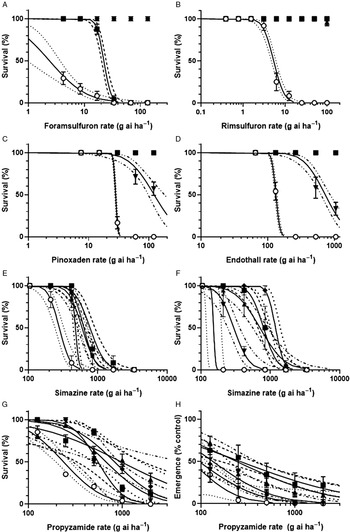
In turf management, Group 2 herbicides are commonly used for POST control of P. annua (Toler et al. Reference Toler, Willis, Estes and McCarty2007). However, this herbicide group is highly prone to the evolution of herbicide resistance, and to date, there are 160 weed species resistant worldwide (Heap Reference Heap2019). In the dose–response experiments with the Group 2 herbicides foramsulfuron and rimsulfuron, the S population was controlled with foramsulfuron at 2.7 g ha−1, and population R1 was controlled with 67.5 g ha−1 foramsulfuron, whereas no control of the three resistant populations R2, R3, and R4 was observed even at the highest rate used (135 g ha−1) (Figure 2A). Population R1 was 9.3-fold more resistant than the S population, and all other resistant populations were >56-fold resistant (Table 4). Similarly, the S population was controlled by 5.37 g ha−1 rimsulfuron, whereas no control of any R population was obtained, even at 100 g ha−1 (Figure 2B). All the R populations showed >19-fold resistance to rimsulfuron (Table 4). In our studies, populations R2, R3, and R4 exhibited strong resistance to both Group 2 herbicides tested, whereas R1 exhibited lower resistance to foramsulfuron (controlled at 67.5 g ai ha−1). Resistance to Group 2 herbicides has previously been observed in P. annua. Populations from South Carolina and Georgia were highly resistant to trifloxysulfuron, foramsulfuron, and bispyribac-sodium (Cross et al. Reference Cross, McCarty, Tharayil, Whitwell and Bridges2013), as was a population from Alabama (McElroy et al. Reference McElroy, Flessner, Wang, Dane, Walker and Wehtje2013). The variable response of R populations to the Group 2 herbicides observed in our study suggests the likelihood of different target-site mutations in ALS or the presence of a different resistance mechanisms (e.g., difference in uptake and translocation) in different populations.
Survival after 28 d of susceptible S (○) and resistant R1 ( ), R2 (
 ), R3 (
 ), and R4 (
 ) populations of Poa annua treated with foramsulfuron (A), rimsulfuron (B), pinoxaden (C), endothall (D), simazine in Experiment 1 (E), simazine in Experiment 2 (F), and propyzamide (G) at POST herbicide timing, and emergence following treatment with propyzamide (H) at PRE herbicide timing. Each point is the mean of eight replications of 6 plants, except for simazine, where it is the mean of four replications of 6 plants for each run. The lines are the probit curves back transformed to percentages with 95% confidence intervals: S (
 ), R1 (
 ), R2 (
 ), R3 (
 ), and R4 (
 ). Where no mortality occurred, probit analysis was not conducted and no curve was plotted. Data points are the means of eight replicates (four replicates for each simazine experiment) ± SE.

The dose required for 50% mortality (LD50) of susceptible and resistant Poa annua populations in response to various herbicides with 95% confidence intervals (CI) in parentheses.a

a R/S is the ratio of LD50 of resistant and susceptible populations.
Resistance to Group 1 Herbicides
Recently, pinoxaden was registered at up to 60 g ha−1 in the United Kingdom to control ryegrass (Lolium spp.) in fine-leaf fescue (Festuca rubra and Festuca ovina) in turf (Anonymous 2010). Poa annua is normally considered to be tolerant to Group 1 herbicides (Herbert et al. Reference Herbert, Cole, Pallett and Harwood1997); however, some herbicides in this group can provide control (Takahashi et al. Reference Takahashi, Yamada and Tanaka2002). The S population was controlled with 60 g ha−1 pinoxaden in our experiments showing it was susceptible to pinoxaden (Figure 2C). In contrast, populations R1, R2, R3, and R4 were not controlled with this rate of pinoxaden. The four R populations exhibited different levels of resistance to pinoxaden (Figure 2C). Population R3 was 4.3-fold resistant to pinoxaden, whereas the other three populations were >4.3-fold resistant (Table 4). To date, 48 weed species have been reported to be resistant to the Group 1 herbicides (Heap Reference Heap2019).
Resistance to Endothall
Endothall was one of the first herbicides registered to control P. annua in turf. Control of the S population was achieved with 525 g ha−1, whereas no control of the R populations was observed even at 1,050 g ha−1 (Figure 2D). Population R3 exhibited lower resistance (5.5-fold) than the other resistant populations (>7-fold; Table 4). Endothall resistance has not been reported in any weed species other than P. annua (Heap Reference Heap2019). The mechanism of action of endothall is not well understood; however, inhibition of serine/threonine protein phosphatases 1 and 2A are thought to be the targets (Bajsa et al. Reference Bajsa, Pan, Dayan, Owens and Duke2012; Tresch et al. Reference Tresch, Schmotz and Grossmann2011).
Resistance to Group 5 Herbicides
Simazine is a POST herbicide most widely used to control P. annua in turf. Simazine at the recommended rate of 840 g ha−1 controlled 94% of the S population, but only caused 20% mortality in the four resistant populations, equating to 2- to 8-fold resistance (Figure 2E and F; Table 4). There was a significant effect of run for the simazine dose response, suggesting environmental conditions could affect the response of populations to the herbicide. LD50 values were different between the two runs for the S population and populations R3 and R4 (Table 4); however, there was no consistency in these differences. Group 5 resistance was first reported in P. annua more than 40 yr ago in France, after 10 yr of repeated exposure to simazine (Darmency and Gasquez Reference Darmency and Gasquez1983). Resistance to Group 5 herbicides has been observed widely in P. annua in the United States, having been reported in Oregon (Mengistu et al. Reference Mengistu, Mueller-Warrant, Liston and Barker2000), Mississippi (Hutto et al. Reference Hutto, Coats and Taylor2004; Syvantek et al. Reference Svyantek, Aldahir, Chen, Flessner, McCullough, Sidhu and McElroy2016), Tennessee (Brosnan et al. Reference Brosnan, Breeden, Vargas and Grier2015) Alabama, North Carolina, and Virginia (Heap Reference Heap2019). Hutto et al. (Reference Hutto, Coats and Taylor2004) identified simazine resistance in P. annua from 43% of golf courses sampled in Mississippi. This extent of resistance is less than observed in the samples tested here (Table 3). The level of resistance to Group 5 herbicides in the United States (Brosnan et al. Reference Brosnan, Breeden, Vargas and Grier2015; Kelly et al. Reference Kelly, Coats and Luthe1999; Syvantek et al. Reference Svyantek, Aldahir, Chen, Flessner, McCullough, Sidhu and McElroy2016) appears to be much greater (more than 1,000-fold) than in the Australian populations examined. These populations, while surviving 840 g ha−1, the field rate for Australia, could be controlled by the highest rate used, 3.36 kg ha−1 (Figure 2E and F). Therefore, these populations may be less of a problem in situations where a higher rate of simazine can be used. As target-site mechanisms typically result in high levels of resistance to Group 5 herbicides (Ashworth et al. Reference Ashworth, Han, Knell and Powles2016), it is likely that NTSR could be responsible for the 2- to 8-fold resistance observed in the populations in Australia.
Resistance to Propyzamide
Propyzamide, an inhibitor of microtubule assembly, is used for PRE and early POST weed control in golf courses. In the dose–response experiments, complete control of the S biotype was obtained at the recommended rate of 500 g ha−1 propyzamide applied PRE, whereas 1,000 g ha−1 applied POST was required for complete control. Resistance to POST propyzamide was confirmed in populations R1, R2, R3, and R4 (Figure 2G), with resistance ranging from 2.0-fold for population R3 to 4.1-fold for population R2 (Table 4). The level of propyzamide resistance was much lower in the PRE treatment (Figure 2H). Only population R1 had an LD50 different from the S population for PRE propyzamide and was 3.3-fold resistant.
To date, P. annua is the only weed species in which resistance to propyzamide has been confirmed. In Georgia, USA, McCullough et al. (Reference McCullough, Yu and Czarnota2017) reported resistance to POST application of propyzamide (>10-fold), whereas in our experiments, resistance PRE and POST resistance was confirmed, but the levels of resistance were less than 5-fold. In a recent study, a biotype of ryegrass (Lolium spp.) showed 2.7-fold resistance to propyzamide used PRE (Brunton et al. Reference Brunton, Boutsalis, Gill and Preston2018). Our experiments show that P. annua populations from golf courses in Australia have evolved resistance to both PRE and POST applications of propyzamide, which could cause control failures.
Target-Site Mutation Identification
ALS Gene Mutations
Target-site resistance to Group 2 herbicides is a result of missense mutations causing amino acid substitutions at any of eight sites in ALS: Ala-122, Pro-197, Ala-205, Asp-376, Arg-377, Trp-574, Ser-653, and Gly-654 (Brosnan et al. Reference Brosnan, Vargas, Breeden, Grier, Aponte, Tresch and Laforest2016; Délye et al. Reference Délye, Wang and Darmency2002b; Heap Reference Heap2019; Yu et al. Reference Yu, Han and Powles2008). The ALS gene of five individuals, out of the 24 treated, from each population that had survived the field rate of herbicides, was sequenced to investigate the presence of a target-site mutation. An amino acid substitution at position 574 from Trp to Leu was present in all individuals of resistant populations R2, R3, and R4, whereas in population R1, all individuals had a Pro-197 to Ser mutation (Table 5). Population R1 showed variable response to the two Group 2 herbicides investigated (foramsulfuron and rimsulfuron). A Trp-574 to Leu amino acid substitution was reported to confer cross-resistance to multiple Group 2 herbicides in P. annua (McElroy et al. Reference McElroy, Flessner, Wang, Dane, Walker and Wehtje2013), and an Ala-205 to Phe mutation provided resistance to imidazolinone, sulfonylurea, triazolopyrimidines, sulfonylamino-carbonyl-triazolinones, and pyrimidinyl (thio) benzoate herbicides (Brosnan et al. Reference Brosnan, Vargas, Breeden, Grier, Aponte, Tresch and Laforest2016). Furthermore, the Pro-197 to Ser mutation has been identified as providing resistance to sulfonylurea herbicides in other weed species, including rigid ryegrass (Lolium rigidum Gaudin) (Yu et al. Reference Yu, Han and Powles2008).
Nucleotide and amino acid changes identified in herbicide target-site genes in resistant Poa annua populations.

ACCase Gene Mutations
Seven ACCase amino acid substitutions have been confirmed to confer resistance in weed species: Ile-1781-Leu, Ile-2041-Asn, Ile-2041-Val, Trp-2027-Cys, Gly-2096-Ala, Asp-2078-Gly, and Trp-1999-Cys (Délye et al. Reference Délye, Matéjicek and Gasquez2002a, Reference Délye, Zhang, Chalopin, Michel and Powles2003, Reference Délye, Zhang, Michel, Matéjicek and Powles2005; Liu et al. Reference Liu, Harrison, Chalupska, Gornicki, O’Donnell, Adkins, Haselkorn and Williams2007; Zhang and Powles Reference Zhang and Powles2006b). An amino acid substitution at position 1781 from Ile to Leu was identified in all five individuals from each of the four resistant populations (R1, R2, R3, and R4) (Table 5). However, population R3 was not as resistant to pinoxaden as the other populations (Figure 2), which suggests other mechanisms may play a role. The Ile-to-Leu substitution at position 1781 has been identified in other grass species resistant to Group 1 herbicides (Zhang and Powles Reference Zhang and Powles2006a). This mutation has previously been identified in P. annua (Délye and Michel Reference Délye and Michel2005). Those authors considered the mutation to be the likely source of the inherent tolerance of P. annua to some Group 1 herbicides. However, the susceptible populations in our study had Ile at position 1781. This suggests there may be different lineages of P. annua with and without this mutation. Further research would be required to confirm this.
psbA Gene Mutations
Previous studies have confirmed that resistance to Group 5 herbicides in many weed species is conferred by mutations in the highly conserved chloroplast gene psbA (Lu et al. Reference Lu, Yu, Han, Owen and Powles2019). Seven mutations resulting in amino acid substitutions at six positions (Ser-264-Gly, Ser-264-Thr, Val-219-Ile, Asn-266-Thr, Ala-251-Val, Phe-255-Ile, and Leu-218-Val) in psbA have been shown to confer resistance to Group 5 herbicides (Thiel and Varrelmann Reference Thiel and Varrelmann2014). The most common of these mutations, Ser-264-Gly, confers high levels of resistance to the triazine herbicide atrazine in P. annua and other weed species (Perry et al. Reference Perry, McElroy, Dane, Van Santen and Walker2012). Another report confirmed that the Val-219-Ile mutation provides resistance to psbA (metribuzin and diuron) in P. annua (Mengistu et al. Reference Mengistu, Mueller-Warrant, Liston and Barker2000). However, in our study, no mutations within the psbA gene were found in any of the populations (Table 5). Therefore, resistance to simazine observed in this study is likely due to a non–target site based mechanism or another mutation not reported previously in the literature. This is consistent with the moderate levels of resistance in the P. annua populations compared with the much higher levels of resistance due to target-site mutation reported for Group 5 resistance in P. annua populations elsewhere (Perry et al. Reference Perry, McElroy, Dane, Van Santen and Walker2012).
α-Tubulin Gene Mutations
Genetic evidence suggests that the herbicidal effects of the dinitroanilines amiprophos-methyl and propyzamide are related to microtubule function (Schibler and Huang Reference Schibler and Huang1991). However, no mutation in the α-tubulin gene was identified in plants from either of the resistant populations that had survived either PRE or POST propyzamide. It is therefore likely that the low level resistance identified in P. annua is non–target site based. McCullough et al. (Reference McCullough, Yu and Czarnota2017) reported that resistance to POST propyzamide in a population of P. annua from a golf course in Georgia, USA, was associated with reduced absorption and translocation.
Even though resistance to nine mechanisms of action has been confirmed in P. annua globally, there have only been two confirmed reports of multiple resistance, a biotype resistant to simazine and trifloxysulfuron (Brosnan et al. Reference Brosnan, Breeden, Vargas and Grier2015) and another resistant to prodiamine and glyphosate (Breeden et al. Reference Breeden, Brosnan, Mueller, Breeden, Horvath and Senseman2017). In this study, 31 populations of P. annua from golf courses that were not being adequately controlled with herbicides were tested for herbicide resistance. Resistance to multiple mechanisms of action was confirmed in all populations. Dose–response experiments conducted with four of these populations confirmed resistance to propyzamide, simazine, rimsulfuron, foramsulfuron, endothall, and pinoxaden. High levels of resistance to rimsulfuron, foramsulfuron, endothall, and pinoxaden and lower levels to propyzamide and simazine were confirmed. Only a single susceptible population from an area where herbicides had not been applied was used in this study. It is possible that this population may not have been representative of the susceptibility of P. annua to herbicides. This means that the resistance ratios reported here could be different if another susceptible population was used. This would not affect the conclusion that the populations were resistant to the Group 1, Group 2, or Group 27 herbicides, but could do so for resistance to the Group 3 and Group 5 herbicides. Known target-site mutations were identified in ALS and ACCase, but not in PSII or α-tubulin. Therefore, future research should aim to explore mechanisms of NTSR in these populations and response to herbicides from different site-of-action groups. Poa annua is primarily a self-pollinated species (Ellis Reference Ellis1973), so multiple resistance may have arisen from sequential selection with multiple herbicides over an extended period. The turf managers indicated that most of the sites had received multiple applications of different herbicides each year for at least the past 10 yr, showing a high intensity of selection for multiple resistance. However, Ellis (Reference Ellis1973) suggests up to 15% outcrossing can occur in this species, which provides the possibility of accumulation of herbicide-resistance traits through cross-pollination. The extensive amount of herbicide resistance present and the limited nonchemical methods available means that management of multiple-resistant P. annua in turf will be challenging.
Acknowledgments
This research was supported by the Grain Research and Development Corporation (GRDC) and an ASI (Adelaide Scholarship International) awarded to RB. The authors acknowledge Ruwan Lenorage and Geetha Velappan for technical assistance with herbicide application and Tijana Petrovic for technical support in lab work. No conflicts of interest are declared.