IN 1856, WHEN MANY VICTORIAN PHYSICIANS WERE STRUGGLING TO DEFINE A MODEL OF CLINICAL MEDICINE, the reviewer of one collection of case histories voiced his dismay at the physician-author's preference for “dreadful incidents” and “cases exceptional and strange” (“Works” 473). Indeed, although physicians of the clinical era did not disguise their efforts to achieve a new kind of discourse, productive of a “realist” vision, few acknowledge how often the “clinical” case history of the nineteenth century also shares the romantic discourse of the Gothic, especially its interest in the supernatural and the unexplainable and its narrative aim of arousing suspense, horror, and astonishment in the reader. Literary critics have also focused primarily on the association of medical narrative with a realist literary discourse.1
The connection between an Eliotan realism and clinical medicine has been productively discussed by Rothfield and Logan, among others.
Nineteenth-century physicians did campaign for the formal, objective, and professional clinical discourse that serves as their contribution to a realist aesthetic, in the process explicitly rejecting eighteenth-century medicine's fascination with “the curious” and its subterranean affiliation with the unknown, the unexplainable, and the subjective. But, as I show in this article, a discourse of “the curious,” allied with a Gothic literary aesthetic, stubbornly remained a critical element of many case histories, though it often presented under the mask of the more acceptable term, “interesting.” The discourse of Gothic romance
2 I use “romance” in this essay to refer broadly to the tradition from which the Gothic emerges. See Richter, Duncan.
in the case history provides a narrative frame that, unlike the essentially realist clinical discourse, could make sense of the physician's curious gaze, which had become nearly unrecognizable as a specifically medical vision. Indeed, a “curious” medical discourse haunts even case histories of the high clinical era, late in the century; and it energizes the nineteenth-century Gothic novel. Samuel Warren's novel
Passages from the Diary of a Late Physician–deplored in the quotation above–illuminates this tradition of “Gothic medicine” as it plays out in the nineteenth-century novel. This tradition, I argue, provides the novel with a powerful model of cultural contamination and conflict in its yoking of disparate discourses. Gothic medicine demonstrates the importance of clinical medicine to literary romance, and it cannot help but reveal the ghost of “the curious” in the clinic.
Samuel Warren's Case Fictions
THE VEXED RELATION OF LITERARY AND “CURIOUS” DISCOURSES in the novel and the case history in the first half of the nineteenth century crystallizes in the volatile public reception of Samuel Warren's Passages from the Diary of a Late Physician, a novel serialized in Blackwood's Magazine from 1830 to 1837 and then issued in hardcover. This series of fictional case histories, loosely framed by an introductory chapter depicting the narrator's start in medical practice, evidently fascinated both lay and medical readers. It enjoyed an impressive publishing success both in Britain and abroad throughout the Victorian period, going through five editions in as many years. It was widely reviewed again in 1856, when Warren published his collected Works, and appeared in a new edition as late as 1905. In contrast to Warren's successes in the nineteenth century, the Diary and its author (who was indeed trained as a physician) have now virtually disappeared from critical view.3
The Diary was translated into multiple languages and reprinted numerous times in Britain and America. The Dictionary of Literary Biography claims that Warren's works “threatened for a while to surpass those of Charles Dickens” in popularity (Bowers 335).
The widespread and longstanding publishing success of this novel, with its focus on “the curious,” threatened the status of the case history as a genre and its validity as scientific evidence. It called into question the claim of the clinical case history to represent true depictions of episodes based on real patients and historical events, and to maintain a decent, professional distance from a proper subject of investigation. Thus, although Warren's case histories strove to enlist the reader's benevolent identification with a physician portrayed as hardworking and sensitive, the narrator's exaggerated sympathy, overbearing moralization, and curious interests ultimately represented a challenge to the nineteenth-century medical community, which aimed to produce itself as objective, professional, discreet, and above all truthful. That same curious exaggeration, especially because it was presented through the graphic detail of a medical lens, likewise outraged literary critics as an offense against good taste, even as it delighted the reading public.
Although they are fictional, these “diary excerpts” make use of the common convention of pretending to be true, with Warren himself posing as the editor rather than the author of the papers.4
Warren presents himself to Blackwood's as “publishing in your Magazine these papers of my late friend” (1: 74). The Diary purports, of course, to be excerpts from a diary, not from case histories per se. But many case histories of the time existed not as published articles in medical journals, nor as official hospital records, but as jotted notes in a physician's personal journal. See, for example, Brownrigg. As such the Diary does represent the case history in a historically-specific form. And, as readers' responses showed, many read the standards of the case history onto this collection.
In a running series of footnotes and asides, Warren avers over and over again that the scenes he portrays represent historical truth. After detailing the case of “The Turned Head,” Warren rattles off a series of similar cases to refute the charge of “[o]ne of the papers” that “the foregoing is ‘pure fiction’” (1: 204). At the conclusion of the sad tale of “The Wife,” he admits that “[v]ery many inquiries … have been made as to the veracity of its details. I would to Heaven that, for the honour of humanity, I could say the principal incidents narrated had no other basis than fiction! I solemnly assure you, reader, that they are true” (1: 234–35).
The florid vehemence of Warren's expostulations should have alerted his audience that his work was more romantic than real, but at least some medical readers believed the series to be truly “the diary of a late physician.”5
Blackwood's, in its obituary of Warren in 1877, explained that “the detailed exposition of feeling …[in Warren's novels] tends greatly to preserve the illusion of naturalness and probability…. In this way the passages from the Diary come to have all the vraisemblance of a real record of medical experience…[and] were sufficient to impose upon the [medical] Faculty of the day” (“Samuel” 387). As I will show, Warren's focus on feeling and sensation, praised here as evidence of his realist literary skill by his publisher, prompted outcries from literary critics, who perceived it instead as sentiment and sensation-mongering.
In fact, the ambiguous factuality of these “case histories” roused anxiety in the medical community, the history of which is legible in Warren's many protests against the incivility of his readers. A letter in the
Lancet charged him with “
disclosing to the public the sacred secrets which are communicated to us in perfect confidence by our patients, and ought to be preserved inviolable” (M.D. 879), a criticism which prompted Warren to pen a lengthy rebuttal.
6 Warren reprinted his reply as a note inserted at the beginning of chapter seven (1: 73).
The
London Medical Gazette, on the other hand, accused him of literary plagiarism, earning another rebuttal (1: 149). Warren himself exacerbated the situation by, on the one hand, swearing to the truth of his case histories while, on the other, coyly refusing to identify the original author of this exuberant, colorful “diary.” The well-known and respected Dr. John Ayrton Paris, had to defend himself against suspicions that he had authored the
Diary (Seccombe 424). Even Warren's eventual disclaimer (in his introduction) stubbornly retains his fiction of factuality, explaining only that “the various names which have been pitched upon, in the papers, as those of the writers of this Diary, are
all of them totally erroneous, and that it has, in particular, no claim whatever to the honourable names of ‘Dr. Gooch, Dr. Armstrong, or Dr. Baillie’” (x–xi).
7 British Authors of the Nineteenth Century comments that, due to the publication of Warren's Diary, “a well known doctor [not named] … narrowly escaped expulsion from his profession on the charge of having betrayed medical secrets” (645).
Moreover, despite their sensational bent, the pose of these chapters as true histories at times mimicked the clinical case history closely enough–especially given that they had been purportedly “edited” for a lay audience–that one could not definitively declare them fictional rather than nonfictional, literary rather than medical in nature. Although, as I will show later, most of his prose was overwhelmingly melodramatic, Warren included enough medical detail to support the pretense that the narrator had encountered these cases in his role as a medical advisor. For example, the patient in the chapter titled “The Spectre-Smitten”
began … to utter long deep-drawn groans, that gradually gave place to the heavy stertorous breathing, which, with other symptoms–his pulse, for instance, beating about 115 a-minute–confirmed me in the opinion that he was suffering from a very severe congestion of the vessels of the brain. I directed copious venesection–his head to be shaven, and covered perpetually with cloths soaked in evaporating lotions–blisters behind his ears, and at the nape of the neck–and appropriate internal medicines. (1: 255)
Despite his long, periodic sentences–anathema to medical advocates of plain speech–Warren here gestures toward the conventions of the clinical case history. He ticks off a series of symptoms indicating his physical examination of the patient, offers his diagnosis, and follows up with his treatment. He offers this information with a fair amount of precision (“about 115 a-minute”) and with reference at least occasionally to clinical discourse (“a very severe congestion of the vessels of the brain”).
The clinical realism of Warren's tales rendered the medical community vulnerable to criticism when his narrator chronicled less-than-professional behavior, however. In “The Turned Head,” Mr. N———suffers from the delusion that his head has been turned around backwards. The narrator “cures” the problem by wrenching the blindfolded patient's head violently just as two other doctors give him an electric shock to the neck. This use of what early nineteenth-century physician Joseph Mason Cox recommended as a “pious fraud” (58–59) potentially poses grave problems for clinical medicine. Although Cox's textbook on insanity reached a third edition in 1813 and was praised even late in the century as “the best medical treatise of the day on insanity,”8
It was psychologist D. H. Tuke who praised Cox so highly (qtd. in Small 40).
the efficacy of his method depends on the physician's deliberate deception of his trusting patient. Physicians hardly wanted to advertise this model of treatment to the public as their usual practice, for, as critic Helen Small notes, it demonstrates “not medical expertise but … power” (44).
Indeed, “The Turned Head” acknowledges that the physician's attitude toward his patient could damage his reputation, and that of his profession at large. The physician narrator, on finding Mr. N———dressed backwards, gives vent to “successive shouts of laughter–for [he] found it impossible to stop…[in an] ecstasy of laughter, almost bordering on frenzy” (1: 199). The pose of clinical investigator is altogether lost in this scene, which displays a kind of emotional orgy shared with his consulting colleague. Indeed, when a neighbor, Mrs. M———, spies the physician “laughing immoderately” after one visit, she concludes that he was “in the habit of ‘making [him]self merry at the expense of [his] patients!’” (1: 198). In just the same way, Warren's tale itself, meant to be amusing and engaging, endangers the serious reputation of clinical medicine. The Mrs. M———s in his audience could read “The Turned Head” as evidence of the condescending, deceptive tactics practiced by physicians. The “pious fraud” could not deny its roots in “funny business”–its combination of slapstick humor and amateur dramatics, coupled with the same fraudulent tactics that made the “quackery” of sectarian (alternative) medicine so despicable in the eyes of clinical medicine. As such, this case threatened the professional credentials of clinical medicine in their vulnerable infancy: it may have enhanced medical credentials with its successful cure, but it also memorably demonstrated a fundamental similarity between medical treatment and carnival tricks.
This lack of emotional mastery or professional behavior in the narrator suffuses the novel. Warren explicitly renounces the pose of the distanced, objective observer, the attitude valued by clinical medicine.9
In fact, an early edition of the Diary was titled Affecting Scenes: Being Passages from the Diary of a Physician (New York: J. & J. Harper, 1831).
He endangers the professional standing of the physician by insisting on his subjective embodiment rather than his rational, distanced perspective. When installing one pathetic patient in a new cottage (in “The Magdalen”), for example, the physician narrator admits, “I am not ashamed to acknowledge, that I felt so overpowered myself with my feelings, that I was compelled to quit the little room abruptly, and recover myself presently in the garden” (2: 97). Such affective dis-order reads, within a clinical medical context, as illness, blurring the distinction between physician and patient by communicating to him a pathological symptomatology. Indeed, just as the narrator's “whole frame ach[ed] with the profound convulsive fits of irrepressible laughter,” above (1: 199), his “heart aches” at the tragic madness of another patient (2: 446). While Warren means to cast the narrator as a sensitive and caring physician, his effect is instead to show how thoroughly the physician's observations are subject to the distorting, disruptive, and feminizing effects of his overwrought emotions.
Indeed, the blurring of the boundary between fiction and fact represented only Warren's initial trespass against the code of the clinical case history. Warren's stylistic choices compounded his offence by looking to a sentimental, lowbrow literature and gesturing toward the necessarily subjective stance of even the physician. He thus aligned himself with the prose traditions farthest from the gentlemanly ideal of scholarly rumination that the ambitious medical community valorized as a literary model. His persistent trumpeting of a sensationalist discourse is unhappily reminiscent of the old-fashioned, “curious” case history of the eighteenth century: a first-person narrative in which the physician is not an objective, distanced, and analytical observer of medical phenomena, but rather a highly-strung character amplifying the high emotional tensions of an incredible scene.
Unfortunately for Warren, the definition of appropriate medical discourse was a sensitive topic in the clinical medical community, which was busy denying its roots in “the curious.”10
See, for example, Fordyce and Stillé (33–46) for examples of Warren's contemporaries' attempts to decrease medical reliance on nonfactual “evidence.”
Nineteenth-century physicians recognized that the value of medical evidence is dependent on the perceived reliability of its vehicle in prose, the case history. Medical knowledge is thus imperiled by either a fraudulent or a sensationalistic record, for if the first lacks authenticity, the second lacks the authority implied by a pose of objective distance. Warren's series of case histories fails on both counts. That is, the
Diary–because it flaunts both the ambiguity of its antecedents and its own hyperbolic sensationalism–popularized a model of the medical case history that not only cast doubt on its truth but highlighted the physician's “interest” in his most graphic, fantastic, and dramatic cases. Warren's popular portrait of the “interested” physician, in fact, represented a threat to the professional ambitions of clinical medicine in the mid-nineteenth century.
The Campaign Against “Curious” Medicine
Our only safeguard against the spirit of quackery…is continued recurrence to the scientific basis on which the practice of medicine rests. Our art is most satisfactory and efficient when most closely resting on science.
—Pye-Smith, “Medicine as a Science and Medicine as an Art”
W
HEN PHILIP HENRY PYE-SMITH, an elite physician and surgeon, wrote these words in 1900, he was writing out of a decades-long struggle of clinical medicine against the “irregular” or “sectarian” medicine that required subduing in part because it represented medicine's “curious” past. The clinical case history was significantly shaped by this struggle over what would become accepted as standard medical practice. A discourse of “the curious” had typically emerged, in the eighteenth-century case history, at the points where a medical knowledge base failed the physician in his quest for explanation and cure. After the increased focus on clinical, scientific discourse in the nineteenth-century case history, the appearance of “the curious” became more and more disruptive of the text. Its association with the image of the physician as voyeur and/or the patient as spectacle impugned even the alternate, more respectable stance of “curiosity”–that which describes the physician's skeptical, exploratory observation–
to the degree that the term “curious” began to disappear from the case history altogether. The physician's “curious observation” itself persisted, appearing more commonly than is usually acknowledged, although it was renamed “interesting” in a curtsey to the precepts of clinical medicine.
Among the first indicators of the campaign against “the curious” in clinical medicine, the professionalizing movement (figured as a “reform”) strove to exile any curious practices from its armamentarium, and curious practitioners from its ranks. This most often meant excluding treatments and theories considered speculative or deceptive, or too closely linked to popular belief rather than to formal medical training–which was itself haphazard in content, uneven in quality, and largely unregulated throughout much of the century.11
Medical schools affiliated with hospitals, providing intensive clinical training for all students, were rare until the latter half of the century. The Medical Act of 1858 established ground rules for licensure, but there was no universal exam until 1884. Physics, chemistry, and biology were not universally required for entry into medical schools until the 1880s. See Peterson 5, 60–64, 241 and Warner, Therapeutic 170–75, 270–77.
Just as the clinical case history came to value plain over romantic speech and the normative over the extraordinary case, clinical medicine worked hard to define norms of practice, purportedly in order to discourage fraudulent or inept practitioners and increase public confidence in the profession as a whole.
12 For the lack of public confidence in establishment medicine, see Peterson 38, 90. Ironically, physicians also complained that the public had too much confidence in sectarian medicine. Homeopathy and other peculiar practices had rapidly established colonies of support in influential sectors of the patient population. A primary danger of such “quackery” was its ability, by entrancing the lay public, to exclude “regular” medicine from its usual, and profitable, domain. By professionalizing and regularizing care, by repudiating both the quacks and the older, harmful “heroic medicine” as unscientific, and by distancing their work from the craft of surgery and the trade of apothecary, reformist physicians hoped to regain market share and public trust, and to secure a position in the powerful new professional class. However, as George Eliot's Middlemarch shows, patients themselves were not sure they wanted reformist, professional physicians.
The Lancet, a radical journal supporting the newly-emerging professional class, was at the forefront of the reform movement. It was known for its fierce attacks on homeopathy, hydropathy, mesmerism, and other approaches considered “sectarian” and unreliable by the “regular” (allopathic) medical establishment. The Lancet's editor, the surgeon, radical reformist, and general gadfly Thomas Wakley, positioned the journal, which he founded in 1823, as an alternative to establishment medicine; but it rapidly became both powerful and influential in its own right. Driven by the goal of grounding medicine as a science unswayed by personal interests or unfounded beliefs, the Lancet published case histories informed by clinical ambitions and (despite Wakley's radical politics) broadly representative of the practice of regular medicine in Britain.13
The Lancet was perhaps best known for reformist zeal, although The London Medical and Surgical Journal also exposed incompetent practitioners (Crawford 223). Overall, medical journals provided a central force for reform. See Crawford and Warner, “Idea” 138–42.
Case histories frequently served as rhetorical ammunition in the Lancet's pages. In an 1850 editorial, the Lancet includes a brief case history to show that the fad of homeopathy14
Homeopathic physicians treat symptoms with an infinitesimal dose of whatever provokes those symptoms.
demonstrated equal parts “knavery” (by the practitioners) and “idiocy” (by the patients):
A lady, who had gone the round from mesmerism to hydropathy, had an attack of pericarditis.15
Pericarditis is an inflammation of the lining of the heart.
The symptoms were plain and unmistakable. The subject of it had been thoroughly convinced of the truth of homeopathy, and placed implicit confidence in her homeopathic attendant. His effrontery, however, quailed before a disease so earnest and energetic as pericarditis, and he requested that some regular physician should be called in to treat the malady. A physician was summoned, who ordered depletory measures. But, although the homeopath himself ran from his flag, the poor lady refused to do so. She refused all remedies and medicines, and died most miserably, after a day or two, leaving her family to deplore an infatuation but little removed from insanity. ([Editorial] 179)
The
Lancet's rhetoric here aligns the “regular physician” with the family, lumping homeopathy together with mesmerism and hydropathy, other suspect sectarian practices. The editorial damns the homeopath by figuring his claims as the empty boast of a coward in battle: his knowledge and experience are revealed as an “effrontery” that “quails” before serious illness and the homeopath himself is unmasked as a traitor who “ran from his flag,” his strength too dilute to stand up even for his own livelihood. The unfortunate patient's homeopathic faith–an “infatuation,” almost an “insanity”–becomes instead the agent of evil, standing in for the physical cause of her death from cardiac causes. Indeed, the case history figures her almost as a victim of seduction, a woman whose “infatuation” with sectarian medicine leads to her death from, literally, a broken heart. Even here, in the service of a plea for dispassionate scientific medicine, the case history as a genre demonstrates its ability to evoke and express emotion, whether indignation, ridicule, sentiment, or even (as I will show) horror.
In fact, because the borders of professional medicine remained fuzzy well into the nineteenth century, the case history, as the public face of medicine, became a crucial site in which to construct an ideal of clinical medicine against the onslaught of sectarian methods. The historian John Harley Warner comments,
In order to set themselves apart from sectarians, regular physicians continually had to reaffirm their regularity…. [Thus] the appearance of unity was an essential goal that demanded carefully guarded conduct in therapeutic discourse, [with criticism limited to] proper …forums …, [chiefly] medical journals and society meetings. (Warner, Therapeutic 182)
If, as Warner claims, professional identity was largely constructed through the policing of its discourse, then the changes in the case history–the fundamental textual vehicle for medical information and the building block for texts of broader scope, such as monographs and textbooks–significantly contributed to establishing the credentials of clinical medicine. And the opposition between quackery and science evident in Pye-Smith's warning to his colleagues, in my epigraph to this section, meant that the clinical case history had to foreground its use of a scientific discourse in order to signal the seriousness of the medical knowledge production at work in the text.
The battle against sectarianism stands in for and amplifies clinical medicine's embarrassed rejection of its past fascination with “the curious.” The attempt to discredit sectarian practices asserted the professionalism of regular medicine by implicitly disavowing its curious past as well as asserting its clinical present. In this way clinical medicine defined itself in opposition not only to disciplinary others but to its own disciplinary ancestry as well.
Warren's “late physician,” whether chuckling at his patient or tricking him into health, emblematizes a style of practice more in keeping with the more informal, personal approach of the old-fashioned doctor than that of the modern clinician aspiring to a highly-trained, objective gaze. When a physician like Warren hijacked medical terms, even the medical genre of the case history, to pose his fictions as fact, he jeopardized the rhetorical authority of other medical texts seeking to claim cultural status as professional, serious, and true.
Ironically, Warren's novel appealed to the public appetite for a floridly curious medical discourse just as the campaign to reform medicine began to suppress “the curious” in the nineteenth-century case history and mount attacks against some of the more spectacular offenders. Toward the end of the period in which “the curious” appears openly in case histories, it often clearly suggested the carnivalesque or the miraculous, demonstrating the migration of this construct toward a nonmedical, unprofessional fascination with the unusual, and the dying away of other usages of “curious” (such as “skillfully crafted,” “rare,” “of medical interest,” or “worthy of study”) that could have remained coherent within a clinical project. Among the last to advertise cases as curiosities, a decision which cost the author in professionalism what he gained in public interest, are Thomas Barnes, in his “Account of William Dempster, who swallowed a table-knife nine inches long with a notice of a similar case in a Prussian knife-eater” (1824) and William Reid Clanny, in “A faithful record of the miraculous case of Mary Jobson” (1841). Surely one of the last uses of “curious” in a reputable medical journal must be “A Menstruating Man: A Curious Form of Hermaphroditism,” published in the British Medical Journal by William Rushton Parker in 1899 (272).16
This case may have compelled such an outdated description because of its overdetermined curiosity: this patient, “A.B.,” is not only a hermaphrodite–that staple of the eighteenth-century “curious” case, with its explicit interrogation of sexual and gender boundaries–but also a “curious form” of hermaphrodite who menstruates. Dreger argues that nineteenth-century medical theory kept raising the bar of what was a “true hermaphrodite” (A.B. qualifies under some classification systems, sporting gonads of both sexes), with the result that fewer and fewer cases of hermaphroditism could be classified as such, effectually eradicating that particular category of curiosity (139–57).
In fact, the term “curious” had become a rarity in medical discourse by the mid-nineteenth century. The collections of medical curiosities published in the nineteenth century–such as J. G. Millingen's in 1838, or George Gould and Walter Pyle's in (unbelievably) 1897–were not received as serious medical monographs, though their bulk attests to Millingen's and Gould's ease in finding, and transposing, so many cases from respectable medical publications into their reprinted collections of “curious” cases.
17 Gould's nearly one-thousand page, densely printed tome references cases gathered from over seven hundred medical texts and journals, and his bibliography reads like a who's who of nineteenth-century medical professionalism. The extent of this proliferation of curiosity can be appreciated more clearly given that Gould fills over 900 pages with curiosities even while alloting generally only a sentence or two to each case. Moreover, Gould is far from exhausting the field in his survey of the most well-known curiosities; most curious cases (including the case by Chapple that I will discuss later in this article) do not appear in his text.
Indeed, Millingen's American editor takes pains, in his Preface to the work, to deny responsibility for its more dubious content and present it as light reading for a broad audience.
The proponents of clinical science, who proposed themselves as both more objective and more skeptical than the gullible amateurs of the eighteenth century, measured their progress in part by the rapid-fire offensive they trained upon such curious claims, a skirmish conducted in a series of case histories. In 1863, for instance, Lewis Albert Sayre offered a “Remarkable case of deception: A woman professing to secrete nothing but charcoal and stones for a number of years, all the natural functions being arrested, and the deception unmasked.”18
In another typical example of “deception unmasked,” Thomas Renwick published in 1817 a pamphlet, the “Narrative of the Case of Miss Margaret McAvoy” (with “some optical experiments” on what he later explained as “her peculiar powers of distinguishing colours, reading &c., through the medium of her fingers”). These claims invited rapid rebuttal by Joseph Sandars, who replied with “Hints to Credulity! Or, An Examination of the Pretensions of Miss M. M'Avoy, Occasioned by Dr. Renwick's “Narrative” of Her Case.”
This back-and-forth of claimants and debunkers was not new to the nineteenth century, but it throve upon the nineteenth-century fervor of truth-seeking that helped to solidify an incipient scientific community.
19 Barbara Maria Stafford talks about this gesture as a crucial component of the Enlightenment itself: “Most fundamentally, to enlighten meant unmasking charlatanism of every stripe by teaching the public its conning strategems…. Fear of contaminating pristine or authentic experience reached epidemic proportions in the second half of the eighteenth century” (74). In the case history, however, the enthusiasm for an unmasking “enlightenment” pervades the case history most noticeably in the early nineteenth century.
In the midst of such ostentatious skepticism, the use of the term “curious” or one of its synonyms in a case history could be considered a red flag inviting attack, as Warren's uneven reception, and the flurry of unmasking literature, testify. Physicians with unusual cases thus sought to balance their assertion of the interest and value of the case with a moderate tone, distancing themselves from the curiosity of the previous century. For example, the Lancet in 1850 published a “Case of Concussion of the Brain, with Displacement of the Vertebrae.” The patient, “Mary K———, aged twenty-five….fell from a window thirty feet high, alighting on her head” but “recovered without a bad symptom” other than an unusual “tumour” on the back of her neck, caused apparently by displaced vertebrae. The author, a Mr. H. M. Greenhow,20
The case is reported (with a drawing) by Mr. T. M. Greenhow, but Mary K is actually “under the care of” a Mr. T. M. Greenhow. The drawing is also by Mr. H. M. Greenhow. The title “Mr.” indicates that these practitioners lacked a college degree; they might have been general practitioners, surgeons, or apothecaries.
emphasizes how unusual this case is by reciting a triumphant list of his patient's nonexistent symptoms:
There is no pain, or paralysis, or other symptoms of compression of the cord. She uses her limbs with perfect ease, and has the proper control over them. Her mind is quite unimpaired. She has completely recovered from her other injuries. This case is worthy of observation, from the absence of all the symptoms which usually accompany any injury to the spinal cord. (392)
In other words, this patient's utter absence of symptoms after what could very well have been a fatal fall raises the status of her case to the extra-ordinary. An ordinary case of concussion certainly would not rate inclusion in this medical journal. In fact, the case of Mary K———might in the eighteenth century have been called “curious,” since this term often included unexpected survivals after major trauma (drownings, falls, wounds). But Greenhow, despite taking care to enunciate in what ways Mary K———'s course is “worthy of observation,” refrains from calling her case “curious” or from using, in fact, any other single word that might likewise trigger an association with sideshow frauds and tricksters or imply a less-than-objective stance. In other words, he refuses to summarize, with the term “curious,” what his presentation otherwise takes care to foreground: her
difference from the normative, expected case of concussion.
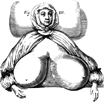
The case history of Mary K———thus displays its methodology as an instance of clinical (as opposed to curious) observation, a distinction especially clear when the illustration that accompanies Greenhow's text (Figure 3) is contrasted with the “curious” presentations common to an earlier medicine. The artist (her physician) renders Mary K———as a woman in profile, clothed in a wrap slipped away from her shoulders to reveal an unremarkable swelling on the back of her neck; the curve of the tumor could almost be taken for the edge of her far shoulder. The pose includes her hand protectively clutching the wrap over her bosom and carefully excludes any recognizable view of the woman's face, modestly shrouded in a bonnet and turned away from the artist. In contrast, consider the case of “very sudden and excessive Swelling of a Womans Breasts” that William Durston published in 1669, the heyday of the “curious” case; consider in particular the analogous but very different illustration Durston provides of Elizabeth Trevers (Figure 4).21
Although the Philosophical Transactions lists the author's name as “William Darston,” a later installment of the case (Philosophical Transactions 4.53, 1068–69) represents him as “William Durston,” which is also how the 1809 reprint edition of the Philosophical Transactions consistently spells his name.
She, too, wears a bonnet but faces the artist directly, exposing both her face and (of course) her prodigious breasts. Her arms curve around at her sides as though to frame her swollen chest. Trevers's face is expressionless and her eyes do not meet the reader's, signaling her ostensible disengagement with her audience. Other elements of the illustration, however, suggest that it solicits an interested response from viewers. Trevers's placid self-exposure in a full-frontal pose, and the artist's use of bold strokes and heavy shading to highlight her breasts in apparent three-dimensional perspective, underscore the voyeuristic “curiosity” of the viewer and the spectacular nature of the case, and belie the pose of objective distance that Durston otherwise attempts to convey. The understated portrayal of Mary K———, instead, suggests the subtle (almost ordinary) nature of the changes in her appearance, and highlights both her modesty and anonymity and the physician's and reader's distanced perspicacity of observation.
22 It is significant that the Lancet does not appear to have printed any images of women's breasts in the twenty years before it published Greenhow's case–even when the subject matter might have been more clearly conveyed with a careful rendering of the early stages of breast cancer, or the particular changes indicating a diagnosis of pregnancy–so it was not possible to find a more exact early-nineteenth-century comparison to Durston's startling illustration. The closest was a depiction of a patient's extremely advanced breast cancer, in Liston (309), but in this image the breast proper is not easily discernable, having been displaced by the tumor. This absence of the full-frontal breast from the pages of the Lancet during this period demonstrates how the struggle to professionalize medicine affected even the norms of medical portraiture.
The clinical case history's vexed relationship to the curious case history is here evident by its refusal to admit in itself the very element which brings it to the attention of the journal's readership: “the curious” as a vision of the extra-ordinary.
Mary K—. Illustration from H. M. Greenhow, “Case of Concussion of the Brain, with Displacement of the Vertebrae.” Lancet 2 (1850):392.
Elizabeth Trevers. Illustration from William Durston, “An Extract of a Letter Written by the Learned Dr. William Durston, Physitian at Plimouth, to the Right Honorable the Lord Vice-Count Brouncker as President of the R. Society; concerning a very sudden and excessive Swelling of a Womans Breasts.” Philosophical Transactions of the Royal Society of London 4.52 (17 October 1669): Figure III. Courtesy of Brown University Library.
However, nineteenth-century physicians' fascination with “the curious” was obscured more than eradicated. Explaining away “the curious” often served as another form of spectacle, as Sayre's debunking of the charcoal-secreting woman demonstrates. By ambiguously titling his pamphlet a “remarkable case of deception,” he both touts the “remarkable” and “unmask[s]” it as “deception.” Hence he manages to retain the rhetorical pull of curiosity upon the reader–playing upon his or her avidity for the unusual and the scandalous–while portraying himself as a skeptical, objective observer. Sayre performs with his title a verbal sleight-of-hand not unlike the kind of carnival trick he claims to debunk–drawing the reader's attention with a “remarkable case” only to substitute for it a “deception.” Less flamboyantly, Greenhow likewise deploys the force of curiosity while dissociating himself from its vulgar implications: he chooses to downplay the oddities of his case rather than not to publish it at all. Clearly, the current of interest in “the curious” in the nineteenth-century case history has been deflected into other channels rather than dammed up altogether.
The Ghost in the Clinic
GREENHOW IS NOT ALONE in his cautious sidestepping of “the curious” in a strange case that he nonetheless cannot resist presenting. Perhaps in an effort to avoid affiliation with the voyeurism and spectacularity of the eighteenth-century case history, the nineteenth-century physician often turns to the euphemism “interesting” to mask his interest in what earlier he would have termed “curious.” “Interesting” implied a professional propriety no longer available to a frankly curious physician, perhaps because it could refer to a merely out-of-the-ordinary case as well as a truly peculiar one. The British obstetrician Robert Lee, for example, uses the term to introduce an “interesting case” of crural phlebitis (inflammation of the crural veins) or an otherwise rare presentation of disease (304). “Interesting” thus suggested the rhetorical attraction of a curious case without, apparently, sacrificing conformity to the professional norms gradually being established.
“Interest” could also be suspect, however. Since the early days of natural philosophy, the ideal of experimentation included a demonstration of one's disinterested stance toward the objects of investigation. Although the clinical case history surely employs the term “interesting” to mean “worthy of further study,” the alternate meaning, in which “interest” connotes prejudicial influence rather than scholarly attention, could endanger its currency.
Worse, the term is also a staple of the sentimental novel, where it is closely linked with emotion, especially the painful emotions of distress.23
The sentimental novel and the sensation novel represent traditions distinct from the Gothic romance that is my focus, but they function similarly within the clinical case history as anti-realist discourses and as challenges to its objectivist ideology, and Warren's novel draws upon sentimental and sensational as well as Gothic discourses. Warren's use of what one might call “sentimental medicine” reflects a trend most evident in nineteenth-century obstetrical cases but also evident in medical and surgical cases such as, for example, the patient that the Lancet portrayed as “Poor Hoo Loo and His Tumour” in an 1831 surgical report from Guy's Hospital (“Removal”). Hoo Loo's 56-pound genital tumor is also a good example of the kind of sensational medicine Warren mimics in his novel, and demonstrates how often “curious” cases draw upon more than one mode of non-clinical discourse (sentimental, sensational, Gothic, romantic) in their efforts to frame their affecting tales.
It is used in particular to describe scenes designed to evoke sentiment and sympathetic identification, the very situation most carefully to be avoided by the would-be “disinterested” clinician. In particular, an “interesting” condition is an early-nineteenth-century euphemism for the sensations called forth in the observer of pregnancy and childbirth, especially in contexts which emphasize the woman's physical and emotional vulnerability. Warren uses the term in the chapter “The Wife” in order to comment on his patient's “delicate and interesting situation–within a very few weeks of her accouchement” (1: 213). Here the phrase emphasizes the pathos of the woman's physical and emotional “delicacy” as it is exacerbated by her sufferings at the hands of her drunken brute of a husband, and it prefaces not a description of her medical condition but a torrent of accusations against her abusive spouse. In medical examples, the physician Samuel Kneeland, Jr. typically discussed childbirth as an “interesting and painful function” (4), and
Copland's Medical Dictionary considered childbirth “the most interesting and suffering period of female existence” (qtd. in Holmes 104).
As is evident in these phrases, “interesting” often evokes the pain and suffering of the subject as an object of sympathy. The persistence in the clinical case history of what is “interesting” illustrates how strongly an undercurrent of subjectivity persisted in the “objective” science of clinical medicine. In fact, as with Sayre's case of “remarkable deception,” the discourse of the “interesting” points to a distanced, judicious observation while not quite concealing the subjective emotion that motivates it. “Interesting” thus suggests not only “of interest” but also “calling forth the emotion (especially the pity and sympathy) of observers.” As such, “interesting” descends directly from the eighteenth-century tradition of sensibility, in which virtue was measured in part by an observer's susceptibility to being moved by the sufferings of others. The term references the observer's subjective, affective relation to the observed, exactly the construct that clinical medicine wished to avoid. In other words, the popularity of the term “interesting” in mid-nineteenth-century medical texts complicates their claim to a distanced objectivity even as this term is called upon to substitute for–and to some extent to obscure–the tradition of “the curious” in the case history.
The term “interesting,” in fact, often signals the imminent derailment of clinical discourse, not just in a pretended case history like Warren's, but in actual medical reports as well, such as the “Interesting Case of Catalepsy Followed by Epilepsy in a Military Officer,” presented in the Lancet in 1875 by Surgeon-Major Chapple, of the Royal Artillery. Long after the demise of the term “curious” in the clinical case history, Chapple's article clearly demonstrates the persistence of a construct of “the curious” under the mask of “the interesting.”24
Because this case foregrounds its ambiguous relation to the stylistic imperatives of the clinical case history, it does not represent what clinical ideology valorizes as “typical” case narrative. Rather, it is useful because it presents quite frankly the symptoms of generic uncertainty that are repressed (but rarely entirely absent) in the “typical” case. Such “curious” cases, symbolic of clinical medicine's incomplete professionalization and lingering allegiance to an older, more openly-subjective medical culture, are in fact not uncommon.
Chapple attempts to manage “the curious” not only by renaming it “interesting,” but also by returning, repeatedly, to his clinical purpose. But Chapple also works to frame what is most “curious” in the case by selectively deploying discourses–especially from the Gothic romance–ostensibly off-limits to the clinical case history. A Gothic or romantic discourse, with its interest in the unreal and the subjective, seems clearly antagonistic to the aims of clinical realism. But Chapple's case history demonstrates that, although he must defend his use of these discourses, they paradoxically help his text mediate the even more disruptive presence of what is “curious” in the case by providing a context within which “the curious” is not only normal but expected.
25 Such Gothic or romantic case histories occur most frequently in reports on neurological or psychological illness. Forbes Winslow's often-reprinted 1860 monograph, On Obscure Diseases of the Brain, and Disorders of the Mind, for example, includes cases of ghosts, demoniacal possession, phantasms, “mysterious prophetic power,” speaking in tongues, uncanny powers of sight and hearing, and other “inexplicable facts” and “curious and inexplicable cases,” presented in narratives that, like Chapple's, alternately invite the reader's wonder and horror and demystify that response with clinical prose (See, for example, 128–30, 162, 196, 200–08, 217–20, 317, 365–69, 380, 464–65). This is not to say that Gothic cases do not occur in other medical specialties. The nineteenth-century Lancet alone presents startling narratives of galvanism (1835–36, 2: 526); a seemingly two-headed Chinese girl (1839–40, 2: 852); Marshall Hall's method of re-animation (1857, 1: 530–31, 565); ghostly blows in the eye (1857, 1: 573–74); being buried alive in what the author calls the “winding sheet” of a patent sail (1863, 2: 187–88), disembodied body parts (“Why, girls, there's my arm!” 1863, 2: 188); poisoning (1866, 1: 310–11); and debates over the possibility of suspended animation (1866, 1: 323, 360, 611) to name just a few examples. Most of these cases also, like Chapple, anxiously attempt to recuperate their slips into non-clinical discourse, presenting a hybrid narrative which seeks both to inform and to fascinate the reader.
The opening sentences of Chapple's report acknowledge at the very start the precarious position of this case history at the intersection of clinical, literary, and curious discourses. He sets the scene as an encounter between friends, complete with a detailed description of the setting. Chapple begins:
I received a message one morning, requesting me to see Captain J. B———, who, it was stated, was very ill. Captain J. B———'s house adjoined mine. I was there at once, and walked direct into the drawing room. To my surprise I found my supposed sick friend sitting at a writing-table, holding open before him an official letter, as I thought reading it. I wished him “Good morning.” Receiving no reply, I said, “I was told you were ill; what's the matter?” Still no answer. I was puzzled to account for his silence. We were not only on good terms, but intimate. (42)
This passage, with its odd combination of style (a brusque syntax consistent with clinical norms), setting (a contrived scene between friends suggestive of a romance), and content (a mysterious silence pregnant with “curious” overtones) confesses to the vexed position of the clinical case history unable to resist an “interesting” case. This opening passage stages a most curious scene, indeed, foregrounding the physician's own curiosity and initial inability to explain the mysterious silence of his friend. The captain's case, like that of Mary K———, merits publication precisely because there is something strange about it. Chapple is more willing than Greenhow to acknowledge his experience as unusual, although he is just as skittish about calling it “curious.”
Chapple's introductory passage does register, and manage, its curiosity in another way: by drawing upon a novelistic discourse. While he does adopt a plain style of writing with his curt sentences, Chapple quickly departs from the functionalist ideals of clinical discourse by including many statements of little or no medical value: the location of the captain's house; the course of the surgeon-major's own thoughts, as well as his feelings of first surprise (his friend appears to be well) and then puzzlement (his friend is certainly acting very strangely); even the precise nature of the friendship between doctor and patient.26
The pertinent medical facts only might read, “Upon responding to a report of illness one morning, the surgeon-major found his patient sitting in a catatonic state, in an apparently natural position but utterly unresponsive.”
These details, unnecessary (that is, ornamental) from a purely clinical consideration, and thus in violation of the precepts of plain speech, do fulfill a function in the text, although their achievements are more literary than scientific. They serve to present the scene in its most striking and memorable aspects; they establish the characters, their social position, and their relation to one another; they introduce a conundrum seemingly about the human character; and they work to engage the reader's own curiosity and interest in the outcome of this puzzle. For example, this brief introduction deftly stages the captain's mysterious silence and hints at three possible explanations for it, two of them more at home in a romance than a medical history: the captain is “cutting” his friend out of anger (the surgeon-major's first surmise, dismissed by the reassuring thought of their good friendship); the captain has been “struck dumb” by the contents of the mysterious letter (a prominent prop in this scene as well as in romantic plots); or the captain is indeed physically ill in some undefined way. In short, Chapple's case history opens by frankly acknowledging his initial lapse in medical knowledge and romanticizing both the curious presentation of his patient and his own curiosity as a physician and as a friend—all more-or-less suspicious matters given the stylistic ideals of the clinical case history.
By mediating these instances of “the curious” through the discourse of the novel, Chapple draws upon a mode of writing commonly employed to comprehend and manage the odd and unexplained, and to figure its narrator's curiosity as productive and necessary. Using this discourse implicitly sets the mystery of Captain J. B———within the context of similarly romantic stories in novels, rather than with other medical case histories, which claimed stricter norms of objectivity and efficient narrative. Thus the use of a romantic discourse can normalize both Captain J. B———'s strange silence–which turns out to be a catalepsy [catatonia] inexplicable in medical terms–and Chapple's own disconcerted fascination; but his use of such an unprofessional discourse must itself be explained.
Chapple was aware that his case history began in an irregular fashion. His prose registers his effort to wrench the story back into its properly generic confines, revising itself as a case history rather than a novel (a gesture that Warren, tellingly, makes only rarely). He defends his opening scene by explaining,
I mention these particulars to show how perfectly natural position and appearance were–indeed, so natural, that his wife, after addressing him several times and failing to get a reply or a look, went out of the room in tears. Not knowing what to think of such strange conduct, she sent for me. This was all the information his wife could give. (42)
Here Chapple re-casts his inclusion of these unexpected “particulars” as necessary medical evidence, showing the strangely “natural” appearance of the captain's catalepsy and introducing what little he is able to discover of what we now call the “history of present illness.” It is typical of the contested relation between curious and clinical discourse at this time that even Chapple's attempt to render his narrative style intelligible as medical discourse (by providing a medical rationale for his literary details) only compounds the romantic atmosphere of the case. Far from renouncing the literary style of his introduction, his purported apologia instead vividly and dramatically introduces yet another character and her emotional response to his inexplicable, persistent silence.
In fact, Chapple's entire narrative is punctuated by such irruptions of the curious in the midst of an explanatory clinical discourse; but his text works almost as hard to explain, contain, or reduce “the curious” as to showcase it. His title chooses to convey the moderated tone of what is “interesting” rather than “curious” about the case, and his text generally qualifies or limits his most curious statements (that the captain “remain[ed] poised … [in] positions, in health, impossible to be maintained without much muscular exertion”; that his muscles' creaking were “sounds to me new and startling”; that “[h]e had an infirmity [of temper] I have never seen equalled in any one” (42–43, emphasis mine). He is also careful to note when the captain's illness does fall within the expectations set up by the physician's knowledge and experience: “An epileptic fit, with the usual rapidity of its seizure set in; the fit was severe, but presented no uncommon features (43; emphasis mine).” And he interpolates such claims with more stolid statements indicative of judgment and medical authority. “[N]o doubt was left in my mind that he was fixed in catalepsy,” Chapple remarks by way of diagnosis. “His face was cold and pale…. Pulse slow and weak,” he later comments, with impeccably “plain” syntax (42). By establishing a pattern of presenting symptoms in curious terms, only to redeem them within a more clinical context, Chapple both suggests an alternate explanatory mechanism for the captain's curious symptoms and excuses this use of a non-medical, novelistic discourse which, although not unusual within the context of mid-nineteenth-century cases, did fall outside the bounds of recognized clinical medical discourse.
To mark the climax of the case, Chapple reveals the specifically Gothic allegiance of his narrative. He describes an eerie interruption to one meeting:
Capt. J. B———came to consult me. In the middle of our conversation he stood up, looked intently towards the door which was open behind my back, repeated questions in monosyllables, “Who?” “What?” “Yes”; at the same time leaning his body a little forward, though his feet never moved. Thinking there was some one at the door I turned round, but there was no person there. (43)
In content and style, Chapple's depiction of this episode highlights its most curious and romantic aspects. Captain J. B———'s mysterious conversation here perfectly balances and complements his earlier mysterious silence. By presenting the scene in the doctor's office in such dramatic fashion, complete with dialogue and stage directions, without a preliminary comment on what to expect, and with a superb sense of dramatic suspense, Chapple places the reader in his own position, surprised and alarmed to find “no person there”–or at least no earthly person. Was it a supernatural visitation, or merely the quite natural (though still dark to clinical knowledge) effect of a kind of static in the brain? Rather than prefacing this scene with an explanatory phrase (“during one attack, a brainstorm caused the patient to imagine a visitor in the room”), Chapple instead chooses–as Warren surely would–to dramatize the eerie visitor as a ghost in the clinic.
The captain's case history is possessed not just by any romance, it seems, but a Gothic one. In such a context, the appearance of the supernatural is as expected and unremarkable as other events–misunderstandings between friends, or bad news by letter. Chapple's almost offhand reliance on a more literary than clinical discourse here serves to frame “the curious” for his readers in a way familiar to them, likely to excite their appetite for his tale and (at least temporarily) deflect their disbelief by normalizing it within the frame of a romance. Moreover, Chapple's own curiosity in the pursuit of this case is excused and explained when he becomes the narrator of a Gothic romance, in which fascination with the unusual is expected.
However, while Chapple's use of a Gothic discourse definitively explains the presence of “the curious” and his own curiosity in the case, it presents a problem in its own terms, as becomes apparent by his (typically) speedy retreat from the creepy climax of his tale.27
The Gothic novel itself commonly performs a similar retraction of its most mysterious occurrences by explaining them in more mundane terms, as in Radcliffe's Udolpho.
With a swift stylistic shift by now familiar to readers, Chapple breaks the spell of the uncanny with a brisk return to clinical considerations. He writes,
I looked at my friend. He drew a deep breath and said, “I felt rather queer just now.” He had had the petit mal. A consultation for epilepsy interrupted by the patient getting a fit, not at once recognized by his medical advisor, may appear strange, but it is still more strange that voice, gesture, and expression of face should remain unchanged by epilepsy in its mildest form. Of course this was not usual; indeed, quite exceptional. (43)
Here the eerie conversation is reduced to “the petit mal”; “my friend” and “I” become “the patient” and “his medical advisor”; and what is most “strange” about this episode is not the queerly estranging appearance of the spirit world in the midst of the consultation, but the comparatively quotidian fact that the patient's affect “should remain unchanged” by the attack. That is, in the act of asserting what was “quite exceptional” about this case, Chapple also takes care to defuse its most explosive and spectacular aspects, re-entering them as marvels of disease rather than of the other world. He thus inscribes what is most peculiar about this case under the sign of the body rather than the spirit, the clinical rather than the curious–using clinical medicine to mediate “the curious” whenever it seems remotely able to contain it.
Indeed, if Chapple's indulgence of a Gothic discourse in this scene signals the presence of “the curious” in the case history, his overdetermined efforts to contain that discourse testify to the force of professional expectations pressuring him toward a realist clinical medicine. For Chapple works to normalize what is extraordinary about this scene in yet another way: he presents it as an individual response to disease, in the context of which (for this patient) the curious is expected. He says,
I subsequently saw Captain J. B———attacked by the petit mal under a variety of circumstances–on horseback (whip or sword or reins would fall out of his hands, but he never fell off), at table, &c., each fit presenting some novel feature. (43; emphasis mine)
This passage seems at first yet another exemplum of the curious in the freakish image of the captain's fits on horseback (he miraculously never falls off). But Chapple uses this image to reframe the preceding one (the ghostly conversation) so that they conform to clinical medicine's interest in the norm. That is, if “each” of the captain's attacks of petit mal epilepsy presents “some novel feature,” then
novelty itself–although “interesting” in contrast to the expected course of epilepsy –becomes an
entirely normative feature of Captain J. B———'s own case of epilepsy. That is, Chapple here presents the very oddity of the captain's behavior as medically usual, in the captain's case at least. Chapple's discomfort with his more unruly, romantic discourse is legible in these repeated attempts to draw the case back under the cloak of a respectable clinical discourse. In contrast, Warren–writing half a century earlier, anonymously, and without the need to maintain a professional medical practice–rarely seeks to excuse his indulgence in unprofessional discourse. Even so, the irruption of romance in Chapple's text, apparently despite his best intentions, significantly destabilizes the professionalizing project of clinical medicine.
Indeed, in the end clinical medicine is insufficient to explain the captain's “interesting” case. Perhaps not surprisingly, in a case where medical and extra-medical observations so persistently rub shoulders, Chapple can conclude with neither and admits to wondering
[h]ow long would the cataleptic state have lasted if not interfered with? Did the recumbent positions…end the cataleptic fit, and bring on the epileptic fit…? and whence originated that strange sound heard before catalepsy had passed away and epilepsy had begun?–are questions I do not feel competent to answer. (43)
In other words, Chapple presents this “interesting” case to the reader only to decline its role as a contribution to clinical understanding; that is, he provides more questions than answers. This in itself is not a problem, as the case history was often considered a spur to further investigation. But Chapple's emphasis on his uncertainty leaves him and his text lacking the narrative authority important in engaging the reader in possible further investigation. As in the eighteenth-century case history, the prevalence of curious discourse in this case is necessary to supplement the faltering understanding of a purely medical knowledge. By ventriloquizing some of the conventions of nineteenth-century Gothic romance, Chapple implicitly refers his reader to an alternate explanatory mechanism which may help make sense of the captain's inexplicable symptoms and Chapple's excited interest in them.
In sum, Chapple uses the familiar tropes and conventions of the novel–especially the Gothic romance–to contain the elements of his story in a frame where the outlandish and the extraordinary do not automatically meet with skepticism. What has changed in the nineteenth century, of course, is that the case history has to be even more cautious in its use of literary discourse and in its application to “the curious” case, given the changing understanding of medicine's place in the professionalizing world of “science.” Writing in 1875, Chapple is surely aware of the formal and stylistic strictures within which the clinical case history should operate. Thus we find his peculiar shifts of style and emphasis between the clinical, the literary, and the curious; and his cagey choice of the term “interesting” as the “hook” of his title. These shifts are in fact typical rhetorical maneuvers in the Gothic or romantic medical cases that appear throughout the century, and they register the pressure of cultural medical norms upon the curious physician and his curious case.
But Chapple's anxiety, in those concluding questions, over “that strange sound heard before catalepsy” casts the shadow of a Gothic discourse back over this case, signaling that the literary itself is not so easy to contain. The persistence of his curious, literary prose results in the very paralysis of medical discourse that it is designed to alleviate; and the “strange sound” of Chapple's case history concludes only in its own catalepsy, in which the drive toward medical knowledge is astonied into a helpless questioning. The fabric of Chapple's case history is fatally torn by its conflicting disciplinary alliances; when clinical discourse proves unable to manage or normalize “the curious,” a romantic literary discourse gesturing toward the Gothic promises to do so–but at the cost of clinical progress itself.
An “interesting” case history like Chapple's, with its awkward juxtapositions of clinical and curious observation, clinical and literary prose, skates close to the limits of professional medicine in the mid-nineteenth century. Physicians fretted over how to secure those limits, given the possibility of fraudulent claims and deceptive practices in experiments, demonstrations, and the like. Clinical medicine thus valued professionalizing strategies–avoiding a literary prose, campaigning against sectarian medicine, purging “the curious” from the case history–which could police the newly-established boundary between scientific and non-scientific work.
Samuel Warren and Gothic Medicine
CHAPPLE'S AWKWARD ATTEMPTS TO EXPLAIN AWAY the mixture of Gothic and clinical discourse in his case history demonstrate his awareness that he had trespassed against the implicit clinical injunction to adopt a homogeneous, professional medical discourse. Although Warren, in contrast, rarely acknowledges his text's dance along the border between romantic and clinical narrative, it was his mixture of the Gothic and the clinic that triggered most attacks from literary and medical tastemakers–for Warren's “late physician,” alternately fascinated, horrified, or distraught, steps right from the pages of Gothic romance into the case history. The Diary investigated typically Gothic themes like ghosts, graverobbing, madness, elopements, and broken hearts, pairing them with other scandalous incidents like duels, gambling, dissipation, adultery, murder, domestic abuse, forgery, “the gallows,” and suicide. The chapter titled “The Spectre-Smitten” even announces its stake in the “fearful and horrific ideas” of the Gothic by placing a devotee of Charles Maturin's romances, the young law student M———, at the center of one of the most clearly Gothic scenes in Warren's novel. Upon entering his rooms in the gloomy, “sombrous…ancient inn of court” one night late (1: 249), M———was confronted with
a figure sitting in [his] arm-chair…. [I]t turned slowly towards M———, revealing to him a countenance of a ghastly hue–the features glowing like steel heated to a white heat, and the two eyes turned full towards him, and blazing–absolutely blazing, he described it–with a most horrible lustre. The appalling spectre…slowly rose from its seat[,] stretched out both its arms, and seemed approaching him, when he fell down senseless on the floor. (1: 250–51)
Warren lingers on the scene, drawing out the suspense and enjoying–absolutely enjoying–the “ghastly,” “horrible,” and “appalling” effect of the apparition. The narrator's purpose in this case history is ostensibly to describe his treatment of M———'s subsequent insanity; but his interest is clearly in the typically Gothic scene that brought it on.
Similarly, in the chapter called “The Thunder-Struck,” for example, the “late physician” and his consultant try galvanism (electric shock) to revive a young woman from catalepsy after a lightning strike.
Her colour went and came–her eyelids and mouth started open–and she stared wildly about her with the aspect of one starting out of bed in a fright. I thought at one moment that the horrid spell was broken, for she sate up suddenly [sic], leaned forward towards me, and her mouth opened as though she were about to speak! “Agnes! Agnes! dear Agnes! Speak, speak! but a word! Say you live!” I exclaimed, rushing forwards. Alas, she heard me–she saw me–not, but fell back in bed in her former state! (2: 23)
In almost every respect this scene violates the norms of clinical discourse. The narrator's breathless phrases and startled exclamations here play up the sensational horror of the scene, which for a moment (“she heard me–she saw me”) promises the curious vision of a young woman raised from the dead. The delayed “not” toys with the reader, enticing and then disappointing him with a sleight-of-hand that, like Sayre's “remarkable case,” flirts with deception. Worse, the narrator suffers a galvanic impulse like that of the patient herself, “rushing forwards” in a mirror image of the girl's jerk toward him.
Critics pounced on the novel for this focus on what was most “curious” and subjective about a physician's practice. Edgar Allen Poe, in an 1850 satirical essay on “How to Write a Blackwood Article,” held it up as an example of the “bizarreries” typical of the magazine. Poe's skeptical take on Blackwood's mocks the “flummery” and “minute attention to the sensations” in such cases.28
The degree to which Warren's fiction, and Blackwood's “bizarreries” of this period generally, anticipate the sensation fiction of the 1860s is evident in the advice that Poe has his fictional “Mr. Blackwood” give a would-be author of “a genuine Blackwood article of the sensation stamp”: “Sensations are the great things after all. Should you ever be drowned or hung, be sure and make a note of your sensations–they will be worth to you ten guineas a sheet. If you wish to write forcibly, Miss Zenobia, pay minute attention to the sensations” (2).
Warren's use of the case history form exacerbated his offenses of style as, paradoxically, both too medical (too pedantic) and not medical enough (too emotional). Warren laments that for the use of “stertorous” and “venesection” in “The Spectre-Smitten”–two terms which help him to position this text as a case history–“a weekly work accuses the writer of PEDANTRY!” (1: 255). On the other hand, a reviewer in the
London Quarterly Review warns (in reference to the horrified cries of the narrator at the conclusion of “The Statesman”): “No man of education was ever startled into such violent exclamations, and it is quite absurd to give them as deliberately entered in a Physician's journal” (“The Works” 469). Here, Warren's choice of a medical fiction allows the critic to hold him to a higher standard of realism, restraint and good judgment: although a common man might utter such tripe, no “Physician” would realistically write it. In either case, the precarious stance of Warren's cases, balanced between history and fiction, pointed up all too clearly his failure to observe disciplinary norms of literary as well as medical discourse.
Warren does attempt to forestall such criticism, but not (as Chapple does) by giving medical reasons for his romantic prose. Rather, Warren poses his magnification of sentiment and sensation as a moral aesthetic, a means of drawing a lesson for the reader from these unhappy episodes. He comments at the end of the chapter titled “A Man About Town,”
A word to those who may think its statements exaggerated: Would to Heaven that he who suspects as much, but once had been beside the frightful deathbed of Effingstone!…[T]his narrative has wrought the most satisfactory effects upon minds and hearts by themselves thought irreclaimably lost…. “The Man about Town” will continue long to be a beacon, warning off from guilt and ruin the “simple-hearted, the unwary, the beguiled.” (1: 184–85)
Here and elsewhere Warren attempts to recast his (and his readers') sentimental horror as sensibility, a subjective response which was still respected as a medical ideal, although it received little attention in clinical ideology. More explicitly, at the beginning of the chapter called “The Magdalen,” Warren warns,
Reader, if your tears start, if your heart ache as you go on with the gloomy narrative–pause, that those tears may swell into a stream, that that heart may well-nigh break, to think how common, how every day is the story! Look round you, upon the garden of humanity; see where the lilies, lovely and white as snow in their virgin purity, are blooming…. Go nearer–and behold an adder lying coiled around their stems. Think of this–and then be yourself–young man, or old–THAT ADDER if you can! (2: 40)
When Warren addresses the presumed-male reader here, calling upon him to indulge the emotion loosed by the text, he almost parodies the eighteenth-century model of sensibility as moral compass in his dreadful earnestness.
Such clumsy moralizing failed to convince his critics, however. Whether Warren's “exaggerated” topics represented vulgar excess or crude attempts to promote virtue, they transgressed canons of taste and prompted haughty distinctions between “true” and “false” art. The London Quarterly Review decried, in particular, Warren's sensational interests. To “make the flesh creep and the roots of the hair strike cold,” that is, was “not by any means the legitimate effect of art” (“The Works” 467). Indeed,
[a] certain coarse reality, a merely superficial truth at best, is characteristic of his vivid pictures; and the reader derives no more pleasure from the scene than from a country wax-work exhibition, representing the murder of Maria Martin, or the figure of Mrs. Manning as she appeared at the bar. The vulgar eye is perhaps awe-struck and delighted; but persons of pure taste and feeling turn away with loathing from the rude mechanical contrivance, whose ghastly likeness to our humanity is the very ground of their disgust. (468–69)
Such a statement warns that the literary had mounted its own campaign to mark the “curious” effects of the Gothic romance as lowbrow, like the “vulgar” (but popular) Newgate novel: a bastard discourse exiled from the “legitimate” province of art.
Ironically, given the respect that this critic elsewhere cedes the “Physician,” it is the combination, specifically, of sensational or graphic content with the detail and verisimilitude of clinical realism that most offended literary mores by producing a “coarse reality,” “merely superficial truth,” “rude mechanical contrivance,” and “ghastly likeness.” Warren's narrator makes the rotting body of syphilis tangible to the reader, for example, by commenting in “A Man About Town” that “It is absolutely revolting to enter [the patient's] room, the effluvia are so sickening–so overpowering” (1: 173). His juxtaposition of the clinical term “effluvia” here with the sensational, visceral descriptors “revolting,” “sickening,” and “overpowering” seeks to prompt a similarly powerful response in his reader. Or he combines, even more effectively, a clinical realism with a “censorship” of the diary, purportedly to protect the lay reader: “The flesh of the lower extremities–the flesh–** Horrible!” (1: 175). The verbalized disgust of the narrator, in the language of the “man of science,” here exquisitely evokes the body as a living corpse. But critics warned that “the horrible details of disease…make us not only to shudder and to sicken, but also to turn away; [while] pure and genuine art is pleasurable and attractive” (“Works” 467). Such a concern was widespread among literary and cultural critics at the time.29
Despite similar jeremiads against sensation fiction in the 1860s, there is some evidence that the literary establishment had become somewhat inured to sensational stimulation, at least Warren's early, naïve brand of it. One review of Warren's career, written in 1870, comments, “In these days, after years of sensational romance, it is hardly possible to write any thing highly enough seasoned to rouse the dulled sensibility of the habitual novel-reader. But…in a few fearful narratives contained in the ‘Diary,’ even the most blasé of novel-readers may yet find something to interest and excite them–with this enormous advantage, that the excitement will not partake of the unhealthy moral tone which is almost the sole result of a large proportion of modern fiction” (“Samuel,” Appleton's 493). Although this critic's imagery disparages all novel-readers through an analogy with the degenerate, over-stimulated addict, he is sufficiently taken in by (and nostalgic for) Warren's moralism to allot the sensational Diary the role of a beneficial stimulant instead of an “unhealthy” one.
Bulwer-Lytton similarly warned, in his essay “On Art in Fiction,” “True art never disgusts. If, in descriptions intended to harrow us, we feel sickened and revolted by the very power with which the description is drawn, the author has passed the boundary of his province; he does not appal[l]–he shocks” (141–42). Clearly, the specificity lent by Warren's medical pose only emphasizes his transgression against literary taste, and in presenting curious tales with clinical exactitude for a literary purpose, Warren “passes the boundary of” both his literary and his medical “province.”
30 That Warren's medical focus was responsible for part of the outcry against his work is evident in that, despite the popularity of the Diary, Warren chose to set his later works in the law-courts; and that, although his style in these novels was similarly sensational, their critical reception was more accommodating.
The hostile reception of Warren's Diary emblematizes the problems raised for clinical medicine and for the novel by the slippery relation between medical and literary discourse. That is, securing the border between medical and literary discourse had become important enough to inspire considerable anxiety when a case history demonstrated how unclear that disciplinary boundary really was. Warren's case histories, after all, were fundamentally similar to a case history like Chapple's, with its overtly literary framing, its sensational events, and its acknowledgement of the subjective responses of the physician to his patient. The contested status of Samuel Warren's Diary, as medicine and as literature, then, arises from his refusal to ignore the ghost in the clinic–that is, clinical medicine's disavowed investment in curious discourse and the curious cases that demand it.
If choosing the form of the case history for his Gothic tales meant blurring both the recent distinction between medical and literary prose and the even more important distinctions between fact and fiction, thus risking the ire of both medical and literary critics, what was its attraction for an author? In fact, Warren's Diary situates itself in relation to several literary traditions, most immediately (as Poe's critique remarks) with the Blackwood's tale of terror in the 1820s and 30s and with the perpetually popular melodrama. As one reviewer admitted, “We do not deny … that a certain rude excitement may attend the perusal of this Diary” (“The Works” 467). The Diary also has much in common with the Newgate novel of the 1830s, with its interest in crime and punishment (as in Warren's chapter on “The Forger”); and the British casebook fiction of the 1850s and 60s, with its insistence that its melodramatic narratives of crime and insanity are “truly” cases from a police log.
Most specifically, however, Warren participates in a tradition that could be called “Gothic medicine,” which stretches from Mary Shelley's Frankenstein through Charles Reade's Hard Cash, Stevenson's Dr. Jekyll and Mr. Hyde, Stoker's Dracula, James's Turn of the Screw and beyond. Gothic medicine, with its interest in psychology and the sublime, looks specifically to the ghost in the clinic for its effects. Indeed, it is because the ghost of “the curious” still lurks within clinical medicine that Gothic medicine can so memorably, and so successfully, pair these discourses. These novels thrive on the energy produced by revealing a secret history, and the unexpected presence of a repressed Other–the monstrous in medicine, the curious in the clinic, the romance in realism. If, as Winifred Hughes has argued, the sensation novel derives part of its force from its uneasy juxtaposition of outrageous melodrama with scientific realism (16), then nineteenth-century medicine provides a context particularly suited for, but also oversensitive to, this pairing of the curious and the clinical; and Warren's Gothic medicine provides a significant precursor of the scientific trappings of British sensation fiction. Furthermore, the popularity of Warren's novel during the nineteenth century, and its invisibility now, suggest how lively was the debate over “Gothic medicine” and its curious cases in nineteenth-century medicine, and how successful twentieth-century medicine has seemingly been in attempting to render such cases obsolete.
Finally, if Gothic medicine, with its hardly catholic tastes, reveals the ghost in the clinic, it also demands that we recognize the clinic in the Gothic. In other words, the long-lasting popularity of Samuel Warren's Diary, and the persistence of a tradition of Gothic medicine throughout the nineteenth century, reminds us that the influence of clinical medicine on British fiction was not just on the serious, highbrow realism of George Eliot and others. Rather, the conflicted relation of clinical medicine to its curious past sparked an alternate literature which foregrounds the alarmingly “interested” stance of the physician. The jeremiads against sectarian medicine, the new popularity of the term “interesting,” the continued use of literary discourse under increasing pressure to conform to clinical norms–all these represent some attempts of clinical medicine to revise its relation to “the curious.” This attempt was successful insofar as the figure of the “medical man” and the icon of “clinical realism” are often presented, within the Victorian novel, as signifiers of objective observation and judicious reasoning. But “the curious” persists in the case history, mediated though it may be by a Gothic or sensational romantic discourse. And Warren's Diary–with the critical furor it roused in the medical community–illuminates particularly clearly how the tradition of Gothic medicine in the novel was powered by the struggle of clinical realism to exorcise the ghost of “the curious” from its house.
I would like to thank Julie Nelson Couch, Désirée Henderson, Nina Markov, Jennifer Ruth, and Annette Van for their thoughtful comments on earlier versions of this essay, and the staff at the John Hay Library at Brown University for assistance during my research.