Introduction
No-till farming on the Canadian Prairies can now be considered the ‘conventional’ farming system since no-till methods are used in more than 60% of the area in some provincesReference Johnson, Thomas, Leeson, Shirtliffe, Brandt, Cloutier and Leblanc1. The area seeded to certified organic crops also increased from 2000 to 2007 and has stabilized at approximately 576,000 haReference Macey2. Organic crop production relies heavily on tillage for weed control and incorporation of residues from cover or green manure crops. Tillage can result in less crop residue on the soil surface, exposing the soil to wind and water erosion. A long-term crop rotation experiment in Saskatchewan found that surface residue levels were frequently insufficient to protect against erosion and 35–50% of land under organic systems was at high risk for serious erosionReference Brandt, Zentner, Olfert, Thomas, Malhi, Malhi, Gan, Schoenau, Lemke and Liebig3. There has been significant research in organic crop production on the Canadian Prairies (reviewed by Knight et al.Reference Knight, Johnson, Malhi, Shirtliffe, Blackshaw, Malhi, Gan, Schoenau, Lemke and Liebig4); however, there has been very little research focusing on no-till organic production. Recently, Vaisman et al.Reference Vaisman, Entz, Flaten and Gulden5 investigated the use of a blade-roller for terminating green manure crops to reduce the amount of tillage associated with this practice. Since there is little published research on western Canadian no-till organic production to review, we recently conducted two studies related to this. Our results are presented in this article.
Green manure crops are grown for the purpose of leaving their nutrient-rich biomass on the land rather than harvesting and removing it. They are essential to organic cropping systems because they provide nutrients to subsequent crops and suppress weedsReference Ashford and Reeves6. However, green manure crops are usually terminated with tillage, increasing the risk of soil erosion. A potential solution may be using a roller–crimper to terminate green manure crops. Roller–crimpers have been successfully used to kill fall rye prior to the planting of no-till organic soybeanReference Davis7. An objective of the first study was to determine the short- and long-term effects of terminating green manure crops by roller crimping compared with tillage and mowing.
Mechanical weed control can be effective in controlling weedsReference Johnson and Holm8, Reference Kirkland9; however, most post-emergence tillage implements do not perform well in the presence of crop residuesReference Leblanc, Cloutier, Cloutier and Leblanc10. If minimum or no-till organic farming is going to be a reality, a mechanical tool that is able to control weeds and operate in the presence of crop residues is required.
The rotary hoe is not a common implement on the Canadian Prairies. It has two sets of spiked wheels with spoon-shaped tips attached to the ends of the tipsReference Leblanc, Cloutier, Cloutier and Leblanc10. and is operated at speeds of 10–20 km h−1; therefore, it can cultivate large parcels of land in a relatively short time frame. A minimum tillage (min-till) rotary hoe can work in the presence of crop residues because extender arms provide greater separation between the front and back wheels, preventing plugging of the implement with straw.
No research has been conducted on the performance of a min-till rotary hoe under no-till conditions on the Canadian Prairies. As part of our second study, we conducted two experiments to evaluate the potential for the min-till rotary hoe as a weed management tool in no-till production of field pea. The first experiment evaluated the following: (1) the ability of a min-till rotary hoe to operate in standing stubble and maintain surface residues, and (2) the tolerance of field pea to rotary hoeing at different crop stages and hoeing intensities. The second experiment determined the timing and number of min-till rotary hoe passes required to optimize weed control and grain yield in field pea.
Materials and Methods
First study: green manure termination experiment
This experiment determined the effect of two no-till methods of green manure termination (mowing and crimping) on faba bean and pea green manures at three different crop stages. The experiment was conducted at the Kernen Research Farm (52°09′N, 106°33′W; elevation 528 m) near Saskatoon, SK and at a commercial organic farm (52°19′N, 106°05′W; elevation 508 m) near Vonda, SK. Both sites are on black chernozemic clay loam soil (USDA classification: clayey, mixed, frigid, typic haplustoll soil). Both sites were seeded on land previously cropped to spring wheat (Triticum aestivum L.) that had been under organic production for over 10 years. The experimental design was a three-way factorial randomized complete block design (RCBD), with the factors being crop (field pea and faba bean), termination method (tillage, mowing and crimping) and termination timing (early flower, late flower and early pod fill). Treatments were repeated four times in 4×6 m plots. Each site-year of the experiment ran for 2 years, with the green manure treatments applied in year 1 followed by a wheat re-crop in year 2 on all plots. The experiment was initiated at the same two sites in 2008 and 2009, resulting in four site-years.
The forage cultivars 4010 (field pea) and CDC SSNS-1 (faba bean) were used for green manure crops. Pea and faba bean were planted at the recommended rates of 88 seeds m−2 for pea and 44 seeds m−2 for faba bean. Plots were managed according to certified organic practices. Termination methods included flail mowing (mowing), a single pass with a tandem disk (tillage) and a single pass with a roller–crimper11.
There were three timings for the termination based on the stage of pea development: early flower (BBCH 61), late flower (BBCH 67) and late pod fill (BBCH 76)Reference Meier, Bleiholder, Buhr, Feller, Hack, Heß, Lancashire, Schnock, Stauß, van den Boom, Weber and Zwerger12. In mid-September, weed regrowth following termination was sampled by harvesting green weed biomass. All treatments were then tilled with a cultivator to kill the remaining weeds and prepare the soil for seeding the following spring. Crop and weed biomass were sampled at each operation from two 0.25 m2 quadrats per plot; the biomass was separated into crop and weeds and oven dried prior to weighing.
In the year following the green manure treatments, the land on all treatments was cultivated prior to planting spring wheat (cv. CDC Go) at 250 seeds m−2. The wheat was harrowed for weed control at the two-leaf stage. We collected data on wheat biomass at physiological maturity, wheat seed yield and protein content.
Second study: rotary hoe experiments
The rotary hoe study consisted of two experiments. Both experiments were conducted at the Scott Research Farm (52°21′N, 108°51′W; elevation 650 m) near Scott, Saskatchewan on a loam soil (Canadian soil classification: dark brown cherozem; USDA soil classification: typic boroll). The soil contains 31% sand, 42% silt and 27% clay. Soil organic matter content is 4% and the soil pH is 6.0.
Rotary hoe experiment 1
This experiment was conducted in 2004, 2005 and 2006 to investigate the tolerance of field pea to rotary hoeing at various development stages. The experimental design was a split-plot, and the treatment design was factorial with four replicates. Plot size was 3×6 m. The treatment of the main plots was the crop development stage of field pea at the time of rotary hoeing: pre-emergence (BBCH 07), ground-crack (GC) (BBCH 09), the three above-ground node stages (BBCH 13/33), the six above-ground node stage (BBCH 16/36) and the nine above-ground node stage (BBCH 19/39). The treatment of the sub-plots was the number of rotary hoe passes (0–6 passes) conducted at each stage.
Field pea (cv. CDC Sonata) was seeded directly into standing spring wheat stubble with a zero-till hoe drill at a rate of 80 viable seeds m−2. The only tillage received by the plots was that of the min-till rotary hoe. All plots were maintained weed-free with two herbicide treatments in the fall prior to the study: ethafluralin and imazethapyr were applied to the soil surface at 1100 and 12.5 g ai ha−1, respectively.
Rotary hoeing was done with a 3 m Yetter min-till rotary hoe (Yetter Manufacturing Inc., Colchester, IL, USA). Hoeing was done at a speed of 12 km h−1. At each crop stage, the passes were done sequentially, with one pass conducted in the direction that the crop rows were seeded and alternating passes performed in the opposite direction.
To assess the effect of rotary hoeing on crop surface residues, digital photos of each treatment (number of passes) were taken when the field pea was hoed at the pre-emergence stage. The images were projected on a computer screen, and a 10×10 grid was then overlaid on the photos. Surface residue cover was calculated as the percentage of grid intersections that lie over crop residue.
Tolerance data included field pea density (plants m−2) measured 3 weeks after treatment and crop yield.
Rotary hoe experiment 2
This experiment evaluated the efficacy of rotary hoeing in field pea. Prior to seeding, wild mustard (Sinapis arvensis L.) and green foxtail (Setaria viridis L.) were broadcast at a rate of 100 seeds m−2 over the entire experimental area. There was a large population of indigenous wild oat (Avena fatua L.) in the second year of the study.
A factorial treatment design was employed with single, double and triple passes applied to field pea at the GC, GC followed by the same treatments at the three above-ground node stage (GC-3N), and GC followed by the same treatments applied at the three and five above-ground node stages (GC-3N-5N). The GC, 3-node and 5-node stages correspond to BBCH growth stages 09, 13/33 and 15/35, respectively. An untreated check and herbicide treatment were also included. The herbicide treatment consisted of imazamox applied at 20 g ai ha−1 with a registered adjuvant at the three above-ground node stage of field pea. Experimental design was RCBD with four replicates. The plot size was 3×6 m.
Using a zero-till hoe drill, the field pea (cv. Sonata) was cross-seeded into standing cereal stubble at a rate of 100 viable seeds m−2. Since the plots were cross-seeded, the rotary hoe treatments were applied perpendicular to the field pea rows.
The following data were collected: field pea density measured 3 weeks after the final hoeing treatments, weed density and biomass (fresh weight) by species at crop maturity, and crop yield.
In the analyses, year and year-by-treatment interactions were considered a random effect, and data were combined over years if there was no significant year-by-treatment interaction. For experiment 2 data are presented by year because the dominant weed species varied between years.
Results and Discussion
First study: green manure termination experiment
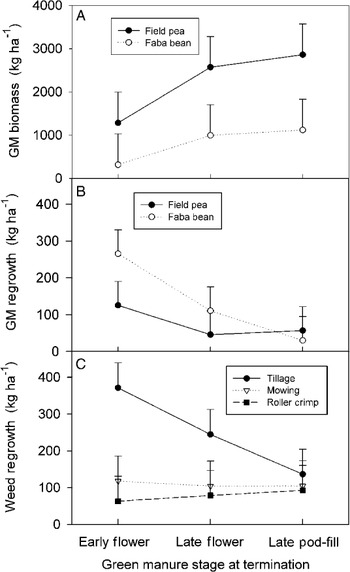
Averaged over all termination timings, pea had a threefold greater biomass than faba bean (Table 1, Figure 1A). The lower biomass in faba bean may be partially because the recommended target plant population of faba bean is one-half that of pea (44 versus 88 plants m−2). Faba bean has a large seed; therefore, its target plant population is low to keep the seeding rate low and affordable. The faba bean cultivar CDC SSNS-1 was chosen for its small seed sizeReference Oomah, Luc, Leprelle, Drover, Harrison and Olson13; however, even though the faba bean target population was lower, the weight per area seeding rate was similar to pea since the seed weight of faba bean was approximately double that of pea (287 versus 133 mg seed−1).
Effect of green manure stage at termination on: (A) green manure crop biomass, (B) green manure crop regrowth and (C) weed regrowth, as affected by termination method. Average of four site-years. Bars indicate standard error.

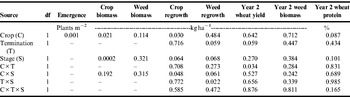
ANOVA for fixed effects of green manure termination study. Saskatoon and Vanscoy, SK, Canada 2007–2010.

As the green manure stage of termination was delayed, both green manure crops accumulated more biomass (Fig. 1A). The accumulation from early flower to late flower was greater than that from late flower to late pod.
Faba bean tended to have higher though not statistically significant weed biomass than field pea (P=0.11; Table 1). However, at three of the four site-years, the difference in weed biomass between faba bean and field pea was highly significant, while one site-year did not have a significant difference (data not shown). The lower faba bean biomass accumulation reflects its lower competitiveness, which allows for greater weed regrowth. We also observed that faba bean had a much sparser canopy with more erect plants than field pea, which also may allow for greater weed growth. The field pea variety 4010 has been observed to be very competitive with weedsReference Spies, Warkentin and Shirtliffe14.
The effect of crop regrowth following termination depended on the interaction of crop and timing (Table 1 and Fig. 1B). There was little regrowth in pea regardless of the crop stage at termination. At the early flowering stage faba bean had greater regrowth than pea (Fig. 1B). At later stages, there were no differences between the regrowth of faba bean and pea. There was no difference in crop regrowth between termination methods (Table 1 and Fig. 1A) because tillage does not kill all plants. Because there was no effect of termination method on crop regrowth, we concluded that roller crimping and mowing are effective termination methods for faba bean and field pea green manure crops. Roller crimping had to be conducted during flowering in order to effectively terminate fall rye (Secale cereale L.)Reference Ashford and Reeves6; therefore, the timing for effective roller crimping is crop dependent. Pea may be well suited for use as an annual green manure terminated with a roller crimper since there was little regrowth regardless of termination method or crop stage.
Weed growth following termination was greatest when tillage was conducted at the early flowering stage (Table 1 and Fig. 1C). With later terminations, there were no differences in weed growth among termination methods. There was a significant crop by stage interaction (Table 1); however, inspection of the results indicated no meaningful effect (data not shown).
Faba bean appears to be an inferior choice for a green manure crop compared with field pea. It had lower crop biomass and allowed greater weed biomass production. The total weed and crop biomass production were similar for both crops; however, with peas most of the biomass was crop. It is possible that the low biomass yields of the faba bean were due to pest problems. In two of the site-years, blister beetles (Lytta nuttalli) were a problem; they partially defoliated the faba beans and appeared to reduce biomass accumulation. However, the sites without blister beetles still had reduced yields compared with peas.
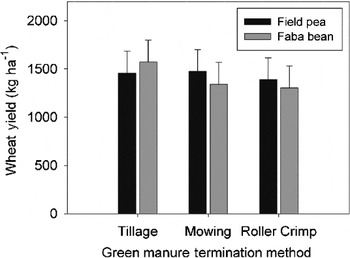
Overall, the type and timing of green manure crop termination had little effect on the following year's wheat crop. Wheat yield was affected by the interaction between termination method and the previous crop (Table 1 and Fig. 2). When pea was the previous green manure crop, the termination method had no effect on wheat yield. Terminating the faba bean by tillage resulted in higher wheat yields compared with mowing or roller crimping. Vaisman et al.Reference Vaisman, Entz, Flaten and Gulden5 found that in two of three site-years, replacing tillage with roller crimping resulted in a linear reduction of wheat yields as tillage operations were eliminated. The yield reduction was found to be associated with reduced nitrogen mineralization in the roller–crimper treatments. In contrast to Vaisman et al.Reference Vaisman, Entz, Flaten and Gulden5, we did not attempt to eliminate tillage from the cropping system; rather, we eliminated tillage associated with terminating the green manure crop.
Effect of green manure crop and termination method on the following year's wheat yield. Average of four site-years.

There was a trend towards greater protein concentration in wheat following pea than following faba bean (Table 1). Timing of green manure termination also had an effect on the protein concentration of wheat the following year, with the earliest timing resulting in the highest wheat protein concentration (data not shown).
Second study: rotary hoe experiment 1
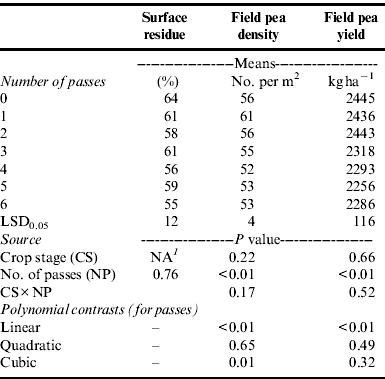
The number of rotary hoe passes did not have a significant effect on the level of surface residue (P=0.763) (Table 2). In all years, surface residue was maintained at greater than the 30–50% ground cover that is required to prevent wind or water erosion15.
ANOVA and effect of min-till rotary hoe passes on percent surface crop residue, field pea density and field pea seed yield. Scott, SK, Canada 2004–2006.
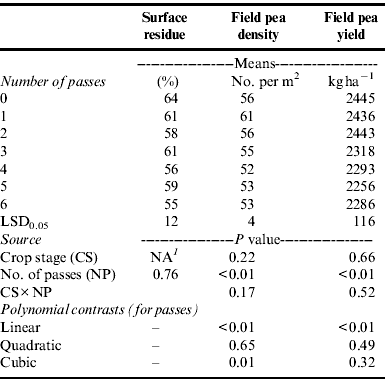
1 Not applicable—surface residue data only collected at one crop stage (Pre-).
We evaluated crop tolerance by assessing the hoeing effect on field pea density. Crop stage had no effect on plant density; however, the number of passes had a significant linear effect on plant density (y=−1.0357x+58.25; r 2=0.55) (Table 2). A single pass resulted in slightly higher crop density than the untreated control, and plants declined by about one plant for every pass conducted after that (Table 2). Plant density never dropped below 50 plants m−2, the point at which lower densities tend to result in reduced grain yieldsReference Johnston, Clayton, Lafond, Harker, Hogg, Johnson, May and McConnell16. The differences in plant mortality were not likely biologically significant; field pea was able to tolerate up to six passes of a min-till rotary hoe at all crop stages evaluated.
Crop stage at rotary hoeing had no effect on field pea yield, and there was no crop stage by number of passes interaction on yield (Table 2). As crop yield indicates the crop's ability to recover from rotary hoeing; crop recovery was similar at all crop stages. Increasing the number of passes resulted in a linear decline in crop yield, independent of crop stage (Table 2). Based on a linear regression model (y=−35.2x+2459.4; r 2=0.83), each pass reduced field pea yield by 35 kg ha−1. Overall, compared with the untreated check, pea yield declined by about 7% with six passes; therefore, the impact of hoeing on crop yield under weed-free conditions was negligible.
Second study: rotary hoe experiment 2
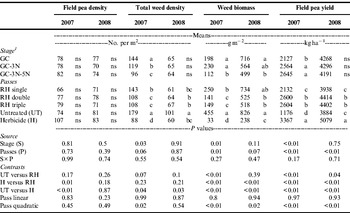
The number of rotary hoe passes had no effect on field pea density at any crop stage in either year, showing that field pea tolerated rotary hoeing in weedy conditions, irrespective of crop stage and the number of passes (Table 3).
Means and ANOVA for min-till rotary hoe efficacy study in field pea. Scott, SK, Canada 2007–2008.

1 GC (ground-crack), 3N (3-node) and 5N (5-node) correspond to BBCH stages 09, 13/33 and 15/35, respectively.
Means followed by different letters are significantly different at P<0.05.
Weed density was higher in 2007 than in 2008, with respective mean densities of 176 and 82 plants m−2 (data not shown). In 2007, the predominant weed species were wild mustard and green foxtail, with respective densities of 101 and 30 plants m−2. Indigenous populations of common lambsquarters (Chenopodium album L.) and wild buckwheat (Polygonum convolvulus L.) were also present. The same species were present in 2008; however, wild mustard densities were very low, with a mean density of 6 plants m−2. Green foxtail and wild oat densities were 39 and 23 plants m−2, respectively, which was approximately 40 and 28% of the total weed density. Green foxtail densities were not high enough to cause significant yield loss in field pea; therefore, wild oat was the predominant weed leading to crop interference in 2008.
Both crop stage and the number of rotary hoe passes had an effect on weed density in 2007, but neither had an effect in 2008 (Table 3). This indicates that the large-seeded wild oat may be more tolerant of rotary hoeing than small-seeded weeds. In 2007, rotary hoeing reduced weed density by about 20% for each successive stage that it was conducted (Table 3). Lowest weed densities were achieved with a double pass, but no significant reductions occurred with a triple pass.
Crop stage and number of passes had a significant effect on weed biomass in 2007. Although the P-values for stage and passes were not significant for 2008, means separation detected significant differences (Table 3). The lowest weed biomass was obtained by conducting a double or triple pass at all three growth stages (GC-3N-5N) in 2007. Conducting rotary hoeing at all three growth stages resulted in a 75% reduction in weed biomass compared with the untreated check. The herbicide treatment reduced weed biomass by 93% compared with the untreated control in 2007 (Table 3).
In 2008, the GC-3N-5N stage had lower weed biomass than the GC stage but was not significantly different than the GC-3N stage (Table 3). Both the double and triple passes had similar biomass, which was significantly lower than the GC stage and the untreated check. On average, the best rotary hoe treatments and the herbicide treatments resulted in a 40 and 71% reduction in weed biomass compared with the untreated control in 2008 (Table 3).
The greater reduction in weed biomass from rotary hoeing in 2007 is likely due to the weed species present. In 2007, small-seeded broadleaf and grassy weeds were dominant, and in 2008 wild oat was more prevalent. This indicates that rotary hoeing is more effective on small-seeded, shallow-rooted weed species than on large-seeded, well-anchored weed species. This observation is consistent with results from studies evaluating the efficacy of pre- and post-emergence harrowing in grain cropsReference Johnson, Thomas, Leeson, Shirtliffe, Brandt, Cloutier and Leblanc1, Reference Knight, Johnson, Malhi, Shirtliffe, Blackshaw, Malhi, Gan, Schoenau, Lemke and Liebig4, Reference Johnson and Holm8, Reference Kirkland9.
Crop stage and the number of passes had a significant effect on grain yield in 2007, while the number of passes had a significant effect in 2008 (Table 3). In 2007, rotary hoeing at the GC stage resulted in 80% higher yields than those obtained in the untreated check. Subsequent rotary hoeing at the 3-node stage improved yields by 20% compared with the GC stage, while additional hoeing at the 5-node stage did not improve yields compared with hoeing at the GC-3N stage. In 2007, a single pass improved yields by 81% compared with the untreated check, and a double pass further improved yield by 22%. A triple pass, however, was not significantly higher yielding than the double pass. Herbicide application resulted in a 2.9-fold increase in grain yield over the untreated check, whereas the highest yielding rotary hoe treatments resulted in a 2.2-fold increase over the untreated check. Min-till rotary hoeing resulted in as much as 89% of the grain-yield attained by herbicide application.
In 2008, rotary hoeing at the GC stage resulted in 10% higher yields than in the untreated check, with no improvement by rotary hoeing at subsequent growth stages. A single pass did not increase grain yield compared with the untreated check, but a double pass resulted in 14% higher yields. Conducting more than a double pass at the GC stage did not improve grain yield. Herbicides improved grain yield by 31% compared with the untreated check. In 2007 a double pass at the GC stage resulted in 87% of the grain yield attained by herbicide application, which was similar to the results attained with the best rotary-hoeing treatment that year.
Field pea yields were more than 50% higher in 2008 than in 2007 (Table 3). Growing conditions were more conducive to pea production in 2008 due to higher precipitation, particularly in the month of July. In addition, mean daily air temperatures were above average in July 2007, and field pea can be sensitive to high temperatures during the flowering period. The yield responses from weed control were much lower in 2008 under the more favorable environmental conditions for field pea production.
Conclusions
Terminating a field pea green manure crop with a roller crimper is a viable option for reducing tillage in organic crop production. Wheat following the roller crimper treatment had seed yields that did not differ from plots that were terminated with mowing or tillage. Plots terminated by tillage actually had greater regrowth of weeds following crop termination compared with mowing or roller crimping. As crimping has much lower energy requirements compared with mowing it is preferable. Furthermore, with crimping the crop residue remains attached to the ground, potentially reducing erosion. Field pea was a superior annual green manure crop than faba bean, with field pea having greater biomass accumulation, greater weed competition, reduced regrowth following termination, and lower seed costs.
The min-till rotary hoe provides partial annual weed control in organic no-till cropping systems. It worked well in the presence of standing cereal-crop residues and was able to maintain residues on the soil surface even after multiple passes. Field peas exhibited good tolerance to multiple passes at numerous growth stages. The min-till rotary hoe was particularly effective at controlling small-seeded weeds in field pea, where it achieved 87% of the yield achieved with herbicide application. The min-till rotary hoe will not likely effectively control perennial weeds, which are a major challenge to no-till organic production.
The roller–crimper and min-till rotary hoe exhibited potential to reduce tillage in organic-cropping systems; however, further research and innovation are required for no-till organic agriculture to become a reality in western Canada.
Acknowledgements
We greatly appreciated the financial support of the Agriculture and Agri-Food Canada Pesticide Risk Reduction Program, the Agriculture and Agri-Food Canada Research Branch and the Saskatchewan Ministry of Agriculture. We thank S. Campbell, L. Nielsen and A. Kapiniak for their technical support.