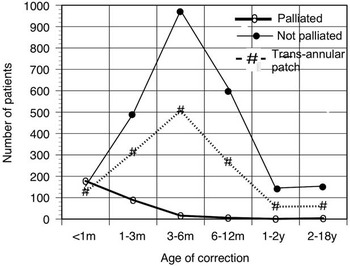
In the early days, open-heart surgery was seldom used in infants because anaesthetic, surgical, and postoperative techniques were inadequate; therefore, repair of a complex lesion such as tetralogy of Fallot was deferred until the child was several years old. If cyanosis was too severe, a systemic-to-pulmonary artery shunt was used as palliation. With experience, techniques improved, and eventually it became possible to perform a complete repair of tetralogy of Fallot in the neonate with very low mortality. The age distribution of total correction is shown in Figure 1, derived from the Society of Thoracic Surgeons Database.Reference Al Habib, Jacobs and Mavroudis 1
The age distribution at time of corrective surgery for those with and without previous palliation, and frequency of transannular patch in those without previous palliation. The percentage needing a patch was the highest among the youngest (and smallest) children. Palliation was almost always by an arterio-pulmonary shunt. Study years 2002–2007.

The question to be asked is “what is the optimal age for correction?”.
The advantages of early correction (<3 months of age) are multiple. Restoring normal arterial oxygen saturation facilitates growth, possibly improves brain function, and avoids the occurrence of hypercyanotic spells that do not usually appear until after 3 months of age. Prolonged hypoxaemia causes polycythaemia that increases the risk of intracranial thrombosis or abscess. Early surgery also reduces the duration of severe parental anxiety. These are all worthwhile achievements, but they come at a cost. In more severe forms of the anomaly, the pulmonary annulusFootnote 1 is unusually small, and the surgeon is faced with the decision to leave some obstruction or else cut across and enlarge the pulmonary annulus – transannular patch – thereby causing pulmonary valve regurgitation and all of its late consequences, including replacing the abnormal valve. For many of these patients what we term “complete correction” is really palliation.
Shimazaki et alReference Shimazaki, Blackstone, Kirklin, Jonas, Mandell and Colvin 2 found that the size of the pulmonary annulus in tetralogy of Fallot ranged from +3z to −12z, with a median value of −2z; z indicates the number of standard deviations from the mean.Footnote 2 The probability of requiring a transannular patch was 39% when z was −3 and up to 94% when z was −5; the probability of systolic pressure in the right ventricle being >0.7 of that of the left ventricle even if a transannular patch was used was 11% for z of −3 and 26% for z of −8.Reference Shimazaki, Blackstone, Kirklin, Jonas, Mandell and Colvin 2 With a hypoplastic right ventricle, there is little chance of having both a normal right ventricular systolic pressure and an intact pulmonary valve. According to the Society of Thoracic Surgeons Database,Reference Al Habib, Jacobs and Mavroudis 1 52% of 2534 patients required a transannular patch without previous palliation, but 66% of 217 patients with previous palliation required a patch. This may reflect the greater severity in those who needed palliation. A more recent study by Luijten et alReference Luijten, van den Bosch and Duppen 4 of 453 patients with tetralogy of Fallot (median age 0.6 years) noted that 65% needed a transannular patch. In the European Association for Cardio-Thoracic Surgery Congenital Database,Reference Sarris, Comas, Tobota and Maruszewski 5 57.5% of patients had a transannular patch, and on average these patients were about 22 months of age, whereas those without a patch were on average 34.4 months of age.
What are ways around this dilemma? One possibility would be to develop procedures for reconstructing the outflow tract that do not leave residual stenosis and do not cause pulmonary regurgitation. Although several attempts have been made, none has achieved long-term success. Until that can be done, other methods are needed. At present, there are four candidates a systemic-to-pulmonary artery shunt, infundibulectomy, long-term treatment with a β-adrenergic blocking agent, and balloon dilatation of the infundibulum.
Before discussing therapy, we need to appreciate that tetralogy of Fallot covers a wide range of anatomical abnormalities.Reference Anderson and Weinberg 6 In principle, the outflow tract of the right ventricle is hypoplastic, with abnormally placed muscle bands in the infundibulum, a hypoplastic pulmonary valve attachment (annulus), and a pulmonary valve that in about 75% of patients is stenotic. The main and branch pulmonary arteries are small and sometimes stenotic. Obstruction to outflow from the right ventricle can therefore occur at one or more of these sites. In some patients, the outflow tract is so hypoplastic and distorted that it is unlikely that any non-surgical approach can palliate it.
Systemic-to-pulmonary artery shunt
The Blalock–Taussig–Thomas shunt was the first attempt to palliate cyanosis in tetralogy of Fallot by anastomosing the subclavian artery to the ipsilateral pulmonary artery. Subsequently, anastomoses were created between the descending aorta and the left pulmonary artery – Potts anastomosis – or between the ascending aorta and the right pulmonary artery –Waterston anastomosis; these latter two anastomoses were difficult to make the right size, and soon dropped out of favour. More recently, a polytetrafluorene tube has been interposed between the subclavian and pulmonary arteries – modified Blalock–Taussig–Thomas shunt. The mortality for these procedures is now <10%,Reference Hoffman 7 , Reference Dorobantu, Pandey and Sharabiani 8 quite an achievement considering that these operations are performed on the smallest and sickest children.
These shunts are usually successful in increasing arterial oxygen saturation. There is also evidence that they may increase the size of the right ventricular outflow tract and pulmonary arteries,Reference Alfieri, Blackstone and Parenzan 9 – Reference Rittenhouse, Mansfield and Hall 13 although whether the increase in annular diameter is more than expected from normal growth is uncertain. From the data of Al Habib et al,Reference Al Habib, Jacobs and Mavroudis 1 the fact that the percentage of patients requiring a transannular patch was higher for those with palliation than without palliation suggests that the shunt did not increase growth of the right ventricular outflow tract. Even if shunts do increase annular diameter, they have a number of potential complications,Reference Hoffman 14 and make the final correction more complicated; therefore, other alternatives need to be considered.
Infundibulectomy
This surgical operation was introduced by Brock and Campbell in 1949Reference Brock and Campbell 15 and was moderately successful. Others repeated these results, for example, Lin et al,Reference Lin, Diehl and Kittle 16 but the advent of complete correction with open-heart surgery made this operation obsolete. Now that it is possible to perform infundibulectomy with catheters with cutting blades,Reference Carlson, Neish, Justino, Leonard, Mullins and Grifka 17 it might be worth re-considering using a non-surgical infundibulectomy.
β-Adrenergic blockade
Hypercyanotic spells in tetralogy of Fallot were thought to be due to spasm of the infundibular muscle, and it was known that the abnormal muscle in hypertrophic cardiomyopathy contracted excessively with β-adrenergic stimulation, and that a β-adrenergic blocking agent could decrease the contraction. In 1964, Honey et alReference Honey, Chamberlain and Howard 18 showed that β-adrenergic blockade with pronethalol increased arterial oxygen saturation in patients aged 14–38 years with tetralogy of Fallot, and in 1966 Singh and GotsmanReference Singh and Gotsman 19 showed that pronethalol would abolish the hypercyanotic spells in very young children. Owing to its toxicity, pronethalol was replaced by propranolol, and in 1966 Cumming and Carr showed that it too abolished hypercyanotic spells in three infants. Many similar case reports were soon published, and in 1969 Eriksson et alReference Eriksson, Thoren and Zetterqvist 20 published the first report on the long-term successful treatment of tetralogy of Fallot in children aged 2–11 years, with success being judged by an increase in arterial oxygen saturation and a reduction or abolition of hypercyanotic spells. These children had been selected for treatment on the basis of a favourable response to propranolol during cardiac catheterisation. They were given 1 mg/kg of propranolol four times daily.
Since then, propranolol has been used by many centres.Reference Ponce, Williams, Webb, Riopel and Hohn 21 , Reference Garson, Gillette and McNamara 22 It is not always effective.Reference Ross, Robertson and Watson 23 At times ineffectiveness may be due to too small a dose; Garson et alReference Garson, Gillette and McNamara 22 observed that failure was more likely in patients given doses of 1.2 versus 2.6 mg/kg. Adrenergic blockade would also be ineffective if the major sites of obstruction were at the pulmonary valve or pulmonary artery. Today, it would be easy using pulse oximetry to determine which patients respond to propranolol and what dose is needed.
Studies have shown that patients on long-term propranolol at the time of corrective surgery are not at a disadvantage,Reference Graham, Bandisode, Bradley, Crawford, Simsic and Atz 24 , Reference Sanches, Galas, Silva, Carmona, Auler and Santos 25 although Barazzone et alReference Barazzone, Jaccard and Berner 26 demonstrated that the effects of isoproterenol were blunted but could be overcome by giving higher doses of the adrenergic agent. To avoid intra-operative problems, Garson et alReference Garson, Gillette and McNamara 22 discontinued propranolol 4 days before surgery, but this risks having hypercyanotic spells before or even during surgery.
There are potential complications with long-term propranolol. Occasionally with higher doses, patients may develop congestive heart failure.Reference Garson, Gillette and McNamara 22 The possibility of severe hypoglycaemia must always be considered and checked,Reference Feller 27 , Reference McBride, McBride and Viles 28 and occasionally severe bradycardia leads to withdrawal of the drug.Reference Clark, Chan and Gibbs 29 Apart from these problems, in a minority of patients, propranolol does improve arterial oxygen saturation and reduces or abolishes hypercyanotic spells. The big unanswered question is whether the added months of growth make reconstruction of the outflow tract easier. Is body growth accompanied by annular growth?
Balloon dilatation and stenting
A second approach would be to dilate the stenotic pulmonary valve and/or infundibulum with a balloon, thus allowing more flow and time for growth to occur – BrockReference Brock 30 had shown that surgical valvotomy relieved cyanosis, but balloon valvotomy is much more convenient. Qureshi et alReference Qureshi, Parsons and Tynan 31 used an atherectomy catheter to perform a myomectomy. Several groups used stents to keep the outflow tract wide.Reference Castleberry, Gudausky, Berger, Tweddell and Pelech 32 – Reference Zeidenweber, Kim and Vincent 39
Most of these studies showed an improvement in arterial oxygen saturation and a growth of the pulmonary arteries.Reference Castleberry, Gudausky, Berger, Tweddell and Pelech 32 – Reference Zeidenweber, Kim and Vincent 39 The effect on the pulmonary annulus was mixed. Almost all studies that reported changes in the annulus used z values. As the annulus tends to increase in size with age, even in tetralogy of Fallot, the z value indicates whether the increased size is proportional to age – z value unchanged – or has increased beyond what is expected from ageing – less negative z value. Some studies related the size of the pulmonary annulus to the aorta, but this is less well validated. Several investigators described improved growth of the annulus by 2 SD or more,Reference Godart, Rey and Prat 40 – Reference Sousa Uva, Chardigny and Galetti 46 and Kreutzer et alReference Kreutzer, Perry, Jonas, Mayer, Castaneda and Lock 47 found that z increased from −4.0 to −3.3.
In a series of 19 infants studied by Sluysmans et al,Reference Sluysmans, Neven and Rubay 45 a transannular patch was avoided in 69%, representing a 30–40% reduction from their usual practice; on the other hand, Battistessa et alReference Battistessa, Robles, Jackson, Miyamoto, Arnold and McKay 48 found that balloon dilatation caused no improvement, and Piechaud et alReference Piechaud, Delogu and Iserin 49 had mixed results that on average were disappointing. Sreeram et alReference Sreeram, Saleem and Jackson 50 noted that after balloon dilatation the annulus enlarged by an average of 29%, but this was no more than what occurred because of growth in those without dilatation. Although arterial oxygen saturations increased, the frequency of annular patching was unchanged.
As with all procedures, there is some risk of damage. Lamb et alReference Lamb, Qureshi and Arnold 51 observed that at surgery 15 months after the balloon dilatation there was linear tear in the main pulmonary artery. Ugurlu et alReference Ugurlu, Oto, Unal and Akcoral 52 noted at surgery two pseudoaneurysms in the outflow tract.
Conclusion
The final decision about the optimal timing of repair of tetralogy of Fallot that will leave minimal distortion of the right ventricular outflow tract cannot be determined with the information discussed above; it will take years of clinical trials to do that. What I have tried to do is to show that some forms of palliation should be reconsidered.
Given the wide variety of pathological findings in tetralogy of Fallot, no one treatment is likely to be effective in all these patients; the “one-size-fits-all” approach is doomed to failure. Failure to improve may be due to selecting the wrong form of treatment for the anatomy; valvotomy will not help the patient if the main obstruction is infundibular, and propranolol will not be useful if obstruction is mainly at the valve level; therefore, it is first necessary to determine the anatomy of the right ventricular outflow tract and to base therapy on the findings. If the main obstruction is at the pulmonary valve, then balloon dilatation of the valve is a reasonable choice. If the main obstruction is at the infundibulum, then propranolol is the first choice. Sometimes relief of an obstructive pulmonary valve may be associated with an increase in infundibular obstruction when the distending ventricular pressure is decreased, and as obstruction may occur at more than one site in any patient there is no reason why a patient should not get propranolol and balloon dilatation, with perhaps stenting of the outflow tract if the infundibulum remains obstructive. Infundibulectomy remains a possible treatment if other methods do not work.
There is no guarantee that palliation will improve outcomes, but if palliation appropriate to the abnormal anatomy is successful in many patients, subsequent repair may be easier and more successful.
Acknowledgements
None.
Financial Support
This research received no specific grant from any funding agency or from commercial or not-for-profit sectors.
Conflicts of Interest
None.