Introduction
Epistaxis is the commonest ENT emergency, with 23 723 admissions recorded in the National Health Service Hospital Episode Statistics in England and Wales during 2009–2010.1 The number of treated epistaxis episodes has remained fairly stable over the last 10 years. With an ageing population increasingly dependent on anti-coagulant medications for a variety of medical disorders, this figure is unlikely to decrease.
The implementation of the European Working Time Directive has necessitated changes in out-of-hours cover, which means that care is often provided by non-ENT trained doctors, and often across large geographical areas.Reference Horrocks and Cripps2 There is likely to be widespread variation in the management of epistaxis patients related to staffing, training, geographical area, out-of-hours care and local policy.
Kotecha et al. carried out a national survey of epistaxis, which suggested that an average of 10.2 epistaxis patients are admitted under every on-call ENT consultant within a 3-month period.Reference Kotecha, Fowler, Harkness, Walmsley, Brown and Topham3 The average length of stay for these patients is 2.9 days. Based on our own in-patient costs for a hospital bed, this equates to approximately £660 per epistaxis admission.
An audit of epistaxis management was carried out in an attempt to improve the quality of service provided and the overall patient experience at Guy's Hospital, London.
Materials and methods
The level of evidence for studies on epistaxis management is universally poor. Furthermore, epistaxis management remains an area lacking in objective national guidelines.Reference Melia and McGarry4, Reference Schlosser5 It is therefore difficult to form a consensus opinion on epistaxis management. Anecdotally, it was felt that the lack of clear structure and variability in management between different personnel was resulting in inefficiency and an ad hoc approach to epistaxis management. This was perhaps exacerbated by the fact that management was generally determined by more junior members of the ENT team.
We utilised a recent UK review of epistaxis management by Daudia et al. as the framework for our audit, which represented a published standard of national best practice.Reference Daudia, Jaiswal and Jones6
Unfortunately, these guidelines were not directly transferable owing to several issues related to the increasing centralisation of ENT services and the implementation of the European Working Time Directive. For instance, Guy's Hospital exists as a central ENT ‘hub’, servicing other sites such as King's College Hospital and St Thomas' Hospital by providing ENT in-patient care. There is therefore no realistic opportunity for ENT review prior to transfer; the hospital instead relies on information relayed by the medical professional making the referral. Nasal packing may become a necessary ‘holding measure’ to ensure safe transfer. In addition, in 66 per cent of cases seen between 5:00 pm and 8:00 am, a patient admitted under ENT would initially be evaluated by a doctor from urology, orthopaedics or thoracic surgery, who would be covering the specialty as part of the hospital at night rota. The lack of specialised cover has been highlighted recently in a nationwide survey of departments.Reference Biswas, Rafferty and Jassar7 Furthermore, like many ENT departments nationwide, at Guy's Hospital there was no suction diathermy or bipolar diathermy available.
With these issues in mind, we established pragmatic local management guidelines with clear goals, which focused on identifying relevant pathology and providing appropriate treatment in a safe, standardised, stepwise manner.
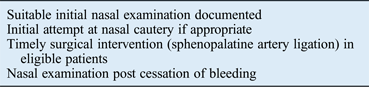
Four essential audit standards (with 100 per cent compliance targets) were evaluated to determine the quality of service provided to patients admitted for epistaxis (Table I).
In-Patient Epistaxis Assessment Parameters

Surgical intervention was defined as appropriate in cases of continued bleeding (for over 48 hours) despite posterior or nasal packing. In this scenario, bipolar diathermy (for anterior bleeding points) or sphenopalatine artery ligation were advocated; recent pooled case series data show that these have low procedural morbidity rates and high success rates.Reference Kumar, Shetty, Rockey and Nilssen8
In 2009, a retrospective review was conducted based on 50 consecutive referrals (to Guy's and St Thomas' ENT department) of adult patients (aged 16 years and above) with epistaxis (categorised according to Hospital Episode Statistics coding criteria; code R04.0). Patient clinical notes, including the emergency department records, were obtained. Similar retrospective reviews were carried out in 2010 and 2011.
Results
First audit cycle
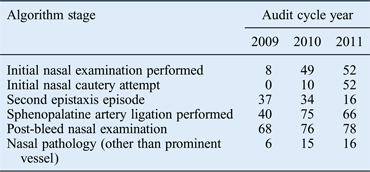
The data for the 2009 audit cycle (Table II) indicate the low priority often afforded to epistaxis patients who are admitted to hospital. The lack of documented nasal examination (8 per cent) and total absence of nasal cautery was unexpected. In addition, the high re-bleed rate (37 per cent) was concerning, with one patient re-bleeding on four occasions. Within this cohort, five patients were eligible for sphenopalatine artery ligation yet only two received surgical intervention.
Epistaxis audit summary
Data represent percentages of patients (n=50 for each cycle).
Intervention
The results clearly highlighted a deficiency in the local management of epistaxis. A clear, departmentally-approved algorithm was therefore created in an attempt to formalise the management process (Figure 1). The algorithm utilised the treatment framework of Daudia et al.,Reference Daudia, Jaiswal and Jones6 while also accounting for hospital at night rota arrangements. This protocol was disseminated throughout the ENT clinics, wards and treatment rooms at Guy's Hospital, and assimilated into the senior house officer induction programme and handbook. The promotion of nasal cautery within emergency departments and emphasis on the necessity of equipment provision (headlight and silver nitrate cautery sticks) were essential steps of this management process.
Epistaxis management algorithm adopted at Guy's Hospital 2009–2011. A&E = accident and emergency department; SpR = specialist registrar; SPA = sphenopalatine artery ligation
Second audit cycle
The results for the 2010 audit cycle revealed a trend for improvement across all four audit standards; nevertheless, the overall rate of improvement indicated the need for further intervention. Uptake of nasal cautery on assessment remained low within the emergency departments. The increased uptake of sphenopalatine artery ligations where facilities were available (three of the four eligible cases) was probably the result of increased involvement of the rhinology team in cases of persistent bleeding and more widespread training in the surgical technique.
Further intervention
Further reinforcement of emergency department education remained central to our strategy for intervention. Promotion of the epistaxis management algorithm within the department had increased clarity in decision making amongst juniors. There was a move to increase the out-of-hours availability of flexible nasoendoscopes through the utilisation of disposable wipe sterilisation procedures. It was thought that this may increase the number of nasal examinations performed post epistaxis. A lack of equipment had been postulated as a reason for the omission of examinations.
Third audit cycle
The results of this 2011 cycle reflect the effects of the departmental drive to promote nasal cautery (where appropriate) within the emergency departments. The results represent an attempt to reduce unnecessary epistaxis admissions through early, proactive intervention (obviously, patients were not admitted if they were cauterised with success within the emergency department). The progress achieved with the cumulative and multi-level interventions initiated in 2009 is reflected in the level of improvement attained. Nasal examination post cessation of bleeding was carried out in 78 per cent of patients in 2011, compared with 68 per cent of patients in 2009. Importantly, the number of patients who experienced a re-bleed within the 2011 cohort was 16 per cent; this represents an improvement of over 50 per cent from the 2009 and 2010 figures.
Discussion
Epistaxis is the commonest emergency faced by ENT departments. Examination of epistaxis management provides a unique representation of the changing clinical landscape with regard to the European Working Time Directive and the centralisation of specialist care. Epistaxis management therefore requires attention commensurate to its value and should be an area in which departments evaluate the quality of their service.
Despite the absence of a definitive evidence base for epistaxis management in general, the role of surgical intervention in refractory epistaxis has been highlighted, particularly in relation to endoscopic sphenopalatine artery ligation. The overall morbidity rate is lower following sphenopalatine artery ligation than embolisation or open approaches involving the external carotid and maxillary arteries. A pooled case series indicates a 98 per cent resolution rate for this technique.Reference Kumar, Shetty, Rockey and Nilssen8 In addition, a prospective randomised controlled trial indicated cost benefits and high rates of patient satisfaction for early endoscopic sphenopalatine artery ligation in comparison with nasal packing.Reference Moshaver, Harris, Liu, Diamond and Seikaly9
The optimisation of epistaxis management has obvious, significant cost implications (associated with an overall reduction in bed stay). Other potential implications include the prevention of hospital-acquired infections and subsequent morbidity.
Persistent and repeated nasal packing is an outdated approach to refractory epistaxis; there are now more effective and better-tolerated treatment options. Efforts are increasingly being made to ensure that epistaxis is actively managed, with senior surgical input.Reference Douglas and Wormald10
It is important to acknowledge that epistaxis is a symptom, rather than a diagnosis in itself. Re-examination of the nasal cavity post cessation of bleeding in order to discern an underlying cause is an important tenet of good practice. Although rare, pathology such as sinonasal tumour may present in this manner.
• Epistaxis is the commonest ENT emergency
• Service improvements in epistaxis management should be actively promoted within departments
• A multi-cycle audit demonstrated continued progress in epistaxis management following interventions
• Persistent, repeated nasal packing is an outdated approach for refractory epistaxis
This audit is limited by its focus on in-patient care of epistaxis. This meant we were unable to include the subgroup of patients discharged following treatment within the emergency department. In addition, this data set was not set up to include the overall bed stay details for epistaxis patients, a fact which has provided a focus for further audit and service evaluation.
Conclusion
This audit shows our department's progression in epistaxis management achieved following the adoption of a defined protocol. Surgeons play a vital role as educators; a more formalised role in emergency department induction could have considerable rewards. A drive to improve generalised epistaxis care would be best achieved in close partnership with emergency departments themselves.
This audit was based on the simple precepts of epistaxis management conducted within a single hospital. The stage is set for a further multi-centre, national review of epistaxis management, with a particular emphasis on in-patient stay. This approach is likely to be the only means by which to assess and appropriately evaluate the degree of variability in management.