1 Introduction
The quantification of irreversible vertical turbulent mixing of momentum and density in stably stratified geophysical flows in both the Earth’s hydrosphere and its atmosphere remains an important ongoing challenge. This is not surprising given the complexity introduced into most geophysical flows by factors such as density stratification, complex topography and the different physical phenomena associated with such flows. However, accurate prediction of small-scale irreversible turbulent mixing is crucial for many practical applications ranging from air quality prediction in the atmospheric boundary layer to the prediction of heat fluxes and circulation in oceanic flows. The traditional approach often used for quantifying vertical mixing in turbulent flows involves specification of the turbulent (eddy) viscosity
 $K_{m}$
and diffusivity
 $K_{{\it\rho}}$
which are based on the gradient-transport hypothesis (Pope Reference Pope2000). For example, in a unidirectional shear flow, these are given as
 $$\begin{eqnarray}\displaystyle \left.\begin{array}{@{}c@{}}\displaystyle K_{m}=-\frac{\overline{u^{\prime }w^{\prime }}}{\text{d}\overline{U}/\text{d}z},\\ \displaystyle K_{{\it\rho}}=-\frac{\overline{{\it\rho}^{\prime }w^{\prime }}}{\text{d}\overline{{\it\rho}}/\text{d}z},\end{array}\right\} & & \displaystyle\end{eqnarray}$$
where
 $\overline{u^{\prime }w^{\prime }}$
is the Reynolds stress (turbulent momentum flux),
 $\overline{{\it\rho}^{\prime }w^{\prime }}$
is the turbulent density flux,
 $\overline{U}$
is the mean streamwise velocity and
 $\overline{{\it\rho}}$
is the fluid mean density. Here, an overbar
 $\overline{(\,)}$
implies averaging (spatial or temporal), and the ratio
 $Pr_{t}=K_{m}/K_{{\it\rho}}$
is commonly referred to as the turbulent Prandtl (or Schmidt) number (Launder & Spalding Reference Launder and Spalding1972). Direct estimates of
 $K_{m}$
and
 $K_{{\it\rho}}$
can be obtained as long as the turbulent fluxes and the mean gradients can be computed from measurements (Lozovatsky & Fernando Reference Lozovatsky and Fernando2013). However, while it is, in principle, possible to obtain direct estimates of fluxes if certain technical challenges can be resolved (e.g. spatial resolution issues, especially in water bodies such as the oceans), the coexistence of internal wave motions and turbulence in stably stratified flows further complicates such measurements. Separation of flux contributions from linear internal waves (which have negligible contributions to irreversible mixing) and turbulence still remains a major difficulty to resolve in flux measurements. Hence, a number of indirect methods have been used by oceanographers to infer heat and momentum fluxes, such as those due to Osborn & Cox (Reference Osborn and Cox1972) and Osborn (Reference Osborn1980).
Estimates of turbulent viscosities and diffusivities from indirect methods essentially assume that the turbulent flow is statistically stationary (i.e. the turbulence statistics are invariant in time) and homogeneous (the statistics are invariant under translation). For example, the popular Osborn (Reference Osborn1980) model uses the above assumptions to simplify the turbulent kinetic energy (
 $k$
) equation to obtain an estimate for the vertical eddy diffusivity of density as
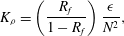 $$\begin{eqnarray}\displaystyle K_{{\it\rho}}=\left(\frac{R_{f}}{1-R_{f}}\right)\frac{{\it\epsilon}}{N^{2}}, & & \displaystyle\end{eqnarray}$$
where
 ${\it\epsilon}$
is the dissipation rate of
 $k$
,
 $N=\sqrt{-(g/{\it\rho}_{0})\partial \overline{{\it\rho}}/\partial z}$
is the buoyancy frequency of the background (stable) density field, where in
 $g$
is the acceleration due to gravity, and
 $R_{f}$
, the flux Richardson number which provides a measure of the mixing efficiency, is defined as
 $$\begin{eqnarray}R_{f}=\frac{B}{P},\end{eqnarray}$$
where
 $B=g/{\it\rho}_{0}(\overline{{\it\rho}^{\prime }w^{\prime }})$
is the buoyancy flux and
 $P=-\overline{u^{\prime }w^{\prime }}(\text{d}\overline{U}/\text{d}z)$
is the rate of production of
 $k$
. The term
 ${\it\Gamma}=R_{f}/(1-R_{f})$
is also sometimes loosely referred to as the mixing efficiency in the literature. However, in this paper, we shall refer exclusively to
 $R_{f}$
(together with the two other alternative formulations that will be described below) as the mixing efficiency. Osborn (Reference Osborn1980) recommended a canonical value of
 $R_{f}\approx 0.17$
(i.e.
 ${\it\Gamma}\approx 0.2$
) on the basis of some controlled laboratory experiments by Britter (Reference Britter1974) and theoretical predictions by Ellison (Reference Ellison1957). Since then, numerous studies have been carried out to ascertain the variability of
 $R_{f}$
on the strength of the stratification, which is usually quantified in terms of the gradient Richardson number
 $Ri_{g}=N^{2}/S^{2}$
, where
 $S=\text{d}\overline{U}/\text{d}z$
is the mean shear rate (Gregg Reference Gregg1987; Rohr et al.
Reference Rohr, Itsweire, Helland and Atta1988; Fernando Reference Fernando1991; Ivey & Imberger Reference Ivey and Imberger1991; Itsweire et al.
Reference Itsweire, Koseff, Briggs and Ferziger1993; Peltier & Caulfield Reference Peltier and Caulfield2003; Ivey, Winters & Koseff Reference Ivey, Winters and Koseff2008; Shih et al.
Reference Shih, Koseff, Ivey and Ferziger2005, among others). However, there is a lack of a universal parameterization of the mixing efficiency due to both ambiguities inherent in single parameter based formulations as well as the general complexity of stably stratified flows (Mater & Venayagamoorthy Reference Mater and Venayagamoorthy2014).
The inherent assumptions of stationarity and homogeneity are idealizations that are not always applicable from a practical standpoint, be it in observational studies or direct numerical simulations (DNS). In an attempt to remedy this issue, Ivey & Imberger (Reference Ivey and Imberger1991) proposed an alternative generalized definition for
 $R_{f}$
(hereafter denoted by
 $R_{f}^{II}$
) given by
 $$\begin{eqnarray}R_{f}^{II}=\frac{B}{m}=\frac{B}{B+{\it\epsilon}},\end{eqnarray}$$
where the denominator
 $m$
now, in addition to
 $P$
, includes the inhomogeneous transport terms in the turbulent kinetic equation (i.e. viscous diffusion of
 $k$
, the divergence of pressure flux, and the divergence of the turbulent convection of
 $k$
) and the unsteadiness term. It should be noted that for stationary homogeneous shear flows,
 $R_{f}^{II}$
is identical to
 $R_{f}$
given by (1.3). While this alternative definition precludes the need to assume that the turbulence is stationary and/or homogeneous, it also suffers from the effects of countergradient fluxes that are common in more strongly stratified flows. Thus, a third definition of
 $R_{f}$
(denoted commonly as
 $R_{f}^{\ast }$
) that more rigorously only accounts for the irreversible conversions of energy locally has recently been defined (Peltier & Caulfield Reference Peltier and Caulfield2003; Venayagamoorthy & Stretch Reference Venayagamoorthy and Stretch2010), where only the irreversible components of the buoyancy flux (i.e. the dissipation rate
 ${\it\epsilon}_{PE}$
of the turbulent (available) potential energy
 $E_{PE}^{\prime }$
) and of the production term (i.e. the total dissipation rate,
 ${\it\epsilon}+{\it\epsilon}_{PE}$
) are used, as follows:
 $$\begin{eqnarray}R_{f}^{\ast }=\frac{{\it\epsilon}_{PE}}{{\it\epsilon}+{\it\epsilon}_{PE}}.\end{eqnarray}$$
Here,
 ${\it\epsilon}_{PE}=N^{2}{\it\epsilon}_{{\it\rho}}(\text{d}\overline{{\it\rho}}/\text{d}z)^{-2}$
, in which
 ${\it\epsilon}_{{\it\rho}}={\it\kappa}\overline{(\boldsymbol{{\rm\nabla}}{\it\rho}^{\prime })^{2}}$
is the dissipation rate of density (scalar) variance, with
 ${\it\kappa}$
defined as the molecular diffusivity of density. Further details and a conceptual explanation for the basis of this definition can be found in Venayagamoorthy & Stretch (Reference Venayagamoorthy and Stretch2010). Again, it is worth noting that for stationary homogeneous flows,
 $R_{f}^{\ast }=R_{f}^{II}=R_{f}$
. However, as discussed earlier, such conditions are rarely applicable in practice. Given the fact that the data used to develop parameterizations of the flux Richardson number are from stably stratified flows that are evolving in time and/or spatially inhomogeneous, it is imperative to investigate the differences and similarities between these three commonly used definitions of the flux Richardson number. Such an analysis is likely to provide insights that will not only be helpful for improved estimates of irreversible fluxes using indirect measurement techniques, but will also aid the development of more robust parameterizations for quantifying irreversible mixing in numerical simulations of geophysical flows. We note that Karimpour & Venayagamoorthy (Reference Karimpour and Venayagamoorthy2015) carried out a detailed analysis of turbulent mixing in stably stratified channel flow where they also performed a comparison of two of the three definitions for the flux Richardson number, namely
 $R_{f}$
and
 $R_{f}^{\ast }$
. However, to the best of our knowledge, an in-depth comparative study involving all three definitions of the flux Richardson number using different flow configurations has not been carried out to date. This simple and important goal is the focus of this paper.
In what follows, in § 2, we present a brief description of the datasets that we use in our study to facilitate such a comparison. The results of our study are presented in § 3 and conclusions are given in § 4.
2 Data sources
Our objective is to explore the behaviour of the three different definitions of the flux Richardson number outlined in § 1 using available data that have all the necessary variables for computing the flux Richardson number as a function of the gradient Richardson number
 $Ri_{g}$
. Accordingly, consideration is given to datasets that are obtained for evolving homogeneous and inhomogeneous flows that include mean shear and density stratification. We primarily use the dataset from the DNS study of homogeneous shear flows by Shih et al. (Reference Shih, Koseff, Ivey and Ferziger2005, hereafter SKIF). These simulations are for temporally developing homogeneous turbulence subjected to different values of the uniform mean shear rate and uniform stable stratification. The gradient Richardson numbers used in the simulations were
 $0.05\leqslant Ri_{g}\leqslant 1$
. For low
 $Ri_{g}$
, the turbulent kinetic energy
 $k$
grows in time, while at high
 $Ri$
(
 ${>}0.25$
),
 $k$
decays. An approximately stationary state was achieved for
 $Ri\simeq 0.17$
for the simulations cases considered here. All statistics were obtained by volume averaging over the computational domain. The data presented are for non-dimensional shear time
 $St\geqslant 4$
to the end of the simulation time, in order to filter out the initial transients during the development phase of the turbulence encountered in the initialization of the simulations. Further details on the simulations can be found in SKIF. We also use the stably stratified turbulent channel flow DNS dataset of García-Villalba & del Álamo (Reference García-Villalba and del Álamo2011, hereafter GVA). For the purpose of this study, we use data from simulations performed at a friction Reynolds number of
 $Re_{{\it\tau}}=u_{{\it\tau}}{\it\delta}/{\it\nu}=550$
, with an initial stratification given by a friction Richardson number of
 $Ri_{{\it\tau}}=|{\rm\Delta}{\it\rho}|g{\it\delta}/{\it\rho}_{0}u_{{\it\tau}}^{2}=60$
. Here,
 $u_{{\it\tau}}$
is the friction velocity,
 ${\it\delta}$
is half of the channel depth,
 ${\it\nu}$
is the kinematic (molecular) viscosity and
 $|{\rm\Delta}{\it\rho}|$
is the initial density difference between the bottom of the channel (
 $z=0$
) and the free stream (
 $z={\it\delta}$
).
Comparison of the flux Richardson numbers
 $R_{f}$
,
 $R_{f}^{II}$
and
 $R_{f}^{\ast }$
as functions of the gradient Richardson number
 $Ri_{g}$
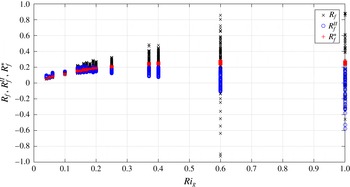
, computed from the DNS data of Shih et al. (Reference Shih, Koseff, Ivey and Ferziger2005).

3 Results
3.1 Comparisons of the three different flux Richardson numbers
Figure 1 shows the flux Richardson numbers
 $R_{f}$
,
 $R_{f}^{II}$
and
 $R_{f}^{\ast }$
as defined by (1.3), (1.4) and (1.5) respectively as functions of the gradient Richardson number
 $Ri_{g}$
using the DNS data of SKIF. There are two main observations worth noting. First, for low
 $Ri_{g}$
(up to
 $Ri_{g}\simeq 0.25$
), it can be seen that all three definitions are approximately equivalent (albeit with some differences which on average are within
 $\pm 25\,\%$
) in this shear dominated flow regime. Conceptually, this implies that both the Reynolds stress and the buoyancy flux are downgradient. Previous studies by Rogers, Mansour & Reynolds (Reference Rogers, Mansour and Reynolds1989) and Holt, Koseff & Ferziger (Reference Holt, Koseff and Ferziger1992) postulated that the fluxes in the shear dominated regime are produced by pumping of fluid through coherent hairpin shaped eddies. The data suggest that the flux Richardson number (regardless of which definition is used) increases with
 $Ri_{g}$
in a quasi-linear manner for small
 $Ri_{g}$
(
 ${\lesssim}0.1$
) and continues to increase with decreasing slope for
 $0.1\lesssim Ri_{g}\leqslant 0.25$
. The favourable comparison between the three different definitions is encouraging in the sense that it highlights the fact that both buoyancy and momentum fluxes are dominated by turbulent processes in this regime. The good agreement suggests that any of the three definitions could be used for inferring the irreversible mixing in the shear dominated regime in stably stratified flow with a reasonable degree of accuracy. As a side note, it is worth mentioning that it is common practice to consider
 $Ri_{g}=1/4$
as the threshold for the onset of shear instabilities in stably stratified flows, and hence this value is typically termed as the critical Richardson number
 $Ri_{gc}$
(Howard Reference Howard1961; Miles Reference Miles1961). It is interesting to note that the transition in the behaviour of the three definitions is conceptually consistent with the notion of a critical threshold in
 $Ri_{g}$
. However, it is important to note that this does not imply that a physical transition in the flow regime has to occur strictly at
 $Ri_{g}=1/4$
and thus should only be considered as a conceptual delineation of flow regimes.
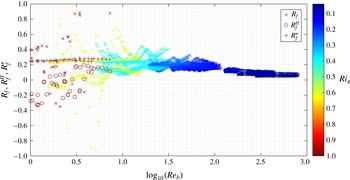
Comparison of the flux Richardson numbers
 $R_{f}$
,
 $R_{f}^{II}$
and
 $R_{f}^{\ast }$
as functions of the buoyancy Reynolds number
 $Re_{b}$
, computed from the DNS data of Shih et al. (Reference Shih, Koseff, Ivey and Ferziger2005). The colour bar shows the corresponding gradient Richardson number
 $Ri_{g}$
.

Second, it can be seen that both
 $R_{f}$
and
 $R_{f}^{II}$
exhibit significant variability at higher
 $Ri_{g}$
(
 ${>}0.25$
), while
 $R_{f}^{\ast }$
shows almost negligible variation in comparison to the former two definitions. It should be noted that for a given
 $Ri_{g}$
, the variability in
 $R_{f}$
indicates oscillations in time of both the buoyancy flux and the momentum flux, while for
 $R_{f}^{II}$
, the variability signifies oscillations of the buoyancy flux. Physically, at high
 $Ri_{g}$
(i.e. the so-called buoyancy dominated flow regime), the production
 $P$
of
 $k$
becomes small while the buoyancy flux
 $B$
is increasingly dominated by adiabatic displacements from linear internal waves. Hence, the traditional definition of
 $R_{f}$
becomes less meaningful in such buoyancy dominated flow regimes. Similarly,
 $R_{f}^{II}$
suffers from the significant oscillations at high
 $Ri_{g}$
. However, it is worth noting that unlike the trend in
 $R_{f}$
, on average,
 $R_{f}^{II}$
appears to decrease for
 $Ri_{g}\geqslant 0.25$
but becomes quickly less meaningful at higher
 $Ri_{g}$
values (i.e. attains negative values) when significant countergradient buoyancy fluxes become prevalent. On the other hand, the irreversible flux Richardson
 $R_{f}^{\ast }$
does not suffer from such issues since, by definition, it excludes the effects of reversible contributions. Furthermore,
 $R_{f}^{\ast }$
appears to asymptote to an approximate constant for high
 $Ri_{g}$
. The approximate constancy of the overall mixing efficiency computed from time-integrated energy budgets is also evident at large Richardson numbers in previous studies (Stretch et al.
Reference Stretch, Rottman, Venayagamoorthy, Nomura and Rehmann2010). These results underscore the importance of separating out the reversible contributions to both the momentum and scalar fluxes in such time evolving (i.e. locally non-equilibrium) flows, especially in the strongly stratified buoyancy dominated flow regime.
Given the widespread use of other parameters such as the buoyancy Reynolds number
 $Re_{b}={\it\epsilon}/({\it\nu}N^{2})$
, where
 ${\it\nu}$
is the kinematic viscosity of the fluid (e.g. Shih et al.
Reference Shih, Koseff, Ivey and Ferziger2005), for parameterizing mixing in stratified turbulence, it is instructive to explore the variation of
 $R_{f}$
,
 $R_{f}^{II}$
and
 $R_{f}^{\ast }$
with such a parameter. Figure 2 shows the dependence of
 $R_{f}$
,
 $R_{f}^{II}$
and
 $R_{f}^{\ast }$
with
 $Re_{b}$
. It can be seen that all three definitions seem to be in approximate agreement for
 $Re_{b}\gtrsim 30$
. This is also consistent with the low-
 $Ri_{g}$
regime (
 ${\lesssim}0.25$
), as can be seen in the colour bar insert in figure 2 and the dependence on
 $Ri_{g}$
shown in figure 1. Furthermore, at lower
 $Re_{b}$
values (
 ${<}30$
, and correspondingly higher
 $Ri_{g}$
values), the agreement deteriorates similarly to that seen in figure 1 with
 $Ri_{g}$
. This figure also underscores the fact that turbulence is suppressed at higher
 $Ri_{g}$
as buoyancy effects become dominant (at least in these simulations).
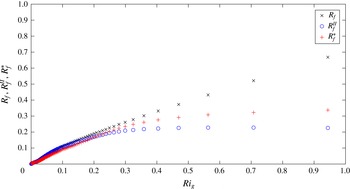
Figure 3 shows a comparison of
 $R_{f}$
,
 $R_{f}^{II}$
and
 $R_{f}^{\ast }$
using the DNS data of GVA for a fully developed stably stratified turbulent channel flow. Again, the relatively good agreement between the three definitions can be seen for
 $Ri_{g}\lesssim 0.25$
. Given the notable fundamental differences between the two sets of simulations, i.e. the SKIF simulations are for time evolving homogeneous shear flows while the GVA simulations are for fully developed wall-bounded turbulent flow, it is encouraging to see similar trends in the behaviour of all three definitions. This highlights the fact that the fundamental physics associated with shear generated turbulence that is locally in a state of quasi-equilibrium is at play in both of these flows as long as
 $Ri_{g}\lesssim 0.25$
, and indicates that the fluxes are predominantly downgradient (i.e. turbulent) for both flows. On the other hand, for high
 $Ri_{g}$
, the agreement between the three definitions decreases rather rapidly (but without oscillations since the data shown are for steady fully developed flow), especially between the traditional definition
 $R_{f}$
and the other two definitions. This is not surprising given that the production
 $P$
of
 $k$
decays as the mean shear rate drops further away from the wall (i.e. in the inner core of the channel). On the other hand, in this far-wall region, reversible effects from linear internal waves are dominant and contaminate the buoyancy flux. Both
 $R_{f}^{II}$
and
 $R_{f}^{\ast }$
appear to level out with increasing
 $Ri_{g}$
, with
 $R_{f}^{II}$
somewhat smaller than
 $R_{f}^{\ast }$
, consistent with the trend also seen in figure 1.
Comparison of the flux Richardson numbers
 $R_{f}$
,
 $R_{f}^{II}$
and
 $R_{f}^{\ast }$
as functions of the gradient Richardson number
 $Ri_{g}$
, computed from the DNS data of García-Villalba & del Álamo (Reference García-Villalba and del Álamo2011).

3.2 A simple parameterization for the irreversible flux Richardson number
 $R_{f}^{\ast }$

It is evident from the discussion in § 3.1 that the irreversible flux Richardson number
 $R_{f}^{\ast }$
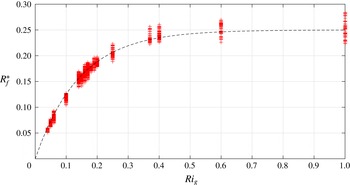
is the only definition that is guaranteed to remain positive definite across a broad range of stratification, a requirement that is necessary in order to be consistent with the eddy-viscosity and diffusivity formulations defined in (1.1) which are based on the gradient-transport hypothesis. Figure 4 shows
 $R_{f}^{\ast }$
as function of
 $Ri_{g}$
as well as a simple exponential fit that was originally proposed by Karimpour & Venayagamoorthy (Reference Karimpour and Venayagamoorthy2014) to mimic the popular parameterization for the flux Richardson number proposed by Mellor & Yamada (Reference Mellor and Yamada1982). The particular form of the exponential function that is proposed here is given as
 $$\begin{eqnarray}R_{f}^{\ast }=R_{f\infty }^{\ast }[1-\exp (-{\it\gamma}Ri_{g})],\end{eqnarray}$$
where we set
 $R_{f\infty }^{\ast }=0.25$
, and
 ${\it\gamma}$
is a constant that is set equal to 7. The agreement between the proposed fit and the data is very good for all
 $Ri_{g}$
. A value of
 ${\it\gamma}=7$
with a
 $\pm 1$
variation (not shown here) envelops the upper and lower bounds of the data in the low-
 $Ri_{g}$
regime (
 $Ri_{g}\lesssim 0.25$
) very well. Such a parameterization is simple to use given that it is based on
 $Ri_{g}$
which is an external parameter that is reasonably easy to measure in laboratory/field experiments and straightforward to compute in numerical simulations.
The irreversible flux Richardson number
 $R_{f}^{\ast }$
as a function of the gradient Richardson number
 $Ri_{g}$
, computed from the DNS data of Shih et al. (Reference Shih, Koseff, Ivey and Ferziger2005). The dashed line shows the fit given by (3.1).

4 Concluding remarks
In this study, our goal was to present a careful comparison of the three definitions of the flux Richardson number,
 $R_{f}$
,
 $R_{f}^{II}$
and
 $R_{f}^{\ast }$
, that are commonly used to provide a measure of the efficiency of the irreversible conversion of turbulent kinetic energy into background potential energy (for a detailed definition of the background potential energy, see Lorenz (Reference Lorenz1955) and Winters et al. (Reference Winters, Lombard, Riley and D’Asaro1995)). Using DNS datasets of time evolving stably stratified homogeneous shear flow as well as channel flow, we have shown that in the shear dominated flow regime (
 $0\leqslant Ri_{g}\lesssim 0.25$
), all three formulations are approximately equivalent. This is an important result in that it allows for the estimation of irreversible mixing directly from flux measurements, and vice versa for inferring fluxes from indirect estimates of dissipation rates. On the other hand, our analysis show that the agreement between the three definitions deteriorates dramatically as
 $Ri_{g}$
increases above 0.25, with significant oscillations in both
 $R_{f}$
and
 $R_{f}^{II}$
in time evolving homogeneous stably stratified shear flows. Both
 $R_{f}$
and
 $R_{f}^{II}$
do not separate out the effects of countergradient fluxes which are pervasive in the buoyancy dominated flow regime. The irreversible flux Richardson number
 $R_{f}^{\ast }$
is the only formulation that is free from such large oscillations and exhibits a clear positive definite trend with increasing
 $Ri_{g}$
. We find that a simple exponential fit for
 $R_{f}^{\ast }$
as a function of
 $Ri_{g}$
mimics the trend in the data remarkably well. As a final note, it is necessary to evaluate data from flows at much higher Reynolds numbers in order to ascertain the sensitivity of the trends found in this present study, especially in the strongly stable flow regime.
Acknowledgements
The authors thank the two anonymous referees for their constructive comments and recommendations. S.K.V. gratefully acknowledges support from the UPS Foundation for his sabbatical at Stanford University, during which time this paper was written. S.K.V. also gratefully acknowledges support from both the National Science Foundation under grant no. OCE-1151838 and the Office of Naval Research under grant no. N00014-12-0938 (Scientific Officers: Dr T. Paluszkiewicz and Dr S. Harper). J.R.K. wishes to acknowledge the generous support from the Stanford Woods Institute for the Environment.