INTRODUCTION
Due to increasing pressures on pastoralist systems, many traditionally practiced risk management strategies are no longer as effective as they were. Here, we use risk to mean the possible occurrence of an event with negative impacts; while risks and shocks are used interchangeably, shocks are generally understood to mean the actual occurrence of a risk. In this paper we analyse results from studies on the perceptions of pastoralist communities on the effectiveness of these risk management strategies and present some innovative initiatives that offer a clear departure from traditional approaches.
Livestock production systems, especially in developing countries, appear to be in a state of flux. As Kinyangi et al. (Reference Kinyangi, Herrero, Omolo, van de Steeg and Thornton2009) point out the livestock production systems, which are important to the rural poor, are rapidly changing in response to population growth, urbanization and changing market conditions. The increase in population is exerting increasing pressure on natural resources and influencing the magnitude of exposure to risks. Countries experiencing rapid rates of population growth will overstretch current public infrastructure, institutions and services. With low institutional adaptive capacity the proportion of migrant workers, rural land displacements and urban-poor households is expected to increase.
Livestock keepers living in harsh rangelands are particularly confronted with a variety of downside risks that constantly threaten to disrupt their livelihoods, devastate assets and therefore impoverish them. These risks, coupled with a limited range of increasingly ineffective risk management options, underlie risk-related vulnerability in pastoral and agro-pastoral systems. We define vulnerability as the level of exposure to and defencelessness against risks. (See Dercon (Reference Dercon2005) for an incisive perspective on vulnerability.) Assessments in Kenya (Mude et al., Reference Mude, Ouma, Steeg, Van de Kariuki, Opiyo and Tipilda2007; Ouma et al., Reference Ouma, Mude, Radeny and Kariuki2008) have identified four main risk categories: climate risks, disease risks, risk of market exclusion and policy shocks.
Climatic extremes, primarily droughts with occasional flooding, are the most severe and constraining of risks faced by pastoralists. Rass (Reference Rass2006) lists eight major droughts that have occurred in the past five decades in Africa: 1965/66, 1972/74, 1981/84, 1986/87, 1991/92, 1994/95, 1999/2001 and lastly 2005/06, with 1981/84 being the worst drought in recent history in the Greater Horn of Africa. In Kenya, the year 2009 was also a major drought year.
Climate-related risks have direct and indirect effects. Rangeland climate patterns have historically dictated spatio-temporal variability in water and fodder availability, influencing mobility, migration and settlement patterns, and leading to the development of pastoralism as the more suitable livelihood (Fratkin et al., Reference Fratkin, Roth and Nathan1999; Swift, Reference Swift1988). And while pastoralists have evolved their methods of managing these risks overtime, increasing population pressure, more rapidly evolving socioeconomic conditions catalysed by increasing interaction with larger towns and cities, have begun to erode coping mechanisms. Climate-related risks increase seasonal hunger by reducing livestock productivity and by causing a collapse in livestock prices as desperate herders try to dispose of emaciated animals. The relative terms of trade between livestock and grain rapidly turn against livestock during droughts (McPeak, Reference McPeak2006; McPeak and Little, Reference McPeak and Little2006), making the purchase of grains and other commodities significantly more difficult for affected households.
Droughts and floods also indirectly influence household behaviour by pushing them toward livelihood options such as petty trading, shop-keeping and other alternatives whose income streams are lower on average, but less volatile than pastoralism (Rosenzweig and Wolpin, Reference Rosenzweig and Wolpin1993). Under the threat of a weather shock, poor households, afraid of losing their assets and increasing their vulnerability, avoid risky but higher return investments in livestock assets (Dercon, Reference Dercon2004; Lybbert et al., Reference Lybbert, Barrett, Desta and Coppock2004). Even if a drought occurred only once in several years, the very threat of this shock is sufficient to keep poor households trapped in poverty as they pursue lower-return livelihoods as an inefficient means of managing their risks, ex-ante (Carter and Barrett, Reference Carter and Barrett2006).
The effect of seasonal rainfall variability on pastoral livelihoods in Africa will be complicated by rapid climate change. A trend of global warming is set to alter weather patterns, resulting in increased severity and frequency of extreme climatic events (IPCC, 2007). It has been argued that the effects of climate change will probably be most acute for pastoralists and agro-pastoralists, especially those in Africa (Thornton et al., Reference Thornton, Jones, Owiyo, Kruska, Herrero, Kristjanson, Notenbaert, Bekele, Omolo, Orindi, Otiende, Ochieng, Bhadwal, Anantram, Nair, Kumar and Kulkar2007). Van de Steeg et al. (Reference van de Steeg, Herrero, Kinyangi, Thornton, Rao, Stern and Cooper2009) review results from various climate change models for East and Central Africa and their implications; while they project an increase in mean precipitation over East Africa, they also suggest significant losses of length of growing periods (up to 20%) in marginal areas that are important for pastoralists.
Climate-related risks interact with other stresses – diseases, changing land tenure, sedentarizing populations, increasing banditry – to promote a vicious cycle of poverty. For pastoral populations, this scenario is aggravated by their low adaptive capacity, which, as opposed to more intensively managed systems tend to evolve slowly in the face of change and to be vulnerable to extreme shock (Thornton et al., Reference Thornton, Jones, Owiyo, Kruska, Herrero, Kristjanson, Notenbaert, Bekele, Omolo, Orindi, Otiende, Ochieng, Bhadwal, Anantram, Nair, Kumar and Kulkar2007).
To cope with fluctuations in forage and water availability, pastoralists and agro-pastoralists developed survival strategies largely based on endogenous social safety nets. Migration is the backbone of the pastoralist's risk management strategy, but the accumulation of livestock as a precautionary savings measure and cultural norms that promote informal transfer of assets toward those who are visited by misfortune are among other methods used to protect against the impact of shocks. These traditional risk-management strategies are essentially second-best options pursued in the absence of market-mediated risk-reduction and risk-transfer arrangements. In this paper we present evidence of increasing ineffectiveness of traditional mitigation and coping mechanisms among pastoral groups. Moreover, we discuss innovative approaches that can help households to deal better with the complications posed by increased seasonal rainfall variability and future climate change.
DATA SOURCESFootnote 1 AND STUDY APPROACH
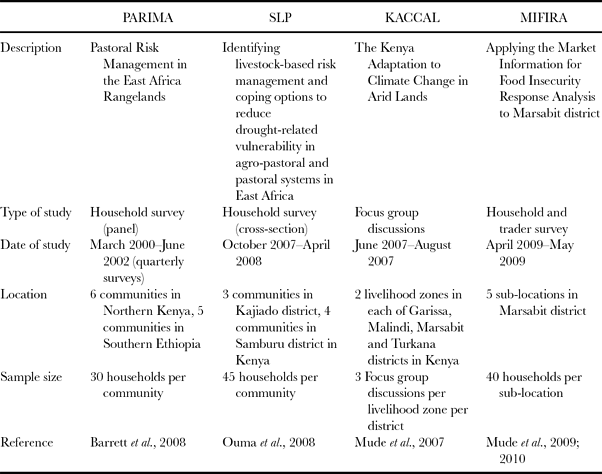
The information analysed in this paper comes, mainly, from four studies of pastoral communities in Kenya and Ethiopia. The project Improving Pastoral Risk Management on East African Rangelands (PARIMA) collected quarterly survey data from 330 households in 10 largely pastoral communities in northern Kenya and southern Ethiopia from March 2000 through June 2002. In the System-wide Livestock Program, aimed at identifying livestock-based risk management and coping options that reduce drought-related vulnerability in agro-pastoral and pastoral systems in East Africa, 300 households from the Samburu and Maasai pastoral communities were interviewed between late 2007 and early 2008. In the Kenyan Adaptation to Climate Change in Arid Lands (KACCAL) project, undertaken in 2007, 24 focus group discussions and numerous stakeholder surveys were undertaken in several communities of the districts, Garissa, Malindi, Marsabit and Turkana, all of which (with the exception of Malindi) are predominantly pastoral. The last study is from April 2009: 200 household surveys across five sub-locations in Marsabit district collecting market information to determine optimal response options to food insecurity in the region (MIFIRA). See Table 1 for a summary of the data from the different projects.
Sources of data used.

In the first three of the four studies that generated information used in this paper, communities and households were asked to demonstrate their degree of concern or satisfaction across various variables by ranking their perceptions of its impact on their welfare. The ranking of coping and mitigation strategies was based on perceived effectiveness, while ranking of risk management and development interventions was based on perceived benefit. To capture temporal dynamism, the households and communities were asked to rank these variables based on past performance and present performance. They were further asked, based on an overall subjective assessment of their circumstance and changing risk portfolio, to rank the same variables in terms of expected effectiveness or benefit in the future. The past and future were pegged on a 5–10 year horizon. The list of choice responses for each variable was provided to assist with the ranking, but respondents were free to add options that they felt were not included but relevant.
In order to compare variables ranked across respondents and communities we normalize these rankings from [0,1], with zero indicating an unranked risks, and one, which was the highest rank, normalized to one. Normalization was conducted using the formula:

where rank is the position in the order of ranking, and maxrank is the highest position in the ranking by a respondent.
The results are presented as averages across specified variables. The presentation of this data in the form of normalized rankings and its analysis allows us to compare similar variables across different data collection methodologies. As these rankings are not cardinal, they do not provide insight into the quantitative difference between the various alternatives and thus do not allow us to extract relative measures of utility (or disutility) across alternatives. Normalization of rankings simply allows us to compare the responses of similar ranking exercises across various entities and get a sense of ordinal differences in preferences. When trying to get a sense of the key risks to a community, the main response mechanisms they apply to mitigate or cope with risk and their preferences for interventions, using normalized rankings is a sufficient tool for extracting key insights and variation across households and communities (McPeak et al., Reference McPeak, Doss;, Barrett; and Kristjanson2009; Mude et al., Reference Mude, Ouma, Steeg, Van de Kariuki, Opiyo and Tipilda2007).
EFFECTIVENESS OF TRADITIONAL RISK MANAGEMENT STRATEGIES
Three factors could determine how risk in pastoral areas is managed. The first is whether the risk is idiosyncratic or covariate. Whereas idiosyncratic risks affect individuals, covariate risks are non-discriminatory, affecting large areas and entire populations often in several different ways. The second factor is whether existing institutions foster negative externalities that might affect wealth dynamics (institutions is used in the sense of ‘rules of the game’ rather than organizations). For example, the incentive to conserve ‘common property’ grazing lands may be low. The last consideration is whether the pastoral system exhibits the phenomenon of ‘poverty traps’, that is, the existence of low level self-reinforcing wealth equilibriums that perpetuate penury (Carter and Barrett, Reference Carter and Barrett2006). These poverty traps are a quirk of the system and ensure that pastoral households holding livestock assets below a certain threshold cannot escape from poverty. In ranking risk management strategies, we assume that the views of sampled households implicitly contain the totality of their experience and account for these three factors.
Risk mitigation and coping
Risk mitigation refers to actions or strategies that households pursue ex ante in order to avoid or reduce the impact of future shock. Figure 1 presents a ranking of mitigation strategies by communities surveyed under the KACCAL study. The figure shows the ranking in terms their perception of past, present and future effectiveness of a series of mitigation strategies. Various forms of community action (community action aggregates self-help groups, savings and credit co-operative societies, community natural resource management initiatives and vigilante groups) are ranked as the most effective mitigation strategy (Figure 1). As observed in Mude et al. (Reference Mude, Ouma, Steeg, Van de Kariuki, Opiyo and Tipilda2007) collective action at community level in pastoral areas is evolving from cultural kinship into formalized and legally registered groups. This evolution is driven primarily by the need for increased institutional complexity to mobilize local or external resources and ideas. This change might also explain why group action was not considered as effective in the past (Figure 1).
Ranking of risk mitigation strategies across temporal scales (KACCAL data: adapted from Mude et al., Reference Mude, Ouma, Steeg, Van de Kariuki, Opiyo and Tipilda2007).

The temporal analysis (Figure 1) shows that communities surveyed regard the deepening of financial services (mainly savings and credit), diversification of livelihoods, improved cropping practices and livestock disease control as mitigation strategies that are, with time, becoming increasing more effective relative to other options. Conversely, traditional mitigation measures, such as migration, livestock accumulation and food storage are not only regarded as relatively less effective, but are losing their significance as effective strategies. As a result of various pressures, migration has become more difficult, diminishing its effectiveness. This may have forced herders to try alternative mitigation strategies. While migration is diminished, mobility in general is still important in pastoral areas. Ouma et al. (Reference Ouma, Mude, Radeny and Kariuki2008) discuss some of the aspects of non-migratory mobility that an increasingly greater proportion of semi-nomadic pastoralists pursue. Still purely nomadic pastoralists are also observed to move less often, further and over longer periods.
The conventional wisdom that the unfavourable agro-ecology and market infrastructure of the arid and semi-arid lands offers little hope for diversified livelihood approaches to risk management is not supported by the KACCAL data. Livelihood diversification has been and continues to be highly ranked as a risk mitigation strategy. While access to the variety of viable socio-economic activities differs by wealth, the recognition that diversification is key is widespread in pastoral communities surveyed (Mude et al., Reference Mude, Ouma, Steeg, Van de Kariuki, Opiyo and Tipilda2007; Ouma et al., Reference Ouma, Mude, Radeny and Kariuki2008).
Risk coping, unlike risk mitigation, means strategies that households pursue ex post, mainly to deal with the negative effects of a shock. Unlike risk mitigation strategies that may improve long-term resilience, risk coping strategies mostly ensure survival during and after a shock. Figure 2, based on community rankings of risk coping strategies shows declining effectiveness of traditional risk coping mechanisms. All top seven ranked coping strategies, with the exception of livelihood diversification, will be less useful to these communities in the future suggesting, not only declining confidence in the effectiveness of these traditional coping strategies, but a clear gap in coping options. Reliance on friends, food aid and sale of assets register particularly large drops in ranking of future effectiveness.
Ranking of coping strategies across temporal scale (KACCAL data: adapted from Mude et al., Reference Mude, Ouma, Steeg, Van de Kariuki, Opiyo and Tipilda2007).

Pastoralist livelihood is essentially an adaptation to seasonal and spatial rainfall variability in the rangelands. This influences the spatial and temporal availability of forage. Evidence discussed in this section indicates that traditional strategies of pastoral lifestyle are increasingly less effective. The implication is clear; pastoralists may need support to develop more effective risk management options. Subsequently, we turn our attention to pastoral perceptions of the effectiveness of development interventions common in pastoral rangelands of Kenya.
Risk management and development interventions
We define development interventions as initiatives undertaken to improve human welfare and general productivity within a locality. In this sense, we deliberately consider some overt risk management interventions as developmental. In assessing their effectiveness, we also make no distinction between the sources of the interventions: government, non-governmental organizations or the community. It is however plausible that community perception of interventions may be influenced to some extent by perceptions about the agencies that provide it.
Development increases the asset base of a given community and with it their ability to deal with risks and withstand shock. While mitigation and coping can be mere intra-household reactions to risk, development can be externally stimulated and carefully planned to foster long-term adaptation. To elicit perceptions of the benefits of certain development interventions, households were asked whether their community received those development interventions, and to rank them how beneficial those interventions were in the past, as well as how beneficial they believe those interventions would be in the future.
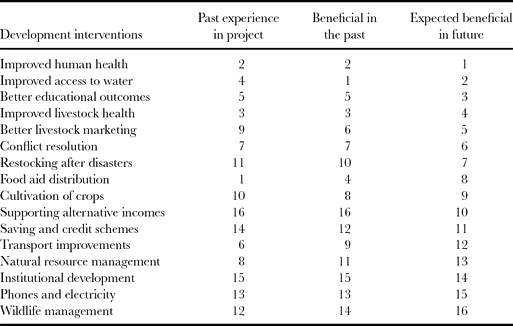
Table 2, based on results from PARIMA, shows the rankings of a range of development priorities, from improved access to safe water, improved human and livestock health outcomes to better conflict resolution, and the provision of food aid. These rankings show the relative importance individuals attach to development interventions for themselves as well as for the whole community. They are an overall assessment of perceived benefit. The first column ranks projects that they have experienced the most. The second column reveals what in their view have been the more beneficial projects for their households and communities, and the last column is futuristic – ranking the projects that community members feel would be most beneficial in the future based on their needs.
Rankings of risk management and development priorities for PARIMA communities.

Source: PARIMA, McPeak et al. (Reference McPeak, Doss;, Barrett; and Kristjanson2009).
There are several insights we can extract from these results (Table 2). First, there is a large degree of inconsistency between the resources and activities channelled to actual intervention activities, and community members’ perceptions of what is important. Food aid provides a clear example. It is ranked as the most experienced intervention, suggesting that substantial resources are used in the provision and widespread distribution of food aid. However, interventions that focus on water management, human health and livestock health are perceived to be of greater importance. As far as the communities are concerned, if their votes or preferences were to determine development and risk management resource distribution, food aid would have been a fourth priority. Furthermore, looking into the future, food aid as a priority drops even further to eighth place. This likely a reflection of the communities understanding that food aid is a hand-out and reliance on food aid is accepting a future circumstance of need and a lack of capacity to fend for oneself.
Food aid is not considered developmental by communities: food aid does not improve the productivity of current livelihoods, provide access to enhanced livelihoods or contribute to the formation of an enabling economic environment. However, development based interventions, i.e. interventions that increase productivity are considered top priority (Table 2). Other than food aid, rankings for the past and for the future are roughly consistent. First, basic needs such as water and health must be met. Illness and lack of water are fundamental to human integrity and capacity; they constrain labour output and place a significant burden on both finance and time resources. Education comes next, a clear signal of the recognition that as the economy evolves a good education opens doors to alternative and relatively lucrative income sources. The next set of priorities, livestock health and marketing, focus on increasing the returns to pastoral production – the key livelihood source in these areas. It is only then that risk mitigation (conflict resolution) and risk coping (restocking and food aid) interventions feature as important interventions.
Figure 3 presents ranking of development interventions from the KACCAL study. The results show that education, improvements in access to water, human and livestock health outrank other development priorities from community perceptions of benefit. These results, therefore, show a close similarity with the findings of the PARIMA study. The top three ranked priorities in Figure 3 are the same, the only difference being a switch in ranking between education and human health. Food aid suffers a similar decrease in ranking. Where it was ranked as the third most important intervention in the past, it falls to seventh when its usefulness as an intervention for future welfare is considered. The main difference has to do with the relative rankings in livestock-related interventions. KACCAL survey districts put less emphasis on livestock health and management issues although they rank restocking somewhat higher. Interestingly for KACCAL districts, non-trivial decreases in the ranking of education and human health interventions are witnessed from the perceived effect on past welfare and expected impact on future welfare. Conversely, increasing importance seems to be placed on agricultural extension, savings and credit interventions, and alternative income generation.
Rankings of development and risk management interventions across time (KACCAL data: adapted from Mude et al., Reference Mude, Ouma, Steeg, Van de Kariuki, Opiyo and Tipilda2007).

The communities surveyed show a preference for development interventions that may increase long-term capacity (such as education, health and water) over initiatives that alleviate immediate suffering (such as food aid). In the longer term, carefully planned development interventions would have positive influence on risk management. While increasing pressures on pastoral lifestyle such expected increases as rainfall variability and climate change offer challenges to pastoral lifestyle – they perhaps creates new opportunities and call for different approaches that account for community perceptions. The next section presents some ideas and approaches that we believe offer hope for better risk management.
INNOVATIONS IN PASTORAL RISK MANAGEMENT
The results presented so far illustrate declining confidence in the effectiveness of traditional risk coping and mitigation strategies by pastoral communities. Increasing pressures have complicated the intricate balance of risks that households could sidestep with the informal risk management strategies available to them. Recognizing the limited range of traditional risk management, mitigation and coping mechanisms, development practitioners, international aid agencies and governments are working on new and more effective tools to help poor and vulnerable households in pastoral and agro-pastoral systems to manage risks more effectively. This section discusses some of these ideas.
Index-based livestock insurance
In the previous section, we observed the limitations of traditional groupings and the increasing trend towards group formalization in order to better mediate successfully with the formal financial system. Self and group insurance means the accumulation of assets to help ride through disaster, individually and collectively respectively. Some studies contend that self insurance strategies would be advantageous in circumstances where credit markets are inefficient (Deaton, Reference Deaton1991); under these circumstances, it is believed households that self-insure would more likely experience smoother consumption but with greater variability in savings as they are periodically drawn to deal with shock events. We use the term informal insurance to denote such individual and group efforts where assets such as livestock are lent back and forth to help households survive. These arrangements obviously rely heavily on strong social and kinship ties. For example, pastoralists in northern Kenya provide cattle to neighbours who have lost a portion of their herds based in part on assistance received in the past as well as to create future obligations (McPeak and Little, Reference McPeak and Little2006).
However, in general, individual households can hardly self-insure or group-insure against major climate related covariate risks such as droughts and foods. As Alderman (Reference Alderman2008) points out, such informal insurance arrangements tend to fail poor families for several reasons. One is the inherent limitation of insuring for covariate shocks; as opposed to idiosyncratic risks, these risks operate at macro levels affecting entire communities and exerting negative multi-dimensional impacts across livelihoods and production systems (Dercon, Reference Dercon1999; World Bank, 2001). A drought may simultaneously destroy crops and cause livestock mortality. It may also have multi-dimensional impacts on, for example, market performance, health and nutrition, food and water availability. Under these circumstances, one's neighbours cannot provide reliable assistance if they are also under stress. Moreover, similar individuals, based on ethnicity, gender and wealth status, tend to form networks with each other. Covariate shocks will most frequently affect similar people in much the same way.
Another limitation is that group insurance arrangements may entail transaction costs of searching for partners, co-ordinating activities and monitoring reciprocal arrangements. As these costs increase, the optimal size of a mutual support network is reduced, also reducing risk sharing.
For these reasons, traditional mutual insurance, though useful, tends to fall short when it is most needed. The poor also have limited social networks and fewer contacts to rely on during times of stress. Our analysis of coping and mitigation strategies in the previous sections support these observations; the increasing attempts to formalize and modernize community action and the increasingly dim view of livestock accumulation as an effective strategy against shocks like droughts suggest that group and self insurance do not work as well anymore.
The creation of insurance markets for risk events whose likelihood of occurrence can be precisely calculated and associated with a well-defined index is increasingly being championed as a way by which the benefits of insurance can be offered to the poor (Barrett et al., Reference Barrett, Barnett, Carter, Chantarat, Hansen, Mude, Osgood, Skees, Turvey and Ward2007b; Skees et al., Reference Skees, Hartell, Hao, Sarris and Hallam2006; World Bank, 2005). Because index insurance is based on the realization of an outcome that cannot be influenced by insurers or policy holders (such as the amount and distribution of rainfall over a season or the related forage experience), it has a relatively simple and transparent structure. This makes such products easier to understand and consequently to design, develop and trade. Indeed the success of several pilot programmes conducted in India, and various countries in Africa and Latin America, have proven the feasibility and affordability of such products (Hellmuth et al., Reference Hellmuth, Osgood, Hess, Moorhead and Bhojwani2009).
Like any insurance product, the purpose of index-based insurance is to compensate clients in the event of a loss. Unlike traditional insurance which assesses loses on a case-by-case basis and makes payouts based on individual client's loss realizations, index-based insurance offers policy holders a payout based on an external indicator which triggers a payment to all insured clients within a geographically defined space. For index insurance to work, their must be a suitable indicator variable (the index) that is highly associated with the event being insured but is not prone to manipulation by either the insured or insurer. For example, if one is insuring against livestock mortality, then an indicator such as rainfall or forage availability may be suitable. The idea would be that rain failure during the rainy season, shortage of available forage, or a combination of the two would result in some level of livestock mortality. Having sufficiently modelled this relationship, one could then write an insurance contract based on a rainfall or forage indicator to protect against various degrees of aggregate livestock losses.
An index-based insurance product has significant advantages over traditional insurance. Traditional insurance requires that the insurer monitor the activities of their clients and verify the truth of their claims. For relatively small clients in infrastructure-deficient environments the costs of such monitoring are often overly prohibitive. With index-based insurance products, all one has to do is monitor the index. Furthermore, by using an index based on variables that cannot be influenced by any insuree's behaviour, index-based insurance products overcome the key problems with traditional insurance contracts of an individual's experience: that more (less) risk-prone individuals will self-select into (out of) the contract and that insured individuals have an incentive to take on added risk – phenomena known respectively as ‘adverse selection’ and ‘moral hazard’.
Index-based products can be used to insure pastoral and agro-pastoral populations from the significant drought-related losses that they incur as a result of climate risks. Currently, a successful pilot of index-based livestock insurance (IBLI) is ongoing in Mongolia (Barnett et al., Reference Barnett, Barrett and Skees2008; Skees and Enkh-Amgalan, Reference Skees and Enkh-Amgalan2002). In addition, the International Livestock Research Institute (ILRI) and its partners, in January 2010, launched a pilot product tailored to the needs of pastoralists in Marsabit District in Kenya's arid north. The pilot is being closely monitored for uptake and welfare impact (see www.ilri.org/ibli for more information on this).
The idea behind IBLI is straightforward. One would define a specific area (e.g. an administrative subdivision such as a Location), a specific index variable for the area (e.g., a measure of forage availability such as normalized difference vegetation index (NDVI) or rainfall shortfalls), and a specific level of the index that would trigger insurance payments (e.g. greater than 30% predicted livestock mortality based on NDVI readings within the insured area and period, or the rainfall shortfall that corresponds to 30% mortality). This would essentially describe the key features of an IBLI contract. From this, the relevant premiums would be calculated conditional on the likelihood of the trigger being struck and the amount of indemnity payment expected.
To obtain a policy, clients will be required to make a non-refundable payment (premium) either directly to an insurance company or an intermediary player in order to be covered by the scheme for the specified amount of time. Clients are to understand that during this time frame, if the index is triggered, the insurance company will pay policy holders according to the amount insured. Clients must also be aware that payments are made only if the index is triggered and not according to individual loss experience. As a result, should the index be triggered, all policy holders automatically qualify for a payout.
Improving food insecurity response
Food aid is the most experienced external intervention in northern Kenya and southern Ethiopia. Yet, while food relief alleviates human suffering and saves lives of the starving, it does little to improve longer-term resilience. In fact, food aid is often said to undermine local markets and depress domestic production. Chronic food aid abets sedentarization and may lead to dependency phenomena often referred to as ‘relief traps’. Households realize this and, as we demonstrated in the previous section, have consistently ranked food aid as progressively less beneficial to them, particularly from a risk management point of view.
In recent years, donors and international agencies tasked with response to food crises have been increasingly offering cash instead of food. Cash transfer programmes are now being seen as a more effective alternative to food in situations where markets and traders can adequately meet local demand. The Market Information and Food Insecurity Response (MIFIRA) framework (Barrett et al., Reference Barrett, Lentz and Maxwell2007a; Maxwell et al., Reference Maxwell, Lentz and Barrett2007) provides a market-based system for ex ante evaluation of optimal aid response choices among food, cash or a mixture; and whether the food ought to be sourced through local and regional purchases or transoceanic shipments (Figure 4).
The food aid/ local purchase/cash transfer decision tree (Barrett and Maxwell, Reference Barrett and Maxwell2005).

Fresh research from several communities across Marsabit district that have been regular beneficiaries of food aid over the past decade indicates that markets are not only accessible to poor households, but are sufficiently stocked and regularly replenished by traders and transporters (Mude et al., 2009; Reference Mude, Ouma and Lentz2010). They further demonstrate sufficient excess capacity among traders to meet all the demand that would be generated by cash transfers.
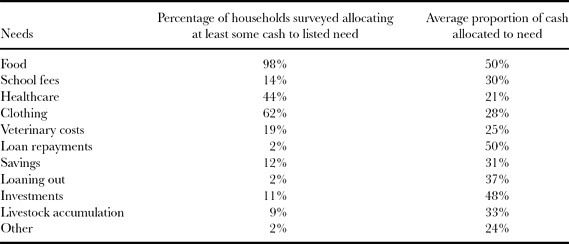
Moreover significant proportions of pastoral households seem to prefer a partial or complete shift towards cash as a response to food insecurity due to its superior exchangeability. Table 3 shows the various applications cited by households of a cash injection of KES 2000 (US$ 27), roughly equivalent in value to a typical food aid basket. Food remains a key expenditure item for most households (98%) if they were to receive cash injections, but they would spend, on average, far less (only 50%) on it. A variety of other expenses (clothing, healthcare, school fees, veterinary costs and even investments) would also receive attention. The application of funds to these other uses suggests that cash would constitute a more effective all round safety net, much more likely to support asset protection and improve risk management than the exclusive distribution of food.
Proportions of households that would allocate cash to different objectives, in the event of cash transfer.

Source: MIFIRA data.
Recasting development interventions as risk management initiatives
A clear lesson from studies on risk management and pastoralists’ perceptions of effectiveness of the various strategies implemented indicate that respondents hardly make a distinction between purely risk management interventions and development initiatives in health, water or education (see Risk management and development interventions above). This is for good reason. The protection of life and assets are fundamental to the overall sense of well-being. Besides, it is clear that in societies with greater investments in social overhead capital, there is a greater longer-term risk management capacity (World Bank, 2001). In this section we review several ideas that improve how development initiatives could serve risk management objectives in pastoral settings.
Developing climate-robust development projects for pastoral risk management. One of the more revealing insights from consideration of Risk management and development interventions is that households seem to prioritize projects that are not overtly directed at risk management. They appear to be more concerned with development projects that improve quality of life in the longer term – education, health, water. It is clear that individuals and communities with higher welfare and development outcomes are more capable of handling risk in the long term. These results suggest an important paradigm shift requiring agencies to view development projects as risk management.
Mude et al. (Reference Mude, Ouma, Steeg, Van de Kariuki, Opiyo and Tipilda2007) have already demonstrated that development interventions, if carefully chosen, meticulously planned and well implemented could encourage improved response to climatic risks. Analysing community perspectives on development projects, Mude et al. (Reference Mude, Ouma, Steeg, Van de Kariuki, Opiyo and Tipilda2007) recommended for the arid and semi-arid areas three broad development interventions: investments in water management, strengthening diversification into dryland commodities and efforts aimed at developing and deepening livestock markets. In addition to these three areas, results from the top-ranked development initiatives of the KACCAL project (Figure 3) suggest education, health and financial services as key areas of development that could strengthen the resilience of pastoralists.
Water availability and access are directly linked to seasonal rainfall variability. Carefully targeted investments in water development including large storage tanks, dams and large-scale piping have shown immediate positive results (Mude et al., Reference Mude, Ouma, Steeg, Van de Kariuki, Opiyo and Tipilda2007). Regrettably, many water-related projects fail because of poor project design, placement and assessment of economic viability. A study of borehole placements in Wajir district (Kenya) has shown that poor planning of water projects may increase vulnerability (Oxfam, 2008), by discouraging mobility and interfering with dry season pasture reserves. In their study, Mude et al. (Reference Mude, Ouma, Steeg, Van de Kariuki, Opiyo and Tipilda2007) make a strong case for large, carefully planned water development projects targeted at improving human health but also supporting pastoralism.
Broad livestock policy studies (Pica-Ciamarra, Reference Pica-Ciamarra2005; Rass, Reference Rass2006) have regarded education as an opportunity to increase diversification options. Little et al. (Reference Little, Aboud and Lenachuru2004) found in a study from Baringo (Kenya) that pastoralist's households having at least one member of the family with at least secondary or post-secondary education have higher incomes, better chances of salaried employment and higher food security. Feder et al. (Reference Feder, Just and Zilberman1985) have shown that the capacity to adapt is closely related to the education of the household head. Increasing levels of education may speed up the process of innovation. Pastoralists themselves rank education as critically important to improving their welfare (McPeak; et al., Reference McPeak, Doss;, Barrett; and Kristjanson2009; Mude et al., Reference Mude, Ouma, Steeg, Van de Kariuki, Opiyo and Tipilda2007). There is a recognition that education offers opportunities to increase welfare and security. This is reflected in education scoring amongst the highest positive impact intervention (Figure 3).
Health projects respond directly to a key risk in pastoral areas. Both human and livestock diseases undermine the asset base and increase vulnerability to other shocks, like droughts. The increase in climate-related disease epidemics (Thornton et al., Reference Thornton, Jones, Owiyo, Kruska, Herrero, Kristjanson, Notenbaert, Bekele, Omolo, Orindi, Otiende, Ochieng, Bhadwal, Anantram, Nair, Kumar and Kulkar2007) makes it imperative to prioritize disease management projects. Animal diseases constitute a grave, sometimes ever-present, source of risk to poor livestock keepers in a variety of ways and continue to be a major constraint to livestock productivity, agricultural development and poverty alleviation in many regions of the developing world (Perry et al., Reference Perry, Randolph, McDermott, Sones and Thornton2003). Heffernan et al. (Reference Heffernan, Misturelli and Pilling2003) in a survey of 3000 households across Kenya, Bolivia and India found that livestock diseases are the most significant problem for approximately 20% of all producers, second only to water and fodder scarcity for the majority. Carefully targeted disease control projects could have significant impact in the management of risks in pastoral areas.
Institutional development for risk management. As we pointed out under Risk mitigation and coping, an increasingly important response to risk among pastoralists and agro-pastoralists is the development of formalized groups, like village grazing and environmental management groups. This is also linked to the continuing breakdown of previously important traditional groups; family ties and socio-cultural cohesion that traditionally helped manage risk (Mude et al., Reference Mude, Ouma, Steeg, Van de Kariuki, Opiyo and Tipilda2007).
However, this idea is taken further, when government is involved in creating institutions to manage risk. For example, the District Steering Group (DSG) mechanism, created under the Arid Lands Management Project (ALRMP) in 28 districts in Kenya. The DSG brings together key officers from ministries, non-governmental organizations operating in the districts, religious organizations and political leaders to co-ordinate the drought and community development efforts in the districts, reviewing early warning bulletins, food security assessments and other information to plan contingency and prioritize actions (Mude et al., Reference Mude, Ouma, Steeg, Van de Kariuki, Opiyo and Tipilda2007). The DSGs are also linked to the Kenyan Food Security Meeting (KFSM) and the Kenya Food Security Steering Group (KFSSG) as national co-ordinating bodies for all actors in food security. In this way risk management practices and efforts are made coherent, while resources are spent more effectively, minimizing duplication. In securing partnerships, wider ownership and co-funding of risk management interventions, the DSG has improved the implementation probability and eventual sustainability of interventions. Investments in creating institutions that manage drought response, attract adaptation funds and encourage concerted action could be a critical factor in responding to changing climates.
Livestock early warning systems. The recurrence of humanitarian crises affecting, in particular arid and semi-arid regions over the years, has highlighted early warning systems (EWS) as a key component of drought risk management. Early warning systems collect data to monitor people's exposure to drought risks in order to provide timely notice when the risk threaten and thus to elicit appropriate responses (Davies et al., Reference Davies, Buchanan-Smith and Lambert1991). Unfortunately most of the national and regional early warning systems developed in the 1970s and 1980s were not designed to cater for the specific needs of populations that derive their livelihoods from livestock. While these systems were developed to monitor weather patterns and to report the effects on agriculture, their over reliance on national cereal balances – measuring aggregate cereal availability – did not take into account measures and indicators relevant for communities relying on animals and other food products (FAO, 2006).
The hazards to livestock-based livelihoods of the arid and semi-arid areas do not lend themselves easily to the tools and approaches pursued in traditional EWS. This has led to the development of EWS sensitive to shocks prevalent in arid and semi-arid areas, and in particular the so called Livestock-based EWS that target perils related to pastoral livelihoods. Modern technology, including satellite imagery, applied to study vegetation development by analysing the NDVI has improved the precision and predictive capacity of EWS. The new thinking in delivering relevant, timely risk management information to pastoralists and agro-pastoral populations promises to improve, dramatically, the speed and relevance of risk mitigation and coping responses among households.
CONCLUSIONS
By juxtaposing evidence of declining effectiveness of traditional risk coping and mitigation strategies with some new and innovative ideas, we show how dynamism and adaptation might work for pastoral groups in the rangelands. Existing pressures caused by variable rainfall combine with new complications such as exponential population growth, urbanization and changing market conditions to create a situation where old methods for dealing with risks are increasingly ineffective.
However, the examples of the new ideas offered here suggest that all is not lost. With innovation and careful planning of development support, risk management in the rangelands can be improved. These new ideas can help improve how households deal with seasonal rainfall variability and future climate change. While these ideas have been, mostly, tested in the East African rangelands, they have broader appeal and are easily adaptable to other pastoral regions in Africa. Many of the new ideas, however, require the right policy framework and resource support from governments, donors and aid agencies.
Acknowledgements
The data used in this research was collected by four projects: the Pastoral Risk Management Project (PARIMA) of the Global Livestock Collaborative Research Support Program, funded by the Office of Agriculture and Food Security, Global Bureau, USAID, under grants DAN-1328-G-00-0046-00 and PCE-G-98-00036-00; the Systemwide Livestock Program study aimed at identifying livestock-based risk management and coping options to reduce drought-related vulnerability in agro-pastoral and pastoral systems in East and West Africa; the Kenyan Adaptation to Climate Change in Arid Lands (KACCAL) study funded by the World Bank and the Market Information for Food Insecurity Response Analysis (MIFIRA) study in Marsabit District, Kenya, funded by the Regional Strategic Analysis and Knowledge Support System node for East and Central Africa (ReSAKSS-ECA). The opinions expressed do not necessarily reflect those of the various donor organizations.