Introduction
Patients with hemispheric injury often demonstrate attentional and action-intentional spatial and magnitude-length biases in both the transverse and coronal planes. Studies of healthy right-handed people have revealed several attentional and action-intentional spatial asymmetries of the forelimbs. For example, in one of the earliest studies of normal subjects’ spatial bias, it was demonstrated that on a horizontal (intersection of the transverse and coronal planes) line bisection task, healthy young adults exhibit a bias to the left of true center (Bowers & Heilman, Reference Bowers and Heilman1980; Jewell & McCourt, Reference Jewell and McCourt2000), even with eyes closed. Although most of the subsequent studies of normal subjects examined right–left biases in the transverse plane using horizontal lines, it has also been demonstrated that normal participants have an upward bias with midline vertical lines (intersection of the midsagittal and coronal planes) and a distal bias with midline radial lines (intersection of the midsagittal and transverse planes) (Mennemeier, Wertman & Heilman, Reference Mennemeier, Wertman and Heilman1992; Shelton, Bowers, & Heilman, Reference Shelton, Bowers and Heilman1990).
Normal subjects also demonstrate a spatial bias when attempting to draw horizontal lines with their eyes closed. For example, Graff-Radford, Crucian, and Heilman (Reference Graff-Radford, Crucian and Heilman2006) had blindfolded healthy subjects perform a bimanual horizontal line-drawing task in the transverse plane. This study revealed that as the two hands approached each other at the midsagittal plane, the right hand deviated closer to their body than did the left hand. Other studies (e.g., Fujii, Yamadori, Fukatsu, & Suzuki, Reference Fujii, Yamadori, Fukatsu and Suzuki1996; Jeong, Tsao, & Heilman, Reference Jeong, Tsao and Heilman2006) have also demonstrated that when attempting to make horizontal movements in the transverse plane the left hemisphere-right hand has a proximal motor intentional bias. In addition, the right hand traveled less than the left, demonstrating a relative right hand-left hemisphere hypometria when making adductive horizontal movements in the transverse plane. It is not known, however, if there will be right or left deviations from midline for each hand when normal subjects attempt to make bimanual vertical movements in the middle of the body centered coronal plane (intersection of the coronal and midsagittal plains).
It is also unknown if the magnitude (length) of the movements will be affected by the hand used, the direction of movement (up vs. down), and the body centered position of these movements. Thus, the purpose of this experiment is to assess normal participants for these biases when they attempt to make bimanual vertical movements in the midsagittal plane. A better understanding of the spatial attentional and action-intentional biases demonstrated by healthy persons would better allow us to know what might be abnormal in patients with brain dysfunction, as well as the possible mechanism of these altered biases. This understanding may also aide rehabilitation research and the management of persons with brain damage. For example, research on horizontal biases in healthy persons has contributed to the understanding of persons with hemispatial neglect and has helped inform rehabilitation efforts (e.g., Barrett et al., Reference Barrett, Buxbaum, Coslett, Edwards, Heilman, Hillis and Robertson2006).
In this study, like the study of Graff-Radford et al. (Reference Graff-Radford, Crucian and Heilman2006), we use a simultaneous bimanual task because both clinical studies and studies of laterality in normal subjects suggest that alterations of attention and intention are more likely to be observed with bilateral than unilateral tasks (e.g., dichotic listening and extinction to simultaneous stimulation). Consistent with findings on movements in the transverse plane, we hypothesize that processing biases will be manifest as (1) systematic angular deviations from midline (midsagittal plane) and (2) as hyper/hypo-metric movements (longer/shorter distances traveled).
Previous investigations have also indicated that each hemisphere has a propensity to attend and intend to contralateral hemispace (Heilman, Bowers, & Watson, Reference Heilman, Bowers and Watson1984). In accordance with this postulate, in a straight ahead pointing task, Chokron, Colliot, Atzeni, Bartolomeo, and Ohlmann (Reference Chokron, Colliot, Atzeni, Bartolomeo and Ohlmann2004) reported that pointing was deviated toward the side of the hand used and toward the starting point, that is, the most leftward deviation was observed when participants used the left hand and started on the left side, whereas the most rightward deviation was observed when they used the right hand and started on the right side. In addition, whereas the right hemisphere is better able to attend and intend to both hemispatial fields, the left hemisphere primarily attends and intends to the right hemispatial field (Heilman & Van den Abell, Reference Heilman and Van den Abell1979, Reference Heilman and Van den Abell1980; Weintraub & Mesulam, Reference Weintraub and Mesulam1987). Based on this right–left hemispheric asymmetry we predict a greater deviation of the right than left hand. In contrast, there is evidence to suggest that, in people who are right handed, the left hemisphere-right hand can perform more precise movements than the left including spatial accuracy (Haaland, Harrington, & Knight, Reference Haaland, Harrington and Knight1999) and based on this “praxis asymmetry” the right hand should perform more accurately (deviate less) than the left.
Ungerleider and Mishkin (Reference Ungerleider and Mishkin1982) as well as others (Bálint, Reference Bálint1909; Lissauer,1890), have described two visual systems, a ventral “what” and dorsal “where” system. Although these two systems were described in the visual modality, it is possible that even in the absence of vision spatial “what” and “where” computations may be, at least in part, mediated by these two systems. The ventral visual system primarily receives projections from the lower half of the retina, which primarily receives visual stimuli from the upper visual field. Since the “where” system is dorsal it is possible that “where” spatial procedures are better performed in lower than upper space, and prior research has indeed suggested that the “dorsal-where” processing system has preferential access to information from lower space (Rapcsak, Cimino, & Heilman, Reference Rapcsak, Cimino and Heilman1988). Whereas prior research has shown that the “dorsal-where” networks process visual stimuli, there is also evidence that these same networks are involved in spatial processing even in the absence of visual input. For example, Bonino et al. (Reference Bonino, Ricciardi, Sani, Gentili, Vanello, Guazzelli and Pietrini2008) demonstrated that tactile spatial working memory activated the dorsal extrastriate cortical pathway in congenitally blind individuals. In this study, while moving their hands up or down, the participants’ hands were in three portions of space (above, at, and below eye level). Because the task used in this study requires spatial navigation of the upper limb, we posited that these dorsal-where systems would influence performance on this bimanual vertical task and hence predicted that our participants would be more accurate (have less deviation in either direction) when working in lower than upper space.
Simultaneous bimanual vertical movements engage both attentional and intentional processes, but we are unable to empirically test the relative contribution of each to task performance. Attention and intention are highly intertwined and integrated processes (e.g., Heilman Watson, & Valenstein, Reference Heilman, Watson and Valenstein2003) that are difficult to dissociate in healthy persons and we are not aware of any task that is purely attentional or purely intentional. Because participants in this study are blindfolded and receive no visual feedback when performing these spatial movement tests, the participants probably had to rely more strongly on spatial motor planning (intention) and motor programming systems (i.e., praxis-deftness). Therefore, the experimental task used in this study is primarily a spatial-action-intentional test, but since the subjects do receive proprioceptive feedback, this task does have a sensory-perceptual-attentional component. Furthermore, when performing this task participants may image a vertical line and attend to this representation when guiding their actions.
In summary, the purpose of this study was to learn when patients attempt to draw vertical lines in their midsagittal plane if they have right versus left spatial biases, and if they have differences in the magnitude of their movements as a function of the hand used (right, left), the direction of movement (up, down) and egocentric spatial position (above, at and below eye level) of these actions.
Materials and methods
Participants
The participants were seventeen healthy volunteers (eight men and nine women) without a previous or current neurological or psychiatric disease. All participants were right-handed, as determined by the Edinburgh-handedness inventory (Oldfield, Reference Oldfield1971). The mean age and education for these participants were 26.2 years (SD = 5.0) and 17.9 years (SD = 1.7), respectively. This study was approved by the Institutional Review Board (IRB) at the University of Florida and was completed in accordance with the guidelines of the Helsinki Declaration. Participants provided formal, IRB-approved written informed consent before participating.
Apparatus
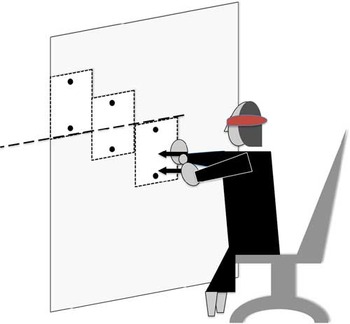
The participant was seated in a chair, which was placed so that his or her eyes were approximately 40 cm in front of a smooth and flat wall. At this distance the subjects could easily reach the wall with either hand. We placed 21.59-cm by 27.94-cm sheets of white paper in front of each participant's sternum, the long side of the paper aligned with the subject's sagittal plane and the short side with their transverse plane. Markings on the wall helped guide the examiner's placement of the stimulus page to ensure that the long side was indeed vertical. On each piece of paper there were two small (5.5 mm in diameter) circles that were 10 inches (25.4 cm) apart, one at the upper portion of the paper and the other at the lower portion (2.54 cm from the top and bottom of the vertically positioned paper), and these two dots were aligned with the subject's midsagittal plane.
The participants were given two ballpoint pens, one to hold in each hand. After blindfolding the subjects with a bandana, the examiner guided the tips of each ballpoint pen to the starting position. The participants had the point of the pen they were holding in their right hand placed on the upper dot for one half of the trials, while simultaneously the pen in their left hand was placed on the lower dot (Figure 1). For the other half of the trials the up–down right–left hand positions were reversed. Participants saw the stimulus page only once during the explanation of the task, but were not offered the opportunity to practice or to receive feedback on their performance. Participants were then blindfolded and helped into position in a chair without armrests and faced a wall.
Apparatus. This figure shows the position of participant and his/her hands in relation to each position of paper (above, eye level, and below).

With the participant's body as the frame of reference, the papers were placed in three spatial positions: (1) Mid-eye level, such that the subject's eyes bisected the vertically placed papers (e.g., 13.97 cm from each end of the paper); (2) Above-eye level, such that the bottom of the paper was aligned with the subject's eyes; (3) Below-eye level, such that the top of the vertically positioned paper was aligned with the participant's eyes. Hence, there were a total of six experimental conditions: three positions of the paper (above, middle, below eye level) and two hand conditions, right hand on top and left on bottom or left hand on top and right hand on bottom. There were 12 trials for each condition for a total of 72 trials. These trials were performed within a single testing session and were randomized for each participant so that there were no systematic effects of fatigue or learning across conditions. These 72 trials took approximately 30 min to complete.
Analysis
There are three dependent variables: (1) the absolute maximum value of the angle of the drawn line's deviation from the mid-sagittal plane (to measure the magnitude of error in degrees regardless of direction); this maximum value was used since many of the participants demonstrated an initial bias (away from their midsagittal plane) such that each hand deviated in a different direction; however, as these participants’ hands approached each other they attempted to compensate by attempting to vertically align their hands. Thus, by measuring maximum deviation (e.g., rather than a weighted trajectory), we avoid confusing the bias with the latter attempt to compensate by alignment; (2) the right or left directional deviation of that angle (to measure direction of error); (3) the length of the drawn line by the left and right hands (to measure asymmetry of movement magnitude). The independent variables for this analysis are: hand (right vs. left), movement direction (upward vs. downward), and position of paper (above, below, at eye level). After inspection of the dependent variables for normality and statistical consideration of skewness and kurtosis, repeated-measures analyses of variance (ANOVAs) within subject were conducted for each dependent variable in the conditions mentioned above.
Results
Angular Deviation
Because many of the lines drawn by the participants were not straight, the angle of deviation was measured from the point of origin to the point of maximal deviation from the mid-sagittal plane. The mid-sagittal plane was defined by the two dots on the upper and lower ends of the page. Rightward deviations from the mid-sagittal line were scored as positive and leftward deviations were scored as negative.
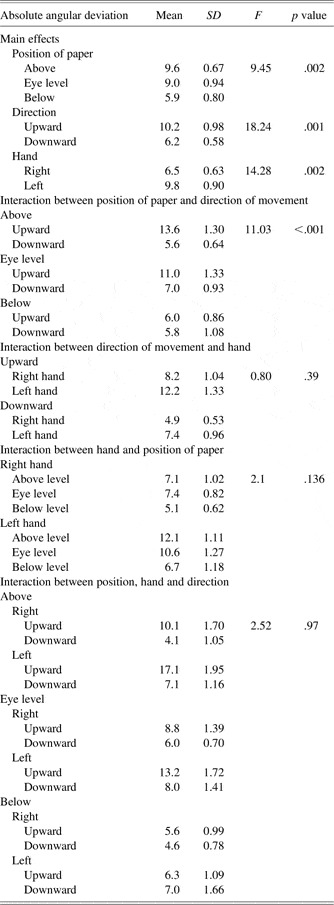
Within-subject repeated-measures ANOVAs were used to analyze the absolute value of deviation for each angle drawn to assess main effects of movement direction (upward, downward) and hand (right, left), as well as interactions (Table 1). Participants were more accurate in the below eye level spatial condition than in the other spatial conditions: F(2,15)=9.45; p=.002. In addition, participants were more accurate when drawing lines downward than in the upward direction: F(2,15) = 18.24; p = .001. Furthermore, subjects were more accurate using their dominant hand (right) than non-dominant (left) hand: F(2,15) = 14.28; p = .002. There was an interaction effect of direction of movement and spatial condition such that angles were more accurate with downward movements in the above space condition: F(2,15) = 11.03; p = .001). No other interactions were significant (Table 1).
Magnitude (absolute value) of angular deviation: main and interaction effects

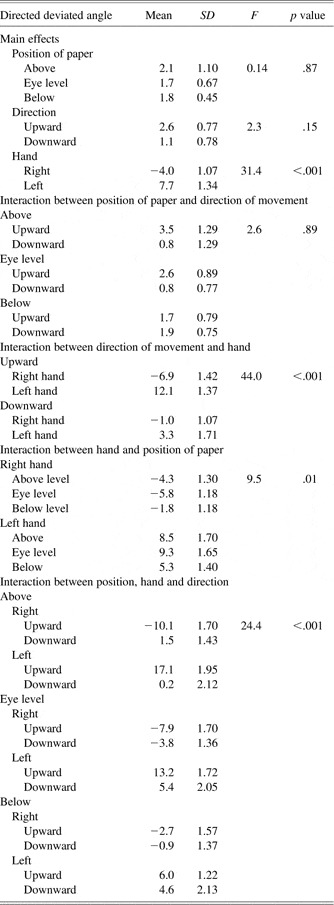
To determine if participants had a right or left bias in the vertical (coronal) plane, we analyzed the direction or angle of deviation from the midsagittal plane. When using the right hand, the created angle was deviated toward the left hemispace and with use of the left hand, subjects deviated toward the right hemispace: F(2,15) = 31.4; p = .001). Other main effects including space and direction were not significant (Table 2).
Direction of angular deviation: main and interaction effects

Line Length
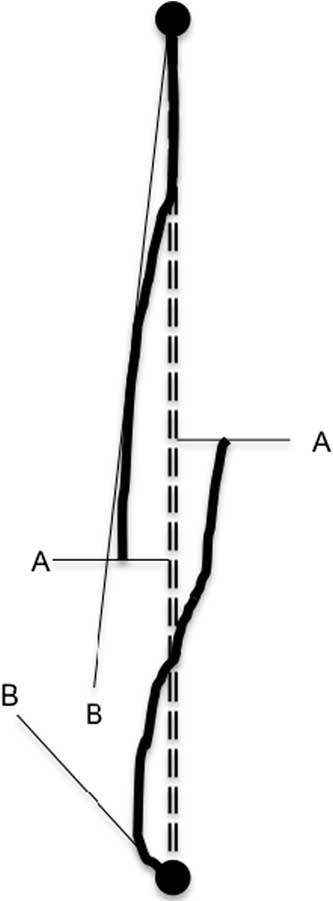
To determine if our participants exhibited vertical asymmetries in the magnitude or length of movement related to the hand used (right, left), the direction of movement (up, down), and the spatial location of the paper with respect to the eyes (below, above, and at eye level) or interactions between these conditions, we determined the distance traversed in the sagittal plane. To determine length, we located the end of the subject's drawn line, and then drew a perpendicular line from the midsagittal line, intersecting the end of the drawn line. This procedure was necessary because the subjects’ lines were not straight (see Figure 2 for an example of the procedure by which length was determined). We then measured the length from origin dot to this perpendicular line at its intersection with the midsagittal plane (vertical distance).
Example of performance. This figure shows the measurement of the maximum distance travelled in the midsagittal plane (A), as well as most deviated angle (B). The dashed line shows the midsagittal line.

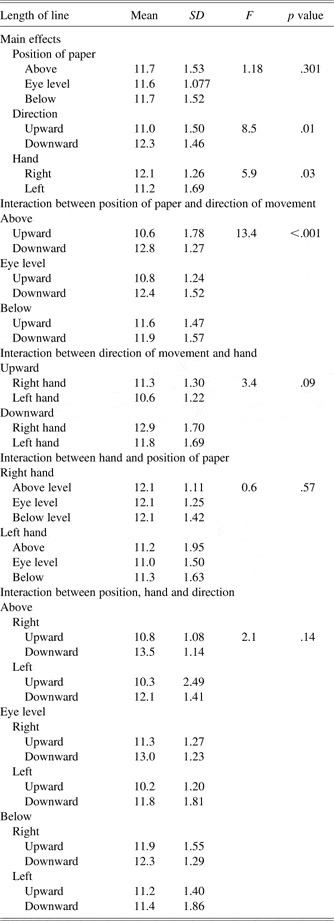
To learn if there were any main or interaction effects of hand, movement direction, or paper position on line length, we analyzed the effect of these independent variables by using within-subjects repeated measures ANOVAs. First, there were no significant differences in line length as a function of eye level space: F(2,15) = 1.18; p = .303. Second, lines were longer with downward hand movements than upward: F(2,15) = 8.5; p = .01. Finally, the lines made by the right hand were longer than those of the left hand: F(2,15) = 5.9; p = .03. Of the possible interactions, in the above eye level and middle eye level conditions, upward drawn lines were shorter than downward drawn lines: F(2,15) = 13.4; p = .001). In the below eye level condition, the upward versus downward movements were not different. Other interactions were not significant. These results are also presented in Table 3.
Line length: Main and interaction effects

Discussion
Angular Deviation
The results of this study indicate action-intentional spatial biases are influenced by the vertical space of action, the direction of movement, and hand used. We found that in right-handed participants the right hand deviated less from the mid-sagittal plane than did the left hand. This is consistent with our hypotheses and with previous investigations using the midsagittal plane pointing task (Cohen, Burtis, Williamson, Kwon, & Heilman, Reference Cohen, Burtis, Williamson, Kwon and Heilman2010; Heilman, Bowers, & Watson, Reference Heilman, Bowers and Watson1983) and horizontal line bisection (e.g., McCourt, Freeman, Tahmahkera-Stevens, & Chaussee, Reference McCourt, Freeman, Tahmahkera-Stevens and Chaussee2001).
Before potential mechanisms of this forelimb asymmetry can be discussed, it is important to note that the type of error made by the left hand is different in midsagittal line drawing and pointing tests than in the line bisection tests. For example, in the line bisection task the left hand, when compared to the right hand, deviates more to the left (McCourt et al., Reference McCourt, Freeman, Tahmahkera-Stevens and Chaussee2001). However, in the pointing test (Cohen et al., Reference Cohen, Burtis, Williamson, Kwon and Heilman2010; Heilman et al., Reference Heilman, Bowers and Watson1983), and also in our line drawing task the left hand, when compared to the right hand, deviated to the right. The reason for the different left–right directions of spatial deviations in these tasks is not known; however, this dichotomy might be related to differences in hemispheric asymmetries of attention in relation to allocentric versus egocentric foci of attention. For example, in the line bisection task, the subject is required to find the middle of an object and hence action-intention is “allocentrically” oriented. In the midsagittal plane pointing task, while the subjects are asked to point to space they must attend to their own body's midsagittal plane and thus this task may be more “egocentrically” oriented. Studies of patients with hemispheric lesions and physiological studies of normal subjects all suggest that the right hemisphere is dominant for allocentric attention and intention (for a review, see Heilman et al., Reference Heilman, Watson and Valenstein2003). Thus, because attention-intention is more allocated to the left than right side of the line normal subjects performing the line bisection task often deviate leftward (Bowers & Heilman, Reference Bowers and Heilman1980). Furthermore, this deviation is greater when the left hand is used because the left hand is primarily controlled by the right hemisphere and use of this left hand might also increase activation of the right hemisphere.
In contrast, unlike allocating attention-intention to allocentric space where there is a leftward bias (right hemisphere dominance), when allocating attention-intention to the body (egocentric space) the left hemisphere may be dominant. Support for this postulate comes from Mark and Heilman (Reference Mark and Heilman1990) who found that normal participants’ performance on the midsagittal plane pointing task was affected by their ability to see their body; when they were unable to see their body they deviated to the right of their midsagittal plane. However, when these same subjects were able to see their body, they corrected this deviation.
The reason for this rightward deviation is not known; however, many cognitive functions related to the body such as finger knowledge or right versus left orientation are mediated by the left hemisphere and when attempting to find the midsagittal plane, without seeing their own body, a person might have to activate their left hemisphere and this activation might cause a rightward spatial bias. In addition, when using their left arm to point, a person might compute their body's midline by estimating the left versus right half of their body. If with use of the left hand they activate their right hemisphere and attend more to the left half of their body or body image then this half will appear larger. Perceiving the left side of the body as larger than the right might then shift the percept of the midsagittal plane toward the right.
Regarding the main effect of direction, downward movements were overall more accurate than upward movements. The mechanism that accounts for this asymmetry is not known; however, since the work of Lissauer (Reference Lissauer1890) and Bálint (Reference Bálint1909), it has been known that ventral temporal–occipital lesions cause visual object agnosia (defects in object recognition) and dorsal parietal–occipital lesions produce what has been called “optic ataxia” where patients are impaired when attempting to grasp or touch an object in space, such as the examiner's finger (defect in spatial–motor programming). Ungerleider and Mishkin (Reference Ungerleider and Mishkin1982) replicated this dichotomy in monkeys demonstrating two visual processing systems, a ventral “what” system that is important in object recognition and a dorsal “where” system important in guiding movement in space. In addition, patients with parietal lesions are more likely to be inattentive to (i.e., neglect) stimuli in lower space (Rapcsak et al., Reference Rapcsak, Cimino and Heilman1988) and patients with ventral temporal–occipital lesions are more likely to be inattentive to stimuli in upper space (Shelton et al., Reference Shelton, Bowers and Heilman1990) Thus, downward movements may be primarily controlled by the dorsal system that is superior at spatial guidance than is the ventral system, which controls upward movements.
The gravitational or “plumb line” hypothesis is an alternate, but not contradictory explanation for the superior accuracy of downward movements. According to this hypothesis, the goal of the movement was to move vertically in the midsagittal plane, and when moving downward versus upward the subjects could have used the force of gravity to help guide their movements.
The final main effect was the position of the paper with respect to the participants’ eye level. The results indicate that when performing this task below eye level the subjects were more accurate than when performing at eye level or above eye level. These results are consistent with the dorsal stream hypothesis mentioned above and thus help provide converging evidence for the superiority of the dorsal versus the ventral systems in the spatial guidance of hand movement. Some may question whether this advantage is the result of practice; indeed, it is true that many human activities are performed below eye level. However, the causal relationship between performance and brain processing biases cannot be known. That is, perhaps spatial processing is particularly good below eye level because of the brain's dorsal-where preference, or perhaps the dorsal-where preference evolved to match the high rate of activities performed in that space. The results described here simply demonstrate the phenomenon for the first time during bimanual vertical movements.
Line Length
Our results also revealed two main effects of line length: the right hand moved a greater distance than did the left, and downward movements were longer than upward movements. We had no a priori hypotheses that would have predicted these results of line length, but did develop several post hoc explanations for these magnitude asymmetries. In regard to hand used, right handed people are normally less accustomed to using their left than right hand and therefore might have allocated more attention to their left hand when it was being used. Stimuli that receive greater attention appear to have a greater magnitude and this leftward focus of attention might have altered (increased left vs. right) estimates of magnitude. Our results and this hypothesis, however, are not consistent with the work of Graff-Radford et al. (Reference Graff-Radford, Crucian and Heilman2006) who in their horizontal bimanual task found that the left hand moved more than the right. Thus, the reason that the right hand is relatively hypometric when compared to the left with bilateral horizontal movements and relatively hypermetric with vertical movement remains to be determined.
In regard to direction (down vs. up), the transparent explanation would be that it is easier to go with the force of gravity than against gravity. However, attention is also related to effort and the greater the effort exerted to make a movement the greater attention a person may allocate to that movement. As mentioned above, estimates of magnitude are influenced by the allocation of attention, and items that receive greater attention appear to be larger than items that receive less attention. Thus, upward movement might have appeared longer than downward movement because going against gravity requires more effort, but in actuality downward movements were longer.
Whereas there have been a multitude of studies examining brain impaired patients’ right and left attentional and intentional biases in the transverse plane (e.g., horizontal line bisection), there has been a paucity of studies investigating deficits in the coronal (vertical) plane. In this study, we demonstrated biases during healthy participants’ performance of a simultaneous bimanual vertical line drawing task. It may be valuable for future studies to assess patients with brain impairments, as well as unilateral movements in both brain impaired and normal subjects. In addition to helping us better understand normal brain function, these studies may help uncover disabilities that were previously unknown as well as help to provide strategies for rehabilitation (e.g., Barrett et al., Reference Barrett, Buxbaum, Coslett, Edwards, Heilman, Hillis and Robertson2006).
Acknowledgments
We thank Salsabil Haque and Na-yun Kwon for their assistance with coding data. The information in this manuscript and the manuscript itself has never been published, either electronically or in print. None of the authors have conflicts of interest, financial or otherwise. This research was supported in part by the Department of Veterans Affairs Research Service.