Introduction
In Aspicilia A. Massal. (Pertusariales, Megasporaceae) a number of species have radiating thalli and elongate, often ± diverging and branched marginal areoles, closely attached to the substratum. Magnusson (Reference Magnusson1939), who treated Aspicilia as a subgenus of Lecanora, placed these in different subgroups of section Orbiculares, together with species with a distinct zonation. Those containing norstictic acid (‘sectiones thalli KOH crystallos rubros formantes’) were for instance placed in the subgroup Rubescentes. The placodioid to lobate species, usually referred to Lobothallia were not treated by Magnusson and are not closely related (Nordin et al. Reference Nordin, Savić and Tibell2010).
For some time we have been aware of the existence of two species with affinity to those of the Rubescentes group, but not agreeing with any of them. Nor have we been able to find matches in other groups or among species described elsewhere. The species were first observed and collected several years ago in the province of Jämtland, Sweden, and not until recently have we discovered new localities and additional herbarium material of both species from other areas. They are described here as new to science, and a parsimony analysis based on ITS sequences is employed to elucidate their phylogenetic relationships. Further, Aspicilia epiglypta (Norrl. ex Nyl.) Hue, A. disserpens (Zahlbr.) Räsänen and A. sublapponica (Zahlbr.) Oxner are lectotypified. Aspicilia disserpens is reduced to synonymy with A. perradiata (Nyl.) Hue.
Materials and Methods
Sampling
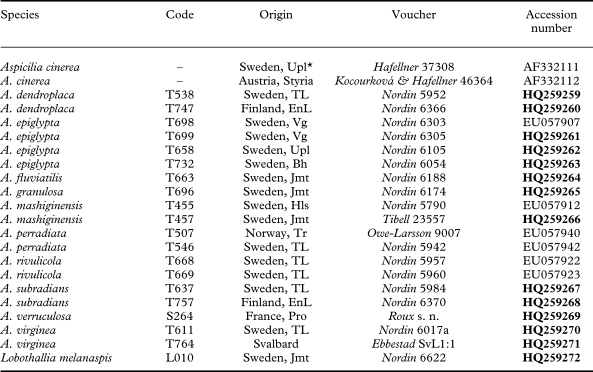
Nuclear ITS1-5.8S-ITS2 rDNA sequences of 22 specimens representing 11 Aspicilia species and Lobothallia melanaspis (Ach.) Hafellner were used in the molecular study. New sequences were produced from 14 specimens and 8 sequences were downloaded from GenBank (Table 1). Seven of the Aspicilia species used, viz. A. dendroplaca (H. Magn.) Oxner, A. perradiata, A. mashiginensis (Zahlbr.) Oxner, A. rivulicola (H. Magn.) Räsänen, A. subradians (Nyl.) Hue, A. verruculosa Kremp. and A. virginea Hue (sensu Magnusson Reference Magnusson1939, who investigated the type), are morphologically similar to the new species described (A. fluviatilis and A. granulosa); and the ITS sequences of A. epiglypta are similar to the new species. Lobothallia melanaspis was used as an outgroup. In an analysis of Megasporaceae by Nordin et al. (Reference Nordin, Savić and Tibell2010), where a subdivision of Aspicilia is proposed, Lobothallia is sister to the rest of Megasporaceae.
Sequence and voucher information for species used in the phylogenetic analysis. New sequences are in bold. Vouchers of A. cinerea are deposited in GZU, the rest in UPS

* Province abbreviations: Bh = Bohuslän, EnL = Enontekiön Lappi, Hls = Hälsingland, Jmt = Jämtland, Pro = Provence-Alpes-Côte D'azur, TL = Torne Lappmark, Tr = Troms, Upl = Uppland, Vg = Västergötland.
Extractions and PCR amplifications
Total DNA for the new sequences was extracted from the samples using the Qiagen DNeasy Plant Mini Kit.
PCR amplification was conducted by using the primers ITS1-F (Gardes & Bruns Reference Gardes and Bruns1993) in combination with LR7 or LR1n (Tibell Reference Tibell2006) to specifically amplify the fungal ITS1-5.8S-ITS2. When no or only a weak band was obtained in the first PCR, the product from this reaction was used for a nested PCR using primers ITS4 and ITS5 (http://www.biology.duke.edu/fungi/mycolab/primers.htm). The PCR ran for 35 cycles (1 min at 94°C, 1 min at 54°C, 45 s at 72°C with a 4 s/cycle extension at 72°C) using ABI Taq. Promega Taq or alternatively AccuTaq premix tubes were used. Before sequencing the PCR product was purified using the Qiaquick Spin kit and protocol by Qiagen or Millipore Cleanup Plates.
Sequencing reactions were carried out with the following primers: ITS2, ITS3, ITS4 and ITS5 (White et al. Reference White, Bruns, Lee, Taylor, Innis, Gelfand, Sninsky and White1990). The sequencing reactions were carried out by MACROGEN Inc. (www.macrogen.com). Sequences were assembled manually.
The sequences were aligned using ClustalW as implemented in the Bioedit software packet (http://www.mbio.ncsu.edu/RNaseP/info/programs/BIOEDIT/bioedit.html) and optimized manually. The alignment can be obtained on request.
Phylogenetic analysis
The data matrix was processed by the computer software PAUP* 4.0b10 (Swofford Reference Swofford2002). The analysis applied a heuristic search using 1000 random addition sequences, TBR branch swapping algorithm, collapse branches if maximum branch length is zero, save multiple trees, gaps treated as missing data, and characters given equal weight. Bootstrap support values were estimated using 1000 bootstrap replicates, each with 1000 random addition sequence replicates.
Morphology and chemistry
Fresh material from Finland, France, Norway, Svalbard and Sweden was studied together with herbarium material from H, O, S and UPS. The material was examined using dissection and compound microscopes. Sections, mainly cut by hand, were studied in water, 10% KOH (K) (tips of paraphyses) and Lactic Blue. Lugol's solution was used for the detection of amyloid reactions, c. 50% HNO3 (N) for epihymenial pigments, and c. 50% H2SO4 for calcium oxalate. Spore measurements are given as (min.–)M−SD–[M]–M+SD(–max.), rounded to the nearest 0·1 µm, where ‘min.’ and ‘max.’ are the extreme values recorded, M the arithmetic mean and SD the corresponding standard deviation. Conidia length and spore measurements in the key are given as min–[M]–max. Measurements of other details represent extreme values. HPTLC was performed according to standard methods (Arup et al. Reference Arup, Ekman, Lindblom and Mattsson1993; Orange et al. Reference Orange, James and White2001).
Geographic coordinates
Geographic coordinates for our own collections were assessed using a GPS receiver with the map datum WGS84.
Results
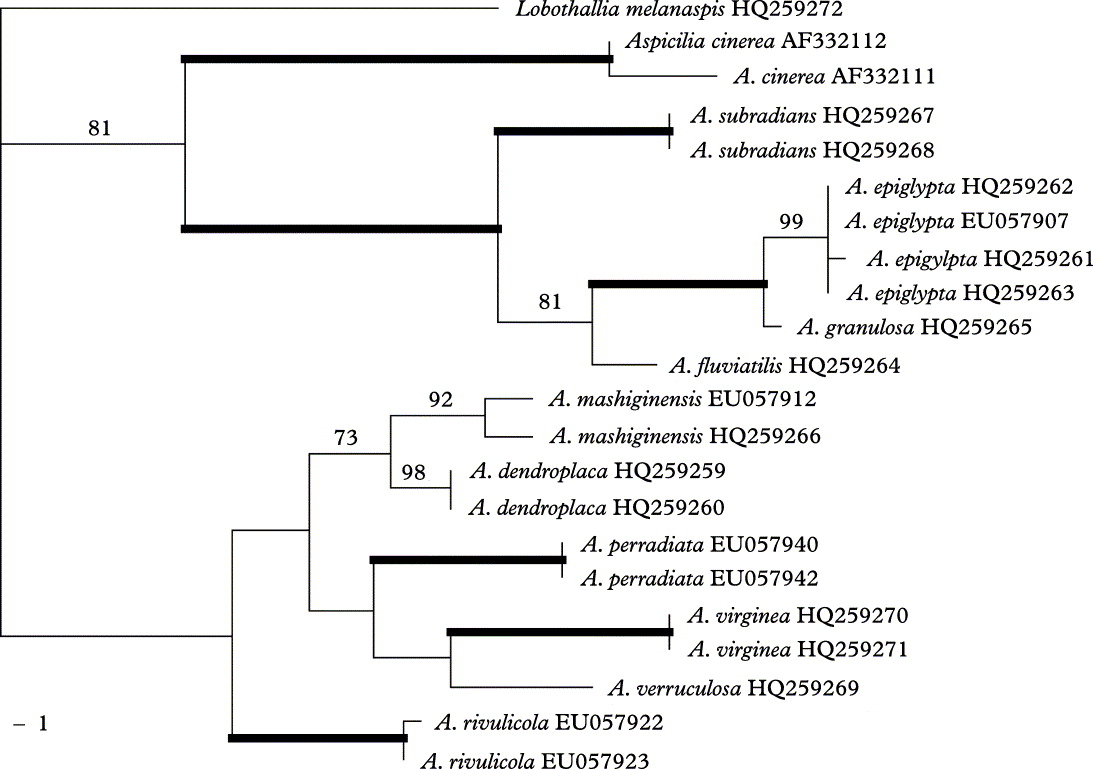
The parsimony analysis resulted in a single most parsimonious tree with a length of 233 steps. The tree is shown in Fig. 1, with bootstrap support values indicated. The ITS sequences of the two new species described below are most similar to those of the mainly coastal lowland species A. epiglypta. Together with these and A. subradians they form a strongly supported sister group to A. cinerea, the type species of Aspicilia, while the remaining species with radiating thalli and/or elongated and ± diverging marginal areoles are clustered in a poorly supported group with an unresolved relationship to the former group. The French specimen of A. verruculosa does not agree with A. perradiata but seems to be more closely related to A. virginea. The taxonomic consequences of this are discussed in connection with A. perradiata below.
The single most parsimonious tree resulting from the MP-analysis of ITS sequences from a number of Aspicilia species, showing the phylogenetic placement of the new species A. fluviatilis and A. granulosa. Branch lengths correspond to the number of changes. Thickened branches indicate 100 % bootstrap support. Bootstrap values between 70 and 99 % are indicated above internal branches.

The Species
Aspicilia epiglypta (Norrl. ex Nyl.) Hue
Nouv. Arch. Mus. Hist. Nat., 5 sér. 2: 7 (1912) [1910].—Lecanora epiglypta Norrl. ex Nyl., Flora 64: 4 (1881); type: Finland, Uusimaa, ‘ad Helsingfors, 1860’, J. P. Norrlin (H-NYL 25457a!—lectotype, designated here).
Aspicilia fluviatilis A. Nordin & Owe-Larss. sp. nov
MycoBank MB518886
Thallus saxicola, tenuis, rimoso-areolatus, radians, ochraceocinereus vel paulo fuscus tinctus. Apothecia primum immersa dein emergentia, ad 0·6 mm diametro, discus concavus ad paulo convexus, primum laevis mox scabrosus, vulgo pruinosus, pars interior marginis thallini saepe orbis albus formans. Ascosporae hyalinae, simplices, ellipsoideae, 16·9–28·2 × 9·0–15·8 µm. Conidia 11·3–16·9 µm. Acidum norsticticum continens.
Typus: Sweden, Jämtland, Åre par., Handölsforsarna, W side, just below the suspension bridge, c. 1 km S of Handöl, alt. c. 600 m, 63°14′59·5″N 12°26′33·4″E, on siliceous rocks in the river bed, 1 August 1993, B. Owe-Larsson H93-133 (UPS—holotypus).
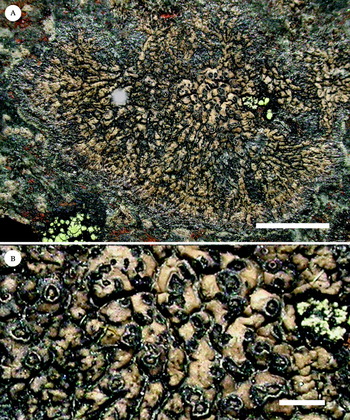
(Fig. 2)
Aspicilia fluviatilis (holotype). A, habitus; B, central part of thallus with white-rimmed, pruinose apothecia. Scales: A = 5 mm; B = 1 mm.

Thallus grey to ochraceous grey, partly with a brownish tinge, thin, 0·2–0·5 mm thick, in inner part irregularly cracked-areolate, in outer part usually separated by radiating cracks and forming a dendroid branching pattern. Areoles irregular, smooth. Cortex paraplectenchymatous, obscured by norstictic acid crystals, c. 22–43 µm thick, cells c. 5–9 µm diam., epinecral layer thin, up to 8 µm thick. Medulla with abundant Ca-oxalate crystals, forming needles in H2SO4. Hypothallus distinct, dark brown to black, smooth to striate or fimbriate, seen between the areoles in the inner part of the thallus and sometimes forming a distinct marginal zone. Photobiont trebouxoid.
Apothecia urceolate to broadly attached, round to irregular, detached or sometimes confluent, 0·2–0·7 mm diam., 1–4 per areole. Thalline margin blackening in older apothecia, usually with a white inner rim. Disc dark brown to black, first smooth, soon uneven, concave to slightly convex, usually covered by white-grey pruina containing norstictic acid crystals. Proper exciple c. 40–55 µm wide in upper part, narrowing below, cells in upper part c. 5 µm wide, thick-walled, thinner in lower part, I−. Epihymenium brown-green, N+ green, K+ red-brown (needles) due to the norstictic acid of the pruina. Hymenium hyaline, 115–145 µm tall. Paraphyses branched and anastomosing, predominantly moniliform, with 3–5 ± globose apical cells, up to 3·5 µm wide (in K). Asci Aspicilia-type, clavate, 85–101 × 32–43 µm. Ascospores hyaline, broadly ellipsoid, (16·9–)20·3–[23·0]–25·7(–28·2) × (9·0–)10·7–[12·3]–13·9(–15·8) µm (n = 40). Hypothecium 40–90 µm thick.
Pycnidia found only once, c. 0·20 ×0·17 mm, wall pigmented in upper part, algae present below. Conidia filiform, 11·3–[15·0]–16·9 × 1 µm (n = 20).
Chemistry. Thallus K+ yellow turning red, C−, Pd+ yellow-orange; norstictic acid present in cortex and apothecium discs (pruina). The pigment Caesiocinerea-green (Meyer & Printzen Reference Meyer and Printzen2000) present in the epihymenium.
Distribution and ecology. Aspicilia fluviatilis is so far known from subalpine–alpine localities at altitudes ranging between 430–1175 m in the Scandinavian mountains and from a locality close to the Siberian coast in the Russian province Yamal-Nenets. It grows on siliceous rocks close to running water or on scree slopes below steep mountain sides. Associated species include Aspicilia granulosa, A. mashiginensis, Buellia aethalea, Ionaspis odora, I. suaveolens, Lecanora polytropa, Lecidea praenubila, L. sp., and Rhizocarpon cf. geographicum.
Notes. Aspicilia fluviatilis is characterized by an areolate, usually radiating thallus; apothecia with uneven, pruinose disc and a white inner rim of the thalline margin; large spores; and the presence of norstictic acid both in the thallus and epihymenium. The similar A. fimbriata (H. Magn.) Oxner, described from Siberia, has distinctly smaller spores and lacks norstictic acid in the epihymenium. For a comparison with other Fennoscandian species, see the key below.
The material from Norway was found as an admixture in a collection of Aspicilia mashiginensis, from which it was separated; the Russian collection was originally determined to be A. stygioplaca (Nyl.) Hue by the collector. The material collected by G. Gilenstam in Lule Lappmark was referred to the Lecanora cinerea-group by the collector and in the herbarium placed under Aspicilia cinerea.
Norstictic acid in the epihymenium also occurs in Aspicilia cuprea Owe-Larss. & A. Nordin and often also in A. epiglypta.
Aspicilia fluviatilis hosts a gall-inducing lichenicolous fungus forming both perithecia and pycnidia (possibly a Stigmidium sp., but ripe spores not seen), making some areoles unusually large.
Additional specimens examined. Norway: Hordaland: Ullensvang, Litlos, rocks at the river on E side close to Littosvand, alt. 1175 m, 15 vii 1947, G. Degelius s. n. (UPS).—Russia: Yamal-Nenets: Tumenskaya, Chugor-Yakha River, c. 3 km NW of the mouth, 69°07′N 74°40′E, M. Andreev 912511 (UPS).—Sweden: Jämtland: Åre par., Handölsforsarna, W side, just below the suspension bridge, c. 1 km S of Handöl, alt. c. 600 m, 63°14′59·5″N 12°26′33·4″E, 2006, A. Nordin 6174 (UPS). Lule Lappmark: Gällivare par., Stora Sjöfallet National Park, SE slope of Mt. Nieras, Parnekårsa, alt. 550 m, 67°30′45·4″N 18°23′41·1″E, 2010, A. Nordin 7065 (UPS); Loamejåkkå, c. 3 km N of Suorva, alt 580 m, 67°33′08·1″N 18°11′58·2″E, 2010, A. Nordin 7113 (UPS); slopes of Mt. Joulmme, E of Suorva, alt. 540 m, 67°31′29·0″N 18°13′41·5″E, 2010, A. Nordin 7097 (UPS); by the Ritsem road c. 1 km SE of Suorva, alt. 430 m, 67°31′00·6″N 18°13′15·8″E, 2010, A. Nordin 7127 (UPS); Jokkmokk par, Lilla Luleälv, Sitojaure, E Piutjapakte, 1964, G. Gilenstam 997 (UPS); scree slopes below Mt Piutjapakte, alt. 700–740 m, 67°18′19·6″N 18°15′36·0″E, 67°18′21·9″N 18°15′28·9″E and 67°18′23·0″N 18°15′27·4″E, 2010, A. Nordin 7076, 7081, 7085 (UPS; 7085 will also be distributed to ASU, BM, CANL, CBG, GZU, H, HMAS, LD, M, MIN, O, TNS and US in Moberg, Lich. sel. exs. UPS).
Aspicilia granulosa A. Nordin sp. nov
MycoBank MB518887
Thallus saxicola, tenuis, parte interiore granulosus vel verrucosus ad indistincte areolatus, parte marginali areolis elongatis ordinationem dendroideam formantibus, cinereus, viridicinereus vel fuscocinereus, partim brunneus. Apothecia immersa, ad 0·6 mm diametro, discus concavus vel planus, margo thallinus laevis ad granulosus vel interdum exipulo proprio substituto. Paraphyses praecipue moniliformes. Ascosporae hyalinae, simplices, ellipsoideae, 15·4–18·7 × 8·8–12·1 µm. Acidum norsticticum continens.
Typus: Sweden, Jämtland, Åre par., the waterfall Silverfallet, c. 4 km S of Enafors, lower part, W side, alt. c. 690 m, 63°15′08·0″N 12°19′37·2″E, on slightly sloping ridge with schistose rock c. 5 m above the stream, 9 September 2007, A. Nordin 6516 (UPS—holotypus; isotypi will be distributed to ASU, BM, CANL, CBG, GZU, H, HMAS, LD, M, MIN, O, TNS, US and UPS in Moberg, Lich. sel. exs. UPS).
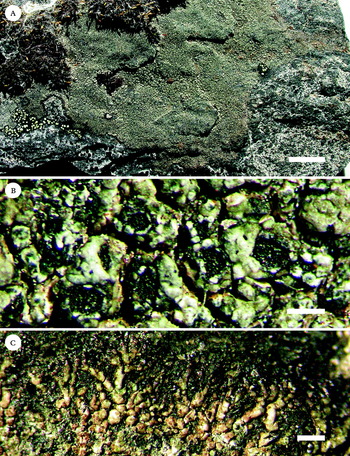
(Fig. 3)
Aspicilia granulosa (holotype). A, habitus; B, central part of thallus with immersed apothecia; C. marginal part with diverging elongate areoles. Scales: A = 10 mm; B & C = 0·5 mm.

Thallus grey, green-grey, brown-grey to brownish, often minutely white-spotted, thin, 0·2–0·3 mm thick, in inner part finely granulose or subisidiate to verrucose or indistinctly areolate, at margin usually with elongate areoles forming a dendroid pattern. Areoles c. 0·1–0·2 mm wide and up to 1 mm long, often brown at the tips, in central parts indistinct, irregularly rounded, often nodulose or subdivided into granules, sometimes bursting open and exposing the medulla. Cortex paraplectenchymatous, more or less pigmented in upper part, c. 20–35 µm thick, cells c. 5 µm diam., epinecral layer usually present, up to 15 µm thick. Medulla opaque from crystals, insoluble in K, N, HCl and H2SO4, and also present in the proper exciple. Hypothallus dark brown to black, smooth, often fimbriate at margins. Photobiont trebouxoid.
Apothecia urceolate, irregularly rounded, 0·2–0·6 mm diam. Thalline margin indistinctly delimited from the surrounding thallus, smooth to subcrenulate, sometimes replaced by a proper margin. Disc black, smooth, concave, epruinose. Proper exciple c. 40–70 µm wide in upper part, narrowing below, cells in upper part c. 5 × 6 µm, thick-walled, thinner in lower part, I+ faintly blue. Epihymenium brown-green, N+ green, K+ brown. Hymenium hyaline, 105–115 µm tall. Paraphyses branched and anastomosing, predominantly moniliform, with 3–6 ± globose upper cells, up to 3 µm wide (in K). Asci Aspicilia-type, clavate, 8-spored, 52–104 ×17–20 µm. Ascospores hyaline, broadly ellipsoid, (15·4–)15·6–[16·7]–17·8(–18·7) ×(8·8–)8·8–[10·2]–11·5(–12·1) µm (n = 10). Hypothecium 52–58 µm thick.
Pycnidia not found.
Chemistry. Thallus K+ yellow turning red, C−, Pd+ yellow-orange, contains norstictic and connorstictic acids. The pigment Caesiocinerea-green (Meyer & Printzen Reference Meyer and Printzen2000) is present in the epihymenium.
Distribution and ecology. So far Aspicilia granulosa is known only from the provinces of Jämtland and Lule Lappmark in the Swedish part of the Scandinavian mountains. At the type locality and in a second locality at Silverfallet it grows by a series of falls and rapids running from an altitude of about 850 m down to c. 650 m. The two localities are situated at altitudes of c. 690 m and 750 m respectively. In Stora Sjöfallet National Park it also grows close to running water, for instance at lower altitudes (460–500 m) at bridges along the road from Vietas to Ritsem but also higher up along the streams. At Mt Piutjapakte and SE of Suorva it grows on siliceous boulders in scree slopes below steep mountain sides, at Mt Piutjapakte at altitudes 720–760 m and at Suorva at 460 m. The specimens collected or observed at Silverfallet grew on schistose, slightly ferriferous rock close to running water. Associated species include Amygdalaria panaeola, Lecanora polytropa, Lecidea spp., Porpidia tuberculosa, poorly developed Rhizocarpon spp, and Umbilicaria torrefacta. In Lule Lappmark it was also sometimes found together with Aspicilia fluviatilis.
Notes. Aspicilia granulosa is characterized by a thin thallus with an irregularly granulose inner part and elongated, diverging marginal areoles, and the presence of norstictic acid. When first collected it was mistaken for a somewhat strange A. mashiginensis, but this species has rounded and often raised true soralia and contains substictic acid. For comparison with other Fennoscandian species, see the key below. The Siberian A. fimbriata has more well-developed and discrete central areoles, numerous apothecia with a prominent thalline margin, and smaller spores.
The material from Lule Lappmark was referred to the Lecanora cinerea-group by the collector and in the herbarium placed under Aspicilia cinerea.
Like Aspicilia fluviatilis, A. granulosa hosts a gall-inducing lichenicolous fungus forming both perithecia and pycnidia (possibly a Stigmidium sp., but ripe spores not seen), making some areoles unusually large.
Additional specimens examined. Sweden: Jämtland: Åre par., the waterfall Silverfallet, c. 4 km S of Enafors, lower part, W side, alt. c. 690 m, 63°15′08·0″N 12°19′37·2″E, 2006, A. Nordin 6174 (UPS); ibid., middle part, E side, alt. c. 750 m, 63°15′03·0″N 12°19′41″E, 2007, A. Nordin 6520 (UPS). Lule Lappmark: Gällivare par., above the Ritsem road c. 3 km SE of Suorva, alt. 460 m, 67°30′50·6″N 18°14′46·8″E, 2010, A. Nordin 7089 (UPS); Stora Sjöfallet National Park, Loamejåkkå, c. 3 km N of Suorva, alt. 540 m, 67°32′58·6″N 18°12′02·7″E, 2010, A. Nordin 7114 (UPS); Lapsejåkkå, at the Ritsem road bridge, alt. 480 m, 67°35′52·5″N 18°02′51·6″E, 2010, A. Nordin 7118, 7119 (UPS); Maukojåkkå, W side, c. 300 m N of the Ritsem road, alt. 500 m, 67°38′07·2″N 17°51′26·3″E, 2010, A. Nordin 7120 (UPS); Maukojåkkå, at the Ritsem road bridge, alt. 470 m, 67°37′58·0″N 17°51′14·1″E, 2010, A. Nordin 7124 (UPS); Jårmejåkkå, W side, below the Ritsem road bridge, alt. 460 m, 67°40′54·4N″ 17°36′33·4″E, A. Nordin 7125 (UPS); Jokkmokk par, Lilla Luleälv, Sitojaure, E Mt. Piutjapakte, 1964, G. Gilenstam 1015 (UPS); scree slopes below Mt Piutjapakte, 67°18′21·9″N 18°15′28·9″E and 67°18′24·6″N 18°15′27·4″E, 2010, A. Nordin 7076, 7081 (UPS).
Aspicilia perradiata (Nyl.) Hue
Nouv. Arch. Mus. Hist. Nat., 5 sér. 2: 114 (1912) [1910].—Lecanora perradiata Nyl., Flora 67: 213 (1884); type: [Russia, Chukotka], Siberia Septentrionalis, Sinus Konyam ad Fretum Bering, 64°50 lat. bor., 173° long. occid. (Greenw.), 28–30 June 1879, E. Almquist s. n. (S L-4638!—holotype).
Lecanora perradiata var. disserpens Zahlbr., Rep. Scient. Res. Norw. Exp. N. Zemlya 1921, 44: 10 (1928).—Lecanora disserpens (Zahlbr.) H. Magn., Kungl. Vet. Akad. Handl. Ser. 3, 17(5): 164 (1939).—Aspicilia disserpens (Zahlbr.) Räsänen in Huuskonen, Kuopion Luonnon Ystäväin Yhdistyksen Julkaisuja, ser. B, II, 5: 18 (1949); type: [Russia, Arkhangelsk], Novaya Zemlya, Northern Kristovii Isl., 14 July 1921, B. Lynge s. n. (O L-1098!—lectotype, designated here).
Notes. Magnusson (Reference Magnusson1939) regarded var. disserpens as “certainly nearly related to L. perradiata” but chose to raise it to species level due to the “discrete ± whitish lobes, the granular, lax medulla and the negative K-reaction of its thallus”. However, there is considerable and seemingly continuous variation in colour and ‘lobation’ in 12 collections from which we have almost identical ITS sequences. In some the marginal areoles are narrow and widely diverging, just like those of Fig. 42 in Magnusson (op. cit.); in others the radiating areoles are ± contiguous and forming a rim limited by a distinct prothallus as in Fig. 43 (op. cit.). The colour of the thallus varies from bluish white to dark brown, often with great variation within the same thallus. The difference in medulla structure noticed by Magnusson is due to varying amounts of calcium oxalate crystals: in white thalli they are abundant, in dark thalli sparse. There is thus neither morphological nor molecular evidence for the recognition of ‘var. disserpens’. Both the type of A. perradiata and the proposed type of var. disserpens (also studied by Magnusson) contain stictic acid. Some specimens, however, lack substances detectable by TLC, such as the voucher of the sequence EU057940. Hence we find no support either for the species delimitation introduced by Magnusson, or for the use of infraspecific taxa.
In Nordin et al. (Reference Nordin, Tibell and Owe-Larsson2007) the vouchers of the sequences EU057940–EU057942 were regarded as belonging to Aspicilia verruculosa, described from the Alps. At that time we believed it to be conspecific with A. perradiata, which is a more recent name. A sequence from French material of A. verruculosa, however, differed considerably from those from Fennoscandia (Fig. 1), and here we accept them as separate species. For a closer investigation of morphological differences more material of A. verrucuolosa from Central Europe is necessary.
Swedish specimens determined as Aspicilia hyperboreorum Zahlbr. by Magnusson, also belong to A. perradiata. The type of A. hyperboreorum in O is a tiny specimen, regarded by Magnusson (Reference Magnusson1939) as an “apparently abnormal specimen, probably grown under unfavourable conditions”. Like A. perradiata it contains stictic acid, although it was found to be K− both by Zahlbruckner (Reference Zahlbruckner1928) and Magnusson (Reference Magnusson1939). It might be conspecific with A. perradiata, but for the time being we prefer not to propose a synonymization.
Aspicilia sublapponica (Zahlbr.) Oxner
in Kopaczevskaja et al., Handb. lich. USSR 1: 204 (1971).—Lecanora sublapponica Zahlbr., Rep. Scient. Res. Norw. Exp. N. Zemlya 1921, 44: 17 (1928); type: [Russia, Arkhangelsk], Novaya Zemlya, Fram Bay, Mashigin, 10 August 1921, B. Lynge s. n. (O L-740!—lectotype, designated here).
Key to Fennoscandian Aspicilia spp. with elongate, marginal areoles
Occasionally species other than those included in the key may also form elongate marginal areoles or a radiating thallus organization, for instance in sites periodically overrun by water, and Aspicilia permutata (Zahlbr.) Clauzade & Rondon does so even in drier habitats. Swedish material of A. alboradiata (H. Magn.) Oxner reported as Lecanora alboradiata by Magnusson (Reference Magnusson1952), belongs to A. permutata. The single report of A. circularis (H. Magn.) Oxner (as Lecanora c.) (op. cit.) from Sweden is based on material of A. rivulicola (the type of which supports a wider circumscription than of the original description in Magnusson Reference Magnusson1939). Also, A. sublapponica belongs to the group of species only occasionally forming elongate areoles. Of the syntypes in O only the proposed lectotype has elongate areoles. Reports of A. sublapponica from Sweden (Magnusson Reference Magnusson1939) are doubtful; the material from Lule Lappmark seems better placed in A. haeyrenii (H. Magn.) Creveld and that from Torne Lappmark is too scarce to be identified with certainty.
1 Thallus zonate, usually lacking distinct elongate areoles but with radiating cracks, whitish grey to grey, often with a brownish tinge; greyish prothallus usually present; apothecia immersed to subsessile and then with distinct thalline margin, up to 2 mm diam.; ascospores 13·6–[17·1]–22·6 × 7·9–[9·6]–12·4 µm; conidia 23·7–[30·0]–36·2 µm long; secondary substances absent; subalpine; aquatic ... ... A. rivulicola
Thallus not zonate, usually with distinct elongate ± branching marginal areoles ... 2
2(1) Thallus K+ yellow turning red, containing norstictic acid ... 3
Thallus K+ yellow or K− ... 5
3(2) Norstictic acid present in epihymenium ... A. fluviatilis
Norstictic acid not present in epihymenium ... 4
4(3) Central part of thallus ± granulose; ascospores < 19 µm long ... A. granulosa
Central part not granulose, central areoles ± convex, sometimes partly compressed in upper part, marginal areoles sometimes poorly developed, often contiguous, grey to almost black; prothallus usually distinct, black, often fimbriate; apothecia immersed to subsessile, up to 0·8 mm diam.; ascospores 14·7–[24·0]–30·5 × 9·0–[12·2]–15·8 µm; conidia 15·8–[18·7]–21·5 µm long; arctic-alpine ... ... A. subradians
5(2) Soralia present, discrete, scattered, flattened to slightly stipitate; thallus whitish grey to dark grey or brownish grey; marginal elongate areoles diverging; apothecia rare, immersed to slightly protruding, up to 1 mm diam., thalline margin sometimes sorediate; ascospores 13·6–[15·4]–18·1 × 9·0–[9·8]–11·3 µm; conidia 12·4–[16·2]–19·2 µm long; contains substictic acid; widespread; at waterfalls and on cupriferous rock (at old copper mines) ... A. mashiginensis
Soralia absent ... 6
6(5) Thallus containing substictic acid, sometimes in low concentration, brown to dark greenish grey, elongate marginal areoles contiguous or diverging, central areoles slightly convex; blackish prothallus usually present; apothecia long remaining immersed, slightly protruding with age, then with indistinct thalline margin, up to 0·6 mm diam., but usually smaller; ascospores 13·6–[15·7]–19·2 × 7·9–[8·9]–11·9 µm; conidia 17–20 µm long (fide Magnusson Reference Magnusson1939); subalpine-alpine, mainly on calciferous rocks ... A. dendroplaca
Thallus containing stictic acid, or substances absent ... 7
7(6) Thallus usually containing stictic acid, white to dark grey or brown, often variegated, elongate marginal areoles contiguous or diverging; brown or black prothallus usually present; apothecia protruding early, adnate to sessile, with distinct thalline margin (rarely blackening), up to 1·5 mm diam. but usually c. 0·3–0·7 mm diam.; disc often pruinose; ascospores 12·4–[15·9]–20·3 × 7·9–[9·9]–12·4 µm; conidia 15–21 µm (fide Magnusson Reference Magnusson1939); arctic-alpine, on calcareous rock, often together with Xanthoria elegans on vertical rock surfaces ... A. perradiata
Thallus found once only with stictic acid, whitish, marginal elongated areoles less conspicuous than in A. perradiata; prothallus indistinct or absent; apothecia slightly protruding, with distinct dark and usually pruinose rim, to 1·4 µm diam. but usually smaller; ascospores 14·7–[17·9]–21·5 × 9·0–[11·1]–12·4 µm, sometimes globose. Conidia not observed; arctic-alpine, little known ... A. virginea
Claude Roux and Jan-Ove Ebbestad are acknowledged for contributing fresh material. Financial support was granted from The Swedish Taxonomy Initiative and the Olsson-Borgh Foundation, Uppsala University.