1. Introduction
Continuum manipulators (CMs) [Reference Ma and Dollar1] offer superior flexibility, inherent compliance, and dexterity compared to traditional rigid manipulators, making them fit for confined and unstructured environments. However, their non-linear deformation, compliance behavior, and varying dynamics complicate accurate motion control [Reference Dehghani and Moosavian2, Reference Falkenhahn, Mahl, Hildebrandt, Neumann and Sawodny3]. Whereas traditional rigid-link robots struggle in confined spaces, highlighting the scope of the unique characteristics of CMs [Reference Singh and Krishna4]. The ability to accurately track desired trajectories in the presence of external forces is paramount for many applications, like harvesting [Reference Morar, Doroftei, Doroftei and Hagan5], minimally invasive surgery [Reference Shi, Luo, Qi, Li, Song, Najdovski, Fukuda and Ren6], manipulation in cluttered spaces [Reference Xu, Mu, Liu and Liang7], and underwater exploration [Reference Youssef, Soliman, Saleh, Mousa, Elsamanty and Radwan8].
Tendon-driven continuum manipulators (TDCMs) use a flexible backbone and routed tendons to produce motion. Planar TDCMs simplify kinematics and reduce actuator count, while spatial designs increase dexterity at the expense of model and control complexity. Thus, a research gap exists to retain planar designs and actuation simplicity while enabling spatial tip manipulation for robust trajectory tracking under parameter uncertainty and external interactions.
Kinematic models [Reference Su9–Reference Chikhaoui and Burgner-Kahrs11] based on constant-curvature assumptions are computationally efficient but fail to capture manipulator dynamics in force-interactive tasks. Conversely, high-fidelity dynamic models such as Cosserat rod [Reference Janabi-Sharifi, Jalali and Walker12, Reference Chikhaoui, Lilge, Kleinschmidt and Burgner-Kahrs13] and Euler–Lagrange [Reference Falkenhahn, Mahl, Hildebrandt, Neumann and Sawodny3] can capture external interactions but incur computational cost and are sensitive to parameter variations, restricting their robustness. Advanced techniques such as Kane’s approach [Reference Rone and Ben-Tzvi14], shape function [Reference Godage, Branson, Guglielmino, Medrano-Cerda and Caldwell15], and lumped mass models [Reference Zhang, Yang, Song, Khanesar, Branson, Dai and Kang10, Reference Giri and Walker16] improve fidelity but remain fragile under parameter variability. On the control side, model-based strategies [Reference Penning, Jung, Ferrier and Zinn17–Reference Santina, Duriez and Rus19] achieve accuracy but demand precise models, while model-free methods [Reference Back, Lindenroth, Rhode and Liu20, Reference Kang, Kim, Choi, Jeong, Kim, Jo and Cho21] adapt to uncertainty but at high training cost and without guarantees of stability.
Recent works have also explored deployable and bio-inspired continuum designs, including an elephant-trunk-inspired programmable robot [Reference Li, Kan, Yuan, Rajabi, Wu, Zhang, Peng and Wu22], a coiling-based deployable continuum robot [Reference Yuan, Sun, Chang, Dong and Song23], and the RobOstrich manipulator, inspired by the ostrich neck [Reference Nakano, Gunji, Ikeda, Or, Ando and Inoue24]. While these studies demonstrate mechanical morphologies and deployment strategies, they primarily focus on design novelty rather than robustness-oriented control under parameter uncertainty and external disturbances. The control of CMs is particularly challenging due to their infinite degrees of freedom, unlike rigid-link manipulators with discrete joints. Elastic backbone deformations [Reference Su9, Reference Zhao, Zhang, Zhang, Zhu and Xu25] and environmental interactions [Reference Sadati, Naghibi, Walker, Althoefer and Nanayakkara26] further introduce non-linearities and uncertainties that degrade accuracy. These complexities highlight the need for control strategies to ensure stable and accurate trajectory tracking despite parameter variability and external disturbances.
The integration of online disturbance observers (DOBs) into model-based control enhances real-time robustness by estimating and compensating unknown forces and modeling errors [Reference Ohishi27, Reference Chen, Ballance, Gawthrop and O’Reilly28]. Such observers enhance disturbance rejection without requiring controller re-tuning, yet their integration with optimization-based PID control in tendon-driven continuum manipulators remains largely unexplored. Prior studies on continuum design also show limitations, like pulley-based [Reference Chen, Yuan and Xu29] tendon routing possesses a risk of instability under external wrenches, while simplified orthogonal actuation neglects statics and dynamics, leading to tracking errors. Existing designs either focus on planar manipulators [Reference W.I. Gravagne and Rahn30] with limited dexterity or spatial designs [Reference Escande, Chettibi, Merzouki, Coelen and Pathak31] that require high control complexity. Thus, research opportunities exist to systematically address robustness against parameter variability in dynamic force-interactive conditions.
Planar TDCMs simplify modeling, reduce actuator and tendon requirements, and improve payload capacity, but lack dexterity. In contrast, spatial designs provide redundancy and dexterity but at the cost of complex modeling and control. This trade-off motivates hybrid approaches, where planar geometry is leveraged to achieve spatial tip configurations. Such designs can mitigate limitations of both classes and offer innovative scope for payload-specific and external force interaction-rich applications. The modular planar-to-spatial (P2S) TDCM [Reference Pachouri and Pathak32] achieves spatial distal-end motion by serially stacking two planar sections, actuated orthogonally to overcome these limitations. This design minimizes tendon interference, simplifies kinematics and dynamics, and enhances workspace, bending flexibility, and out-of-plane stiffness, while keeping force and moment propagation tractable.
This paper distinguishes itselffrom prior studies by integrating a P2S-TDCM design that retains planar simplicity while enabling spatial manipulation through a robustness-oriented control framework that incorporates GA-PID to compensate for parameter uncertainty and online DOB to reject external disturbances. The research question is to develop and investigate the dynamic model of P2S-TDCM. To look for the possibility of tip tracking under external tip force and parameter uncertainty using optimized controller gains for the considered manipulator. This study aims to develop and validate a dynamic-model-based control framework and demonstrate robustness to model parameter variability under external forces. To address this research problem, the paper makes the following contributions:
-
• Development of a comprehensive Euler–Lagrange dynamic model for a two-section P2S TDCM that incorporates tendon stiffness, viscous damping, and backbone flexibility to represent manipulator behavior under external forces.
-
• Formulation of a GA-based PID tuning pipeline that includes a deterministic and robustness-oriented strategy for parameter uncertainties under external wrenches.
-
• Simulation studies compare deterministic and robust approaches, including convergence behavior, sensitivity sweeps, and quantitative RMSE/error norm evaluation under external tip forces.
-
• Validation of the deterministic controller on a prototype, confirming the accuracy of the dynamic model and demonstrating reliable trajectory tracking, while highlighting the feasibility.
This paper is organized into seven sections. Followed by the introduction and literature review in the first section, the second section describes the manipulator design. The third section develops the dynamic model, and the fourth section presents the control framework, including Lyapunov stability analysis. Then, fifth section reports simulation studies under nominal, external force, and uncertain parameter conditions. The sixth section provides experimental validation for the deterministic case, followed by the seventh section that concludes the work and outlines future research directions.
2. Manipulator design and description
The considered TDCM is a two-section flexible manipulator, each section consisting of four vertebrae and actuated by tendons, as illustrated in Figure 1. This design [Reference Singh and Krishna4] uses fewer actuators per section than traditional designs [Reference W.I. Gravagne and Rahn30]. The proposed configuration includes two orthogonally actuated planar sections. The adjacent disks are connected via the intervertebral revolute joint. This constraint ensures planar motion within each section, prevents local buckling, and enables spatial manipulation of the distal end in three-dimensional space. This unique arrangement integrates simplicity of planar design with spatial manipulability.
Schematic of P2S-TDCM portraying frame assignment and tendon routing.

The movement of the arm is achieved by pulling and releasing tendons [Reference Escande, Chettibi, Merzouki, Coelen and Pathak31]. Tendons are routed through eccentric holes on the disks, while the flexible backbone passes through the center of the disks. Unlike traditional rigid-link robots with discrete joints, the TDCM offers continuous degrees of freedom, enabling smooth, adaptive poses ideal for manipulation in complex environments. The
 $i^{th}$
vertebra comprises two disks (lower and upper) connected by a revolute joint. Figure 1 illustrates the frames for
 $i^{th}$
vertebra in the first section and the
 $(i+1)^{th}$
vertebra in the second section.
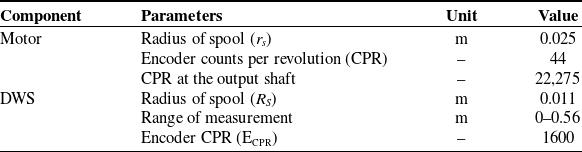
Figure 2(a) presents the CAD model of the TDCM [Reference Pachouri and Pathak33] and portrays key components such as tendon routing, manipulator backbone, actuation housing, spool, clamp, motor, and sections. Figure 2(b) shows the master–slave control board and actuator housing. The master and slave controllers transfer data bi-directionally using the I2C communication protocol. The manipulator’s flexible backbone comprises hollow polyurethane pipes routed through central holes on the disks, while tendons pass through eccentric holes. The disks are 3D-printed using PLA, with 1 mm diameter nylon threads employed as tendons and actuated via DC-geared motors, with position feedback provided by encoders. Four in-house developed draw wire sensors (DWS) provide input on tendon length. The DWS contains a torsional spring, spool, rotary encoder, sensor housing, and cable. The DWS wires are distinctly labeled as cables to differentiate from the manipulator’s tendons. Manipulator motion passively actuates DWS cables, and the DWS rotary encoder records this change. Based on these encoder counts, the instantaneous cable length (
 $L_{i}$
) is computed [Reference Pachouri and Pathak33].
Specification of manipulator electro-mechanical components.

Tendon-driven continuum manipulator (a) CAD model (b) Prototype.

Table I presents the description of the manipulator’s electro-mechanical components. The P2S-TDCM is designed for open-air applications, such as vegetable harvesting, which require efficient and accurate manipulation of the end-effector. An application prototype is shown in Figure 3(a), while Figure 3(b) illustrates a brinjal-picking application scenario represented through six sequential frames.
Considered manipulator (a) Prototype and (b) Application scenario.

3. Dynamic modeling of P2S-TDCM
This section presents the mathematical modeling of the proposed P2S-TDCM, including kinematics, energy formulations, and dynamics incorporating stiffness, damping, and external force considerations. The P2S-TDCM assumes a constant-curvature hypothesis, with each section bending in its actuation plane. Tendons are treated as inextensible, massless, and frictionless, while the backbone is considered to have uniform properties with negligible torsion. External forces are applied only at the tip, taking into account gravity and viscous damping. Since each section translates and rotates about different axes, distinct motion characteristics exist. The local transformation from the
 $i^{th}$
to
 $(i-1)^{th}$
frames are derived using translation (
 ${}^{i-1}{\mathbf{p}}{}_{i}$
) and rotation (
 ${i}^{i-1}{\mathbf{R}}{}$
) components, as defined in Eqs. (1) and (2). The first section revolves around the x-axis and translates along the y and z axes, whereas the second section revolves around the y-axis with translation along the x and z axes. These kinematic relations are adapted from [Reference Pachouri and Pathak32, Reference Pachouri and Pathak33], where
 $\mathrm{q}_{i}$
and
 $l_{i}$
are the curvature angle and arc length of the flexible backbone for
 $i^{th}$
vertebra of
 $j^{th}$
section, where
 $j\in (1,2)$
.
 \begin{equation} ^{i-1}{\mathbf{p}_{i}}{}=\begin{cases} \left(\dfrac{l_{i}}{\mathrm{q}_{i}}\right)\quad [\begin{array}{c@{\quad}c@{\quad}c} 0 & \left(1-\cos \mathrm{q}_{i}\right) & \sin \mathrm{q}_{i} \end{array}]^{T},\quad j\rightarrow odd\\[8pt] \left(\dfrac{l_{i}}{\mathrm{q}_{i}}\right)\quad [\begin{array}{c@{\quad}c@{\quad}c} \left(1-\cos \mathrm{q}_{i}\right) & 0 & \sin \mathrm{q}_{i} \end{array}]^{T},\quad j\rightarrow even \end{cases}\end{equation}
 \begin{equation} {i}^{\,i-1}{\mathbf{R}}{}=\begin{cases} \mathrm{Rot}_{\mathrm{x}}\left(\mathrm{q}_{i}\right),\quad j\rightarrow odd\\ \mathrm{Rot}_{\mathrm{y}}\left(\mathrm{q}_{i}\right),\quad j\rightarrow even \end{cases}\end{equation}
The angular velocity of each section is expressed in Eq. (3), while the velocity formulation for the
 $i^{th}$
vertebral disk and the backbone tube are presented in Eqs. (4) and (5). Using these equations, the manipulator’s linear and angular Jacobians are derived. The linear Jacobian (
 $\mathbf{J}_{vi}$
) translates joint velocity into the linear velocity of the end-effector or another point of interest on the manipulator. Conversely, the angular Jacobian (
 $\mathbf{J}_{\omega i}$
), maps joint angular velocities to the angular velocity of the end-effector or another point of interest on the manipulator. The kinetic energy (
 $\mathcal{T}$
) of the manipulator is computed as the sum of linear and rotational energies, represented by Eq. (6). For simplification, this equation can be compacted in Eq. (7), where
 $\mathbf{M}(q)\in \mathbf{R}^{n\times n}$
represents the inertia matrix. This configuration-dependent matrix is symmetric and positive definite, ensuring stability during manipulator operation. Where
 $\boldsymbol{\omega}_{i}$
,
 ${}^{i}{\mathbf{I}}{}_{li}$
, and
 ${}^{G}{\mathbf{R}}{}_{i}$
represent
 $i^{th}$
frame angular velocity, moment of inertia, and rotation of the body fixed
 $i^{th}$
frame described in the global frame. The moment of inertia
 $(I_{xx},I_{yy},I_{zz})$
is configuration-dependent and is transformed from the body fixed frame to the global frame, as shown in Eq. (8).
 \begin{equation}\boldsymbol{\omega}_{i}=\begin{cases} [\begin{array}{c@{\quad}c@{\quad}c} \dot{q_{i}} & 0 & 0 \end{array}]^{T},& j\rightarrow odd\\ [\begin{array}{c@{\quad}c@{\quad}c} 0 & \dot{q_{i}} & 0 \end{array}]^{T},& j\rightarrow even \end{cases} =\mathbf{J}_{\omega i}\,.\,\dot{q_{i}}\end{equation}
 \begin{equation}{}^{G}{\vec {\mathbf{v}}_{di}}{}=\frac{d}{dt}\big({}^{G}{\vec {\mathbf{p}}_{i}}{}\big)=\mathbf{J}_{vi}\,.\,\dot{q_{i}}\end{equation}
 \begin{equation}{}^{G}{\vec {\mathbf{v}}_{ti}}{}=\frac{d}{dt}\left(\frac{{}^{G}{\vec {\mathbf{p}}_{i}}{}}{2}\right)\end{equation}
 \begin{equation}\mathcal{T}=\frac{1}{2}\left(\dot{q_{i}}\right)^{T}\sum _{i=1}^{n}\left[{\mathbf{J}_{vi}}{\left(q_{i}\right)^{T}}m_{di}\mathbf{J}_{vi}\left(q_{i}\right)+\mathbf{J}_{\omega i}\left(q\right)^{T}\left({}^{G}{\mathbf{R}}{}_{i}\left(q\right){}^{i}{\mathbf{I}}{}_{li}{}^{G}{\mathbf{R}}{}_{i}\left(q\right)^{T}\right)\mathbf{J}_{\omega i}\left(q\right)\right]\dot{q_{i}}\end{equation}
 \begin{equation}\mathcal{T}=\left(\dot{\boldsymbol{{q}}_{i}}\right)^{T}M\left(q\right)\dot{\boldsymbol{{q}}_{i}}\end{equation}
 \begin{equation}{}^{G}{\mathbf{I}}{}_{li}={}^{G}{\mathbf{R}}{}_{i}\left[\begin{array}{c@{\quad}c@{\quad}c} I_{xx} & 0 & 0\\ 0 & I_{yy} & 0\\ 0 & 0 & I_{zz} \end{array}\right]{}^{G}{\mathbf{R}}{}_{_{i}}^{T}\end{equation}
The Christoffel symbol of the first kind (
 $c_{ijk}$
) is defined in Eq. (9), where
 $M_{ij},M_{ik}$
, and
 $M_{jk}$
are elements of the inertia matrix,
 $\mathbf{M}(q)$
. Here, i, j, and k range over the manipulator’s number of joints or degrees of freedom. For a manipulator with
 $n$
joints, these indices independently range from 1 to
 $n$
. These Christoffel symbols account for Coriolis and centrifugal forces in the equations of motion, as formulated in Eq. (10). These terms describe the interactions between joint motions and are used to compute the Coriolis matrix
 $\mathbf{C}_{ij}(q,\dot{q})$
, which quantifies how joint velocities (
 $\dot{\mathbf{q}_{k}}$
) contribute to joint forces or torques.
 \begin{equation}c_{ijk}=\frac{1}{2}\left(\frac{\partial M_{ij}}{\partial q_{k}}+\frac{\partial M_{ik}}{\partial q_{j}}-\frac{\partial M_{jk}}{\partial q_{i}}\right)\end{equation}
 \begin{equation}\mathbf{C}_{ij}\left(q,\dot{q}\right)=\sum _{k}c_{ijk}\dot{q}_{k}\end{equation}
The manipulator’s potential energy (
 $\mathcal{U}$
) consists of gravitational energy, spring energy (resulting from a change in tendon lengths), and elastic potential energy of the flexible backbone as described by Eq. (11). The stiffness of the
 $t^{th}$
tendon,
 $\mathcal{K}_{i}^{t}$
is defined as
 $\mathcal{K}_{i}^{t}=E_{C}A_{C}$
/
 $(L_{i}+L_{wi})$
, where
 $E_{C}$
,
 $A_{C}$
,
 $L_{i}$
, and
 $L_{wi}$
represent Young’s modulus, cross-sectional area, tendon length, and tendon wrench length, respectively. The vector
 ${}^{G}{\mathbf{A}_{i}}{}$
denotes anchor point coordinates described in the global frame, following the vector method. The gravitation components, derived from potential energy, are formulated as described in Eq. (12). Additionally, the proposed TDCM incorporates viscous damping, generalized in Eq. (13), where
 $\mathcal{C}_{t}$
denotes the damping coefficient of the
 $t^{th}$
tendon and
 ${\unicode[Arial]{x0394}} \dot{\unicode{x1D4C1}}_{\mathrm{t}}$
is the rate of change of tendon length, and Eq. (14) expands it for the considered two-section system. Finally, the manipulator’s equation of motion, including Cartesian external forces (
 $\mathbf{F}_{ext}$
) acting on the tip, is presented in Eq. (15). Although the proposed model captures inertia, gravity, and damping, it omits several phenomena that may affect accuracy. These include distributed environmental forces along the backbone, non-linear tendon friction, and time-varying stiffness due to tendon pre-tension.
 \begin{equation}\mathcal{U}=\sum _{i=1}^{n}\mathrm{m}_{\mathrm{i}}g\mathbf{p}_{i}+\frac{1}{2}\sum _{i=1}^{n}\mathcal{K}_{i}^{t}\left({}^{G}{\mathbf{A}_{{i_{f}}}}{}-{}^{G}{\mathbf{A}_{{i_{s}}}}{}\right)^{2}+\frac{E_{b}I_{b}}{2L_{i}}q_{i}^{^{2}}\end{equation}
 \begin{equation}\mathbf{G}_{n\times 1}=\frac{\partial \mathcal{U}}{\partial q_{k}}\end{equation}
 \begin{equation}\mathcal{D}=\frac{1}{2}\sum _{i=1}^{t}\mathcal{C}_{t}\left({\unicode[Arial]{x0394}} \dot{\unicode{x1D4C1}}_{\mathrm{t}}\right)^{2}\end{equation}
 \begin{equation}\mathcal{D}=\frac{1}{2}\mathcal{C}_{1}^{^{I}}\left({\unicode[Arial]{x0394}} \dot{\unicode{x1D4C1}}_{1}^{^{I}}\right)^{2}+\frac{1}{2}\mathcal{C}_{1}^{^{II}}\left({\unicode[Arial]{x0394}} \dot{\unicode{x1D4C1}}_{1}^{^{II}}\right)^{2}+\frac{1}{2}\mathcal{C}_{2}^{^{I}}\left({\unicode[Arial]{x0394}} \dot{\unicode{x1D4C1}}_{2}^{^{I}}\right)^{2}+\frac{1}{2}\mathcal{C}_{2}^{^{II}}\left({\unicode[Arial]{x0394}} \dot{\unicode{x1D4C1}}_{2}^{^{II}}\right)^{2}\end{equation}
 \begin{equation}\underset{n\times n}{\underbrace{\mathbf{M}\left(q\right)}}\underset{n\times 1}{\underbrace{\ddot{\mathbf{q}}}}+\underset{n\times n}{\underbrace{\mathbf{C}\left(\mathrm{q},\dot{\mathrm{q}}\right)}}\underset{n\times 1}{\underbrace{\dot{\mathbf{q}}}}+\underset{n\times 1}{\underbrace{\mathbf{G}\left(q\right)}}+\underset{n\times 1}{\underbrace{\left(\frac{\boldsymbol{\partial} \boldsymbol{\mathcal{D}}}{\boldsymbol{\partial} \dot{\mathbf{q}}_{\mathbf{i}}}\right)}}=\underset{n\times 1}{\underbrace{\boldsymbol{\tau}}}+\mathbf{J}^{T}\left(q\right)\mathbf{F}_{ex}\end{equation}
4. Control framework: GA-based PID, robust optimization, and stability analysis
This section presents the control framework developed for the P2S-TDCM. A GA-PID-based strategy is employed in both deterministic and robust configurations to enhance trajectory tracking performance. The robust approach integrates GA-based parameter randomization with an online DOB for real-time disturbance compensation. The section further includes a Lyapunov-based stability analysis to establish theoretical guarantees of the proposed control framework.
Simulate system with given PID gains

Evaluate fitness function

4.1. Deterministic GA optimization approach
A deterministic GA-based PID tuning approach is introduced, where the controller gains are optimized using the nominal dynamic model of the P2S-TDCM without considering parameter uncertainties. The controller gains are optimized through a genetic algorithm (GA) to address non-linearities and external disturbances. The P2S-TDCM consists of two sections, each governed by coupled angles of curvature,
 $\mathbf{q}_{i}$
and the system dynamics as defined by the control effort (τ), as shown in Eq. (15). Thus, GA optimization minimizes the sum of the squares of Cartesian errors, control efforts, and curvature angles. In addition, the constraints (
 $C_{1}^{j}$
and
 $C_{2}^{j}$
) ensure that the angles of curvature remain within the permissible lower and upper bounds (
 $q_{l}$
and
 $q_{u}$
) inspired by ref. [Reference Bhandari, Raj, Pathak and Yang34]. These parameters are weighted using
 $w_{1}$
,
 $w_{2}$
, and penalties (
 $w_{p}$
) for constraint violations. The fitness function, described in Eq. (16), balances these elements, with constraints detailed in Eq. (17). Equal importance is assigned to weights
 $w_{1}$
and
 $w_{2}$
, while a higher penalty factor enforces physical constraints effectively.
 \begin{equation}\overline{f}\left(g\right)=w_{1}\int _{0}^{t}\sum _{i=1}^{n-1}\left(e_{i}^{2}+\tau _{i}^{2}\right)dt+w_{2}\sum _{j=1}^{n}\left| q_{j}\right| +w_{p}\left(\sum _{j=1}^{n}\left(C_{1}^{j}+C_{2}^{j}\right)\right)\end{equation}
 \begin{equation} C_{1}^{j} :\!= \begin{cases} \quad 0, & q_{i}-q_{l}\geq 0\\ | q_{i}-q_{l}| , & q_{i}-q_{l}\lt 0 \end{cases} \ \text{and}\ C_{2}^{\,j} \ :\!= \begin{cases} \quad0, & -q_{i}+q_{u}\geq 0\\ \left| -q_{i}-q_{u}\right| , & -q_{i}+q_{u}\lt 0 \end{cases}\end{equation}
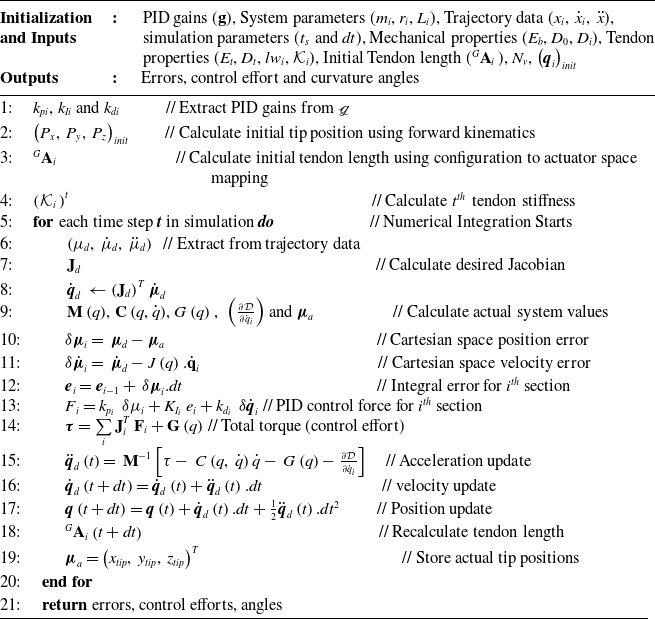
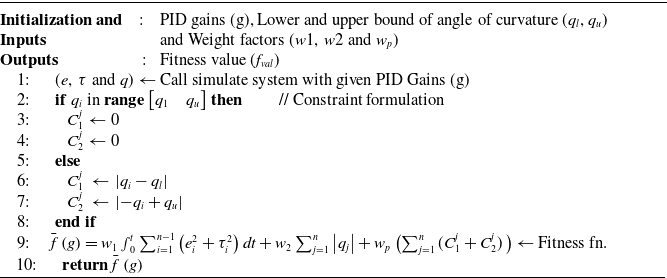
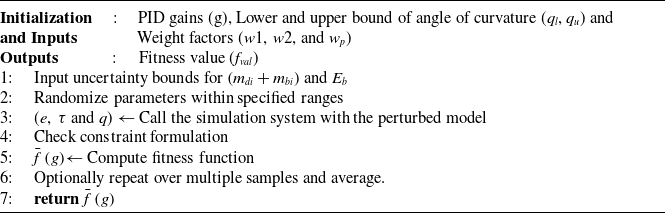
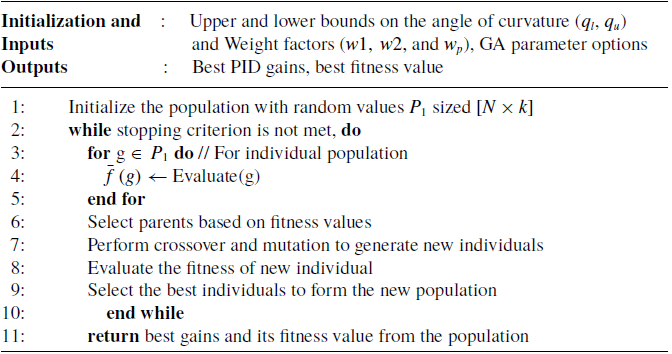
The Pseudocodes 1 and 2 present the simulated system using specified PID gains (referred as the Main function) and the function to evaluate constraints and fitness function (as described by Eqs. (16) and (17)). The GA algorithm to tune gains (detailed in the Appendix).
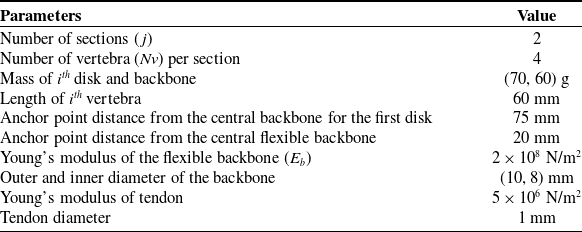
System geometric and material parameters.

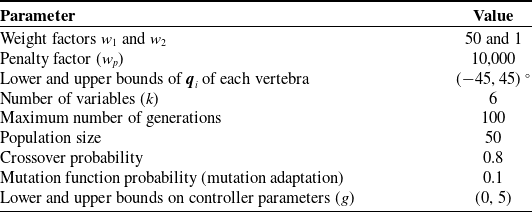
Simulation parameters of GA optimization.

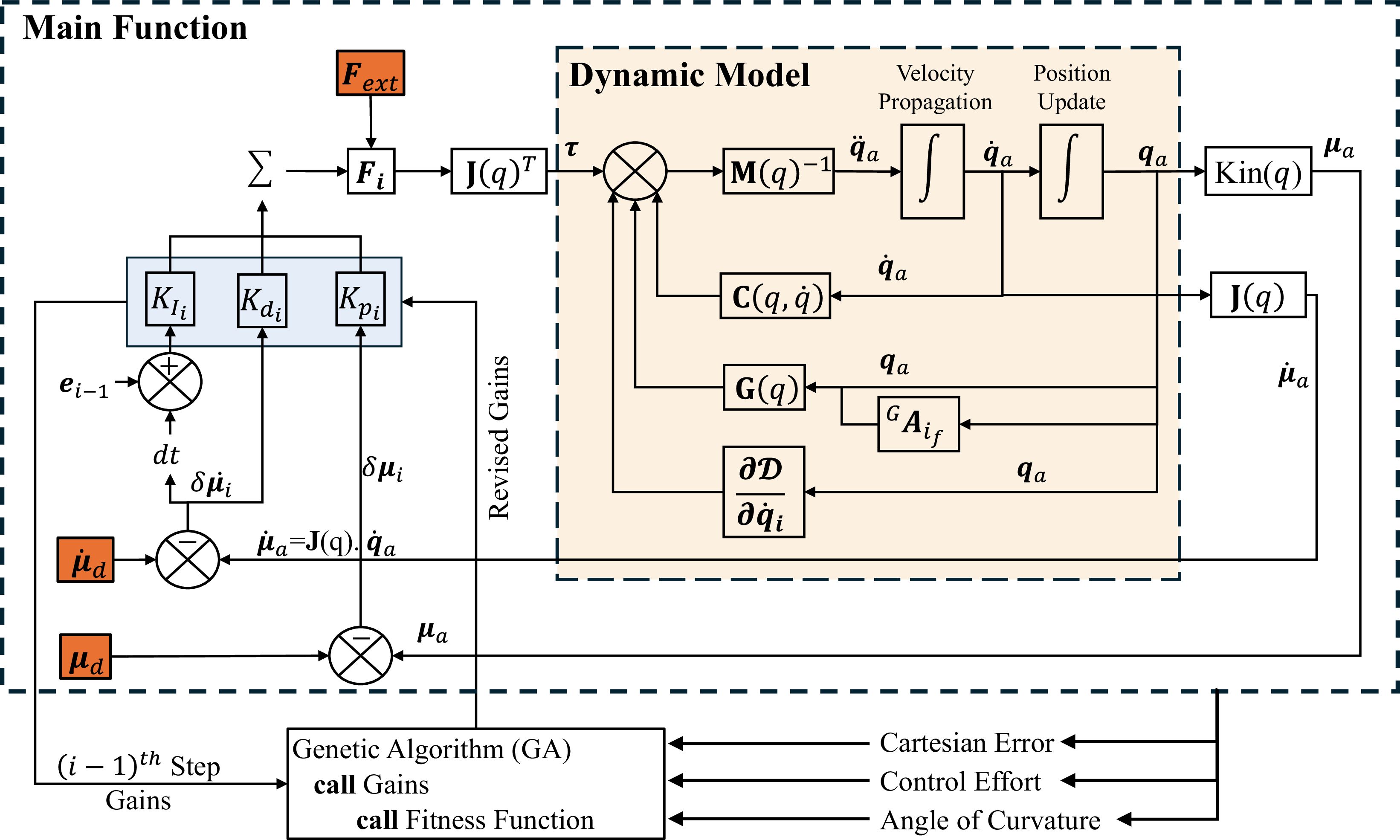
Cartesian model-based control with GA-based optimization under external forces.

Figure 4 illustrates the interaction between the main function (Pseudocode-1), the fitness function (Pseudocode-2), and the GA algorithm. This figure depicts the process of minimizing position errors and GA tuning by optimizing the fitness function. The fitness function is defined by Cartesian space error, control effort, curvature angle, and constraints, detailed in Pseudocode 2. This constraint restricts the curvature angle to the desired range. The system dynamics incorporate inertia, Coriolis, gravitational forces, and viscous damping. Gravitational forces include potential energy and tendon elongation, modeled as a spring connecting anchor points on disks. Viscous damping accounts for tendon elongation rates, while joint positions and velocities are updated via numerical integration. The feedback loop modifies control inputs to maintain desired behavior under external disturbances. GA optimizes PID parameters through selection, crossover, and mutation, minimizing trajectory errors and control effort. Tables II and III summarize system and GA simulation parameters, respectively.
4.2. Robust controller: GA-based random parameter uncertainty and disturbance observer
Although deterministic GA optimization yields effective gains for the nominal model, its performance can degrade under uncertainties such as variations in mass, modulus, damping, and external loads. To overcome this, a two-fold robust strategy is adopted – offline robustness via GA-based parameter randomization and online robustness through an integrated DOB.
In the robust GA tuning phase, the model parameters are randomized within bounded ranges during fitness evaluation to ensure that the optimized control gains perform well across a range of parameter variations. Specifically, the vertebra mass is varied by ±2% and backbone bending modulus by ±5% accounting for manufacturing tolerances and material uncertainties, as detailed in Table IV. The randomization is embedded within the GA fitness evaluation function so that each candidate solution is tested on a randomly perturbed model before its performance is scored. The fitness function and constraints remain identical to Eqs. (16) and (17), but they are now evaluated across randomized parameter realizations. This approach enhances robustness and convergence stability, yielding a conservative yet reliable controller. The overall process is outlined in Pseudocode 3. However, the GA-based optimization alone cannot handle unknown external disturbances; hence, an online compensation layer is added using a DOB.
To enhance robustness against external disturbances, an online DOB is integrated into the feedback loop. The DOB is inspired by refs. [Reference Ohishi27, Reference Chen, Ballance, Gawthrop and O’Reilly28] estimates the lumped disturbance vector, which includes unmeasured external tip forces, payload variations, and residual modeling errors, and compensates them in real-time.
Random parameter uncertainty for GA tuning.

Robust fitness evaluation under parameter uncertainty

External disturbance is represented as an external force wrench
 $\mathbf{F}_{ex}$
, expressed as generalized tip forces
 $\mathbf{J}^{T}(q)\mathbf{F}_{ex}$
. These forces are modeled as a lumped disturbance term
 $\mathbf{d}$
in the manipulator dynamics as expressed in Eq. (18), where
 $\mathbf{M}(q)$
is the inertia matrix,
 $\mathbf{C}(q,\dot{q})$
is the Coriolis and centrifugal terms,
 $\mathbf{G}(q)$
represents the gravity vector,
 $\boldsymbol{\tau }$
is the control torque, and
 $\mathbf{d}$
is the lumped disturbance. Following the formulation of ref. [Reference Chen, Ballance, Gawthrop and O’Reilly28], the DOB introduces an auxiliary state z, whose dynamics are expressed by Eq. (19), where
 $\boldsymbol{{L}}(q,\dot{q})$
is a diagonal and positive definite observer gain matrix and
 $\hat{\mathbf{d}}=(\mathbf{z}-\boldsymbol{\tau })$
. The estimated disturbance is then obtained as
 $\hat{\mathbf{d}}=\mathbf{z}-\boldsymbol{\tau }$
. Using this estimate with Eqs. (19) and (18), the disturbance estimation error dynamics are obtained, as expressed by Eq. (20), where observer error,
 $\mathbf{e}(t)=\mathbf{d}-\hat{\mathbf{d}}$
, which guarantees exponential convergence of
 $\hat{\mathbf{d}}$
to
 $\mathbf{d}$
under a positive definite observer gain matrix
 $\mathbf{L}(q,\dot{q})$
. For the two-section P2S-TDCM, the gain matrix is
 $\mathbf{L}(\boldsymbol{{q}})=\text{diag}(\alpha _{1},\alpha _{2})\mathbf{M}^{-\mathbf{1}}(q)$
, with positive scalar observer bandwidths
 $\alpha _{1},\alpha _{2}\gt 0$
. Since initially no prior disturbance information is available,
 $\dot{\mathbf{d}}\approx 0$
is assumed, implying that disturbances vary slowly compared to observer dynamics. Accordingly, the control law is revised as
 $\boldsymbol{\tau }^{\mathbf{*}}=\boldsymbol{\tau }_{\mathrm{GA}-\mathrm{PID}}-\hat{\mathbf{d}}$
. thereby ensuring real-time disturbance compensation. The DOB effectively handles constant and slowly varying external wrenches, such as those arising during vegetable detachment or payload manipulation. However, its ability to reject high-frequency or impulsive disturbances is limited by the observer bandwidth and sensor noise characteristics.
 \begin{equation}\mathbf{M}\left(q\right)\ddot{\boldsymbol{{q}}}+\mathbf{C}\left(q,\dot{q}\right)\dot{\boldsymbol{{q}}}+\mathbf{G}\left(q\right)+\left(\frac{\boldsymbol{\partial} \boldsymbol{\mathcal{D}}}{\boldsymbol{\partial} \dot{\mathbf{q}}_{\mathbf{i}}}\right)=\boldsymbol{\tau }+\mathbf{d}\end{equation}
 \begin{equation}\dot{z}=-\mathbf{L}(q,\dot{q})z+\mathbf{L}\left(q,\dot{q}\right)\left[\mathbf{M}\left(q\right)\ddot{\boldsymbol{{q}}}+\mathbf{C}\left(q,\dot{q}\right)\dot{\boldsymbol{{q}}}+\mathbf{G}\left(q\right)+\left(\frac{\boldsymbol{\partial} \boldsymbol{\mathcal{D}}}{\boldsymbol{\partial} \dot{\mathbf{q}}_{\mathbf{i}}}\right)-\boldsymbol{\tau }\right]\end{equation}
 \begin{equation}\dot{\boldsymbol{{e}}}\left(\boldsymbol{{t}}\right)+\mathbf{L}\left(q,\dot{q}\right)\mathbf{e}\left(\boldsymbol{{t}}\right)=0\end{equation}
4.3. Lyapunov stability analysis
A Lyapunov-based analysis verifies the stability of the PID-controlled continuum manipulator under the influence of external forces. The task-space tracking error is defined as
 $e(t)=\mu _{d}(t)-\mu (t)$
, where
 $\mu _{d}(t)$
is the desired trajectory and
 $\mu (t)$
is the actual end-effector position. Similarly, the task-space velocity error is defined as
 $\dot{e}(t)=\dot{\mu }_{d}(t)-\dot{\mu }(t)$
. For the considered TDCM, the Lyapunov candidate function (
 $V$
) is derived incorporating proportional, integral, and derivative error terms as shown in Eq. (21), where
 $M(\mu )$
is the positive definite task-space inertia matrix. This Lyapunov function is positive definite, and its time derivative is shown in Eq. (22). Substituting the control input from the GA-tuned PID controller and incorporating the system dynamics, the corresponding
 $\dot{V}$
can be simplified as shown in Eq. (23), where
 $K_{d}$
is a derivative gain and positive definite. Where d is the bounded external disturbances, considered an external force, and gains are positive definite. If the disturbance is small, this implies uniform ultimate boundedness (UUB), and expression (23) can be written as Eq. (24).
 \begin{equation}V\left(\mu ,\dot{\mu },\eta \right)=\frac{1}{2}\dot{e}^{T}M\left(\mu \right)\dot{e}+\frac{1}{2}e^{T}K_{p}e+\frac{1}{2}\left(\int edt\right)^{T}K_{I}\left(\int edt\right)\end{equation}
 \begin{equation}\dot{V}=e^{T}K_{p}\dot{e}+\dot{e}^{T}M\left(\mu \right)\ddot{e}+\frac{1}{2}\dot{e}^{T}\dot{M}\left(\mu \right)\dot{e}+\left(\int edt\right)^{T}K_{I}e\end{equation}
 \begin{equation}\dot{V}=-\dot{e}^{T}K_{d}\dot{e}+\left\| d\right\| \left\| \dot{e}\right\|\end{equation}
 \begin{equation}\dot{V}\leq -\dot{e}^{T}K_{d}\dot{e}\Rightarrow e\left(t\right)\rightarrow 0\end{equation}
From the above argument, if the dynamic model of the system as shown in Eq. (15) is represented under the control law presented in Section 4.1, then the Lyapunov function is non-increasing over time. As it is positive definite and radially unbounded, the system is globally stable in Lyapunov. Under the tuning performed via GA, the controller ensures asymptotic convergence of the error to zero, even under external disturbances.
5. Simulation studies
This section presents simulation studies evaluating the effectiveness of the proposed GA-PID control strategies for the P2S-TDCM under deterministic and robustness-oriented configurations. The robust framework incorporates GA-based parameter randomization and a DOB to enhance resilience against uncertainties and external disturbances. The simulations demonstrate improved Cartesian tracking accuracy, disturbance rejection, and overall system stability.
5.1. Setup and trajectory generation
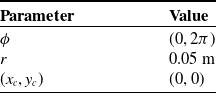
Trajectory tracking is a critical aspect of robotics, especially in environments with external disturbances. The manipulator is tasked with a circular trajectory (Eqs. (25) and (26)) with the trajectory parameter summarized in Table V. The simulations are conducted over 60 s with a fixed integration step size of
 $dt-0.001s$
using a fourth-order Runge–Kutta scheme. Initial conditions are set with zero curvature angles and tendon lengths corresponding to the neutral configuration. To ensure smooth motion within the TDCM’s curved workspace, the desired trajectory is generated using a quintic polynomial interpolation (as shown in Eq. (27)), which minimizes oscillations between adjacent points. Additionally, the tolerance set between the projected path and workspace points is less than below
 $10^{-6}$
m, inspired by ref. [Reference Pachouri and Pathak32].
 \begin{equation}x_{d}=x_{c}+r\sin \left(\phi \right)\end{equation}
 \begin{equation}y_{d}=y_{c}+2r\cos (\phi )\end{equation}
Figure 5 illustrates the position, velocity, and acceleration profiles of the first and second sections. Minor oscillations (<5% of the trajectory scale) are observed when the manipulator transitions across quadrants, caused by sign changes in curvature angles. Notably, the first section exhibits no x-axis translation, as shown by
 $x_{1}(t)$
,
 $\dot{x}_{1}(t)$
,
 $\ddot{x}_{1}(t)$
, which aligns with the physics of the manipulator. The simulation incorporates inertial, Coriolis, gravitational, and damping effects, with two independent PID controllers regulating each section.
Trajectory parameters.

Desired position, velocity, and acceleration data for desired circular trajectory (a) First and (b) Second section.

 \begin{equation}p\left(t\right)=a_{0}\hspace{0pt}+a_{1}\hspace{0pt}t+a_{2}\hspace{0pt}t^{2}+a_{3}\hspace{0pt}t^{3}+a_{4}\hspace{0pt}t^{4}+a_{5}\hspace{0pt}t^{5}\end{equation}
5.2. Deterministic GA result
This section presents the results of GA-optimized PID control for a deterministic approach, where system parameters are assumed to be fixed and known. The GA tuning framework follows the methodology described in Section 4. Initial controller gains are selected from a random population (
 $P_{1}$
) of size
 $(N\times k)$
, where
 $N=50$
represents the candidate solutions (sets of PID gains) per generation, and
 $k=6$
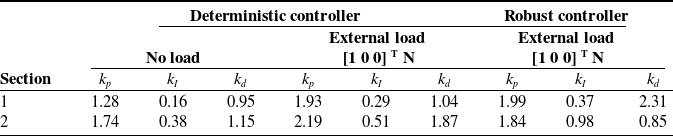
, corresponds to the two PID controllers for the TDCM. Gain values are constrained within [0, 10], balancing diversity and convergence rate [Reference Bhandari, Raj, Pathak and Yang34]. The optimization minimizes Cartesian tracking errors and control efforts while enforcing curvature limits. The numerical integration process begins with extracting the desired trajectory data (position, velocity, and acceleration). Then, the Jacobian matrix computes the desired joint velocities. The system’s dynamic parameters, such as inertial, Coriolis, gravitational, and damping effects, are calculated. The simulation incorporates inertial, Coriolis, gravitational, and damping effects, with two independent PID controllers regulating each section. To optimize the PID gains, a GA minimizes the sum of squared errors and control efforts while penalizing deviations from upper and lower bounds on the curvature angles. The GA iteratively refines controller gains via selection, crossover, and mutation, ensuring stable and accurate tracking under varying conditions. Results are reported for two cases: (i) Trajectory tracking without external forces and (ii) Trajectory tracking under an external force. Table VII presents the optimal controller gains for no-load and external load scenarios. This deterministic optimization provides a baseline for later robustness studies with parameter uncertainties.
5.2.1. Trajectory tracking without external forces
The section presents the trajectory tracking of the proposed TDCM without considering any external forces at the manipulator’s tip. Figure 6(a) illustrates the three-dimensional configuration of the manipulator as it follows a circular trajectory without any external load. Figures 6(b) and 6(c) provide the
 $x-y$
and
 $x-z$
views, respectively, of the configuration shown in Figure 6(a). The controller gains are optimized using GA-based parameter tuning, as presented in Table VII. The results confirm the controller’s effectiveness in achieving planar movement in each section. This configuration enables the manipulator tip to actuate spatially as desired when actuated orthogonally. Figure 6(d) compares the tip coordinates of the desired trajectory based on numerical simulations and the experimental setup, demonstrating strong agreement between them.
Trajectory tracking without external load (a) Three-dimensional view, (b) X-Y plane view, (c) X-Z plane view, and (d) Comparison of desired, simulated and actual tip coordinates.

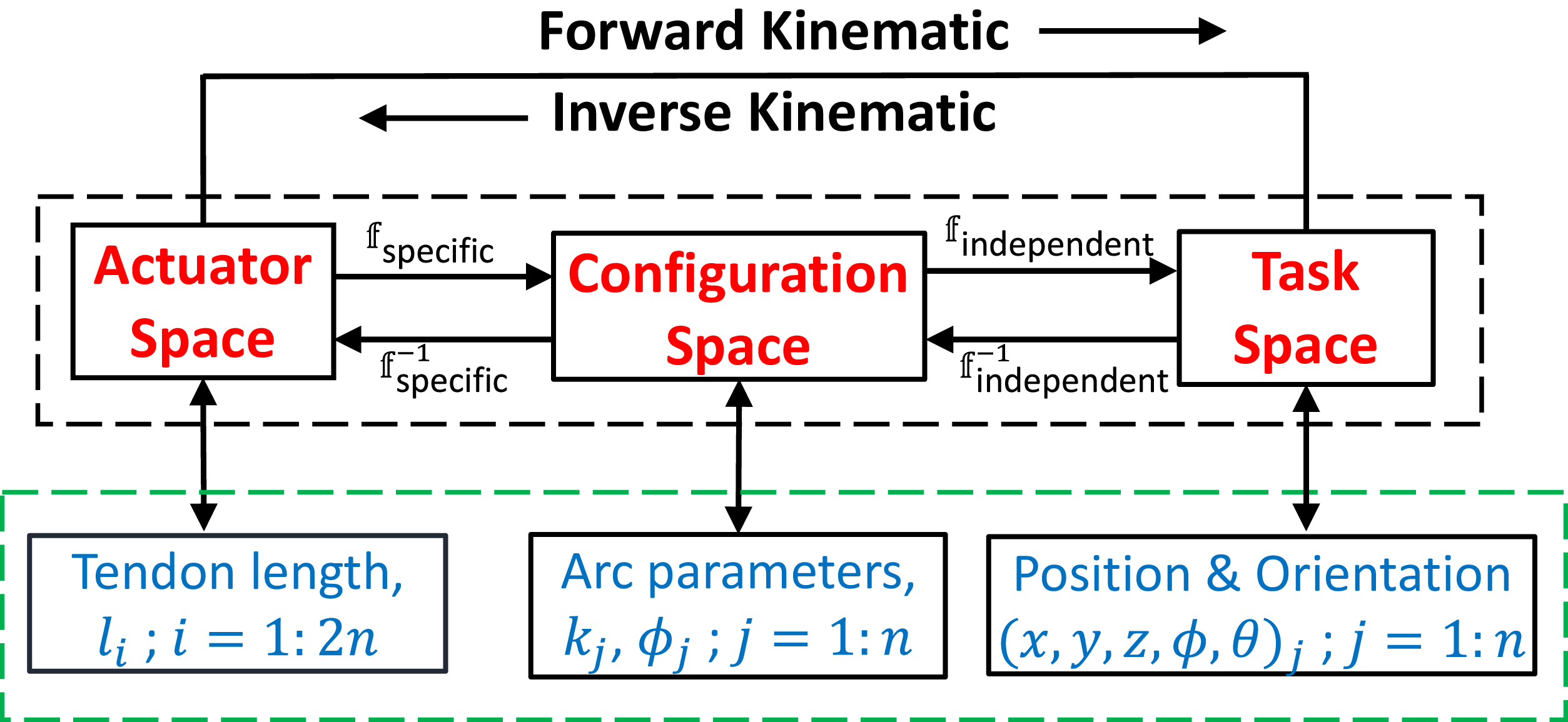
The tip trajectory shown in Figure 6(d) is computed from the cable lengths recorded by the draw-wire sensors from the experimental setup. These lengths, representing actuator space, are input into the forward mapping to determine the corresponding task-space parameters, as described in refs. [Reference Escande, Chettibi, Merzouki, Coelen and Pathak31, Reference Escande, Merzouki, Pathak and Coelen35]. Figure 7 demonstrates the mapping between the actuator, configuration, and task spaces. A potential source of error arises from using the constant-curvature model to compute the tip trajectory based on the draw-wire sensor data. This model may not fully capture all the dynamics involved, which may lead to certain inaccuracies in the calculated trajectory.
Mapping between actuator, configuration, and task space for TDCMs.

Figure 8 illustrates the tendon lengths based on kinematic and dynamic models, without considering external loads. This comparison highlights the differences in response between the two simulation approaches. In the kinematic simulation (Figure 8(a)), oscillations are observed, particularly in the tendon length of the second section. These oscillations are comparatively lower in the dynamic simulation (Figure 8(b)), indicating improved stability in the model’s response. Additionally, the kinematic model shows flattening behavior in specific tendon lengths, such as
 $L_{3}$
near the 120th step and
 $L_{4}$
near the 370th step, indicating the kinematic model’s limitations to counter the manipulator’s self-weight. This flattening effect is absent in the dynamic simulation, which continuously accounts for gravitational effects, maintaining smooth periodicity. Quantitatively, the dynamic model outperforms the kinematic model by reducing tendon length oscillations by approximately 12.5%, as indicated by the lower standard deviation. This demonstrates the dynamic model’s improved capability to capture the manipulator’s behavior, effectively minimizing internal disturbances, and resulting in smoother tendon actuation.
Tendon length variation during circular trajectory without external load (a) Inverse kinematic model and (b) Dynamic model.

5.2.2. Trajectory tracking with external force
This section presents the manipulator’s dynamic model and control strategy under external force (
 $\mathbf{F}_{ex}=[\! -100]^{T}$
N) applied in the negative x-direction during trajectory tracking. The controller gains are re-tuned considering the external force acting on the manipulator tip. The motivation for such a loading condition stems from its relevance to the target application of open-air vegetable harvesting, as illustrated in Figure 3. During the picking process, the manipulator primarily experiences a downward external force after detaching a vegetable from the plant, which guided the choice of a constant external tip force.
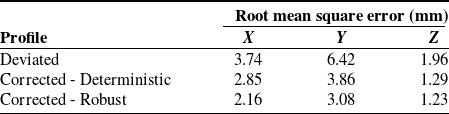
Figure 9(a) shows the desired tip trajectory, tip deviation under external load and the subsequent correction using updated gains. As illustrated in Table VIII, the corrected trajectory condenses root mean square error (RMSE) values from 3.74 to 2.85 mm, 6.42 to 3.67 mm, and 1.96 to 1.29 mm. This corresponds to improvements of 23.8, 39.88, and 34.11% concerning the deviated trajectory. Figure 9(b) compares tendon lengths for the desired trajectory, deviations, and corrections from the updated control parameters. The first section experiences higher moments, countering tip forces alongside inertial and Coriolis forces from the second section. Although full recovery is constrained by structural flexibility and tendon tension limits, notable improvements are achieved, validating the dynamic control strategies to mitigate external disturbances.
(a) Tip trajectory under external force and (b) Tendon length variations.

5.3. Robust control: GA evaluation with parameter uncertainty and disturbance observer for external forces
To assess robustness via a GA-based controller, the parameter uncertainties are introduced to the closed-loop system by randomly varying the vertebra mass,
 $(m_{di}+m_{bi})$
by ±2% and the backbone Young’s modulus by ±5%. The gains obtained from the deterministic GA under external forces are benchmarked by initializing them for GA tuning under parameter uncertainty and external force. The same GA simulation parameters are applied to both GA approaches for fair comparison. The process to tune with random parameter uncertainty is detailed in Pseudocode 3. In addition to parameter randomization, the robust control configuration integrates an online DOB to compensate for external wrenches, thereby enhancing real-time robustness beyond what can be achieved through offline GA tuning alone.
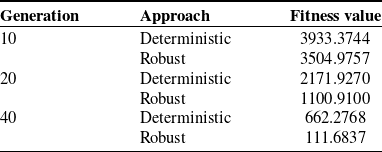
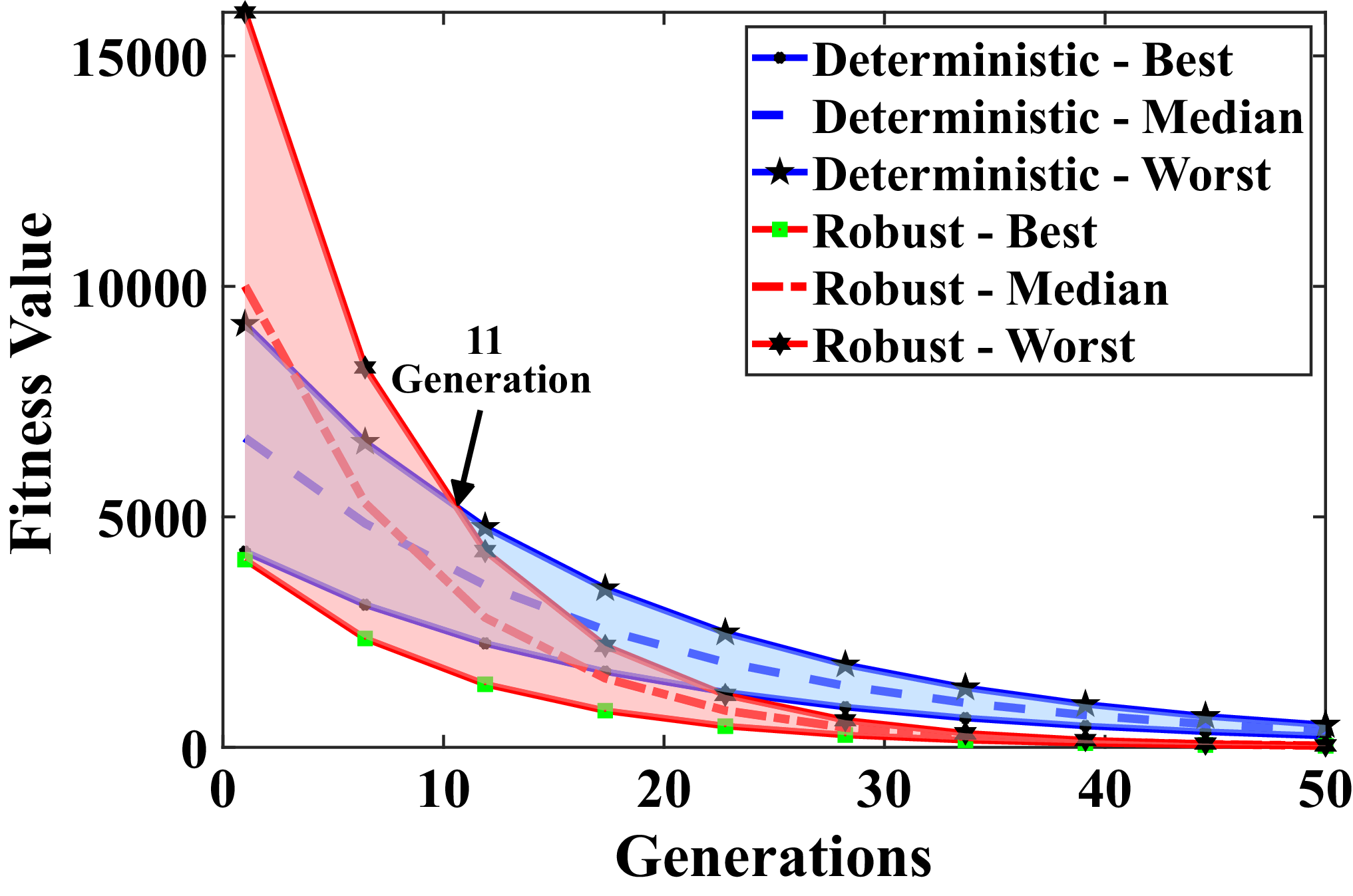
Figure 10 presents the best, median, and worst fitness values across 10 randomly seeded runs of the GA for the deterministic and robust approaches. The results show that the robust GA-PID achieves lower fitness values in fewer generations, with the worst robust case outperforming even the best deterministic case after the 11th generation. This result demonstrates the superiority of the robust approach, as further confirmed by Table VI, which reports lower fitness values for the robust case presented for sampled generations. Additionally, the shaded regions for the robust approach converge and narrow earlier than those of the deterministic case. Note that this is not a detailed statistical study, as the focus here is on demonstrating control effectiveness, with extended statistical validation left for future work. Table VII presents the gains obtained from robust control.
Median fitness values for the sampled generation for deterministic and robust approaches.

Controller gains: deterministic and robust approaches.

Best, median, and worst fitness values for sampled generations (deterministic vs robust).

After optimization, numerical experiments are conducted on a circular trajectory. Parameter uncertainty is introduced by increasing vertebra mass by 2% and backbone Young’s modulus by 5% combined with a DOB under external wrenches [1 0 0] T N. This combined strategy enhances tracking accuracy even when both parameter variations and external forces are present. System behavior regarding trajectory tracking and RMSE is analyzed for a robust approach over deterministic, demonstrating the ability to maintain improved tracking despite parameter variations and external load under a selected range.
Figure 11 illustrates the task-space trajectory tracking performance of the manipulator, showing the desired circular trajectory, deviation under external force, and corrected under deterministic and robust control. As summarized in Table VIII, both controllers significantly reduce RMSE compared to the deviated case, with the robust controller improving tracking accuracy by 24.21% in
 $x$
, 20.21% in
 $y$
, and 4.65% in
 $z$
comparison to deterministic. Figure 12(a–c) shows detailed tracking along individual axes, with shaded regions highlighting improved error reduction. Most error accumulation occurs in the first quadrant, where the manipulator moves against gravity. Figure 12(d) compares the task-space tracking errors along the in
 $x$
,
 $y$
, and
 $z$
directions for the deterministic and robust control approaches. The robust controller achieves visibly lower error amplitudes and smoother convergence, consistent with the reduced RMSE values. This demonstrates its improved disturbance-handling capability and reduced sensitivity to parameter variations.
Parameter uncertainties are introduced in the closed-loop system along with the external tip force of [1 0.5 0] T N. Such uncertainties may arise from inaccuracies in disk manufacturing, machining tolerances, or imprecise estimation of backbone flexible properties. While many factors could contribute to uncertainty (damping, stiffness, friction, sensor noise), this study focuses on vertebra mass and the backbone Young’s modulus. In the robust configuration, the DOB mitigates the effect of unmeasured external wrenches, while the GA-based randomization handles model parameter uncertainty. Thus, the robust controller addresses both major sources of performance degradation.
RMSE in task-space under external load.

Trajectory tracking under external tip force for deterministic and robust approaches.

Trajectory tracking deterministic and robust approaches in (a)
 $x$
, (b)
 $y$
, (c)
 $z$
direction and (d) Task-space tracking errors in the
 $x$
,
 $y$
, and
 $z$
direction under external tip force.

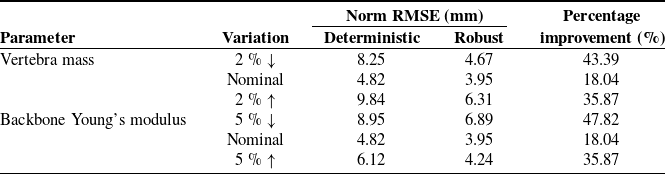
Figure 13 compares deterministic and robust approaches in terms of RMSE and sensitivity for parameter variations. For vertebra mass variation (shown in Figure 13(a)), the deterministic approach shows steep slopes, indicating higher sensitivity to mass perturbations. Specifically, increasing vertebra mass has more adverse effect than reducing it, as reflected by the sharper slope of 5.02 compared to −3.43. This is because added mass increases inertial loading, resulting in amplified trajectory deviation. The robust controller significantly reduces slope magnitudes (–0.72 and 2.36 for –2% and + 2% vertebra mass variations, respectively), reflecting improved robustness. Table IX further shows that the robust controller achieves 43.39%, 18.04%, and 35.87% reductions in RMSE norms across different variations.
Error norm for deterministic and robust approach under parameter uncertainty and external tip force: (a) Vertebra mass variation and (b) Backbone Young’s modulus variation.

For backbone modulus variation (shown in Figure 13(b)), RMSE decreases when backbone Young’s modulus increases by + 5%, due to reduced deformation. The robust controller again produces flatter slopes (–2.940 and 0.290), indicating reduced sensitivity. An interesting observation from the backbone modulus variation is that the RMSE decreases as the Young’s modulus increases, indicating that a stiffer backbone enhances trajectory tracking accuracy by reducing structural deformation. Future work will include tendon wrench analysis and extended tendon–backbone interaction studies. While detailed statistical analysis is not performed, the comparative trends clearly demonstrate the superiority of the robust controller. The combined influence of GA-based robustness (for parameter variability) and DOB-based compensation (for external disturbances) yields consistently lower RMSE and reduced sensitivity across all tested variations.
Norm of RMSE for deterministic and robust approaches under external load.

6. Experimental validation – deterministic
The numerical simulations are validated experimentally using an in-house prototype, focusing on the deterministic case. Robust controller testing is limited to simulations, as replicating parameter uncertainties (e.g., vertebra mass, backbone modulus, tendon properties) would require challenging hardware modifications. First, the methodology of inputting numerical simulation data into the physical prototype is discussed. Then, the deterministic trajectory tracking performance is evaluated under no-load and external load. Finally, a comparative discussion highlights the key differences between these scenarios.
6.1. Deployment
The motor counts inputted into the hardware are computed from the respective simulation tendon lengths, as expressed in Eq. (28), where C,
 $L_{i}$
,
 $L_{0}$
, and
 $r_{s}$
denotes the motor counts per revolution (hardware-specific value), the instantaneous tendon length, the initial tendon length and the spool radius, respectively. The DWS simultaneously provides feedback on the
 $i^{th}$
instantaneous tendon length (
 $L_{i}^{DWS}$
), calculated using Eq. (29), where CPR,
 $\mathrm{E}_{\mathrm{C}}$
,
 $\mathrm{L}_{0}$
, and
 $\mathrm{R}_{\mathrm{s}}$
are the encoder counts recorded from DWS, the counts per revolution of the DWS encoder (hardware-specific), the initial cable length and the spool radius of the DWS. Details of these parameters are provided in Table I.
 \begin{equation}M_{ref}=\frac{\mathrm{C}}{2\pi }\left(\frac{L_{i}-L_{0}}{r_{s}}\right)\end{equation}
 \begin{equation}L_{i}^{DWS}=L_{0}+2\pi \mathrm{R}_{\mathrm{s}}\left(\frac{\mathrm{CPR}}{\mathrm{E}_{\mathrm{CPR}}}\right)\end{equation}
6.2. Deterministic control under no-load conditions
The proposed dynamic-model-based control is evaluated under deterministic no-load conditions to validate its improvements over kinematic control. Figure 14(a) portrays nine sequential frames during which the manipulator follows the desired trajectory. Based on the tendon length obtained from the DWS, Figure 14(b) compares it with numerical simulations. The dynamic-model-based control strategy produces tendon length variations consistent with the kinematic-based approach [Reference Pachouri and Pathak32, Reference Pachouri and Pathak33], but with reduced oscillations, owing to its ability to capture inertia, Coriolis, and acceleration effects. As the circular trajectory progresses through four quadrants, the backbone curvature changes sign, which is observed in tendon lengths during experiments.
Tendon-level tracking error metrics: RMSE and maximum absolute error.

Trajectory tracking without external load (a) Frames, (b) Tendon length, (c) Tendon length tracking errors and (d) Error distribution.

Trajectory tracking with external force applied at the manipulator tip using the gains from the case when no external force is acting (a) Frames, (b) Comparison of tendon lengths between numerical simulation and experiment, (c) Tendon length tracking errors and (d) Error distribution.

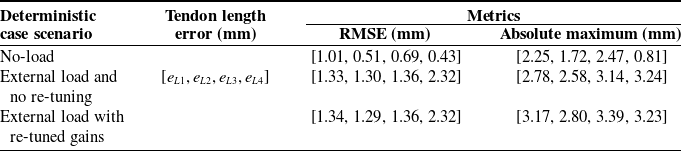
Figures 14(c) and 14(d) illustrate tendon length error and error distribution, respectively. The norm of the tip position error is reduced to 2.75 mm, representing a significant improvement compared to the 4.72 mm error norm achieved with kinematic control [Reference Pachouri and Pathak32]. These results confirm that the deterministic dynamic-model-based control strategy effectively enhances trajectory tracking. Additionally, the RMSE and absolute maximum errors shown in Table X confirm that the tendon length tracking remains within acceptable bounds, with RMSE values of [1.01, 0.51, 0.69, 0.43] mm and absolute maximum errors of [2.25, 1.72, 2.47, 0.81] mm for
 $[e_{L1},e_{L2},e_{L3},e_{L4}]$
, demonstrating accurate and stable tendon regulation under deterministic no-load conditions.
6.3. Deterministic performance under external load
The performance of the proposed controller is further evaluated under external loading conditions, first using the GA-tuned gains from the no-load case, then with gains re-tuned to compensate for the external load explicitly. Figure 15(a) shows nine sequential frames of trajectory execution, while Figure 15(b) presents tendon length profiles from simulations and experiments. Figure 15(c) shows the corresponding tendon length errors, and Figure 15(d) presents the tendon length error distribution when gains from the no-load case are used.
Trajectory tracking under external force with re-tuned GA-based controller gains: (a) Sequential nine frames of the manipulator, (b) Tendon length comparison between simulations and experiments, (c) Tendon length tracking errors and (d) Error distribution.

It is observed that tendon length errors remain bounded within ±3 mm, with RMSE values of [1.33, 1.30, 1.36, 2.32] mm and maximum absolute errors of [2.78, 2.58, 3.14, 3.24] mm for
 $[e_{L1},e_{L2},e_{L3},e_{L4}]$
with marginal offsets occur during sign changes of backbone curvature, likely due to hysteresis and frictional effects.
The controller gains are re-tuned to improve performance using GA optimization, incorporating the external tip force in the simulation model. The results for this scenario are shown in Figure 16, where Figure 16(a) illustrates the trajectory execution frames, Figure 16(b) compares tendon length variations, Figure 16(c) presents tendon length errors, and Figure 16(d) presents the tendon length error distribution. With re-tuned gains, tendon length exhibits consistent accuracy, with RMSE values of [1.34, 1.29, 1.36, 2.32] mm and maximum absolute errors of [3.17, 2.80, 3.39, 3.23] mm. Moreover, task-space accuracy improves, with RMSE reduced by 23.80% in the X-axis, 39.88% in the Y-axis, and 34.11% in the Z-axis, as shown in Table VIII. These results confirm that re-tuning for external load conditions enhances trajectory tracking robustness and compensates effectively for load-induced disturbances.
6.4. Discussion
This section discusses the results from numerical simulations and experimental trials to assess the performance of the proposed dynamic-model-based GA-PID controller under different scenarios: (i) deterministic no-load case, (ii) deterministic case with external load using no-load tuned gains, and (iii) deterministic case with external load using re-tuned gains. The aim is to highlight how load conditions and controller tuning strategies influence tendon-level accuracy, tip tracking, and robustness.
Table X presents the tendon-level error metrics across the three experimental cases, quantifying the mismatch between simulation and experimental tendon profiles. RMSE indicates the average fidelity in reproducing behavior, while the maximum absolute error captures the worst-case deviation between model and physical response. In the no-load case, RMSE values remain low (0.43–1.01 mm) with maximum deviations under 2.5 mm, demonstrating strong agreement between simulation and experiment. Discrepancies increase under external load without re-tuning, with RMSE values rising to 2.32 mm and maximum deviations above 3 mm, highlighting the effect of unmodeled non-linearities such as friction and hysteresis. When controller gains are re-tuned for the load case, tendon-level RMSE between simulations and experiment remains similar, but task-space results (Table IX) show improvement in trajectory accuracy. This indicates that while tendon-level simulation-experiment agreement is already high, re-tuning enhances global tip tracking robustness.
Comparison of tip positional accuracy of two-section CMs.

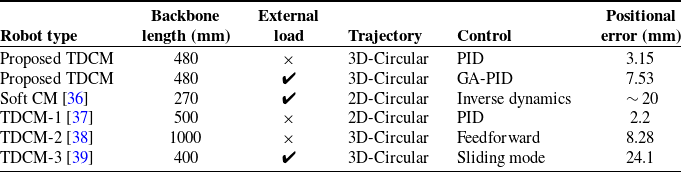
Table XI compares the tip positional errors of the proposed TDCM with other two-section manipulators reported in the literature. As the manipulators compared in Table XI have different backbone lengths, the results are presented as a representative comparison rather than a normalized one. The P2S-TDCM with GA-tuned PID control achieves tip errors of 3.15 mm (no-load) and 7.53 mm (under load). This performance surpasses earlier soft continuum designs such as Soft CM (∼35.56 mm) [Reference Mazare, Tolu and Taghizadeh36] and is competitive with TDCM-1 [Reference Aner, Ibrahim and Omar37] and TDCM-2 [Reference Pekris, Williams, Atkins, Georgilas and Bailey38]. While TDCM-1 demonstrates slightly lower error (2.11 mm), it is restricted to planar (2D) trajectories and validated in simulation, whereas the proposed TDCM achieves 3D trajectory tracking and is experimentally validated. Compared to TDCM-2, which employs a feedforward controller and achieves an error of 8.28 mm, the proposed TDCM offers comparable no-load performance but greater robustness under load conditions. Additionally, the TDCM-3 [Reference Qin, Chen and Ming39] employs a sliding-mode controller, reports a positional error of 24.1 mm for 3D circular tracking, and shows higher tracking error than the proposed approach. However, a direct one-to-one comparison with these studies is not feasible due to differences in manipulator architecture, backbone length, actuation configuration, and testing conditions; thus, this table outlines, based on attributes such as robot type, backbone length, loading condition, trajectory, control method, and reported positional error. The following are the key observations from the numerical simulation and experiments conducted in this article:
-
• The GA-optimized dynamic controller reduced the norm of tip position error to 2.75 mm, a significant improvement over the 4.72 mm error with inverse kinematic control under no external load, while also reducing tendon oscillations by ∼ 12.5% for smoother stability.
-
• Lyapunov-based analysis confirmed global asymptotic stability without external forces and UUB under bounded disturbances, ensuring reliable tracking.
-
• The control strategy improved RMSE in task space by 23.80% (
 $x$
), 39.88% (
$y$
), and 34.11% (
$z$
) after correction; experimental results kept tip errors below 5%.
-
• Deterministic GA ensured baseline accuracy, while robust GA-DOB controller reduced sensitivity to parameter variations and disturbances, achieving lower RMSE and flatter error slopes (e.g., slopes reduced from −3.43 and 5.02 in deterministic to −0.72 and 2.36 in robust for mass variation).
-
• The DOB enhanced the manipulator’s recovery under external wrenches by estimating and compensating for unmodeled loads in real-time, further stabilizing the transient response.


Experimental validation is limited to a single constant tip force, demonstrating stability under bounded loads. Future work will extend the DOB-assisted robust control to varying or distributed force conditions for adaptive real-time compensation. While robust GA simulations suggest improved performance across a broader range of force conditions, experimental confirmation under varying or distributed forces remains future work.
7. Conclusion and future directions
This study presents a comprehensive Euler-Lagrange-based dynamic framework for a P2S-TDCM to address external force disturbances. The model incorporates flexible backbone dynamics, tendon stiffness, and viscous damping to accurately capture the system’s behavior. A GA optimizes the PID controller gains to minimize Cartesian errors, ensuring precise trajectory tracking within predefined limits. The findings reveal a reduction in the norm of tip position error to 2.75 mm, compared to 4.72 mm observed with conventional kinematic control methods, with oscillations in tendon lengths reduced by approximately 12.5%. Lyapunov-based analysis confirms global asymptotic stability and ensures UUB under bounded external forces.
Beyond deterministic control, this paper systematically evaluates a robust GA-tuned PID framework for a two-section P2S-TDCM under parameter uncertainties in vertebra mass and backbone stiffness. In addition, an online DOB is integrated to estimate and reject unmeasured external wrenches, improving real-time robustness during environmental interactions. Numerical simulations demonstrated that the robust approach achieves lower RMSE values – for example, 43.39% in the
 $x$
-axis, 18.04% in the
 $y$
-axis, and 35.87% in the
 $z$
-axis relative to the deterministic approach. Moreover, robust tuning reduced sensitivity to parameter variations, yielding smaller slopes in RMSE changes (−0.72 and 2.36) compared to deterministic counterparts (−3.43 and 5.02), thereby confirming superiority under parameter uncertainties and external interactions. The DOB effectively compensates for constant and slowly varying tip wrenches, enhancing disturbance rejection beyond parameter randomization alone. These results establish the novelty of this work in combining planar-to-spatial design with robust-oriented control optimization. The deterministic controller is validated experimentally, demonstrating that the proposed dynamic model effectively maintains tip trajectory accuracy and compensates for external loads, with tip errors below 5 mm.
In conclusion, the proposed GA-PID-DOB control framework demonstrates enhanced 3D trajectory tracking accuracy, stability, and robustness under external forces, outperforming existing TDCM in normalized tip positional error. This work contributes a new pathway toward robustness-oriented design in CMs and establishes a foundation for extending uncertainty and disturbance-aware control strategies to realistic interaction conditions. Future work will incorporate adaptive and machine-learning-based DOBs capable of self-tuning under dynamic external forces acting along the manipulator’s body, thereby more closely mimicking environments.
Author contribution
Vipin Pachouri: Conceptualization, methodology, conducted simulation and experiments, wrote paper, reviewed, and edited. Pushparaj Mani Pathak: Supervision, validation, and reviewing.
Financial support
This research received no specific grant from any funding agency, commercial, or not-for-profit sectors.
Competing interests
The authors declare that they have no known competing financial interests or personal relationships that could have appeared to influence the work reported in this paper.
Appendix A
Genetic algorithm for tuning controller gains