1. Introduction
negative polarity items (hereafter NPIs) are words or expressions that occur only in certain kinds of negative environments (see Ladusaw Reference Ladusaw1979). A well-studied example is the English indefinite any, which, as illustrated in the examples below, is only accepted in negative contexts introduced by the sentential negation not, a negative indefinite such as nobody, or a seminegative expression such as few.
-
(1)


The focus of this paper is not the English indefinite any but three verbal NPIs expressing necessity in the three West Germanic languages: Dutch hoeven, English need, and German brauchen. These Germanic ‘need’-verbs all exhibit typical NPI distribution, as they do not appear in the absence of negation (Zwarts Reference Zwarts1981, Van der Wouden Reference Van der Wouden1997, Hoeksema Reference Hoeksema, Horn and Kato2000). However, as section 2 illustrates, these verbs do show distributional differences (compare Van der Wouden Reference Van der Wouden, Sheila, West and Solms2001). These differences give rise to a pattern in which German is located between Dutch and English.
By discussing two factors that may affect the timing of language acquisition, namely, opacity and frequency, section 3 explains why the pattern observed for the distribution of the West Germanic ‘need’-verbs also predicts the same pattern for language acquisition. In particular, acquisition of the German NPI brauchen is predicted to take place earlier than that of the English NPI need, but later than Dutch children's acquisition of the NPI hoeven.
To examine the prediction for language acquisition, a corpus investigation of the distribution of the three verbal NPIs in child English, child Dutch, and child German was conducted. For data collection, the CHILDES database (MacWhinney Reference MacWhinney2009) was employed. Section 4 presents the exact procedure of the corpus research and also provides information about the subcorpora analyzed in the current research.
Results are presented in section 5, which shows that the Dutch NPI hoeven already emerges around age two, whereas its English counterpart need is never attested in child English. With respect to the German NPI, the corpus data show that the first brauchens found in early child German are virtually all non-NPIs, and NPI-brauchen does not appear at a rate of more than 10% until the age of six. Section 6 concludes the paper. Some implications for language change arising from the acquisition pattern are discussed as well.
2. Distribution of the West Germanic ‘Need’-Verbs
English need, Dutch hoeven, and German brauchen all show NPI distribution (Zwarts Reference Zwarts1981; Van der Wouden Reference Van der Wouden1997, Reference Van der Wouden, Sheila, West and Solms2001; Hoeksema Reference Hoeksema, Horn and Kato2000). This is illustrated in the examples below, where the appearance of need, hoeven, or brauchen is ungrammatical without the sentential negation not, niet, or nicht in the a-sentences, or the negative indefinite nobody or niemand in the b-sentences:
-
(2)
-
(3)
-
(4)
A closer look at the distribution of the West Germanic ‘need’-verbs, however, reveals a number of differences. The English verb need can appear as a lexical verb, a modal verb, or a modal auxiliary, as illustrated in the examples below; but only when need is used as a modal auxiliary does it exhibit an NPI distribution and requires proper licensing by negation, as in 5c (see Van der Wouden Reference Van der Wouden1997, Reference Van der Wouden, Sheila, West and Solms2001, among others).
-
(5)
The German ‘need’-verb brauchen appears to have similar functions as the English need. As shown in 6, brauchen is also attested as a lexical verb, a modal verb, or a modal auxiliary. Different from need in English, however, German brauchen is an NPI not only when it is used as a modal verb, as in 6b, but also when it appears as a modal auxiliary, as in 6c (see Duden Zweifelsfälle 1972 in Van der Wouden Reference Van der Wouden, Sheila, West and Solms2001).
-
(6)
Compared to its English and German counterparts, the Dutch ‘need’-verb hoeven has no auxiliary use and appears only as a lexical verb, as in 7a–c, or a modal verb, as in 7d.Footnote 1 In both its uses, hoeven is an NPI: It does not survive without negation (Zwarts Reference Zwarts1981, Hoeksema Reference Hoeksema, Horn and Kato2000, Van der Wouden Reference Van der Wouden, Sheila, West and Solms2001).Footnote 2
-
(7)
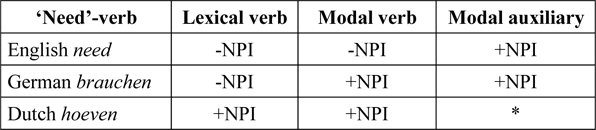
The observations described above give rise to a distributional pattern of the West Germanic ‘need’-verbs, in which German brauchen holds the position in between English need and Dutch hoeven. This pattern with respect to the NPI-use of the West Germanic ‘need’-verbs is presented in table 1.
German brauchen between English need and Dutch hoeven.

The pattern summarized in table 1 is observed not only for adult language. As the next section demonstrates, the same pattern is also predicted for language acquisition. By taking two factors into consideration, namely, opacity and input frequency, section 3 presents arguments for the prediction that the Dutch NPI hoeven is acquired earlier than the German NPI brauchen, which is in turn acquired earlier than the English counterpart need.
3. Predictions for Language Acquisition
This paper assumes (at least) two factors that may influence the word learning process by language-acquiring children: opacity and input frequency. These factors are defined and examined in sections 3.1 and 3.2, respectively. As I show, both factors predict the same pattern, in which the acquisition of the German NPI occurs before the English NPI but after its Dutch counterpart.
3.1. Opacity
Opacity is defined in this paper as the degree of transparency between a certain lexical form and its possible use(s) or meaning(s). In the particular case of the West Germanic ‘need’-verbs, the factor of opacity is interpreted as follows. English need is the most opaque form. This is because the lexical form [need] has three different uses (as a lexical verb, a modal verb, or a modal auxiliary); but only in its use as a modal auxiliary does [need] exhibit an NPI distribution (consider again the examples in 5). Dutch hoeven is positioned on the other end of the scale: It is the least opaque form of the three. Although the lexical form [hoeven] is shared by both its lexical and modal verb use, the verb hoeven can only appear as an NPI, independent of whether it is used as a lexical verb or a modal verb (see 7). Compared to its English and Dutch counterparts, German brauchen seems to hold an in-between position in terms of lexical opacity. The lexical form [brauchen] has three uses (as a lexical verb, a modal verb, or a modal auxiliary), just like English [need]. Nevertheless, since [brauchen] shows an NPI distribution only when it is not used as a lexical verb (compare 6a to 6b and 6c), German brauchen can be described as less opaque than English need, but more opaque than Dutch hoeven.
What has been discussed above gives rise to an opacity scale, which can be presented as follows. On this scale, ‘>’ stands for ‘more opaque than’; and the scale shows that German brauchen holds the position between English need and Dutch hoeven.
-
(8)
The opacity scale presented in 8 leads to a prediction about the order in which the Germanic ‘need’-verbs emerge as NPIs in child language. Assuming that the more opaque a lexical form is, the longer it takes before children acquire it, the English NPI need is expected to be acquired later than both its German and Dutch counterparts, of which the Dutch counterpart is predicted to be acquired earlier than the German one.
However, opacity alone is not always sufficient in predicting or explaining a certain acquisition pattern. Distribution of a target word or expression in the language input can be crucial as well. Consider English need, for instance. Although [need] is the most opaque of the three ‘need’-verbs investigated in this paper, its NPI use may be acquired earlier than that of the other two ‘need’-verbs if need appears frequently, and almost only as an NPI in the language input. This means that acquisition may be facilitated by robust input evidence—despite a high degree of opacity. In contrast, one may imagine that acquisition can be delayed in the absence of sufficient input evidence—even if the target form may not be opaque at all, having only a single use in the target language. Clearly, in addition to the factor of opacity, input frequency needs to be taken into consideration when talking about predictions for language acquisition. This is discussed in more detail in the next section.
3.2. Input Frequency
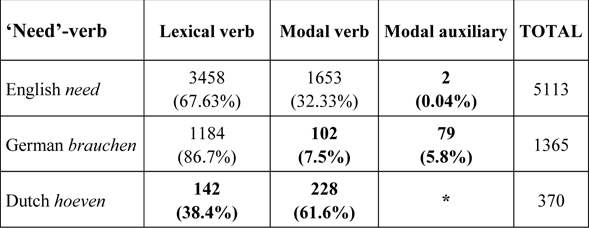
Input frequency refers to how often a target form is attested in adult language directed toward language-acquiring children (that is, child-directed speech). Input frequency influences the pace of the word learning process in the following way: The more frequent a target form is attested in the input, the earlier it is acquired by children. In order to explore the role of input frequency in predicting the order of emergence of the Germanic ‘need’-verbs in child language, frequency data on how need, hoeven, and brauchen are distributed in child-directed speech are required. Therefore, a corpus investigation in the CHILDES database (MacWhinney Reference MacWhinney2009) was conducted for frequency data collection—under the assumption that corpus data at least provide a representative and quantitative view of how the three ‘need’-verbs may be distributed in real language input. Results of this corpus investigation are summarized in the table below, in which bold figures represent NPI frequencies.
Distribution of the Germanic ‘need’-verbs in the language input.

English need is most frequently attested in the language input.Footnote 3 Altogether, 5,113 utterances containing this target verb are attested in the investigated subcorpora. However, only in two of these 5,113 utterances was need used as a modal auxiliary, and thus as an NPI (amounting to 0.04% of the input evidence).
In child-directed German, the verb brauchen is attested in a total of 1,365 utterances.Footnote 4 Among these utterances, 1,184 contain brauchen used as a lexical verb, and hence not as an NPI. This amounts to approximately 87% of the input data. In the remaining 13% of the input evidence, brauchen appears as either a modal verb (that is, 102 out of 1,365) or a modal auxiliary (that is, 79 out of 1,365). In both of these uses, brauchen displays an NPI constraint.
Finally, let us look at the distribution of Dutch hoeven.Footnote 5 Although only 370 utterances containing hoeven are attested in the input, each of these 370 utterances represent the NPI use of the Dutch ‘need’-verb. Thus, there seems to exist robust input evidence supporting hoeven's appearance as an NPI, from a learner's perspective, which amounts to 100% of the input.
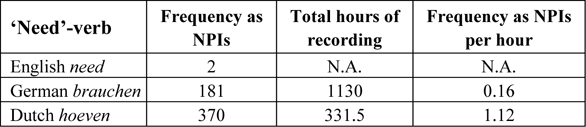
However, what has been presented above does not provide a relative view of how the West Germanic ‘need’-verbs are distributed in child-directed speech. One does not know, for instance, how often in a day these ‘need’-verbs appear as NPIs in the input. Therefore, in order to relativize the frequency data presented in table 2, the total number of recording hours of the CHAT files included for frequency data collection were calculated. This information is presented in the following table (the third column), for each of the investigated NPIs. Note that for the English files, a total number of recording hours was not available due to a lack of corpus information.
Frequency of the Germanic ‘need’-verbs as NPIs per recording hour.

Given the absolute frequencies of the West Germanic ‘need’-verbs when appearing as NPIs, and the total hours of recording, a relative frequency was calculated for each NPI per recoding hour. I assume that the child-directed speech recorded in CHILDES provides a representative overview of the real language input. The relative frequency data in table 3 (the fourth column) indicate how often language-acquiring children are confronted with utterances containing an NPI-use of the relevant ‘need’-verb.
Although it was not possible to retrieve the total number of recording hours for the English NPI, it is clear that the NPI use of need is extremely infrequent in the input. Comparing the relative frequencies of the German NPI brauchen and the Dutch NPI hoeven, one sees that Dutch hoeven appears almost seven times more often as an NPI than its German counterpart. These relative frequency data lead to the following scale with respect to the input frequency of the West Germanic ‘need’-verbs. On this scale, ‘>’ stands for ‘more frequently attested than’. In this respect, the German NPI brauchen again holds the in-between position.
-
(9)
Assuming that the more frequent an item is attested in the input, the earlier children acquire it, the above scale makes a prediction for the order of emergence of the Germanic ‘need’-verbs as NPIs in child language. In particular, the Dutch NPI hoeven is predicted to emerge earlier than its German counterpart brauchen, which is predicted to arise earlier than the English NPI need.
4. Methodology
Section 3 discussed two factors that may influence the timing of language acquisition—namely, opacity (section 3.1) and input frequency (section 3.2). These factors were discussed with respect to the West Germanic ‘need’-NPIs. Having defined opacity as the degree of transparency between a certain lexical form and its possible meaning(s) or use(s), section 3.1 presented an opacity scale on which German brauchen is situated between English need (the most opaque of the three) and Dutch hoeven (the least opaque of the three). Having taken relative frequency data into consideration, section 3.2 presented an input frequency scale on which German brauchen again holds a position between English need (the least frequent of the three) and Dutch hoeven (the most frequent of the three).
Both factors discussed in section 3 predict that the German NPI brauchen is acquired earlier than its English counterpart need, but later than its Dutch counterpart hoeven. In order to examine this prediction, a corpus investigation was conducted in the CHILDES database (MacWhinney Reference MacWhinney2009). Data of child Dutch were collected in the following subcorpora of CHILDES: BolKuiken (Bol & Kuiken Reference Bol and Kuiken1990), CLPF (Fikkert Reference Fikkert1994, Levelt Reference Levelt1994), Groningen (Wijnen & Bol Reference Wijnen and Bol1993), VanKampen (Van Kampen Reference Van and Jacqueline1994), and Wijnen (Wijnen Reference Wijnen1988, Reference Wijnen1992). Altogether, 710 CHAT files were analyzed, covering speech data from 59 monolingual Dutch children between approximately one and five years of age.
For English data collection, the following subcorpora in CHILDES were employed: Belfast (Henry Reference Henry1995, Wilson & Henry Reference Wilson and Henry1998), Cruttenden (Cruttenden Reference Cruttenden1978), Fletcher (Karmiloff-Smith Reference Karmiloff-Smith1986, Fletcher & Garman Reference Fletcher and Garman1988, Crystal et al. Reference Crystal, Fletcher and Garman1989), Forrester (Forrester Reference Forrester2002), Howe (Howe Reference Howe1981), Lara (Rowland & Fletcher Reference Rowland and Fletcher2006), Manchester (Theakston et al. Reference Theakston, Lieven, Pine and Rowland2001), Thomas-Heritage (Lieven et al. Reference Lieven, Salomo and Tomasello2009), and Wells (Wells Reference Wells1981). A total of 1,492 CHAT files were investigated, and 145 monolingual English children between the age of one and five were included.
Finally, data from German children were collected from six subcorpora in CHILDES. They were: Caroline, Leo (Behrens Reference Behrens2006), Miller (Miller Reference Miller1979), Szagun (Szagun Reference Szagun2001), Rigol (Rigol Reference Rigol2007), and Wagner (Wagner Reference Wagner1985).Footnote 6 Altogether, 917 CHAT files were analyzed, including speech data from 41 monolingual German children. Since the subcorpora Wagner and Rigol also provide longitudinal data from 11 children until the age of twelve, the age range of German children studied in the current research was larger compared to that of Dutch and English children.
The exact procedure of the investigation was as follows. The frequency of the target verbs (that is, need, hoeven, and brauchen) in different inflected forms of the present and past tense, as well as their infinitive form, was first counted by employing the freq-command of the CLAN program. For English need, it concerned three forms: needs, need, and needed; for its Dutch counterpart, six forms were involved: hoef, hoeft, hoeven, hoefde, hoefden, and gehoeven. As for German brauchen, the following forms were included while running the freq-command: brauche, brauchst, braucht, brauchen, brauchte, brauchtest, brauchtet, brauchten, and gebraucht.
After collecting the frequency data, each utterance containing the target verb (that is, need, hoeven, or brauchen) was further analyzed for how the target verb was used: as a lexical verb, a modal verb, or a modal auxiliary in the case of English and German. This was done by using the kwal-command of the CLAN program. Generally, three lines of context preceding and following an utterance containing the target verb were analyzed by adding “+w3” and “-w3” to the command. If a total of six lines of context were not sufficient to evaluate the use of the target verbs, more contextual data were examined manually.
5. Results
Results of the corpus research are presented per language: Dutch hoeven in section 5.1, English need in section 5.2, and German brauchen in section 5.3. The development of each ‘need’-verb is presented by different groups based on the children's ages at the time of recording, ranging from one to four years old in the case of English need and Dutch hoeven, and from one to six years old and beyond in the case of German brauchen. A summary of the corpus results follows in section 5.4.
5.1. The Development of Dutch Hoeven
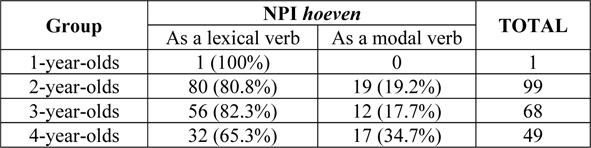
The development of Dutch hoeven is approached by analyzing spontaneous speech data from 59 monolingual Dutch children aged between approximately one and five. Relevant results are summarized in the following table, per age group (one- to four-year-olds) and per use (as a lexical or modal verb). Note that hoeven is an NPI in both cases.
Distribution of Dutch hoeven in child language.

The corpus data presented in table 4 clearly show that Dutch children are not able to produce hoeven in their spontaneous speech until they are two years old, suggesting that hoeven is acquired after the age of two. However, it is hard to tell which use of hoeven is acquired first—the lexical or the modal one—as the first hoevens attested in child Dutch involve both uses, though in more than 80% of the initial utterances hoeven is used as a lexical verb.
With respect to the absolute number of hoeven attested in child language, there is no increase when comparing different age groups, but rather a decrease: from 99 among the two-year-olds to 68 among the three-year-olds, which further decreases to 49 among the four-year-olds. However, this decrease is due to the fact that the number of CHAT files available for analysis for each age group decreases when children grow older.
As for the distribution of this verb in child Dutch, there is a significant change. Results of a chi-square test indicate that Dutch four-year-olds use hoeven significantly more often as a modal verb compared to their younger counterparts (X 2 (1, N=216)=5.703, p=.017). In particular, the four-year-olds use hoeven as a lexical and modal verb approximately 65% and 35% of the time, respectively. Although such a distribution differs significantly from hoeven's distribution in the language input (X 2 (1, N=419)=12.921, p=.000; see also table 2), where it is used as a lexical verb about 38% of the time and as a modal verb around 62% of the time, the significant change attested in child language does represent a development toward adult-like language.
However, what is crucial to the current research is when hoeven emerges as an NPI in child Dutch. Since hoeven is an NPI independently of its use as a lexical or modal verb, the conclusion drawn here is that Dutch children have already acquired the NPI as early as two years of age (see also Koster & Van der Wal Reference Koster, Van der Wal, Verrips and Wijnen1995, Van der Wal Reference Van der Wal1996, Lin et al. Reference Lin, Weerman and Zeijlstra2015 for similar results).
5.2. The Development of English Need
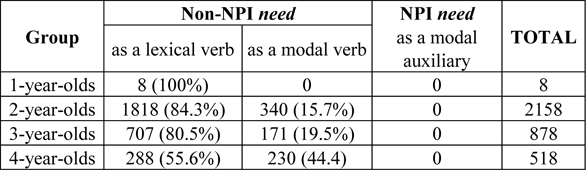
In order to draw a developmental pattern of English need, spontaneous speech data from a total of 145 monolingual English children aged between approximately one and five were analyzed. Results of this investigation are presented in table 5. Two categories of nee d in child language are distinguished: non-NPI need (when it appears as either a lexical verb or a modal verb), and NPI need (when it is used as a modal auxiliary). The children were divided into four groups, based on the age at which their speech was recorded.
Distribution of English need in child language.

Before age two, only eight utterances containing English need are attested in child language. In all these initial utterances, need is used as a lexical verb, and hence is not an NPI. This means that among the three uses of English need, the use as a lexical verb emerges first.
From age two, children start to use need quite frequently in their spontaneous speech. Altogether, 2,158 utterances containing need are used by two-year-olds, and 878 and 518 utterances containing the target verb are attested with three- and four-year-olds, respectively.Footnote 7 Compared to the initial needs attested in child English, there is a substantial change in the distribution of this verb after the age of two. That is, from age two, children use need not merely as a lexical verb, but also as a modal verb. This means that the use of need as a modal verb is acquired after its lexical use.
Another important development in the distribution of English need in child language concerns a significant increase in how often English children use need as a modal verb: from 15.7% at age two, to 19.5% at age three, and further increasing to 44.4% at age four. Results of a chi-square test confirm that this increase is significant (X 2 (2, N=3554)=209.052, p=.000). This suggests that when they grow older, English children become more and more adult-like in how they use need. This is because need is also more often attested in the language input as a lexical verb (67.63%) than as a modal verb (32.33%; see further table 2).
However, the significant development discussed above does not guarantee the emergence of need in child language as an NPI (that is, when it is used as a modal auxiliary). At least until the age of five, no single utterance containing an NPI need is attested. Thus, the corpus results presented in table 2 do not provide any evidence for English children's acquisition of need as an NPI—at least not before the age of five.
5.3. The Development of German Brauchen
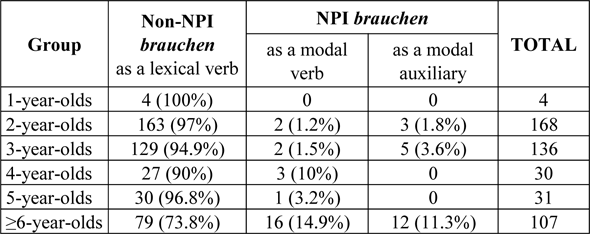
Spontaneous speech data from a total of 41 monolingual German children were analyzed to study the development of their knowledge of the target verb brauchen. Since 11 of the investigated children were longitudinally recorded until the age of twelve, the age range of the German children reported in this section is larger compared to that of the Dutch and English children presented in sections 5.1 and 5.2, respectively. As a result, the German section of the study contains two additional age groups: five-year-olds and those aged six and older. Two main categories are defined to describe the use of German brauchen: non-NPI brauchen (when it appears as a lexical verb) and NPI-brauchen (when it appears as either a modal verb or a modal auxiliary). Relevant corpus results are summarized in the table below.
Distribution of German brauchen in child language.

German one-year-olds do not seem to have acquired the target verb, as merely four utterances containing brauchen are attested in the speech of these young children. It is clear, however, that German children start to use brauchen more and more frequently after the age of two. This strongly suggests that the acquisition of the verb brauchen takes place around two years of age.
However, the first brauchens uttered by the two-year-olds are virtually all lexical ones (97%), thus non-NPIs. This distributional pattern remains the same until the age of six. A Fisher's exact test confirms this observation: There is no significant difference in how German children below the age of six distribute brauchen (p=.255). On average, brauchen appears around 96% of the time as a non-NPI, whereas it is used as an NPI only 4% of the time. These results suggest that brauchen is first acquired as a lexical verb. Moreover, children do not seem to have acquired the modal or the auxiliary use of brauchen until the age of six—since the average percentage of brauchen appearing as a modal or an auxiliary verb below age six is too marginal.
The distribution of brauchen in child German shows a significant change when children turn six years of age (X 2 (2, N=472)=46.731, p=.000). In particular, children above age six start to use brauchen as an NPI—either as a modal verb or an auxiliary modal—significantly more frequently than their younger counterparts. Hence, the NPI-use of German brauchen does not emerge until the age of six. On top of this, one also finds that the distribution of brauchen in late child German displays a similar trend to the one observed in their parents’ speech. In both late child German and the language input, brauchen is most often attested as a lexical verb and least often as an auxiliary modal, although there is a significant difference between brauchen's distribution in late child language and the input (X 2 (2, N=1472)=13.581, p=.001; see also table 2).
5.4. Summary
Results presented in this section clearly show that the average age of emergence of all three ‘need’-verbs is around two years. The ‘need’-verbs that are initially uttered by language-acquiring children are all lexical ones, which means that the first use of Dutch hoeven, English need, and German brauchen acquired by children is the lexical use (illustrated in 5a, 6a, and 7a,b).
However, when looking at the development of the NPI-use of the West Germanic ‘need’-verbs, one finds that the average age of emergence differs from language to language. The relative corpus results lead to the following scale, with respect to the acquisition timing of the West Germanic ‘need’-verbs. On this scale, ‘>’ stands for ‘acquired earlier than’. Note that the German NPI brauchen holds the in-between position again.
-
(10)
There is strong evidence that Dutch children have already acquired hoeven as an NPI around the age of two (see table 4). Although German children are able to utter brauchen as an NPI at the age of two, they seem to fully acquire it only by the age of six (see table 6). English need, finally, is never attested as an NPI in child language—at least not until the age of five (see table 5). This order of emergence of the NPI-use of the three West Germanic ‘need’-verbs confirms the prediction: The German NPI brauchen is acquired earlier than its English counterpart need and later than the Dutch ‘need’-verb hoeven.
5. Discussion and Conclusion
This paper investigated the distribution and acquisition of Dutch hoeven, English need, and German brauchen—three verbs expressing necessity. These verbs—historically and etymologically unrelated (see Van der Wouden Reference Van der Wouden, Sheila, West and Solms2001)—all exhibit distribution restricted to certain negative environments only, and are therefore categorized as NPIs. However, this paper presented some distributional differences among these West Germanic ‘need’-verbs when they appear as NPIs. These differences give rise to a pattern, in which German brauchen is found between English need and Dutch hoeven. By discussing two factors that may influence language acquisition, namely, lexical opacity and input frequency, this paper moreover predicted a similar pattern for the acquisition. In particular, the Dutch NPI hoeven emerges earlier in child language than the German NPI brauchen, which in turn arises earlier than the English NPI need.
This order of emergence is confirmed by child data from CHILDES. The Dutch NPI already emerges around age two—in both its lexical and modal use. NPI-need (that is, the auxiliary one), however, is never attested in child English—at least not until the age of five. The first brauchens attested in early child German are virtually all lexical ones, thus non-NPIs; and there is no strong evidence for the acquisition of NPI-brauchens (that is, the modal and the auxiliary ones) before age six. However, since the factors lexical opacity and input frequency made exactly the same prediction with respect to the acquisition timing of the West Germanic ‘need’-verbs, it was impossible to tease apart the influence of each factor during the acquisition process. Nonetheless, the exploration of how children acquire the ‘need’-verbs shows that the absence of robust input evidence—due to either lexical opacity and/or insufficient input frequency—delays acquisition.
The results presented in this paper, with respect to the different ages at which the West Germanic ‘need’-verbs are acquired as NPIs, have an implication for language change. Assuming that language acquisition requires different learning mechanisms that are sensitive to different factors, such as lexical opacity and/or input frequency, the acquisition patterns of the West Germanic ‘need’-verbs may give rise to the following predictions for language change. As Dutch hoeven is acquired as an NPI quite early on, which is around age two, one may expect this NPI to be stable in the language. In contrast, since the German NPI brauchen is acquired much later, namely, around the age of six, one may expect this NPI to be less stable in the language; for example, it may only appear in fixed constructions, such as Du brauchst keine Angst (zu) haben ‘You need not fear’. Finally, English need may turn out to be susceptible to change as it does not seem to be acquired during childhood. One may expect it to disappear from the language. Moreover, as one of the anonymous reviewers points out, need is not an NPI (anymore) for most contemporary speakers of the language: The NPI-use appears to be restricted to formal speech only—a typical consequence of late acquisition.