INTRODUCTION
It is now well established that phonology plays a crucial role in early reading, given that the base of reading acquisition consists in learning the correspondences between the letters and sounds of a given language (Share, Reference Share1995). Phonological processing in reading has been widely investigated through phonological awareness tasks, in which participants have to isolate, remove or blend phonological sublexical units such as phonemes, syllables or rimes in spoken items (e.g. Carroll, Snowling, Hulme & Stevenson, Reference Carroll, Snowling, Hulme and Stevenson2003; Denton, Hasbrouck, Weaver & Riccio, Reference Denton, Hasbrouck, Weaver and Riccio2000). An interesting result reported by studies on phonological awareness is that the manipulation of large units (syllables, rimes) is easier than the manipulation of phonemes (e.g. Carroll et al., Reference Carroll, Snowling, Hulme and Stevenson2003; Denton et al., Reference Denton, Hasbrouck, Weaver and Riccio2000; Liberman, Shankweiler, Fischer & Carter, Reference Liberman, Shankweiler, Fischer and Carter1974; see also Morais, Content, Cary, Mehler & Segui, Reference Morais, Content, Cary, Mehler and Segui1989, in illiterate adults). In syllable-timed languages such as French or Spanish, syllables could act as phonological units and play an important role in language development. Given that syllables are functional units of spoken word processing, beginning readers would keep on relying on syllables to process written words guided by their knowledge of spoken language (Bastien-Toniazzo, Magnan & Bouchafa, Reference Bastien-Toniazzo, Magnan and Bouchafa1999; Doignon & Zagar, Reference Doignon and Zagar2006). However, syllable activation during visual word recognition in beginning reading has received little attention.
To investigate the role of syllables in written word processing, Colé, Magnan & Grainger (Reference Colé, Magnan and Grainger1999) used a visual adaptation of the syllable monitoring task (see Mehler, Dommergues, Frauenfelder & Segui, Reference Mehler, Dommergues, Frauenfelder and Segui1981). In this study, children had to detect consonant–vowel segments (CV segments, e.g. so) and consonant–vowel–consonant segments (CVC segments, e.g. sol) that were presented in written French words with a CV or CVC first syllable (respectively so.leil ‘sun’ and sol.dat ‘soldier’).Footnote 1 The data yielded shorter response latencies in detecting segments corresponding exactly to the first syllable of the word (so in so.leil, CV segment–CV target, and sol in sol.dat, CVC segment–CVC target) rather than in detecting those not corresponding to the first syllable (sol in so.leil, CVC segment–CV target, and so in sol.dat, CV segment–CVC target). This syllable congruency effect was found in French for the more advanced readers in Grade 1 (Colé et al., Reference Colé, Magnan and Grainger1999) and for children in Grade 5 (Colé & Sprenger-Charolles, Reference Colé and Sprenger-Charolles1999). Using the illusory conjunction paradigm, Doignon & Zagar (Reference Doignon and Zagar2006) investigated whether the colour perception of a letter in a word was influenced by its syllable structure in French. In this task, words were printed in two colours corresponding or not to the syllable segmentation (e.g. respectively MI.cro ‘mike’, BAR.bu ‘bearded’ vs. MI.Cro, BAr.bu).Footnote 2 Children were instructed to report the colour of the central letter of briefly presented words. The results showed that children in Grade 1 to 5 made more errors with items like MI.Cro and BAr.bu (no syllable colour match) than with items like MI.cro and BAR.bu (syllable colour match). In other words, readers restored the word syllable structure by erroneously perceiving that the c in MI.Cro was the same colour as the letters ro.
To account for such syllable effects, it has been assumed that syllable representations are constructed through the early stages of exposure to spoken language. This level is then involved in written language processing, influencing the speed and efficiency of word processing in children (Colé et al., Reference Colé, Magnan and Grainger1999; Doignon & Zagar, Reference Doignon and Zagar2006). In their seminal study on the syllable frequency effect in adults, Carreiras, Alvarez & de Vega (Reference Carreiras, Alvarez and de Vega1993) proposed that an intermediate prelexical syllabically structured level would be connected to both letter and word levels and would intervene during silent reading (referred to as the syllable activation hypothesis). Following this hypothesis, syllable effects in subsequent studies have been accommodated in the interactive activation framework (IA model, McClelland & Rumelhart, Reference McClelland and Rumelhart1981) by adding a syllable level, since the original IA model could not capture syllable effects (see Conrad, Carreiras, Tamm & Jacobs, Reference Conrad, Carreiras, Tamm and Jacobsin press). In this sense, Mathey, Zagar, Doignon & Seigneuric (Reference Mathey, Zagar, Doignon and Seigneuric2006) described the interactive activation model with syllables (IAS model), an IA-based model incorporating syllables. The syllable units are connected to both the letter and the word units, hence forming a phonological route of lexical access. By means of two major modifications with respect to anterior propositions, the model makes it possible to account for syllable effects and for the influence of orthographic information on the syllable effects. First, adjacent letters are connected at the letter level, and second, syllable activation ensues from both the letter activation and the frequency-based resting level of syllables. It should be noted that the multiple-trace memory model (Ans, Carbonnel & Valdois, Reference Ans, Carbonnel and Valdois1998) is an implemented model with syllables, yet this model is dedicated to reading aloud and does not allow to account for inhibitory syllable frequency effects (see Hutzler, Bergmann, Conrad, Kronbichler, Stenneken & Jacobs, Reference Hutzler, Bergmann, Conrad, Kronbichler, Stenneken and Jacobs2004).
In visual word recognition frameworks such as the IAS model (Mathey et al., Reference Mathey, Zagar, Doignon and Seigneuric2006), syllable effects are assumed to ensue from two complementary processes, a facilitatory between-level process and an inhibitory within-level process (see Barber, Vergara & Carreiras, Reference Barber, Vergara and Carreiras2004). First, when a letter string is displayed, the letter representations send activation to the syllable representations, and activation reaches the word level via direct connections between the syllable and the word levels. Second, syllable activation spreads to syllabic neighbours (i.e. words sharing the corresponding syllable unit) by means of facilitatory connections, and the activated word units then compete with each other via inhibitory connections. Word target response is usually delayed since the process of word recognition is achieved when all the candidates are eliminated except the matched one. Hence, if the facilitatory process is stronger than the inhibitory process, response latencies are shortened such as in facilitatory syllable congruency effects (e.g. Alvarez, Carreiras & Perea, Reference Alvarez, Carreiras and Perea2004, in adults; Colé et al., Reference Colé, Magnan and Grainger1999, in children). In the opposite case, response latencies are lengthened such as in the inhibitory syllable frequency effects (e.g. Carreiras et al., Reference Carreiras, Alvarez and de Vega1993; Conrad, Grainger & Jacobs, Reference Conrad, Grainger and Jacobs2007; Mathey & Zagar, Reference Mathey and Zagar2002; Mathey et al., Reference Mathey, Zagar, Doignon and Seigneuric2006, in adults). The direction of syllable effects depends on the type of stimuli used in the task (Carreiras & Perea, Reference Carreiras and Perea2002) and on reading efficiency (Jiménez Gonzalez & Hernandez Vallé, Reference Jiménez Gonzalez and Hernandez2000). A critical point of previous studies on the syllable activation hypothesis in beginning readers is that participants had to detect either a letter cluster (Colé et al., Reference Colé, Magnan and Grainger1999; Colé & Sprenger-Charolles, Reference Colé and Sprenger-Charolles1999) or a letter (Doignon & Zagar, Reference Doignon and Zagar2006). Hence, these tasks may not involve the stage of lexical access since explicit word reading is not required for the participants to perform the task (Doignon & Zagar, Reference Doignon and Zagar2006). However, given that the syllable effects are assumed to ensue from both facilitatory prelexical activation and inhibitory lexical activation, it seems crucial to investigate syllable effects in beginning reading with a task specifically requiring lexical access, in order to grasp the syllable activation processes as a whole. Until now, this issue has mostly been investigated in skilled reading.
The aim of the present study was to test the syllable activation hypothesis in children in Grade 2 when using a task involving the lexical access stage, that is, a task allowing the emergence of facilitatory and inhibitory processes during visual word recognition. To do this, the syllable congruency effect was tested with a coloured lexical decision task (LDT). In a previous study by Carreiras, Vergara & Barber (Reference Carreiras, Vergara and Barber2005), which used this task, adults were presented with items written in two colours; they had to press a button to indicate whether the stimulus was a word or not. In the first condition, the colours matched the syllable boundaries (e.g. CA.si.no ‘casino’), while in the second condition the colours and the syllable boundaries did not match (e.g. CA.Si.no). The matched and mismatched conditions were then compared. An inhibitory syllable congruency effect was found for low-frequency words and for pseudo-words. The items were recognized more slowly in the syllable congruent condition (CA.si.no) than in the incongruent condition (CA.Si.no). According to the authors, the words were parsed into syllables during the recognition process. In the congruent condition, the colours made the syllables salient so lexical representations sharing the first syllable with the target item were strongly activated. Hence, lexical competition occurred and the target recognition was delayed in the congruent condition compared to the syllable incongruent condition. In the present study, the same procedure as that in Carreiras et al. (Reference Carreiras, Vergara and Barber2005) was used, except that the structure of the target first syllable (CV vs. CVC syllables) was manipulated to test the syllable congruency effect entirely (see Mehler et al., Reference Mehler, Dommergues, Frauenfelder and Segui1981). In addition, the reading level of the children was taken into account. If syllables are functional units of lexical access during silent reading in beginning readers, a syllable congruency effect should be found in the coloured LDT. In addition, the effect should vary according to the children's reading level, given that reading efficiency is known to modify phonological effects (e.g. Booth, Perfetti & MacWhinney, Reference Booth, Perfetti and MacWhinney1999; Colé et al., Reference Colé, Magnan and Grainger1999; Jiménez Gonzalez & Hernandez Vallé, Reference Jiménez Gonzalez and Hernandez2000).
METHOD
Participants
Forty-six second graders (mean=8 ; 0, SD=0 ; 3) participated in this study. They were recruited and tested at three French primary schools located in an area of middle-to-high socioeconomic level from urban zones in Bordeaux. All children were native French speakers, had corrected-to-normal vision, and attended their grade at the regular age. According to their teachers, none of the children had reading difficulties or sensory impairment. The children were tested individually in a single session of approximately twenty-five minutes. One participant was excluded from the analyses because of a high percentage of errors in the LDT. The reading level of the children was evaluated with the standardized reading test ‘L'Alouette’ (Lefavrais, Reference Lefavrais1965). The average reading level was 8 ; 2 (SD=0 ; 8). There were differences between the reading scores of the children so it was possible to distinguish between two groups of readers: a group of twenty-eight children at least one month ahead of reading (mean=8 ; 6, SD=0 ; 8, group of good readers) and a group of fifteen children at least one month behind in reading (mean=7 ; 6, SD=0 ; 3, group of poor readers). These two groups significantly differed according to their reading level (t(41)=5·52, p<0·001).
Materials
Thirty pairs of bisyllabic words were selected in the French lexical database MANULEX (Lété, Sprenger-Charolles & Colé, Reference Lété, Sprenger-Charolles and Colé2004), a database specifically suited for French elementary school readers. Target type and colour type were cross-factorially manipulated. First, the two words in each pair shared the first three letters (e.g. carotte ‘carrot’, carton ‘cardboard’), but one word had a consonant–vowel first syllable (ca.rotte, referred to as a CV target) and the other had a consonant–vowel–consonant first syllable (car.ton, referred to as a CVC target). The CV and CVC target were middle-to-high frequency words (standard frequency index: 56·53) and were strictly matched on printed frequency, word length, number of higher frequency orthographic neighbours and summed bigram frequency (sum of the letter-pair frequencies). Second, the targets were written in two colours, green and red. In the first condition, the two first letters of the target were green and the remaining ones were red (CArotte, CArton, referred to as a CV colour), while in the second condition, the three first letters were green and the remaining ones were red (CARotte, CARton, referred to as a CVC colour). Thus, four experimental conditions were created, two exhibiting a syllable congruency pattern (CV target–CV colour: CA.rotte; CVC target–CVC colour: CAR.ton) and the others not (CVC target–CV colour: CAr.ton; CV target–CVC colour: CA.Rotte). Thirty pairs of pseudo-words were added for the task requirement. They were derived from real words so that they were orthographically legal and pronounceable in French. They were matched on the target words according to the first syllable structure (e.g. bo.rile/bor.cie) and were displayed in a similar way to word targets. Thirty pairs of fillers were added (half were words, the other half were pseudo-words). They were similar to the targets except that they were not displayed in two colours. The lists of trials were created so that no participant was presented with the same item more than once.
Procedure
First, the participants performed individually a warm-up exercise prior to the LDT experiment (see Castles, Davis & Letcher, Reference Castles, Davis and Letcher1999). In this exercise, six cards displaying a coloured letter string on a black background were presented one at a time by the experimenter. Children were asked to say whether or not the printed stimulus was a real word. They were given feedback on the accuracy of their responses. Then, the participants were told that they would have to perform the same game on a computer, except that they would not give their responses out loud but by means of two buttons on the keyboard. Then the children performed the LDT on a portable computer using the DMDX software (Forster & Forster, Reference Forster and Forster2003). Each trial began by presenting a fixation point for 500 ms on the centre of the screen, which was replaced by a lower-case coloured target item on a black background. The target remained on the screen until the participants responded. Participants had to decide as quickly and as accurately as possible whether the target was a French word or not by pressing one of two buttons on an external keyboard. Visual feedback was provided when they failed to respond. Response times (in milliseconds) were measured from target onset until response. All participants performed 12 practice trials before receiving the 180 trials in a different random order.
RESULTS
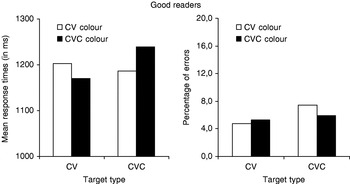
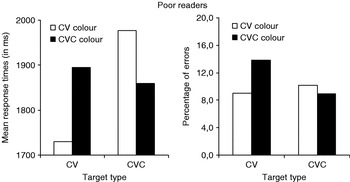
The mean correct response times and mean error rates averaged over participants for experimental words are presented in Figures 1 (good readers) and 2 (poor readers). Response times outside the range of two standard deviations from the individual mean of the participants were excluded (4·1% of the data). Three words were excluded from the analyses because of a high error rate, which suggested that they were not familiar to some children.
Mean response times (left) and percentage of errors (right) of good readers as a function of target type and colour type.

Mean response times (left) and percentage of errors (right) of poor readers as a function of target type and colour type.

Response times
The data were submitted to a target type (2)×colour type (2)×reading level (2) three-way ANOVA. The main effect of reading level was significant (F(1, 40)=52·87, p<0·001), showing that the good readers were faster in recognizing words (1200 ms) than the poor readers (1865 ms). The main effect of target type was also significant (F(1, 40)=12·57, p=0·001), indicating that CV targets were processed more rapidly (1499 ms) than CVC targets (1566 ms). The main effect of colour type was not significant (F<1). The target type (2)×reading level (2) two-way interaction was significant (F(1, 40)=4·54, p=0·04). The target type (2)×colour type (2) two way-interaction was also significant (F(1, 40)=7·24, p=0·01). The colour type (2)×reading level (2) two-way interaction was not significant (F<1). Finally, the target type (2)×colour type (2)×reading level (2) three-way interaction was significant (F(1, 40)=25·21, p<0·001).
In the good reader analysis, the main effect of target type failed to reach significance (F(1, 26)=2·49, p=0·13). The main effect of colour type was not significant (F<1). The target type (2)×colour type (2) two-way interaction was significant (F(1, 26)=11·98, p=0·002), showing that CV targets were recognized more slowly when displayed in CV colour (1203 ms) rather than in CVC colour (1170 ms), while CVC targets were recognized more slowly when displayed in CVC colour (1239 ms) rather than in CV colour (1186 ms).
In the poor reader analysis, the main effect of target type was significant (F(1, 14)=6·90, p=0·02), indicating that CV targets (1812 ms) were recognized faster that CVC targets (1919 ms). The main effect of colour type was not significant (F<1). The target type (2)×colour type (2) two-way interaction was significant (F(1, 14)=10·20, p=0·007), showing that CV targets were recognized faster when displayed in CV colour (1729 ms) than in CVC colour (1895 ms), while CVC targets were recognized faster when displayed in CVC colour (1860 ms) than in CV colour (1977 ms).
Error rates
The main effect of reading level was significant (F(1, 40)=11·13, p=0·002), showing that the good readers made fewer errors (5·85%) than the poor readers (10·49%). Neither the main effect of target nor the main effect of colour was significant (all Fs<1). The target type (2)×reading level (2) (F(1, 40)=2·82, p>0·10) and the colour type (2)×reading level (2) (F(1, 40)=1·07, p>0·10) two way-interactions were not significant. The target type (2)×colour type (2) two way-interaction was marginally significant (F(1, 40)=3·82, p=0·06). CV targets produced fewer errors when displayed in CV colour (6·90%) rather than in CVC colour (9·55%), while CVC targets produced fewer errors when displayed in CVC colour (8·81%) rather than in CV colour (7·41%). Finally, the target type (2)×colour type (2)×reading level (2) three-way interaction was not significant (F<1).
The target type (2)×colour type (2) two-way interaction was significant neither in the good reader analysis (F<1) nor in the poor reader analysis (F(1, 14)=2·07, p>0·10).
DISCUSSION
The aim of the study was to investigate the syllable activation hypothesis in visual recognition of French words in second grade children. To do so, a coloured LDT was used to test the syllable congruency effect in silent reading. The findings can be summarized as follows. First, a syllable congruency effect was found in children when a task involving lexical access was used, and more importantly, this effect varied according to the reading level. Second, the syllable structure complexity of the first syllable of the target word influenced recognition latencies, and this effect was stronger for poor readers than for good readers.
To test the syllable congruency effect, word targets with a CV or a CVC first syllable were printed in two colours so that the colours matched the syllable structure or did not match. A facilitatory syllable congruency effect was found for the less advanced readers in Grade 2. Their recognition latencies were shorter when the colour of the words exactly matched the syllable boundaries (CV target–CV colour, CVC target–CVC colour) rather than did not match (CV target–CVC colour, CVC target–CV colour). In other words, the fact that the colour made the syllables salient helped poor readers to read the words. This result is consistent with the data reported by Colé et al. (Reference Colé, Magnan and Grainger1999) with a visual syllable monitoring task, since they found a facilitatory syllable congruency effect for the more advanced readers in Grade 1. We can assume that our poor readers in Grade 2 are similar to their good readers in Grade 1. This finding can be accommodated in the IAS model (Mathey et al., Reference Mathey, Zagar, Doignon and Seigneuric2006). When the colour made the syllables salient, the corresponding units were strongly activated at the prelexical syllable level, and activation was sent to the corresponding word unit by means of direct connections between the syllable and the word levels. On the other hand, an inhibitory syllable congruency effect was found for the good readers.Footnote 3 The recognition latencies were longer when the colour of the words exactly matched the syllable boundaries rather than when it did not match. In that case, the fact that the colour made the syllables salient slowed down word recognition. A similar result was reported by Carreiras et al. (Reference Carreiras, Vergara and Barber2005) when skilled readers processed pseudo-words and low-frequency words. According to the syllable activation hypothesis, inhibitory syllable effects ensue from competition between syllabic neighbours at the word level (e.g. Carreiras et al., Reference Carreiras, Alvarez and de Vega1993; Carreiras et al., Reference Carreiras, Vergara and Barber2005; Mathey & Zagar, Reference Mathey and Zagar2002; Mathey et al., Reference Mathey, Zagar, Doignon and Seigneuric2006). Thus, when the colours are congruent with the syllable units, the target word unit receives activation from syllable units at the phonological level, but the syllable units also fire lexical units sharing these syllables. These candidates then compete with each other until word recognition is achieved (Carreiras et al., Reference Carreiras, Vergara and Barber2005). Since within-level inhibition is stronger than between-level facilitation, word recognition is slowed down in the case of syllable congruency compared to syllable incongruency. To our knowledge, no inhibitory syllable effect has been reported in beginning reading in previous studies. This may be due to the fact that the tasks used in studies showing facilitatory syllable effects did not allow inhibitory processes to occur. The choice of a given task to investigate phonological activation is therefore decisive, since different tasks tap into different word recognition processes. In addition, this inhibitory syllable effect was found only in the more advanced readers. Given that word recognition processes in good readers are quicker and more efficient than those in poor readers (e.g. Booth et al., Reference Booth, Perfetti and MacWhinney1999), the lexical competition which is responsible for slowed down responses in syllable congruency conditions would have time to be triggered in good readers but not in poor ones. This suggests that changes in syllable effects are subsumed by modifications in the strength of inhibitory and facilitatory processes. It should be noted that the study of Geudens & Sandra (Reference Geudens and Sandra1999) in beginning reading showed that onset/rime effects in monosyllabic Dutch words varied according to the reading level in the same way as in the present study (i.e. facilitatory sublexical unit effect in poor readers vs. inhibitory sublexical unit effect in good readers).
A second important finding in the present study is that the structural complexity of the first syllable of the target words influenced lexical decision latencies. More precisely, though all the targets began by a CVC letter string, the targets with a CV first syllable were recognized more easily and faster than the targets with a CVC first syllable, and this effect was stronger in the less advanced readers. This result is consistent with previous data in skilled reading showing that the more complex the first syllable is, the more visual recognition is slowed down (e.g. Alvarez et al., Reference Alvarez, Carreiras and Perea2004). In reading aloud also, Sprenger-Charolles & Siegel (Reference Sprenger-Charolles and Siegel1997) showed that syllable unit complexity affected its processing in children. There would be a hierarchy in the acquisition of syllable structure, CV syllables being established and manipulable earlier and more easily than CVC syllables, themselves established earlier than CCV syllables. For example, first graders frequently read ti.bul or ti.ri.bul instead of the pseudo-word tir.bul. In that case, the CVC syllable tir was restored to a simpler CV syllable (ti) (see also Bastien-Toniazzo et al., Reference Bastien-Toniazzo, Magnan and Bouchafa1999). The results of the present study are consistent with these findings and extend them to silent reading. The fact that the poor readers failed more than the good ones with complex phonological structure (CVC targets) could be attributed to weaker phonological abilities (see Booth et al., Reference Booth, Perfetti and MacWhinney1999). An alternative explanation would be that the good readers were more sensitive to bigram frequencies than the poor readers. Thus, they would rely on the fact that the intra-syllabic bigram in CVC words (e.g. rt in car.ton) does not exist at the beginning or end of a syllable, contrary to the intra-syllabic bigram in CV words (e.g. ro in ca.rotte which exists in ro.cher ‘rock’).Footnote 4
To conclude, the present findings argue in favour of a functional role of syllable units during visual word recognition in French second graders. More precisely, the data suggest that prelexical facilitation and lexical inhibition processes underlying syllable effects occur as a function of reading efficiency. Thus, the study of syllable activation could prove fruitful to investigate the basic processes of phonological activation in reading acquisition. Future research manipulating syllable structure complexity and using a longitudinal design should help to shed more light on this issue.