Introduction
The reform of mental healthcare in the former Federal Republic of Germany started in the mid-1970s, initiated by a federal expert commission's report on the state of West German mental healthcare (Deutscher Bundestag, Reference Deutscher1975). During the following years, change from custodial care provided by large institutions to community-focused services made considerable progress. For instance, between 1990 and 2000, the number of beds in psychiatric hospitals dropped by half, and the number of psychiatric departments at general hospitals increased from 147 to 220 (Arbeitgruppe Psychiatrie der Obersten Landesgesundheitsbehörden, 2003). During the same time period, the density of office-based psychiatrists and psychotherapists increased substantially. In addition, hospital-based out-patient services and social-psychiatric services, both specialized in the care for the severely mentally ill, were established (Bauer et al. Reference Bauer, Kunze, Von Cranach, Fritze and Becker2001). Marked changes could also be observed in the complementary sector: in 2000, three times as many places were available in supervised housing than 10 years before (Arbeitgruppe Psychiatrie der Obersten Landesgesundheitsbehörden, 2003). This process continued, although at a slower pace, during the following years (Arbeitgruppe Psychiatrie der Obersten Landesgesundheitsbehörden, 2007; Priebe, Reference Priebe2012).
A population survey conducted in the former Federal Republic of Germany in 1990 revealed that at that time the public was relatively open to integrating in-patient care for patients with mental disorders in general hospitals while attitudes towards establishing group homes proved to be quite ambivalent (Angermeyer & Matschinger, Reference Angermeyer and Matschinger1991). The question arises as to how the changes in the provision of mental healthcare which have occurred in the meantime are reflected in changes of attitudes of the public. Theoretically, two opposite trends seem possible. According to contact theory (Holzinger et al. Reference Holzinger, Matschinger and Angermeyer2011) one might expect that with increasing exposure to community psychiatry services the public may have become more familiar with them and, therefore, less rejecting. On the other hand, following the notion of the Not In My Back Yard (NIMBY) syndrome (Piat, Reference Piat2000; Zippay, Reference Zippay2007) it appears also conceivable that the increasing density of psychiatric services may have resulted in an increasing reservation of the public against establishing such services in the community. Data from two population surveys in Germany, the first conducted in 1990, the second 21 years later, allow us to examine which of the two predictions is supported by empirical evidence.
Methods
Surveys
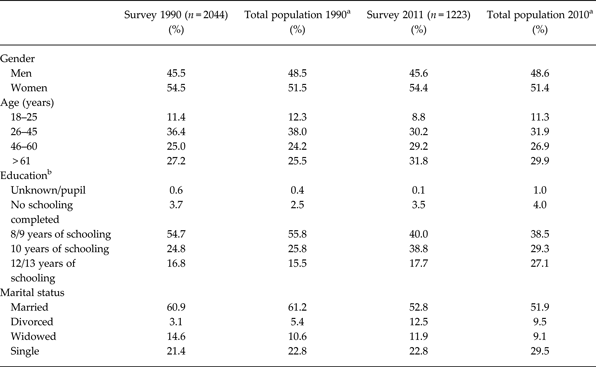
Two population surveys were conducted among German citizens aged 18 years and over, living in the ‘old’ German States, the first in 1990 (n = 3067, response rate 70.0%), the second in 2011 (n = 2416, response rate 64.0%). In both surveys, samples were drawn using a random sampling procedure with three stages: (1) sample points, (2) households and (3) individuals within target households. Target households within sample points were determined according to the random route procedure. Target persons were selected using random digits. Informed consent was considered to have been given when individuals agreed to complete the interview. The fieldwork for the first survey was carried out by GETAS, Hamburg, for the second survey by USUMA, Berlin, both institutes specializing in marketing and social research. Before the first survey, the interview had been pretested with 20 persons to insure maximum understandability of the questions. Socio-demographic characteristics of both samples are reported in Table 1.
Socio-demographic characteristics of study samples

aData from the Federal Statistical Office of Germany.
bOnly persons ≥20 years, population data for younger persons not available.
Interview
In both surveys, the same interview mode (face-to-face, paper-pencil) was used. On both occasions, the interview was identical as concerns wording and sequence of questions. In the first part, which is not subject of the present paper, questions related to a case-vignette of a person with mental illness were asked. The second part covered issues unrelated to the case-vignette. Here, randomly drawn subsamples of respondents (1990: n = 2004; 2011: n = 1232) received questions regarding attitudes towards psychiatric units at a general hospital and group homes for people with mental illness (see Tables 2 and 3 for exact wording). Other variables used for our analyses included respondents’ age, gender, educational attainment and familiarity with psychiatric treatment (i.e., whether respondents themselves had already been in treatment or knew such a person in their family or among their friends or acquaintances).
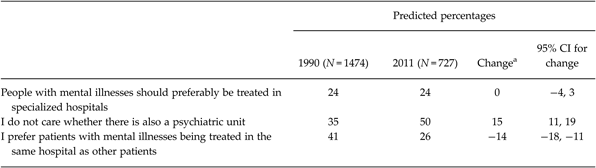
Attitudes of the German public towards psychiatric units in general hospitals: 1990 v. 2011 (multinomial logit regression). Question: ‘Should the hospital where you or someone from your family will eventually be treated include a psychiatric unit?’
aDue to rounding, figures shown will not always equal the difference between predicted percentages for 1990 and 2011.
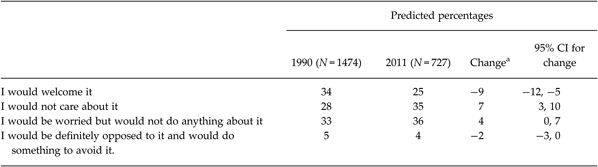
Attitudes of the German public towards group homes for people with mental illness: 1990 v. 2011 (multinomial logit regression). Question: ‘You have just learned that in your neighbourhood a group home for people with mental illness will be opened. How would you react?’
aDue to rounding, figures shown will not always equal the difference between predicted percentages for 1990 and 2011.
Statistical analysis
In order to examine the probability for change of public attitudes, multinomial logit regressions were calculated with the two attitude items. To adjust the year effect for demographic changes across samples, the regression analyses controlled for respondents’ gender, age and educational attainment, and whether they already had any mental health treatment or not. To illustrate the magnitude of changes, discrete probability changes were calculated for both attitude items. A discrete change coefficient is the difference in the predicted probability of a given outcome between 1990 and 2011 calculated with controls held at their means for the combined sample. Ninety-five percent confidence intervals were computed with the delta method. To make adjusted predictions comparable to unadjusted predictions, probabilities and discrete changes were multiplied by 100 and can thus be read as percentages. The calculation of probability changes and the testing for differences in probabilities between two time points were carried out by means of the modules prvalue and prchange (Xu & Long, Reference Xu and Long2005; Long & Freese, Reference Long and Freese2006) using STATA (Statacorp, 2011).
Results
In 1990, a substantial proportion of respondents (41%) welcomed the idea that the hospital where they would eventually be treated did also include a psychiatric unit. Two decades later, the enthusiasm about integrating inpatient care for psychiatric patients into the general hospital had lessened, with only 26% still being explicitly in favour of it. At the same time, the proportion of those who did not care about whether or not there exists a psychiatric unit increased from 35 to 50%. No change occurred in the proportion of respondents giving preference to specialized psychiatric hospitals which was 24% in 1990 and 2011 (Table 2).
A similar pattern emerged with the establishment of group homes for mentally ill people in the neighbourhood (Table 3). Again, the percentage of those who welcomed such an institution decreased (from 34 to 25%), while a growing number of respondents reacted with indifference (change from 28 to 35%). As with psychiatric units at the general hospital, the proportion of those who were opposed to opening a group home remained unchanged over the time period of 21 years.
In order to find out whether previous contact to psychiatric treatment was associated with different attitudes, we repeated our analyses for both items, including the interaction between familiarity with psychiatric treatment (yes/no) and time point (1990/2011). This did not yield any significant interaction effect, indicating that the trend over time of attitudes towards community psychiatry services was the same in the group of those who had some kind of contact to the mental health system as among those who had not.
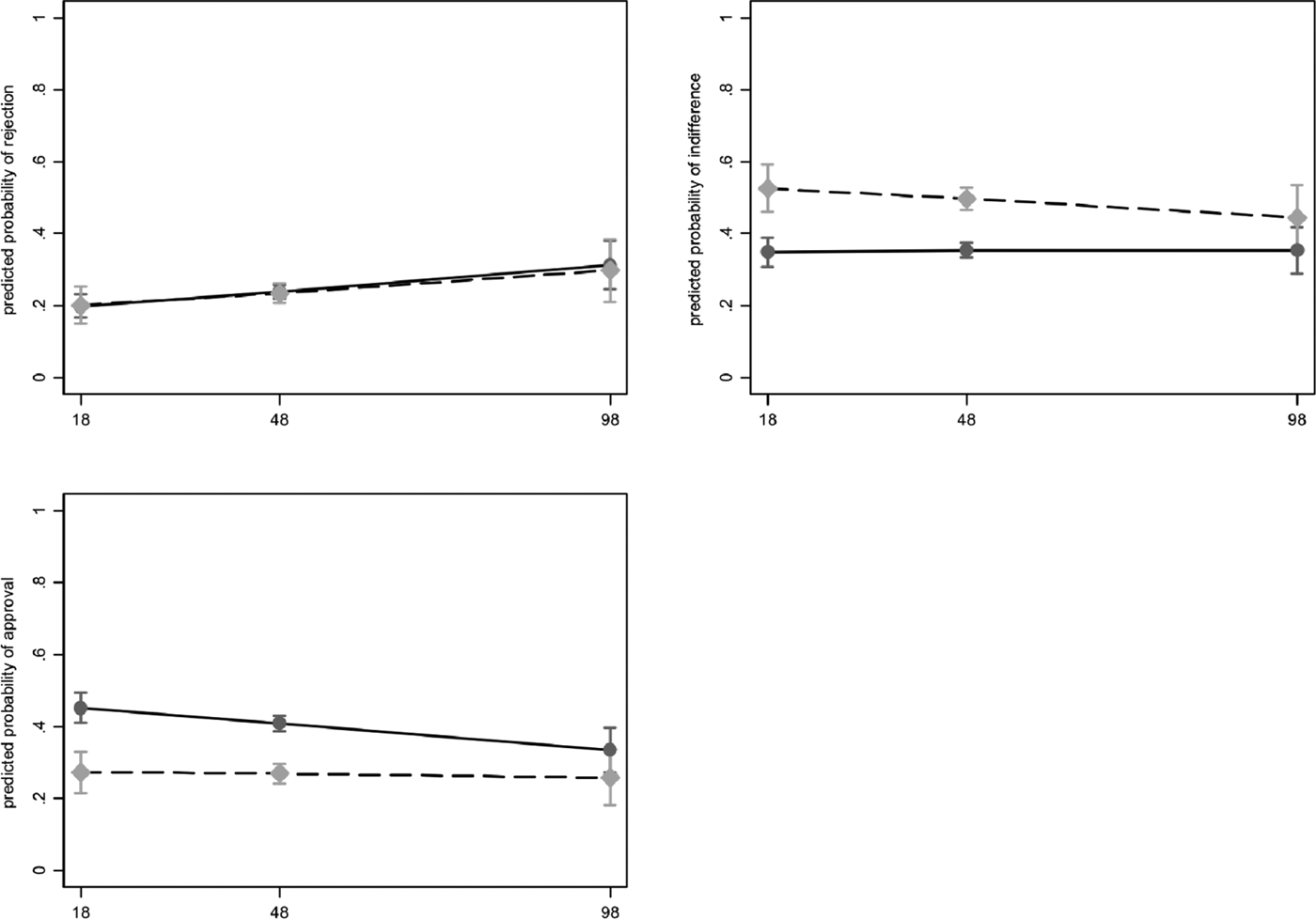
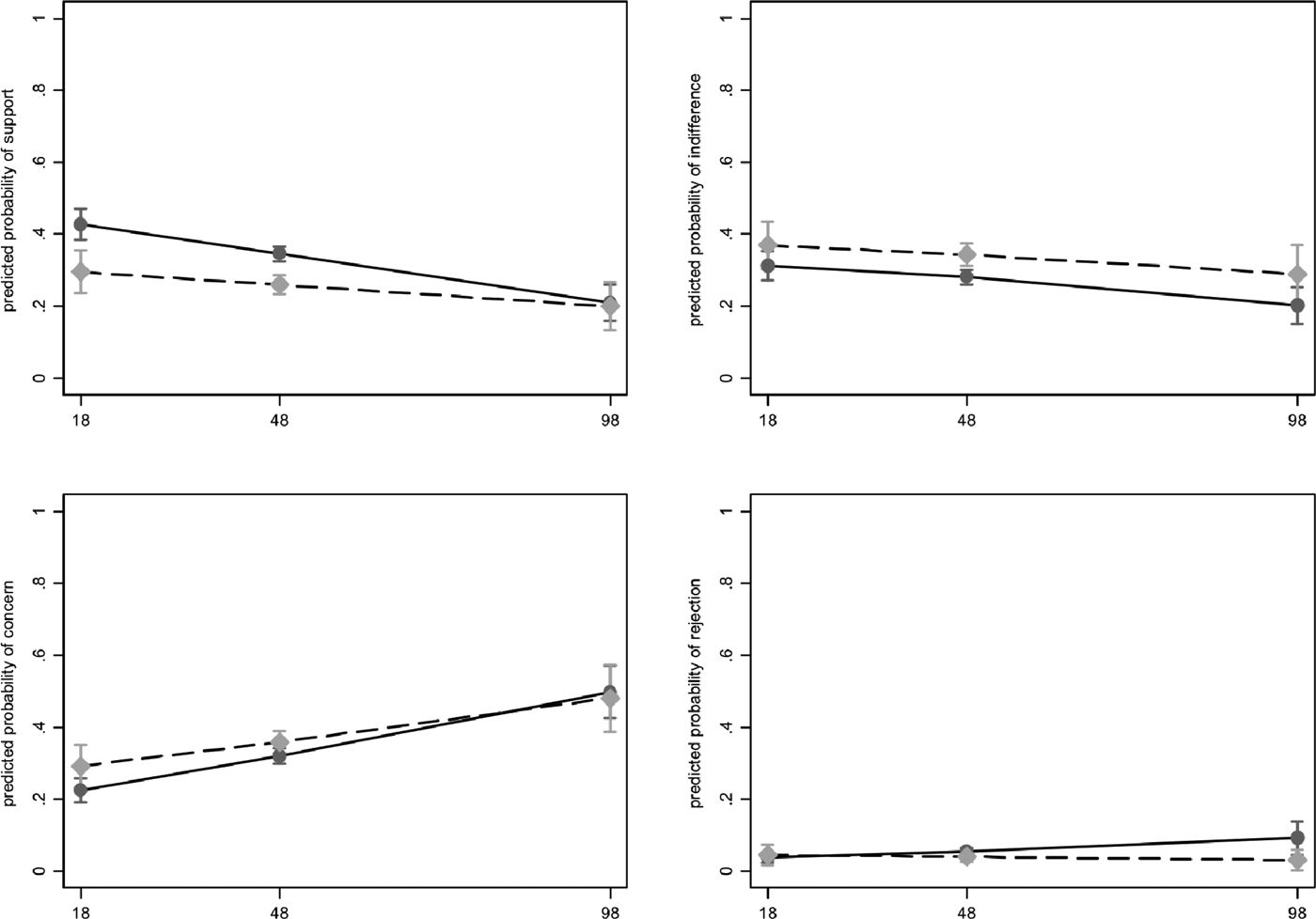
We were also interested in knowing whether a cohort effect could be shown and introduced the interaction effect age × time point into the multinomial logic models. As reported in Fig. 1, public preference for specialized hospitals increased slightly with age in 2011 as in 1990. By contrast, as concerns indifference towards and approval of such services a clear cohort effect was found. Among younger respondents, indifference was significantly greater in 2011 than in 1990, while among older respondents there was no significant difference between both time points. Correspondingly, among younger respondents approval of psychiatric units was more pronounced in 1990 than in 2011, while among older respondents no difference between both years was observed.
Attitudes of the German public towards psychiatric units in general hospitals: interaction effects between age and time point. Abscissa: age (years); solid line 1990; dashed line 2011.
A similar pattern emerged from responses of the public to establishing group homes for people with mental illness (Fig. 2). Younger respondents approved these services significantly less frequently in 2011 than two decades before, while there was no difference among older respondents. Irrespectively of age, respondents reacted with more indifference in 2011 than in 1990. At both time points, concerns about such services increased with age while only a small minority of younger as well as older respondents was definitely opposed to them.
Attitudes of the German public towards group homes for people with mental illness: interaction effects between age and time point. Abscissa: age (years); solid line 1990; dashed line 2011.
Discussion
To begin with the most unambiguous result, one has to state that the proportion of the German population that explicitly rejected the implementation of the two services promoted by community psychiatry has not changed over the last two decades. Obviously, the reform of mental health care that has taken place in the meantime, with a marked increase of the number of psychiatric units in general hospitals and group homes for people with mental illness, has produced neither more nor less resistance among the public. Thus, neither our predictions derived from contact theory nor those derived from the notion of the NIMBY syndrome have been confirmed by our results. After two decades of reform of psychiatric care, there is still a hard core among the general public which tends to keep services for the care of people with mental disorders away from the community rather than supporting their integration into the community.
Less clear is how the switch from an explicit welcoming of such services in the community to an indifferent attitude has to be interpreted. On the one hand, this could be seen as expression of some kind of ‘normalization’ process in the sense that the presence of psychiatric services in the community has become an everyday experience and part of normal life, not arousing special attention anymore and resulting in increasing indifference towards such services. This should particularly hold for younger people who are unfamiliar with the previous situation. In fact, the decrease of explicit support of and the increase of indifference towards psychiatric units at general hospitals was particularly pronounced among younger people; the trend of attitudes towards group homes for mentally ill people points to the same direction. Another argument could be that the reform process has lost momentum in recent years and fewer services of this kind have been newly established, which may have led to a decline in enthusiasm about and a more detached attitude towards community care. Consequently, community psychiatry may have become less an issue than it used to be two decades ago.
On the other hand, one may also consider the change from positive to indifferent attitudes as indication of a discrete tendency towards greater reservation among the public about integrating mentally ill people into the community. This view is supported by the result of a study in Austria yielding in 2007 less agreement with the notion that someone with schizophrenia should live in the middle of society than 9 years before (Grausgruber et al. Reference Grausgruber, Schöny, Grausgruber-Berner, Koren, Frajo-Apor, Wancata and Meise2009). In the same direction point also results of recent trend analyses of the public's desire for social distance which did show no changes or changes rather for the worse than for the better (Angermeyer & Dietrich, Reference Angermeyer and Dietrich2006; Angermeyer & Matschinger, Reference Angermeyer and Matschinger2005; Schomerus et al. Reference Schomerus, Schwahn, Holzinger, Corrigan, Grabe, Carta and Angermeyer2012).
It would certainly be of interest to put our findings in a broader international perspective and to compare them with results from other countries where reforms of mental healthcare have also taken place. Unfortunately, to the best of our knowledge no similar study has so far been conducted in another country (Holzinger et al. Reference Holzinger, Floris, Schomerus, Carta and Angermeyer2012). There is a need for such studies which then should also include, beyond psychiatric units at general hospitals and group homes for mentally ill people, other community psychiatry services such as day clinics or sheltered workshops. This would help clarify whether our admittedly preliminary findings represent a more general phenomenon or not.
Declaration of Interest
This study was funded by the Fritz-Thyssen-Stiftung (Az. 10.11.2.175).