Introduction
The psychoactive ingredient in cannabis, Δ9-tetrahydrocannabinol (THC), binds to cannabinoid receptors in the brain that are expressed in neural networks that subserve regulatory processes, such as motivation (Oleson & Cheer, Reference Oleson and Cheer2012; Vlachou & Panagis, Reference Vlachou and Panagis2014). Thus, the effects of THC exposure on motivation processes have been widely studied. These studies show that exposure to THC impacts motivation processes by altering reward responsivity and decision-making, and, impairing inhibition (Casey & Cservenka, Reference Casey and Cservenka2020; Cousijn etal., Reference Cousijn, Wiers, Ridderinkhof, Brink, Veltman, Porrino and Goudriaan2012; Fatima, Howlett, & Whitlow, Reference Fatima, Howlett and Whitlow2019; Fridberg etal., Reference Fridberg, Queller, Ahn, Kim, Bishara, Busemeyer and Stout2010; Lawn etal., Reference Lawn, Freeman, Pope, Joye, Harvey, Hindocha and Curran2016; Meier & White, Reference Meier and White2018; Silveira etal., Reference Silveira, Adams, Morena, Hill and Winstanley2016; van Leeuwen, Creemers, Verhulst, Ormel, & Huizink, Reference van Leeuwen, Creemers, Verhulst, Ormel and Huizink2011; Vingerhoets etal., Reference Vingerhoets, Koenders, van den Brink, Wiers, Goudriaan, van Amelsvoort and Cousijn2016; Wrege etal., Reference Wrege, Schmidt, Walter, Smieskova, Bendfeldt, Radue and Borgwardt2014; Zilverstand, Huang, Alia-Klein, & Goldstein, Reference Zilverstand, Huang, Alia-Klein and Goldstein2018). It is important to note that some findings in the relationship between cannabis and motivation processes have been inconsistent, partly due to the complexity of the construct of motivation (Berridge, Reference Berridge2012; Oudeyer & Kaplan, Reference Oudeyer and Kaplan2009; Pacheco-Colón etal., Reference Pacheco-Colón, Coxe, Musser, Duperrouzel, Ross and Gonzalez2018; Pacheco-Colón, Ramirez, & Gonzalez, Reference Pacheco-Colón, Ramirez and Gonzalez2019). For example, motivation may be impacted by parameters that influence the subjective value of rewards such as the type of reward and the state of the individual (Berridge, Reference Berridge2012; Clithero, Reference Clithero2011; Green & Myerson, Reference Green and Myerson2013; Massar, Libedinsky, Weiyan, Huettel, & Chee, Reference Massar, Libedinsky, Weiyan, Huettel and Chee2015). Thus, understanding how these parameters influence motivation in cannabis users is important.
Measuring motivation through effort-based decision-making tasks evaluates some of the parameters involved in the selection of an action based on the integration of goals and values. Effort-based decision-making is the decision to engage in an action based on a cost–benefit analysis whereby the subjective value of a reward may be discounted based on the amount of effort expenditure involved. Objective measures of effort-based decision-making utilize varying rewards, and physical effort levels (via button pressing, grip strength, or performing calculations). For example, in a widely utilized task of effort-based decision-making, the Effort Expenditure for Reward Task or EEfRT (Treadway etal., Reference Treadway, Buckholtz, Schwartzman, Lambert and Zald2009), individuals are required to make response selections by weighing the levels of reward (e.g., $1-$4.25) against the effort expenditure required across multiple decision trials (e.g., number of button presses required for the easy 10 in 7s vs. hard choice 100 in 21s). Response selection options consist of combinations between level of effort and reward; for example, low effort with low reward and high effort with high reward. Studies using EEfRT have shown abnormal EEfRT performance in psychiatric disorders, such as decreased selection of high-effort/high-reward options relative to healthy populations. Furthermore, EEfRT performance has also correlated with symptoms of anhedonia, or the inability to feel pleasure (Culbreth, Moran, & Barch, Reference Culbreth, Moran and Barch2018; Johnson, Swerdlow, Treadway, Tharp, & Carver, Reference Johnson, Swerdlow, Treadway, Tharp and Carver2017; Mosner etal., Reference Mosner, Kinard, McWeeny, Shah, Markiewitz, Damiano-Goodwin and Dichter2017; Reddy etal., Reference Reddy, Horan, Barch, Buchanan, Dunayevich, Gold and Green2015; Treadway, Bossaller, Shelton, & Zald, Reference Treadway, Bossaller, Shelton and Zald2012; Treadway, Peterman, Zald, & Park, Reference Treadway, Peterman, Zald and Park2015). For example, Treadway etal., (Reference Treadway, Bossaller, Shelton and Zald2012) found that individuals with major depressive disorder chose less hard trial choices compared to controls, which was correlated with level of anhedonia and most recent episode duration. These studies illustrate the relationship between motivational processes and mood disorders.
Emergent findings in the context of substance use suggest similar alterations in effort-based decision-making in response to alcohol (Grodin etal., Reference Grodin, Steckler and Momenan2016), morphine (Fatahi etal., Reference Fatahi, Zeinaddini-Meymand, Karimi-Haghighi, Moradi, Khodagholi and Haghparast2020), and cannabis (Lawn etal., Reference Lawn, Freeman, Pope, Joye, Harvey, Hindocha and Curran2016). For example, decreased effort expenditure during effort-based decision-making operationalized as decreased button presses and increased non-response trials during an functional Magnetic Resonance Imaging (fMRI)-adapted effort task were observed in individuals who met Diagnostic Statistical Manual (DSM)-IV criteria for alcohol dependence compared to healthy controls (Grodin etal., Reference Grodin, Steckler and Momenan2016). The authors suggest this could indicate hypersensitivity to reward or an increased subjective value for the low-effort condition as opposed to the high effort. A recent preclinical study by Fatahi and colleagues (Reference Fatahi, Zeinaddini-Meymand, Karimi-Haghighi, Moradi, Khodagholi and Haghparast2020) showed that male rats that were chronically administered morphine exhibited decreased high-effort choices despite larger rewards (i.e., larger food reward by navigating over a barrier) over low-effort choices with smaller rewards (i.e., smaller reward with no barrier). These two studies demonstrate altered effort-based decision-making following chronic use of substances.
In terms of effects of cannabis, the two existing studies focused on acute effects of THC (i.e., <1 hr following exposure) as opposed to chronic effects as in the above studies in alcohol and morphine. In the first study to examine effort in response to cannabis, Silveira and colleagues (Reference Silveira, Adams, Morena, Hill and Winstanley2016) administered THC without cannabidiol (CBD), CBD isolate, and 1:1 THC:CBD cannabis in male rats. Under each condition, rats performed an effort task that consisted of lever-pressing to obtain one or two sugar pellets, 30-min post-administration of the cannabis compounds. They found that administration of THC decreased the amount of high-effort choices, while the administration of 1:1 THC:CBD attenuated these effects. Lawn and colleagues (Reference Lawn, Freeman, Pope, Joye, Harvey, Hindocha and Curran2016) translated these preclinical findings in humans in a cannabis administration study in cannabis-experienced individuals. Specifically, the authors administered cannabis with and without CBD along with a placebo control to determine differences in effort-based decision-making using EEfRT within an hour post-cannabis administration (Lawn etal., Reference Lawn, Freeman, Pope, Joye, Harvey, Hindocha and Curran2016). Using a repeated measures design, they found that cannabis without CBD administration led to reduced high-effort choices compared to both placebo and cannabis with CBD conditions. Taken together, these two studies provide concordant evidence that THC reduces effort during acute intoxication. The question then becomes whether these effects in response to THC are transient and constrained to the intoxication period. To address this question, Lawn etal. (Reference Lawn, Freeman, Pope, Joye, Harvey, Hindocha and Curran2016) compared 12-hr abstinent cannabis-dependent individuals and controls but found no difference between the groups in EEfRT performance. The authors attributed the absence of a difference to co-use of other substances (e.g., tobacco, benzodiazepines, cocaine, opioids, and hallucinogens) in the controls. Hence, a study that controls for potential confounding effects of other substance use is needed in determining the effects of cannabis on effort.
The aforementioned studies indicate that drugs and alcohol have effects on motivation and effort-based decision-making. To date, although two existing studies described reported decreased effort during acute cannabis intoxication, the effects of long-term or residual cannabis use need to be further elucidated. The goal of this study was to determine whether residual or non-acute effects of THC on effort are observable in 24-hr abstinent, long-term adult cannabis users relative to nonusers. Based on the scientific premise that THC has long-lasting effects whereby non-acutely intoxicated cannabis users display behavioral effects of the drug such as hypersensitivity to drug-related cues (Filbey etal., Reference Filbey, Dunlop, Ketcherside, Baine, Rhinehardt, Kuhn and Alvi2016), we hypothesized that there will be observable differences between non-acutely intoxicated cannabis users and non-using controls on effort-based decision-making and that this effect would be related to THC. We predicted that cannabis users will display decreased effort expenditure compared to non-using controls.
Methods
Participants
All participants provided written informed consent in accordance with the Declaration of Helsinki. The research protocol was approved by the Institutional Review Board (IRB) of the University of Texas at Dallas. Forty-one adult cannabis users and 45 non-using controls were recruited from the Dallas–Fort Worth area to participate in this study (refer to Table 1 for participant demographic information). Inclusion criteria for all study participants were 18–55 years of age, English proficiency, right-handedness, and no use of other drugs exceeding 25 lifetime occurrences. Cannabis users must have self-reported regular use of cannabis of at least three times a week and no DSM-5 substance use disorder for any drug other than cannabis. Cannabis use was verified by quantification of 11-nor-9-carboxy-delta-9-THC/creatinine (THC/CR) metabolites in urine via gas chromatography/mass spectrometry (GC/MS) from Quest Diagnostics (https://www.questdiagnostics.com). Non-using controls must have had < 25 lifetime occurrences of cannabis use and must not have used cannabis in the last year.
Participant demographic characteristics and self-reported measures of substance use, mood, and motivation. The anhedonia and amotivation self-report measures consisted of: the Smith-Hamilton Pleasure Scale (SHAPS), the Behavioral Inhibition System/Behavioral Approach System Scale (BIS/BAS), and the General Causality Orientation Scale (GCOS). The psychological and substance use measures consisted of: the Beck Depression Inventory (BDI), the Beck Anxiety Inventory (BAI), and the Timeline Follow Back (TLFB). * p < .05

aSocioeconomic status categories: $0–9,999/$10,000–19,999/$20,000–29,999/ $30,000–39,999/$40,000–49999/$50,000–59,999/over $60,000)
The cannabis users were instructed to abstain from cannabis use 24 hrs prior to the experiment to ensure the absence of acute intoxication during data collection. Abstinence was verified via the Timeline Follow Back (TLFB; Robinson, Sobell, Sobell, & Leo, Reference Robinson, Sobell, Sobell and Leo2014), self-reported date and time of last use, and observation of behavioral signs of cannabis intoxication (via marijuana intoxication scale for signs of cannabis intoxication adapted from Bond & Lader, Reference Bond and Lader1974). At the time of the experiment, all participants were screened for drug use via urinalysis. Non-using controls were excluded if any drug use was detected; users were excluded if any drug other than cannabis was detected. All participants also took a breathalyzer test to ensure alcohol sobriety at the start of the session and were excluded from continuing with the study if BAC > 0.001.
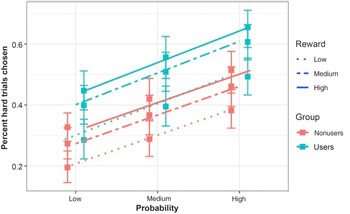
Mixed 2x3x3 ANOVA results. There were significant main effects of group, reward levels, and win probability levels. Group means are indicated by squares. Confidence intervals are indicated by error bars around the means.

Assessments
A questionnaire was used to collect information on demographic characteristics including sociodemographic status. To assess substance use disorder and other psychiatric disorders, we used the Mini International Neuropsychiatric Interview (MINI-IV; Sheehan etal., Reference Sheehan, Lecrubier, Sheehan, Amorim, Janavs, Weiller and Dunbar1998) adapted for DSM-5 criteria. To characterize cannabis use and other substance use behavior, we collected the TLFB (Robinson, Sobell, Sobell, & Leo, Reference Robinson, Sobell, Sobell and Leo2014). We used the behavioral inhibition system and behavioral approach system scale (BIS/BAS;Carver & White, Reference Carver and White1994) to measure avoidance and approach motivation. The 20-item questionnaire consists of one BIS scale (seven items) and three BAS subscales: drive (four items), reward responsivity (five items), and fun-seeking (four items). Items in the BIS scale reflect motivation to avoid aversive stimuli such as punishment, while those in the the BAS scale reflect motivation to approach rewarding stimuli. Additionally, we collected the Snaith–Hamilton Pleasure Scale (SHAPS; Snaith etal., Reference Snaith, Hamilton, Morley, Humayan, Hargreaves and Trigwell1995) and the General Causality Orientation Scale (GCOS; Deci & Ryan, Reference Deci and Ryan1985) as measures of anhedonia. The SHAPS is a 14-item questionnaire where participants rate how much they relate to hedonic experiences on a four-point Likert scale from strongly agree to strongly disagree. Endorsement of “strongly agree” or “agree” for any item is scored as a 0, while endorsement of “strongly disagree” or “disagree” for any item is scored as a 1. The SHAPS results in a total score ranging from 0 to 14. The GCOS is a 12-vignette questionnaire where participants answer three questions for each of the 12 scenarios based on a 7-point Likert scale from very unlikely to very likely. The GCOS results in three total scores for the Autonomy, Impersonal, and Control scales with scores ranging from 7 to 84 (see Supplementary Materials for SHAPS and GCOS reliability and validity information). We also assessed depression using the Beck Depression Inventory (BDI; Beck, Ward, Mendelson, Mock, & Erbaugh, Reference Beck, Ward, Mendelson, Mock and Erbaugh1961) and anxiety using the Beck Anxiety Inventory (BAI; Beck, Epstein, Brown, & Steer, Reference Beck, Epstein, Brown and Steer1988). The BDI is a 21-item questionnaire of self-reported depression symptoms based on a 4-point Likert scale. The BDI results in a total score ranging from 0 to 67. The BAI is also a 21-item questionnaire of self-reported anxiety symptoms based on a 4-point Likert scale. The BAI leads to a total score ranging from 0 to 63. To assess for IQ, we used the Wechsler Adult Intelligence Scale – Fourth Edition (WAIS-IV; Cohen, Reference Cohen1957).
Effort Expenditure for Reward Task (EEfRT)
The EEfRT is a task developed to measure effort during decision-making (Treadway, Buckholtz, Schwartzman, Lambert, & Zald, Reference Treadway, Buckholtz, Schwartzman, Lambert and Zald2009). EEfRT has been used across different clinical populations to evaluate action based on the integration of goals and values (Reddy etal., Reference Reddy, Horan, Barch, Buchanan, Dunayevich, Gold and Green2015; Treadway etal., Reference Treadway, Bossaller, Shelton and Zald2012, Reference Treadway, Peterman, Zald and Park2015). In this study, we used the version of the task originally described by Treadway and colleagues (Reference Treadway, Buckholtz, Schwartzman, Lambert and Zald2009) that consisted of trials in which participants are asked to choose between two conditions with varying reward amounts and probability of a “win” trial where the reward is disbursed (Treadway etal., Reference Treadway, Buckholtz, Schwartzman, Lambert and Zald2009). The duration of the task is 20 min with the range of trials completed by participants between 48 and 95 depending on the conditions chosen.
The overall goal of the task was to accumulate earnings based on task performance. To that end, participants completed trials that required “effort” operationalized as button pressing for a specified number of times within a short duration in order to earn monetary rewards. For a given trial, the participants were asked to select how much effort they would like to make based on the combination of likelihood that the trial is a "win” trial (i.e., probability of a payout given successful completion of the trial) and amount of reward. The options that participants selected from were (1) easy effort versus (2) hard effort. For the easy effort conditions, participants used their pointer finger of their dominant hand to press a key on the keyboard 10 times within 7 s to be successful on the trial. For the hard effort conditions, participants used their fifth digit (pinkie) on their non-dominant hand to press a key on the keyboard 100 times within 21 s (feedback was provided on the screen to show participants their progress toward the 10/100 button presses, respectively). Reward amounts were always $1 for the easy condition and across three levels for the hard effort condition: low = $1.24-$2.41, medium = $2.50-$3.40, and high ≥ $3.49. There were three levels of win probabilities: low = 12%, medium = 50%, and high = 80%.
The participants were given explicit instructions that they had 20 min to complete the task and that they will receive their cumulative earnings from four randomly selected win trials. They were also informed of the trade-off in time between the easy (7 s) and hard (21 s) effort conditions. Research assistants observed participants closely during the task to ensure that they used the appropriate fingers for each condition across all trials.
Each trial began with a 1-s fixation cross, then the participants were presented with the reward probability and reward amount for both conditions when making their decision. Participants had 5 s to make their choice of amount of effort toward the trial. If they did not make a choice during that time, the computer randomly selected a condition (these trials were excluded from analyses). After making a choice, the participants were presented with a 1-s “Ready” screen. Following the button press period, participants viewed a 2-s feedback screen letting them know if they successfully completed the trial and another 2-s feedback screen displaying the amount of money earned for that trial.
In line with previous research (Reddy etal., Reference Reddy, Horan, Barch, Buchanan, Dunayevich, Gold and Green2015; Treadway etal., Reference Treadway, Bossaller, Shelton and Zald2012, Reference Treadway, Peterman, Zald and Park2015), the primary outcome measure from the EEfRT was the percentage of trials for which the hard condition (vs. easy condition) was selected (% hard trials). We calculated % hard trials for each probability and reward level. Additionally, total money earned, trial completion rate, button press rate, and trial decision reaction time were calculated.
Statistical Analyses
Analyses were performed using SPSS (IBM Corp. Released 2016. IBM SPSS Statistics for Windows, Version 24.0.). Trials that were auto-selected by the computer due to the participant’s non-response during the selection period time limit were excluded from the analyses. In this way, only trials that were based on the participant’s effort-based decision were included. % hard trials were calculated for each win probability level (low, medium, and high) and for each reward level (low, medium, and high). To determine potential confounding effects of psychomotor ability on % hard trials, we performed a multiple analysis of variance (MANOVA) with group as the independent variable and trial completion rate, button press rate, trial decision reaction time, and total money earned as the dependent variables. Significance thresholds for the ANOVAs were set to α = .05.
-
a. Effects of cannabis use on effort-based decision-making
To address our main aim of examining the effect of group on EEfRT performance, we performed a mixed 2x3x3 ANOVA based on previous studies using the EEfRT (Barch, Treadway, & Schoen, Reference Barch, Treadway and Schoen2014; Chang etal., Reference Chang, Chu, Treadway, Strauss, Chan, Lee and Chen2019). In this model, % hard trials was the dependent variable, group (cannabis users and nonusers) was the between-subjects independent variable, and win probability levels (low, medium, and high) and reward levels (low, medium, and high) were within-subjects independent variables. Due to previous findings suggesting an effect of age on EEfRT performance (Byrne & Ghaiumy Anaraky Reference Byrne and Ghaiumy Anaraky2019), age was added to the model as a covariate.
-
b. Relationship between cannabis use and effort-based decision-making
We also conducted secondary analyses to examine the relationship between EEfRT performance and cannabis use measures. We performed Pearson’s correlations between cannabis users’ % hard trials and cannabis use measures (THC/CR ratio measured via GC/MS, time since last cannabis use, and frequency of cannabis use over the past 90 days). For these correlations, a Bonferroni correction was applied for multiple comparisons, resulting in a corrected p-value of 0.017 for the statistical significance threshold.
-
c. Relationship between effort-based decision-making and self-reported motivation
To evaluate the relationship between EEfRT performance and self-reported motivation and anhedonia, we performed Pearson’s correlations between % hard trials and anhedonia (SHAPS total score) and motivation (GCOS subscale scores and BIS/BAS total scores) measures in the total sample as well as in the cannabis using group only. For these correlations, a Bonferroni correction was applied for multiple comparisons, resulting in a corrected p-value of 0.008 for the statistical threshold.
-
d. Post hoc analyses
To better understand factors that may contribute to observed effects, we performed post hoc analyses to evaluate the confounding effects of psychomotor ability, sex, tobacco and alcohol use, and depression on EEfRT performance. We tested separate mixed 2x3x3 ANOVA models with age and the following variables: IQ scores from the WAIS-IV, BDI total scores, BAI total scores, and past 90-day alcohol and tobacco use (from the TLFB). Additionally, we evaluated potential aging effects to examine whether younger or older cannabis users might prefer harder effort trials. We performed a median split on age that led to a younger group (N = 40, 18–21 years) and older group (N = 44, 22–49 years). We then conducted a 3 (probability) x 3 (reward) x 2 (user; nonuser) x 2 (older; younger) ANOVA.
Due to previous research indicating confounding effects of fatigue on effort-based decision-making (Massar, Csathó, & Van der Linden, Reference Massar, Csathó and Van der Linden2018), we also examined whether self-reported fatigue may have impacted our findings via (1) changes in EEfRT performance over time (reaction time, trial completion rate, and button press rate) and (2) the NASA Task Load Index (NASA-TLX). The NASA-TLX is a six-item questionnaire that provides a task load index based on mental demands, physical demands, temporal demands, performance, effort, and frustration. For changes in EEfRT performance over time, we compared % hard trials, button press rate, and trial completion rate across the EEfRT task. We divided the first 32 trials completed by all participants into quartiles of 8 trials each. A MANOVA was performed with time (1st vs. 2nd vs. 3rd vs. 4th quartile) and group (user vs. control) as the independent variables and EEfRT performance measures (% hard trials, button press rate, and trial completion rate) as the dependent variables. For the NASA-TLX analysis, we performed an ANOVA to determine the effect of group on the NASA-TLX task load index.
Results
Participant Characteristics
Table 1 summarizes the characteristics of the participants. Cannabis users and nonusers did not significantly differ in age, years of education, socioeconomic status, biological sex, or IQ (Table 1).
In terms of substance use, 20 participants in the control group endorsed alcohol use (days drinking alcohol in the past 90 days; M = 2.51, SD = 4.23) and 3 endorsed tobacco use (days smoking cigarettes or a vape in the past 90 days; M = .11, SD = .438). Additionally, 34 participants in the cannabis using group endorsed alcohol use (M = 13.07, SD = 19.55) and 9 participants endorsed tobacco use (M = 13.30, SD = 31.45). Given the large standard deviations, we used an independent samples Mann–Whitney U test and found that the groups significantly differed in number of alcohol drinking days (U = 1114, p = .002). None of the participants reported other drug use over the past 90 days.
In terms of measures of self-reported motivation, SHAPS, BIS/BAS, or GCOS total scores did not significantly differ between the two groups (Table 1; Refer to the Supplementary Materials for information on the BAS subscales).
EEfRT Task Performance
Users did not significantly differ in the number of total trials completed during EEfRT [users: M = 63.24 (SD = 10.01); nonusers: (M = 66.27, SD = 8.90); t = 1.48, SD = .142]. However, they significantly differed in number of auto-selected trials [users: M = 2.02 (SD = 2.09); nonusers: M = 3.51 (SD = 4.36); t = 1.99, p = .050]. Following removal of the auto-selected trials, the resulting number of trials did not differ between the groups [users: M = 61.22 (SD = 10.82); nonusers: M = 62.76 (SD = 10.45); t = 0.67, p = .505]. Further, there were no group differences in EEfRT motor performance variables – decision reaction time, button press rate, trial completion rate, and total money earned (Table 2).
Performance metrics from the EEfRT in cannabis users and nonusers. Decision reaction time represents the average time in seconds that it took the participants to choose the hard or easy condition for the trials. Button press rate is the participants’ average number of button presses per second. Trial completion rate is the percentage of trials the participants were able to successfully complete (e.g., they were able to fill up the bar in time). Total money earned is the amount of money the participants would have won from the EEfRT if winnings from all trials were disbursed.

aTests statistics are between-subjects effects from a one-way ANOVA with group as the IV and % hard trials chosen overall as the DV. Eta-squared is displayed here instead of partial eta-squared. bThere were three levels each for the probability and reward conditions: low (12%), medium (50%), and high (80%) probability; low ($1.24–2.41), medium ($2.50–3.40), and high ($3.49+) reward. Test statistics are between-subjects effects from a MANOVA with group as the IV and the % hard trials for each condition as the DVs.
The mixed 2x3x3 ANOVA showed significant main effects of group [F = 8.95, p = .004, generalized eta-squared (Gη2) = .085], reward (F = 5.65, p = .004, Gη2 = .004), and probability (F = 4.39, p = .014, Gη2 = .007 ; Figure 1). A post hoc Tukey test showed that the mean % hard trials was significantly greater in users than nonusers for low (adjusted p < .001), medium (adjusted p < .001), and high (adjusted p < .001) win probability levels. Additionally, a post hoc Tukey test showed that the mean % hard trials was significantly greater in users than nonusers for low (adjusted p = .003), medium (adjusted p < .001), and high (adjusted p < .001) reward levels.
The post hoc Tukey test showed that % hard trials was greater for highest level of reward compared to both low (adjusted p < .001) and medium (adjusted p = .014) reward levels for both groups. Additionally, % hard trials was greater for the medium reward level compared to the low-reward level (adjusted p < .001) for both groups.
The post hoc Tukey test showed that % hard trials was greater for highest level of win probability compared to both the low (adjusted p < .001) and medium (adjusted p < .001) levels of win probability for both groups. Additionally, % hard trials was greater for the medium level of win probability compared to the low level of win probability (adjusted p < .001) for both groups.
No significant interactions emerged.
Correlations between EEfRT Performance and Cannabis Use Measures
We found that there was a significant positive relationship between % hard trials and frequency of cannabis use (r = .355, p = .001). Additionally, we found that % hard trials was not significantly correlated with THC/CR ratio (r = .343, p = .086) or time since last use (r = −.092, p = .628; see Table 3 for information on users’ cannabis use measures).
Cannabis use information

aBased on the TimeLine Follow Back; bTHC metabolites by creatinine ratio (THC/CR) measured via gas chromatography/mass spectrometry (GC/MS) urine analysis; cfrom the cannabis use disorder (CUD) section of the Mini International Psychiatric Interview (MINI)
EEfRT Performance and Self-reported Measures of Anhedonia and Motivation
The correlations between scores on the SHAPS, BIS/BAS, GCOS, and % hard trials did not reach a level of significance in the total sample or in the cannabis using group only.
Post hoc Analyses
BDI scores had a significant main effect on % hard trials (F = 4.20, p = .044, Gη2 = .043). Additional analysis that excluded participants with moderate-to-severe depression (BDI score >18; 4 users, 6 nonusers) found a significant group difference on % hard trials chosen for the low-reward condition (F = 4.108, p = .021).
There were no significant main effects of sex, IQ, BAI, and alcohol or tobacco use on % hard trials (see Supplementary Materials for alternative multiple linear regression approach predicting % hard trials from cannabis, tobacco, and alcohol use). The test of potential aging effects did not show significant main or interaction effects.
In terms of our test of effects of fatigue on EEfRT performance, MANOVA results on performance over time found that the time x group interaction was not significant reflecting that performance between the two groups did not differ over time during the EEfRT (See Table 2 for quartile information). Additionally, the groups did not differ on the NASA-TLX.
Discussion
This study aimed to examine the residual (vs. acute) effects of cannabis use on effort-based decision-making in regular cannabis users. Based on previous research, we predicted that cannabis users would show decreased willingness to exert effort during an effort-based decision-making task compared to nonusers. However, our findings contradicted our predictions. Specifically, our results indicated that cannabis users chose hard effort conditions significantly more than nonusers. Our results also showed that effort-based decision-making in cannabis users was related to their frequency of cannabis use over the past 90 days. In sum, our findings suggest that regular cannabis use has residual effects on effort-based decision-making that demonstrate increased effort allocation toward reward relative to nonusers. This effect was greater with greater frequency of cannabis use.
These findings of increased effort allocation in cannabis users compared to nonusers contradict findings from the two existing studies on the acute effects (i.e., <1-hr post-administration) of cannabis on effort (Lawn etal., Reference Lawn, Freeman, Pope, Joye, Harvey, Hindocha and Curran2016; Silveira etal., Reference Silveira, Adams, Morena, Hill and Winstanley2016). This suggests that there are distinguishable effects of acute versus non-acute (>24-hr post-administration) or residual effects of cannabis use. Because the dopaminergic system underlies the valuation of effort and reward, these differential effects of acute versus residual cannabis use are likely related to the complex interaction between THC and dopamine (Bloomfield, Ashok, Volkow, & Howes, Reference Bloomfield, Ashok, Volkow and Howes2016). Similar residual effects of cannabis use have been associated with alterations in other cognitive functions, including reduced motor inhibition (Behan etal., Reference Behan, Connolly, Datwani, Doucet, Ivanovic, Morioka and Garavan2014), working memory (Cousijn etal., Reference Cousijn, Wiers, Ridderinkhof, van den Brink, Veltman and Goudriaan2014), attention (Solowij etal., Reference Solowij, Stephens, Roffman, Babor, Kadden, Miller and Vendetti2002), learning (Grant, Gonzalez, Carey, Natarajan, & Wolfson, Reference Grant, Gonzalez, Carey, Natarajan and Wolfson2003), decision-making and psychomotor speed (Gonzalez, Reference Gonzalez2007), and increased cognitive impulsivity (Figueiredo, Tolomeo, Steele, & Baldacchino, Reference Figueiredo, Tolomeo, Steele and Baldacchino2020).
Given the reported acute effects of cannabis on EEfRT, it is notable that we did not find time since last cannabis use to correlate with EEfRT performance. However, % hard trials chosen overall correlated with THC:CR ratio at trend-level significance with a moderate effect size (r = .34) similar to that of the significant correlation between % hard trials and cannabis use frequency (r = .36). An association between effort-based decision-making and THC levels support the notion that THC directly affects effort allocation for reward during decision-making that is observable beyond the intoxication period. The lack of statistical significance suggests low statistical power of this effect that should be considered in future studies.
In addition to our main findings of an effect of group on % hard trials, we also found main effects of probability and reward. In this case, both users and nonusers increased their number of hard condition choices with increasing probability and reward. These results are consistent with previous findings (McCarthy, Treadway, & Blanchard, Reference McCarthy, Treadway and Blanchard2015; Treadway etal., Reference Treadway, Buckholtz, Schwartzman, Lambert and Zald2009). Surprisingly, despite cannabis users choosing more hard trials overall the two groups did not differ on motor performance variables, including total money earned on the EEfRT. Our findings are similar to those observing the effects of cannabis use on other monetary decision-making tasks, in that overall performance compared to nonusers does not significantly differ (Fridberg etal., Reference Fridberg, Queller, Ahn, Kim, Bishara, Busemeyer and Stout2010; Vaidya etal., Reference Vaidya, Block, O’Leary, Ponto, Ghoneim and Bechara2012). However, when these studies examined trial-by-trial decisions (such as those following gains and losses) throughout the task in more detail, they found minute differences that may suggest altered decision-making strategies in cannabis users (Fridberg etal., Reference Fridberg, Queller, Ahn, Kim, Bishara, Busemeyer and Stout2010; Vaidya etal., Reference Vaidya, Block, O’Leary, Ponto, Ghoneim and Bechara2012). Notably, the cannabis users indiscriminately selected hard trials over easy trials across all probability and reward levels (except low reward) compared to nonusers. This pattern of effort allocation may reflect altered sensitivity to the cost of effort in the cannabis using group. Due to these findings, further examination of decision-making strategies of cannabis users during the EEfRT via computational modeling is warranted.
Similar to Lawn etal., (Reference Lawn, Freeman, Pope, Joye, Harvey, Hindocha and Curran2016), we did not exclude tobacco or alcohol users from our sample, and, thus, our findings are generalizable to the general population of cannabis users who are likely to have comorbid alcohol and tobacco use (odds ratios range from 1.6 to 3.0; Hammond, Chaney, Hendrickson, & Sharma, Reference Hammond, Chaney, Hendrickson and Sharma2020; Hayley, Stough, & Downey, Reference Hayley, Stough and Downey2017; Lee, Brook, & Kim, Reference Lee, Brook and Kim2018). While Lawn etal. (Reference Lawn, Freeman, Pope, Joye, Harvey, Hindocha and Curran2016) attributed the absence of group differences to the likelihood that they did not control for other substance use in their control group, the difference between groups in the current study on overall % hard trials remained even when controlling for tobacco and alcohol use. These findings indicate that cannabis use has unique contributions to performance on the EEfRT in our sample of cannabis users.
Pacheco-Colón and colleagues’ (Reference Pacheco-Colón, Ramirez and Gonzalez2019) recent review suggested that poorer educational outcomes in cannabis users may be mediated by decreased motivation that may also be associated with depression. Interestingly, we did find that general ability (i.e., IQ scores) and depression symptoms were positively correlated with EEfRT performance such that the greater IQ and depression scores, the greater number of hard effort trials selected by participants across groups. This is in line with previous studies showing that individuals with higher IQ scores tend to have less steep discounting rates and that IQ may have a moderating influence between substance use and discounting (Bailey, Gerst, & Finn, Reference Bailey, Gerst and Finn2020; Shamosh & Gray, Reference Shamosh and Gray2008). In this case, the amount of effort involved in the hard trials does not discount the reward as much in participants with higher IQ scores. The depression results are opposite that of previous findings which have shown that depression is associated with steep discounting rates, but this has been said to be largely dependent on the state of the individual (Imhoff, Harris, Weiser, & Reynolds, Reference Imhoff, Harris, Weiser and Reynolds2014; Pulcu etal., Reference Pulcu, Trotter, Thomas, McFarquhar, Juhasz, Sahakian and Elliott2014).
Finally, it is important to note that our findings were not related to self-reported measures of motivation related to amotivation (SHAPS), motivational orientation (GCOS), and behavioral inhibition or approach motivation system (BIS/BAS). This lack of correspondence could be because reward-motivated behavior integrates multiple processes that include hedonics, reward prediction, reinforcement learning, reward valuation, effort valuation, and action selection (Barch, Pagliaccio, & Luking, Reference Barch, Pagliaccio and Luking2018). Thus, it is not surprising that the dynamic effort–reward integration captured by EEfRT does not fully explain the broad behavioral constructs assessed by the self-reported measures.
Conclusion and limitations
One limitation of this study is the use of a single measure of effort-based decision-making. Previous studies have distinguished between different forms of effort expenditure such as physical effort, or grip strength, and cognitive effort such as solving a math problem (Białaszek, Marcowski, & Ostaszewski, Reference Białaszek, Marcowski and Ostaszewski2017; Schmidt, Lebreton, Cléry-Melin, Daunizeau, & Pessiglione, Reference Schmidt, Lebreton, Cléry-Melin, Daunizeau and Pessiglione2012). However, in this study, the EEfRT mainly involves physical effort by having individuals complete a series of button presses. Therefore, future research should aim to incorporate multiple measures of effort-based decision-making, including both physical and cognitive effort. Additionally, future research should explore underlying neural mechanisms and examine if this residual effect persists into more long-term abstinence (i.e., > 30 days).
To conclude, cannabis users demonstrate increased effort allocation during effort-based decision-making. Further, frequency of cannabis use positively correlated with percentage of hard condition choices. The indiscriminate selection of hard trials over easy trials across all probability and reward levels (except low reward) in the users compared to nonusers suggests a pattern of effort allocation that reflects altered sensitivity to the cost of effort in the cannabis using group. These results support the notion of altered effort-based decision-making in cannabis users and suggest a potential barrier to treatment success that should be considered when implementing behavioral treatment strategies.
FINANCIAL SUPPORT
This work was supported by the National Institutes of Health (grant number: R01 DA042490-03).
CONFLICTS OF INTEREST
Mackenzie Taylor and Francesca Filbey declare they have no conflicts of interest.
Supplementary Material
To view supplementary material for this article, please visit https://doi.org/10.1017/S1355617721000473