I. INTRODUCTION
The role of non-linear impairments in wireless communications systems is currently drawing the interest of researchers in order to bridge the gap of the efficiency-versus-linearity trade-off, together with the benefits that can be derived from novel hardware and software architectures for compensating nonlinear behavior, either at the transmitter or the receiver sides. The synergistic interaction of increasing computing and simulation power with nonlinear measurement instrumentation has pushed the interest of behavioral modeling (BM) applied to wireless design at system level, being the power amplifier (PA) of the most critical subsystem.
Several BM approaches have been successfully developed to characterize nonlinear memory effects in PAs [Reference Pedro and Maas1]. Among the class of Volterra-based behavioral models, in addition to the memory polynomial (MP) model, an excellent performance has been accomplished by the generalized memory polynomial (GMP) [Reference Morgan, Ma, Kim, Zierdt and Pastalan2] and dynamic deviation reduction (DDR) [Reference Zhu, Dooley and Brazil3, Reference Zhu, Pedro and Brazil4] models. The structure of the GMP model involves envelope waveforms with different time shifts, embodying the so-called cross-terms. In the DDR representation, the terms of the full-Volterra (FV) structure are reorganized depending on the order of dynamics involved in the model. Thus, each Volterra kernel is classified according to its corresponding nonlinearity and dynamic order, and the reduction in model complexity is also attained by controlling the value of this dynamic order.
Although most of the BM proposals follow heuristic reasoning, the use of specific physical knowledge has enabled a deeper understanding of the model structure and its connection with the PA equivalent circuit [Reference Crespo-Cadenas, Reina-Tosina and Madero-Ayora5] or the device's physical properties [Reference Cunha, Pedro and Cabral6]. An example is the inclusion of the physical phenomenon of self-heating by considering the contribution of thermal power feedback (TPF). In [Reference Crespo-Cadenas, Reina-Tosina and Madero-Ayora7], the authors applied TPF to the equivalent circuit of a unilateral field-effect transistor (FET) device to derive a continuous time representation of the PA response in the presence of long-term memory effects. The resulting model enabled the reliable prediction of the dynamics of pulsed radio frequency (RF) waveforms with two PAs and the dependence of AM/AM and AM/PM characteristics with symbol rate. In [Reference Crespo-Cadenas, Reina-Tosina and Madero-Ayora8], a similar approach led to the formal derivation of a third-order discrete-time BM. Its structure could be represented in terms of a bank of parallel filters driven by instantaneous power, with each filter tuned at a different frequency sub-band in order to provide a reliable representation of memory effects in a wide range of signal bandwidths.
The objective of this paper is to generalize the model structures presented in [Reference Crespo-Cadenas, Reina-Tosina and Madero-Ayora7, Reference Crespo-Cadenas, Reina-Tosina and Madero-Ayora8] and derive a novel baseband BM that can be favorably tested against other popular models. A discrete-time representation of the model presented in [Reference Crespo-Cadenas, Reina-Tosina and Madero-Ayora7] is derived in Section II, by applying conventional nonlinear circuit analysis to demonstrate kernel constitution. Particularization to the common scenario of RF signals, covering narrow bandwidths with respect to the generally flat amplifier response, is shown to enable further reduction in model complexity. Although the third-order kernel exhibits the same structure as that of [Reference Crespo-Cadenas, Reina-Tosina and Madero-Ayora8], the expressions are generalized for higher orders and the terms are rearranged regarding the order of filtering, which allows the representation of nonlinear memory effects in increasing dynamic order. Section III presents a discussion of the resulting behavioral model and it is compared with other well-established approaches in terms of complexity. Section IV is dedicated to test the performance of this technique with experimental data using time and spectral domain measurements. Finally, Section V presents some concluding remarks.
II. DERIVATION OF THE DISCRETE-TIME BASEBAND MODEL
According to [Reference Crespo-Cadenas, Reina-Tosina and Madero-Ayora7], a simple structure that enables consideration of long-term memory effects is the simplified unilateral equivalent circuit of a FET device with a feedback path coupling the nonlinear currents to a “thermal” node. Voltages at the gate-to-source capacitor, thermal, and output nodes will be denoted as v(t), θ(t), and y(t), respectively. We will consider well-designed impedance matching networks, memoryless (ML) at the input and with a bandpass response centered at the carrier frequency at the output. The drain current is expanded in Taylor series as:
 $$i\left(v\comma \; \theta \right)= \sum_{\mu = 1}^{\infty} g_\mu v^{\mu} + \sum_{\mu\comma \upsilon = 1}^{\infty} \gamma_{\mu \nu} v^{\mu} \theta ^{\nu} + \sum_{\nu = 1}^{\infty} \gamma_{0 \nu} \theta^{\nu}\comma \;$$
where μ, ν are discrete summation indexes. As stated by the approach demonstrated in [Reference Crespo-Cadenas, Reina-Tosina and Madero-Ayora5], the first step is to deduce the nth-order nonlinear transfer functions H gn(ω 1, … , ω n) and H n(ω 1, …, ω n), relating the complex envelopes v(t) and y(t) with the input waveform, respectively. In this case, it is also necessary to consider the thermal transfer functions H θn(ω 1, … , ω n) relating the temperature rise θ(t) with the input. After the results published in [Reference Minasian9], we can deduce that H gn(ω 1, … , ω n) = 0 for n ≥ 2, and that there is no linear relation between θ(t) and the input voltage. Since H θ1(ω) = 0, the linear output transfer function is H 1(ω) = –g 1H g1Z 0(ω), where Z 0(ω) is the output impedance.
Considering that the thermal response presents a low-pass characteristic, self-heating can be related to the low-frequency components of the nonlinear current [Reference Crespo-Cadenas, Reina-Tosina and Madero-Ayora8]. Therefore, the second-order thermal transfer function can be written as
 $$H_{\theta 2} \lpar \omega_1\comma \; \, \omega_2\rpar = -g_2 \vert H_{g1} \vert^2 Z_\theta \lpar \omega_1 + \omega_2\rpar \comma \;$$
where Z θ(ω) is the thermal impedance connecting the thermal-node to ground, modeled as an RC low-pass filter. Observe that (2) is a low-pass function dependent on ω 1 + ω 2, negligible outside the baseband zone.
Following a similar analysis to that contained in [Reference Minasian9], it can be observed that the third-order nonlinear current presents components at the fundamental frequency and the third harmonic bands. Since no electro-thermal path interconnecting the drain and the thermal-node exists in these bands, no low-frequency dispersive terms are produced, and H θ3(ω 1, ω 2, and ω 3) = 0. The third-order transfer function for the output was deduced in [Reference Crespo-Cadenas, Reina-Tosina and Madero-Ayora8]:
 $$\eqalign{H_3 \lpar \omega_1\comma \; \omega_2\comma \; \omega_3\rpar &= -\left[g_3 \vert H_{g1} \vert^2 H_{g1} Z_0 \lpar \omega_1 + \omega_2 + \omega_3\rpar \right. \cr &\quad \left. + \gamma_{11} \overline {H_{g1} \lpar \omega_1\rpar H_{\theta 2} \lpar \omega_2\comma \; \omega_3\rpar } Z_0 \lpar \omega_1 + \omega_2 + \omega_3\rpar \right]}$$
inside the fundamental zone, and zero otherwise. The overbar indicates symmetrization of the Volterra transfer function product. The first term in (3) is ML, but the second one takes into account the connection of the drain current and temperature rise, θ(t), through the electro-thermal path, and is responsible for low-frequency dispersive effects. Once the nonlinear transfer function (3) is known, and relying on the assumption that the input signal is band-limited, the corresponding third-order component of the discrete-time complex envelope can be derived by following the procedure described in [Reference Crespo-Cadenas, Reina-Tosina and Madero-Ayora5], and is expressed as
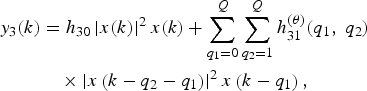 $$\eqalign{y_3 \lpar k\rpar &= h_{30} \left\vert x\lpar k\rpar \right\vert^2 x\lpar k\rpar + \sum_{q_1 = 0}^Q \sum_{q_2 = 1}^Q h_{31}^{\lpar \theta\rpar } \lpar q_1\comma \; q_2 \rpar \cr &\quad \times \left\vert x \left(k - q_2 - q_1 \right)\right\vert^2 x\left(k - q_1 \right)\comma \; }$$
where k is the discrete time index and Q stands for the memory length. The ML term includes both electrical and thermal effects, and the sum represents the dynamic deviation induced by the thermal effects.
In a similar fashion, the fifth-order term can be expressed as
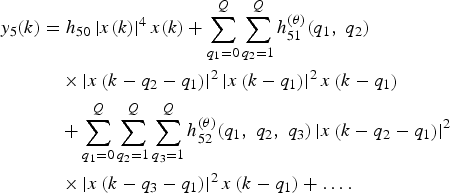 $$\eqalign{y_5 \lpar k\rpar &= h_{50} \left\vert x\lpar k\rpar \right\vert^4 x\lpar k\rpar + \sum_{q_1 = 0}^Q \sum_{q_2 = 1}^Q h_{51}^{\lpar \theta \rpar } \lpar q_1\comma \; q_2 \rpar \cr &\quad \times \left\vert x\left(k - q_2 - q_1 \right)\right\vert^2 \left\vert x\left(k - q_1 \right)\right\vert^2 x\left(k - q_1 \right)\cr &\quad + \sum_{q_1 = 0}^Q \sum_{q_2 = 1}^Q \sum_{q_3 = 1}^Q h_{52}^{\lpar \theta\rpar } \lpar q_1\comma \; q_2\comma \; q_3\rpar \left\vert x\left(k - q_2 - q_1 \right)\right\vert^2 \cr &\quad \times \left\vert x\left(k - q_3 - q_1 \right)\right\vert^2 x\left(k - q_1 \right)+ \ldots.}$$
Here, the first term represents the static part, electrical and thermal. The dynamic part, generated by the electro-thermal filter, is composed of two terms with sums on the discrete delays. An additional simplification can be included by assuming a flat response for output impedance in the signal bandwidth [Reference Crespo-Cadenas, Reina-Tosina and Madero-Ayora5], i.e. q 1 = 0 in the summations of (4) and (5). In this form, y 5(k) is described by a first term, ML, a second term with a linear convolution, and a third term with a two-dimensional convolution. The same procedure to gather the sums can be extended to higher-order terms of y(k), allowing a final representation with the elements collected regarding the order of filtering. This form of grouping the coefficients makes it possible to express the output of the PA separated into an ML and a dynamic part, as follows
 $$y\lpar k\rpar = y_0 \lpar k\rpar + y_d \lpar k\rpar \comma \;$$
where y 0(k) is given by
 $$y_0 \lpar k\rpar = \lsqb h_{10} + h_{30} \vert x\lpar k\rpar \vert^2 + h_{50} \vert x\lpar k\rpar \vert^4 + h_{70} \vert x\lpar k\rpar \vert^6 + \cdots +\rsqb x\lpar k\rpar .$$
The dynamic characteristic can be separated in compliance with the aforementioned order of filtering, y d(k) = y d1(k) + y d2(k) + ··· . The first dynamic component, associated with linear filtering, can be written as
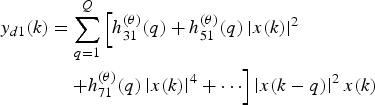 $$\eqalign{y_{d1} \lpar k\rpar &= \sum_{q = 1}^Q \left[h_{31}^{\lpar \theta\rpar } \lpar q\rpar + h_{51}^{\lpar \theta\rpar } \lpar q\rpar \left\vert x\lpar k\rpar \right\vert^2 \right. \cr &\quad \left. + h_{71}^{\lpar \theta\rpar } \lpar q\rpar \left\vert x\lpar k\rpar \right\vert^4 + \cdots \right]\left\vert x\lpar k - q\rpar \right\vert^2 x\lpar k\rpar }$$
the second dynamic component entails quadratic filtering, expressed as
 $$\eqalign{y_{d2} \lpar k\rpar &= \sum_{q_1 = 1}^Q \sum_{q_2 = 1}^Q \left[h_{52}^{\lpar \theta\rpar } \lpar q_1\comma \; q_2\rpar + h_{72}^{\lpar \theta\rpar } \lpar q_1\comma \; q_2\rpar \left\vert x\left(k \right)\right\vert^2 + \cdots \right]\cr &\quad \times \left\vert x\lpar k - q_1\rpar \right\vert^2 \left\vert x\lpar k - q_2\rpar \right\vert^2 x\lpar k\rpar \comma }$$
and the successive dynamic components are associated with the corresponding higher-order filtering. Let us emphasize that in this representation the filtering acts directly on envelope power |x(k)|Reference Morgan, Ma, Kim, Zierdt and Pastalan2, so that the terms of the dynamic component y dr(k) correspond to terms of (2r)th-order dynamics in the DDR model [Reference Zhu, Dooley and Brazil3].
III. DISCUSSION OF THE PRESENT APPROACH
More than a model, here we are presenting a procedure to prune the Volterra-based behavioral model for wideband amplifiers (VBW) [Reference Crespo-Cadenas, Reina-Tosina and Madero-Ayora5], referred to as the dynamic VBW (DVBW) approach. A first observation about this result is that the coefficients have been regrouped according to the DDR method after drastic pruning as a consequence of the assumptions outlined in the deduction of the VBW representation. To illustrate the complexity reduction, consider the FV, DDR, and DVBW models. For a seventh-order model, with a memory length of 10 delayed samples, and a first-order dynamic reduction (only one-dimensional filtering), the number of coefficients necessary for the FV model is in the order of 105, while the DDR needs 74 coefficients, the MP 44, and the DVBW only 34 coefficients.
In precedent schemes, the structure is commonly truncated to fifth-order terms because of the enormous increase in the complexity and the computational cost of the model. For example, the term y 5(k) of the VBW model involves quadratic filtering, a structure that augments excessively the number of parameters. However, the DVBW proceeds by relocating the term h 5(0,0)|x(k)|Reference Morgan, Ma, Kim, Zierdt and Pastalan2x(k) in the ML part, and the terms associated with one-dimensional filtering into the first-order dynamic characteristic. Similarly, some seventh-order terms of the VBW model are relocated in the ML part, and in the first-order and the second-order dynamic characteristics. As in the case of the ML part, the first-order dynamic characteristic (8) of a seventh-order DVBW model is more robust due to an increase of the input level, because it also includes seventh-order terms. In the structure that emerges, the model order can be large, with an ML portion requiring only a few coefficients (four parameters for a seventh-order model), and a trade-off between complexity and precision can be made by controlling the memory length and the dynamic order, analogously to the DDR model [Reference Zhu, Pedro and Brazil4]. The consequence is a well-suited approach to accurately explain the PA response to excitations in a wide range of levels.
Finally, note that the assumptions of this approach are general and also applicable to wideband PAs with more complicated structures of the thermal filter, or even with other low-frequency dispersive effects, like charge-trapping or impact ionization.
IV. EXPERIMENTAL VALIDATION OF THE APPROACH
In order to test the proposed model, a wideband commercial amplifier has been extensively characterized. The device under test is a medium high PA (model ZHL42W of MiniCircuits Inc., Brooklyn, NY) exhibiting a minimum gain of 30 dB in the frequency range 10–4200 MHz, with a minimum output 1-dB compression point of +28 dBm. The experimental setup has been presented in [Reference Reina-Tosina, Crespo-Cadenas and Madero-Ayora10] and is based on an SMIQ02B vector signal generator, from Rohde & Schwarz, Inc., and an E4407B spectrum analyzer, from Agilent Technologies Inc., with modulation analysis facility and a bandwidth of the input signal limited to 10 MHz. The PA has been tested utilizing a double set of 2-GHz communication signals with different symbol rates and otherwise modulating parameters in compliance to the UMTS–WCDMA standard. These test signals are referred to as WCDMA-like signals. One set of these digitally modulated signals was used for kernel identification and the other for validation purposes, with 35 different symbol rates in the range from 2 ksym/s to 1 Msym/s, and a power level of –6 dBm, corresponding to the 1-dB input compression point. The peak-to-average ratios for the identification and validation test sets were 4.5 and 4 dB, respectively. For each symbol rate, all of the signals were acquired at a sampling rate of 7.5 sa/sym, at least, then were post-processed from the raw data to correct phase, frequency and timing misalignments, resampled to 5 sa/sym, and the average of 30 acquisitions was calculated. Model identification was performed by using conventional least squares over 635 aligned samples of the identification signal.
The normalized mean square error (NMSE) of each post-processed acquisition with respect to the averaged signal was obtained in order to assess the experimental limit of the test bench. Then, the average value of the NMSE obtained among the successive acquisitions of the same probing signal was calculated. By doing this, an estimation of the repeatability of the measured data was obtained, establishing a practical limit for the models accuracy below which their predictions can be considered beyond the experimental uncertainty. According to this, the NMSE results presented in this section have been calculated with the set of validation signals and are expressed with respect to the experimental limit.
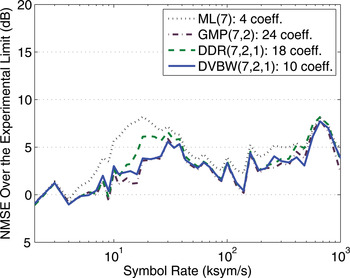
The data corresponding to four seventh-order approaches, the ML, GMP, DDR, and DVBW models, have been represented in Fig. 1 against the symbol rate. In all the structures with memory, a delay of up to Q = 2 sa has been assumed, and a first-order dynamic for the DDR and DVBW models has been calculated. With regard to the GMP model, we have used the particular GMP model that provided the best results to the authors of [Reference Morgan, Ma, Kim, Zierdt and Pastalan2]; in particular, the implementation is based on the last row of Table I in the referred paper.
Comparison of different high-performance seventh-order models representing the response of a commercial PA driven by WCDMA-like signals at different symbol rates, in terms of the improvement of the NMSE over the setup limit.

It can be observed that the ML model is adequate for very low symbol rates but departs from the setup limit at low-medium symbol rates. In a band centered in about 20 ksym/s the deviation is distinctly large, indicating the existence of significant low-frequency memory effects [Reference Crespo-Cadenas, Reina-Tosina and Madero-Ayora8]. An explanation to this behavior is that when the symbol rate is very low, the signal bandwidth is large with respect to that of the thermal filter, and the response becomes ML. Thus, the resulting model is static. In the other extreme, for signals with a high-enough symbol rate, the time-varying term is significantly attenuated by the thermal low-pass filter, which originates a quasi-static behavior for the PA model (short-term memory). Considering that for some low rates the symbol period is comparable to the memory length of the thermal filter, the contribution of the thermal effects can be significant here (long-term memory). The validation characteristics of the other models show a marked closeness to the experimental limit in this low-frequency band, an indication that the memory effects are being captured. In particular, the proposed model not only presents better performance in the presence of low-frequency memory effects, but also the highest efficiency, revealed by a significant reduction in the number of coefficients: GMP performs very similarly to DVBW, but at the cost of over the double of coefficients, while DDR exhibits a peak degradation of about 3 dB in this range of symbol rates even with an increase in the number of parameters. Outside this range of rates, and with the exception of a narrow band of about 700 ksymb/s, the ML model is not outperformed significantly by the models with memory, in accordance with our previous discussion.
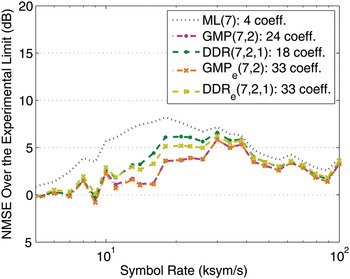
Although the inclusion of even-order terms in the baseband model has been considered as beneficial in predistortion linearization, a formal deduction of the amplifier model contains only odd-order terms, see (2) of [Reference Ding and Zhou11]. The positive effect is produced by the richer basis set formed with these even-order terms in a low-order nonlinear model. To investigate the possible favorable effects of these terms, the DDR and GMP models were tested in a range of model delays from Q = 1 to Q = 10 sa. The implementation of the DDR model with even-order terms is introduced in [Reference Lima, Cunha, Pirola and Pedro12], while that of the GMP model has already been commented. It is important to note that the even-order terms in the baseband model do not come from any even-order term in the bandpass model and the positive effect is significantly reduced as the order of the nonlinear model increases. The best overall results in terms of the NMSE are depicted in Fig. 2 for seventh order, where the models with and without even-order terms are compared for Q = 2 sa. It is remarkable that the GMP model does not exhibit a significant improvement by the inclusion of even-order terms, and this trend is followed in the full range of tested model delays. On the other hand, the performance of the DDR model improves when such terms are accounted for in the Q = 2 sa case, but it downgrades as model delay increases, a matter that can be associated to the fact that the vector space spanned by the regressors of the DDR model contains elements that are not representative of the test PA.
Comparison of different high-performance seventh-order models with the inclusion of even-order terms: ML (dots), DDR model (dashed lines), and GMP model (dash-dotted lines). The marks correspond to model delays of Q = 2 sa, with odd-order terms only (•), or including even-order terms (×), for WCDMA-like input signals in the range of symbol rates from 5 to 100 ksym/s.

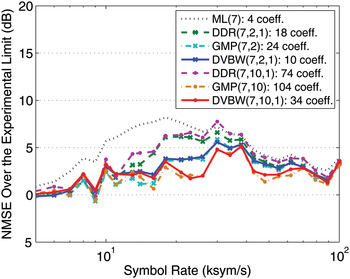
We focus now on the DDR and GMP models, with only odd-order terms, together with the DVBW approach, to evaluate their relative performance in the range of symbol rates where the PA exhibits the strongest dynamic effects. The results of Fig. 3 display the departure of the NMSE against the experimental limit for memory lengths of Q = 2 and Q = 10 sa. The DDR model characteristic captures the memory at some rates, but not in all the range, and remains practically invariable with the increase in the number of delayed samples. However, the GMP and DVBW models improve accuracy considerably, with a deviation over the experimental limit below 5 dB, and their performance is enhanced with the incorporation of more memory. We recall that the GMP model shows the highest structural complexity of the approaches under study, with the largest amount of parameters, and the number of coefficients necessary for the DVBW model approximately halves those of the DDR model. Although the selection of memory lengths such as Q = 10 sa may not be an optimal approach for actual applications, this comparison does not change qualitatively for lower values of Q.
Performance of seventh-order models in terms of the NMSE: ML (dots), DDR model (dashed lines), GMP model (dash-dotted line), and DVBW model (solid lines). The marks correspond to model delays of Q = 2 sa (×) and Q = 10 sa (•) for WCDMA-like input signals in the ranges of symbol rates from 5 to 100 ksym/s.

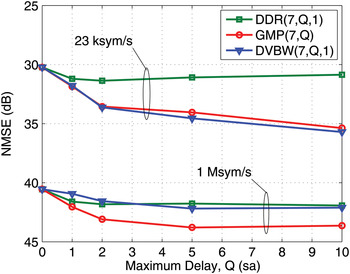
According to previous results, a symbol rate of 23 ksym/s was subsequently selected to focus on the frequency band where the PA exhibits a higher deviation from the ML behavior. The progress of the error as the memory length increases is perfectly observed in Fig. 4, starting with an NMSE = −30 dB, a slight worsening of the error after two delays is clearly observed in the DDR model, which could be an indication of a certain overfitting. On the contrary, the GMP and DVBW models reduce the error monotonically with the incorporation of more delays, reaching an NMSE = −36 dB. Their NMSE improvements compared to DDR can be about 5 dB for Q = 10 sa. At a symbol rate of 1 MHz the NMSE of the ML model is as good as −40 dB. However, all models show only a slight improvement with the increment of the memory from Q = 2 sa, indicating that the low-frequency memory effects are not very significant. As was mentioned before, observe that the number of coefficients necessary to describe the PA behavior to meet a target NMSE is not the same for different symbol rates.
Validation performance of the seventh-order DDR (□), GMP (○) and DVBW (∇) models in terms of the NMSE as a function of the model delay, for WCDMA-like input signals with symbol rates of 23 ksym/s and 1 Msym/s.

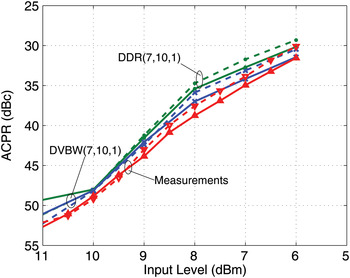
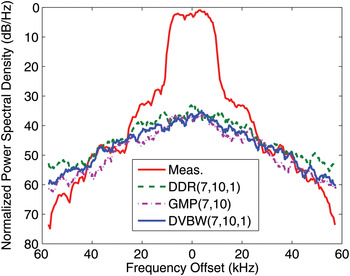
While the prediction of spectral regrowth is not clearly distinguishable when DDR, GMP, and DVBW models are used, the accuracy of the model to represent spectral regrowth ensures reliable prediction of the adjacent channel power ratio (ACPR). The same validation signal waveform was applied to the test PA with input levels swept in the range from −11 to −6 dBm, to measure the left and right ACPR levels, and are represented with marks in Fig. 5. The measured ACPR levels, exhibiting an asymmetry of about 1 dB, were estimated with the DDR and DVBW models from the simulated output waveforms, and are depicted in the same figure. It is remarkable that the left and right ACPR predicted with the DVBW model are closer to the measured values, and the actual difference is within ±1 dB in the full range of levels. These outcomes are also evident in Fig. 6, where the measured spectrum and modeled error spectra are depicted for the highest input level, and a superior performance is obtained with the DVBW model against the DDR model as is revealed by a lower level for the spectrum of the error signal. Compared to the GMP model, in-band error is very similar, but the proposed model takes the advantage of a significant saving in the number of coefficients (34 versus 104 coefficients for Q = 10 sa).
Measured (Δ, ∇) and predicted left and right ACPR of a 23-ksym/s WCDMA-like input signal with seventh-order DDR (•) and DVBW (×) models (Q = 10 sa). Dashed-lines correspond to the left ACPR, while solid-lines correspond to the right ACPR.

Measured (marks and solid line) and modeled error spectra (dashed lines) of a 23-ksym/s WCDMA-like input signal with seventh-order DDR, GMP, and DVBW models (Q = 10 sa). The error of the spectra is represented in dotted line for the DDR model, in dash-dotted line for the GMP model, and in solid line for the DVBW model.

V. CONCLUSION
A new configuration of PA behavioral model has been demonstrated in this paper, which is derived by using a simple equivalent circuit model with thermal effects. The structure can be considered as a particular case of the VBW model, with the kernel coefficients rearranged according to the DDR approach.
We have confronted satisfactorily our results with the previously published high-performance GMP and DDR models. The gain in efficiency of the present approach is evident if it is considered that not only the accuracy is superior, but also that the number of coefficients experiments a radical reduction.
Measurement results on a commercial PA showed the existence of a clear band where the low-frequency dispersive effects are present and where the models have more difficulty to accurately reproduce the experimental data. Comparing different zones in a symbol rate sweep, we observe that the number of needed coefficients can vary depending on the signal bandwidth.
A future progress of this work is a study of the techniques that can be used in a laboratory context to identify the model parameters. For example, the combined use of pulse measurements to identify the ML parameters, and WCDMA signals to identify the dynamic part. The implementation of CAD models and algorithms in simulation software and application to linearization of PA are two directions in which this work can be further developed. In particular, the preliminary development of a DVBW-based predistorter for a GaN PA has already been reported by the authors in [Reference Madero-Ayora13], showing a satisfactory linearization performance compared to other conventional approaches.
ACKNOWLEDGEMENTS
This work was completed with the support of the Spanish National Board of Scientific and Technological Research (CICYT) and the Andalusian Government in the projects TEC2011-23559 and P11-TIC-7869.
 Carlos Crespo-Cadenas was born in Madrid, Spain. He received a degree in Physics in 1973 and Doctor degree in 1995 from Polytechnique University of Madrid. Since 1998, he has been an Associate Professor and currently he gives lectures on Radio Communications in the Department of Signal Theory and Communications, University of Seville. His current interests are Nonlinear Analysis applied to Wireless Digital Communications and to Microwave Monolithic Integrated Circuits (MMIC).
 Javier Reina-Tosina was born in Seville, Spain. He received the Telecommunication Engineering and Doctor degrees from the University of Seville, Seville, Spain, in 1996 and 2003, respectively. Since 1997, he has been with the Department of Signal Theory and Communications, University of Seville, where he is currently an Associate Professor. His research interests include MMIC technology, nonlinear analysis of active microwave devices, and integration of information technologies in biomedicine.
 María J. Madero-Ayora received the Telecommunication Engineering and Doctor degrees from the University of Seville, Seville, Spain, in 2002 and 2008, respectively. Since 2003, she has been with the Department of Signal Theory and Communications, University of Seville, and is currently an Associate Professor. Her research interests focus on the area of nonlinear analysis of active microwave devices and measurement techniques for nonlinear communication systems.