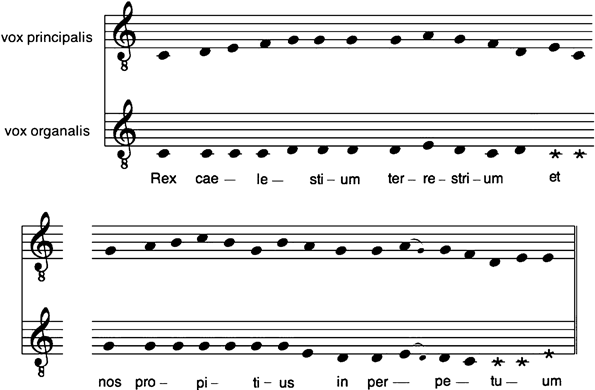


Among the many issues regarding the birth and development of polyphonic music in early medieval Europe questions that still remain unanswered are what we know of the practice of polyphonic singing in the tenth century, and when, and in what forms, the first organa began to be notated on parchment. London, British Library, MS Harley 3019, fol. 56v, contains two musical annotations: a two-voice organum on the antiphon Sancte Bonifati martyr and a second antiphon Rex caelestium terrestrium. Written in north-western Germany during the first half of the tenth century, the annotation is the earliest written source for polyphonic music outside music treatises, earlier as well as contemporary. Both the text and the music of the two antiphons are unica, and the importance of such a discovery merges with the history of early neumatic notation, as both antiphons are notated in an exceptionally rare type of music script, generally referred to as Palaeofrankish notation. The aim of this study is to provide a preliminary analysis of the London source, its notation and style, and to lay down the basis for further discussion on music writing and creativity in early polyphonic practice.Footnote 1
The manuscript
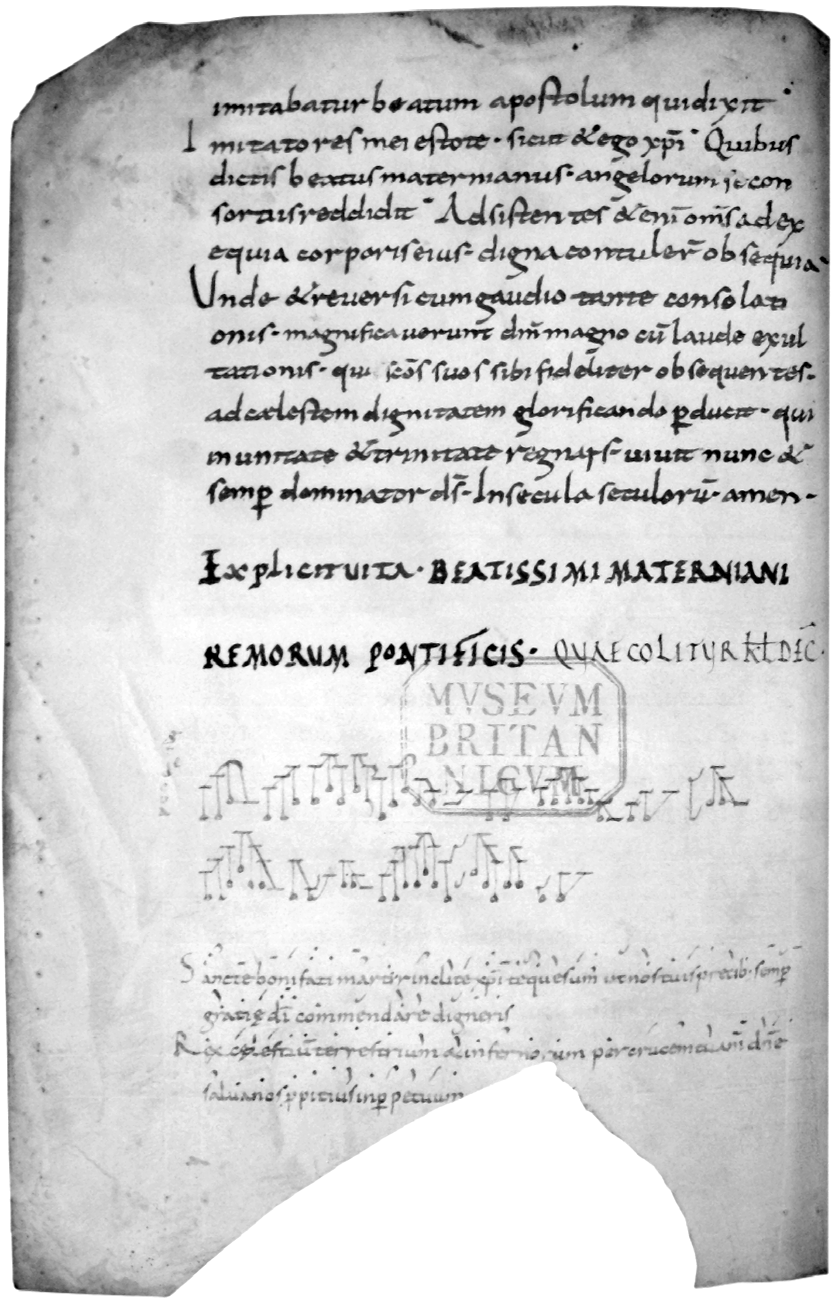
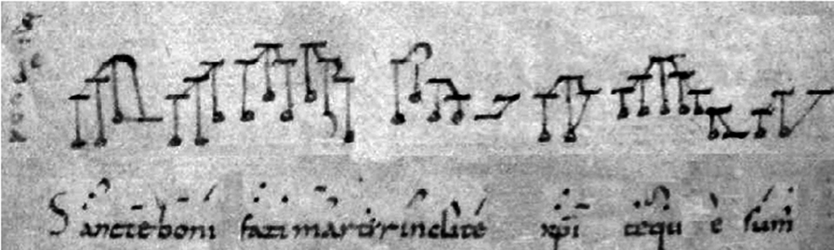
London, British Library, Harley 3019 (hereafter Harley 3019) is an in quarto composite manuscript made up of four parts.Footnote 2 The fourth and last unit (fols. 54r–56v) is the latter part of the Vita of bishop Maternianus of Reims (†368), imperfect at the beginning, inc. ‘… <prae>dictus vero diaconus …’.Footnote 3 The script is a Carolingian minuscule from the first half of the tenth century.Footnote 4 On fol. 56v, after the explicit of the Vita, a second hand wrote a two-voice organum for St Boniface, Sancte Bonifati martyr, as well as its chant version alone and the piece Rex caelestium terrestrium (see Figure 1).Footnote 5 Questions about its provenance and use will be discussed further below; however, it is possible that it used to be part of a Passionary containing lessons from the Acts of the Martyrs or legends of the saints, for reading during the Office.
London, British Library, Harley MS 3019, fol. 56v.

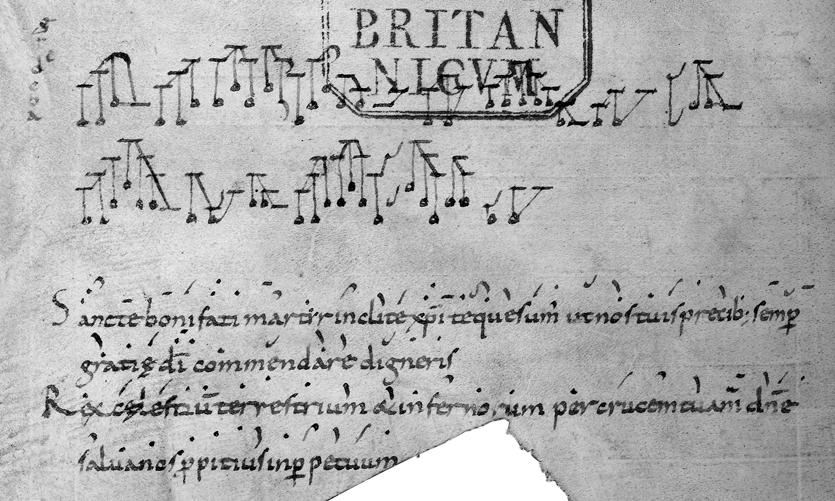
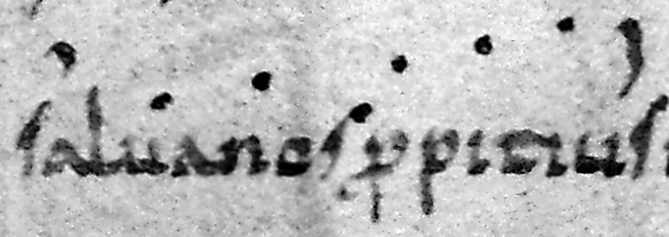
The layout for the musical content is a feature which deserves to be analysed here. The annotation occupies the bottom half of fol. 56v and is carefully laid out using the pre-existing ruling as a basis for the arrangement of the antiphon texts (see Figure 2). In particular, one line of notated text corresponds to one ruled text line, with the notation filling in the interlinear space. The scribe chose to compress his text script, possibly in order to fit in a line of text and its notation, which compression also enabled a semi-diastematic arrangement of notation signs.Footnote 6 The space was calculated meticulously as the four lines of the two antiphons are written exactly on the last four ruled lines.
London, British Library, Harley MS 3019, fol. 56v (detail).
The organum notation above these four lines is placed differently: the ‘stave-lines’ use the existing text lines, but the scribe added two more dry-point lines to four of the five lines from the original ruling (see Figure 3). The space results in thirteen ruled lines where the first seven are labelled with the letters a to g as clefs. This aspect confirms the annotation's planned execution, as opposed to a rough, careless jotting. The scribe's intervention in the original spacing results from his graphical and theoretical acquaintance with the advanced forms of performance practice and notation that were available at his time. Thus, it is all the more difficult to regard this annotation as an experiment, given the clarity of the musical hand and the few signs of erasure in the organum notation.
London, British Library, Harley MS 3019, fol. 56v, page ruling
The organum notation
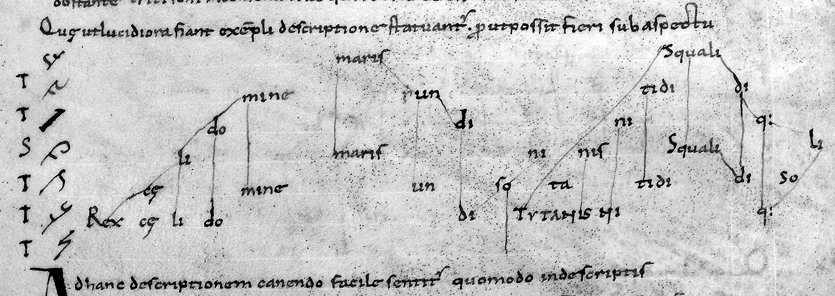
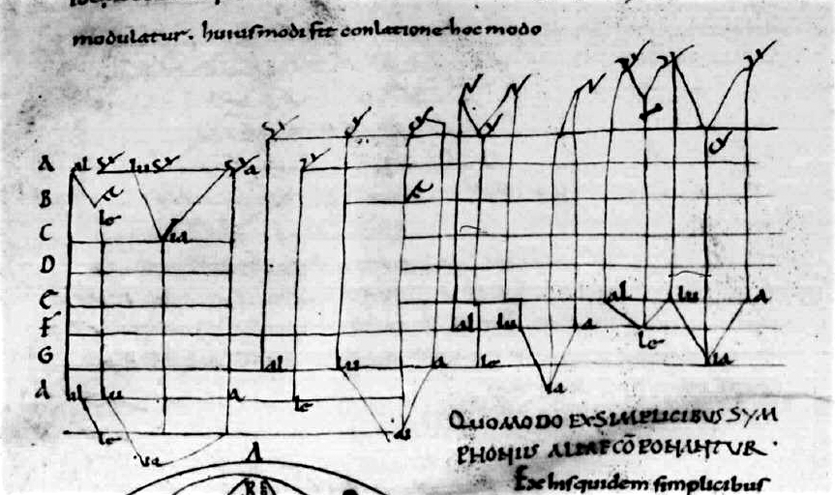
A concern to indicate pitch predominates in ninth- to eleventh-century music treatises. The ‘line diagrams’, where syllables of a text are written on a system of lines with pitches in the left margin, is found primarily in theoretical texts.Footnote 7 Hucbald of Saint Amand (c. 840/850–20 June 930), in his De harmonica institutione, presented a series of parallel horizontal lines whose spaces were designated T (tone) or S (semitone) in the left-hand margin, and then wrote the syllables of a text on the appropriate lines. The author of Musica enchiriadis used Daseian symbols to designate the pitches of lines arranged vertically (see Figures 4 and 5), as did the authors of the Commemoratio brevis and of the Bamberg Dialogues I and II. Despite their wide circulation in theoretical texts, these elaborate notation systems did not find any application in other musical contexts and their use was confined to theoretical writings. Harley 3019 is the only example of a tenth-century source containing polyphony notated in precise pitches outside music treatises, employing what will be defined below as cithara notation.Footnote 8
Musica enchiriadis (Valenciennes, Bibliothèque municipale, MS 337, fol. 52v)
Musica enchiriadis (Valenciennes, Bibliothèque municipale, MS 337, fol. 47v)
The notational system used by the Harley 3019 scribe for the organum Sancte Bonifati martyr shares some important features with the polyphonic notation found in theory treatises but, at the same time, it also employs a range of innovative tools that differentiate it from the theoretical tradition. Instead of syllables we find a set of symbols, placed on a system of seven parallel lines. To each line is assigned a pitch, indicated by a letter of the alphabet (a–g). Two contrasting geometrical figures effectively specify the relationship between the two voces: short horizontal pen strokes ‘–’ are used to differentiate the vox principalis from the vox organalis, which is instead designated by little circles, ‘o’.Footnote 9 In the case of a cadential unison or, to use Guido d'Arezzo's terminology, an occursus, a single sign is employed and the horizontal stroke of the vox principalis, hierarchically, prevails.Footnote 10
The presence of ligatures is a common feature in diastematic-syllabic notations: syllables are usually joined with lines to direct the eye through the notes. In Harley 3019, this feature reveals a system with a great level of precision, and its attention to detail confirms that it was developed with an intention that went beyond mere recording of pitch. Ligatures in the vox principalis follow the organisation prescribed by the neumatic notation and isolated tractuli and puncta are considered part of the main melodic movement within which they belong. With the aid of a digitally modified image, Figure 6 shows the correspondence between ligatures in the organum notation and the neumed chant version for the incipit Sancte Bonifati martyr inclite Christi te quesumus. To these general rules, exceptions are to be found where the voices meet in a unison: generally, one note in the vox organalis is only ligated to the following one by a pen stroke for the one- or two-step rising melodic movements in occursus. In case of a prolonged occursus, the held note is not ligated in the vox organalis (with the only exception of the unison on ‘sancte’ and ‘nos’) and the same principle applies to the vox principalis (with the exception only of the unison on ‘inclite’ where, apparently, priority is given to the neumatic arrangement).
Correspondence of the organum ligatures to the neumatic arrangement (digitally enhanced)
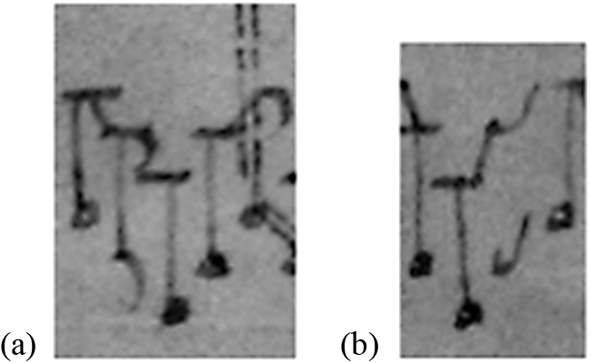
As mentioned above, ligatures in the vox principalis follow the neumatic groupings, as if to highlight the melodic inflections. Lines linking the two voces are also provided in order to ensure correct vertical alignment. Another possible understanding of the meaning of these joining lines involves, once again, the hierarchical relationship between the vox principalis and the vox organalis: the vox organalis, for its part, only follows the vox principalis to which it is joined, as if it existed in order to serve the chant melody, stressing its contra punctum status.Footnote 11 One of the qualities of the Harley 3019 organum notation is the presence of liquescent signs (see Figure 7). Once again, the level of detail and precision of this polyphonic notation is evidently exceptional, for there are no other extant sources that offer the use of ‘special’ neumes such as liquescences, and therefore their employment is, for now, a unicum. In Harley 3019, the epiphonus, the cephalicus and the liquescent pes are found integrated in the notation of complex syllables in the text, especially at diphthongs and the juxtaposition of consonants as in sa ncte, ma rtyr, i nclite, u t nos, se mper, comme ndare and di gneris.
Liquescent neumes on (a) ma rtyr i nclite and (b) comme ndare
Finally, it is important to consider the significance of the coexistence of two different kinds of notation. In particular, the Sancte Bonifati organum notation not only offers the possibility of writing out a second voice, i.e., the vox organalis, which could have been written using only neumes, as in the case of the organa in the Winchester Troper (Cambridge, Corpus Christi College, Parker Library MS 473) and the Chartres fragments (Chartes, Bibliothèque de la Ville, MS 4), but it also compensates for the lack of pitch-specificity of the neumatic version for both the vox principalis and the vox organalis.Footnote 12 In addition, what emerges from the analysis of the organum notation is a close relation with the neumatic arrangement: the presence of neumes was perhaps the only possible way known to the scribe to indicate rhythmic nuances such as longer or shorter note lengths. Therefore, it is possible to assert that both notations played different roles in the musical writing of Harley 3019, roles we can legitimately define as complementary. The London organum notation is thus the earliest and most accomplished synthesis of two different systems coming together before polyphony came to be notated on a stave.Footnote 13
A notational concordance
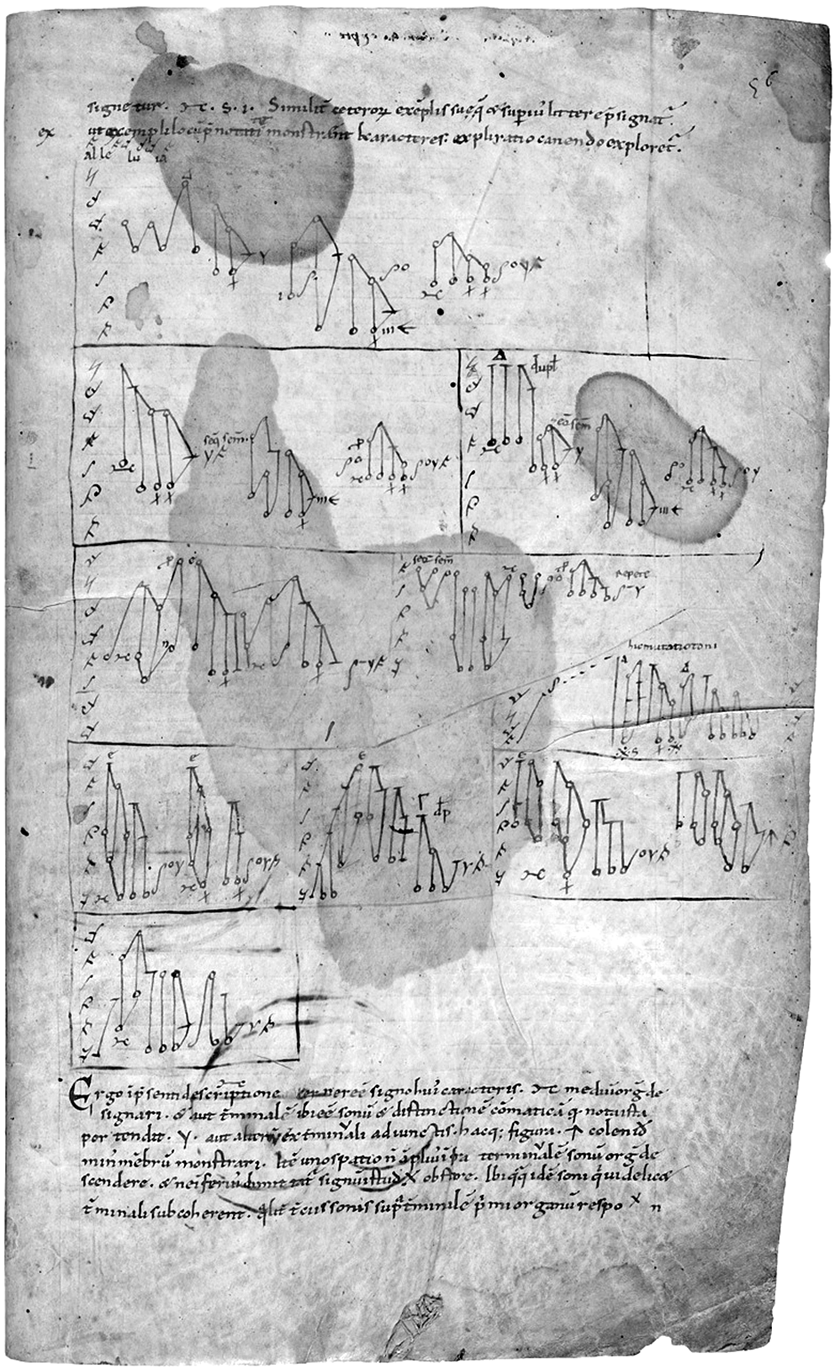
A notational system remarkably similar to that of Harley 3019 is found in another music treatise: the Parisian De organo. The only extant source for this treatise is an autonomous tract on polyphonic singing written after the closing section of a copy of the Musica enchiriadis in Paris, Bibliothèque nationale de France, lat. 7202 (hereafter lat. 7202).Footnote 14 The manuscript preserves a copy of Boethius' De musica (fols. 1–50), the Tonarius additus in Boethii institutionem musicam (fols. 24–36), the Parisian Musica enchiriadis in its version Inchiriadon Uchubaldi francigenae (fols. 50–54v), and finally, the De organo treatise (fols. 54v–56).Footnote 15 At the end of the treatise, on fol. 56r, there is an example of organum at the fourth: it is the polyphonic version of a complete melody, the sequence Benedicta sit for the Feast of the Holy Trinity (see Figure 8).Footnote 16 Similarities between the notations in Harley 3019 and lat. 7202 are indeed striking and they can be considered as specimens of related notational types. As in Harley 3019, instead of writing the text of the sequence by setting syllables on line-diagrams of the type commonly found in music treatises, the scribe drew little circles and lines in the appropriate spaces and connected them with vertical or oblique lines. However, the scribe of lat. 7202 appears to be less consistent in the use of ligatures. Here, while the ligatures in the vox principalis seem to follow the same principle as those written by the Harley 3019 scribe, i.e., taking as a pattern the neumatic organisation, the ligatures in the vox organalis expand the rule of involving only the last two notes of its rising cadential melodic movement: a number of different segments, usually no more than three notes, are ligated in both voices. A similar lack of regularity in the use of the ‘–’ and ‘o’ signs is apparent: the same sign is either found on the vox principalis or on the vox organalis and there are several instances where these signs are used interchangeably. Furthermore, in the London example, the letters a–g are used to indicate pitches for each line, while in lat. 7202, the employment of Daseian signs in the left-hand margin of each of the ten distinctiones (which are separated from each other by lines) shows the notational relationship between this example and those found in other organum treatises.
Paris, Bibliothèque nationale de France, lat. 7202, fol. 56
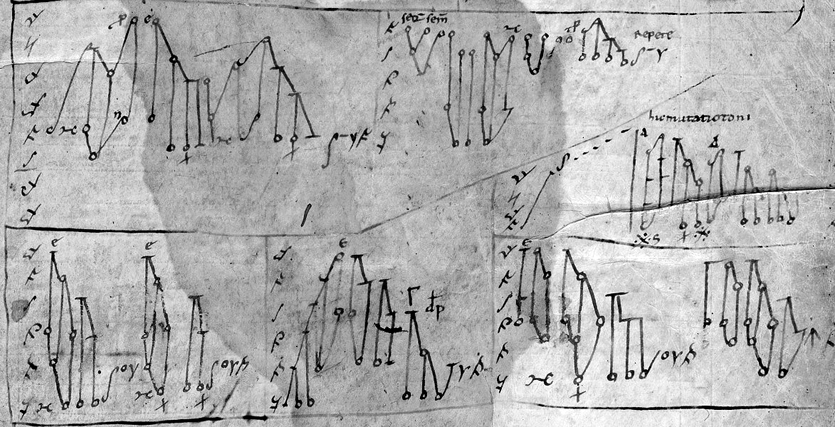
This difference may also be noticed in relation to the manuscript and textual context of the London and Paris organa: one is practical, an annotation in the blank space at the end of the Vita Materniani to record the Sancte Bonifati marytr organum and chant as well as the antiphon Rex caelestium terrestrium, while the other is chiefly theoretical. This is understood by another important feature in lat. 7202, the presence of a series of additional signs explained in a detailed commentary at the bottom of fol. 56r (see Figure 8). In order to draw attention to or clarify the relationship between the voice parts, the author devised an elaborate set of supplementary signs written above, below, or beside the appropriate place in the polyphonic sequence. Some of these signs, listed below, are made up of Latin and Greek letters.Footnote 17 Other verbal indications for the repetition of the same passage are provided, such as sequitur semel, eadem semel, duplicatur, etc. (See Figure 9.) Given the theoretical context of the notation for the polyphonic Benedicta sit, it is possible that this complex series of letters and symbols was intended more as analytical rather than explanatory, thus showing different relationships between the two voices and their role in the composition. At closer inspection, it becomes evident that – with the exception of the cadential ‘So’ and those signs indicating repetitions, whose absence would result in an incomplete organum – most signs are purely descriptive. Moreover, we may even infer that the basic notational system to which these signs were added was already in use, and common to the extent that it needed no supplementary explanations. The Parisian version can therefore be seen as an expanded version of the notational system employed by the notator of Harley 3091: a similar set of basic signs – although used more freely – is supplemented by a set of additional descriptive signs (whose presence might also explain the relative flexibility in the employment of the basic signs). This expanded version might have been elaborated for didactic purposes.Footnote 18
Paris, Bibliothèque nationale de France, lat. 7202, fol. 56 (detail)
A new definition for an early notation: the cithara notation
A notational system employing letters and syllables placed diastematically on a number of parallel lines in order to notate chant or polyphony is perhaps the most common in early and late Carolingian music treatises. Despite its importance, there is no agreement on its designation. Until the discovery of the London annotation, its use was only known from music treatises such as Musica and Scolica enchiriadis or Hucbald's De harmonica institutione, and not in any practical sources. This may have been the reason for a general reluctance to give this notation, which has been considered perhaps too sporadic and inconsistent, a clear and unique classification. It is usually defined as ‘diastematic-syllabic notation’, ‘notation syllabique diastématique’, ‘Textschrift zwischen Linien’, ‘Liniendiagrammen’, ‘Stufenbezifferung mit Dasia-Zeichen’, etc.Footnote 19 These definitions, however, are either incomplete or misleading. When the presence of syllables is stressed (syllabic, syllabique, Textschrift, etc.), examples such as those described so far, using symbols such as ‘–’ and ‘o’, are excluded. Conversely, when attention is drawn to the presence of letters, examples featuring Daseian signs are left aside. The system of parallel lines, defining the musical space, is also an important feature which must be immediately recalled when referring to this kind of notation. Indeed, it is possible to recognise some basic principles, common to all these notational types, forming the analytical ground on which we build our definition.
The notation has a continuity with the preceding theoretical tradition: Boethius used the strings of the cithara to assign Greek names to musical notes. Hucbald, in turn, drew on Boethius' auctoritas and made use of the Greek instrument for a similar pedagogical purpose, that is, in order to explain the difference between tone and semitone. Although already employed by Boethius and known from the wide transmission of his treatise, the first description of this kind of notation is given to us by Hucbald himself where, in order to ‘mark well the distance separating the tone from the semitone, Hucbald … arranges the words … in the spaces between the six horizonal lines representing the strings of the cithara tuned diatonically (from ut to ut, or as here A=ut), which he has just described’.Footnote 20 Hucbald's description of this notational system is the following: ‘And then an example of a semitone can be seen on the six-string cithara between the third and the fourth string, either ascending or descending…. Let specimens also be put forward … distinguishing the six strings, whose place is taken by the lines, and always indicating between the strings where a tone or a semitone is contained’ [my emphasis].Footnote 21 In this passage, Hucbald clearly suggests a graphical representation of the cithara's chordae where, almost like a tablature ante litteram, the syllables of the responsory Ecce vere Israhelita are placed between the lines (inter chordas) defined by each of the instrument's six strings (.VI. cordarum).
As mentioned above, this system, which I shall now refer to as cithara notation, was broadly adopted in later treatises and thus can also be considered the forerunner of the Harley 3019 and lat. 7202 musical notations. The number of ‘strings’ is sometimes increased to allow the notation either of a larger ambitus or to accommodate more than two voices, while the addition of different sets of signs, including liquescent neumes, proved efficient in making the notation more comprehensive. As Susan Rankin remarks, the system employing text syllables was ‘cumbersome – greedy for space and slow to write’, to the extent that the innovative use of symbols to replace syllables may be looked at in the context of a general tendency to guarantee diastemacy while saving space on parchment (which culminated a few years later in the use of both lines and spaces onto which to place neumes, i.e., Guido's staff).Footnote 22 This of course required the chants' texts to be already known or transmitted separately. In Harley 3019 the Sancte Bonifati martyr text was provided by the scribe (although I argue that the reason for writing the text was chiefly subsidiary to the presence of neumes providing performance indications), while its absence in lat. 7202 indicates the manuscript's theoretical purpose: the illustration of the rules governing polyphonic music more than the notation of an organum for performance.
In conclusion, cithara notation is a type of music writing in which syllables or symbols are placed diastematically on either lines or spaces designated by letters of the alphabet (e.g. a–g, Tonus/Semitonus) or Daseian signs. The distinction between the use of lines and spaces is crucial, in that it diverges from the early Guidonian system, which employs neumes on both lines and spaces.Footnote 23 Hucbald's notational tool surely led the way for later developments but its heritage unfairly has remained underestimated for, as Chartier remarks, ‘there was nothing left for the monk of Elnon but to devise the symbols replacing the syllables for him to be recognised, 150 years before Guido d'Arezzo, as the inventor of the musical staff’, although we now know that symbols were already in use at the beginning of the tenth century during Hucbald's lifetime and that, more importantly, this mere substitution was still insufficient to consider the St-Amand monk as the inventor of the staff.Footnote 24 The process was still to be completed and we shall look elsewhere in time and place for the true responsibility for this pivotal notational shift.
The chant notation
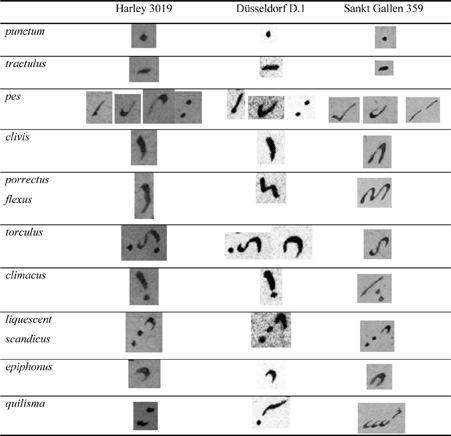
The two antiphons added to Harley 3019, fol. 56v, Sancte Bonifati martyr and Rex caelestium terrestrium, are notated in Palaeofrankish neumes (see above, Figure 2).Footnote 25 Besides the evident graphical concordance with other known sources of Palaeofrankish notation (see Table 1), the following analysis was also made possible with the aid of the polyphonic diastematic notation for the organum Sancte Bonifati martyr; considerations of the significance of these neumes are corroborated by the arrangement of ligatures in the same notation. The terminology used for defining neume-shapes will mostly be the standard and most common, even though it is sometimes difficult to maintain the same criterion throughout as conventional nomenclature raises questions of conceptual interpretation by challenging our assumptions of the early medieval approach to music writing.Footnote 26
Comparison between neumatic notation in Harley 3019, Düsseldorf D.1 and Sankt Gallen 359
The punctum is a single-pitch neume used (1) isolated, with syllabic value, or (2) as the two notes of a rising figure (e.g., bonifati), (3) the first two elements of the liquescent scandicus (e.g., sancte), (4) the first and last element of the torculus praepunctis subpunctis (e.g., te) and (5) compound with a clivis as the third element of the climacus (e.g., nos). The other single-pitch neume is the tractulus. It can be found (1) isolated with syllabic value or (2) compound as the second element of the quilisma pes on tuam.Footnote 27 The pes can be found (1) in the standard shape for Palaeofrankish notation, (2) in the shape of two puncta ‘:’, (3) liquescent in the form of the Sankt Gallen pes and finally (4) in the form of the Sankt Gallen cephalicus. The clivis is a two-pitch neume in the standard shape for Palaeofrankish notation of a reversed solidus ‘ \’. The lack of the left-hand upward stroke, common in the Italian, French and German notations, is another feature which sets Palaeofrankish neumes apart from these major notational families. Generally, in Harley 3019 the slanting pen stroke of the Palaeofrankish clivis is thicker than that of the pes, as well as slightly thinner and curved towards the end. This neume is found (1) isolated and (2) compound with another clivis, as well as the first element of the porrectus flexus. Harley 3019 contains a single example of the torculus and its shape is similar to that commonly found in other French sources. The torculus inserted in the melisma on te forms a more complex compound form with the two preceding and following puncta: according to the standard semiological nomenclature, the resulting figure can be defined as torculus praepunctis subpunctis. It is possible that the choice for this arrangement may contain performance indications such as a more fluent vocal delivery for the middle part of the melisma, articulated by an emphasis on the first and last note, both designated by puncta. The porrectus is here flexus in the shape of two compound clives. The scandicus in Harley 3019 appears only in the intonation of the first antiphon, on sancte. The top note is liquescent and thus the scandicus can also be interpreted as a disjointed pes with an added epiphonus at the top. The epiphonus is a liquescent punctum that can be found isolated or compound as the top element of a scandicus. The climacus is another peculiarity of Palaeofrankish neumes, in that it uses the characteristic clivis with an added punctum at the bottom (clivis subpunctis). The quilisma pes can be found on tuam in the form of a wavy tractulus followed by a higher straight tractulus: the shape recalls the standard French and German quilisma episemata, except that the two elements are disjunct in Harley 3019, possibly involving rhythmic nuance. The presence of this neume is of exceptional interest as it is the first appearance of this particular shape for a quilisma pes in any Palaeofrankish source. The lack of quilisma pes in early Palaeofrankish sources, which confirms the importance of the discovery of the Harley 3019 annotation, is also remarked by Solange Corbin: ‘the distinguishing feature of the oldest witnesses is that the ornamental neumes such as the quilisma, oriscus and strophici are lacking’.Footnote 28
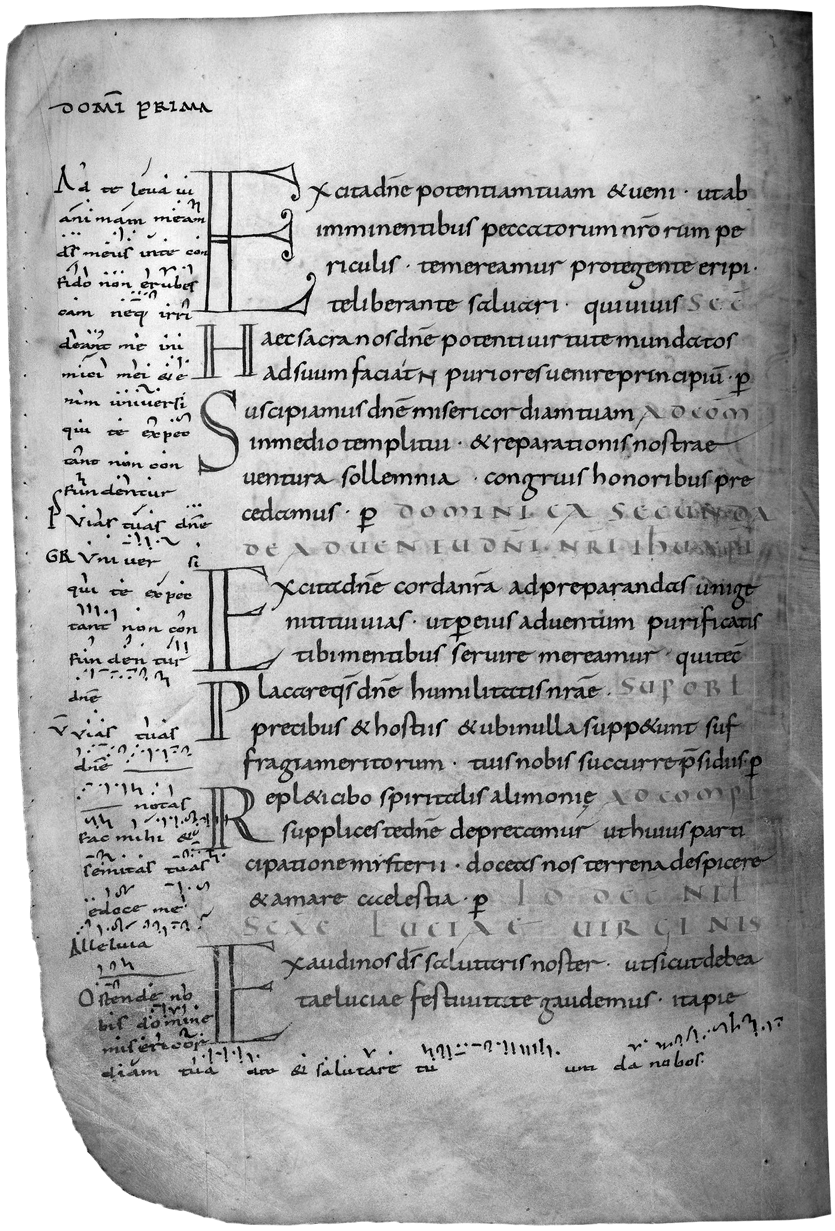
Another important feature is a concern for using the position of the notational signs on the vertical space in a meaningful relation to musical pitch. Early literature has tended to describe this as diastematic writing, or writing showing a tendency to diastemacy, but Leo Treitler has introduced the notion of directionality, which might more readily apply, since the use of space is not absolutely measurable, and the melody cannot be transcribed only taking such positioning into account.Footnote 29 In both antiphons, there is an evident concern for directionality, since neumes are arranged following the shape of the melody to the same degree as in other Palaeofrankish sources, particularly Düsseldorf, Universitätsbibliothek, D.1, D.2 and D.3.Footnote 30Puncta are generally placed diastematically, except when followed by pedes: where this occurs, e.g., Bonifati, tuis and gratiae, they are placed at the same height as the base of the following pes, despite being one step lower in the antiphon melody. An interesting example is the rising pattern of puncta on salva nos propitius in Rex caelestium terrestrium, which clearly outlines an ascending scale (see Figure 10).Footnote 31
The puncta scale
Overall, the analysis of the neumes in Harley 3019 reveals a similarity with those used in other Palaeofrankish sources probably from Corvey and Cologne, i.e. the group D.1, D.2 and D.3 now in Düsseldorf as well as the Wolfenbüttel Gradual fragments (for D.1 see Figure 11).Footnote 32 The presence of the torculus and quilisma in a design similar to that of French and German sources also confirms that the notation might have originated in an area comprising north-eastern France or, more possibly, north-western Germany. In conclusion, what the palaeographical analysis of the neume-shapes in Harley 3019 suggests is a performance-orientated notation, in which every neume carries its particular performance indication, reaching a greatly detailed degree of interpretative information.Footnote 33 The semiological study of Palaeofrankish notation has hitherto been carried out mainly through comparative analysis with other later or contemporary neumatic sources.Footnote 34 When sources in pitch-specific notations have been compared to versions notated in Palaeofrankish neumes, these were, in most cases, either chronologically or geographically significantly far from the date and place of origin of the original notation.Footnote 35 In Harley 3019, the unique coexistence of pitch-specific notation alongside the neumatic version is of exceptional interest as it helps us to compare the two systems within exactly the same geographical and chronological context.
The closest notational source to London, British Library, Harley MS 3019: Düsseldorf, Landes- und Stadtbibliothek, D.1, fol. 126v
The sancte bonifati martyr organum: text and style
Generally thought to have been written in the second half of the ninth century, the book entitled Musica enchiriadis is one of the most famous documents in early medieval music theory; the treatise's central concern was to illustrate a coherent pitch system and to elucidate relationships among its elements in symphoniae.Footnote 36 From the ninth century onwards, different types of organal technique have been described in other theoretical texts, but Musica enchiriadis remains the most authoritative theoretical source we shall refer to for analytical examination of the London organum, not only because it is the first to discuss the principles of polyphonic music but also for the chronological proximity of its circulation. In the musical practice of that time, extempore polyphonic singing belonged to ‘a realm of ad hoc practice which required no written record’ and thus, no sources survived outside music treatises.Footnote 37 The Harley 3019 annotation represents the earliest example of organum in a practical context, less than a century after Musica enchiriadis was written, and constitutes an important source for the study of early polyphonic music. The following discussion will concern the transcription and analytical examination of both the text and the music of the Sancte Bonifati martyr antiphon and organum.
The text of the antiphon Sancte Bonifati martyr inclite Christi te quesumus ut nos tuis precibus semper gratiae Dei commendare digneris (Saint Boniface, illustrious martyr of Christ, we beg you that you may always commend us to the grace of God by your prayers) has no concordances in any source containing the Office for St Boniface.Footnote 38 The only textual concordance is an antiphon opening the Office for St Vitus.Footnote 39 It is possible that the original Office for St Boniface, although with different responsories and verses, included the organum in the same position as the antiphon in the Office for St Vitus: a polyphonic elaboration of the opening antiphon would have conferred a solemn character on the saint's celebration.Footnote 40
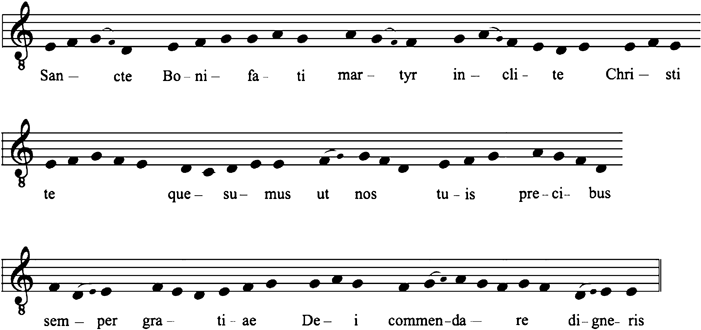
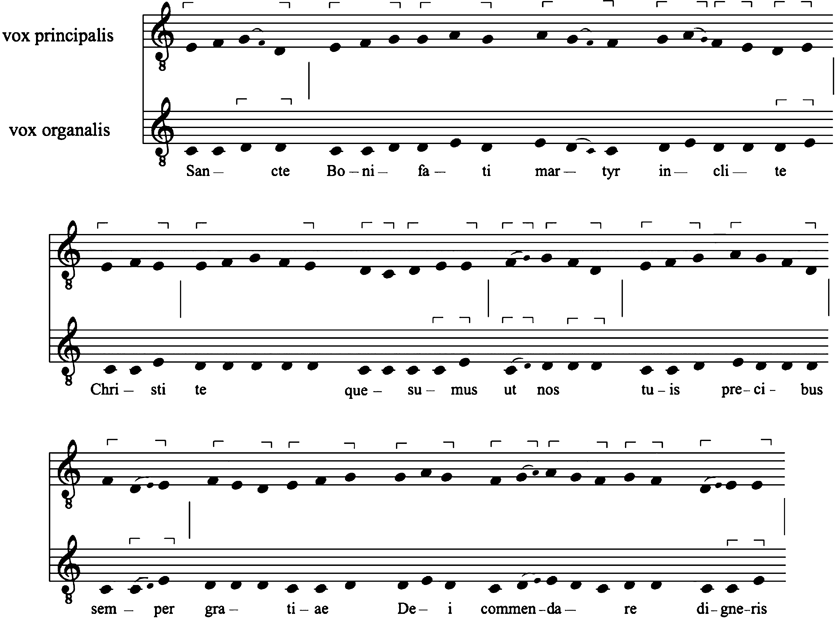
The Sancte Bonifati martyr antiphon opens with a typical third-mode intonation formula in a rising three-step movement (E–F–G) (See Example 1). The melody then develops principally around E and G, frequently reaching a and D. The overall character of the antiphon melody cannot be defined as melismatic; however, it is surely ornate, with a minimum average of two notes per syllable, and a five-note melisma on the pronoun te. The relationship between the antiphon melody and its text makes it evident how phrase divisions are arranged according to a clear rhetorical significance: these divisions have the function to draw attention to certain concepts or attributes, e.g., Bonifati martyr inclite the dedicatee, te quesumus the purpose, tuis precibus the means, etc. In Harley 3019, musical phrases are articulated (1) melodically, by a constant return to the finalis E or to the subfinalis D of the mode; the former being perceived as a stronger caesura; (2) rhythmically, by the employment of tractuli, possibly involving a lengthening of the sound and, in the case of the polyphonic setting, also (3) harmonically, by the meeting of the two voces on a unison in organal cadences. The existence of one to three of these musical techniques creates a hierarchy based on different degrees of rhythmic, melodic and harmonic articulation. The first two features generally fulfil musical and expressive necessities while the third responds solely to the absence of likely alternative organal solutions to the one actually employed in the source. When all of these conditions appear simultaneously in a particular place in the composition, a stronger caesura can be heard. Conversely, some instances present only the meeting of voices on a unison without being caesurae, as will be explained later.
Antiphon Sancte Bonifati martyr
In the organum Sancte Bonifati martyr the most pronounced cadences are on Chri sti, sem per and digne ris, corresponding to the close of three longer phrases in which the melody is arranged (see Example 2). Each of these cases features a unison meeting on the finalis (E) as well as the presence of a tractulus, except for digne ris, where a punctum is used instead, for no supplementary notational and rhythmical emphasis was needed since this was already at the end of the composition. The other marked division is on San cte, where a cadence on the subfinalis (D) makes the caesura less distinct than that aforementioned despite also being marked by a tractulus; the opposite case is found on the incli te and quesu mus divisions, where the cadences on the finalis (E) are notated with a punctum, thus resulting in a moderate rhythmic caesura. An even lighter articulation is the unison meeting on nos and on preci bus, both cadencing to the subfinalis (D) and with no particular rhythmic prominence.
Antiphon organum Sancte Bonifati martyr
Thus, strong cadences are used to highlight specific words in the text, e.g., sancte, Christi and semper. In the case of the first phrase division, the intonation is accentuated by a rhythmically articulated pes compound with an epiphonus on the first and stressed syllable, providing a clear rendering of the rising melodic movement E–F–G, while the presence of a tractulus on the last syllable of sancte directs the weight of the phrasing to the end of the word. This effect is sustained by another tractulus on the first syllable of the following word Bonifati, the combination of the two producing an emphasis of the opening. The third phrase employs an articulated pes on the first syllable of Christi followed by a tractulus on the last syllable. Here too the result is to emphasise one of the most crucial points in the antiphon text. Another case is that of semper, where this technique is even more emphasised by the presence of two tractuli, on the first and last syllable, separated by a melodic inflection leading to the finalis of the mode (E) through a liquescence on the subfinalis (D). All these cases end on a unison with the vox organalis and allow the singers to give prominence to the articulation of the musical phrases. Two meetings of the chant on a unison with the vox organalis are also found within words. The first occurs on the first two syllables of quesumus, while the second is on the first syllable of gratiae. Musically, these are not perceived as cadences compared to other unison meetings in the organum, as the delivery of the words allowed no rest, thus ensuring the flowing of the chant.
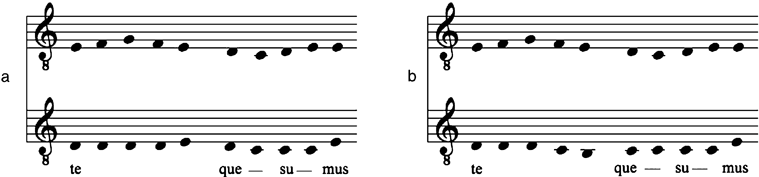
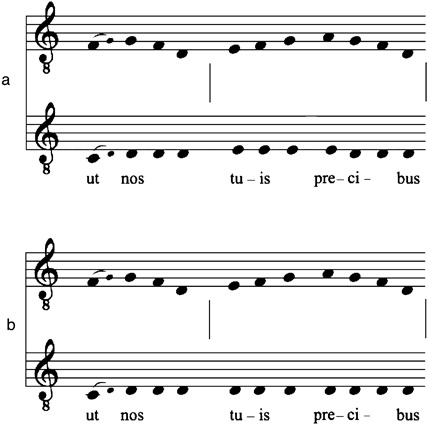
The case of the te quesumus division, where the unison is reached just after a short melisma on te, on the second note of quesumus, is particularly interesting. The vox principalis starts on E with an interval of a second with the vox organalis (D/E) then rises up a third with the same melodic movement as the antiphon's intonation (E–F–G), while the vox organalis holds the tone (D), providing a drone effect, in this way giving prominence to the melisma on te. The vox principalis then stresses the accented syllable of quesumus by a descending two-note inflection (D–C) and designs a cadence rising up to the finalis (D–E–E). As mentioned above, the unison with the organal voice (C/C) ends up being partially audible, almost lost in the flow imposed by the delivery of the word, and the vox organalis waits for the end of the sense unit to return to the finalis of the mode (E): the organal voice holds the note one step below the subfinalis (C) and by the end of the word prepares a cadence by meeting again in a unison on quesu mus, where the main phrase ends. Here, the vox organalis repeats the same melodic movement of the cadence in the Christi phrase (C–C–E), albeit in a different chant context (D–E–E vs. E–F–E), using the same cadential melodic movement that can be found later for the semper phrase, again in a different chant context (F–D–E), and also at the end of the organum on digneris, this time identical to sancte. The main purpose of the antiphon, an invocation to St Boniface, is professed by the words te quesumus (‘we beg you’) so that a sole emphasis on te might have been unnecessary and, perhaps, even confusing. Moreover, the shift of the vox organalis's held tone from D to C also enhances the textual articulation of the phrase and must have been preferred to a parallel sequence of intervals. This is why, instead of continuing to hold the tone and reaching the unison exactly at the end of the melisma by a cadence on E and starting again with a unison on the first syllable of quesumus (Example 3a), the choice was made to avoid the cadential movement and follow the chant, closing with a cadence only on the last syllable. Furthermore, another possible realisation for the vox organalis was holding the tone until it reached the interval of a fourth with the vox principalis (on the third note of the melisma on te) and then continuing in parallel fourths right to the end of the melisma, preparing the cadence on quesumus (see Example 3b), but this was avoided following the Musica enchiriadis rule that the vox organalis could not go below the tetrardus in which the phrase ends. It would also have produced a tritone imposing a flattening of a note (B) in the organal voice.
Alternative organal solutions for te quesumus
A similar consideration applies to the last phrase, gratiae Dei commendare digneris, where the two voices meet on a unison on the first syllable of gratiae. The resulting phrases would have been comparable to the sequence of intervals in the division Bonifati martyr inclite. Instead, the descending melodic contour of the te quesumus and gratiae Dei commendare digneris divisions required a unison imposed by the vox organalis's ambitus (a major third), which was not to be extended below its bottom limit. These choices reveal a lesser mobility of the vox organalis than that found in later organa. The style of Sancte Bonifati martyr may be defined as ‘archaic’; an example of an old type of organum, a generation or so before the Winchester organa.Footnote 41
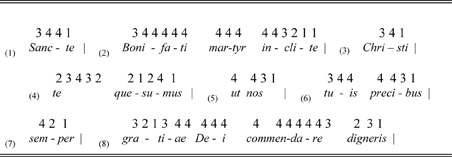
In general, the vox organalis adopts three procedures of movement in relation to the chant, recognisable as the principal stylistic characteristics also of the later Winchester repertory of organa: parallel movement in fourths, the holding of one tone against changing tones in the chant and frequent meeting with the chant on a unison. As I have discussed above, the whole organum can be divided into short sections based on one or another of these procedures. The three events follow each other in regular order as oblique movement (held tone) : parallel movement : unison. Moreover, in contrast to the musical style of the Winchester organa, in the Harley 3019 organum there is no inclusion of extra notes to prolong some cadential moments. Instead of the cadence with prolongation, an organal technique used in Winchester to create a hierarchy of cadences, Sancte Bonifati martyr employs different tools as a means to emphasise certain moments of unison meeting more than others. Unisons are reached on pitches occurring in a part of the organum where that pitch is crucial to the overall structure. The close analysis of Sancte Bonifati martyr has revealed how the frequency with which each of these is used and the points at which one gives way to another are governed by the musical and textual structure of both the chant itself and that of the composed organum. In Harley 3019, the interval relationship between the vox principalis and the vox organalis is also based on the fourth, with frequent meetings on the unison. However, some exceptions are found in incipits and cadences: the former feature an extensive use of the third (phrases 1, 2, 3, 5 and 8), while the latter produce patterns such as second : unison (phrases 2 and 7) or third : unison (phrases 5, 6 and 8) or fourth : unison (phrases 1, 3 and 4). Table 2 shows the interval patterns between the vox principalis and the vox organalis for each of the eight sections of Sancte Bonifati martyr.
Phrase articulation and sense units in the antiphon Sancte Bonifati martyr
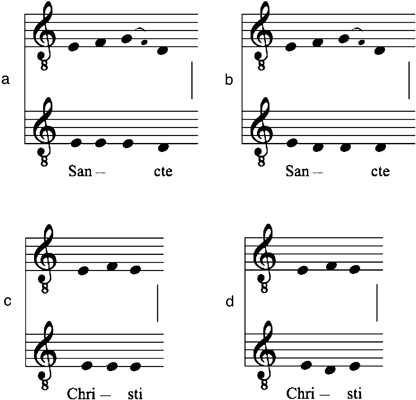
The employment of thirds in incipits is particularly significant, for it is not a common feature in early types of organum, where the unison is preferred. Indeed, alternative solutions involving a unison start would have been possible for each of these instances. However, they would have created ‘irregular’ sequences of intervals, in contradiction to basic organal techniques, as the following examples will show. The first case involves phrase 1 (sancte). Two alternative solutions would have been possible by starting on a unison instead of a third. The first solution would have involved an held E in the vox organalis which, however, would not have reached the interval of a fourth with the vox principalis before the phrase ended, meeting on a unison on D (see Example 4a). The phrase, instead, was perceived as self-contained and thus it needed the presence of a fourth in order to validate its autonomy. The phrase's self-sufficiency, possibly given by the invocatory weight of the word sancte, is also confirmed by looking at the neumatic version of the Sancte Bonifati martyr antiphon: the presence of a tractulus clearly indicated a musical caesura by an emphasis on the last sound. The second possible realisation, not so different from the actual one, would have involved starting on a unison and descending to D, thus creating a contrary motion with the vox principalis (Example 4b). Instead, what will be a common technique in later organa is here avoided in favour of a greater adherence to convention. A similar situation is found in the Christi phrase. The lack of fourths produced by a held E (Example 4c), or the contrary motion resulting in a unison : third : unison (E–D–E), would have been perceived as inappropriate and thus would have prevented the regular arrangement of this passage (Example 4d). Starting on a third was the only possible solution for the correct arrangement of intervals in the musical phrase. Once again, the presence of the tractulus on the last syllable, intensified by the preceding pes on the first syllable, rhetorically enhances the musical realisation of the word Christi.
Alternative organal solutions
To be sure, at least one other place in the organum reveals a deliberate use of the third by choice rather than of necessity. The tuis precibus phrase starts with an interval of a third (C–E) between the vox organalis and the vox principalis preceded by a unison meeting on the subfinalis (D) which closes the ut nos phrase. This last phrase features a climacus on nos in its neumatic version which, although it articulates the three descending notes in two and a final separated neume, at the same time does not suggest a strong musical caesura, as in the case of the sancte and Christi phrases. Conversely, the choice of a third to start the tuis precibus division may be seen as a vertical compensation for such a caesura. If the vox organalis had proceeded with a held E tone for the first four notes on tuis (Example 5a), or simply a D drone throughout the entire phrase (Example 5b) it would have been theoretically correct. However, a new phrase in the text begins on tuis and thus these solutions would have prevented a ‘new’, clearly audible interval from stressing the textual articulation. This set of organal techniques emphatically defines the phrase as a both textual and musical phenomenon.
Alternative organal solution for ut nos tuis precibus
The remarkable balance of adherence to convention, a term conceptually more appropriate in this context than prescriptive rules, and innovative solutions that we can identify in the Sancte Bonifati martyr organum brings us to the reflections proposed by Susan Rankin in her article The Early Theory and Practice of Organum: ‘is there really no evidence of “creativity” in examples of early organum? What was actually going on in practice?’Footnote 42 Practical sources, such as Harley 3019 and the later Winchester Troper, made evident use of procedures of the type described in Musica enchiriadis and its associated treatises, offering, at the same time, a rich scenario in which standard conventions are found alongside ways of experimentation, due also to embracing a larger repertory, which imposed new choices and musical challenges. Moreover, early medieval theory about polyphonic music usually described a picture of a practice that was, in fact, in constant flux and development. As later sources will show, we may not want to think of early organum as immutable, governed by a fixed set of rules for an unchallengeable, mechanical practice. This is why it is only through direct and accurate knowledge of organa as actually sung, as well as of the musical techniques by which they were arranged, that a clear assessment can be made of the extent to which theoretical rules actually reflected practice and of the degree of creativity exercised by the tenth-century cantores. As Rankin states, ‘theoretical rules and concepts may only be regarded as a starting point for interpretation of the practical examples, rather than as controlling and limiting factors’.Footnote 43 Evidence from the analytical examination of the musical style of the organum Sancte Bonifati martyr confirms once again that the Harley 3019 scribe recorded a procedure of which the roots belonged to a previous musico-theoretical tradition, but at the same time broke away from it by exploring new compositional paths that may have been unexpected by contemporaries; hence the need for recording this organum in written form.
A gap hitherto existed in the history of early organum as, until the discovery of the London organum, no practical sources of polyphonic music had survived from before the early eleventh century. Throughout the eleventh century, with the exception of the Winchester repertory of 174 organa, a few scattered sources, often fragmentary, contain small groups of polyphonic pieces copied as additions to monophonic repertories or scribbled on empty flyleaves, mainly associated with Chartres, Fleury, Tours and Saint-Maur-des-Fossés.Footnote 44 Only with the various Saint-Martial codices in the early twelfth century do we find polyphonic pieces assembled in a relatively systematic way.
The rex caelestium terrestrium organum: a reconstruction
The second notated piece on fol. 56v in Harley 3019 is Rex caelestium terrestrium et infernorum per crucem tuam domine salva nos propitius in perpetuum (King of all that is in the heavens, the earth and the depths, save us, O favourable Lord, for eternity through your cross). There are no extant concordances for the text and a direct relationship with the office for St Boniface will be questioned here in favour of a different liturgical use. Furthermore, the antiphon melody, notated in Palaeofrankish neumes, cannot be transcribed in a pitched version. However, it will be worth mentioning here as a possible path to follow for the reconstruction of the antiphon's melodic shape as well as for its role in the Harley 3019 annotation. Let us start in medias res by asserting that the antiphon Rex caelestium terrestium was notated along with Sancte Bonifati martyr because they were both meant to be sung polyphonically. This hypothesis, which alludes to the presence of a second, hidden polyphonic composition, is based on a series of observations. The reiterative references to Musica enchiriadis that appeared so clearly in many of the aspects of the musical annotation are too insistent not to take the treatise into consideration as a possible source of the musical material of Rex caelestium terrestium.
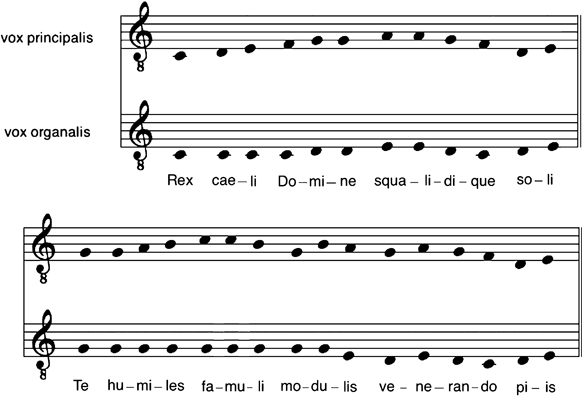
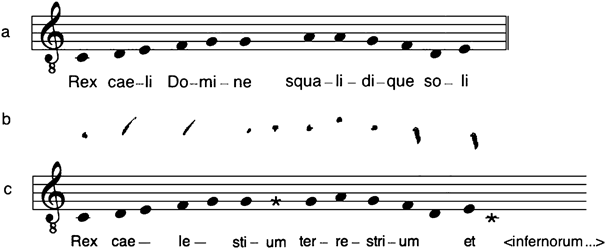
The Musica enchiriadis example of organum at the fourth Rex caeli domine is not only the most interesting piece of music in the treatise, as well as the earliest known polyphonic sequence, but it also serves as a basis for my reconstruction (see Example 6).Footnote 45 Besides the interesting textual correspondence of the two incipits which, alone, would be of too little consequence as evidence, a comparison between the melody of the first verse of the polyphonic sequence Rex caeli domine squalidique soli and that of the neumatic incipit Rex caelestium terrestium reveals remarkable similarities, as shown in Example 7. The few melodic variants have no substantial impact and can be considered as minor adjustments due mainly to a different textual underlay.Footnote 46
The organum Rex caeli Domine in Musica enchiriadis
(a) melody of the first verse of the sequence Rex caeli Domine in Musica enchiriadis; (b) neumatic notation for the antiphon Rex caelestium terrestrium (incipit) in Harley 3019; (c) a proposed reconstruction of the melody
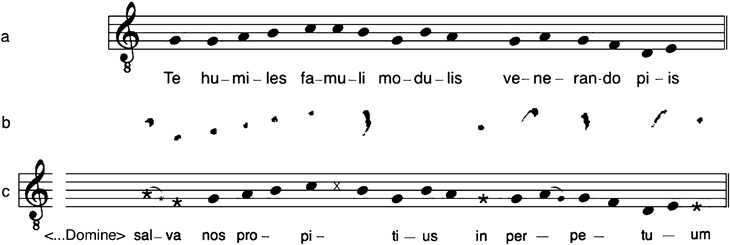
The same applies, then, to the explicit salva nos propitius in perpetuum of the London manuscript and the Musica enchiriadis example's second verse of the sequence: te humiles famulis modulis venerando piis (see Example 8).Footnote 47 The resulting transcription of the two segments of Rex caelestium terrestium with the added organal voice drawn from the treatise's example and adapted to the slightly varied principal voice, reveals a second organum elaborated partly on pre-existing musical material and adapted for the liturgy with the additional middle section et infernorum per crucem tuam domine. (See Example 9 for a reconstruction of the incipit and explicit.) Overall, the musical style responds to standard canons and extempore organal techniques.Footnote 48 In this regard, the absence of a fully written-out vox organalis in Harley 3019 accounts for the easily improvised nature of the Rex caelestium terrestrium organal voice as well as corroborating the status of Sancte Bonifati martyr as a newly composed musical work with the use of innovative and, may we also say, experimental solutions which warranted written recording.Footnote 49
(a) melody of the third verse of the sequence Rex caeli Domine in Musica enchiriadis; (b) neumatic notation for the antiphon Rex caelestium terrestrium (explicit) in Harley 3019; (c) a proposed reconstruction of the melody
A possible reconstruction of the incipit and explicit of the antiphon organum Rex caelestium terrestrium
The provenance of harley 3019: a reading of the evidence
The problem of assessing the annotation's provenance deserves to be treated separately here. Several clues can help us to determine a possible place of origin for the Harley 3019 fascicle and its musical annotation: some are formal and some are textual. The palaeographical evidence, for both the music and text, will constitute the main point of departure for the analysis of the formal hints, while the Vita Materniani, the addition qui colitur kalendae decembris at the end of the explicit and the Sancte Bonifati martyr antiphon are those pertaining to the textual level. We may start with the first group and subsequently refine our considerations with the aid of the second type of evidence. First, the script of the Vita Materniani, as well as that of the two antiphons, is a type of Carolingian minuscule which bears no particular features pointing to a precise copying centre. However, it has already been remarked that it is possible that it was written in the northern Rhine region during the first half of the tenth century. This indication circumscribes an area corresponding approximately to the modern north-eastern France and part of north-western Germany. Despite a difference in style between the hand of the vita and that of the musical annotation, the estimated provenance is valid for both hands. The latter is more elegant than the former, but this feature is not so sharp as to suggest a very different geographical provenance.Footnote 50
Secondly, the presence of Palaeofrankish neumatic notation confirms the fascicle's provenance in the same area where the main text might have been written. At the time, among major monastic communities in which it has been suggested that Palaeofrankish notation was employed, there were Anchin, Beauvais, Marchiennes and St-Amand in the western portion of this region, and Cologne, Corvey and Werden in the eastern portion. Naturally, we should not exclude a different provenance, since we are far from knowing the precise geography of Palaeofrankish notations. I have already pointed out the morphological differences between the Harley 3019 neumes and those commonly associated with St-Amand, revealing a similarity to north-western German sources such as the Düsseldorf manuscripts and Wolfenbüttel Gradual fragments rather than the manuscripts associated with north-eastern France. To put it in Arlt's terms, these are Eastern Palaeofrankish neumes, rather than Western Palaeofrankish neumes.Footnote 51
It seems that the hand that wrote the rubric qui colitur kalendas decembris at the end of the Vita explicit is not the same as the one that wrote the text of the musical pieces: the ink of the rubric has a slightly darker shade and the only two comparable morphological elements (capital ‘R’ and the common mark of abbreviation) show remarkable dissimilarities. Irrespective of the multiplicity of scribes involved,Footnote 52 one might be entitled to assume, in the lack of evidence pointing to the contrary, that such additions would not point to completely different regions. It is with this working hypothesis in mind that we might introduce the following considerations.
Usually, St Maternianus is celebrated on 30 April.Footnote 53 However, the introduction to the Life of Maternianus in the Acta Sanctorum contains an important indication.Footnote 54 According to the commentary, the life of St Maternianus edited by the Société des Bollandistes was contained in a Passional from Bodeeken abbey (Bodecensis coenobii) in the diocese of Paderborn, just a little to the east of the major centres of eastern Palaeofrankish notations listed above. There, St Maternianus was included in the section corresponding to the month of December. The Passional, it continues, was without doubt (haud dubie) copied from an older source from Egmond abbey (ex vetustiori Egemondani monasterii Codice desumpta),Footnote 55 in Frisia, where St Maternianus also used to be celebrated in December; possibly (credo) to commemorate the translatio of his body to the abbey (ob memoriam facta ad eum locum translationis) by Hincmar of Reims, whereas in Reims itself the dies natalis was taken to be the 30th of April.Footnote 56 The association of Maternianus with the month of December thus points to a geographic region similar to that associated with Palaeofrankish notation, in the northern Rhine region, only stretching more widely to include Frisia to the west and the Paderborn diocesis to the east.
The other textual clue comes from the content of Sancte Bonifati martyr itself. Saint Boniface (c. 672–5 June 754), the Apostle of the Germans, was an Anglo-Saxon missionary who propagated Christianity in the Frankish Empire during the eighth century, later becoming the patron saint of Germany and the first archbishop of Mainz, widely commemorated in Germany.Footnote 57 Although this makes it difficult to pinpoint a specific centre, it reinforces the palaeographical argument for an Eastern Frankish, rather than Western Frankish, provenance.Footnote 58
Finally, we are left to consider the connection of the text of Sancte Bonifati martyr with the Office for St Vitus, which makes it possible to define a geographical proximity with the area emerging so far. In 756, the relics of St Vitus were brought to the monastery of Saint-Denis by Abbot Fulrad. They were later presented to Abbot Warin of Corvey in Germany, who solemnly transferred some of them to this abbey in 836. From Corvey the veneration of St Vitus spread throughout Westphalia and in the districts of eastern and northern Germany. In particular, Corvey is among those centres associated with the eastern type of Palaeofrankish sources such as MSS Düsseldorf, Universitätsbibliothek, D.1 and D.2. Without allowing for precise localisation, all of the preceding arguments are concordant in pointing to north-western Germany as the place where the annotation on fol. 56v of Harley 3019 was conceived and written.
Let us review briefly the evidence for such claim. It goes without saying that it would be desirable to substantiate it further by deeper liturgical and historical analysis. A few centres have been identified which celebrated the cult of St Maternianus in December: Bodeeken in the diocese of Paderborn and Egmond in Frisia (now diocese of Haarlem). Furthermore, St Boniface's cult was celebrated throughout Germany but with a particular connection with the Abbey of Fulda, where he was martyred, and with the historical region of Frisia. Moreover, St Vitus, whose Office shows textual similarities with Sancte Bonifati martyr, was also celebrated in the area comprising the main centres of Saint-Denis and Corvey, where Palaeofrankish notation is thought to have been employed. Liturgical information thus agrees with both textual and musical palaeographical observations, leading to the conclusion that the Harley 3019 annotation was written in the first half of the tenth century in an area which I suggest to be modern day north-western Germany.Footnote 59
The birth of European polyphony is an aspect of music history which has been discussed extensively since the very early days of modern musicology. One of the reasons for this is, of course, the lack of original source material: an issue which is, in turn, the object of divisive argumentation. That the sporadic nature of written sources of polyphony reflected its wide and usual practice is unquestionably still to be determined. The discovery of a new source of polyphonic music is an exceptional event, which requires cautious preliminary analysis. Moreover, writing on the origin of an undated, unattributed and partially untranscribable unique musical annotation is all the more challenging, taking into account the relevant debates, which may hardly be answered in the space of a single essay. Out of the broad range of different approaches and investigations that might have been followed here, the path chosen was the palaeographical and musical analysis of the Harley 3019 organum and antiphons, in order to offer a general contextualisation of the London source in the history of polyphonic practice.
A carefully laid-out annotation on the blank space left at the end of an early tenth-century Passional offers interesting textual and notational comparisons with other similar sources. Palaeofrankish neumatic notation has been compared with existing examples and has revealed connections with north-western German sources. It has also shown a definite concern with nuances of delivery, which suggests a close relation to a practical context. The same musical features emerged from the study of the organum notation, a specific elaboration of the group of cithara notations found in earlier and contemporary music treatises, for which only one later similar example survives (Paris, Bibliothèque nationale de France, lat. 7202, fol. 56r). At every turn, the stylistic analysis has confirmed Sancte Bonifati martyr as an example of an early type of organum. Although the two voices aim at relative independence, the polyphonic arrangement of an antiphon melody is consequently abridged and less articulated than later examples, e.g. the tropes and organa from Winchester. Moreover, a second, hidden organum, Rex caelestium terrestrium, has been brought to light, its compositional practice examined and partially reconstructed. Therefore, one can safely document the existence of a practice of written polyphonic music in the early tenth century, in which techniques such as those described in the Musica enchiriadis and its related treatises blend with innovative organal solutions. This provides new perspectives on the development of the techniques of making liturgical music.
Nevertheless, some questions do still linger: to what extent may one label these organa compositions stricto sensu, therefore conceiving of them as the result of bringing together different musical entities? In making this kind of music, what was the exact role of writing? Did it act as a compositional tool? Are the two organa the product of a single cantor or of a collective practice? Can one differentiate between individual and collective products in such a context, based on musical materials alone? Unfortunately we are, as yet, unable to give any definitive answers to such questions. Let us conclude on a positive note, however. This discovery is certainly bound to change our perception of the early practice of organum as based on more than a century of musicological scholarship. What stands out here is a written example of tenth-century organum practice, a small link between two milestones for early medieval music history, the Musica enchiriadis and its related treatises from the late ninth century, and the early eleventh-century organal practices, as represented by the large collection from Winchester as well as Guido's Micrologus. The musical and textual elaborations represented by these two organa constitute vivid examples of the ways in which musical and liturgical practices in the Carolingian Empire were evolving, in constant transformation, around the year 900.