1 Introduction
Throughout Old English (OE), weorðan ‘become, be’ is ranked the fifth most frequent verb overall, with about 1,500 occurrences per million words (pmw) (see Petré & Cuyckens Reference Petré, Cuyckens, Gotti, Dossena and Dury2008 for a more detailed frequency overview). The verb is particularly common as an alternative to the cluster is/beon (present – on their distribution, see Kilpiö Reference Kilpiö, Rissanen, Kytö and Palander-Collin1993) and wesan (past). All of them were used mostly as copulas or as auxiliaries of the passive, but they could also be used intransitively, meaning ‘happen, occur’ or ‘exist’.Footnote 2Weorðan denotes a change of state (as in (1)) while the various other verbs with which it alternated usually simply denote a state (as in (2)). However, in some cases there is no obvious semantic distinction between them, and both can be translated by be (as will be illustrated below).
(1)

(2)

In Middle English (ME), weorðan initially continues to be used, but already from the start decreases in use, and by the end of the fourteenth century its frequency has dropped to less than fifty occurrences pmw (see Petré & Cuyckens Reference Petré and Cuyckens2009: 355). Instead of weorðan, a variety of devices are used from ME onwards, among them newly developed copulas of change such as become or wax, as well as simply be, but also occasionally alternative expressions with begin (to) V and be made/done XP.
In this article, I present an account of this mysterious disappearance of weorðan. After a brief overview of some previous studies (section 2), section 3 sets out a new approach to the problem, taking as its starting point the importance of narrative language use, a genre that is particularly frequently realized in the past tense. Under the assumption that developments in the way a narrative is syntactically realized may eventually affect the behaviour of all past tense use and differentiate it from the present tense, the analysis focuses on the differences in distribution between the indicative past tense of weorðan and wesan (which will be referred to by the third-person indicative forms wearð and wæs respectively). Section 4 introduces the typological distinction between bounded language use, which typically divides up a narrative in completed temporal segments, and unbounded language use, which tends to express narrative action as ongoing within the frame of a prolonged now, and introduces the hypothesis that a crucial link exists between the breakdown of bounded language use in English and the loss of weorðan. Section 5 is devoted to testing this hypothesis through a detailed analysis of the distribution of wearð and wæs, on the basis of a corpus specially compiled for this purpose. Unlike wæs, wearð prefers main clauses, in which the main narrative action is usually represented. Also, wearð co-occurs significantly more often with time adverbials that mark progress in the narrative, and whose frequency drastically decreases during ME. Finally, wearð is used significantly more often in inverted clause constructions, a type of construction that is also typical of the bounded language use of OE. Together, these preferences show that the fate of wearð is tied up with that of an OE system of boundedness.
2 Previous studies
The only scholar so far who has focused on the loss of the copula weorðan (with adjectival and nominal subject complements) is Biese (Reference Biese1932, Reference Biese1952), who explained the loss of the copula weorðan rather succinctly as a consequence of competition with the much more frequent beon as well as its replacement – whenever beon was not suitable semantically – by more expressive verbs such as wax or grow.
By contrast, a wealth of studies exists that is devoted to wesan and weorðan in the passive construction, as well as to their differences and development (Frary Reference Frary1929; Zieglschmid Reference Zieglschmid1930; Kurtz Reference Kurtz1931; Klingebiel Reference Klingebiel1937; Mitchell Reference Mitchell1985; Kilpiö Reference Kilpiö1989; Green Reference Green2009; Müller Reference Müller2009). Early on, Frary (Reference Frary1929) and (Kurtz Reference Kurtz1931) argued that the two verbs are basically in complementary distribution: wesan was used for statal passives and expressed states resulting from previous actions with present relevance (resultative, as in (2)) or with past relevance (pluperfect); weorðan was used for actional passives, focusing on the event itself (as in (1)). In their view the functions of both verbs do not overlap at all. Because of this lack of competition between the verbs, these studies fail to give a language-internal account of the loss of weorðan – i.e. one that is not limited to interference by contact with another language but maps the mechanisms of change taking place within the language itself. Instead, they are forced to appeal to external influence from either Scandinavian or Latin. Zieglschmid (Reference Zieglschmid1929), however, points out that wesan and beon (perhaps not so much is; see Petré & Cuyckens Reference Petré and Cuyckens2009) were used in actional passives in all the older Germanic languages. On these grounds Klingebiel (Reference Klingebiel1937) concludes that the uses of wesan/beon and weorðan do overlap and that these verbs are involved in some kind of language-internal competition in OE.Footnote 3 Mitchell (Reference Mitchell1985: 324) goes even further, and maintains that the two were in free variation, as is illustrated by (3), where they both express an actional passive with seemingly no difference in context whatsoever.
(3)
Under this assumption, a straightforward explanation for the loss of weorðan is that it was gradually ousted by the far more frequent wesan. This is, for instance, what is expressed by Wattie, who calls the ‘redundant’ presence of weorðan the ‘only false start’ in the OE tense system (Wattie Reference Wattie1930: 143). More recently, however, Kilpiö (Reference Kilpiö1989: 85) shows that their existence side-by-side is not entirely redundant by pointing out the preference of weorðan for sudden changes, which are often negatively connoted (like dying, getting slain, angry etc.), or important actions, as pointed out by Müller (Reference Müller2009). Müller (Reference Müller2009) has also worked out the idea of loss through competition in more detail. His analysis deserves some attention because it assumes that the aspect of passive weorðan at some point shifted from perfective to imperfective (durative), contrary to my own analysis presented in this article, which relates the loss of weorðan precisely to its exclusively perfective use in bounded contexts. Müller's analysis goes as follows. Wesan was used mainly to express resulting states or pluperfects, in which cases it is arguably more like a copula (combined with an adjectival participle) than a passive auxiliary. However, it was also sometimes used in contexts that seemed to express durativity. This is made particularly clear if a durative adverb accompanies the passive construction, as in (4).
(4)
Weorðan did not occur in durative contexts such as these. However, at some point weorðan seemed on the verge of extending its scope to durative contexts as well. From this point onwards, according to Müller, weorðan was fated to disappear, as this extension brought about bleaching of its prototypical semantics of sudden change to such an extent that it lost its reason for existence vis-à-vis the much more frequent wesan. Müller gives the following examples in support of his claim (the first originally appeared in Denison Reference Denison1993: 419).
(5)
(6)
(7)
None of these examples is particularly convincing, however. (6) is very doubtful, as it only involves durativity of the event preceding the weorðan-clause. In (5) the sense of ‘get in the state of being besieged’ might still have been the intended one, in which case swa lange, etc. could be interpreted as an afterthought concerning the duration of the siege (as already suggested by Frary Reference Frary1929: 41). Finally, unlike the example with wesan in (4), the duration involved in (7) is limited by an opening boundary (‘from the beginning of this world’) and a terminal boundary (the time of speaking). Unlimited duration, or real imperfectivity, as expressed in (4), is never expressed by weorðan. Moreover, closer scrutiny of the available OE material shows that weorðan expressing limited duration is not limited to the passive, and that its frequency of use does not increase over time but is found (equally rarely) from the earliest OE texts onwards. An early non-passive instance is given in (8). The earliest passive I have found dates to c.950 and is found in Met: 26.98.Footnote 4
(8) Hu Gaius wearþ casere iiii gear.
‘How Gaius became/was/remained emperor four years.’ (c.925. OrHead: 6.3)
Finally, the phenomenon remains exceedingly rare throughout OE and early ME, with only 7 clear instances out of 1,334, or 0.5 per cent, in my corpus (an overview of the corpus is given in section 5.1). In sum, it seems very unlikely that a peripheral use such as the durative one could have had such a great effect on weorðan as a whole.
3 A different approach
All of the studies discussed in the previous section argue that (passive) weorðan was lost due to its (existing or developing) overlap and subsequent competition with the far more frequent is/beon/wesan. However, the way in which they use the notion of competition as an explanation is not very convincing. Even if overlap of use is not uncommon in the passive (compare the seemingly synonymous uses of weorðan and wæs in (3)), it is overall a peripheral phenomenon, as shown in particular by my discussion of Müller (Reference Müller2009) on durative uses of weorðan. While overlap between function words is found everywhere, the prototypical semantics of two competing items may still remain clearly distinct (Geeraerts Reference Geeraerts and Albertazzi2000: 88–9), and this may help explain their existence side-by-side. My own approach is therefore almost opposite to these previous studies and assumes that functional overlap cannot fully explain why one form ousts another (even if it is a condition for one form to take over the functions of the other). Instead, I will show that a more important part in this process of replacement is taken by frequency of core uses of each form. The core uses, as will be seen, crucially correlate with a certain group of clausal structures or constructions, which together constitute a grammatical system of boundedness in Old English (as explained in the next section). These correlations entail that these core uses stick to these particular constructions, like cognitive chunks, and that their combined usage is equivalent to what Langacker calls entrenched structures (Reference Langacker1987: 59). (A simple example of this phenomenon is an idiomatic expression.) While high frequencies have been evoked in explaining stability of function words or morphemes (e.g. Bybee Reference Bybee, Joseph and Janda2003), a high degree of association between a frequent function word and a certain group of constructions can overrule this stability principle if these constructions are gradually lost from the language, a phenomenon that has been so far largely ignored in the literature. This is precisely what happened to wearð, when the Old English system of boundedness was all but lost by the end of the fourteenth century. Footnote 5
A major reason why previous studies failed to perceive the importance of this association lies in their limitation to weorðan in either the passive or the copular use, and their treatment of the passive auxiliary weorðan, the copula weorðan and the intransitive verb weorðan as three different verbs. But in fact they are one. An elegant way of capturing their unity is provided by constructionist frameworks, in particular that of Croft (Reference Croft, Vogel and Comrie2000, Reference Croft2001), but also Goldberg (Reference Goldberg1995, Reference Goldberg2006). According to construction grammar, ‘syntactic categories . . . are derivative from the constructions that define them’ (Croft Reference Croft, Vogel and Comrie2000: 85), with constructions being syntactic or morphological patterns that combine a certain form with a certain meaning. Thus a word is only a ‘passive auxiliary’ by virtue of its occurrence in a passive construction, and it is the construction as such which adds auxiliary status to the verb, and something similar holds for copula and copular construction (see Petré & Cuyckens Reference Petré and Cuyckens2009 for more details). In other words, weorðan need not be three different verbs only on the basis of its occurrence in three different constructions. Indeed, its prototypical semantics remains the same throughout these constructions and is simply ‘change of state’. This meaning is discernible most of the time in passive constructions, and it is the prevailing one in other uses. Examples of wearð as contrasted to wæs, which does not have this semantics, in a copular construction are given in (9) and (10) and in an intransitive construction in (11).
(9)
(10)
(11)
Moreover, the pervasiveness of a single sense of weorðan is also reflected by the combined use of different constructions in which the verb is used, as for instance the copular and the passive construction. While it might be expected that participles because of their adjectival properties can be freely co-ordinated with adjectives, such co-ordination in fact only occurs following weorðan, as in (12). This also suggests that the copular and passive uses of wæs were already separately represented in speakers’ grammar of Old English (see Petré & Cuyckens Reference Petré and Cuyckens2009 for a more detailed account).
(12)
In the sample of indicative past tense wearð up to 1350, there are fourteen instances of adjective–participle pairs such as the one in (12), or 1.8 per cent of all instances, against not a single one in the case of wæs.
On the basis of these observations, a separate treatment of passive, copular and intransitive constructions involving weorðan does not seem justified. Instead, weorðan has to be treated as a single lexeme, and mechanisms have to be looked for that had an effect on all of its uses. Special attention will therefore be given to those properties that hold across all construction types in which the verb occurs.
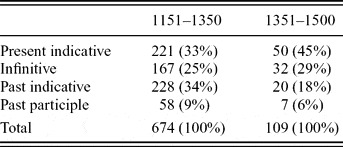
This is not to say that the properties of weorðan cannot vary according to the context in which the verb occurs, but differences in complement type are arguably not very significant contextual parameters. A contextual distinction for which there is evidence that it is more likely very significant is that between the past and the present tense. Some studies mention this distinction, but it has never received due attention. Recently Wischer (Reference Wischer2006) has discussed the emergence of the periphrastic future in English with will/shall + infinitive and the concomitant loss of weorðan as a marker of future tense, which is, naturally, confined to its present tense instances.Footnote 6 Much longer ago, Wandschneider (Reference Wandschneider1887: 7) – in a paper discussing the syntax of Piers the Plowman, and not about weorðan at all – pointed out that the past tense use of weorðan is lost earlier than the present tense use. The difference is also clearly revealed by my own corpus data. Table 1 shows the difference in tense distribution of the instances of weorðan in early ME and in late ME (for the latter period I have complemented the corpus described in section 5.1 with texts found through the MED, s.vv. worthen and iworthen and the OED online, s.v. worth, v.2).Footnote 7
Past and present tense of weorðan

Table 1 clearly shows that the past tense (indicative and participles) of weorðan fell into disuse more quickly than did the present tense. In early ME, weorðan was still distributed evenly between past and present tense, whereas in late ME the present tense is about three times as frequent as the past. The loss of wearð in the past tense, moreover, is fairly evenly spread among its functions, and passive, copular and intransitive uses were all lost roughly about the end of the fourteenth century. The last productive attestations of wearð both with a participle and in its copular use are found in John of Trevisa's Higden, a southern text which the MED dates to a.1387.
An explanation for the different behaviour of past and present tense is provided by genre studies. Past tense in written language is frequently used for the narration of a series of events, that is, for storytelling. The association between past tense and ‘narrative action’ has been shown to be statistically significant (Biber Reference Biber1991: 108). Present tense is only rarely used for this purpose, and is used mainly in genres such as instruction or exposition. It is only to be expected that, when the communicative goals of past and present tense differ so widely, the mechanisms that have an impact on their use will differ as well. Together with the different pace with which weorðan is lost in the past and the present tense, these are sufficient reasons to restrict myself to an account of the loss of weorðan in the past tense.
4 Bounded and unbounded language use
An important distinction related to the narrative genre, and which will be highly relevant for explaining the loss of wearð, is that between bounded and unbounded language use. Basically, bounded language use construes situations with the inclusion of their goal or endpoint, and often serves to mark progress in a narrative (e.g. then he walked over to the other side). By contrast, unbounded language use construes situations as open-ended, often by means of progressive aspect (e.g. he was walking about) (Declerck Reference Declerck2007). In recent psycholinguistic studies (Carroll & von Stutterheim Reference Carroll, von Stutterheim and Ramat2003; Carroll & Lambert Reference Carroll, Lambert, Dimroth and Starren2003; Carroll, von Stutterheim & Nuese Reference Carroll, von Stutterheim, Nuese, Pechmann and Habel2004), it is argued that both types of use are not freely available in a language-independent fashion. Grammatical form is not viewed as a separate system which is independent of meaning, but as one which incorporates a system of meanings which is treated in a given language as prominent in the conceptualization of states of affairs (Carroll et al. Reference Carroll, von Stutterheim, Nuese, Pechmann and Habel2004: 185). Crosslinguistic diversity consists less in what it is possible to specify than in the relative ease with which meanings can be specified. Depending on the availability of certain grammaticalized constructions, some languages, such as German and Dutch, show a strong preference for bounded construal of events, while other languages, such as Present-Day English or Arabic, more easily make use of unbounded construal.
Indeed, speakers of either of these languages, when asked to describe a narrative sequence (when watching, for instance, a short animation film), tend to construe this sequence very differently. For instance, speakers of German divide the narrative action up into a sequence of temporal segments, each requiring an explicit temporal marker, like Auf einmal, dann in (13a) below. Temporal anchors like these serve to set the topic time (or temporal topic). Topic time is the time span about which an assertion is made (Klein Reference Klein1994: 3). By defining topic time, these temporal adverbials co-bound (together with markers of perfectivity and/or goals/endpoints) the event described in the clause containing them: the action is construed as reaching its endpoint or goal within the time span defined by the topic time. These time adverbials also often provide a link to the preceding clause, and as such typically fill the first slot in their own clause. At the same time they also create a ‘time after’ the bounded event and with this the conditions for opening up a new interval on the time line (temporal shift). The effect of temporal shift is that a sequence in strict terms is created in which each situation is completed before the next one begins.
(13)
In the narrative sequence given in (13a), the first event is bounded by auf einmal ‘suddenly’, which sets a brief interruption of an unexpressed ongoing situation as the topic time of the event ‘hear the dripping of water’. The second one is bounded by dann ‘then’, which sets as topic time the time span starting after the hearing event and ending with the giving way of the sand. Following these time adverbials, the finite verb remains in second position (so-called verb-second syntax), and the subject usually follows this finite verb (inversion). This subject defines a second topic, which is usually the protagonist that remains constant throughout the narrative action. The perspective taken in bounded language use can be compared to a camera looking through the eyes of the protagonist, who experiences a narrative action as a series of bounded (complete) events.
By contrast, Present-Day English (PDE) makes abundant use of unbounded construal in describing narrative sequences, as is illustrated in (13b) above. Besides sequences such as those of (13b), Present-Day English preserves the possibility of construing an event as completed or bounded, depending on the viewpoint of the speaker (see Smith Reference Smith1997: 92–4; Carroll & Stutterheim Reference Carroll, von Stutterheim and Ramat2003: 378). For instance, bounded language use remains the normal way of construing first person narratives (where by default the speaker is a participant in what happens). However, Carroll et al. (Reference Carroll, von Stutterheim, Nuese, Pechmann and Habel2004) show that the syntax and grammaticalized constructions of Present-Day English encourage unbounded language use. Unbounded language use typically makes use of a rigid subject-initial syntax, and the subject is the only structural topic available. It is usually identified with the most agentive participant (a natural topic) in the event expressed in each clause, which is not necessarily always the protagonist. There is no structurally required slot for defining topic time, and the events that are conceptualized are anchored to a single point in time which is maintained throughout the event. Each event is described in unbounded terms by means of progressive aspect (hearing, digging, caving in). Topic time implicitly remains the same throughout, and the time span covered by the events is either simultaneous with topic time or is included in it. In the example given in (13b), topic time is not conceptualized at all, but rather it is a prolonged now. All the events described are construed as being included in this now, and this is achieved by the use of the progressive, which denotes events that are ongoing in such a now. The perspective taken in unbounded language use, then, can be compared to filming from a bird's eye view (Carroll et al. Reference Carroll, von Stutterheim, Nuese, Pechmann and Habel2004: 190).
In sum, the differences in present tense descriptions are the following. Speakers of Present-Day English opt for a progressive form in their descriptions, linking them to an implicit topic time. Speakers of German usually construe a narrative action as a series of bounded, perfectively construed events, and they may altogether lack an expression for the progressive. Instead, they prefer anchoring in time (and space), which is normally realized through adverbs like dann filling the first slot of the clause. Past tense descriptions less easily give in to unbounded construal strategies, because bounded construal is probably more accessible as a consequence of the completedness of the events in reality. Accordingly, German need not change its strategies and behaves exactly the same in the past tense. Present-Day English, however, makes use of a hybrid system in the retelling of an event: bounded construal is still fairly common, but unbounded strategies regularly creep in, for instance by making use of inchoative constructions (start Ving) or switching to unbounded progressives in the present tense (Carroll et al. Reference Carroll, von Stutterheim, Nuese, Pechmann and Habel2004: 204–11). A preference for unbounded construal in real-time descriptions therefore also correlates to syntactic strategies in retelling past events that are different from default bounded construal.
OE was much like modern German. This is evidenced in a number of properties, which I will refer to as the bounded system of OE. First, OE lacks a grammaticalized progressive construction. While OE already possessed the be + Vende construction, the predecessor of the PDE be + Ving construction, only in a minority of its occurrences did it express progressiveness (Killie Reference Killie2008). Second, OE grammar is fine-tuned for the bounded construal of events. This is evidenced in its word-order rules and its stock of time adverbials to establish topic time. The most grammaticalized of these adverbials is þa ‘then (particular point in time)’, which (similarly to German dann and Dutch toen) chops up a narrative into temporal segments, foregrounding actions within that narrative (it has therefore been called an ‘action marker’ by Enkvist Reference Enkvist, Kastovsky and Szwedek1986). As in German, time adverbs are often put in the first position in main clauses, the verb being in second position (verb-second syntax) and the subject inverted. In OE though, most time adverbials only trigger inversion if the subject is not a pronoun. The exceptions are þa (and þonne, which however mainly has non-narrative functions), which are the only two that consistently trigger inversion when in first position, even with pronominal subjects (Los Reference Los2009: 103; Westergaard Reference Westergaard2009: 74).
The bounded system of OE is illustrated by the biblical fragment (from the Prodigal Son) in (14) – and note that there are no fewer than three occurrences of wearð in this fragment.
(14) Đa æfter feawa dagum . . . se gingra sunu . . . ferde wræclice on feorlen rice, & forspilde þar his æhta lybbende on his gælsan. Đa he hig hæfde ealle amyrrede þa wearð mycel hunger on þam rice & he wearð wædla . . . Þa beþohte he hine & cwæð, Eala, hu fela yrðlinga on mines fæder huse hlaf genohne habbað. . . Ic. . . fare to minum fæder, & ic secge him, Eala fæder,. . . do me swa anne of þinum yrðlingum. & he aras þa & com to his fæder, & þa gyt þa he wæs feorr his fæder he hyne geseah & wearð mid mildheortnesse astyrod.
‘Then after a few days . . . the younger son . . . travelled abroad to a far country, and wasted there his possessions living a life of pleasure. When he had wasted them all, then a great hunger came over the country & he became a beggar . . . Then he thought to himself and said: “Why, how many servants in my father's house have enough bread . . . I . . . will go to my father, and I will tell him: hey father, . . . take me as one of your servants.” And he arose then and came to his father, and when he was still far from him his father saw him and was stirred by mercy.’ (c.1025. Lk (WSCp): 13–20)
In (14), a variety of time adverbials (in italics) serve to establish topic time and divide the story into segments: ða æfter feawa dagum ‘then after a few days’, ða he hig hæfde ealle amyrrede, þa ‘when he had wasted it all, then’ (causing inversion as well), etc.
PDE lost these time adverbials and verb-second syntax that encouraged bounded construal. Instead, it has the progressive, which encourages unbounded construal. Hence, a transition from one system to the other must have occurred somewhere in between. Van Kemenade, Los & Starren, in an ongoing project (started Reference Kemenade and Westergaard2008, as described in van Kemenade et al. Reference Kemenade, Los and Starren2008), suggest that English develops its preference for unbounded construal in Early Modern English. It is at this time that both SVO word order and the progressive be Ving construction are established, two processes which largely seem to run in parallel (Denison Reference Denison1993; Killie Reference Killie2008). However, there is evidence that the rigid bounded system of OE had largely disappeared already by the end of the fourteenth century. First, the transparency between syntax and information structure originally present in the system of verb-second starts to break down from 1300 onwards (see van Kemenade & Westergaard Reference Kemenade and Westergaard2008) – I will return to this in more detail in section 5.5. Second, there is the rapid decrease of the most typical bounding adverb þa and the obligatory inversion co-occurring with it. Already in the early ME of the thirteenth century, þa (realized as tho in ME) is significantly less frequent than in late OE, and in the course of the fourteenth century, its use becomes exceptional (van Kemenade & Los Reference Kemenade, Los, Kemenade and Los2006: 243–4; Westergaard Reference Westergaard2009: 93–4, where it is shown how main clauses with initial þa (tho)/þonne decrease from about 36 per cent of all main clauses in OE to 15 per cent in early ME and 11.3 per cent in late ME).Footnote 8
The breakdown of the bounded system of OE, and its immediate impact on wearð, can be illustrated by comparing the OE Bible fragment in (14) to the ME counterpart in (15), as found in the Wyclif Bible.
(15) And not aftir many daies . . . the ȝonger sone wente forth in pilgrymage in to a fer cuntre; and there he wastide hise goodis in lyuynge lecherously. And aftir that he hadde endid alle thingis, a strong hungre was maad in that cuntre, and he bigan to haue nede . . . And he turnede aȝen to hym silf, and seide, Hou many hirid men in my fadir hous han plente of looues . . . Y schal . . . go to my fadir, and Y schal seie to hym, Fadir . . . make me as oon of thin hirid men. And he roos vp, and cam to his fadir. And whanne he was ȝit afer, his fadir saiȝ hym, and was stirrid bi mercy. ((c.1384). WBible(1) (Dc 369(2): Luke 15.13–20)
Narration in (15) still mainly proceeds by means of bounded construal, but bounding adverbials signalling topic time have decreased, and an unbounded construction (he bigan to haue nede ‘he began to have need’) has crept in. Importantly, the language of (15) illustrates that the highly grammaticalized way of construing bounded events has been lost. Specifically, þa ‘then’ and verb-second syntax are entirely absent in this late ME version – and so is wearð.
Simultaneously with this breakdown the construction be Vende starts to grammaticalize as an unbounded marker of progressiveness during ME. While it is true that the be Ving construction became fully grammaticalized in this function only in EModE, in which period it also became frequently used to set the topic time maintained throughout the description of the events (the framing use of the progressive, as in while they were Ving, . . .), a recent study by Killie (Reference Killie2008: 80) suggests that this function may have been already more fully developed by late ME than assumed by van Kemenade et al. (Reference Kemenade, Los and Starren2008). Admittedly, the data in Killie (Reference Killie2008) still contain relatively few instances of the focalized use of the be + Vende/ing construction (the use in (13b)). However, this is probably due to its primary use in present tense (real-time) descriptions. As stated earlier, it is easier to maintain the use of unbounded structures in real-time descriptions (with the ongoing now as the topic time) than in retellings of past events. Unfortunately, real-time descriptions – or more accurately, since we are dealing with written material, imitations of such descriptions – are heavily underrepresented in the surviving ME material. Better evidence for the development of unbounded construal already in ME is found in the changes taking place in what I call the ginnen-class, containing the verbs onginnan, aginnan, beginnan and ginnan. In OE onginnan (and, less frequently, beginnan) with bare infinitive probably did not have an ingressive meaning but instead was primarily used as a perfectivizing auxiliary (Los Reference Los, Fischer, Rosenbach and Stein2000). However, from late OE onwards the ingressive use rapidly gains ground. This holds especially for beginnan, which was much more popular in ME than in OE, and which Brinton argues to be ingressive as a rule (see Brinton Reference Brinton1988: 116, 161; Los Reference Los, Fischer, Rosenbach and Stein2000: 256). Verbs of the ginnen-class, if used ingressively, focus on the onset of a new situation and, by implication, on the ongoing (unbounded) character of that situation after it has started. In this respect they differ from weorðan, which focuses on the transitional process itself from one state into another one, including the end result.Footnote 9 Ingressive verbs like begin, now, are frequently found in past tense retellings of events as a counterpart to the progressive in present tense descriptions, and their use seems to be more frequent in unbounded languages (Carroll et al. Reference Carroll, von Stutterheim, Nuese, Pechmann and Habel2004: 206). Their increase in ME, therefore, is a clear indication that ME has a higher preference for unbounded constructions than OE.
Occasionally, inchoatives also replace weorðan, thus illustrating in what way the loss of weorðan might indeed be related to the grammaticalization of unbounded constructions. One example of such a replacement has already been given above in (15), where bigan to haue nede ‘began to have need’ has replaced wearð wædla ‘became a beggar’. A similar difference between OE (16) – which also contains þa – and ME (17) – which lacks a bounding time adverb – appears in two versions of Exodus.
(16)
(17) But sum therof lafte vnto the morwen, and it biganne to boyle wormes, and stonk.
‘But some of them left until the morning, and it began to spawn worms, and stank.’ (a.1425(a.1382). WBible(1) (Corp-O 4): Ex.16.20)
The underlying Latin Vulgate source twice has a form of coepio (see e.g. Tweedale Reference Tweedale1598). Apparently, the OE translators were highly unwilling to translate an unbounded inchoative construction with a direct OE equivalent, and this shows how strongly grammaticalized bounded construal in OE was. The occurrence of begin in the ME version is somewhat less conclusive, since the translation may be literal, and a more detailed study of non-translated prose would be necessary to shed light on the status of inchoatives in ME. But at least it shows that ME grammar was less averse to the use of inchoative constructions than was OE.
5 Wearð and boundedness
5.1 Introduction
In this section, quantitative evidence on the basis of data extracted from an extensive corpus (briefly described in section 5.2) will be given in support of the hypothesis that a breakdown of the bounded system of OE was instrumental in the disappearance of wearð. The evidence comes from three different tests. First, I will show that the relative frequency of wearð in main clauses, which more than other clause types serve to mark progress in a narrative, is significantly higher than that of wæs (section 5.3). Second, I will test the significance of the association of time adverbials such as þa with wearð as contrasted to their association with wæs (section 5.4). Finally, I will look at the different distribution of wæs and wearð over clausal constructions differing in word order (section 5.5).
5.2 Note on the corpus
My analysis is based on a considerably expanded version of the all-genre corpus set out in Petré & Cuyckens (Reference Petré, Cuyckens, Gotti, Dossena and Dury2008).Footnote 10 The corpus tries to enhance comparability between OE and ME by reducing West Saxon predominance (e.g. of Ælfric) and by introducing more Anglian material in the OE part, and by introducing southern material in the ME part (e.g. the Winteney version of the Benedictine Rule). New texts have been added to the 2008 corpus mainly to get a better balance in terms of genre, and to have more narrative data available for the ME periods. Sources of the corpus are mainly the YCOE, YPC, PPCME2, HC, DOEC, MEC (see references) and Arngart (Reference Arngart1968). Table 2 provides the total amount of words (excluding foreign passages) of periods examined in this article.Footnote 11
Size of the corpus used

The corpus study is based on a full sample of all instances of wearð (and weorðan in general) and a 10 per cent sample of all instances of wæs. References to examples drawn from these corpora use the following format: for ME, the stencil used by the MED; for OE, the short title used by the DOE, preceded by a manuscript date (and occasionally a date of the original), which is taken from the editions used by the DOE.
5.3 Types of clause
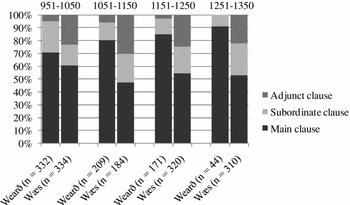
A first observation that links up with OE bounded structures expressing narrative action concerns wearð's distribution over clause types. Figure 1 gives the relative frequencies with which wearð and wæs occur in main clauses, subordinate clauses and adjunct clauses. The figure shows that wearð not only has a preference for main clauses, but that this preference even increases over time, and also that wearð is used increasingly exceptionally in adjunct clauses (the frequency of subordinate clauses decreases as well, but the complexity of its functions makes this tendency harder to interpret). These tendencies are the same for copular, passive or intransitive uses, and can both be related to wearð's change of state semantics. Adjunct clauses are usually descriptive in nature, adding background information to a topical NP, as in They chose his brother Harthacnut, who was a Danish citizen. As such, they typically do not denote changes of state. By contrast, (past tense) main clauses often express events that mark progress in a narrative (they provide foregrounded information), and therefore will often be about changes of state.
Clause types co-occurring with wearð and wæs

Wearð's preference for main clause constructions thus equals a preference for foregrounded events (changes of state) in a narrative. Precisely because of this quality, the mere presence of wearð encourages a correct interpretation of such sentences as expressing foregrounded events. Moreover, this preference increased over time so as to become an almost exclusive association, and this stands in sharp contrast to the idea that the distinction between weorðan and wesan became blurred from late OE onwards, and contradicts the hypothesis that wearð was lost due to the higher frequency combined with its increasing degree of semantic similarity to wæs (as found in some form in Wattie Reference Wattie1930; Mitchell Reference Mitchell1985; Müller Reference Müller2009). On the contrary, wearð might as well have taken over the use of wæs in the expression of events (changes of state) in a narrative, instead of being ousted due to its lower frequency. This is exactly what seems to have happened in (the bounded languages) German and Dutch, where werden and worden have attained to the status of the exclusive auxiliary of the eventive passive, as well as the default copula to express a change of state.
5.4 Wearð and time adverbials
The preference of wearð for main clauses points to its foregrounding function, being mainly used in narrative action. In this section I will further examine main clauses containing wearð and wæs in order to test to what extent it is typical of wearð to occur with bounding time adverbials in this clause type, as for instance in (18). This is done by contrasting the behaviour of wearð to that of wæs in main clauses. A typical such instance of wæs is (19), which provides stative background information to the narrative.
(18)
(19)
(18) has a clause-initial time adverbial with inversion, conforming to the boundedness template of German. In addition to such clause-initial time adverbials, other time adverbials have also been included in the calculations for this section. The main reason is that word order in the older stages of English is a much more intricate matter than it is in German. First, clause-initial time adverbials other than þa (and þonne) do not trigger inversion with pronominal subjects. Second, time adverbials that occur in non-clause-initial positions also generally have a bounding function, as in (20), even if it is unclear to what extent they topicalize the time span for which the assertion holds.
(20)
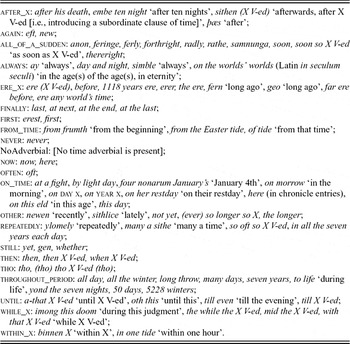
The actual method used for comparing differences in association strengths to time adverbs between wearð and wæs goes under the name of distinctive collexeme analysis, ‘the analysis of alternating pairs of constructions and their relative preferences for words that can (or should be able to) occur in both of them’ (Gries & Stefanowitsch Reference Gries and Stefanowitsch2004: 101). In this case study, the pair of constructions referred to consists of any main clause in which wearð is the finite verb in the past tense and any main clause containing wæs. Usually with this method, all and only tokens belonging to the same word or phrase type constitute a collexeme. This works when thousands of observations are available (as, for instance, in Hilpert Reference Hilpert2008). With the data I have for wearð- and wæs-constructions, amounting to about 200 observations per construction per period, it is useful to group more than one type of time adverbial into larger semantic categories. Using such collexeme categories increases the average frequency of each collostruct (i.e. each construction-specific collocational pattern), which makes significant semantic distinctions easier to spot. A complete list of categories with some representative members is given in table 3 (spelling has been regularized).Footnote 12 The grammaticalized items þa ‘then (single occurrence)’ and þonne ‘then (iterative/generic, ‘each time when X, then’)’ have each been classed under separate categories (tho and then respectively).
List of categories of time adverbials

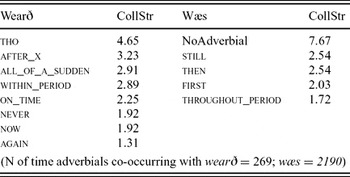
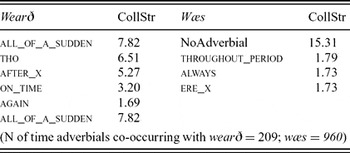
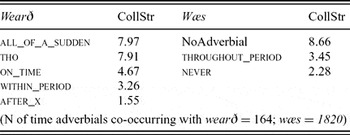
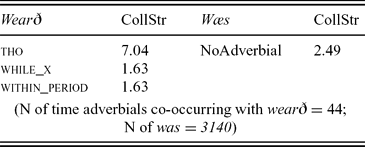
The results of the distinctive collexeme analysis are summarized in tables 4–7. CollostructionalStrength in these tables represents the strength of association between a category of time adverbials and one of the copulas wearð or wæs.Footnote 13 All categories have been included in the tables that had a CollStr of 1 or more, which is equivalent to a significance of p < 0.05. Unfortunately, it is not possible with this method to plot the development of the constructional strength of a particular time adverb over time, because CollStr is extremely sensitive to the raw frequencies of both collostructs for each period examined. The tables can still be compared with regard to their relative rankings of time adverbials, and this turns out to be quite revealing.
951–1050

1051–1150

1151–1250

1251–1350
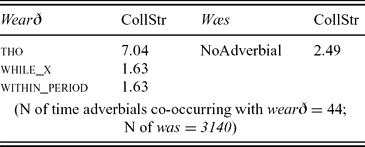
Many of the examples given in this article illustrate the preferences revealed by tables 4–7: wearð occurs with on_time in (12), with tho in (14), and with tho + all_of_a_sudden in (18). Likewise, wæs occurs without any time adverbial in (2) and (10), with throughout_period in (19), and with always in (4). Quite clearly, the tables and the examples show that there is a high collostructional strength between wearð and time adverbials that define temporal segments marking progress in the narrative. All time adverbials but one in the column for wearð clearly have this function – the odd one out is never in the period 951–1051, whose occurrence may be related to a (possibly conflicting) preference for weorðan in clauses negating something (see Kilpiö Reference Kilpiö1989: 65). The collostructional strength of wearð is particularly high with two categories of time adverbials that are clearly associated with boundedness. The first of these is tho, which has already been introduced as the most typical demarcator of a temporal segment. (21), from an Anglian gloss of the Vulgate, once again illustrates how strongly wearð and a bounding time adverbial such as þa evoke each other in OE. Despite it being a gloss, and despite the presence of another, partially open-ended time adverbial (ex illa hora ‘from that time onwards’), it still adds þa to this clause that uses wearð as well. By contrast, the version from the Wyclif Bible in (22) – which has already been mentioned for its lack of bounded constructions in section 4 – uses neither þa nor wearð, but only was.
(21)
(22) And Jhesus . . . seide, Douytir, . . . thi feith hath maad thee saaf. And the womman was hool fro that our.
‘And Jesus . . . said: “Daughter, . . . your faith has made you safe.” And the woman was healthy from that hour on.’ (a.1425(c.1395) WBible(2), Mt 9: 22)
(Latin: ‘At Iesus . . . dixit “confide filia fides tua te salvam fecit” et salva facta est mulier ex illa hora.’ (Vulgate, Mt 9: 22))
The second category is all_of_a_sudden. This category contains various time adverbials, all of which fit well with the notion of boundedness, as they collapse topic time to a single point in time, the functional bottom limit that a bounding construction can have. OE/ME sona/sone ‘suddenly’, the most frequent member of this category, deserves special mention, as, in addition to its temporal semantics, it has also developed a function as a foregrounding or focalizing device. Such a function is also found in Dutch and German, which make ample use of similar adverbs (for instance plots(eling), ineens, onmiddellijk in Dutch). Interestingly, þa too developed a focal use in OE when in clause-internal positions (see van Kemenade & Los Reference Kemenade, Los, Kemenade and Los2006), and overall there seems to be a strong relation between time adverbs marking narrative progress and focalizers in bounded language use (see also footnote 8). In general, the strong association of wearð with these two categories of time adverbials, even if functioning as focalizers, corroborates the hypothesis that wearð was part and parcel of the bounded system of OE.
By contrast, wæs usually lacks the accompaniment of any time adverbial whatever. In those cases it seems to designate an unbounded, imperfective state that held at some point in the past and which usually provides backgrounded information. Those categories of time adverbial that do collocate with wæs a significant number of times mostly have a function quite different from the foregrounding function of marking narrative progress. This holds first for the group of three categories always, throughout_period and still, which all score highly in collostructional strength with wæs, and which have in common a component of duration. Most of the instances belonging to this group are found in clauses providing backgrounded information, such as the clause containing welneah XX wintra ‘almost 20 winters’ given in (19), which gives information on how long King Cnut reigned before he died (the main event), and which, despite being a main clause syntactically, is clearly subordinate in function. Ere_x as well often collocates with wæs to provide backgrounded information on a situation that either pertained up to the event of the main clause, or for some time in a more remote past. The category is particularly frequent in subordinate clauses – which are not included in tables 4–7 – as for instance in the subordinate clause in (23).
(23)
Finally, there are instances of wæs collocating with time adverbials that do normally mark progress in the narrative. This implies that, ultimately, wæs really was an alternative for wearð in most of its uses, although it still seems possible to discern a distinction in emphasis. Thus, the occurrence of þa wæs in (23) might still be interpreted as putting emphasis on the state resulting from the action expressed in the preceding clause rather than on the process of becoming whole again. Importantly, this use of wæs was relatively infrequent as compared to its other uses, and therefore the breakdown of the bounded system did not overall affect the use of wæs very much, unlike its effect on wearð.
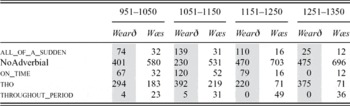
While collostructional strengths cannot be straightforwardly compared between periods with different sample sizes, it is still likely that the association of wearð with the bounding time adverbials, in particular tho and all_of_a_sudden, was probably at its strongest during the period 1051–1150. This period has higher values than those of its neighbouring periods, despite having the smallest sample size – values tend to increase with greater sample size.Footnote 14 So not only was wearð tied up with bounding time adverbials throughout its history, in OE there even appears to have been a language-internal development towards an ever stronger association of wearð with the bounded system, until the time when it started to break down. Two alternative explanations for the difference between 951–1050 and 1051–1150 need to be mentioned. First, the period 951–1050 contains more Anglian material, and thus the difference might simply be a matter of dialect differences. Second, the period 951–1050 contains verse material while the sample for 1051–1150 does not. However, both these conditions also hold for the period 1151–1250, which still has higher collostructional strengths for tho and all_of_a_sudden than 951–1050. Thus, even while the bounded system and wearð's association with it might have been grammaticalized to the highest degree in West Saxon (the dominant dialect in 1051–1150), the figures provide ample evidence that basically the same conditions held across all dialects of English. Significantly, the collostructional strength between wearð and bounding time adverbials remains very high when wearð starts disappearing. This again holds especially for tho and all_of_a_sudden. While both of these decrease during early and late ME – tho quite drastically (Westergaard Reference Westergaard2009), all_of_a_sudden more gradually – their co-occurrence rate with wearð hardly decreases at all (except for all_of_a_sudden in the last period). This is shown in table 8, which gives the number of occurrences of time adverbials per 1,000 instances of wæs/wearð. A gradual, though less marked, decrease also seems to be the fate of the time adverbials belonging to the category on_time, which is evidence that all adverbials marking narrative progress are affected. By contrast, the frequency of a time adverbial typically associated with wæs, such as throughout_period, does not significantly change. Table 8 once more shows how the fate of wearð is tied up with the fate of time adverbials that mark narrative progress.
Frequencies of time adverbials normalized per 1,000 past tense indicative copulas

In sum, given the evidence presented in this section, it is not surprising that, when time adverbials of narrative progress drastically decrease in frequency during the thirteenth and fourteenth centuries (together with other constructions belonging to the bounded system), wearð is lost with them.
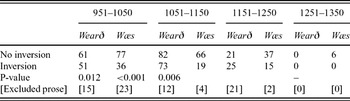
5.5 Wearð and inversion
Besides its association with certain types of time adverbials, wearð also seems to be associated with inverted word order, as in (18), here repeated as (24).
(24)
The variable of word order is relevant because verb-second syntax and boundedness seem to go hand in hand (as implied in Los Reference Los2009: 104–6), while an unbounded system is typically subject-initial. While there are many instances of þa or other bounding time adverbials that do not cause inversion, the lexeme causing inversion is very often one of them, like þa in (18). This overlap may seem to make testing wearð's association with inverted word order redundant. However, inversion constitutes an interesting additional testing variable, because measuring the association between wearð and inversion gives insight into the global effect of the formal side of the bounded system on the loss of wearð, where the collostructional analysis with various time adverbials pins down the most conspicuous semantic conspiracy between wearð and boundedness. Inversion not only occurs with time adverbials in first position but also with other items such as spatial (frequently þær ‘there’) or argumentative (þurh þæt/X ‘through that/X’) adverbs or adverbial prepositional phrases. The similarity in bounding function of temporal and spatial adverbials is established and further elaborated for German in Carroll & Lambert (Reference Carroll, von Stutterheim and Ramat2003: 169–70). For OE, their function as discourse-anchors has been established by Los (Reference Los2009: 104). Put briefly, spatial adverbials perform a function similar to those of time adverbials, which is also partially bounding, in that they define the topic space, i.e. the space within whose boundaries a certain assertion holds. Argumentative prepositional phrases are less transparently bounding structures, but they arguably limit a clause to a certain region in argumentative space. Put differently, all the possible fillers of the first position-slot share a function of structuring information, in anchoring the clause to the preceding one and, in that way, locating it in time, space or argumentative space.
The close relationship between boundedness and verb-second is further corroborated by the fact that the loss of verb-second proceeded simultaneously with the loss of time adverbials such as þa and sona. Particularly significant is the simultaneity of the loss of verb-second and that of sona, as sona only rarely takes up the first position in the clause, which makes it important independent semantic evidence. Van Kemenade & Westergaard (in prep.) show that the logic behind the verb-second system was falling apart after 1300 (at the latest), and that there is evidence for both partial overgeneralization of verb-second in contexts where it was not previously attested, and for a decrease in use and loss of the information-structural relevance of verb-second in contexts where it was previously more robust. Specifically with regard to þa (and þonne), Fuß & Trips argue that its status as a trigger of verb-second is lost roughly in the period 1340–1475 (Fuß & Trips Reference Fuß and Trips2003; Trips & Fuß Reference Trips and Fuß2007). In general, careful assessment of the evidence leads to the conclusion that ‘verb-second was all but defunct by 1500’ (Los Reference Los2009: 110; see also Warner Reference Warner2007).
Given the relevance of verb-second and concomitant inversion for a bounded system, a strong association of wearð with verb-second would once again confirm its loss as the consequence of the collapse of that system. Table 9 gives the significance of the different frequencies with which wearð and wæs co-occur with inverted subjects in main clauses, based on the one-sided Fischer-exact text.Footnote 15 As word order in verse texts tends to be less representative of word order in spoken language, only prose texts have been taken into account. As a consequence of this, hardly any data are available for the final period 1251–1350, in which prose narratives are very poorly documented. Also left out are those cases where the subject is not overtly expressed (either because it is not expressed at all, or because it has undergone ellipsis in the second part of a conjunct), as well as verb-first clauses, whose loss during late Old English preceded the decrease of wearð.
Word order differences between wearð-and wæs-main clause constructions in prose

As it turns out, the association of wearð with inverted word order is highly significant throughout, and this is further evidence that its fate is tied up with the breakdown of the bounded system of OE.
6 Evaluation and conclusion
In most previous studies, the loss of weorðan has been explained by appealing to its competition with the copula-cluster is/beon/wesan as a copula or (most often) a passive auxiliary. By contrast, it was shown in this article that the decrease of weorðan is not dependent on the type of complement the verb takes. Instead, a distinction needs to be made between present and past tense. In this article I focused on the past tense, and on the important part played by narratives in that tense. Ongoing research suggests that in the present tense other factors, such as the development of an analytic future with shall, are more important, but this topic is reserved for future publications. For the past tense I have shown that the loss of wearð is linked to its strong association with two interrelated constructions typical of a bounded language system, notably those involving time adverbials marking progress in the narrative, and the inversion construction (verb-second syntax). More thorough research on word order and the function of time adverbs such as þa and sona against the background of boundedness theory might shed more light on the relationship between time adverbials and their position, and might lead to refinements of the present analysis. What has clearly been established is that an association exists between weorðan, þa and inversion, that weorðan is almost always used resultatively, and that it is likely that the loss of þa and inversion, both core parts of the OE system of boundedness, had an immediate impact on the frequency of weorðan.
In explaining the loss of wearð as due to a shift in the way grammar is used to structure narratives, my account goes beyond simply positing loss through competition with a more frequent form wæs. Not frequency but embeddedness within a network of constructions is of primary importance in the survival of one of the competing forms. The idea that a constructional subsystem of a language's grammar has an impact on its lexicon can probably be fruitfully applied to the history of other function words and other languages as well. Shifting constructions have already been appealed to by Los (Reference Los, Fanego, Lopez-Couso and Perez-Guerra2002) in accounting for the loss of man ‘they’ in Old English, a phenomenon also clearly related to the shift in English from a verb-second to an SVO language. Incidentally, it can thus probably be fitted into the same story as the one presented here on boundedness, and this leads me to a final important consideration: while I made a case for the breakdown of the bounded system by the fourteenth century only in order to account for the loss of wearð, it is obvious that this breakdown and the development of an alternative is in itself a highly interesting topic that needs further looking into.