Implications
The Boswellia serrata resin (BSR) can be a new natural, safe and effective feed additive enhancing broiler chickens health status and productivity. The 3% and 4% addition of BSR in the diets improved the broiler chicken productivity and health parameters. The obtained carcasses were characterized by a high proportion of muscles and low fat content.
Introduction
Phytobiotics are widely used in modern poultry production. Their popularity is associated with their beneficial effect on production traits and birds’ health status as well as consumers’ expectations of the availability of high-quality poultry meat. The positive effects of application of herbs are well known in European husbandry (Alipour et al., Reference Alipour, Hassanabadi, Golian and Nassiri-Moghaddam2015). There are recent reports on the application potential of phytobiotics, which until now have primarily been applied in Asian traditional medicine (Al-Yasiry and Kiczorowska, Reference Al-Yasiry and Kiczorowska2016). They include, for example, feed additives approved for use in poultry production (European Union Register of Feed Additives, 2016) such as BSR (referred to as ‘frankincense’ or ‘olibanum’). Frankincense comes from the Arabian Peninsula, where it is obtained from trees from the Burseraceae family. It exhibits a variety of therapeutic properties, for example, anti-inflammatory, bactericidal and even antitumor activity, which is associated with the content of many aromatic compounds with boswellic acid as the most active compound (Roy et al., Reference Roy, Deka, Bordoloi, Mishra, Kumar, Sethi and Kunnumakkara2016). This has also been confirmed by experiments conducted on laboratory animals. The administration of a B. serrata aqueous extract in diabetic rats lowered the blood glucose levels, limited the development of necrosis of hepatocytes and improved lymphocytic inflammation (Namjoyan et al., Reference Namjoyan, Azemi, Khodayar, Ahmadpour, Darvish Padok and Panahi2012). Ahmed et al. (Reference Ahmed, Abdel-Rahman, Salem, Shalby and Lokman2013) noted that B. serrata methylene chloride extract had a promising therapeutic role against colon cancer induced in rats through its potential anti-inflammatory property, antiproliferative capacity and apoptotic activity. These health-enhancing and therapeutic properties of Boswellia can probably be used in animal production to achieve a broad spectrum of effects on production performance and the related welfare of animals. Monitoring of the production effects against the health status of broiler chickens by measurement of hematological, biochemical and immunological parameters can facilitate detailed assessment of Boswellia resin in its optimal doses as an effective and safe additive in poultry nutrition.
Therefore, the aim of the study was to determine the effect of different levels of BSR supplementation in diets for broiler chickens on the fundamental production traits, nutrient digestibility, selected slaughter analysis, as well as selected hematological, plasma biochemical and immunological parameters.
Material and methods
Tested resin, experimental birds and management
The resin was obtained from B. serrata trees by incision of a bark-less trunk and left to dry in natural conditions (direct information from the herb seller). Fragmented natural BSR was obtained commercially (Baghdad, Iraq). The BSR added to the mixtures contained 95.34% of dry matter (DM), 1.59% DM of ash, 2.65% DM of protein, 63.88% DM of fat and 2.38% acetyl-11-keto-β-boswellic acid (Kiczorowska et al., Reference Kiczorowska, Samolińska, Al-Yasiry and Kowalczyk-Pecka2016b).
The experiment was carried out after receiving an approval from the Second Local Ethics Committee at the University of Life Sciences in Lublin (No. 27/2014). A total of 200 1-day-old broiler chickens (Ross 308; Aviagen, Cracow, Malopolskie province, Poland) were randomly assigned to four dietary treatments with five cages per treatment and five females and five males/cage. The initial BW of the broiler chickens was 42.8±0.2 g. The experiment was carried out for 6 weeks. The broiler chickens were reared in 1-m2 cages placed in a room with controlled temperature and humidity and provided with continuous access to feed and water. The lighting scheme in the hen house allowed controlling the length of light exposure during the day according to the guidelines on rearing broiler chickens (Aviagen, 2014b).
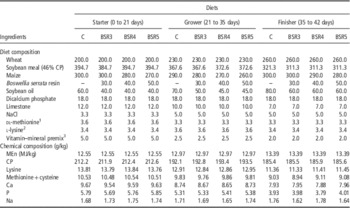
The basal feed diets consisted of cereal meal middlings (wheat and corn) and post-extraction soybean meal as recommended (Aviagen, 2014a) (Table 1). The broiler chickens were fed three types of diets: starter (0 to 21 days), grower (21 to 35 days) and finisher (35 to 42 days). The broiler chickens were fed the starter diet in a crumbled form and the grower and finisher diets in a granulated form. The dietary treatments consisted of the control and the control supplemented with 3% (BSR3), 4% (BSR4) or 5% (BSR5). All the diets were iso-energetic and iso-nitrogenous.
Dietary ingredients and the nutrient content of the experimental diets (g/kg, as-fed basis)

C=control diet without Boswellia serrata supplementation; BSR3=diet with 3% Boswellia serrata supplementation; BSR4=diet with 4% Boswellia serrata supplementation; BSR5=diet with 5% Boswellia serrata supplementation; MEn=metabolizable energy in the mixtures corrected to zero nitrogen balance.
1 Evonik Degussa Gmbh, Essen, Germany (per kilogram of 990 g methionine).
2 Ajinomoto Eurolysine SAS, Amiens, France (per kilogram of 780 g lysine).
3 Added minerals and vitamins per kilogram of starter diet: Mn, 100 mg; I, 1 mg; Fe, 40 mg; Zn, 100 mg; Se, 0.15 mg; Cu, 10 mg; vitamin A, 15 000 IU; vitamin D3, 5000 UI; vitamin E, 75 mg; vitamin K3, 4 mg; vitamin B1, 3 mg; vitamin B2, 8 mg; vitamin B6, 5 mg; vitamin B12, 0.016 mg; biotin, 0.2 mg; folic acid, 2 mg; nicotic acid, 60 mg; pantothenic acid, 18 mg; choline, 1.800 mg. Added minerals and vitamins per kilogram of grower diet: Mn, 100 mg; I, 1 mg; Fe, 40 mg; Zn, 100 mg; Se, 0.15 mg; Cu, 10 mg; vitamin A, 12 000 IU; vitamin D3, 5000 UI; vitamin E, 50 mg; vitamin K3, 3 mg; vitamin B1, 2 mg; vitamin B2, 6 mg; vitamin B6, 4 mg; vitamin B12, 0.016 mg; biotin, 0.2 mg; folic acid, 1.75 mg; nicotic acid, 60 mg; pantothenic acid, 18 mg; choline, 1.600 mg. Added minerals and vitamins per kilogram of finisher diet: Mn, 100 mg; I, 1 mg; Fe, 40 mg; Zn, 100 mg; Se, 0.15 mg; Cu, 10 mg; vitamin A,12 000 IU; vitamin D3, 5000 UI; vitamin E, 50 mg; vitamin K3, 2 mg; vitamin B1, 2 mg; vitamin B2, 5 mg; vitamin B6, 3 mg; vitamin B12, 0.011 mg; biotin, 0.05 mg; folic acid, 1.5 mg; nicotic acid, 35 mg; pantothenic acid, 18 mg; choline, 1.600 mg.
Growth performance parameters
For each broiler chicken, the BW of and feed intake were recorded at 1, 10, 21, 35 and 42 days of life. The BW gains (BWG) and feed conversion ratio (FCR) were calculated for each period. The mortality rates were recorded daily, and the weight of dead broiler chickens was used to adjust the average weight gain in the period, feed intake and FCR.
Feed digestibility was evaluated using the indicator method (with acid-insoluble ash as an internal marker). Four broiler chickens were selected randomly from each cage at the final finisher stage (Kussaibat and Leclercq, Reference Kussaibat and Leclercq1985). The content of DM and organic matter was determined in collected droppings (Association of Official Analytical Chemists (AOAC), 2000), and the content of nitrogen was determined according to Ekman et al. (Reference Ekman, Emanuelson and Fransson1949). Neutral detergent fiber (assayed without heat-stable amylase and expressed inclusive of residual ash), and ADF (expressed inclusive of residual ash) in the diets were determined with the ANKOM’s proprietary 200 Filter Bag Technique (Ankom Technology, Fairport, NY, USA) using the Ankom 220 Fiber Analyzer (Ankom Technology, Fairport, NY, USA). The analyses were performed sequentially on the same sample. Hemicellulose was calculated as NDF−ADF. The DM and organic matter digestibility coefficient and the content of nitrogen-corrected metabolizable energy (MEn) were calculated for each diet according to formulas given in the European Table of Energy Values for Poultry Feedstuffs (World’s Poultry Science Association (WPSA), 1986).
Sample collection and chemical analyses
The content of basic nutrients in the diets was determined (AOAC, 2000). The formulas given in the European Table of Energy Values for Poultry Feedstuffs (WPSA, 1986) were used to calculate the actual content of metabolizable energy in the diets, corrected to zero nitrogen balance (MEn).
The amino acid contents were determined using an automatic amino acid analyzer (AAA 400; Ingos, Prague, Czech Republic) after previous acid hydrolysis with 6 M HCl (method 994.12; AOAC, 2000). Cysteine and methionine were determined after oxidative hydrolysis (Arnoldi, Reference Arnoldi2001). Samples of the feed were dried at 100°C for 24 h and ashed for 10 h at 550°C. The ashed samples were dissolved in a nitric acid–perchloric acid diet (1 : 1) and diluted with deionized water for mineral analysis. Contents of Na and Ca were measured using flame atomic absorption spectrophotometry (Unicam 939/959AA-6300; Shimadzu Corp., Tokyo, Japan), according to the Polish Standard PN-EN ISO 6869 (2002). The total P content was determined colorimetrically (Polish Standard PN-76/R-64781, 1976) with a spectrophotometer (Helios Alpha UV-VIS; Spectronic Unicam, Leeds, UK).
One female and one male broiler chickens with the BW close to the average value were selected from each cage for dissection (Ziołecki and Doruchowski, Reference Ziołecki and Doruchowski1989).
Blood parameters
At the age of 42 days, 10 h before the above-mentioned activities, chicks (two broiler chickens per cage) selected randomly for blood sampling and slaughter were not given any feed but were provided with continuous access to water. Blood was sampled in the morning before the slaughter from the ulnar vein (vena cutanea ulnaris). Blood samples for analyses were collected in tubes with an anticoagulant. Whole blood was analyzed within 3 h after sampling. After placement of the samples on the hematological mixer, the red blood cell (RBC) and leukocyte counts, lymphocyte count, monocyte count and granulocyte count were determined by routine methods (Reece et al., Reference Reece, Erickson, Goff and Uemura2015). The packed cell volume and the hemoglobin content were determined using a hematological analyzer ABACUS Junior Vet (Automatic cell counter; Diatron, Vienna, Austria). The analyses performed also consisted in determination of other parameters of the RBC system. The mean cell volume, mean cell hemoglobin and mean corpuscular hemoglobin concentration were calculated according to Reece et al. (Reference Reece, Erickson, Goff and Uemura2015).
Plasma for analysis of the biochemical parameters was obtained by centrifugation of whole blood at 3000 rpm (603×g) for 15 min in a laboratory centrifuge (MPW-350R; MPW Medical Instruments, Warsaw, Poland) at a temperature of 4°C. Plasma without signs of hemolysis was analyzed within 4 h after sampling and the contents the glucose, total protein, albumin, globulins, creatinine, uric acid and blood urea nitrogen were determined along with the activity of the following enzymes: alkaline phosphatase (ALP), alanine aminotransferase, aspartate aminotransferase (AST), lactate dehydrogenase and γ-glutamyl transferase. The elements were determined in blood plasma with colorimetric methods according to the manufacturer’s protocol using reagent kits (BioMaxima, Lublin, Poland; Hydrex Diagnostics, Warsaw, Poland) and a random access biochemical analyzer Metrolab 2300 GL (Metrolab SA, Buenos Aires, Argentine). The analysis procedures were verified with the use of multiparametric control plasma (BioCal) as well as control plasma with a normal level (BioNorm) and a high level (BioPath) of parameters (BioMaxima, Lublin, Poland; Hydrex Diagnostics, Warsaw, Poland). The concentrations of immunoglobulins G, A and M class in the plasma of the birds were quantified using an ELISA procedure on BioTek ELx808™ Absorbance Microplate Reader (BioTek, Winooski, VT, USA). The protocol was adapted from a commercially developed assay (Bethyl Laboratories Inc., Montgomery, TX, USA). Lysozyme concentrations in plasma were measured using the protocol described by Kreukniet et al. (Reference Kreukniet, Nieuwland and Van der Zijpp1994). Briefly, the plasma samples were measured for their lysozyme activity in the lysis of Micrococcus lysodeikticus (Sigma Aldrich, Poland). For this, purpose a series of lysozyme (Sigma Aldrich) concentrations dissolved in phosphate buffer (pH 6.2) was used to make the standard curve. The standard dilution series of crystalline lysozyme and serum samples were measured for their lysozyme activity in the lysis of M. lysodeikticus.
Experimental design and statistical analysis
Each cage was used as a statistical unit. The data obtained were elaborated with the ANOVA method using one-way ANOVA (α=95; P<0.05) and calculating the mean values for the treatments (
 $$\bar{x}$$
) and the standard error of the mean with Statistica software (version 10; StatSoft, Tulsa, OK, USA). Linear and quadratic polynomial contrasts were used to evaluate the effects of the different dietary levels of BSR. The direction and intensity of the relationships between the level of BSR addition and the productivity, hematological, biochemical and immunological parameters in blood measurement were determined using Pearson’s correlation coefficients.
Results
Growth performance
The supplementation of the broiler chicken diets with B. seratta induced differences in the feed intake (P<0.05) only in the second and third stages of rearing (Table 2). Broiler chicken aged 22 to 35 days exhibited the lowest daily and total intake (P<0.05) of the BSR3 and BSR4 diets following a quadratic pattern (P<0.05). The feed intake showed highly negative correlations with the BSR level (r=−0.878). In the final rearing stage, the lowest (P<0.05) feed intake was noted in the control, whereas the highest (P<0.05) daily and total feed intake were observed in the BSR3 and BSR4 treatments. In the first rearing period, the greatest weight gain (P<0.05) was noted in chickens from the BSR3 treatment group. In the middle rearing period (21 to 35 days), the broiler chickens grew at a similar pace. In turn, in the third feeding stage, chickens from the BSR4 group exhibited the greatest weight gain. The optimal, low (P<0.05) FCR was noted in the broiler chickens fed diets supplemented with 3% and 4% BSR in the first (1 to 21 days) and second rearing period (21 to 35 days). However, during the last 7 days of rearing the lowest FCR was observed in the control. A low mortality rate, that is, one dead broiler chicken, was found only in treatment BSR5.
BWG, feed intake, feed conversion ratio in broiler chickens in the different rearing stages

Data represent the mean of five cages (10 broiler chickens/cage) per treatement.
C=control diet without Boswellia serrata supplementation; BSR3=diet with 3% Boswellia serrata supplementation; BSR4=diet with 4% Boswellia serrata supplementation; BSR5=diet with 5% Boswellia serrata supplementation; BWG=BW gains; FCR=feed conversion ratio.
*P<0.05.
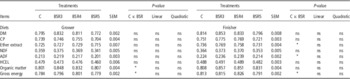
B. serrata resin treatments increased (P<0.05) the digestibility of organic matter and energy in the grower mixtures as well as ether extract, ADF and energy in the finisher mixtures (Table 3). The digestibility of the other nutrients was similar in all chickens, irrespective of the diet intake.
Nutrient and energy digestibility in experimental diets (g/kg)

Data represent the mean of five cages (four broiler chickens per cage) per treatment.
C=control diet without Boswellia serrata supplementation; BSR3=diet with 3% Boswellia serrata supplementation; BSR4=diet with 4% Boswellia serrata supplementation; BSR5=diet with 5% Boswellia serrata supplementation; DM=dry matter; HCEL=hemicellulose.
*P<0.05.
B. serrata resin supplementation of the diets for broiler chickens did not result in an increase in the dressing percentage. The experimental feeding of the broiler chickens with the 3% and 4% BSR supplement increased (P<0.05 control v. BSR, quadratic) the total muscle proportion in the carcass and simultaneously decreased (P<0.05 control v. BSR, linear) the content of abdominal fat (Table 4).
Analysis of chosen slaughter parameters (%)

Data represent the mean of five cages (two broiler chickens per cage) per treatment.
C=control diet without Boswellia serrata supplementation, BSR3=diet with 3% Boswellia serrata supplementation, BSR4=diet with 4% Boswellia serrata supplementation, BSR5=diet with 5% Boswellia serrata supplementation.
1 Proportion in chilled carcass.
2 Proportion in the BW.
*P<0.05.
Blood parameters
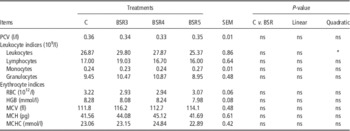
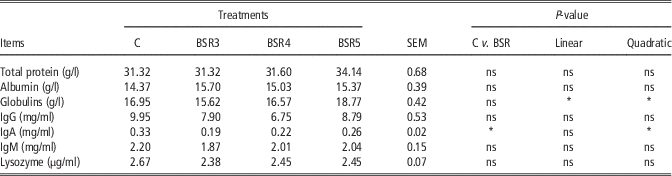
The effects of the dietary treatments on hematological, biochemical and immunity indices in the blood are presented in Tables 5 to 7, respectively. White blood cell counts were decreased (quadratic, P<0.05) as the levels of dietary BSR were increased. The BSR level was not significantly correlated with the hematological parameters.
Hematological indices in the blood of broiler chickens at day 42

Data represent the mean of five cages (two broiler chickens per cage) per treatment.
C=control diet without Boswellia serrata supplementation; BSR3=diet with 3% Boswellia serrata supplementation; BSR4=diet with 4% Boswellia serrata supplementation; BSR5=diet with 5% Boswellia serrata supplementation; PCV=packed cell volume; RBC=red blood cell count; HGB=hemoglobin content; MCV=mean cell volume; MCH=mean cell hemoglobin; MCHC=mean corpuscular hemoglobin concentration.
*P<0.05.
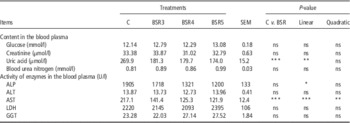
Biochemical indices in the blood of broiler chickens at day 42

Data represent the mean of five cages (two broiler chickens per cage) per treatment.
C=control diet without Boswellia serrata supplementation; BSR3=diet with 3% Boswellia serrata supplementation; BSR4=diet with 4% Boswellia serrata supplementation; BSR5=diet with 5% Boswellia serrata supplementation; ALP=alkaline phosphatase; ALT=alanine aminotransferase; AST=aspartate aminotransferase; LDH=lactate dehydrogenase; GGT=γ-glutamyl transferase.
*P<0.05; **P<0.01; ***P<0.001.
Blood plasma proteins and chosen humoral immunity parameters of the blood of broiler chickens at day 42

Data represent the mean of five cages (two broiler chickens per cage) per treatment.
C=control diet without Boswellia serrata supplementation; BSR3=diet with 3% Boswellia serrata supplementation; BSR4=diet with 4% Boswellia serrata supplementation; BSR5=diet with 5% Boswellia serrata supplementation; IgG=immunoglobulin G; IgA=immunoglobulin A; IgM=immunoglobulin M.
*P<0.05.
The main catabolite of protein metabolism, that is uric acid, was markedly (control v. BSR diets, P<0.001; linear, P<0.01) decreased as the dietary BSR level was increased (Table 6). The other plasma blood constituents were not affected by the treatments. The calculated correlation coefficient indicated a high negative correlation between the level of the BSR supplementation and the uric acid concentration in the plasma (r=−0.793, P=0.002). The blood plasma activities of the AST and ALP enzymes in the chicken broilers were also influenced by the BSR supplementation of the diets (Table 6). The AST serum activity clearly decreased with the addition of of BSR (control v. BSR diets, P<0.001; linear, P<0.001; quadratic, P<0.01). A slightly lower reduction of enzymatic activities was observed for ALP (linear, P<0.05). The calculated coefficient of correlations between the BSR level and AST and ALP activities confirmed their strong negative correlation (r=−0.917, P<0.001; and r=−0.605, P=0.037, respectively).
The globulins content in plasma increased (linear and quadratic, P<0.05) together with the increasing BSR level. Among the analyzed immunity parameters, that is, immunoglobulins (G, A, M) as well as lysozyme activity (Table 7), a significant impact of the experimental additive on the immunoglobulin A concentration was only found (control v. BSR diets, P<0.05; quadratic P<0.05). A moderate negative correlation (Pearson’s correlation coefficient in the range of −0.4~−0.6) was estimated between the level of BSR in the diet and the estimated values of the above-mentioned indices.
Discussion
Application of phytobiotics can improve the efficiency and productivity of poultry production (Alipour et al., Reference Alipour, Hassanabadi, Golian and Nassiri-Moghaddam2015). The present study showed a positive effect of the BSR supplementation on the production performance in broiler chickens. However, the effect was revealed only in the second, and the longest, rearing stage (days 22 to 35), which may suggest the validity of periodic application of the additive rather than throughout the feeding period. Such a solution has also been suggested by other researchers investigating the use of phytobiotics with potent biological activity (Lee et al., Reference Lee, Chen, Wang and Yu2012). Besides the timing, the dosage of the application of this type of supplements plays an essential role. The best production parameters, that is, feed intake, weight gain and FCR, were achieved in the BSR3 group of the broiler chickens. Optimal production performance was noted mainly during the first two periods of rearing when broiler chickens grow intensively. Particularly important are the first post-hatching days when the structures of the gastrointestinal tract (villi) develop ensuring the birds a good production start and accelerating their growth and development. Panda et al. (Reference Panda, Rao, Raju and Sunder2009) report that early supplementation of broiler diet with fatty supplements has a positive effect on the growth, density and length of intestinal villi and stimulates their regeneration. This beneficial effect of B. serrata on the structure and morphology of the gastrointestinal tract in broiler chickens was observed in other studies with broiler chickens (Kiczorowska et al., Reference Kiczorowska, Al-Yasiry, Samolińska, Marek and Pyzik2016a). Normal structure and function of the digestive tract is also related to better availability of nutrients, as evidenced by the increase in the digestibility of organic matter in grower diets and gross energy throughout the rearing time. Interesting seems to be the increased ether extract digestibility in the broiler chicken finisher diets supplemented with BSR. The improved conversion of this dietary supplement was reflected in the increased dietary quality of the meat.
The quality of fatty supplements used in poultry nutrition mainly regulates meat fatness, dietary quality and consumption value without a significant impact on slaughter performance and even muscle proportion (Bou et al., Reference Bou, Guardiola, Barroeta and Codony2005). The 3% BSR supplementation of the diets ensured the best quality of carcasses, which were characterized by a high proportion of muscles and the lowest amounts of abdominal fat.
However, the BSR doses exceeding 4% blocked the beneficial effects of the phytobiotic. This phenomenon was confirmed by Singh et al. (Reference Singh, Khajuria, Taneja, Khajuria, Singh, Johri and Qazi2008) in rat experiments.
An important parameter in assessment of the effectiveness of the BSR treatments is the course of metabolic processes, for example, changes in the values of hematological and biochemical indices in broiler chicken blood (Reece et al., Reference Reece, Erickson, Goff and Uemura2015). The blood biochemistry profiles and hematology indices were within the expected range, and no signs of toxicity were observed. The higher, but still within the reference range, leukocyte count in the chicken blood noted in the BSR2 and BSR3 treatments may indicate good health status of the birds (Reece et al., Reference Reece, Erickson, Goff and Uemura2015; Scanes, Reference Scanes2015).
The BSR treatments reduced the uric acid level in the chicken blood plasma. Uric acid is the major final product of nitrogen metabolism in birds and an endogenous antioxidant (Scanes, Reference Scanes2015). In birds, the content of uric acid in plasma is strongly influenced by such factors as age, sex and nutrition, whereas the content of urea and ammonia are only slightly modified by these factors (Scanes, Reference Scanes2015). In this study, no effect of the BSR treatments on the level of blood urea nitrogen was noted. The decrease in the uric acid concentration in blood plasma may suggest greater utilization of absorbed protein or reduction of endogenous protein turnover in broiler chickens (Scanes, Reference Scanes2015). Boswellic acid isolated from the resin of B. serrata has been identified as an active treatment compound. It stimulates secretion of pancreatic enzymes, thereby leading to improvement of protein and energy digestibility, reduction of endogenous losses of nitrogen and ammonia, and production of other microbial metabolites (Al-Yasiry and Kiczorowska, Reference Al-Yasiry and Kiczorowska2016). On the other hand, it should be borne in mind that gut bacteria contribute to nitrogen metabolism in the host. In the present study, the depressed uric acid contents in blood by dietary supplementation of B. serrata might have been caused by the increased counts of Lactobacillus and Enterococcus and decreased counts of Escherichia coli and Clostridium perfringers in the intestines of the broiler chickens (Kiczorowska et al., Reference Kiczorowska, Al-Yasiry, Samolińska, Marek and Pyzik2016a). Reduction of concentrations of non-protein nitrogen in blood induced by supplemental dietary probiotics or modification of native microbiota has been reported in poultry (Li et al., Reference Li, Rajput, Xu, Li, Lei, Huang and Wang2011; Pan and Yu, Reference Pan and Yu2014). The present result was partly consistent with the findings reported by Isshiki (Reference Isshiki1979), who demonstrated that feeding with Lactobacillus casei resulted in a decrease in non-protein nitrogen in blood, including uric acid, ammonia and urea.
As the liver serves a major function in the organism detoxification process, measurement of the activity of hepatic enzymes provides efficient indicators of the health safety of the BSR supplementation of broiler diets. The significant decrease in blood AST and ALP activities within the normal range (Scanes, Reference Scanes2015) in the treated groups suggested normal status of liver function as a result of biological supplementation with B. serrata, which is consistent with observations reported in other studies. A similar effect of B. serrata extracts has been described in rat experiments (Singh and Atal, Reference Singh and Atal1986), where treatment with the extracts inhibited an inflammation-induced increase in serum transaminase levels. Similarly, the results obtained by Aliyu et al. (Reference Aliyu, Gatsing and Jaryum2007) reported that the Boswellia dalzielii extract decreased AST activities in the treated groups, compared with the control. The hepatoprotective effect of Boswellia is explained by the content of natural flavonoids and polyphenolic compounds, which exhibit protective and strengthening activities on liver cells (Akamatsu et al., Reference Akamatsu, Watanabe, Tamesada, Nakamura, Hayashi, Kodama, Kawase and Yagi2004). This result agrees with that reported by Ibrahim et al. (Reference Ibrahim, Khaja and Narasu2011), who observed a protective effect of B. serrata in rats with paracetamol-induced liver damage, compared with the activities of serum marker enzymes. This may be due to the inhibitory effect of B. serrata extracts on the synthesis of 5-lipoxygenase, which is primarily responsible for injury and inflammation of hepatocytes.
The level of blood plasma proteins is a good parameter showing the health and nutritional status of the organism. The proteins serve, for example, transport, enzymatic, regulatory and immune functions. In this study, we observed increased globulin levels in the blood serum of the BSR-treated broiler chickens. Higher serum globulin is an indicator of better immune response and a source of antibody production (Scanes, Reference Scanes2015). It has been reported in the available literature that boswellic acid exerts effects on both humoral and cell-mediated immunity. The gum resin of B. serrata has been shown to affect the parameters of the immune system in different ways. As far as the humoral defense system is concerned, boswellic extracts and boswellic acids affect antibody titers and immunoglobins (Ammon, Reference Ammon2010). Moreover, immunoglobulin levels aid in the diagnosis of some disorders, particularly liver diseases. The results of blood immunoglobulin level were within the normal range (Larsson et al., Reference Larsson, Bålöw, Lindahl and Forsberg1993), which also confirms the hepatoprotective effect of B. serrata. Boswellia may support the immune function of the organism by interfering with cytokine production, which induces inflammation (interferon γ, interleukin-4 and tumor necrosis factor-α), helping regulate B and T type lymphocytes, and regulating the production of immunoglobulin G and M antibodies, which protect the organism from bacterial and viral infections (Khajuria et al., Reference Khajuria, Gupta, Suden, Singh, Malik, Singh, Gupta, Suri, Srinavas, Ella and Quazi2008; Al-Yasiry and Kiczorowska, Reference Al-Yasiry and Kiczorowska2016). In this study, statistically significant differences were noted only in the case of plasma immunoglobulin A (P<0.05). Thus, one might suspect an increase in humoral systemic response induced by BSR supplementation. However, as indicated in the studies conducted by Sharma et al. (Reference Sharma, Kaul, Khajuria, Singh and Singh1996) and Khajuria et al. (Reference Khajuria, Gupta, Suden, Singh, Malik, Singh, Gupta, Suri, Srinavas, Ella and Quazi2008), where either a mixture of different boswellic acids or a biopolymeric extract of BS was applied, lower doses exhibit a humoral immunostimulating action, whereas this effect was attenuated or even reversed with its increasing dose (Ammon, Reference Ammon2010). Therefore, the relatively high doses of BSR in the diet used in the present study might be an explanation of the lower systemic immunoglobulin content in the blood of the experimental birds, compared with the control ones. The experimental additive did not significantly influence the concentration of either the G class or the M class immunoglobulin. On the other hand, we found that BSR used in the diets had a stabilizing effect on the bacterial flora of the gastrointestinal tract by decreasing the count of E. coli and Clostridium spp. strains, and simultaneously increasing the count of Lactobacillus and Enterococcus (Kiczorowska et al., Reference Kiczorowska, Al-Yasiry, Samolińska, Marek and Pyzik2016a). As especially the immunoglobulins G and M antibodies are very important in fighting bacterial infections, as they are the first type of antibodies produced in response to an infection, the lower systemic concentration in the BSR groups may be a result of stabilization of the chicken gastrointestinal microbiome after 7 weeks of constant supplementation of BSR.
Similarly, the lysozyme is an essential element in the non-specific humoral immune mechanism due to its efficiency and widespread occurrence. It has both bactericidal and opsonin effects, which activate the complement system and phagocytes to prevent infection and disease (Larsson et al., Reference Larsson, Bålöw, Lindahl and Forsberg1993). In the present study, no significant impact of BSR on lysozyme activity was found. Irrespective of the dose of BSR in the diets, its activity level was similar. Lysozyme, as a serum hydrolytic enzyme, can destroy the glucosidic bonds in the cell wall of E. coli and Staphylococcus through the phagocytic activity of phagocytes (Guo et al., Reference Guo, Chen, Xia and Yuan2004). The lower activity of lysozyme in the blood of the BSR-treated birds may result from the beneficial anti-bacterial impact of biologically active substances of Boswellia on the health of broiler chickens. An example of such a stabilizing influence of herbs permanently included in the diet was observed in the study by Awaad et al. (Reference Awaad, Abdel-Alim, Sayed, Kawkab, Nada, Metwalli and Alkhalaf2010) on immunostimulant effects of peppermint and eucalyptus essential oils on chickens. The increased activity of lysozyme in the experimental group of birds was determined only at the beginning of breeding (24 v. 17 μg/l). Nevertheless, as there are no such studies on the impact of BSR supplementation on broiler chickens, further studies are needed to analyze its influence on chicken immunity.
In conclusion, the use of the 3% and 4% addition of the BSR in the diets improved BWG , some nutrients, and energy digestibility in the grower and finisher mixtures and broiler chicken carcass quality. The poultry meat produced had lower fat content, which is a desirable dietary consumption value. Likewise, some blood parameters were positively influenced by the B. serrata supplementation but no clear impact of BSR on humoral immunity was found. On the other hand, the 5% supplementation of the diet with frankincense appears to be too high to ensure satisfactory production performance. It can be concluded that BSR can be regarded as a safe and effective dietary additive in diets for broiler chicken.
Acknowledgment
The study was conducted within doctoral studies on the University of Life Sciences in Lublin, Poland.