Introduction
Angiostrongylus cantonensis, commonly known as rat lungworm, is a zoonotic parasite that causes the neurological condition known as neuroangiostrongyliasis. Neuroangiostrongyliasis is considered an emerging tropical disease. According to recent reports, it is spreading throughout Asia, the Caribbean, Africa and Hawai‘i (USA). Recently, it has been reported from the continental USA in Florida, Louisiana, Texas, Oklahoma and Tennessee (Teem et al., Reference Teem, Qvarnstrom, Bishop, Alexandre, Carter, White-Mclean and Smith2013; Hammoud et al., Reference Hammoud, Nayes, Murphy, Heresi, Butler and Pérez2017; Jarvi et al., Reference Jarvi, Quarta, Jacquier, Howe, Bicakci, Dasalla, Lovesy, Snook, McHugh and Niebuhr2017; Stockdale et al., Reference Stockdale, Slapcinsky, Roff, Mendieta, Diaz and Stern2017). A common mode of infection is by ingestion of L3 (third stage larvae) from infected molluscs often found on fresh produce. It was shown in mice that infection is also possible through unabraded skin (Wang et al., Reference Wang, Chao and Chen1991). The severity of the condition can range from mild flu-like to serious neurological symptoms, such as paralysis, coma and even death. This dramatic range of symptoms appears to be correlated with the L3 exposure load (Wang et al., Reference Wang, Lai, Zhu, Chen and Lun2008; Ji et al., Reference Ji, Yiyue, Xujin, Minghui, Mengying, Yue, Yanqi, Langui, Xin, Datao, Shuo, Huanqin, Zhongdao and Zhiyue2017; Prociv and Turner, Reference Prociv and Turner2018). Early diagnosis of infection is challenging since the incubation period ranges from days to weeks, and early signs and symptoms are very nonspecific and differ case-to-case. In addition, there are no specific diagnostic methods available for early detection (Pien and Pien, Reference Pien and Pien1999; Wang et al., Reference Wang, Lai, Zhu, Chen and Lun2008). Currently, in the USA, specific treatment for neuroangiostrongyliasis is generally initiated only after a confirmed diagnosis of infection by detection of A. cantonensis DNA in the cerebral spinal fluid (Qvarnstrom et al., Reference Qvarnstrom, Xayavong, da Silva, Park, Whelen, Calimlim, Sciulli, Honda, Higa, Kitsutani, Chea, Heng, Johnson, Graeff-Teixeira, Fox and da Silva2016). However, this might take weeks (Wang et al., Reference Wang, Lai, Zhu, Chen and Lun2008; Graeff-Teixeira et al., Reference Graeff-Teixeira, da Silva and Yoshimura2009; Prociv and Turner, Reference Prociv and Turner2018) and during this time, the larvae are likely to have induced neurological damage.
The use of anthelmintics has historically been controversial since their efficacy on A. cantonensis has not yet been thoroughly evaluated (Pien and Pien, Reference Pien and Pien1999; Graeff-Teixeira et al., Reference Graeff-Teixeira, da Silva and Yoshimura2009; Murphy and Johnson, Reference Murphy and Johnson2013). It has been proposed that larvae killed by anthelmintics in the brain could potentially induce severe inflammation, resulting in further complications (Morganti-Kossmann et al., Reference Morganti-Kossmann, Rancan, Stahel and Kossmann2002; Lai et al., Reference Lai, Jiang, Chen, Hsu, Shyu and Lee2004; Prociv and Turner, Reference Prociv and Turner2018). During a study in rabbits infected with 400 A. cantonensis larvae, the histopathological differences of the brain (MRI) were compared between a group that received 5 mg kg−1 day−1 albendazole for 2–14 days post-infection vs a group that did not receive albendazole (Wang et al., Reference Wang, Jung, Chen, Wong, Wan and Wan2006). It was found that the histopathological evidence for inflammation in the brain was more severe in the albendazole treatment group when compared to the non-treatment group. The study concluded that the use of albendazole is not advised for neuroangiostrongyliasis. Additionally, clinical reports have indicated that the use of anthelmintics is associated with negative outcomes (Bowden, Reference Bowden1981; Hidelaratchi et al., Reference Hidelaratchi, Riffsy and Wijesekera2010), and in one case, the use of an anthelmintic was proven to be ineffective (Kliks et al., Reference Kliks, Kroenke and Hardman1982). In contrast, several studies and clinical reports on neuroangiostrongyliasis have shown the use of an anthelmintic to be associated with positive outcomes (Cuckler et al., Reference Cuckler, Egerton and Alicata1964; Bisseru et al., Reference Bisseru, Gill and Lucas1972; Lakwo et al., Reference Lakwo, Ishih, Terada and Sano1998; Jitpimolmard et al., Reference Jitpimolmard, Sawanyawisuth, Morakote, Morakote, Vejjajiva, Puntumetakul, Sanchaisuriya, Tassaneeyakul, Tassaneeyakul and Korwanich2007; Li et al., Reference Li, Xu, Gu and Chen2008; Wang et al., Reference Wang, Qi, Diao, Zheng, Li, Ma, Ji and Yin2010).
However, none of those mentioned above clinical reports or studies had co-administered corticosteroids with the anthelmintic. The FDA recommends the use of corticosteroids along with albendazole (benzimidazole anthelmintic) for helminths that are capable of migrating to the brain, such as neurocysticercosis (FDA prescribing information of albendazole, Food and Drug Administration, 2009). Indeed, studies and clinical reports that describe co-administration of corticosteroids along with an anthelmintic have led to positive outcomes (Hayashi et al., Reference Hayashi, Terada, Ishii, Kino and Sano1982; Hayashi, Reference Hayashi1987; Chotmongkol et al., Reference Chotmongkol, Wongjitrat, Sawadpanit and Sawanyawisuth2004, Reference Chotmongkol, Sawadpanitch, Sawanyawisuth, Louhawilai and Limpawattana2006; Chen et al., Reference Chen, Zhong, Chen, Wu and Ding2006; Han et al., Reference Han, Zhu, Jie, Li, Yan, Ying and Xiong2006; Leone et al., Reference Leone, De Marco, Ghirga, Nicastri, Esposito and Narciso2007; Diao et al., Reference Diao, Wang, Qi, Li, Zheng and Yin2011; McAuliffe et al., Reference McAuliffe, Ensign, Larson, Bavaro, Yetto, Cathey, Mukaigawara, Narita, Ohkusu, Quast and Volk2019). For example, Ma et al. (Reference Ma, Zhang and Qiu2018) reported a case of a 15-month-old infant who was diagnosed with neuroangiostrongyliasis and was treated with levamisole and prednisone. The symptoms resolved 3 days post-treatment and the patient was fully recovered by 4 weeks of levamisole-prednisone therapy. Recently, the ‘Hawai‘i Governor's Joint Task Force on Rat Lungworm Disease: Clinical Subcommittee, preliminary guidelines for the treatment of human neuroangiostrongyliasis, 2018’ (see reference) and ‘Children's Health Queensland Hospital and Health Services, Australia; prophylactic guidelines against neuroangiostrongyliasis, 2019’ (see reference) also recommend albendazole-corticosteroid co-therapy.
Several in vitro studies have utilized differences in muscular contractility patterns (or motility) of adult female A. cantonensis worms to qualitatively assess the effect of various anthelmintics using kymographs and isotonic transductors (Terada et al., Reference Terada, Shii, Kino and Sano1982, Reference Terada, Shii, Kino and Sano1983, Reference Terada, Ishii, Kino and Sano1984, Reference Terada, Rodrigues, Dharejo, Shii and Sano1986; Terada and Sano, Reference Terada and Sano1986). However, these results may not be directly applicable to a clinical setting since it is the L3 that is infectious to humans, not the adult worms (Crook et al., Reference Crook, Fulton and Supanwong1971; Wang et al., Reference Wang, Chao and Chen1991). Anthelmintics that seem effective against the adult worms from the motility studies may not necessarily be effective against their larval stages (Campos et al., Reference Campos, Barbosa, Oliveira, Barbosa, Lobo, Silva, Thomaz and de Castro2016). There has been a paucity of recent studies on the in vitro effects of anthelmintics on A. cantonensis (Mentz and Graeff-Teixeira, Reference Mentz and Graeff-Teixeira2003). Therefore, it is of interest to evaluate their efficacy due to the ever-evolving issue of anthelmintic resistance (Gilleard and Beech, Reference Gilleard and Beech2007; Shalaby, Reference Shalaby2013).
We developed a differential staining technique based on propidium iodide penetration as the indicator of death, combined with the nematode's natural autofluorescence at 525 nm (Jarvi et al., Reference Jarvi, Jacob, Sugihara, Leinbach, Klasner, Kaluna, Snook, Howe, Jacquier, Lange, Atkinson, Deane, Niebuhr and Siers2019). Using this assay, we quantify the in vitro efficacy of the most widely prescribed anthelmintics: albendazole, pyrantel pamoate, diethylcarbamazine, levamisole, piperazine, niclosamide, praziquantel, ivermectin and moxidectin on A. cantonensis L3 isolated from Parmarion martensi (semi-slugs) from East Hawai‘i Island. A relatively high concentration of 1 mm was selected for screening, presuming they are more likely to show some effect at higher concentrations if they have any activity against A. cantonensis. Although albendazole, levamisole and ivermectin were found to be efficacious in vivo (Ishii et al., Reference Ishii, Terada and Sano1985; Ishii, Reference Ishii1994; Tu and Lai, Reference Tu and Lai2006), we have included them in our panel of anthelmintics as internal controls for validating the reliability of our assay.
Materials and methods
Larval preparation
Angiostrongylus cantonensis L3 were isolated based on their unique and continuous ‘Q’ and ‘S’ movements (Lv et al., Reference Lv, Zhang, Liu, Zhang, Steinmann, Zhou and Utzinger2009) from wild P. martensi (semi-slug) collected from east Hawai‘i island, and stock solutions were prepared as described in Jarvi et al. (Reference Jarvi, Jacob, Sugihara, Leinbach, Klasner, Kaluna, Snook, Howe, Jacquier, Lange, Atkinson, Deane, Niebuhr and Siers2019). Since A. cantonensis L3 are isolated from multiple wild P. martensi there may be some level of temporal or slug-to-slug variation. Therefore, larvae (~900) collected from the semi-slugs were pooled into a single 100 mm × 15 mm glass Petri dish to produce a uniform larvae stock before conducting each experiment. Larvae (n = 100) were visually counted and transferred into 60 mm × 15 mm glass Petri dishes (n = 6 dishes per experiment) containing 10 mL of dH2O. Similarly, for killed controls (n = 2 dishes per experiment), larvae were killed by suspending 100 larvae into 1 mL of absolute methanol in 1.5 mL Eppendorf tubes and incubated at −80°C for 30 min. The methanol was removed by transferring the content of the tubes into glass Petri dishes containing 10 mL of dH2O. This washing process was performed three times and this preparation served as the killed larvae stock solution.
Drug and solution preparation
Solutions (2 mm) of all the anthelmintics (Sigma-Aldrich, St. Louis, MO, USA) were prepared in 4% (v/v) biological grade DMSO (Sigma LifeScience, Burlington, MA, USA) in dH2O. These solutions were later added to the treatment wells containing an equal volume of larvae stock solution (see below), which resulted in a final concentration of 1 mm drug and 2% (v/v) DMSO. Similarly, the negative controls consisted of a final concentration of 2% (v/v) DMSO solution alone. Although, 2% (v/v) DMSO is considered as cytotoxic in mammalian cell culture studies (Singh et al., Reference Singh, McKenzie and Ma2017), we found that A. cantonensis L3 can tolerate up to 2% (v/v) DMSO without adverse effects, as we have evaluated various concentrations of DMSO on L3 and compared it with H2O controls (see results section). A 2.5% (v/v) propidium iodide (Biotium, Fremont, CA, USA) solution was prepared with 10× penicillin–streptomycin (Omega Science, Tarzana, CA, USA) in dH2O for differential staining of dead larvae (Jarvi et al., Reference Jarvi, Jacob, Sugihara, Leinbach, Klasner, Kaluna, Snook, Howe, Jacquier, Lange, Atkinson, Deane, Niebuhr and Siers2019). All solutions were stored at −20°C and shielded from light.
Solubilization of avermectins for in vitro testing
Avermectins (ivermectin and moxidectin) could not be solubilized in 4% (v/v) DMSO solution in dH2O due to their extreme hydrophobicity. Therefore, to test avermectins against A. cantonensis L3, they were solubilized in Vitamin E TPGS (D-α-Tocopheryl Polyethylene Glycol Succinate) (Antares Health Products Inc, Jonesborough, TN, USA) micelles using the thin film hydration method (Liu et al., Reference Liu, Chen, Chen, Su and Huang2019). Vitamin E TPGS is an amphiphilic surfactant with GRAS (Generally Regarded as Safe) status. It is widely used for solubilizing hydrophobic drugs in preclinical and clinical studies. Briefly, avermectins (ivermectin or moxidectin) and Vitamin E TPGS (weight ratio of avermectin to vitamin E TPGS: 1:10) were dissolved in absolute ethanol. The organic phase was transferred to a 40 mL vial and the ethanol from the organic phase was evaporated using a rotary evaporator (Buchi Rotavapor® R-210, New Castle, DE, USA). The thin film containing avermectin and Vitamin E TPGS obtained after evaporation of ethanol was hydrated with 10 mL dH2O to yield avermectin-containing Vitamin E TPGS micelles. The final concentration of ivermectin or moxidectin was 2 mm in 2% (w/v) Vitamin E TPGS micelles. Vitamin E TPGS (2% w/v) micelles containing ivermectin or moxidectin (2 mm) were tested directly on A. cantonensis larvae, as described previously. Vitamin E TPGS micelles (2% w/v) alone were used as negative controls.
Plate preparation
Treatments were performed in 384 well PerkinElmer cell culture plates. Live larvae (n = 100/40 μL) from the stock preparation were transferred into six wells and killed larvae (n = 100/40 μL) were transferred into two additional wells of the plate. Propidium iodide–penicillin–streptomycin solution (10 μL) was pipetted into each well containing live and killed larvae. The 2 mm drug solutions (50 μL) were added into the wells containing killed larvae (n = 2 wells) and live larvae (n = 4 wells), resulting in a 1 mm final drug concentration. Similarly, the negative controls consisted of 2% DMSO-dH2O (n = 2 wells). After the addition of each drug, the plates were observed for 1 h using a Leica S9D dissection microscope to document potential changes in motility behaviour in response to the drug. The plates were shielded from light and incubated at 23°C. Each drug was tested in quadruplicate with two replicate experiments performed on different days. Plates were observed and imaged every 24 h for 30 days.
Since, levamisole hydrochloride, pyrantel pamoate, ivermectin and moxidectin are known to induce paralysis and associated behavioural changes, the potential for recovery was evaluated. Larvae (n = 20) were treated with the above drugs (1 mm) separately. After 1 h of exposure to the drugs, the treated larvae were transferred from the treatment wells into a glass Petri dish containing 10 mL of dH2O for observation.
Imaging and analysis
Images of the wells containing larvae were produced using 20× magnification with brightfield, propidium iodide (520–550 nm excitation, 560–630 nm emission) and fluorescein (460–490 nm excitation, 500–550 nm emission) filters on the Operetta® High Content Imaging System (PerkinElmer, Waltham, MA, USA) every 24 h for 30 days. Stained larvae were visually quantified and the mean percent death among the treatment group (800 larvae), along with their respective control group (400 larvae) for each anthelmintic, were plotted. Statistics (two-sample t-tests) were completed using Minitab18.
Results
Effect of DMSO on A. cantonensis L3
Direct effects of various concentrations of DMSO on A. cantonensis larvae were tested to determine the safest workable concentration. Although 2% is considered toxic in cytology (Singh et al., Reference Singh, McKenzie and Ma2017), A. cantonensis L3 were found to tolerate up to 2% DMSO concentration. Concentrations above 2% (v/v) were toxic to the larvae. A 2% DMSO – dH2O solution and a dH2O control demonstrated 35 and 32.5% larvae death, respectively, (n = 100 larvae in duplicates), after 30 days of observation with no significant difference in staining (P > 0.05).
Motility
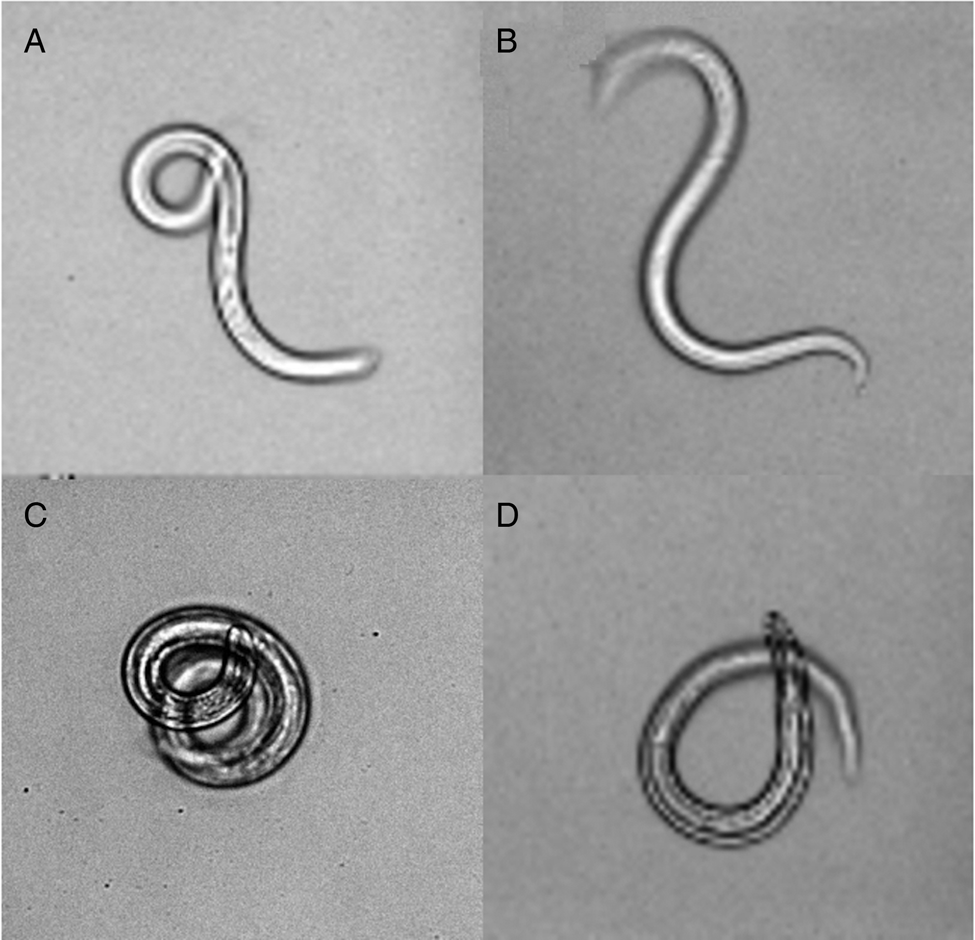
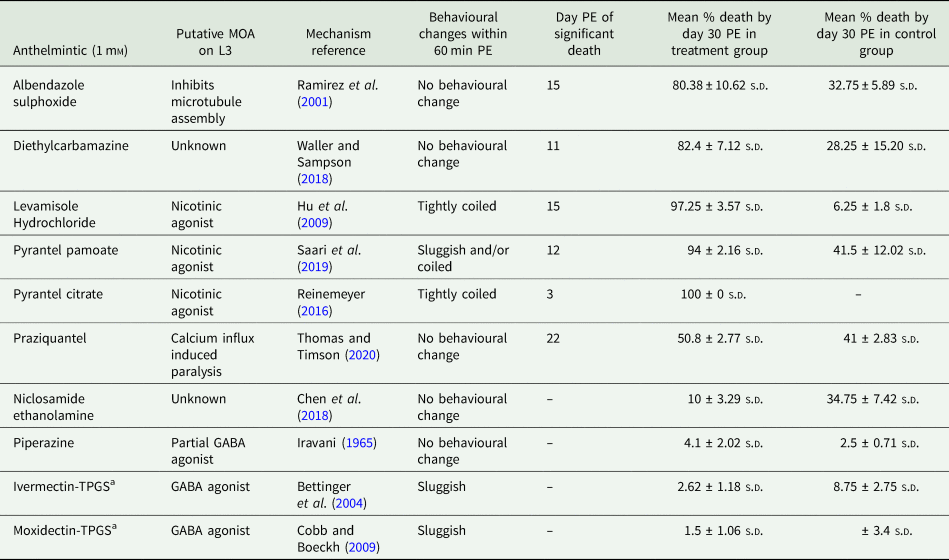
Angiostrongylus cantonensis L3 are reported to have unique ‘Q’ and ‘S’ like continual natural movements (Lv et al., Reference Lv, Zhang, Liu, Zhang, Steinmann, Zhou and Utzinger2009), as shown in Fig. 1A and B, respectively. After the addition of drugs into the treatment wells, each plate was observed under a Leica S9D dissection microscope for 60 mins to document potential changes in behaviour in response to the drug (Table 1). In the majority of the tested anthelmintics, the motility behaviour of the larvae remained unchanged within the first hour post-exposure (PE). In contrast, 100% of the larvae in the levamisole hydrochloride treatment ceased movement and assumed a tightly coiled position almost immediately (Fig. 1C). Similarly, 1 h after the addition of pyrantel pamoate, ivermectin and moxidectin, larvae motility was considerably reduced to a sluggish nature, and most of the larvae became immobile and assumed a coiled or a tightly coiled position (Fig. 1C and D). The coiled or tightly coiled position is a possible indication of distress in A. cantonensis (Perry and Moens, Reference Perry, Moens, Perry and Moens2011).
Unique motility patterns exhibited by A. cantonensis L3. (A) Unique ‘Q’ like movement. (B) ‘S’ like movement. (C) Tightly coiled position. (D) Coiled position.

Anthelmintic drugs tested, putative mechanism of action (MOA) on L3, observed behavioural changes within 60 min PE, and the mean percent larval death 30 days PE with 1 mm drug concentration

GABA, Gamma-aminobutyric acid.
a TPGS (2% w/v) alone was used as controls.
Reversibility of effect
Levamisole hydrochloride, pyrantel pamoate, ivermectin and moxidectin are known to induce paralysis. The larvae treated (separately) with the four drugs were transferred into tap water and after ~12 h, the L3 resumed their normal motility behaviours. This suggests the reversal of drug effects was likely due to a reduction in drug concentration.
Propidium iodide staining
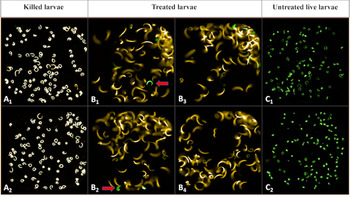
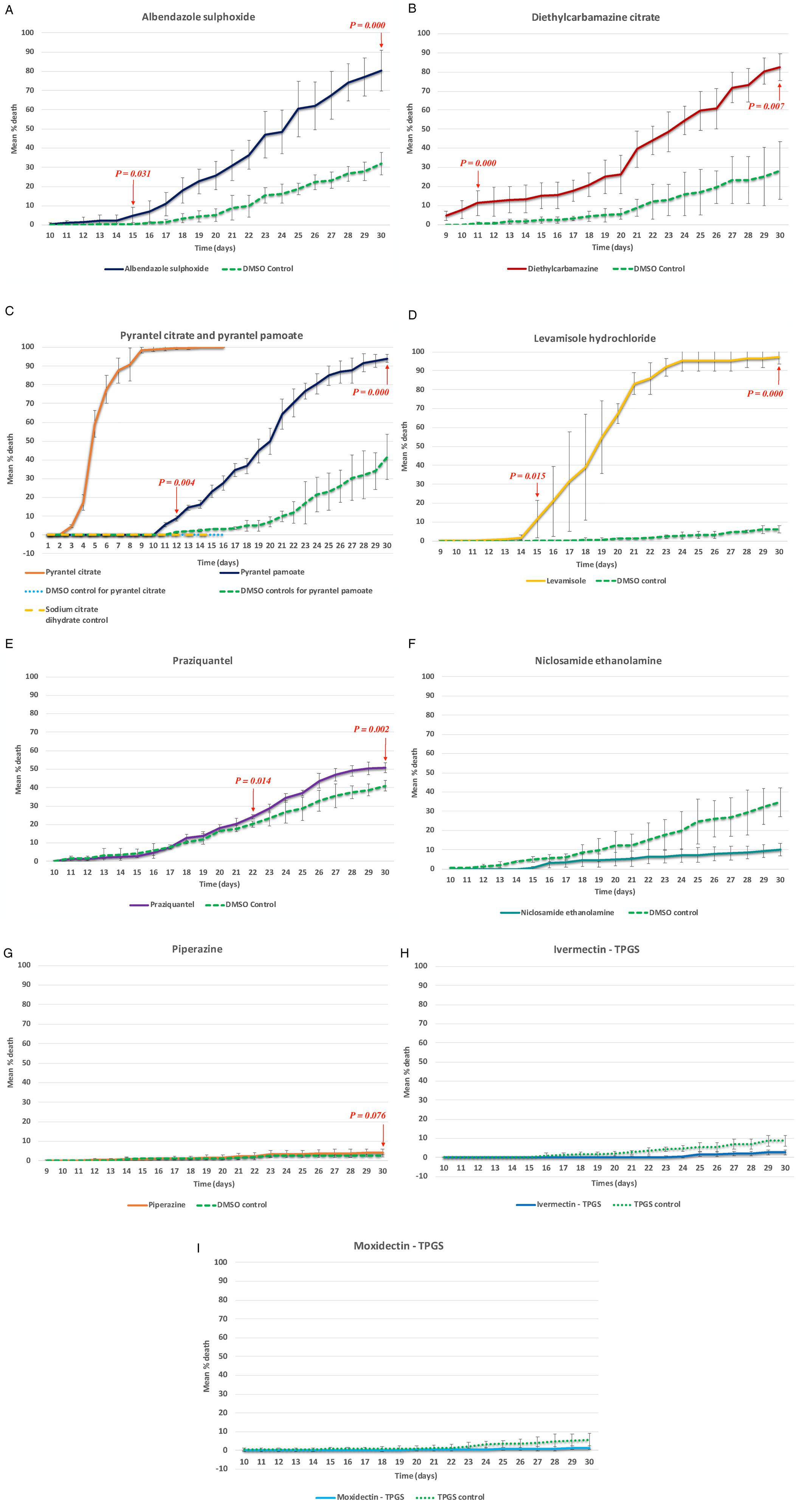
The use of propidium iodide in establishing the death of A. cantonensis larvae was recently demonstrated (Jarvi et al., Reference Jarvi, Jacob, Sugihara, Leinbach, Klasner, Kaluna, Snook, Howe, Jacquier, Lange, Atkinson, Deane, Niebuhr and Siers2019). In this study, the treatment plates were imaged every 24 h for 30 days using the Operetta. As an example, Fig. 2 represents the images collected at day 23 post-levamisole treatment. Figure 2A1–2 shows the images of the duplicates of the methanol-frozen killed controls, Fig. 2B1–4 shows the images of quadruplicate 1 mm levamisole treatments and Fig. 2C1–2 shows the duplicates of the 2% (v/v) DMSO negative controls. The propidium iodide fluorescence from the levamisole treated larvae is less saturated (bright) compared to the killed controls likely due to biodegradation, whereas the residual methanol trapped within the larvae of killed controls preserves them from degrading at the same rate. The number of larvae stained with propidium iodide was quantified visually, and the mean percent death associated with each treatment, along with their respective negative controls, were plotted (Fig. 3A–I). The day of significant staining initiation as determined by statistical analysis, and the number of larvae stained by day 30 (D30) PE of each anthelmintic is provided in Table 1.
Operetta images of levamisole treatment on D23 PE: Larvae stained with propidium iodide (520–550 nm excitation, 560–630 nm emission) and fluorescein (460–490 nm excitation, 500–550 nm emission) taken in a 384 well plate. (A1−2) Duplicate dead control groups consisting of killed larvae. (B1−4) Anthelmintic treatment groups were completed in quadruplicate for all experiments. Arrows indicate unstained larvae within the treatment groups (C1−2). Duplicate negative control groups with 2% (v/v) DMSO.

(A–I) Plots of the time course over 30 days PE vs mean percent death in the presence of each anthelmintic (A–I) with their respective controls.

Albendazole sulphoxide
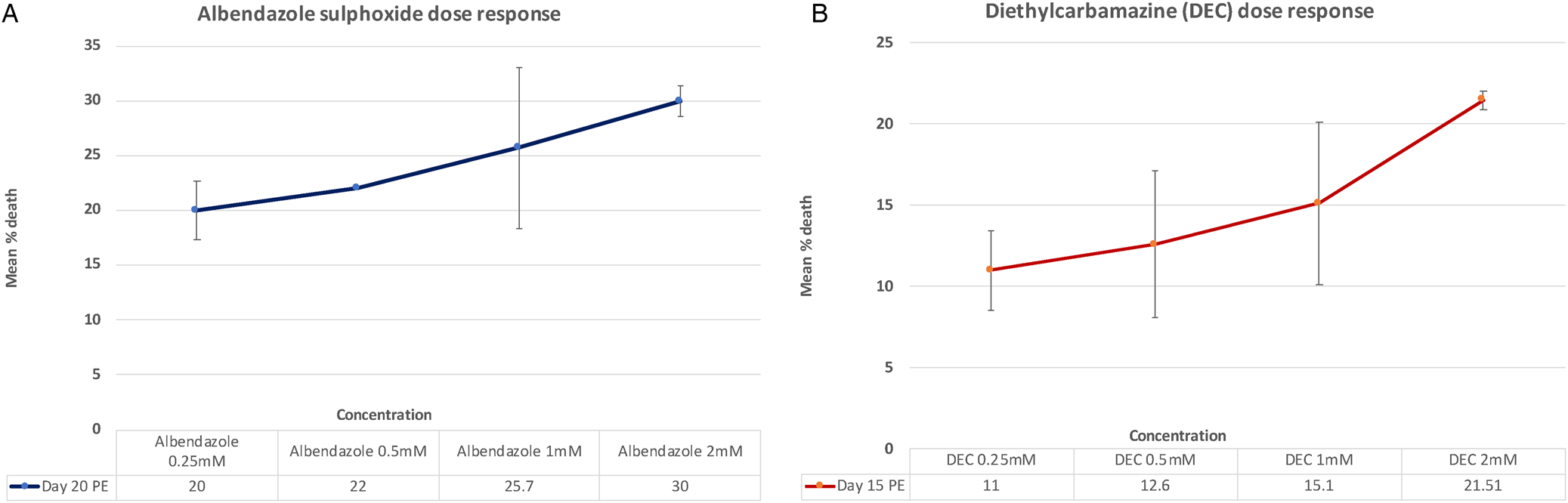
Albendazole is a broad-spectrum benzimidazole that binds to the colchicine-sensitive site of tubulin, thereby hindering microtubule assembly. In addition, it inhibits glucose uptake in the parasite and ultimately leads to immobilization and death of the parasite (Ramirez et al., Reference Ramirez, Benitez-Bribiesca, Ostrosky-Wegman and Herrera2001). Albendazole sulphoxide (1 mm), the active metabolite of albendazole (Ramirez et al., Reference Ramirez, Benitez-Bribiesca, Ostrosky-Wegman and Herrera2001), was tested directly on A. cantonensis L3. Significant larval death was initiated from D15 PE (P = 0.031), and by D30 PE, there was 80.38 ± 10.62 s.d. (standard deviation) mean percent death (P = 0.000) (Fig. 3A). Subsequently, 2, 1, 0.5 and 0.25 mm concentrations were tested in the same manner to demonstrate a dose–response of L3 to albendazole sulphoxide. A dose–response was clearly observed at D20 PE (Fig. 4A).
Dose–response of (A) albendazole sulphoxide (D20 PE) and (B) diethylcarbamazine (D15 PE) on A. cantonensis L3.

Diethylcarbamazine (DEC)
The mechanism of action of DEC is not clearly understood. DEC is the first-line treatment for filariasis (a parasitic nematode) (Waller and Sampson, Reference Waller, Sampson, Waller and Sampson2018). However, since filariasis is rare in the US, DEC is no longer sold in the US market, but physicians can obtain the medication directly from the CDC after confirmation of infection. In this study, significant larval death was initiated by day 11 PE (P = 0.000) and by D30 PE, there was 82.4 ± 7.12 s.d. mean percent death (P = 0.007) (Fig. 3B). Subsequently, 2, 1, 0.5 and 0.25 mm DEC were tested in the same manner to demonstrate a dose–response of the drug. A dose–response was clearly observed at D15 PE (Fig. 4B).
Nicotinic agonists: pyrantel pamoate and levamisole hydrochloride
Pyrantel is a cholinergic agonist that activates nicotinic receptors at neuromuscular junctions causing spastic paralysis (Sharma and Anand, Reference Sharma, Anand, Sharma and Anand1997). In this study, it was found that statistically significant larval death was initiated by D12 PE (P = 0.004) and by D30 PE, there was 94 ± 2.16 s.d. mean percent death (P = 0.000) (Fig. 3C). The insoluble lipophilic form pyrantel pamoate is preferred as it minimizes human systemic absorption and associated side effects (Sharma and Anand, Reference Sharma, Anand, Sharma and Anand1997; Reinemeyer, Reference Reinemeyer and Marchiondo2016; Sheehan et al., Reference Sheehan, Sheehan, Marchiondo and Marchiondo2016). Due to its high lipophilicity, pyrantel pamoate remained heterogeneous and insoluble even in the testing medium containing 2% (v/v) DMSO. Therefore, highly water-soluble pyrantel citrate (Santa Cruz Biotechnology, Dallas, TX, USA) was also tested for comparison. However, pyrantel citrate is not approved by the FDA for human or veterinary use as it has high water solubility and great potential for systemic absorption with associated toxic effects (Reinemeyer, Reference Reinemeyer and Marchiondo2016), (PubChem Database: https://pubchem.ncbi.nlm.nih.gov/compound/Pyrantel-citrate). As a control for the effects induced by citrate, a 1 mm solution of sodium citrate dihydrate (VWR Chemicals BDH, Radnor, PA, USA) was also tested in parallel. Almost immediately after the addition of pyrantel citrate (1 mm), the majority of the larvae (95%) ceased movement and assumed a tightly coiled position (Fig. 1C). We expected that pyrantel citrate would be more potent than pyrantel pamoate because of its greater water solubility, and this was reflected in our data. Larvae stain uptake was observed by D3 PE with pyrantel citrate and 99% of larvae were stained by D10, with 0% stained in the DMSO control groups (Fig. 3C). By D15 PE, 100% of the larvae were stained and this study was then terminated. Larvae treated with 1 mm sodium citrate dihydrate alone showed no stain uptake by larvae at D15 PE, confirming that the larvae death was, in fact, due to the anthelmintic properties of pyrantel (Fig. 3C).
Levamisole is an L-subtype nicotinic acetylcholine receptor agonist that induces spastic paralysis similar to pyrantel (Hu et al., Reference Hu, Xiao and Aroian2009). However, levamisole has been withdrawn from the US market for human use in the year 2000 due to serious side effects such as agranulocytosis. In addition, levamisole has been reported to be a recreational cocaine adulterant (Chang et al., Reference Chang, Osterloh and Thomas2010). Despite this, it is widely accepted and used for the treatment of neuroangiostrongyliasis in some parts of the world (Ma et al., Reference Ma, Zhang and Qiu2018). Statistically significant larval death was initiated from D15 PE (P = 0.015) and by D30 PE, there was 97.25 ± 3.57 s.d. mean percent death (P = 0.000) (Fig. 3D).
Praziquantel
Studies suggest that praziquantel works by inducing spastic paralysis, probably by causing a rapid calcium influx into muscle tissues of the organism (Thomas and Timson, Reference Thomas and Timson2020). However, its exact molecular mechanism is poorly understood. Praziquantel (1 mm), when directly tested on A. cantonensis, showed significant (P = 0.014) larval death initiating from D22 PE. By D30, there were 50.8 ± 2.77 s.d. dead larvae as compared to 2% (v/v) DMSO control (41 ± 2.83 s.d.) (Fig. 3E).
Niclosamide ethanolamine
The mechanism of action of niclosamide is not clearly understood; it is reported to interfere with the uncoupling of oxidative phosphorylation (Chen et al., Reference Chen, Mook, Premont and Wang2018). However, niclosamide is not available for human use in the USA. In this study, niclosamide ethanolamine salt was used due to the insoluble nature of niclosamide. However, the staining within the niclosamide (1 mm) treatment group (10 ± 3.29 s.d.) was lower than its 2% (v/v) DMSO controls (34.75 ± 7.42 s.d.) due to unknown reasons (Fig. 3F). This drug was also tested in quadruplicate in two replicate experiments with consistent results.
Gamma-aminobutyric acid (GABA) agonists (piperazine, ivermectin and moxidectin)
Piperazine, ivermectin and moxidectin are GABA agonists that open glutamate-gated chloride channels in invertebrate nerve and muscle cells. This results in an increase in the permeability of the cell membrane to chloride ions with hyperpolarization of the nerve or muscle cell leading to flaccid paralysis (Lovell, Reference Lovell1990; Bettinger et al., Reference Bettinger, Carnell, Davies and McIntire2004; Cobb and Boeckh, Reference Cobb and Boeckh2009). Piperazine is a partial GABA agonist (Iravani, Reference Iravani1965), and it is expected to be less potent than full agonists such as ivermectin/moxidectin. This was reflected in our data since 1 h post-piperazine exposure; the larvae showed insignificant behavioural changes. In contrast, 1 h PE to ivermectin or moxidectin (GABA full agonists), the larvae appeared sluggish in nature. Piperazine did not show significant mortality (P = 0.076) by D30 PE (Fig. 3G). Ivermectin and moxidectin showed a substantial reduction in motility throughout the 30-day treatment protocol. However, larval staining within treatment groups for both ivermectin and moxidectin in 2% (w/v) TGPS preparations were low as compared to their respective controls (Fig. 3H and I).
Potency comparison
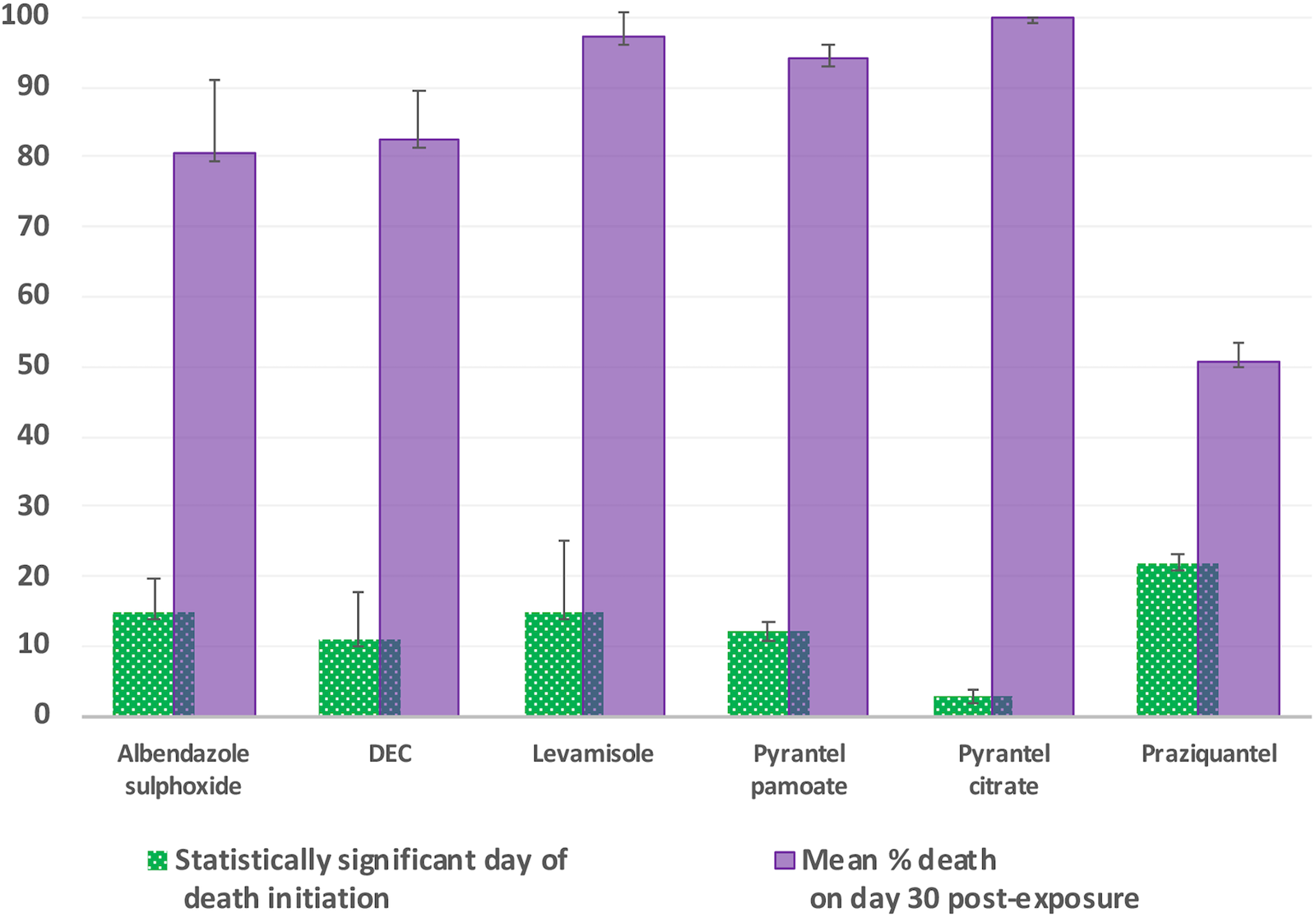
The potency and efficacy of the anthelmintics on A. cantonensis L3 in terms of the statistically significant day of death initiation and mean percent death on D30 PE are illustrated in Fig. 5. The potency and efficacy of soluble anthelmintics that induce spastic paralysis from more effective to less effective are as follows: pyrantel citrate >levamisole >praziquantel. As was expected, pyrantel citrate, which is the soluble form of pyrantel, showed greater effectiveness as compared to its insoluble pyrantel pamoate form (pyrantel citrate>pyrantel pamoate). Similarly, the effectiveness of nematicides tested showed diethylcarbamazine (DEC) > albendazole sulphoxide.
Comparison of the effects of six different anthelmintics on A. cantonensis L3 showing the statistically significant day of initiation of death and the mean percent death on D30 PE.

Discussion
Previous in vitro anthelmintic studies utilized motility of adult female A. cantonensis as a qualitative method to access the efficacy of the drug (Terada et al., Reference Terada, Shii, Kino and Sano1982, Reference Terada, Shii, Kino and Sano1983, Reference Terada, Ishii, Kino and Sano1984, Reference Terada, Rodrigues, Dharejo, Shii and Sano1986; Terada and Sano, Reference Terada and Sano1986). The present study utilizes a previously validated differential staining technique with the uptake of propidium iodide as the indicator of death, in combination with the nematode's natural autofluorescence, to distinguish dead from live larvae thus allowing quantification of larval death (Jarvi et al., Reference Jarvi, Jacob, Sugihara, Leinbach, Klasner, Kaluna, Snook, Howe, Jacquier, Lange, Atkinson, Deane, Niebuhr and Siers2019). We have evaluated the in vitro efficacy of nine clinically established anthelmintics on A. cantonensis L3 using this assay.
The in vivo efficacy of some anthelmintics involved in our study has already been evaluated.
The in vivo efficacy of albendazole based on larva/worm recovery has been studied in various animal models such as mice (Hwang and Chen, Reference Hwang and Chen1988; Lan et al., Reference Lan, Wang, Lai and Chen2004; Tu and Lai, Reference Tu and Lai2006), and rats (Lakwo et al., Reference Lakwo, Ishih, Terada and Sano1998). These studies have found albendazole to be efficacious against A. cantonensis by reducing worm burden and histological signs of inflammation. However, in rabbits (Wang et al., Reference Wang, Jung, Chen, Wong, Wan and Wan2006), inflammation in the brain was more severe in the albendazole treatment group as compared to the untreated group. Contrasting results such as these have led to much discussion among researchers and clinicians.
The in vivo efficacy of levamisole and ivermectin has been evaluated in rats. Ishii et al. (Reference Ishii, Terada and Sano1985) found that there was a significant reduction in the worm recovery after administering ivermectin to rats as compared to the untreated controls. Ishii (Reference Ishii1994) also found that levamisole not only reduced the worm burden in rats but also found the histopathological signs of inflammation lowered as compared to the untreated control groups. Our in vitro study reflects the results from these previous in vivo studies of albendazole, levamisole and ivermectin (Table 1), and thereby serve as internal controls by validating the reliability of our assay.
Quantifying a dose–response is possible only with anthelmintics that possess the nematocidal activity and not with anthelmintics that only induce paralysis, since the degree of paralysis is an unquantifiable parameter. Among the nine anthelmintics that were tested, only albendazole, diethylcarbamazine and niclosamide are known to have larvicidal activity. The remaining six drugs are known to induce paralysis through various mechanisms, which ultimately lead to death. The dose–response of albendazole sulphoxide and DEC were demonstrated, showing that the effects of these drugs on A. cantonensis are indeed dose-dependent (Fig. 4). Niclosamide ethanolamine was ineffective against A. cantonensis.
For anthelmintics that induce spastic paralysis (levamisole and pyrantel pamoate), our findings concur with the hypothesis that the death of A. cantonensis L3 is due to starvation associated with paralysis, i.e. larvae in the paralytic state become incapable of processing food sources within the treatment wells. This can lead to energy deprivation within the larvae due to muscular hypercontraction as a result of muscle spasms (Fru and Puoti, Reference Fru and Puoti2014), which can ultimately lead to larval death (Lovell, Reference Lovell1990; Bettinger et al., Reference Bettinger, Carnell, Davies and McIntire2004; Cobb and Boeckh, Reference Cobb and Boeckh2009). This study showed that soluble pyrantel citrate proved to be more potent than levamisole hydrochloride, based on the statistically significant day of larval death initiation (D3 PE vs D15 PE, respectively) (Fig. 5), and mean percent larval death at D10 PE (99 ± 1.31 s.d. vs 0.25 ± 0.29, respectively) (Fig. 3C and D). A similar trend in potencies (pyrantel > levamisole) was also reported in Ascaris suum nematodes (Harrow and Gration, Reference Harrow and Gration1985; Martin et al., Reference Martin, Valkanov, Dale, Robertson and Murray1996). Although pyrantel pamoate remained heterogeneous and insoluble in the testing medium, significant activity was observed with a day of death initiation from D12 PE and reached a mean percent death of 94 ± 2.16 on D30 PE. As expected, superior activity was observed from the soluble form (pyrantel citrate > pyrantel pamoate) of the same drug, providing the support that solubility is of crucial importance in terms of the potency of pyrantel. However, pyrantel citrate is not approved for human or veterinary use due to toxic effects.
Even though praziquantel is not currently approved for nematode-associated infections, it was included in this study because prior studies on its effect on A. cantonensis were based on motility (Terada et al., Reference Terada, Shii, Kino and Sano1982). This study showed statistically significant larval staining (P = 0.002) by D30 PE. However, the day of significant staining was relatively late (D22 PE) as compared to the other tested anthelmintics. In addition, the difference in the mean percent death between the treatment and the control groups by D30 PE was minimal (Fig. 5), suggesting that it is unlikely to have any clinical significance.
Results revealed several instances where the larvae in the treatment group stained at a slower rate than their respective 2% DMSO control. For anthelmintics that induce flaccid paralysis (extreme relaxation of muscles), such as ivermectin and moxidectin (avermectins) (Fru and Puoti, Reference Fru and Puoti2014), it could be that the state of flaccidity functions as an energy reserve for the larvae, which allows them to live longer than their respective control groups (Fig. 3H and I). Moxidectin is a relatively new anthelmintic that was recently approved by the US FDA for human use for the treatment of onchocerciasis (also known as river blindness), which is also caused by a parasitic nematode (Olliaro et al., Reference Olliaro, Kuesel, Halleux, Sullivan and Reeder2018). Although ivermectin and moxidectin are both avermectins, moxidectin typically provides superior bioavailability, distribution, and systemic retention due to its higher lipophilicity as compared to ivermectin. The serum half-life of moxidectin is greater than 20 days vs only 14–18 h for ivermectin (Prichard, et al., Reference Prichard, Menez and Lespine2012). The efficacy of moxidectin has never been studied on A. cantonensis, and hence, we included moxidectin in our panel of anthelmintics.
Similar to avermectins, larvae in the niclosamide ethanolamine treatment group stained at a slower rate than their respective 2% DMSO control, (Fig. 3F) which is proposed to have a larvicidal effect in cestodes and trematodes (Vermund et al., Reference Vermund, MacLeod and Goldstein1986), but the reason for the lack of larvicidal activity in this nematode is currently unknown.
Albendazole is the only FDA-accepted benzimidazole anthelmintic for humans with the ability to cross the blood–brain barrier (BBB) (Roland et al., Reference Roland, Fritz and Helmut2010), making it suitable as an anthelmintic for the management of neuroangiostrongyliasis. Results from this study show that it took ~15 days PE for the larvae to exhibit significant death in comparison to the 2% DMSO controls. However, the effect of albendazole may result in a faster death rate in vivo, due to the high energy requirement of L3 as they develop into L4 (Prociv and Turner, Reference Prociv and Turner2018). Albendazole may be beneficial for the early as well as the later-stage infection, although further investigation is needed to establish a time frame for albendazole efficacy. This in vitro study, for the first time, provides tangible evidence by actually quantifying the larvicidal activity of albendazole on the A. cantonensis infectious L3.
Although ivermectin/moxidectin is incapable of crossing the BBB, combined administration with albendazole may be beneficial. The paralysis induced by ivermectin/moxidectin may slow the progression of infection, while simultaneously increasing the period of exposure to the nematicidal effects of albendazole. Albendazole–ivermectin combinational therapy has been proven to be effective against bancroftian filariasis (Ismail et al., Reference Ismail, Jayakody, Weil, Nirmalan, Jayasinghe, Abeyewickrema, Rezvi Sheriff, Rajaratnam, Amarasekera, de Silva, Michalski and Dissanaike1998).
According to Mackerras and Sandars (Reference Mackerras and Sandars1955), it takes ~4 h (post-consumption) for L3 to enter the circulatory system from the GI tract in rats. The duration for L3 to reach the systemic circulatory system in humans is unknown and likely varies. Given the data from rat studies, a minimum of 4 h is plausible. Although Mackerras and Sandars were unknowingly describing the life cycle of Angiostrongylus mackerrasae rather than A. cantonensis, both species have extremely similar lifecycles and morphological traits (Bhaibulaya, Reference Bhaibulaya1975). The time interval between consumption of L3 and the larvae gaining access into the systemic circulation offers a window of opportunity to use an anthelmintic with an exclusively localized action, such as pyrantel pamoate. Pyrantel pamoate is an FDA approved, broad-spectrum, anthelmintic, commercially available since 1970 (Page, Reference Page, Maddison, Page and Church2008) for gastrointestinal nematodes, including lungworms, filariae and arthropods (Martin and Geary, Reference Martin, Geary and Marchiondo2016). It is commonly used for intestinal nematodes, such as pinworms (Enterobius vermicularis) (Pickering et al., Reference Pickering, Baker, Long, McMillan, Pickering, Baker, Long and McMillan2006), which becomes unable to remain attached to the gastrointestinal lumen and are expected to be expelled via peristalsis (Saari et al., Reference Saari, Näreaho, Nikander, Saari, Näreaho and Nikander2019). Commercially available pyrantel is in the form of a hydrophobic pamoate salt, pyrantel pamoate. The presence of the pamoate moiety reduces the water solubility of pyrantel (0.00418 mg mL−1 according to ALOGPS, solubility calculator software), minimizing gastrointestinal absorption (Reinemeyer, Reference Reinemeyer and Marchiondo2016; Sheehan et al., Reference Sheehan, Sheehan, Marchiondo and Marchiondo2016). Therefore, the use of pyrantel pamoate is limited to intestinal parasitic nematodes. High concentrations of pyrantel in the circulation could result in serious adverse effects (PubChem Database: https://pubchem.ncbi.nlm.nih.gov/compound/Pyrantel). The World Health Organization's (WHO, 2019) list of essential medicines includes only the most effective and safest medications (see reference). Pyrantel pamoate has been on this list since the third edition published in 1983. The results of this study indicate pyrantel pamoate as a potential candidate for PE prophylaxis after the known accidental ingestion of A. cantonensis L3. In the US, over-the-counter suspension formulations of pyrantel pamoate are available in most pharmacies.
Conclusion
This in vitro study has provided much needed data on the efficacy and potency of many anthelmintics against A. cantonensis L3. Based on this in vitro study and the current United States FDA anthelmintic prescribing guidelines, albendazole and ivermectin/moxidectin (for PE management), and pyrantel pamoate (as a PE prophylactic) appear to be promising candidates for the management and or prevention of neuroangiostrongyliasis. However, in vivo studies to evaluate the optimal dose and time frame for post-infection treatment are crucial for establishing clinical relevance.
Acknowledgments
We thank the Hilo community, especially Ann Kobsa, Mark Crivello, and Steven Jacquier, for providing slugs from their private properties for this study.
Financial support
This work was primarily supported by the Hawai‘i State Legislature (SJ), and the Daniel K. Inouye College of Pharmacy. Collaborative support for supplies and partial salaries were provided by Hawai‘i Community Foundation Grant (19ADVC-95449) (AD), INBRE IV Junior Investigator Award (NIH-NIGMS P20 GM103466) (AD) and Antares Health Products Inc. (AD) for providing complimentary samples of Vitamin E TPGS.
Conflicts of interest
None.
Ethical standards
Not applicable.