Hemiepiphytes comprise two major categories, those that begin their life cycle as epiphytes and later establish soil contact through long descendent roots (primary hemiepiphytes), and those that germinate in the soil and climb up using adherent roots, eventually becoming epiphytes after losing soil contact (secondary hemiepiphytes) (Putz & Holbrook Reference PUTZ and HOLBROOK1986). In several features root-climbing lianas are similar to secondary hemiepiphytes, including adhesion by adventitious roots, ability to colonize host-trees of different sizes (Putz Reference PUTZ1984), and colonization generally restricted to a single phorophyte, differing mainly in the retention of soil contact through strong stems.
Ecological approaches to hemiepiphytes have mainly focused on woody primary hemiepiphytes of the genera Ficus and Clusia (Athreya Reference ATHREYA1999, Daniels & Lawton Reference DANIELS and LAWTON1991, Ting et al. Reference TING, HANN, HOLBROOK, PUTZ, STERNBERG, PRICE and GOLDSTEIN1987). Although hemiepiphytes are important components of tropical and subtropical moist forests, there is still little information on the patterns of relative abundance and spatial distribution of hemiepiphytic communities in different forest types (Kelly Reference KELLY1985, Todzia Reference TODZIA1986). Sampling of hemiepiphytic life forms is generally difficult in natural environments, which may lie behind the paucity of knowledge about this synusia (Prósperi et al. Reference PRÓSPERI, CABALLÉ and CARAGLIO2001).
Considering the different requirements and strategies of the three groups, we expect a more restricted occupation of primary hemiepiphytes on larger trees and a less selective occurrence of secondary hemiepiphytes and root-climbing lianas according to the size of phorophytes. Our hypothesis is that mainly larger trees fulfil the conditions for establishment and early development requirements of primary hemiepiphytes, while secondary hemiepiphytes and root-climbing lianas colonize the first host they reach after germination on the forest floor. For this purpose we tested the partitioning of host size by hemiepiphytes and root-climbing lianas.
This study was conducted in an approximately 13-ha fragment of a forest remnant in the municipality of Dom Pedro de Alcântara (29°23ʹS, 49°50ʹW, 23 m asl), in the northern coastal plain of Rio Grande do Sul, southern Brazil. Although it represents a small area, the studied fragment is currently one of the best preserved in a relatively large region of coastal plain forests in southern Brazil. The region presents a moist subtropical climate (Cfa) (Moreno Reference MORENO1961). Average annual temperature and rainfall are 18.9 °C and 1385 mm, respectively. In a southern Brazilian subtropical context, the region stands out due to a relatively low average number of 1–3 frost days per year (Moreno Reference MORENO1961). Two major soil types occur in the study area, named Red-Yellow Argisols and Eutrophic Melanic Gleisols (EMBRAPA Reference EMBRAPA1999). The study site belongs to the lowland (terras baixas) formation of the Brazilian Atlantic Forest (Veloso et al. Reference VELOSO, RANGEL FILHO and LIMA1991). Vegetation studies carried out by Veloso & Klein (Reference VELOSO and KLEIN1968) in a nearby area revealed the presence of original forests with relatively tall trees, achieving 25–30 m in height.
We recorded all individuals and species of hemiepiphytes and root-climbing lianas presenting vegetative structures (roots or stems) at breast height and attached to the host trees, up to a total number of 300 individuals. The sampling covered almost the entire forest fragment, including mostly well-drained soils but also a smaller area with poorly drained patches. Data sampling was carried out from May to September 2006. For each plant we recorded species and diameter of phorophyte. The diameter of small trees was measured directly using a manual caliper while that of larger trees was estimated by girth measurement. The number of hemiepiphytic individuals per phorophyte was also recorded. Species identification conducted during field work was later confirmed with the aid of regional floras and the opinion of related taxonomists. The circumscription of families follows Smith et al. (Reference SMITH, PRYER, SCHUETTPELZ, KORALL, SCHNEIDER and WOLF2006) for ferns and APG (2003) for flowering plants.
The adequacy of sample size was analysed with a rarefaction test (Gotelli & Graves Reference GOTELLI and GRAVES1996), performing 1000 iterations using the software Past (Hammer et al. Reference HAMMER, HARPER and RYAN2001). The method estimates the possible number of species which can be sampled randomly for a given number of individuals. Abundance was estimated by the number of individuals for both species and ecological categories. The Shannon index (H’) was used as a measure of species diversity for each ecological category. Confidence intervals for expected values of diversity were estimated through the jack-knife technique (Magurran Reference MAGURRAN1988). A data matrix with densities of hemiepiphytic species per diameter classes of phorophytes was constructed for pattern analysis of species and ecological categories. Phorophytes were grouped according to a logarithmic scale of diameters (cm): 0–5; 5–10; 10–20; 20–40 and ≥ 40 cm; intervals closed at the lowest (left) endpoint. The number of phorophytes sampled in each category was 34, 63, 61, 42 and 23, respectively. The distribution of individuals of the three ecological categories in relation to diameter classes of phorophytes was compared by the Kruskal–Wallis non-parametric analysis of variance, with α ≤ 0.05. The differences between groups were obtained by the Mann–Whitney test, with α ≤ 0.05 (Zar Reference ZAR1998).
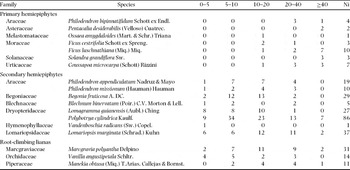
In total 15 families, 16 genera and 18 species were sampled (Table 1). Four families were ferns (Blechnaceae, Dryopteridaceae, Hymenophyllaceae and Lomariopsidaceae) and the remaining 11 families were angiosperms. Overall, the number of species per family was low. Nine species were secondary hemiepiphytes, eight were primary hemiepiphytes and three were root-climbing lianas. Two additional species were observed without vegetative structures at breast height: Vanilla chamissonis (a secondary hemiepiphyte) and Clusia criuva (a primary hemiepiphyte).
Species composition and distribution of hemiepiphytes and root-climbing lianas according to five diameter classes of phorophytes. Intervals (cm) closed at the lowest (left) endpoint. Ni = total number of individuals.

Secondary hemiepiphytes were the most abundant life form, with 71% of all individuals, followed by root-climbing lianas with 19% and primary hemiepiphytes with only 10%. The diversity index values (H’) and their respective 95% confidence intervals were 1.73 (1.50–2.36) for primary hemiepiphytes, 1.67 (1.46–2.09) secondary hemiepiphytes and 0.99 (0.72–1.42) for root-climbing lianas.
The species rarefaction curve indicated a stabilizing tendency after approximately 200 sampled individuals. The 300 sampled hemiepiphytes occurred on 223 phorophytes. Each host tree presented from one to six individuals, considering all categories, but the isolated occurrence (74% of the colonized phorophytes) was by far the most common in comparison to combined occurrences. Four to six individuals on one host tree occurred very rarely (2% of the colonized phorophytes) in the studied forest.
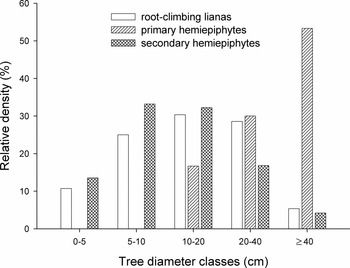
The three ecological categories presented a different distribution in relation to phorophyte diameters (H = 52.1; P <0.001). Primary hemiepiphytes were more abundant in larger phorophytes when compared to secondary hemiepiphytes (U = 614; P < 0.001) and root-climbing lianas (U = 241; P < 0.001), but secondary hemiepiphytes did not differ significantly from the distribution of root-climbing lianas (U = 5267; P = 0.164). The median diameter values for colonized phorophytes were 41.2, 10.5 and 11.8 cm respectively for primary hemiepiphytes, secondary hemiepiphytes and root-climbing lianas. The distribution of primary hemiepiphytes contrasted significantly with that of secondary hemiepiphytes (Figure 1): the former presented 77% of the individuals in larger diameter classes (≥20 cm) while the latter presented 71% of the individuals in smaller diameter classes (<20 cm). The distribution of root-climbing lianas was similar to that of secondary hemiepiphytes.
Proportion of primary and secondary hemiepiphytes and root-climbing lianas (N = 300) on the five diameter classes of phorophytes (N = 223). Intervals (cm) closed at the lowest endpoint.

Hemiepiphytes present a relatively low species richness and diversity in comparison to other forest synusiae, especially trees (Gentry Reference GENTRY1993) and vascular epiphytes (Benzing Reference BENZING1990, Gentry & Dodson Reference GENTRY and DODSON1987). As in most published surveys, Araceae and Moraceae were the most diverse families in the studied area.
The families Begoniaceae and Orchidaceae are absent from general taxonomic lists or overviews of hemiepiphytic plants (Putz & Holbrook Reference PUTZ and HOLBROOK1986), but in the studied area they clearly presented species able to survive with the lower stem-parts disconnected from the soil. The same is true for the family Araceae, but in this case, the family should also be included for the occurrence of some primary hemiepiphytic species. Some authors (Prósperi et al. Reference PRÓSPERI, CABALLÉ and CARAGLIO2001, Williams-Linera & Lawton Reference WILLIAMS-LINERA, LAWTON, Lowman and Nadkarni1995) directed their studies to woody hemiepiphytes, thus excluding typical herbaceous plants families from the above-mentioned lists.
The low occurrence of two or more hemiepiphytes and root-climbing lianas on a single phorophyte may be related to the relatively low density of most species in the studied fragment, and could be related to edge effect, since most species of secondary hemiepiphytes seem to be dependent on forest interiors, with higher levels of humidity and lower lateral incidence of radiation.
The fragment of the Atlantic rain forest studied presents similar species richness values for primary and secondary hemiepiphytes, but very distinct density values, due to the much higher density of secondary hemiepiphytes. Although the inclusion criterion (vegetative structures at breast height) excluded young individuals of all three categories, local observations suggest that the method used in the present study excluded a higher number of secondary hemiepiphytes than of primary hemiepiphytes, since most species of this category seem to invest very early on long descending roots, and thus were included in our inventory. The difference in distribution of primary hemiepiphytes compared with that of secondary hemiepiphytes and of root-climbing lianas on phorophyte diameter-classes (Figure 1) is probably due to the fact that only larger canopy trees provide appropriate sites for establishment and development of the dispersal units of the former. These favourable conditions on canopy trees include larger accumulation of organic matter at the base of main branches and eventually in trunk cavities, and the associated retention of moisture and minerals on older and more fissured bark and higher light incidence at the crown level (Athreya Reference ATHREYA1999, Daniels & Lawton Reference DANIELS and LAWTON1991, Kelly Reference KELLY1985, Laman Reference LAMAN1996, Michaloud & Michaloud-Pelletier Reference MICHALOUD and MICHALOUD-PELLETIER1987, Putz & Holbrook Reference PUTZ and HOLBROOK1986, Reference PUTZ and HOLBROOK1989; Todzia Reference TODZIA1986). In contrast to primary hemiepiphytes, as a whole secondary hemiepiphytes are plants of smaller sizes that are able to colonize a wide range of phorophyte sizes, starting their life cycle in a large area of shady forest soil. In this way, these plants and the related root-climbing lianas can achieve much higher population densities in rain forests.
ACKNOWLEDGEMENTS
We thank Dr Luís Rios de Moura Baptista for the permission to collect sample in his private forest reserve. We also thank the following specialists for helping us in taxonomic identification: Dr Marcus Alberto Nadruz Coelho (Araceae), Drs Daniel de Barcellos Falkenberg, Maria Leonor D'El Rei Souza (Melastomataceae) and Dr Cláudio Nicoletti de Fraga (Orchidaceae). Finally, we are indebted to Eduardo Giehl, Ernestino Guarino and Fernando Rocha for several helpful suggestions.